




No CrossRef data available.
Article contents
- Abstract
- Optimising the delivery of oxygen to the tissues – the need for a different roadmap for the postoperative cardiac surgical patient
- Resistance to flows: what are the components?
- The worst-case: the patient with hypoplasia of the left heart
- The patient following the first stage Norwood procedure: is balancing circulations still important?
- Operations involving banding and shunting
- Conclusion
- References
Manipulating parallel circuits: the perioperative management of patients with complex congenital cardiac disease
Published online by Cambridge University Press: 24 May 2005
Article contents
- Abstract
- Optimising the delivery of oxygen to the tissues – the need for a different roadmap for the postoperative cardiac surgical patient
- Resistance to flows: what are the components?
- The worst-case: the patient with hypoplasia of the left heart
- The patient following the first stage Norwood procedure: is balancing circulations still important?
- Operations involving banding and shunting
- Conclusion
- References
Abstract
In all patients undergoing cardiac surgery, the effective delivery of oxygen to the tissues is of paramount importance. In the patient with relatively normal cardiac structures, the pulmonary and systemic circulations are relatively independent of each other. In the patient with a functional single ventricle, the pulmonary and systemic circulations are dependent on the same pump. As a consequence of this interdependency, the haemodynamic changes following complex palliative procedures, such as the Norwood operation, can be difficult to understand.
Comparison of the newly created surgical connections to a simple set of direct current electrical circuits may help the practitioner to successfully care for the patient. In patients undergoing complex palliations, the pulmonary and systemic circulations can be compared to two circuits in parallel. Manipulations of variables, such as resistance or flow, in one circuit, can profoundly affect the performance of the other circuit. A large pulmonary flow might result in a large increase in the saturation of haemoglobin with oxygen returning to the heart via the pulmonary veins at the expense of a decreased systemic flow. Accurate balancing of these parallel circulations requires an appreciation of all interventions that can affect individual components of both circulations.
Information
- Type
- Review
- Information
- Copyright
- © 2003 Cambridge University Press
In the intensive care unit, protocols for management are useful tools that protect patients, and quickly expose the doctor or nurse to the philosophy behind intensive care. Especially in combined intensive care units, where there is a mix of adults and children, or a mix of medical and surgical patients, general guidelines for postoperative care may prove invaluable. These guidelines may sometimes prove to be unsuitable, however, when applied indiscriminately to all patients with congenital cardiac disease. It is more appropriate to tailor the management to the specific category of congenital cardiac disease.1
Optimising the delivery of oxygen to the tissues – the need for a different roadmap for the postoperative cardiac surgical patient
Medical staff looking after the neonate with a normal heart who returns from theatre following a non-cardiac procedure, such as a laparotomy for necrotising enterocolitis, may have the following goals:
1. Maintenance of systemic perfusion and tissue oxygenation
- Mean blood pressure of at least 40 mmHg.
- Warm limbs.
- Minimum urinary output of 1–1.5 ml/kg/hr.
- Serum lactate of less than 2 mmol/l.
- Haemoglobin of 12–14 g/dl.
- Mixed venous oxygen saturation of more than 55%.
2. Just the right amount of ventilatory support
- Oxygen saturations of 92–98% with as low a fraction of inspired oxygen as possible.
- Lowest amount of positive end expiratory pressure.
- Mean airway pressures as low as possible.
- Partial pressure of carbon dioxide between 35 and 40 mmHg.
Various pharmacological agents and ventilatory adjustments are then used to meet these targets. All of these measures are used to optimise the delivery of oxygen to the tissues.
The most fundamental difference between the patient with necrotising enterocolitis and the neonate who returns to the intensive care unit following surgery for congenital cardiac disease lies in the nature of the cardiac connections in that patient. Trying to improve delivery of oxygen in these patients is not necessarily an easy process.
Cardiologists often compare the behaviour of the heart and its connections to the behaviour of a Direct Current electrical circuit. This comparison is a simple way of explaining the pathophysiology to patients and colleagues. Some terms such as “resistance” are undoubtedly oversimplifications,2 but are nevertheless used on a daily basis to plan future management.3
A normal heart, with its dual pumps and connections to the pulmonary and systemic circulations, behaves like two circuits in series (Fig. 1). Under normal conditions, the two sources of power, namely the right and left ventricles, and the two resistances, in other words the pulmonary and systemic vasculatures, can be considered to be relatively independent. The driving pressures in each part of the circuit, and the saturation of oxygen in the blood within that part of the circuit, are different, but the flows within the entire circuit remain the same since the output of each ventricle is the same.

Figure 1. The heart represented as a circuit in series.
If the postoperative goals highlighted above are followed, manipulations that affect one component, such as increasing positive end expiratory pressure to improve arterial saturations, will only in extreme cases affect the other component. For example, increasing positive end expiratory pressure may increase pulmonary vascular resistance and affect left ventricular preload. This change may go unnoticed by the clinician until extremely high levels of positive end expiratory pressure are applied.
Certain complex congenital cardiac malformations, where the pulmonary and systemic circulations have only one common power source, as for example in tricuspid atresia with concordant ventriculo-arterial connections, can be described as behaving like parallel electrical circuits. This can occur when both great arteries arise from one ventricle, or when the systemic or pulmonary flow is duct-dependent, or when the pulmonary flow is provided by a surgical shunt (Fig. 2).

Figure 2. The functionally univentricular heart with unrestricted pulmonary and systemic blood flows is the essence of circuits existing in parallel.
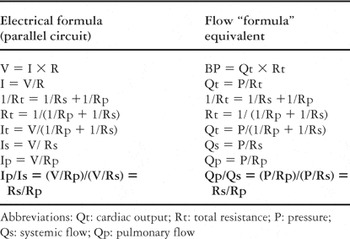
In the patient with a functionally single ventricle giving rise to both arterial trunks, both circulations are sustained by the output of the dominant ventricle. The total cardiac output of the ventricle is the sum of the flows in the systemic and the pulmonary circulations. In this situation, the driving pressure in each part of the circulation is the same, but because of the different vascular resistance in each component, flows are different.
Consider the following comparison (see Fig. 2):

In these settings, the flow in the pulmonary circuit is directly related to resistance in the systemic circuit, and vice versa.
The saturation of oxygen, and hence the content of oxygen, is the same in the aorta and the pulmonary arteries as a result of total mixing of desaturated and saturated blood within the dominant ventricle. Just what the content of oxygen in the aorta in this situation will be is dependent on how much oxygenated blood is “added to the pot” at the time of mixing within the ventricle. This “adding to the pot” is determined by the ratio between flow in the pulmonary circulation and flow in the systemic circulation. Flow in the pulmonary circuit is dependent on the resistance of the circuit. Arterial saturation in the aorta, therefore, becomes dependent in this instance on the ratio between pulmonary and systemic flows. To achieve aortic saturations of 90% in a child who has functionally univentricular physiology, the pulmonary flow must be at least 3 times the systemic flow.4 If the relationship between aortic saturation and the ratio between pulmonary and systemic flows is depicted in the form of a graph (Fig. 3), it becomes evident that increasing pulmonary flow to very high levels is associated with little gain in terms of aortic saturation. Conversely, between the ratios of pulmonary to systemic flow of 1:1 and 2:1, changes in pulmonary flow are associated with significant increases in aortic saturation.

Figure 3. Aortic saturations as plotted against the ratios of pulmonary to systemic flows – modified from Rudolph.4
It is these two issues, first aortic saturation being dependant on pulmonary flow, and second pulmonary flow being directly related to systemic resistance, that make the measures used in the patient with a normal heart to achieve optimal delivery of oxygen to the tissues possibly hazardous in the patient with parallel circulations. For example, injudicious use of an agent which vasodilates the systemic circulation could cause pulmonary flow, and hence aortic saturation, to fall. This might decrease the delivery of oxygen to the tissues, achieving exactly the opposite of the desired effect.
Resistance to flows: what are the components?
In patients with complex cardiac malformations, the resistance to flow in a particular component of the circulation is not just due to the vascular “tone”. In general there are many potential resistors per circuit:
- At the site where the ventricle connects to the circuit.
- The circuit itself.
- At the site where the circulation re-enters the pumping chamber.
Some of these resistors, such as the fixed diameter of a Gore-Tex® shunt, or a restrictive atrial septal defect in a patient with a hypoplasia of the left heart, cannot be manipulated postoperatively by the intensivist. If we consider the pulmonary circulation specifically, there are many potential mechanical and physiological variables that may act either as a “resistor” themselves, or contribute to changing vasomotor tone. These may be listed as follows:
1. Ventricle to pulmonary arterial connection
- Ventricular outflow tract obstruction.
- Pulmonary valvar stenosis.
- Supravalvar pulmonary stenosis or pulmonary arterial band.
- Arterial duct or a prosthetic shunt.
2. Vascular resistance
- Postnatal age of the patient.
- Neurological mediation of vascular tone.
- Physiological variables – pH, calcium and magnesium concentrations, arterial partial pressure of oxygen, arterial partial pressure of carbon dioxide.
- Pharmacological manipulation – nitric oxide, prostaglandins, vasopressors.
- Ventilatory variables – mean airway pressure, positive end expiratory pressure, inspired oxygen concentration.
3. The connection to the pumping chamber
- Pulmonary vein obstruction.
- Size of atrial septal defect in “mitral atresia”.
- Atrioventricular valvar stenosis or regurgitation.
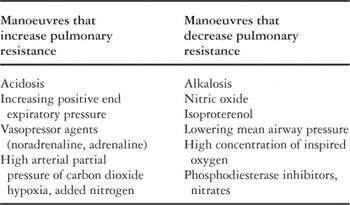
It is helpful to contrast some of the physical or pharmacological manoeuvres typically used by the intensivist that specifically affect pulmonary vasomotor tone (after Meliones et al.).1

For the most part, the plan to optimise delivery of oxygen to the tissues also holds true for the patient with parallel circulations. There are, however, a few important exceptions in the details. For example, achieving just the right amount of positive end expiratory pressure may be difficult; increasing positive end expiratory pressure may treat atelectasis and improve oxygenation, but a very high positive end expiratory pressure may increase the pulmonary vascular resistance and decrease pulmonary blood flow.
On occasion, one of the mechanical components may be responsible for the bulk of the resistance in the circuit as a whole. The resistance offered by the combination of a narrow subclavian artery and a 3.5 mm diameter shunt may be so great that the use of pulmonary vasodilator drugs may only result in minor changes in pulmonary flow. Furthermore, in patients with relatively large fixed resistance components in one circuit, the benefits of using drugs that are both pulmonary and systemic vasodilators may be lost. For example, the inhibitor of phosphodiesterase III, milrinone, is said to have nearly equivalent vasodilator effects in the pulmonary and systemic vasculatures.5 The rationale behind using milrinone in a specific patient with parallel circulations might be that, if the pulmonary flow increases, systemic flow increases, and the ratio remains the same. On the other hand, if a fixed resistor such as a shunt is present, systemic resistance will fall relatively more than pulmonary resistance. Systemic flow will then increase more than pulmonary flow. As a consequence, arterial oxygenation will decrease because of a decrease in the driving pressure for the shunt. Cyanosis will therefore worsen, rather than stay the same.
The worst-case: the patient with hypoplasia of the left heart
Even before the development of the Norwood procedure, manipulation of the component circulations (Fig. 4) was suggested as a therapeutic tool transiently to improve the condition of these critically ill infants.6 With the development of the operative technique to palliate the condition, clinicians caring for the children both before and after operative interventions have recommended “balancing the flows” as a critical part of the management.7 In other words, if pulmonary and systemic flows are approximately equal, the patient will have adequate perfusion of the tissues, the aortic saturation will be subnormal but sufficient, and the patient will not go into cardiac failure.

Figure 4. The diagram of the circuits in hypoplasia of the left heart prior to surgical intervention.
Supplying peripheral tissues with enough oxygen to avoid anaerobic metabolism is a noble aim. If supply is measured by assessing the delivery of oxygen by multiplying the arterial content of oxygen by the systemic flow of blood, the best supply occurs at ratios of pulmonary to systemic flows of less than 1.8 Francis and co-authors9 suggest that the supply of oxygen be estimated considering how the oxygen is delivered under conditions of relative hypoxia, terming this useful delivery of oxygen. In addition, they suggest9 that mixed venous saturations are a better reflection of the effectiveness of delivery, since these values represent what has been used rather than what has been delivered. If useful delivery is measured along with use, the best circumstances occur when the ratio of pulmonary to systemic flows is closer to 1.9
In patients with hypoplasia of the left heart, the resistance in the pulmonary circuit will drop within hours after birth. It will continue to do so just as in any other neonate. Only the orifice in the atrial septum will act as a potentially “fixed” site of resistance. In the systemic circulation, the arterial duct can be considered to be a time-dependent resistor, since it is initially patent, producing a low resistance, and then gradually constricts with time.
Wernovsky and co-authors have described the potential natural history of these patients in a series of scenes10 that can be summarised as follows:
- “Ideal” anatomy and physiology – ratio of pulmonary to systemic flows around 1; only mild right ventricular volume overload; aortic saturation around 80%; normal systemic flow.
- Falling pulmonary vascular resistance – ratio of pulmonary to systemic flows increases with the normal fall in pulmonary vascular resistance; systemic blood flow falls; more volume overload with signs of failure; aortic saturation around 85%.
- Low pulmonary vascular resistance – continued increase in pulmonary flow; obvious heart failure with poor peripheral perfusion, metabolic acidosis but high aortic saturations.
- Closing arterial duct – as the duct constricts, systemic flow is very low; shock with renal failure ensues; paradoxically there are high aortic saturations and the ratio of pulmonary to systemic flows is very high.
Prostaglandin E1 is the first drug to be used in the patient. As a consequence of ductal dilation, systemic flow should increase. Fortunately, although prostaglandin E1 has the potential to lower pulmonary resistance, in practice these effects tend to be of little consequence in the patient with a duct-dependent circulation.
Once ductal patency has been ensured, steps are then taken to control pulmonary resistance so that the balance is maintained. Typical resuscitative measures will include correcting acidosis and ensuring an adequate preload to improve peripheral perfusion. Inotropes should be avoided if possible because of a potential increase in systemic vascular resistance. Adequate sedation should be employed to minimise consumption of oxygen, decrease sympathetic stimulation, and reduce any tendency for hyperventilation.
These patients should preferably be allowed to breath room air spontaneously. If ventilation is necessary, increased concentrations of oxygen should be avoided. Persistently high saturations, greater than 90%, are treated by adding dead space to the ventilator tubing, by ventilating with 5% carbon dioxide, or by adding nitrogen to lower the inspired oxygen concentration to 18%. On occasion, it may be necessary to paralyse the patient and deliberately hypoventilate, allowing the arterial partial pressure of carbon dioxide to rise. There is evidence that adding carbon dioxide to the inspired gas mixture, without hyperventilation to counteract the mild acidosis that ensues, may be a very effective way of improving delivery of oxygen in patients with hypoplasia of the left heart before and after the first stage Norwood procedure.11, 12
The above measures should either make it possible to maintain the “ideal” physiology, or else return the patient to that state. Clearly, it may be difficult to distinguish “ideal” physiology from falling pulmonary vascular resistance solely on the basis of aortic saturation. The detection of low mixed venous saturations as a marker of low systemic cardiac output might help to distinguish the balanced from the unbalanced patient.13 Persistently low aortic saturations, on the other hand, would now raise concerns about a very restrictive atrial septal defect decreasing the ratio of pulmonary to systemic flows to less than 1, or primary pulmonary abnormalities.14
The patient following the first stage Norwood procedure: is balancing circulations still important?
Early attempts at the Norwood procedure were characterised by extremely poor results. Low pulmonary vascular resistance, and excessive pulmonary flow, were identified as villains.7 Postoperative management was aimed at continuing the balancing act. It may, of course, be possible that better results are as a consequence of a better operation rather than any manipulations carried out in the intensive care unit. The size of the shunt used, and the calibre of the brachiocephalic artery, in other words the fixed resistance, may be more important than any postoperative attempts at manipulating the pulmonary flow (Fig. 5).15 Nevertheless, even in patients who appeared to tolerate alkalosis and high concentrations of inspired oxygen, other manoeuvres, such as high mean airway pressures which increase pulmonary vascular resistance, may have contributed to maintaining systemic perfusion.16 Adequate systemic perfusion is crucial in these patients. Concentrating on markers of perfusion, such as differences in arteriovenous saturations of oxygen, or serial measurements of lactate, may be more important than specifically aiming to raise pulmonary vascular resistance.17

Figure 5. The diagram of the circuits in hypoplasia of the left heart subsequent to the first stage of the Norwood procedure.
Operations involving banding and shunting
The principles used in management of the patient with hypoplasia of the left heart can be applied to patients with more common, although equally tricky, problems. In the patient with an unbalanced atrioventricular septal defect, for example, and unrestricted pulmonary and systemic flows of blood, initial management during preparation for a Fontan circulation might consist only of banding the pulmonary trunk. In such patients, relative shifts between pulmonary and systemic circulations are not as dramatic as in the patient with hypoplasia of the left heart, but balancing the circulations can also be used as a tool both preoperatively and postoperatively.
For example, keeping the patient in room air prior to the banding will decrease pulmonary flow and help to decrease congestive cardiac failure. Junior staff often need to be actively encouraged not to use oxygen to treat the situation in which saturations of oxygen are measured transcutaneously at 90%, since they do not realise that such saturations are the result of a very high pulmonary flow.
Getting a band just right can often appear, to the cardiologist at least, to be a matter of luck. Most bands are placed slightly loose to allow for somatic growth. Thus, the patient returning from the operating room may still have a relatively high pulmonary flow with mild failure. Clearly the band is now provides a fixed resistance in the pulmonary circuit, but flow to the lungs may be further manipulated by changing the concentrations of inspired oxygen, and by varying the strategies used for ventilation. Saturations greater than 90% on room air in a patient with total mixing are an indication that the band is too loose, and that consideration should be given to tightening the band. On the other hand, a very tight band may result in relatively low saturations. In this situation, transfusion of blood may be needed to increase oxygen carrying capacity.
It is important to distinguish patients with total mixing as described above from those with preferential streaming, such as the patients with large ventricular septal defects. These patients differ from patients with functionally single ventricles, in that complete admixture of blood has not occurred. The pulmonary arterial saturation is less than aortic because of preferential streaming of blood within the heart. A ratio of pulmonary to systemic flows of 2:1 in a patient with preferential streaming may result in saturations in excess of 95%, compared to 85% in a patient with complete mixing.
Occasionally, patients with simple ventricular septal defects still require banding of their pulmonary trunk. A patient who has a “good” band, with adequate reduction in pulmonary flows, may thus still have high arterial saturations of oxygen, greater than 90% even in room air. Manipulation of the pulmonary vascular resistance may still prove useful in such a patient if there is residual heart failure, or if the band is too loose.
Consider the patient who has had a Blalock-Taussig shunt placed for pulmonary atresia (Fig. 6). The fixed resistance component of the total pulmonary resistance is generally large, and there is little scope for increasing the flow of blood to the lungs by decreasing the pulmonary vascular resistance. On the other hand, decreases in systemic vascular resistance may decrease pulmonary flow even further because of loss of driving pressure at the site of the shunt.

Figure 6. The diagram of the circuits in a patient with tetralogy of Fallot subsequent to creation of a systemic-to-pulmonary arterial shunt.
Thus, the patient who returns from the operating room following construction of a Blalock-Taussig shunt, and is still desaturated, may have a shunt that is too small, or one that is kinked or thrombosed. This diagnosis can only be made after consideration of the relative flows between the systemic and pulmonary circulations. Initial management will thus consist of volume loading of the patient and then increasing systemic resistance, and blood pressure, using noradrenaline for instance. Pulmonary vasodilators may be used, particularly in the neonate who may have residual pulmonary hypertension, or in the more complex patient with injury subsequent to cardiopulmonary bypass. Inspiration of nitric oxide has been described as a method to distinguish patients with desaturation due to residual pulmonary hypertension from those with an anatomical problem such as a blocked shunt.18 In addition, the capacity to carry oxygen should be increased by transfusion. In the absence of a pulmonary parenchymal reason for hypoxia, such as lung contusion or consolidation, consideration must then be given to revising the shunt.
The reverse applies in the patient who is over-shunted. The patient is only mildly cyanosed, and in mild failure, because the shunt used is too large or, more typically, because the arterial duct is still patent. In this situation, increasing pulmonary vascular resistance with positive end expiratory pressure and decreasing systemic flows with systemic vasodilators such as nitrates will result in a decrease in cardiac failure.
Conclusion
Manipulation of parallel circuits is a concept that allows for more appropriate management of certain patients with congenital cardiac disease. The intensivist caring for the patient with parallel circulations will never have the luxury of having a patient who is not cyanosed and not in cardiac failure. In some patients, mild cyanosis, and the absence of failure, may be better than the absence of cyanosis in the presence of significant failure.
References
Meliones JN, Nichols DG, Wetzel RC, Greeley WJ. Perioperative management of patients with congenital heart disease: a multidisciplinary approach. In: Nichols DG, Cameron DE, Greeley WJ, Lappe DG, Ungerleider RM, Wetzel RC (eds). Critical Heart Disease in Infants and Children. Mosby, St Louis, 1995, pp 553–579.
Dreyer WJ, Mayer DC, Neish SR. Cardiac contractility and pump function. In: Garson A, Bricker JT, Fisher DJ, Neish SR (eds). The Science and Practice of Pediatric Cardiology, 2nd edn. Williams and Williams, Baltimore, 1998, pp 211–230.
Choussat A, Fontan F, Besse P, Vallot A, Chauve A, Bricaud H. Selection criteria for Fontan's procedure. In: Anderson RH, Shinebourne EA (eds). Paediatric Cardiology. Churchill Livingstone, Edinburgh, 1997, pp 559–566.
Rudolph AM. Congenital diseases of the heart. Year Book Medical Publishers, Chicago, 1974, pp 124–125.
Chang AC, Atz AM, Wernovsky G, Burke RP, Wessel DL. Milrinone: systemic and pulmonary hemodynamic effects in neonates after cardiac surgery. Crit Care Med 1995; 23: 1907–1914.Google Scholar
Rudolph AM. Congenital diseases of the heart. Year Book Medical Publishers, Chicago, 1974, pp 577–579.
Gustafson RA, Murray GF, Warden HE, Hill RC, Rozar GE. Stage 1 palliation of the hypoplastic left heart syndrome: the importance of neoaorta construction. Ann Thorac Surg 1989; 48: 43–50.Google Scholar
Barnea O, Santamore W, Rossi A, Salloum E, Chien S, Austin EH. Estimation of oxygen delivery in newborns with a univentricular circulation. Circulation 1998; 98: 1407–1413.Google Scholar
Francis DP, Willson K, Thorne SA, Davies LC, Coats AJS. Oxygenation in patients with a functionally univentricular circulation and complete mixing of blood. Are saturation and flow interchangeable? Circulation 1999; 100: 2198–2203.Google Scholar
Wernovsky G, Chang AC, Wessel DL. Intensive care. In: Emmanouilides GC, Riemenschneider TA, Allen HD, Gutgesell HP (eds). Moss and Adams Heart Disease in Infants, Children and Adolescents, 5th edn. Williams and Wilkins, Baltimore, 1995, pp 398–439.
Tabbutt S, Ramamoorthy C, Montenegro L, et al. Impact of inspired gas mixtures on preoperative infants with hypoplastic left heart syndrome during controlled ventilation. Circulation 2001; 104 [Suppl I]: I-159–I-164.Google Scholar
Bradley S, Simsic J, Atz A. Hemodynamic effects of inspired carbon dioxide after the Norwood procedure. Ann Thorac Surg 2001; 72: 2088–2094.Google Scholar
Riordan CJ, Locher JP, Santamore WP, Villafane J, Austin EH. Monitoring systemic venous oxygen saturations in the hypoplastic left heart syndrome. Ann Thorac Surg 1997; 63: 835–837.Google Scholar
Atz A, Feinstein JA, Jonas RA, Perry SB, Wessel DL. Preoperative management of pulmonary hypertension in hypoplastic left heart syndrome with restrictive atrial septal defect. Am J Cardiol 1999; 83: 1224–1228.Google Scholar
Bove EL, Lloyd TR. Staged reconstruction for the hypoplastic left heart syndrome. Contemporary results. Ann Surg 1996; 224: 387–395.Google Scholar
Mosca RS, Bove EL, Crowley DC, Sandhu SK, Shork MA, Kulik TJ. Hemodynamic characteristics of neonates following first stage palliation for hypoplastic left heart syndrome. Circulation 1995; 92 (Suppl II): II-267–II-271.Google Scholar
Charpie JR, Dekeon MK, Goldberg CS, Mosca RS, Bove EL, Kulik TJ. Postoperative hemodynamics following Norwood palliation for hypoplastic left heart syndrome [abstract]. Circulation 1999; 100 (Suppl I): I-98.Google Scholar
Beghetti M, Morris K, Cox P, Bohn D, Adatia I. Inhaled nitric oxide differentiates pulmonary vasospasm from vascular obstruction after surgery for congenital heart disease. Intensive Care Med 1999; 25: 1126–1130.Google Scholar

The heart represented as a circuit in series.

The functionally univentricular heart with unrestricted pulmonary and systemic blood flows is the essence of circuits existing in parallel.

Aortic saturations as plotted against the ratios of pulmonary to systemic flows – modified from Rudolph.4

The diagram of the circuits in hypoplasia of the left heart prior to surgical intervention.

The diagram of the circuits in hypoplasia of the left heart subsequent to the first stage of the Norwood procedure.

The diagram of the circuits in a patient with tetralogy of Fallot subsequent to creation of a systemic-to-pulmonary arterial shunt.
 You have
Access
- 11
- Cited by