There is substantial evidence that early pubertal maturation is associated with externalizing problems such as delinquency, bullying, truancy, disruptive behavior, and violent behavior (Cota-Robles, Neiss, & Rowe, Reference Cota-Robles, Neiss and Rowe2002; Flannery, Rowe, & Gulley, Reference Flannery, Rowe and Gulley1993; Ge, Brody, Conger, Simons, & McBride-Murray, Reference Ge, Brody, Conger, Simons and McBride-Murray2002; Graber, Lewinsohn, Seeley, & Brooks-Gunn, Reference Graber, Lewinsohn, Seeley and Brooks-Gunn1997; Kaltiala-Heino, Marttunen, Rantanen, & Rimpela, Reference Kaltiala-Heino, Marttunen, Rantanen and Rimpela2003; Obeidallah, Brennan, Brooks-Gunn, & Earls, Reference Obeidallah, Brennan, Brooks-Gunn and Earls2004). Several theories provide explanations for the association between early puberty and behavior problems. The maturational deviance hypothesis proposes that any deviation from normal development is presumed to be inherently stressful and thus may catalyze behavior problems (Petersen & Taylor, Reference Petersen, Taylor and Adelson1980). Subsequently, both early- and late-maturing boys and girls will experience adjustment problems associated with puberty. The developmental readiness hypothesis (also called the stage termination or early timing hypothesis) posits that only early pubertal timing will confer the highest risk for problems. Prior to the transition into puberty certain developmental tasks must be completed for an individual to adequately cope with the transition from childhood to adolescence. Due to the convergence of new environmental stressors and changing social expectations and behavioral norms, the developmental asynchrony among physical, social, and cognitive maturity is likely to increase early-maturing childrens' vulnerability (Ge et al., Reference Ge, Brody, Conger, Simons and McBride-Murray2002). Later maturing adolescents will have the best outcomes and least adjustment difficulties because they have had the most amount of time to acquire, assimilate, and strengthen the adaptive and coping skills necessary to adequately deal with the pubertal transition.
Despite the number of studies on puberty and externalizing problems, there are few that have examined the outcome of delinquency specifically and the results from these studies are mixed. Early maturing girls have been found to have the highest levels of delinquency both cross-sectionally and across time (Caspi, Lynam, Moffitt, & Silva, Reference Caspi, Lynam, Moffitt and Silva1993; Haynie, Reference Haynie2003). However, at age 15 on-time maturing girls were found to have the same levels of delinquency as early-maturing girls, both of whom exhibited more delinquency than late maturing girls (Caspi et al., Reference Caspi, Lynam, Moffitt and Silva1993). In studies with all male samples, one study found early maturation to be associated with higher levels of violent and nonviolent delinquency (Cota-Robles et al., Reference Cota-Robles, Neiss and Rowe2002), whereas another found both early and late timing were associated with the highest levels of delinquent behavior (Williams & Dunlop, Reference Williams and Dunlop1999). Results from studies that included both genders found bullying, truancy, and delinquency to be higher in both early maturing boys and girls compared to on-time or late maturing individuals (Flannery et al., Reference Flannery, Rowe and Gulley1993; Ge, Brody, Conger, & Simons, Reference Ge, Brody, Conger and Simons2006; Kaltiala-Heino et al., Reference Kaltiala-Heino, Marttunen, Rantanen and Rimpela2003).
Although overall the evidence shows that early puberty is associated with higher delinquency for both males and females, there has been limited investigation of the mechanisms of this relationship. Early-maturing adolescents may be accepted into older peer groups based on their advanced physical maturity and engage in delinquent behaviors that are relatively normative for the older adolescents but are inappropriate for them. Thus, early maturers may be drawn into delinquency by their older peers but may not have the capacity to deal with these pressures as effectively as later maturing adolescents due to their immature cognitive development. Alternatively, delinquency may be one of the consequences when adolescents try to adjust to the difference between their biological and social maturity (Moffitt, Reference Moffitt1993). Adolescents are reaching biological maturity earlier in contemporary society than in past eras but the corresponding social maturity is not expected until an older age. Thus, there is asynchrony between an adolescent's physical maturity and social expectations. Early maturers may view delinquent behavior as a way of attaining adult status before they have access to conventional means (Jessor, Reference Jessor1991). Their cognitive immaturity may restrict them from identifying more constructive strategies to pursue adultlike goals. Thus, early-maturing adolescents may engage in delinquency on their own, but also may be drawn to peer groups who exhibit delinquent behavior, thus perpetuating their own delinquency. The primary distinction between these two theories is that the first emphasizes an influence effect: association with delinquent friends produces delinquent adolescents. The second theory supports a selection effect: delinquent adolescents tend to affiliate with delinquent friends. To further understand how pubertal timing affects delinquent behavior, it is integral to elucidate the mediational relationships.
Several empirical studies support the influence of peers on the relationship between pubertal timing and externalizing problems. In a sample of girls in mixed gender schools, familiarity with delinquent peers mediated the relationship between earlier age at menarche and norm-violating behaviors for girls without a childhood history of externalizing problems (Caspi et al., Reference Caspi, Lynam, Moffitt and Silva1993). For girls with a childhood history of externalizing problems both earlier age at menarche and familiarity with delinquent peers independently contributed to norm-violating behavior. In addition, another study found that for girls, exposure to peer deviance and involvement in romantic relationships mediated the relationship between early pubertal development and delinquent behaviors (Haynie, Reference Haynie2003). Extensive review of the literature revealed only one study that examined peer delinquency as a mediator for both males and females (Lynne, Graber, Nichols, Brooks-Gunn, & Botvin, Reference Lynne, Graber, Nichols, Brooks-Gunn and Botvin2007). Using a one-item measure of perceived pubertal timing the authors found that peer delinquency in sixth grade mediated the relationship between early pubertal timing in sixth grade and delinquency in sixth, seventh, and eighth grades.
There is clearly a large gap in the knowledge of the mediational mechanisms that link early pubertal timing to delinquent behavior. In particular, there is lack of empirical evidence to support peer influence as a mediator for males. It is likely that males and females cope with the experience of puberty differently and may vary in their susceptibility to peer influence. Based on the available evidence it seems that delinquent peers in particular may pose the most risk for the early developing adolescent. Associating with older and delinquent peers appears to be a mechanism involved in the delinquency of early maturing girls (Stattin & Magnusson, Reference Stattin and Magnusson1990). However, evidence showing whether this mechanism is the same for males and females is limited. In addition, there is limited knowledge about moderators that may affect this mediational relationship.
Maltreatment
Evidence suggests that contextual variables (e.g., neighborhood disadvantage, stressful life events) moderate the relationship between puberty and various psychosocial difficulties (Ge, Conger, & Elder, Reference Ge, Conger and Elder2001; Obeidallah et al., Reference Obeidallah, Brennan, Brooks-Gunn and Earls2004). Entering puberty at an earlier age than their peers is presumed to be distressing for adolescents; however, in the context of other stressful experiences their coping abilities may be especially compromised, rendering additional challenging experiences more deleterious. Stressful life events have been found to moderate the relationship between pubertal timing and adjustment difficulties for females (Ge et al., Reference Ge, Conger and Elder2001). In addition, maltreatment was found to moderate the association between pubertal timing and delinquency for boys and girls in a prior analysis with the current sample (Negriff & Trickett, Reference Negriff and Trickett2010). Maltreatment is an exceptionally stressful experience that by itself increases the risk for delinquent behavior (Bolton, Reich, & Gutierres, Reference Bolton, Reich and Gutierres1977; McCord, Reference McCord1983; Zingraff, Leiter, Myers, & Johnson, Reference Zingraff, Leiter, Myers and Johnson1993), but concurrent with early pubertal development may amplify antisocial behavior (Compas, Ey, & Grant, Reference Compas, Ey and Grant1993; Rutter, Reference Rutter, Rutter, Izard and Read1991; Simmons, Burgeson, Carlton-Ford, & Blythe, Reference Simmons, Burgeson, Carlton-Ford and Blythe1987). Thus, in the context of maltreatment the effects of early pubertal timing may be more detrimental.
Whether the contextual amplification effects of maltreatment experience is relevant to the link between deviant peers and delinquency has been largely untested. Several studies have shown that negative peer networks are detrimental for maltreated adolescents. For abused adolescents, peer delinquency was found to increase the risk for antisocial/delinquent behavior (Perkins & Jones, Reference Perkins and Jones2004). Similarly, in a sample of physically abused adolescents, abused youth with delinquent close friends were at the highest risk for antisocial and delinquent behavior (Salzinger, Rosario, & Feldman, Reference Salzinger, Rosario and Feldman2007).
Other evidence suggests that for maltreated youth perhaps the influence of deviant peers is less important than the adolescent's abuse experiences in the development of delinquency. For example, Salzinger and colleagues (2007) found that delinquent peers did not mediate the association between abuse and violent delinquency. In addition, physical maltreatment has been found to play a causal role in the development of children's antisocial behavior, taking into account genetics and family environment (Jaffe, Caspi, Moffitt, & Taylor, Reference Jaffe, Caspi, Moffitt and Taylor2004). This conflicting evidence regarding the influence of peers on adolescent delinquency for maltreated youth demonstrates the need to compare these relationships for maltreated and comparison adolescents. In addition, there is little evidence elucidating whether the link between pubertal timing and deviant peers is similar for maltreated and comparison adolescents. There is substantial evidence that maltreatment is a considerable risk factor for delinquency; thus, maltreatment experience may be more influential for the delinquency of early-maturing maltreated adolescents than the exposure to deviant peers. In particular, there is a need to understand whether the link between pubertal timing and deviant peers is stronger for comparison versus maltreated adolescents, and whether deviant peers have a similar influence on the delinquency of early maturing maltreated and comparison adolescents.
The Current Study
Although there is reasonable consensus that early pubertal timing is a risk factor for delinquency in adolescence, there has been limited investigation of the mechanisms by which this relationship may function and whether the mechanisms may vary based on gender or maltreatment experience. The literature supports the notion that for early developing females exposure to peer delinquency may increase their delinquent behavior. However, there is less evidence that this mechanism operates for males. It is important to identify mediating variables that may lead to higher risk and whether these mediators vary for males and females. In addition, childhood maltreatment may interfere with the development of adequate coping skills and heighten risk for delinquency, which may alter the mechanisms by which pubertal timing is associated with delinquency. Therefore, the aims of this study were (a) to examine peer delinquency as a mediator between self-report pubertal timing and self-report delinquency for the total sample and (b) to determine whether gender or maltreatment experience moderated this mediational model.
Research Design and Methods
Participants
The present study used data from the first three assessments (approximately 1 year apart) of an ongoing longitudinal study examining the effects of maltreatment on adolescent development. At Time 1 the sample comprised 454 adolescents aged 9–13 years (241 males, 213 females).
Recruitment
The participants who comprised the maltreatment group (N = 303) were recruited from active cases in the Children and Family Services (CFS) of a large west coast city. The inclusion criteria were (a) a new substantiated referral to CFS in the preceding month for any type of maltreatment (e.g., neglect, physical abuse, sexual abuse); (b) a child age of 9–12 years; (c) the child was identified as Latino, African American, or Caucasian (non-Latino); and (d) the child was residing in one of 10 zip codes in a designated county at the time of referral to CFS. With the approval of CFS and the institutional review board of the affiliated university, potential participants were contacted via postcard and asked to indicate their willingness to participate. Contact via mail was followed up by a phone call.
According to information abstracted from the CFS case records, most children in the maltreated group experienced multiple forms of maltreatment and had multiple referrals as well (see Mennen, Kim, Sang, & Trickett, in press, for details of the record abstraction). The majority of the maltreatment sample experienced neglect in some form, about half of the sample experienced physical abuse and/or emotional abuse, and approximately one-fifth experienced sexual abuse. On average, the participants had experienced two types of maltreatment and four referrals to CFS.
The comparison group (N = 151) was recruited using names from school lists of children aged 9–12 years residing in the same 10 zip codes as the maltreated sample. Caretakers of potential participants were sent a postcard and asked to indicate their interest in participating, which was followed up by a phone call.
Upon enrollment in the study the maltreatment and comparison groups were compared on a number of demographic variables. The two groups were similar on age (M = 10.93 years, SD = 1.16), gender (53% male), race (38% African American, 39% Latino, 12% Biracial, and 11% Caucasian), and neighborhood characteristics (based on Census block information). However, they were different in terms of living arrangements. In the comparison group 93% lived with a biological parent, whereas this was the case for only 52% of the maltreatment group. The remainder of the maltreatment group was living in foster care, which is not unusual for those adolescents involved with social services.
Attrition
The attrition rate between Time 1 and Time 2 was 13.4% (n = 61) and between Time 1 and Time 3 was 31% (n = 141). Two separate binary logistic regression analyses were performed to test whether attrition at Time 2 and Time 3 was random. The dependent variable for the attrition analysis was a dichotomous variable (yes/no) indicating attrition at Time 2 and Time 3. Time 1 pubertal timing variables, peer delinquency and self-delinquency variables, and demographic variables were entered in order to predict the dropout of participants during the longitudinal assessment. The results of attrition analyses indicated that the participants who were not seen at Time 2 were more likely to be in the maltreatment group (odds ratio [OR] = 4.38, p < .01) and those not seen at Time 3 were more likely to be Latino (OR = 3.37, p < .01) and in the maltreatment group (OR = 5.36, p < .01).
Procedures
Assessments were conducted at an urban research university. After assent and consent were obtained from the adolescent and their caretaker, the adolescent was administered an array of questionnaires and tasks during a 4-hr protocol. The measures used in the following analyses represent a subset of the questionnaires administered during the protocol, which also included hormonal, cognitive, and behavioral measures. Both the child and caretaker were paid for their participation according to the National Institutes of Healthy Volunteer Program.
Measures
Pubertal development
Tanner stages
Pubertal stage was measured using the adolescent's self-report on the Tanner stages. Five stages of pubertal development are represented by sets of serial line drawings that depict the development of two different secondary sexual characteristics from prepubertal (Stage 1) to postpubertal (Stage = 5; Morris & Udry, Reference Morris and Udry1980). Female drawings are of breast development and pubic hair growth; male drawings are of genital development and pubic hair growth. Self-report on Tanner stages is highly correlated with physician assessment and sufficient when rough estimation of pubertal stage is adequate (Dorn, Susman, Nottelmann, Inoff-Germain, & Chrousos, Reference Dorn, Susman, Nottelmann, Inoff-Germain and Chrousos1990). Scores on each drawing (breast/genital and pubic hair) were used as separate indicators of pubertal development.
Pubertal Development Scale (PDS)
The PDS is a measure of physical changes associated with pubertal development. It was developed as an alternative to physician rating measures and has shown to have adequate reliability and validity (Petersen, Crockett, Richards, & Boxer, Reference Petersen, Crockett, Richards and Boxer1988). On a 4-point scale ranging from 1 (has not yet started) to 4 (has completed) each subject is asked to indicate the level of development on each of the physical changes. Five items were used for both males and females (height spurt, body hair, skin changes, breast growth/deepening of voice, menarche/facial hair). A coding system developed by Shirtcliff, Dahl, and Pollak (Reference Shirtcliff, Dahl and Pollak2009) was used to convert the PDS scores to a 5-point scale to parallel the Tanner stages.
Pubertal timing
When the degree of physical development is standardized within same-age peers, the resulting score can be used as an index of pubertal timing (Ge et al., Reference Ge, Conger and Elder2001). For the present study the scores on each of the Time 1 Tanner stage ratings (breast/genital and pubic hair) and the PDS scores were standardized within each age cohort (e.g., 9, 10, 11) and gender. The resulting z score for each measure had a mean of 0 and a standard deviation of 1 with higher scores indicating earlier maturation relative to peers.
Delinquency
The participants reported on their own delinquent behaviors (self-delinquency) as well as their peers' delinquent behaviors (peer delinquency) within the past 12 months via items from the Adolescent Delinquency Questionnaire (adapted from Huizinga & Elliott, Reference Huizinga and Elliott1986). Computerized administration was used to ensure participant confidentiality. For the present study, three scales were used for self- and peer delinquency: status offenses (6 items, e.g., “run away from home,” T1 self and peer, α = 0.74 and 0.72, respectively), person offenses (7 items, e.g., “carried a hidden weapon,” T1 self and peer, α = 0.83 and 0.77, respectively), and property offenses (10 items, e.g., “damaged or destroyed someone else's property on purpose,” T1 self and peer, α = 0.92 and 0.88, respectively). The items on each factor were summed to yield a composite score for that scale and square root transformations were applied to each composite scale score to reduce skewness.
Data analysis
Normality and transformation of data
In structural equation modeling (SEM), multivariate normality is a key assumption for maximum likelihood (ML) estimation. Test statistics and standard errors based on ML can be biased under severe nonnormality, which tends to inflate the chi-square statistics and to deflate some model fit indices such as the comparative fit index (CFI). The distributions of the peer delinquency and self-delinquency variables indicated these variables were positively skewed, which is common in nonclinical populations because few participants engage in delinquent behaviors. The variables were transformed using a square root transformation method. After transformation, the skewness ranged between 0.08 and 1.6 for all variables except self-delinquency variables at Time 1. The skewness of Time 1 self-delinquency variables ranged between 2.6 and 4.7.
Missing data
For the delinquency scales some cases contained item-level missingness (a particular question on the scale was not answered) and thus a sum score could not be calculated. In order to obtain the maximum number of cases and to calculate the sum scores of peer delinquency and self-delinquency variables, item-level missing data were imputed using a multiple imputation method (Rubin, Reference Rubin1987) with the NORM software program (Schafer, Reference Schafer1999). Multiple imputation replaces missing data with an estimated value “representing a distribution of possibilities” through iteration processes. This resulted in 443 complete cases for Time 1, 391 for Time 2, and 300 for Time 3 for the delinquency scales. As with most prospective longitudinal studies, data for some participants was not available for all three times of assessment. Analyzing only those cases with complete data has the potential to produce biased results; therefore, the total sample was used for analyses (Muthén, Kaplan, & Hollis, Reference Muthén, Kaplan and Hollis1987). Thus, the full information ML estimation method (Arbuckle, Reference Arbuckle, Marcoulides and Schumacker1996) was employed to handle variable level missingness and longitudinal missingness across time. This procedure does not impute data but breaks down the likelihood function into components based on patterns of missing data, allowing estimation to proceed using all available data.
Substantive analyses
All analyses were conducted using SEM with full information ML in Mplus 4.0 (Muthén & Muthén, Reference Muthén and Muthén2006). A series of nested models was tested to examine peer delinquency as a mediator of the longitudinal relationship between pubertal timing and self-delinquency. All models were constructed with latent variables for pubertal timing, peer delinquency, and self-delinquency. The latent variable for pubertal timing included three manifest variables (Z scores of Tanner breast/genital, Tanner pubic hair, and PDS). The latent variables for peer delinquency and self-delinquency each included three manifest variables (status offenses, person offenses, property offenses). Pubertal timing at Time 1, peer delinquency at Time 2 and Time 3, and self-report delinquency at Time 2 and Time 3 were included in the models.
Mediation
James, Mulaik, and Brett (Reference James, Mulaik and Brett2006) articulated the testing of mediation in a framework of SEM where X is a predictor, M is a mediator, and Y is an outcome. There are two endogeneous variables, M and Y and two structural equations explaining the relationship between X and M and between M and Y. In the case of full mediation, the relationship between X and Y is set to 0. The partial mediation model differs from the full mediation model by freely estimating a direct path from X to Y. Although the traditional method for testing mediation (Baron & Kenny, Reference Baron and Kenny1986; Holmbeck, Reference Holmbeck1997) requires a significant relationship between predictor X and outcome Y as a necessary step for establishing mediation, recently a number of studies have demonstrated that this relationship is not necessary (James et al., Reference James, Mulaik and Brett2006; MacKinnon, Lockwood, Hoffman, West, & Sheets, Reference MacKinnon, Lockwood, Hoffman, West and Sheets2002; Shrout & Bolger, Reference Shrout and Bolger2002). In particular, Shrout and Bolger (Reference Shrout and Bolger2002) recommended skipping the test of the predictor–outcome relationship in cases of long-term longitudinal studies. Longitudinal studies often lack the power to detect the direct predictor–outcome relationship because the predictor is distal to the outcome.
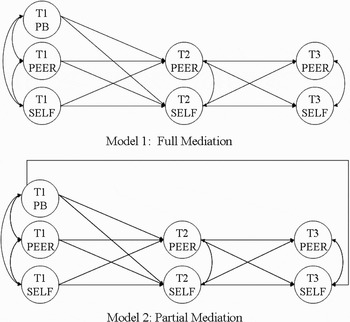
The present study examined two structural models for testing longitudinal mediation (see Figure 1). Model 1 tested full meditation of the relationship between pubertal timing at Time 1 and self-delinquency at Time 3 through peer delinquency at Time 2, whereas Model 2 tested partial meditation. In the full mediation model the direct path from pubertal timing at Time 1 to self-delinquency at Time 3 was set to zero, whereas in the partial mediation mode it was freely estimated. Model 1 and Model 2 controlled for the effects of peer delinquency and self-delinquency at the previous time points. The model fit between Model 1 and Model 2 was examined to determine the best-fitting model using the 1 degree of freedom nested chi-square difference test. The significance of the indirect effect of pubertal timing at Time 1 on self-delinquency at Time 3 through peer delinquency at Time 2 was examined using the Sobel Test (Sobel, Reference Sobel and Leinhardt1982). Although the main interest of the study was to test mediation of peer delinquency between pubertal timing and self-delinquency, it was expected that there would be a reciprocal effect between peer delinquency and self-delinquency over time. Therefore, cross-lagged effects between peer delinquency and self-delinquency across Times 1, 2, and 3 were also included in the models.
Model 1 shows the full mediation model testing Time 2 (T2) peer delinquency as a mediator between Time 1 (T1) pubertal timing and Time 3 (T3) peer delinquency. Model 2 shows the partial mediation model, which is the same as Model 1 with the inclusion of a direct path from Time 1 pubertal timing to Time 3 self-delinquency. Manifest variables have been omitted for simplicity. PB, pubertal timing; PEER, peer delinquency; SELF, self-delinquency.

Moderated mediation
Multiple-group SEM analyses were used to investigate whether gender or maltreatment experience moderated the mediational relationship. The best fitting structural model identified by the preceding analysis with the total sample was simultaneously fit to both subgroups (i.e., males and females then maltreated and comparison), first allowing all parameters to vary across groups, then constraining the factor loadings to be equal across groups, and last requiring the regression weights to be equal across the groups. A significant chi-square difference test indicated whether the groups were significantly different from each other on one or more parameter estimates. The comparison between the first and second models tested the factorial invariance across the groups, which is prerequisite of testing moderation analyses for the structural parameters. The comparison between the second and the third model tested whether the mediational effects were significantly different between genders or between maltreated and comparison adolescents, which would indicate moderated mediation.
Fit indices such as the chi-square goodness of fit statistic, the root mean square error of approximation (RMSEA) and CFI were used to evaluate the fit of the model to the data. Overall, a good model fit is indicated by a small χ2 value, an RMSEA of 0.08 or smaller, and a CFI above 0.90 (Browne & Cudeck, Reference Browne, Cudeck, Bollen and Long1993; Shapiro & Levendosky, Reference Shapiro and Levendosky1999). In addition, a probability value that the RMSEA is less than 0.05 (PCLOSE) provides additional information on how closely a model fits the data.
Control variables
The full and partial meditational models with the total sample included the following covariates: Time 1 age, gender, maltreatment, and household income (to account for socioeconomic status). Age was not included as a covariate for Time 1 pubertal timing because the calculation of this variable already takes age into account. For the moderated meditation models the covariates were Time 1 age, income, and either maltreatment status or gender (depending on which variable was being examined as the moderator).
Results
Descriptive statistics
Puberty, peer delinquency, and self-delinquency
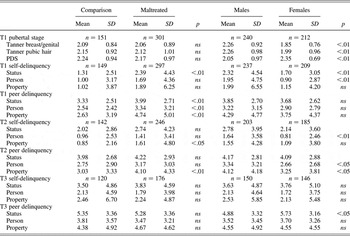
Table 1 summarizes the means and standard deviations of the puberty, peer delinquency and self-delinquency variables by maltreatment status and gender using the raw scores. Significant differences between groups were examined using independent samples t test.
Means and standard deviations for study variables

Note: Significant mean differences between groups was tested using an independent samples t test; delinquency scores reflect composite scores from raw data. T1, T2, T3, respective Time 1, 2, or 3.
Bivariate correlations
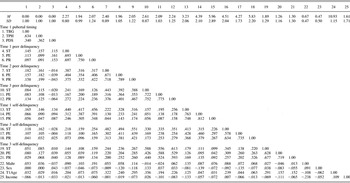
Pearson correlations were computed between the variables of interest (Table 2). Significant correlations were found among all the pubertal timing variables for Time 1 (rs = .34 to .63, p < .01). The three self-delinquency scales were found to have significant intercorrelations for Time 1 (rs = .74 to .81, p < .01), Time 2 data (rs = .57 to .73, p < .01) and Time 3 (rs = .61 to .72, p < .01), as well as the peer delinquency scales for Time 1 (rs = .69 to .75, p < .01), Time 2 data (rs = .67 to .79, p < .01), and Time 3 (rs = .72 to .78, p < .01).
Correlations among pubertal timing, self-report delinquency, and peer delinquency

Note: TBG, Tanner breast/genital; TPH, Tanner pubic hair; PDS, Pubertal Development Scale; ST, status offenses; PE, person offenses; PR, property offenses; Maltr, Maltreatment; T1Age, age at Time 1.
Mediational models with the total sample
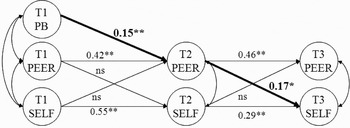
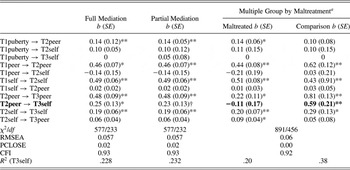
Model 1 (see Figure 1) tested Time 2 peer delinquency as a mediator between pubertal timing at Time 1 and self-delinquency at Time 3. Model 1 fit the data well, χ2 = 577 (233) (RMSEA = 0.057, PCLOSE = 0.02, CFI = 0.93), and explained 22.8% of variance in self-delinquency at Time 3. The results showed that peer delinquency at Time 2 fully mediated the relationship between pubertal timing at Time 1 and self-delinquency at Time 3. Time 1 pubertal timing predicted Time 2 peer delinquency, β (b) = 0.15 (0.14), p < .01, controlling for peer delinquency and self-delinquency at Time 1. In turn, Time 2 peer delinquency predicted Time 3 self-delinquency, β (b) = 0.17 (0.25), p < .01, controlling for peer delinquency and self-delinquency at Time 2 (see Figure 2). There was no relationship between peer delinquency at Time 1 and self-delinquency at Time 2 or between self-delinquency at Time 1 and peer delinquency at Time 2. All factor correlations between the latent variables estimated in the model were statistically significant. For Time 1 latent variables, the factor correlation was .17 (p < .01) between pubertal timing and peer delinquency, .12 (p < .05) between pubertal timing and self-delinquency, and .48 (p < .01) between peer delinquency and self-delinquency. The correlation between the residuals of peer delinquency and self-delinquency at Time 2 was .61 (p < .01) and at Time 3 was .71 (p < .01).
A model showing the results of the full mediation analysis for the total sample with standardized parameter estimates. Manifest variables have been omitted for simplicity. PB, pubertal timing (higher value indicates earlier timing); PEER, peer delinquency; SELF, self-delinquency; χ2 = 577 (233), root mean square error of approximation (RMSEA) = 0.057, confidence interval of RMSEA = 0.051–0.063, probability value that the RMSEA is <0.05 = 0.02, comparative fit index = 0.943. *p < .05. **p < .01.

Model 2 (Figure 1) tested partial mediation of Time 2 peer delinquency and fit the data well, χ2 = 576 (232), (RMSEA = 0.057, PCLOSE = 0.02, CFI = 0.93), and explained 23.2% of variance in self-delinquency at Time 3 (Table 3). However, no significant freely estimated direct effect of pubertal timing at Time 1 on self-delinquency at Time 3 was found. The addition of the direct path did not improve the model fit and there was 1 degree of freedom less compared to Model 1 (Δχ2/Δdf = 1/1, p > .05). Therefore, the results of the analyses supported Model 1 and the significance of the indirect effect of pubertal timing on self-delinquency through peer delinquency was evaluated using the Sobel Test. The Sobel Test statistic was 2.33, indicating the indirect effect was statistically significant (two-tailed p = .02). In sum, the results supported Time 2 peer delinquency fully mediating the relationship between Time 1 pubertal timing and Time 3 self-delinquency. The direction of the parameter estimates indicated that earlier pubertal timing was related to higher peer delinquency that in turn was related to higher self-delinquency.
Model fit indices and unstandardized path coefficients

Note: The parameter in bold type was the only one significantly moderated by maltreatment experience. All other parameters were not significantly different between maltreatment and comparison groups. T1, T2, T3, respective Time 1, 2, or 3; peer, peer delinquency; self, self-delinquency; RMSEA, root mean square error of approximation; PCLOSE, a probability value that the RMSEA is <.05; CFI, comparative fit index.
aFreely estimated model.
†p < .08. *p < .05. **p < .01.
Moderated mediation
Gender as a moderator
Based on the results from the preceding analyses, the full meditation model (Model 1 in Figure 1) was selected for moderation analyses. The unrestricted model was significantly different from the factor loadings restricted model (Δχ2/Δdf = 71/21, p <.01), indicating one or more of the factor loadings were variant across gender. The factor loadings of each latent variable were restricted separately to determine which factor loading(s) contributed to the decrement in model fit. This analysis showed that the factor loadings of pubertal timing at Time 1 (Δχ2/Δdf =13/3, p < .01), peer delinquency at Time 2 (Δχ2/Δdf = 8/3, p < .01), and self-delinquency at Time 1 (Δχ2/Δdf = 31/3, p < .001) and Time 2 (Δχ2/Δdf = 16/3, p < .01) were variant across gender. Only partial invariance of the seven latent factors was achieved; therefore, those variant factor loadings were freely estimated across gender as suggested by Byrne, Shavelson, and Muthen (Reference Byrne, Shavelson and Muthen1989) for the subsequent moderation analyses. Next, each mediational path was fixed to be equal across gender in turn and compared to the freely estimated model. No significant difference was found between the two models indicating gender did not moderate the mediational relationships.
Maltreatment experience as a moderator
The unrestricted model was significantly different from the factor loadings restricted model (Δχ2/Δdf = 100/21, p < .01), demonstrating that the factor loadings of the latent factors were not invariant between maltreated and comparison adolescents. The further investigation of each factor revealed that factorial invariance did not hold for peer delinquency at Time 1 (Δχ2/Δdf = 13/3, p < .01) and Time 3 (Δχ2/Δdf = 8/3, p < .05) and self-delinquency at Time 1 (Δχ2/Δdf = 43/3, p < .001) and Time 2 (Δχ2/Δdf = 27/3, p < .001). Therefore, moderation analyses were conducted with freely estimated loadings of these three latent factors (Byrne et al., Reference Byrne, Shavelson and Muthen1989). As in the previous analysis the mediation paths were fixed to be equal across groups and compared to the model in which they were freely estimated. There was a significant difference between these models, and subsequent tests restricting each structural parameter in turn indicated that maltreatment experience moderated the relationship between peer delinquency at Time 2 and self-delinquency at Time 3 (Δχ2/Δdf = 4/1, p < .01). The relationship was significant only for the comparison group, β (b) = 0.38 (0.59), p < .01, suggesting that the mediation effect only existed in the comparison group. Given that the meditational relationship was not established for the maltreatment group, an ad hoc analysis was conducted to test whether pubertal timing had a direct effect on Time 3 self-delinquency and whether the effect differed between the groups. A significant direct effect of Time 1 pubertal timing on self-delinquency at Time 3 was found in the maltreatment group, β (b) = 0.20 (0.15), p < .05, but this effect was not significant in the comparison group. This difference in parameter estimates between the groups was statistically significant (Δχ2/Δdf = 6/1, p < .01).
Discussion
Although there is substantial evidence that early pubertal timing is associated with delinquent behavior in adolescence, there are few studies that have examined the mechanisms of this relationship. Therefore, the purpose of this study was to examine exposure to delinquent peers as a mediator between pubertal timing in early adolescence and adolescents' own delinquent behaviors 3 years later. Prior research has found that peers influence the delinquency of early maturing adolescents (Caspi et al., Reference Caspi, Lynam, Moffitt and Silva1993; Haynie, Reference Haynie2003; Lynne et al., Reference Lynne, Graber, Nichols, Brooks-Gunn and Botvin2007), but no single study has examined this mediational relationship for both genders using multiple measures of puberty and a racially diverse sample. Of particular interest is the finding that for the multiple group model between genders, exposure to delinquent peers at Time 2 fully mediated the relationship between Time 1 pubertal timing and Time 3 self-delinquency for both males and females, thus providing evidence for a longitudinal effect of puberty on delinquency.
Gender was examined as a moderator of the mediational model because evidence suggests that males may be more susceptible to peer influence than females (Sumter, Bokhorst, Steinberg, & Westenberg, Reference Sumter, Bokhorst, Steinberg and Westenberg2009), whereas females may be more influenced by the discordance between their physical development and social expectations. Our results do not support these suppositions and instead find that the association between pubertal timing and self-delinquency through exposure to peer delinquency is similar for both males and females. This finding is concordant with a study by Fergusson, Vitaro, Wanner, and Brendgen (Reference Fergusson, Vitaro, Wanner and Brendgen2007), which found that gender did not moderate the relationship between peer delinquency and self-delinquency. The focus on females in the puberty literature demonstrates an inclination to assume that early puberty and peer influences pose a greater risk for females than for males. However, the results of this study contradict this assumption and show that early-maturing males and females are both at risk for interacting with peers that may expose and draw them into delinquent behavior. This finding is in agreement with other studies that also find peer influence is an important component for predicting adolescent problem behavior (Beaver & Wright, Reference Beaver and Wright2005; Drapela, Gebelt, & McRee, Reference Drapela, Gebelt and McRee2006; Felson & Haynie, Reference Felson and Haynie2002). Previous studies have primarily only tested peer behavior as a mediator between pubertal timing and delinquency for females or did not test moderated mediation. Thus, the findings presented here add significantly to the literature. The composition of the sample allowed for the clarification of gender differences in the associations between pubertal timing and delinquency, as well as the extension of these relationships to a racially diverse urban sample.
Maltreatment experience was also examined as a moderator of the mediational model. Some studies suggest that the effect of puberty is accentuated in adverse contexts, implying that in the presence of maltreatment the association between early puberty and delinquency may be amplified. There is little evidence showing whether this contextual amplification is relevant to the association between pubertal timing and exposure to deviant peers, or between exposure to deviant peers and the adolescent's own delinquent behavior. Of interest, the results showed that for the comparison group the mediational model was significant while for the maltreated adolescents there was no evidence supporting mediation. Instead, for the maltreated adolescents there was a significant direct effect of pubertal timing on delinquency. This finding suggests that in the context of maltreatment experience the mediational mechanisms linking pubertal timing and delinquency (via exposure to peer delinquency) are disrupted and that, for early maturing maltreated youth, abuse experiences have more effect on the development of delinquency than the exposure to delinquent peers does. These results indicate that although early pubertal timing is related to higher delinquency for both maltreated and comparison adolescents, the mechanism differs. Delinquent peers appear to be influential for early maturing comparison adolescents, but not for early maturing maltreated adolescents.
In addition, the impact of maltreatment on delinquency may be developmentally nuanced, that is, childhood-only maltreatment is less likely to be related to delinquency in adolescence than adolescent maltreatment or persistent maltreatment (Ireland, Smith, & Thornberry, Reference Ireland, Smith and Thornberry2002; Thornberry, Lizotte, Krohn, Smith, & Porter, Reference Thornberry, Lizotte, Krohn, Smith, Porter, Thornberry and Krohn2003). Because we did not include information about the specific abuse experiences we cannot be certain in which developmental period the abuse occurred. Although other studies show contextual amplification of the relationship between puberty and deleterious outcomes we did not find evidence to support this effect via the mediational model. However, we show that early puberty is still a risk for delinquency in maltreated adolescents when compared to on-time and late maturation. Therefore, although early-maturing maltreated adolescents may be at higher risk for delinquency as a result of their experiences, our results indicate that late maturation can be relatively protective.
One theoretical explanation for the association between early pubertal timing and delinquency is that early maturing adolescents may engage in delinquent behavior as a means of gaining social status comparable to their advanced physical maturity. Thus, early maturing adolescents may engage in delinquent behavior as a means of participating in adult behavior, while perhaps not being able to recognize more constructive ways to attain adult social status. This explanation suggests that early maturers will have higher delinquency irrespective of their peers' behavior, and that adolescents' delinquency will be associated with their peers' delinquency because of selection effects. However, we found no evidence that an increase in self-delinquency preceded increased exposure to peer delinquency, negating the possibility of selection effects. An alternative theory proposes that peer influence is the key mechanism linking early puberty to delinquency. Early maturers may be drawn into risky behavior such as delinquency by older adolescents who judge the individual by their physical appearance of maturity rather than by their chronological age. The results from this study support early timing as risk for exposure to delinquent peers, which leads to the adolescent's increased delinquent behavior, but only for nonmaltreated adolescents. Other studies have shown that early maturers are more likely to associate with older peers than on-time and late maturers (Stattin & Magnusson, Reference Stattin and Magnusson1990). Older adolescents are also more likely to be engaging in delinquent behavior, thus modeling it for the early maturing adolescent. However, the age of delinquent peers was not assessed in the current study; therefore we cannot show whether the delinquent peers were older than the adolescent and whether the association with older delinquent peers is the driving mechanism.
There are several limitations of the current study that should be taken into account. First, the measures of pubertal development, self-delinquency, and peer delinquency were obtained by self-report. Although self-reports of pubertal development have been found comparable to physician reports, pubertal ratings from multiple informants would strengthen the validity of these measures. However, the use of multiple informants, in particular physician examination, is not always a feasible option. An important note is that there appeared to be some irregularities in the pubertal stage measures in regard to gender. Males reported being at a more advanced stage than females, which is counter to the known physiological gender differences in pubertal development. Evidence shows that girls appear to be more reliable raters of their own development; thus, it may be that self-report in this study resulted in overestimation of stage for males but accurate estimates for females (Brooks-Gunn, Warren, Rosso, & Garguilo, Reference Brooks-Gunn, Warren, Rosso and Garguilo1987). In addition, an important consideration when interpreting the findings is that the ratings were the adolescents' perception of their pubertal development rather than their actual pubertal development. Both the perception of pubertal development and physician ratings have been found to be associated with psychosocial difficulties in a number of studies (Dorn, Susman, & Ponirakis, Reference Dorn, Susman and Ponirakis2003; Graber et al., Reference Graber, Lewinsohn, Seeley and Brooks-Gunn1997; Siegel, Yancey, Aneshensel, & Schuler, Reference Siegel, Yancey, Aneshensel and Schuler1999; Susman et al., Reference Susman, Dockray, Schiefelbein, Herwehe, Heaton and Dorn2007), but it is still integral to note that they may index different constructs (Dorn, Dahl, Woodward, & Biro, Reference Dorn, Dahl, Woodward and Biro2006). Last, these findings only reflect associations in regard to pubertal timing, not pubertal stage. These are different constructs and different theoretical mechanisms may explain the associations between pubertal stage and delinquency.
Multiple informants would add to the measurement of delinquency as well, although using police reports or arrest records would discount a majority of adolescents as many have not been involved in the juvenile justice system. Perhaps for the assessment of more serious delinquency, official reports would be most useful. Even within the present study the frequency of delinquent behavior was quite low. This may be in part due to the young age range of the sample. Delinquency may be more evident in older adolescents; therefore, it would be informative to follow the adolescents beyond the time point and age used in the present study.
The statistical model used to test the mediational relationships in the current study utilized data by time point (Time 1, Time 2, Time 3). Because there was an age range for the participants at each time point (e.g., 9–13 years for Time 1) there may be developmental differences within each time point that are not being captured with this modeling technique. An alternative way to examine this data would be a sequential cohort design in which variables are modeled by age instead of by time point. However, for the purpose of this paper, this method was not feasible given the large number of parameters needed in such a model and the need to test each individual parameter for moderation. We acknowledge that this may be a more developmentally sensitive method to examine this data, but to test our moderated mediation model we felt the SEM framework by time point was the most appropriate.
There was also substantial attrition at Time 3 of the study. The majority of adolescents who did not return for the Time 3 visit were in the maltreated group. It is extremely difficult to keep track of their whereabouts primarily because of the family disruption and poor family functioning of maltreated children. Due to the characteristics of those participants who did not return for Time 3, there may be underestimation of delinquency in this sample at later time points and restricted variance. However, we do show that even with a number of high-risk children not included at Time 3 we still observed a relationship between early puberty and self-delinquency across 3 years.
Conclusion
Although the results of this study support longitudinal relationships between pubertal timing and delinquency via exposure to peer delinquency for nonmaltreated adolescents, future research should continue to examine these associations across adolescence and into early adulthood. Pubertal timing in midadolescence should be used to examine associations with problems behavior in adulthood. More detailed measurements of peer behavior and relationships with peers would lead to a clearer picture as to the actual mechanisms involved linking puberty to later delinquency. Because of shared method variance, adolescents' reports on their own and their peers' delinquency may result in overestimates in the similarity of behavior (Laird, Criss, Pettit, Dodge, & Bates, Reference Laird, Criss, Pettit, Dodge and Bates2008). However, studies have shown that perception of peer smoking is actually a better predictor of an adolescent's use than is the peer's report (Iannotti & Bush, Reference Iannotti and Bush1992). Thus, it is likely that the adolescents' report of their peers' behavior is important in influencing their own delinquency. However, to better understand the mechanisms that influence delinquency we must examine more specific aspects of peer and friend influence and get corroborating reports from parents or teachers. In addition, it would be useful to determine if particular types of delinquency are more persistent or lead to future criminal behavior. Another consideration is that in a positive context (e.g., no delinquent peers) early maturation may not necessarily be harmful. Last, we have shown that contextual experiences (i.e., maltreatment) can alter the mechanisms of these associations. Thus, it is necessary to examine the environment and individual experiences when examining the relationship between pubertal timing and later problem behavior to fully understand the complexity of these relationships.