INTRODUCTION
American Trypanosomiasis (Chagas disease) is the most important parasitic infection in Latin America in terms of public health and economic impact. Ten to 15 million people are infected by Trypanosoma cruzi (Kinetoplastida: Trypanosomatidae) and 28 million people remain at risk of infection (World Health Organization, 2007). Natural infections by T. cruzi are constituted by multiple clones with different biological properties such as virulence and tissue tropism (Macedo and Pena, Reference Macedo and Pena1998). Trypanosoma cruzi is currently classified into 6 Discrete Typing Units (DTU), TcI – TcVI (Zingales et al. Reference Zingales, Andrade, Briones, Campbe, Chiari, Fernandes, Guhl, Lages-Silva, Macedo, Machado, Miles, Romanha, Sturm, Tibayrenc and Schijman2009), defined as ‘sets of stocks that are genetically more related to each other than to any other stock and that are identifiable by common genetic, molecular or immunological markers’ (Tibayrenc et al. Reference Tibayrenc1998). Considerable genetic diversity at sub-DTU level has been revealed within TcI and TcIII parasite isolates (Herrera et al. Reference Herrera, Bargues, Fajardo, Montilla, Triana, Vallejo and Guhl2007; Llewellyn et al. Reference Llewellyn, Miles, Carrasco, Lewis, Yeo, Vargas, Torrico, Diosque, Valente, Valente and Gaunt2009, Reference Llewellyn, Rivett-Carnac, Fitzpatrick, Lewis, Yeo, Gaunt and Miles2011; Miles et al. Reference Miles, Llewellyn, Lewis, Yeo, Baleela, Fitzpatrick, Gaunt and Mauricio2009; Cura et al. Reference Cura, Mejía-Jaramillo, Duffy, Burgos, Rodriguero, Cardinal, Kjos, Gurgel-Gonçalves, Blanchet, De Pablos, Tomasini, da Silva, Russomando, Cuba, Aznar, Abate, Levin, Osuna, Gürtler, Diosque, Solari, Triana-Chávez and Schijman2010).
The DTUs of T. cruzi are distributed differentially among triatomine bugs, vertebrate host species and habitats in different geographical areas (Higo et al. Reference Higo, Miura, Horio, Mimori, Hamano, Agatsuma, Yanagi, Cruz-Reyes, Uyema, Rojas de Arias, Matta, Akahane, Hirayama, Takeuchi, Tada and Himeno2004; Noireau et al. Reference Noireau, Brenière, Ordoñez, Cardozo, Morochi, Gutierrez, Bosseno, Garcia, Vargas, Yaksic, Dujardin, Peredo and Wisnivesky-Colli2009). The Gran Chaco is a biogeographical region that stretches mostly over Argentina, Paraguay and Bolivia. With 4 million people living under conditions of poverty and weak health-care systems, this region is hyperendemic for Chagas disease and other preventable diseases (Gürtler et al. Reference Gürtler, Kitron, Cecere, Segura and Cohen2007a). In the Argentine Chaco, Triatoma infestans constitutes the main domestic vector of T. cruzi and humans, dogs and cats are the most important domestic hosts. Natural infection by T. cruzi has been found in local sylvatic mammals such as Didelphis albiventris opossums and Dasypus novemcinctus armadillos (Yeo et al. Reference Yeo, Acosta, Llewellyn, Sánchez, Adamson, Miles, López, González, Patterson, Gaunt, Rojas de Arias and Miles2005; Ceballos et al. Reference Ceballos, Cardinal, Vazquez-Prokopec, Lauricella, Orozco, Cortinas, Schijman, Levin, Kitron and Gürtler2006), and in sylvatic triatomine bugs mostly within the Triatoma sordida complex (Bar and Wisnivesky-Colli, Reference Bar and Wisnivesky-Colli2001). However, the role of these species as vectors of T. cruzi in the sylvatic cycle remains unclear (Marcet et al. Reference Marcet, Duffy, Cardinal, Burgos, Lauricella, Levin, Kitron, Gurtler and Schijman2006; Alvarado-Otegui et al. Reference Alvarado-Otegui, Ceballos, Orozco, Enriquez, Cardinal, Schiman, Kitron and Gürtler2012). We hypothesized that T. sordida is a putative sylvatic vector of T. cruzi and may represent a putative (peri)domestic vector in the study area. In the Argentine Chaco, T. infestans has been found infected with TcV and TcVI, and the frequency of these DTUs differed between study areas (Diosque et al. Reference Diosque, Barnabe, Padilla, Marco, Cardozo, Cimino, Nasser, Tibayrenc and Basombrio2003; Cardinal et al. Reference Cardinal, Lauricella, Ceballos, Lanati, Marcet, Levin, Kitron, Gürtler and Schijman2008). Understanding the complex epidemiology of T. cruzi and the variety of transmission cycles and pathogenic behaviours requires a representative, clearer picture of parasite genetic diversity (Brisse et al. Reference Brisse, Verhoef and Tibayrenc2001; Miles et al. Reference Miles, Llewellyn, Lewis, Yeo, Baleela, Fitzpatrick, Gaunt and Mauricio2009). Convenience sampling of insect vectors or patient samples has usually been performed to characterize the genetic diversity of T. cruzi at a local level (Diosque et al. Reference Diosque, Barnabe, Padilla, Marco, Cardozo, Cimino, Nasser, Tibayrenc and Basombrio2003; Marcet et al. Reference Marcet, Duffy, Cardinal, Burgos, Lauricella, Levin, Kitron, Gurtler and Schijman2006; Burgos et al. Reference Burgos, Altcheh, Bisio, Duffy, Valadares, Seidenstein, Piccinali, Freitas, Levin, Machi, Macedo, Freilij and Schijman2007). In addition, most parasite typing studies required isolation by culture expansion (Montamat et al. Reference Montamat, Arauzo, Cazzulo and Subias1987; de Luca d'Oro et al. Reference De Luca D'Oro, Gardenal, Perret, Crisci and Montamat1993; Diosque et al. Reference Diosque, Barnabe, Padilla, Marco, Cardozo, Cimino, Nasser, Tibayrenc and Basombrio2003; Cardinal et al. Reference Cardinal, Lauricella, Ceballos, Lanati, Marcet, Levin, Kitron, Gürtler and Schijman2008; Lewis et al. Reference Lewis, Ma, Yeo, Carrasco, Llewellyn and Miles2009) at the possible expense of selecting certain strains, as was previously described in other studies (Bosseno et al. Reference Bosseno, Yacsik, Vargas and Brenière2000).
Here we investigated the distribution of T. cruzi DTUs in T. infestans and T. sordida in a well-defined rural area in the Argentine Chaco using direct PCR techniques. For T. infestans, we tested the association between identified DTU and bloodmeal source, and we compared our results with those obtained in previous studies from areas with dissimilar epidemiological backgrounds (Diosque et al. Reference Diosque, Barnabe, Padilla, Marco, Cardozo, Cimino, Nasser, Tibayrenc and Basombrio2003; Cardinal et al. Reference Cardinal, Lauricella, Ceballos, Lanati, Marcet, Levin, Kitron, Gürtler and Schijman2008). Regarding T. sordida, we hypothesized that this species may constitute one of the vectors in the sylvatic cycle of transmission and could also represent a secondary vector in the domestic/peridomestic cycle.
MATERIALS AND METHODS
Study area
Field studies were carried out in a section (450 km2) of the Municipality of Pampa del Indio (25° 55′S 56°58′W), Province of Chaco, Argentina, located in the humid (east) Chaco, close to the transition to the dry (west) Chaco. The study area has been described elsewhere (Gurevitz et al. Reference Gurevitz, Ceballos, Gaspe, Alvarado Otegui, Enríquez, Kitron and Gürtler2011). It included 353 houses and several public buildings clustered in 13 neighbouring rural villages. The last community-wide insecticide spraying campaign conducted by vector control personnel was carried out in 1996, except for a few houses treated by villagers or hospital staff in 2006.
Entomological survey
In total, 327 inhabited house compounds were visited for an entomological survey between September and November 2007. All sites within each household were searched for triatomine bugs by timed manual collections conducted by 2 skilled bug collectors from the national or provincial vector control programmes using 0·2% tetramethrin (Espacial, Argentina) as a flushing-out agent. Domiciles were inspected by one person during 20 min whereas all peridomestic sites were searched by one person during 15 min (Gurevitz et al. Reference Gurevitz, Ceballos, Gaspe, Alvarado Otegui, Enríquez, Kitron and Gürtler2011). Infestation by T. infestans was determined in 39·8% of inhabited house compounds, and T. sordida was found in 18·3% of them, mainly in peridomestic sites (Gurevitz et al. Reference Gurevitz, Ceballos, Gaspe, Alvarado Otegui, Enríquez, Kitron and Gürtler2011). Immediately after the baseline survey, a community-wide insecticide spraying campaign was conducted and all sites from each house compound were sprayed with suspension concentrate deltamethrin (K-Othrina, Bayer) at standard dose (25 mg/m2) in December 2007 by vector control personnel (Gurevitz et al. Reference Gurevitz, Ceballos, Gaspe, Alvarado Otegui, Enríquez, Kitron and Gürtler2011). During the next 3 years all houses were regularly inspected for infestation and selectively sprayed with insecticides if found to be re-infested.
All collected bugs were identified to species and stage at the field laboratory and counted as described elsewhere (Cardinal et al. Reference Cardinal, Castañera, Lauricella, Cecere, Ceballos, Vazquez-Prokopec, Kitron and Gürtler2006). All live or moribund third to fifth-instar nymphs and adult bugs were individually examined for T. cruzi infection by optic microscopy (OM) at X400 within 10 days of capture as described (Cardinal et al. Reference Cardinal, Castañera, Lauricella, Cecere, Ceballos, Vazquez-Prokopec, Kitron and Gürtler2006). The overall prevalence of T. cruzi infection was 22·1% (n, number of examined bugs = 2138) for T. infestans and 1·0% (n = 290) for T. sordida (Cardinal et al. unpublished results).
Sampling design
Multi-level sampling was used to select OM-positive T. infestans and establish the overall distribution of DTUs. The 13 rural villages were divided in 4 strata according to the village-specific prevalence of houses with T. cruzi-infected T. infestans bugs: high (over 60%), medium (between 40% and 60%), low (between 10% and 30%), and very low (below 5%). The village-specific prevalence of houses with infected bugs was defined as the number of houses with at least 1 T. infestans positive for T. cruzi (as determined by OM) divided by the total number of houses positive for T. infestans. The very-low prevalence strata included the rural villages of Los Ciervos and La Herradura which had a bug infection prevalence ⩽1% and were therefore ruled out of the sampling frame. Among the rest of the study villages, 35% of all houses were randomly selected to enhance the power of subsequent statistical tests.
Within the randomly-selected houses, all T. infestans collection sites were sampled. To define the total number of bugs to sample within the house-compound level, bug collection sites were divided in 3 abundance strata (i.e., less than 5, between 5 and 15, and more than 15 infected bugs). All bugs from the first stratum were analysed; 40% of bugs from the second stratum were selected, and 20% of bugs from the third one were used for DTU identification. Upper and lower strata boundaries were defined according to the outcome of a preliminary sampling exercise showing that (1) in sites with low bug abundance, it was necessary to examine all OM-positive bugs to display the whole DTU diversity and (2) in sites with high bug abundance, there was an upper number of examined bugs above which no new DTU was identified (i.e. 6 bugs). In this regard, all sites with high bug abundance presented over 30 specimens; thus the minimum of 6 bugs was always ensured. The described sampling protocol yielded a total of 114 OM-positive T. infestans from 25 house compounds in 10 rural villages.
For T. sordida, all domestic and peridomestic bugs infected with T. cruzi were analysed because of its very low infection prevalence. Therefore, we included the total number of OM-positive bugs from surveys conducted before (September–November 2007) and after residual spraying with insecticides (April and November, 2008; May and September, 2009). In total, we analysed 9 OM-positive T. sordida collected from 7 house compounds located in 7 villages.
DNA extraction
Trypanosoma cruzi DNA samples were extracted from the bugs' rectal ampoule of all selected insects by cutting the abdomen below the third tergite and then storing it in microtubes containing 25 μl of sterile saline solution. Forceps were rinsed in 10% bleach and 70% ethanol and flamed between dissections of successive bugs. Negative controls of this procedure were obtained by systematically rinsing forceps in saline solution on a slide and storing the wet preparation in sterile microtubes. The rectal ampoules were boiled for 15 min and DNA from 25 μl of each fecal sample was purified using DNAzol® (Invitrogen, USA) reagent as described previously (Marcet et al. Reference Marcet, Duffy, Cardinal, Burgos, Lauricella, Levin, Kitron, Gurtler and Schijman2006).
Parasite culture
Isolation of T. cruzi from feces of a subset of OM-positive bugs (20 T. infestans and 9 T. sordida) and cultures in biphasic medium (Nutrient agar defibrinated rabbit blood/Brain Heart Infusion) were conducted at the National Institute of Parasitology ‘Dr. Mario Fatala Chabén’-ANLIS. Cultures were kept at 28 °C and 50% relative humidity and microscopically monitored for parasite growth bimonthly for 4 months. Cultures were then stored in liquid nitrogen and defrosted for genotyping as described elsewhere (Lauricella et al. Reference Lauricella, Stariolo, Riarte, Segura and Gürtler2005). T. cruzi DNA was then extracted from culture isolates as before (Marcet et al. Reference Marcet, Duffy, Cardinal, Burgos, Lauricella, Levin, Kitron, Gurtler and Schijman2006).
DTU identification
Trypanosoma cruzi DTUs were identified using a combination of PCR strategies targeted to nuclear genomic markers which had been previously optimized for direct identification from blood samples (Burgos et al. Reference Burgos, Altcheh, Bisio, Duffy, Valadares, Seidenstein, Piccinali, Freitas, Levin, Machi, Macedo, Freilij and Schijman2007). Consequently, we assumed that the protocol proposed by Burgos et al. (Reference Burgos, Altcheh, Bisio, Duffy, Valadares, Seidenstein, Piccinali, Freitas, Levin, Machi, Macedo, Freilij and Schijman2007) could be applied to direct identification of DTUs from samples obtained from the bugs' rectal ampoules. Given that for most samples we did not use amplification of parasites by culture, our main concern was to choose a set of PCR strategies that would not require large amounts of T. cruzi DNA to identify DTUs. The selected protocol allowed successful DTU typing using a range of DNA (100 fg-10 pg) (Burgos et al. Reference Burgos, Altcheh, Bisio, Duffy, Valadares, Seidenstein, Piccinali, Freitas, Levin, Machi, Macedo, Freilij and Schijman2007) that may be obtained from rectal ampoules (results not shown), and was smaller than the ones required by other protocols (Lewis et al. Reference Lewis, Ma, Yeo, Carrasco, Llewellyn and Miles2009). In all rectal ampoule samples we incorporated Taq platinum polymerase (Invitrogen, USA) to augment sensitivity.
As detailed elsewhere (Burgos et al. Reference Burgos, Altcheh, Bisio, Duffy, Valadares, Seidenstein, Piccinali, Freitas, Levin, Machi, Macedo, Freilij and Schijman2007), the selected protocol targeted 3 different genomic markers: the intergenic region of spliced leader genes (SL-IR), the D7 domain of the 24Sα ribosomal RNA genes, and the genomic marker A10. Amplification of the SL-IR using 3 independent hot-start PCR reactions, named SL-IR I, SL-IRac and SL-IR II, were carried out for a first classification of T. cruzi populations in 3 groups of DTUs: Tc I, Tc IV/III and Tc II/V/VI, respectively. Regarding the 24Sα ribosomal RNA genes, a dimorphic region within the D7 domain was amplified by hot-start hemi-nested PCR to distinguish between TcV and TcII/TcVI groups. The first round PCR was performed using D75 and D76 primers. The hemi-nested round was carried out using 1 μl of the first round PCR in a 30 μl vol. reaction using primers D71-D76. Finally genomic marker A10 was used in 2 rounds of PCRs to separate TcII from TCVI. The first round was carried out using Pr1 and P6 primers whereas the hemi-nested round was performed with primers Pr1 and Pr3 (Burgos et al. Reference Burgos, Altcheh, Bisio, Duffy, Valadares, Seidenstein, Piccinali, Freitas, Levin, Machi, Macedo, Freilij and Schijman2007). PCR products were analysed in 3% agarose gels (Invitrogen, USA) and UV visualization after staining with Gel Red (GenBiotech).
It is necessary to point out that some samples infected with TcV amplified both 125 and 140 bp ribosomal DNA bands in the 24Sα DNA-PCR (D71 and D76) (Burgos et al. Reference Burgos, Altcheh, Bisio, Duffy, Valadares, Seidenstein, Piccinali, Freitas, Levin, Machi, Macedo, Freilij and Schijman2007). When this pattern appears, it is not possible to differentiate infections with TcV from mixed infections with TcV + TcVI. When possible, we considered the results from the first round of the 24 s alpha rDNA-PCR (D75 and D76) to distinguish infections with only TcV from those with TcV + TcVI. However, some of the rectal-ampoule samples presented less DNA content and therefore differentiation between these DTUs could not be achieved. For comparative purposes, these bugs were considered as only being infected with TcV because (i) TcV infected the bugs beyond any doubt, and (ii) when we were able to use results from the first round of the 24 s alpha rDNA-PCR, only 3 bugs that showed the double-band pattern presented a mixed infection with TcV + TcVI. Due to the weak sensitivity of the A10 genomic marker, some rectal ampoule samples could not be resolved as TcII or TcVI; these cases were identified as TcII/VI. For statistical analysis we considered them as TcVI, as no TcII infection has been detected in domestic or sylvatic hosts or vectors from our study area so far (unpublished results).
Identification of bloodmeal sources
A direct ELISA assay was used to test bloodmeal contents against human, dog, cat, chicken and goat antisera as described elsewhere (Gürtler et al. Reference Gürtler, Ceballos, Ordóñez Krasnowski, Lanati, Stariolo and Kitron2009).
Data analysis
The associations between parasite DTU and other attributes (bug collection site, bloodmeal sources, and study areas) were assessed by means of Fisher's exact test. The degree of agreement between paired results of DTU identification based on DNA samples obtained by parasite culture and from rectal-ampoule material was assessed by the exact McNemar's test. All tests were made using Stata 10.1 (StataCorp 2007).
RESULTS
Triatoma infestans
In a preliminary sample of 15 OM-positive T. infestans collected in the study area and from other villages within the district (not included in later analyses) that were cultured, TcVI was identified in 93% of the bugs whereas TcV was found only in 1 specimen.
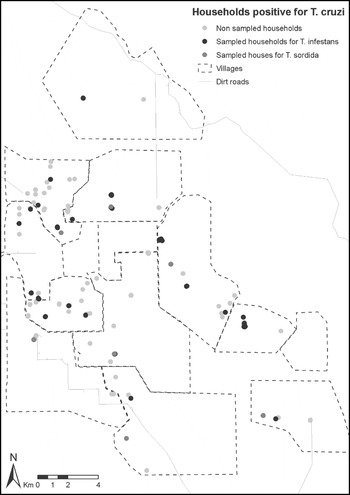
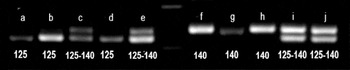
We analysed 114 (peri)domestic OM-positive T. infestans from 25 selected house compounds (Fig. 1). Identification of parasite DTUs from the bugs' rectal ampoule by means of direct PCR strategies was successful in 59 (52%) insects. Identification of DTUs from parasite cultures was successful in all samples. Overall, TcVI was found in 61% (n = 69) of the bugs, and TcV in 16% of them (Table 1). Three specimens showed mixed infections of TcV + TcVI. Figure 2 shows the amplification results obtained with the 24Sα DNA-PCRs. Thirteen T. infestans that were identified as TcV/TcV + TcVI were considered as infected only with TcV for further analyses.
Map of the study area in Pampa del Indio showing villages (polygons) and houses positive for Trypanosoma cruzi-infected triatomine bugs (dots). Dots identify positive houses sampled for DTU identification in T. infestans (dark grey dots) and T. sordida specimens (light grey dots).

Example of the hemi-nested 24Sα rDNA PCR using primers D71-D76 product size polymorphism in DNA samples from parasite cultures and bug rectal ampoules. Bands a–e show the two patterns that individuals infected with TcV display: a single band of 125 bp or 2 bands of 125 + 140 bp, (bands a and d are samples obtained from bug rectal ampoules; bands b and e from parasite cultures; band c: TcV reference stock, PAH 265). Central lane: 100 bp ladder. Bands f–h show the unique pattern for TcVI, a single band of 140 bp (band f: parasite culture sample, band g: rectal ampoule sample, band h: TcVI reference stock CL-Brener). Finally, bands i (parasite culture sample) and j (rectal ampoule sample) show the pattern observed for mixed infections TcV + TcVI that correspond also to a double band of 125 + 140 bp.

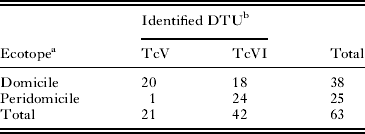
Identification of Trypanosoma cruzi DTUs in domestic and peridomestic vector species, Pampa del Indio, Chaco Province, Argentine, 2007–2009

a Single TcV infections or mixed infections with TcV + TcVI could not be distinguished.
Triatoma sordida
DTU identification was achieved in the 9 OM-positive T. sordida detected (Table 1). TcVI was identified in 56% of the insects, and was also the main DTU. Triatoma sordida bugs infected with TcVI were collected both in domestic and peridomestic sites: 2 of them were collected in a pig corral; 1 in a tree where chickens roosted at night, and 2 in different domiciles. An adult T. sordida infected with TcV was found in a kitchen near human sleeping quarters. Three adult T. sordida were found infected with TcI; 2 of them were captured in a chicken coop and the remainder in a tree where chickens roosted at night.
Identification of DTUs from parasite culture and rectal ampoule samples
The extraction of parasite DNA from rectal ampoules led to successful DTU identification in 52% of 114 T. infestans and in 100% of 9 T. sordida. The remaining samples tested negative or were identified incompletely mainly due to scarce fecal material. Samples from parasite culture always allowed identification of DTUs in both species of triatomine bugs. A subset of 20 T. infestans and 4 T. sordida was typified using both types of DNA samples. Paired results of DTU identification agreed in 18 bugs whereas for 6 specimens we could not identify the DTUs from rectal-ampoule material (exact McNemar's test, p = 0·031). All 3 mixed infections with TcV + TcVI detected directly from fecal material were also detected from parasite cultures. `
DTU distribution among ecotopes
Most of the OM-positive T. infestans analysed for DTUs were collected in domestic sites (68%). Trypanosoma cruzi-infected bugs from peridomestic sites such as storerooms and corrals were much less frequent (29%). A highly significant association between bug collection site and parasite DTU was detected (Fisher's exact test, P=0·001) (Table 2). TcV was found almost exclusively in domestic bugs (95%) and was the main DTU in human habitations. TcVI was detected with rather similar frequency in domestic (57%) and peridomestic bugs (43%) (Table 2). All of the mixed infections with TcV + TcVI occurred in domiciles and were excluded from this analysis.
Distribution of Trypanosoma cruzi DTUs according to the collection sites of infected Triatoma infestans, Pampa del Indio, Chaco Province, Argentine, 2007
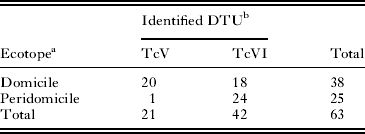
a Three bugs with unreliable information regarding collection site were excluded.
b Three bugs with mixed infections of TcV + TcVI were excluded.
DTU distribution and bloodmeal sources
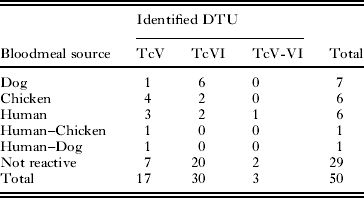
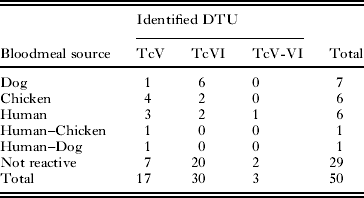
The association between identified DTUs and bloodmeal sources was investigated (Table 3). Of 50 T. infestans with identified DTUs, only 21 were ELISA-reactive. The rest of the bugs lacked bloodmeal contents on dissection and later were not reactive; all T. sordida specimens also lacked bloodmeal contents and were not tested by ELISA. Bloodmeals were identified in 10 (20%) T. infestans infected with TcV, 10 (20%) infected with TcVI, and in 1 (2%) having a mixed infection with TcV + TcVI. Bugs infected with TcV had fed mainly on chickens only (40%) and humans only (33%); one insect had fed on dog only, and 2 bugs had mixed bloodmeals on human and chicken or dog. Among 10 ELISA-reactive bugs infected with TcVI, 60% had fed on dogs only, 20% on chickens only, and 20% on humans only. The insect with a mixed TcV + TcVI infection was positive for human blood only. All human-fed bugs were captured in domiciles. Disregarding chicken bloodmeals (because they cannot be a source of T. cruzi infection) and assuming independence between each identified dog or human bloodmeal and each identified DTU (i.e., each meal and each DTU counts separately), the relative frequency of dog:human meals was not statistically associated to infection with TcV (2:6) and TcVI (6:3) (Fisher's exact test, P = 0·153).
Association between identified DTUs and bloodmeal sources of Triatoma infestans, Pampa del Indio, Chaco Province, Argentine, 2007
Comparative distribution of DTUs in the Argentine Chaco
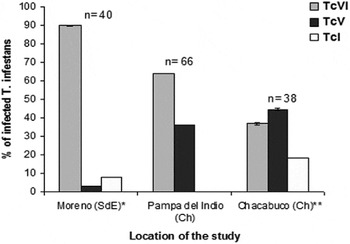
To assess the occurrence of geographical variation in the distributions of parasite DTUs in T. infestans in the Argentine Chaco, we compared the data recorded at Pampa del Indio with those recorded in the Department of Chacabuco (S.E. of Chaco Province) (Diosque et al. Reference Diosque, Barnabe, Padilla, Marco, Cardozo, Cimino, Nasser, Tibayrenc and Basombrio2003) and in the Department of Moreno (E. of Santiago del Estero Province) (Cardinal et al. Reference Cardinal, Lauricella, Ceballos, Lanati, Marcet, Levin, Kitron, Gürtler and Schijman2008) (Fig. 3). Pampa del Indio and Chacabuco lacked recent vector control actions and showed high levels of house infestation and prevalence of infection by T. cruzi both in vectors and hosts. The Moreno study area had been under sustained or more sporadic control efforts, and had low to very low levels of house infestation and prevalence of bug or host infection with T. cruzi. For statistical analysis, we included T. infestans bugs infected with TcV and TcVI, and excluded bugs with TcI to avoid having contingency tables with very sparse data. The frequency distribution of DTUs differed in a highly significant fashion between Pampa del Indio and Moreno (Fisher's exact test, P = 0·0001); in the latter almost all bugs were found infected with TcVI and the prevalence of TcV was marginal. Pampa del Indio and Chacabuco presented similar prevalence of bug infection with TcV and TcVI (Fisher's exact test, P = 0·117). TcI was detected in T. infestans from Chacabuco and Moreno but not in Pampa del Indio.
Geographical variation of Trypanosoma cruzi DTU distribution in Triatoma infestans from three study areas in the Argentine Chaco. Numbers on top of the bars represent the total number of bugs with identified DTUs.

DISCUSSION
Our study shows that at least 3 DTUs (TcI, TcV and TcVI) were present in T. infestans bugs collected in domestic or peridomestic habitats in the study area. TcVI and TcV infected domestic or peridomestic T. infestans, with predominance of TcVI. This may be the first study in which the genotypic diversity of natural populations of T. cruzi associated with triatomine bugs is studied in a carefully selected, representative sample of triatomine bugs in a well-defined area. The number of parasite samples from bugs more than doubled the size of previous studies in the Argentine Chaco (Diosque et al. Reference Diosque, Barnabe, Padilla, Marco, Cardozo, Cimino, Nasser, Tibayrenc and Basombrio2003; Marcet et al. Reference Marcet, Duffy, Cardinal, Burgos, Lauricella, Levin, Kitron, Gurtler and Schijman2006; Cardinal et al. Reference Cardinal, Lauricella, Ceballos, Lanati, Marcet, Levin, Kitron, Gürtler and Schijman2008).
A novel finding of our study is the strong association between the distribution of identified DTUs and the individual collection sites of T. infestans. Bugs infected with TcV were almost exclusively collected in human sleeping quarters, where they most likely contracted the infection, whereas TcVI-infected bugs occurred indistinctively in peridomestic or domestic ecotopes. Whether the latter might have become infected in domiciles and then dispersed to peridomestic habitats or vice versa is also uncertain. For example, in Santiago del Estero Province adult T. infestans infected with TcVI were collected with light traps while dispersing by flight most likely out of a human habitation toward peridomestic habitats (Vazquez-Prokopec et al. Reference Vazquez-Prokopec, Ceballos, Marcet, Cecere, Cardinal, Kitron and Gürtler2006; Cardinal et al. Reference Cardinal, Lauricella, Ceballos, Lanati, Marcet, Levin, Kitron, Gürtler and Schijman2008). Another possibility is that bug infections by TcVI originated in domestic and peridomestic ecotopes from dogs or cats infected with TcVI that used both habitats.
Our results do not provide sufficient evidence for the association between bloodmeal sources (dog or human) and DTUs (TcVI and TcV, respectively). Unfortunately, most of the bugs with identified DTUs lacked bloodmeal contents, and therefore the final sample size of reactive bugs was very small. A second limitation is that bloodmeal identification tests fail to detect the old bloodmeals that may have originated the detected infection (e.g., infected bugs with chicken-only bloodmeals). However, TcVI-infected bugs were more often fed on dogs than on humans whereas TcV-infected bugs tended to show the reverse pattern. These results are consistent with the important role of dogs as domestic reservoir hosts of T. cruzi in northern Argentina and probably elsewhere (Cohen and Gürtler, Reference Cohen and Gürtler2001; Gürtler et al. Reference Gürtler, Kitron, Cecere, Segura and Cohen2007a, Reference Gürtler, Cecere, Lauricella, Cardinal, Kitron and Cohenb; Cardinal et al. Reference Cardinal, Lauricella, Marcet, Orozco, Kitron and Gürtler2007, Reference Cardinal, Lauricella, Ceballos, Lanati, Marcet, Levin, Kitron, Gürtler and Schijman2008). A larger survey of blood-feeding sources of T. infestans in Pampa del Indio showed that domestic bugs fed mainly on humans followed by chickens and dogs, whereas peridomestic bugs blood-fed on dogs and chickens (Ordóñez-Krasnowski et al. unpublished results). Consistent with these patterns, most human cases throughout the Argentine Chaco have been found infected with TcV (De Luca D'Oro et al. Reference De Luca D'Oro, Gardenal, Perret, Crisci and Montamat1993; Diosque et al. Reference Diosque, Barnabe, Padilla, Marco, Cardozo, Cimino, Nasser, Tibayrenc and Basombrio2003; Cardinal et al. Reference Cardinal, Lauricella, Ceballos, Lanati, Marcet, Levin, Kitron, Gürtler and Schijman2008, Cura et al. Reference Cura, Lucero, Bisio, Oshiro, Formicelli, Burgos, Lejonas, Brusés, Hernández, Severini, Velázquez, Duffy, Anchart, Latte, Altcheh, Freilij, Diez, Nagel, Vigliano, Favaloro, Favaloro, Merino, Sosa-Estani and Schijman2011), whereas elsewhere in the Gran Chaco humans are also infected with TcI and TcII (Brenière et al. Reference Brenière, Bosseno, Noireau, Yacsik, Liegeard, Aznar and Hontebeyrie2002; Cura et al. Reference Cura, Lucero, Bisio, Oshiro, Formicelli, Burgos, Lejonas, Brusés, Hernández, Severini, Velázquez, Duffy, Anchart, Latte, Altcheh, Freilij, Diez, Nagel, Vigliano, Favaloro, Favaloro, Merino, Sosa-Estani and Schijman2011). Ongoing efforts seeking to identify DTUs from humans in Pampa del Indio could shed light on the source of infection of TcV-infected bugs.
Although frequent elsewhere in the Gran Chaco region (Bosseno et al. Reference Bosseno, Yacsik, Vargas and Brenière2000; Breniére et al. Reference Brenière, Bosseno, Noireau, Yacsik, Liegeard, Aznar and Hontebeyrie2002; Yeo et al. Reference Yeo, Lewis, Carrasco, Acosta, Llewellyn, Aldo, Vera de Costa, Rojas de Arias and Miles2007), in our study area mixed infections were rare, found only in 5% of the bugs. This could be explained by the occurrence of differential DTU selection processes during culture. However, all mixed infections with TcV + TcVI were identified from both rectal ampoule and culture samples and DTU identification was predominantly performed directly from rectal ampoule samples. Previous studies showed that initially mixed infections with TcI and TcV displayed high degrees of selection at DTU level during culture in liquid medium (Bosseno et al. Reference Bosseno, Yacsik, Vargas and Brenière2000). Groups of clones from these DTUs also presented different growth rates. TcI had a faster growth rate than TcV in LIT monophasic medium (Laurent et al. Reference Laurent, Barnabé, Quesney, Noel and Tibayrenc1997) whereas TcVI had faster growth rates than TcII in liquid medium culture (Yeo et al. Reference Yeo, Lewis, Carrasco, Acosta, Llewellyn, Aldo, Vera de Costa, Rojas de Arias and Miles2007). Our results might be explained by the fact that infections were composed by TcV and TcVI and by the type of culture medium used. Events of selection at the infra-DTU level during DNA extraction from rectal ampoules, culture or when performing PCR were not assessed and cannot be discarded (Llewellyn et al. Reference Llewellyn, Rivett-Carnac, Fitzpatrick, Lewis, Yeo, Gaunt and Miles2011).
The observed distribution of DTUs in Pampa del Indio differed significantly from that in Moreno, where TcVI predominated and TcV was rare (Cardinal et al. Reference Cardinal, Lauricella, Ceballos, Lanati, Marcet, Levin, Kitron, Gürtler and Schijman2008), and resembled the pattern recorded elsewhere in Chaco Province where TcV and TcVI presented similar frequencies (Diosque et al. Reference Diosque, Barnabe, Padilla, Marco, Cardozo, Cimino, Nasser, Tibayrenc and Basombrio2003). In areas with sustained vector control actions such as in Moreno, house infestation and prevalence levels of T. cruzi are low so domestic transmission is depressed or interrupted and human prevalence of T. cruzi declines to low levels over extended time-periods (Gürtler et al. 2007). Trypanosoma cruzi infection in the household is then focused on dogs and cats which, in the Argentine Chaco, are generally infected with TcVI (Diosque et al. Reference Diosque, Barnabe, Padilla, Marco, Cardozo, Cimino, Nasser, Tibayrenc and Basombrio2003, Reference Diosque, Padilla, Cimino, Marino Cardozo, Sanchez Negrette, Marco, Zacca, Meza, Juarez, Rojo, Rey, Corrales, Nasser and Basombrío2004; Cardinal et al. Reference Cardinal, Lauricella, Ceballos, Lanati, Marcet, Levin, Kitron, Gürtler and Schijman2008). In such context, dogs and cats would act as the primary sources of parasite infection for T. infestans and the DTUs in bugs and dogs/cats would agree as recorded by Cardinal et al. (Reference Cardinal, Castañera, Lauricella, Cecere, Ceballos, Vazquez-Prokopec, Kitron and Gürtler2006, Reference Cardinal, Lauricella, Ceballos, Lanati, Marcet, Levin, Kitron, Gürtler and Schijman2008) in Moreno.
In contrast, in areas with no regular vector control actions, higher infestation and host and bug infection levels are observed and domestic transmission is intense. In such a scenario, the possible sources of infection for T. infestans are more diverse and include TcV in humans and TcVI and TcI in dogs and cats, as in Chacabuco (Diosque et al. Reference Diosque, Barnabe, Padilla, Marco, Cardozo, Cimino, Nasser, Tibayrenc and Basombrio2003, Reference Diosque, Padilla, Cimino, Marino Cardozo, Sanchez Negrette, Marco, Zacca, Meza, Juarez, Rojo, Rey, Corrales, Nasser and Basombrío2004). The epidemiological background of Pampa del Indio and Chacabuco were similar, with no recent history of vector control interventions. TcI was identified in both areas infecting D. albiventris opossums (Diosque et al. Reference Diosque, Barnabe, Padilla, Marco, Cardozo, Cimino, Nasser, Tibayrenc and Basombrio2003; Alvarado Otegui et al. Reference Alvarado-Otegui, Ceballos, Orozco, Enriquez, Cardinal, Schiman, Kitron and Gürtler2012). TcI was also detected in T. infestans and dogs in Chacabuco, whereas in Pampa del Indio it was only found in 3 adult specimens of T. sordida despite a large sampling effort of bugs and hosts.
Our study also shows that T. sordida may have been partially implicated in local domestic transmission cycles, as suggested by the finding of TcV and TcVI in 5 specimens collected in peridomestic or domestic habitats. To our knowledge, this is the first such finding in Argentina. However, previous studies in Bolivia suggested that T. sordida posed a low risk of human infection with T. cruzi, with transmission mostly confined to synanthropic mammals (Noireau et al. Reference Noireau, Brenière, Ordoñez, Cardozo, Morochi, Gutierrez, Bosseno, Garcia, Vargas, Yaksic, Dujardin, Peredo and Wisnivesky-Colli1997). Experimental studies showed that the vector competence of T. sordida may lag behind that from other vector species such as T. guasayana (Loza-Murguía and Noireau, Reference Loza-Murguía and Noireau2010); thus the role of this species as a putative domestic vector still needs clarification.
Three adult T. sordida captured in peridomestic habitats associated with chickens were infected with TcI. So far, TcI has only been detected in local D. albiventris opossums trapped in sylvatic habitats (Alvarado-Otegui et al. Reference Alvarado-Otegui, Ceballos, Orozco, Enriquez, Cardinal, Schiman, Kitron and Gürtler2012). Didelphis opossums have been found infected almost exclusively with TcI throughout the Americas (Wisnivesky-Colli et al. Reference Wisnivesky-Colli, Schweigmann, Alberti, Pietrokovsky, Conti, Montoya, Riarte and Rivas1992; Diotaiuti et al. Reference Diotaiuti, Pereira, Loiola, Fernandes, Schofield, Dujardin, Dias and Chiari1995; Diosque et al. Reference Diosque, Barnabe, Padilla, Marco, Cardozo, Cimino, Nasser, Tibayrenc and Basombrio2003; Yeo et al. Reference Yeo, Acosta, Llewellyn, Sánchez, Adamson, Miles, López, González, Patterson, Gaunt, Rojas de Arias and Miles2005; Ceballos et al. Reference Ceballos, Cardinal, Vazquez-Prokopec, Lauricella, Orozco, Cortinas, Schijman, Levin, Kitron and Gürtler2006; Alvarado Otegui et al. Reference Alvarado-Otegui, Ceballos, Orozco, Enriquez, Cardinal, Schiman, Kitron and Gürtler2012). The absence of TcI in local T. infestans, domestic dogs and cats (Enríquez et al. unpublished results), combined with the ability of adult T. sordida to disperse by flight (Schofield et al. Reference Schofield, Lehane, McEwan, Catalá and Gorla1991), suggests that the TcI-infected T. sordida may have become infected from opossums and then invaded peridomestic habitats. However, it is uncertain whether parasite transmission events occurred at the bugs' collection sites or elsewhere in the forest, given that opossums frequently approach human dwellings and may serve as a bridge host between sylvatic and domestic habitats (Diotaiuti et al. Reference Diotaiuti, Pereira, Loiola, Fernandes, Schofield, Dujardin, Dias and Chiari1995; Schweigmann et al. Reference Schweigmann, Pietrokovsky, Bottazzi, Conti, Bujas and Wisnivesky-Colli1999). The available evidence suggests that T. sordida may be a local sylvatic vector of TcI associated with D. albiventris. The use of microsatellite markers and RFLP-PCR to assess the genetic diversity of TcI in local T. sordida and D. albiventris may shed light on these putative associations.
ACKNOWLEDGEMENTS
The authors are grateful to Julián Alvarado-Otegui, Sol Gaspe, Juan Gurevitz and Leonardo Ceballos for field and laboratory assistance. To Gustavo Enríquez, Fernando Garelli, Sol Gaspe, Juan Gurevitz, Yael Provecho, Marcela Orozco, Jimena Gronzo, Marina Leporace, Carla Cecere and Romina Piccinali for valuable comments during the study. To the villagers of Pampa del Indio, for kindly welcoming us into their homes and cooperating with the investigation. Reference strains of TcI-TcVI were kindly provided by Patricio Diosque, Miguel A. Basombrío and Michel Tibayrenc to A.G.S.
FINANCIAL SUPPORT
This study received financial support from the International Development Research Center (EcoHealth Program); the UNICEF/UNDP/World Bank/WHO Special Programme for Research and Training in Tropical Diseases (TDR); the National Institutes of Health/National Science Foundation Ecology of Infectious Disease program award R01 TW05836 funded by the Fogarty International Center and the National Institute of Environmental Health Sciences (to Uriel Kitron and R.E.G.), and University of Buenos Aires. R.E.G., M.V.C. and A.G.S. are members of CONICET Researcher's Career.