The global population is experiencing a significant demographic shift, with the number of individuals aged 60 years or over projected to exceed 2 billion by 2050(1). This ageing trend is closely linked with metabolic dysregulation, which often manifests as obesity, prediabetes, insulin resistance and related health challenges. Ageing and metabolic disturbances are associated with cognitive and motor deficits. Excess adiposity further exacerbates these age-related changes by promoting chronic low-grade inflammation, driven by increased secretion of pro-inflammatory cytokines, thereby compounding metabolic and cognitive vulnerabilities(Reference Nguyen, Killcross and Jenkins2). Collectively, these factors highlight the critical need for research into strategies that promote healthy ageing(Reference Spencer, Korosi and Layé3).
Diet influences the risk of metabolic diseases and cognitive decline throughout ageing(Reference Zhang, Ma and Luo4,Reference Mayans5) . The typical Western diet, high in refined carbohydrates and fat, induces postprandial hyperglycaemia and hyperlipidaemia, oxidative stress, inflammation, impaired insulin action(Reference Burton-Freeman6) and cognitive impairment(Reference Burton-Freeman6,Reference López-Taboada, González-Pardo and Conejo7) . Exaggerated postprandial metabolic responses increase the risk of diabetes and CVD(Reference Pappas, Kandaraki and Tsirona8,Reference O’Keefe and Bell9) . Alternatives to the Western diet, such as the Mediterranean or Dietary Approaches to Stop Hypertension (DASH) diet, reduce the risk of CVD(Reference Papadaki, Nolen-Doerr and Mantzoros10) and type 2 diabetes(Reference Liese, Nichols and Sun11). The MIND (Mediterranean–DASH Intervention for Neurodegenerative Delay) diet, which emphasises green leafy vegetables and berries, has been suggested to be associated with slower cognitive decline and reduced risk of Alzheimer’s disease(Reference Sawyer, Blair and Shatz12,Reference Barnes, Dhana and Liu13) . These dietary patterns include a variety of colourful fruits and vegetables, which are abundant in polyphenols, compounds known for their antioxidant and anti-inflammatory properties(Reference Shukitt-Hale14). Consuming polyphenolic-rich foods may help delay or even reverse age-related neuronal deficits caused by neuroinflammation(Reference Miller and Shukitt-Hale15,Reference Poulose, Carey and Shukitt-Hale16) .
Polyphenol-rich berry fruits, like strawberries and blueberries, have shown beneficial effects on markers of oxidative stress(Reference Burton-Freeman, Linares and Hyson17,Reference Basu, Rhone and Lyons18) inflammation(Reference Edirisinghe, Banaszewski and Cappozzo19,Reference Zunino, Parelman and Freytag20) , vascular function(Reference Huang, Xiao and Zhang21) and cognition(Reference Dodd, Williams and Butler22,Reference Wood, Hein and Mesnage23) . Studies have demonstrated that berry-derived polyphenols improve specific cognitive domains, including measures of executive function, memory, processing speed and psychomotor speed(Reference Delaney, Tsang and Kern24–Reference Travica, D’Cunha and Naumovski27). Red raspberries (RRB; Rubus idaeus), also rich in polyphenols such as anthocyanins, ellagitannins and phenolic acids, play a role in glucose homeostasis(Reference Wedick, Pan and Cassidy28,Reference Kurotobi, Fukuhara and Inage29) . Their fibre content may further aid glycaemic control(Reference Silva, Kramer and de Almeida30). RRB polyphenols and their metabolites are detectable and quantifiable in plasma within hours of consumption(Reference Zhang, Sandhu and Edirisinghe31) and may help reduce the insulin demand to manage glucose homeostasis in individuals with insulin resistance(Reference Xiao, Zhu and Edirisinghe32). Animal models demonstrate that RRB mitigate high-energy and high-fat diet-mediated effects on brain function and improves motor function in aged rats(Reference Galli, Carey and Luskin33,Reference Carey, Pintea and Van Leuven34) . RRB exhibit anti-inflammatory properties(Reference Jean-Gilles, Li and Ma35) and may enhance insulin sensitivity and metabolic control and improve cognitive function.
In this pilot study, we aimed to investigate the effects of RRB intake on cognitive function following a meal challenge containing a high-carbohydrate, moderate-fat meal (56 % carbohydrate, 33 % fat and 11 % protein), in older adults with overweight or obesity. This work derives from knowledge that dysmetabolism and pro-inflammatory states negatively impact cognitive function, and minimising the metabolic and inflammatory disturbance induced by a nutrient-rich mixed meal could lead to enhanced cognitive function. Further, polyphenol-rich foods can attenuate the postprandial metabo-inflammatory burden and improve peripheral vascular reactivity, a proxy for cerebral blood flow, with downstream relevance for cognition(Reference Rendeiro, Rhodes and Spencer36). Accordingly, we hypothesised that reducing the meal-induced metabo–inflammatory burden by RRB would favourably influence vascular and cognitive outcomes.
Methods
Study design
This study was approved by the Institutional Review Board of Illinois Institute of Technology and Tufts Health Sciences’ Institutional Review Board. The study was conducted in compliance with the Declaration of Helsinki and Good Clinical Practice and was registered at ClinicalTrials.gov (NCT03879213, NCT03743792). All subjects provided written informed consent before initiation of any study procedures. The study was conducted from September 2018 to August 2019 in Chicago, IL, and January 2019 to March 2020 in Boston, MA, USA. The study faced disruptions due to the COVID-19 pandemic and associated public health policies. The study was shut down in March 2020 by Tufts University, which ultimately necessitated an early termination of recruitment at the Human Nutrition Research Center on Aging (HNRCA) at Tufts University before reaching our intended enrolment target.
This study was a two-centred, randomised, single-blinded, two-arm, controlled, within-subject crossover design using a repeated postprandial sampling paradigm (Figure 1). Eligible participants completed two study day visits consuming either a high-carbohydrate, moderate-fat (HCMF) breakfast meal with or without 25 g of freeze-dried RRB powder. A 7-d washout period separated visits. Participants adhered to a limited polyphenolic diet throughout the duration of their participation. More strict guidelines were imposed a week prior to a study day visit, including to avoid berries and berry-containing products for 7 d, as well as alcohol, caffeine, dark chocolate and cocoa-containing products for 24 h before each visit. The participants were asked not to take any allergy medications and/or any pain medications (non-steroidal anti-inflammatory drugs) within 48 h of each scheduled study day. Dietary and physical activity patterns were otherwise maintained as usual. Specifically, participants were instructed to maintain their habitual activity levels throughout the study and to avoid vigorous physical activity for at least 24 h prior to each test day. They documented the type and duration of daily exercise for the 3 d preceding each study visit, and compliance was reviewed by study staff prior to initiating procedures. A low-polyphenol standardised dinner meal was provided on the day before each study day visit. The standardised dinner meal consisted of either a meal prepared by the Clinical Nutrition Research Center (CNRC)/HNRCA, a pre-specified sandwich from a local sandwich shop (e.g. Jimmy John’s) or a home-prepared dinner discussed and approved by the research team to ensure nutritional consistency and minimal polyphenol exposure. In practice, most participants selected the sandwich option and consumed the same sandwich type and portion size the evening before both study days, ensuring within-subject consistency across visits. On each study day visit, participants arrived at the study site in the morning in a well-hydrated (water only), fasting state (10–12 h, confirmed by finger stick). After assessing study day readiness based on protocol compliance (i.e. dietary restrictions and fasting), an intravenous catheter was placed in subjects’ non-dominant arm by a licensed healthcare professional and a fasting/baseline blood sample was collected (–2 h), followed by the vascular and cognitive assessments. After baseline testing was completed, participants were provided HCMF breakfast to finish within 15 min (min), based on a coded randomisation sequence provided by a biostatistician. Starting from the beginning time of the breakfast meal intake (T0), subsequent blood samples were collected at 0·5, 1, 2, 4, 5, 6 and 7·5 h. Vascular assessments were performed at 1 h 40 min and 5 h. Cognitive assessments were completed at 2 and 6 h. A standardised low-polyphenolic snack was provided after the 6-h cognitive assessment (at about 7 h to finish within 20 min). After the 7·5 h blood collection, the catheter was removed and subjects were evaluated for safety before leaving the study site. During the entire testing period, participants consumed water ad libitum and were allowed to use a computer or tablet, read and watch television.
Study design. Schematic of the randomised, controlled, crossover trial. Participants underwent a 7-d wash-in period followed by two study days with a 7-d washout in between. On study days, participants consumed either a high-carbohydrate, moderate-fat (HCMF) meal with 25 g freeze-dried red raspberry powder (RRB meal) or the control meal. Blood sampling, cognitive testing and flow-mediated dilation (FMD) assessments were performed at specified time points. ClinicalTrials.gov IDs: NCT03879213 and NCT03743792. All the procedures in this protocol were approved by Institutional Review Boards at Illinois Institute of Technology, Chicago, IL, USA, and Tufts Health Sciences’ Institutional Review Board.

Study participants
Forty-two healthy men and women were recruited and screened for participation at the CNRC at Illinois Tech or the HNRCA at Tufts University (Figure 2). To be eligible for the study, participants were required to be between the ages of 55 and 70 years, have a BMI between 27 and 35 kg/m2 and meet the general eligibility criteria. General eligibility criteria were being a non-smoker and not taking any medications that would interfere with outcomes of the study, that is, lipid-lowering, anti-inflammatory, or glucose-interfering medications or dietary supplements. Individuals were excluded if they were athletes or engaged in regular strenuous exercise, had an allergy or intolerance to berries, consumed > 2 servings of berries per day, and had documented atherosclerotic disease, inflammatory disease, gastrointestinal or kidney disease, diabetes mellitus or other systemic diseases. Participants who had psychological or psychiatric disorders, an on-site screening Mini Mental Status Exam score < 24(Reference Folstein, Folstein and McHugh37) or Beck Depression Inventory score > 20(Reference Steer, Rissmiller and Beck38), or recent surgery or injury to the head were not eligible for the study.
Consolidated Standards of Reporting Trials (CONSORT) flow diagram of the study. CNRC, Clinical Nutrition Research Center; HNRCA, Human Nutrition Research Center on Aging; HCMF, high carbohydrate moderate fat; FMD, flow-mediated vasodilation.

Study foods and interventions
Foods consumed during the study day visits were either the HCMF meal with RRB (RRB meal) or the HCMF meal without RRB (control meal) for breakfast followed by a low-polyphenol snack (plain bagel and cream cheese) approximately 7 h later. The HCMF meals contained buttermilk biscuits with butter and apple jelly, scrambled egg whites and a side drink. The recipe of the meals is provided in online Supplementary Table 1. The RRB meal consisted of 25 g of freeze-dried RRB powder (equivalent to 1 cup of fresh RRB), with half mixed into the side drink and the other half blended into the apple jelly. The control meal contained a colour- and flavour-matched side drink without RRB powder and apple jelly without added RRB powder. The nutrient composition of meals is shown in Table 1.
Nutrient composition * of HCMF meals (drink and breakfast) served on test days

HCMF, high carbohydrate moderate fat.
* Nutrients were analysed using Food Processor Pro SQL Edition by ESHA (version 10.15.41 ESHA Research). Full recipe is provided in the online Supplementary material.
† Value derived from analysis of freeze-dried red raspberry powder contained in the meal.
Subjects consumed a fixed dinner meal the night before each study day. One of three dinner meals was offered before all visits: homemade dinner, Jimmy John’s or Subway, or CNRC dinner (based on subjects’ energy requirements). To ensure consistency, subjects selected a meal they could replicate before each clinic visit, which was verified before each visit day of assessments.
Study procedures
Motor function and cognitive assessment
A battery of validated tests was administered according to standardised guidelines provided by the test developers. The test battery was specifically selected to cover key cognitive domains, including complex attention, executive function, learning and memory, and perceptual motor function. The Profile of Mood States is a questionnaire commonly used to determine the overall mood state of study participants(Reference Shahid, Wilkinson and Marcu39).
The Digit Symbol Coding from the Wechsler Adult Intelligence Scale-Third Edition (WAIS-III) (Reference Wechsler40) assesses psychomotor speed. Participants are provided with a key containing nine numbers, each paired with a unique symbol. Using the key, they are instructed to draw the corresponding symbols under the appropriate numbers on a response sheet as quickly and accurately as possible within a 120-s time limit. The score is determined by the number of symbols correctly drawn during the allotted time.
The Grooved Pegboard Test (Lafayette Instruments #32025), a test of finger dexterity, was used to assess finger dexterity, eye–hand coordination and motor(Reference Ashendorf, Vanderslice-Barr and McCaffrey41,Reference Bowden and McNulty42) . The test requires participants to manipulate twenty-five keyhole-shaped pegs, one at a time, and insert them into matching holes on a 5-by-5 grid with varying slot orientations. Each peg must be rotated to align the groove with the corresponding slot while working row by row in a specific direction. The dominant hand is tested first, followed by the non-dominant hand. Participants are instructed to use only one hand and to pick up one peg at a time. If a peg is dropped, it is not allowed to be picked up during the trial; instead, the test continues using another peg. Completion time and drops for each hand are recorded.
The Hopkins Verbal Learning Test Revised (HVLT-R)(Reference Benedict, Schretlen and Groninger43) is an extension of the HVLT test to assess verbal learning and memory(Reference Brandt44). The HVLT-R consists of a list of twelve nouns, with four words drawn from each of three semantic categories. Participants are asked to read the list at a rate of one word for every 2 s and then asked to freely recall as many words as possible, in any order. The initial recall trial is repeated twice, yielding a total immediate recall score ranging from 0 to 36, with no penalty for repeated words. The delayed recall trial is administered 20–25 min later, after participants complete unrelated non-verbal tasks (CANTAB (Cambridge Neuropsychological Test Automated Battery) tests). During this trial, participants are asked to recall the same list of words without prior re-presentation. Following delayed recall, a delayed recognition trial is conducted, where participants are asked to read a list of twenty-four words: twelve target words from the original list and twelve distractors (false positives), half of which are semantically related to the target list and half are unrelated. Participants must identify whether each word was part of the original list. To minimise practice effects, all six equivalent forms of the HVLT-R are used, with each participant completing a different form at each testing time point.
CANTAB Paired Associates Learning (PAL) task. This task evaluates visual memory and associative learning. Onscreen boxes are presented and opened in a randomised sequence, with certain boxes containing patterns. Subsequently, the patterns are shown individually at the centre of the screen, and participants are tasked with selecting the box where each pattern was initially found. If the participant makes a mistake, the boxes are reopened to aid in pattern recall, continuing until the participant correctly identifies the locations. The primary outcome measures include the total number of attempts to locate all patterns and the total number of errors made to completion.
CANTAB Spatial Working Memory (SWM) task. This task evaluates the ability to retain spatial information and manipulate remembered items in working memory. Participants are shown multiple squares on the screen and tasked with locating yellow tokens. Each time a token is found, the participant continues searching for the next yellow token; however, no token is hidden twice in the same box. This process is repeated until all the yellow tokens are located. Primary outcome measures include between-search errors (the number of times the subject revisits a box where a token had been located before), total errors and search strategy for both six and eight tokens. Search strategy is the number of times when a subject initiates a new search pattern from the box they previously started with. If the subject consistently starts their search from the same point, it implies the use of a deliberate strategy to find the token. As a result, a low score implies a high level of strategy implementation (e.g. always initiating the search from the same box), while a high score indicates a greater variation in the starting point of their search (i.e. beginning the search from multiple different boxes).
CANTAB Rapid Visual Processing (RVP) task. The RVP is a 10-min test which measures sustained attention. A white box is displayed in the centre of the screen, in which digits 2–9 are rapidly presented at 100 digits per minute. Participants are required to detect target sequences (e.g. 2–4–7, 3–5–7 or 4–6–8) and respond to this target sequence as quickly as possible. The primary outcome measure includes A prime (A′), which represents the subject’s ability to detect target sequences and which reflects the subject’s sensitivity to the target sequence (a string of three numbers), regardless of their response tendency. The expected range for this measure is 0·00 to 1·00, where lower values indicate poorer performance and higher values indicate better performance.
The order of test sequences remained constant across the two visits. CANTAB data were electronically collected and processed. The outcome variables selected for each CANTAB test were based on their sensitivity to detect changes in ageing and nutrition(Reference Mustra Rakic, Tanprasertsuk and Scott45,Reference Cheatham, Canipe and Millsap46) and the demonstrated sensitivity of the tests and outcome variables in healthy older subjects(Reference Yurko-Mauro, McCarthy and Rom47).
Blood analyses
Plasma samples
Blood samples were collected in vacutainers spray-coated with EDTA, immediately placed on ice and centrifuged at 453 g for 15 min at 4°C within 1 h of collection. After centrifugation, plasma was aliquoted into individual cryovials and stored at –80°C until analysis.
Plasma analyses
Analyses of plasma glucose, insulin and triacylglyceride (TAG) were assessed at all time points in all subjects using a Randox Daytona automated clinical analyser (Randox Laboratories) by the enzymatic colorimetric method with appropriate standards and quality controls. IL-6 in plasma samples was measured using high-sensitive ELISA assay methods (cat. HS 600B; R&D Systems). Tests were performed according to the manufacturer’s protocols, and appropriate quality controls suggested by the manufacturers were used in all assays. Intra- and interassay percent CV were < 10 % in all the assays.
Serum samples
Blood samples were collected in serum separation tubes for cell culture studies. To obtain serum, tubes were placed upright to allow blood to clot for 30 min at room temperature and centrifuged for 15 min at 575 g within 1 h of collection. After centrifugation, serum was aliquoted into individual cryovials and stored at −80°C for cell culture studies.
Microglial neuroinflammation assay
Serum and cell culture
Highly aggressively proliferating immortalised (HAPI) rat microglial cells (generously provided by Dr Grace Sun, University of Missouri) were cultured in Dulbecco’s modified Eagle’s medium (DMEM, Invitrogen) with 10 % fetal bovine serum, 100 U/ml penicillin and 100 µg/ml streptomycin. Cells were maintained at 37°C in a humidified incubator with 5 % CO2. Cells were maintained in 100 mm plates and later transferred to twelve-well plates for treatment. For the experiments, cells were placed in serum-free DMEM without phenol red. The serum collected from subjects was then substituted for fetal bovine serum at a concentration of 10 % for 8 h and used to pretreat HAPI cells; the media was then removed before stimulation with lipopolysaccharide (LPS, Sigma-Aldrich) at 200 ng/mL overnight.
Nitrite quantification
The production of nitric oxide (NO) by LPS-treated HAPI cells was evaluated by measuring extracellular nitrite (NO2-) levels using the Greiss reagent (Invitrogen), following the manufacturer’s protocol and the method described previously(Reference Cahoon, Fisher and Lamon-Fava48). Absorbance was measured at 548 nm, and nitrite concentration was calculated using the standard curve derived from known nitrite concentrations.
Western blots
Following experimental treatments, cells were washed with ice-cold PBS, resuspended and lysed by agitation in CelLytic-M Cell Lysis Reagent (Sigma-Aldrich) containing phenylmethylsulfonylfluoride (10 µg/mL). The lysate was then centrifuged at 18 000 g for 10 min at 4°C to obtain the supernatant. Western blotting was performed as previously described(Reference Rutledge, Fisher and Miller49). Primary antibodies for inducible nitric oxide synthase (iNOS) (Millipore) and cyclo-oxygenase-2 (COX-2) (Santa Cruz) were used at 1:1000 dilutions and incubated overnight at 4°C. Glyceraldehyde 3-phosphate dehydrogenase (Santa Cruz) was used as a protein loading control marker. Detection was carried out using an enhanced chemiluminescence kit (Bio-Rad). The optical density of antibody-specific bands was analysed using VisionWorks LS image acquisition and analysis software (UVP). Values were normalised to glyceraldehyde 3-phosphate dehydrogenase protein levels.
Vascular assessments
Flow-mediated vasodilation (FMD) at Illinois Tech CNRC and near-infrared spectroscopy at Tufts were planned. Due to instrument issues and sample size limitations, the near-infrared spectroscopy data are not available and only the FMD data are reported.
Ultrasound measures of the diameter and flow-mediated vasodilation
The brachial artery FMD was measured by a single well-trained researcher using a high-resolution B-mode ultrasound system (GE LOGIQ e) following standardised methods recommended by the American College of Cardiology(Reference Corretti, Anderson and Benjamin50) with minor modifications. Briefly, the brachial artery above the elbow of the non-catheter arm was scanned in a longitudinal section after 15 min of rest, and the diameters of the brachial artery (mm) were measured at rest (pre-occlusion baseline). A blood pressure cuff was applied below the elbow and inflated to 220 mm Hg to occlude blood flow for 5 min. Immediately after cuff deflation, brachial artery vessel images (post-occlusion) were collected every 5 s for 2 min, and vessel diameters were measured to obtain the peak vessel relaxation. Vessel diameters were manually assessed using visual inspection of single frames and placement of ultrasonic callipers at discrete points along the long axis of the B-mode image(Reference Celermajer, Sorensen and Gooch51). FMD is expressed as the percent change in arterial diameter pre- and post-occlusion (FMD%). Ultrasound procedures were performed in a quiet, dimmed-light, temperature-controlled room. All brachial artery FMD measurements and manual vessel diameter assessments were performed by the same experienced researcher to ensure consistency. The researcher was blinded to the treatment condition during image acquisition and diameter measurement.
Statistical analysis
Randomisation schedules and data analyses were performed using PC-SAS (SAS version 9.3; SAS Institute Inc.). As this was a proof-of-concept/exploratory study, no formal power calculation was performed for sample size with cognition as the primary endpoint. Instead, prior berry research, including testing RRB effects on metabolic endpoints, was used to guide sample size estimates(Reference Xiao, Zhu and Edirisinghe32). Considering the comparison between raspberry intake v. control and mean differences in the insulin-integrated responses of 8 uIU/mL with an sd of 11, a minimum of eighteen participants would be needed per site to provide 80 % power to detect a significant difference, assuming possible site differences and independent analyses. Allowing for additional variance in cognitive tests and 20 % attrition, twenty-five individuals per site were planned for recruitment.
Analyses were performed blinded, and normality tests were performed prior to all analyses. Data not conforming to normal distribution patterns based on the Shapiro–Wilks test were log-transformed and indicated accordingly. Anthropometric data obtained at screening (height, weight, waist and body composition) were used for subject characteristics. Mixed-model repeated-measures ANOVA (RM-ANOVA) was used to test the main effects of intervention (control meal and raspberry meal), time (hour) and time-by-meal interactions. Potential covariates, including demographic and study-related variables (e.g. baseline values, sequence, study site, age, sex and BMI), were initially included in the models. Variables that were not statistically significant and did not alter the meal-related effects were removed from the final models to improve model parsimony. Post hoc comparisons were adjusted for multiple comparisons using Tukey when the main effects were significant (P < 0·05). Evaluable datasets for analyses included time point values (0–7·5 h) for each subject’s measured plasma glucose, insulin, TAG and IL-6 (n 29 for all measures, due to one participant experiencing catheter difficulties that prevented complete sample collection), FMD (n 30) and test score responses in motor function and cognitive assessments (n 36). Postprandial responses as areas under the response curves (AUC) and incremental areas under the curve (iAUC) were calculated from evaluable datasets using the linear trapezoidal method(Reference Johan and Daniel52). A P value of < 0·05 was considered significant after accounting for multiple comparisons and significant covariates. For 0–6 h inflammatory indices (nitrite, iNOS and COX2) in serum (n 36), the data were analysed by RM-ANOVA (raw values) as well as ANOVA for % change from baseline to test for statistical significance at a level of P < 0·05 using Systat (SPSS, Inc.). Post hoc comparisons were performed using Fisher’s least significant difference (LSD) test to determine differences among groups.
Results
Subject demographics
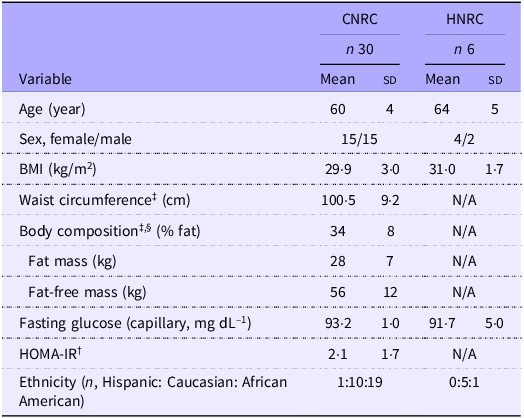
Participants were recruited from two research centres. A total of forty-two subjects passed the prescreening questionnaire and were invited for on-site screening. From these, thirty-six participants passed the on-site screening and were enrolled in the study (Figure 2). The mean age and BMI of participants were 61 (sd 5) years and 30·0 (sd 2·8) kg/m2, respectively. Participant characteristics are listed in Table 2. No adverse events related to meals were reported during the study.
Subject demographic characteristics at screening visit *

CNRC, Clinical Nutrition Research Center; HNRC, Human Nutrition Research Center on Aging.
* Data are mean and standard deviation.
† Homeostatic Model Assessment of Insulin Resistance (HOMA-IR) = fasting glucose × fasting insulin concentration/405, value obtained from fasting plasma sample on study day visit.
‡ Body composition and waist circumference were not measured at the HNRC site due to differences in site-specific standard screening procedures and lack of access to the body composition analyser at that location.
§ Body composition was obtained by Segmental Body Composition Analyzer, Tanita Corp.
Motor function and cognitive assessment
CANTAB Paired Associates Learning
Visual memory and associative learning (CANTAB-PAL) were assessed before and at post-meal time points using onscreen boxes presented and opened in random sequence, with certain boxes containing patterns. The total number of attempts to locate all patterns during the eight-shape level did not differ by meal (P > 0·05); however, a significant meal-by-time interaction (P = 0·01) was observed, suggesting fewer attempts were required to locate all eight shapes at 2 h post-RRB meal compared with the control meal (2·4 (se 0·2) v. 3·0 (se 0·2), P = 0·04, Figure 3(a)). When analysing attempts across all levels (2, 4, 6 and 8 shapes), the meal-by-time interaction approached significance (P = 0·06). Post hoc analysis showed significantly fewer total number of attempts to completion at 6 h after the RRB meal compared with control (7·5 (se 0·3) v. 8·3 (se 0·3), P < 0·05, Figure 3(b)). For the total error analysis across all levels, no significant effects of meal, time or meal-by-time interaction were observed (Figure 3(c)). These results suggest that while RRB supplementation did not influence overall error rates, it decreased the number of attempts to completion, particularly in the most demanding level (eight shapes), and these effects coincide with time points at which polyphenol metabolites are elevated(Reference Zhang, Fan and Xiao53).
CANTAB Paired Associates Learning (PAL) results before and after intake of the breakfast meal containing 0 g (Ctrl) or 25 g of freeze-dried red raspberry powder (RRB). n 36. (a) Number of attempts required to locate patterns during the eight-pattern level. (b) Total number of attempts across all levels (2, 4, 6 and 8 patterns combined). (c) Total errors (adjusted) across all levels. Data are means (se). *Significant differences between meals at specific time points (P < 0·05). CANTAB, Cambridge Neuropsychological Test Automated Battery.

CANTAB Spatial Working Memory
The SWM task evaluates the ability to retain spatial information and manipulate remembered items in working memory. Participants are shown multiple squares on the screen and tasked with locating yellow tokens as described in the methods. The primary outcome measures include between-search errors, total errors and search strategy (lower values are better). Evaluating only the more demanding task levels (6–8 tokens levels), there is no overall effect of a meal in between-search errors, total errors or strategy (P > 0·05). However, a meal-by-time interaction (P < 0·05) showed fewer between-search errors at the eight-token level (Figure 4(a): 6·9 (se 1·2) v. 9·5 (se 1·2), P < 0·05, respectively), fewer total errors (Figure 4(b): 7·0 (se 0·9) v. 9·9 (se 0·9), P < 0·05, respectively) at the eight-token level and better strategy (Figure 4(c): 6·3 (se 0·3) v. 7·2 (se 0·3) P < 0·05, respectively) after the RRB meal compared with control at 6 h.
CANTAB Spatial Working Memory (SWM) results before and after intake of the breakfast meal containing 0 g (Ctrl) or 25 g of freeze-dried red raspberry powder (RRB). n 36. (a) Between errors at the eight-box level. (b) Total errors at the eight-box level. (c) Strategy use at the 6–8 box level. Data are means (se). *Significant differences between meals at specific time points (P < 0·05). CANTAB, Cambridge Neuropsychological Test Automated Battery.

Digit Symbol Coding, Grooved Pegboard Test, Hopkins Verbal Learning Test and CANTAB Rapid Visual Processing
RM-ANOVA revealed no significant effects of meal, time or meal-by-time interaction on the Digit Symbol Coding task, Grooved Pegboard Test, the HVLT or the CANTAB RVP task (data shown in online Supplementary materials).
Postprandial metabolic and inflammation marker responses
Glucose
Glucose increased after both meals (time effect, P < 0·0001); however, a significant meal-by-time interaction (P = 0·0025) indicated the time response curves were influenced by the meals consumed. Peak glucose concentrations were significantly reduced by approximately 8 % at 0·5 h following the raspberry meal compared with the control meal (P < 0·05). Additionally, the raspberry meal attenuated glycaemic dips below baseline observed in the control meal condition at 4 h (Figure 5(a), 107·6 (se 4·6) v. 96·2 (se 4·1) mg/dL, P = 0·039). The postprandial glucose AUC were not different between meals (P > 0·05).
Postprandial metabolic and inflammatory responses before and after intake of the breakfast meal containing 0 g (Ctrl) or 25 g of freeze-dried red raspberry powder (RRB). n 29. a) Plasma glucose concentrations (mg/dL), (b) plasma insulin concentrations (µU/mL), (c) plasma TAG concentrations (mg/dL) and (d) plasma IL-6 concentrations (pg/mL). Data are means (se). *Significant differences between meals at specific time points (P < 0·05).

Insulin
Similar to glucose, postprandial insulin concentrations increased after both meals (time effect, P < 0·0001) with a significant meal-by-time interaction (P = 0·018). At 0·5 h post-meal, insulin concentration was significantly lower following the RRB meal compared with the control meal (P < 0·05), as indicated in Figure 5(b). Peak insulin concentrations were significantly lower following the raspberry meal compared with the control meal (P < 0·05). Moreover, including raspberry in the meal led to an overall 30 % reduction in postprandial insulin total AUC (P = 0·03) and baseline-corrected AUC (P < 0·05).
TAG and IL-6
No statistical differences were observed in postprandial TAG concentrations between meals (Figure 5(c)). The postprandial TAG AUC did not differ between meals (P > 0·05). IL-6 increased after both meals (time effect, P < 0·0001) with no significant meal-by-time interaction. Interestingly, IL-6 concentrations were numerically lower in the RRB group at 5 h (5·8 (se 0·7) pg/mL) compared with control (7·3 (se 0·7) pg/mL; Figure 5(d)), suggesting a potential signal that may merit further investigation. The postprandial IL-6 AUC did not differ between meals (P > 0·05).
Neuroinflammation
Nitrite (NO2-) is a stable breakdown product of free radical NO and a well-known indicator of microglia activation. Serum from raspberry-supplemented older adults attenuated LPS-induced NO production in HAPI microglial cells, as shown by a significant time-by-meal interaction in an RM-ANOVA (P < 0·001) (Figure 6(a)). An analysis of percent change from baseline showed a significant meal effect (P < 0·001), and post hoc testing showed that nitrite measured at 2 and 6 h in the raspberry group was lower than the control but not different from each other (Figure 6(b)).
Effects of postprandial serum from older adults consuming a red raspberry (RRB) or control (Ctrl) meal on inflammatory markers in a microglial cell model. Serum samples collected at 0, 2 and 6 h post-meal were applied to HAPI microglial cells, and levels of (a) nitrite concentrations (µM), (b) percent change in nitrite concentrations from baseline, (c) relative band density of inducible nitric oxide synthase (iNOS) protein expression, (d) percent change in iNOS expression from baseline, (e) relative band density of cyclo-oxygenase-2 (COX-2) protein expression and (f) percent change in COX-2 expression from baseline were assessed. Data are means (se). *Significant differences between RRB and control meals at specific time points (P < 0·05); #Significant difference between 2-h and 6-h time points within the RRB meal condition.

iNOS is responsible for producing NO as a defence mechanism against cell stress. Serum from raspberry-supplemented older adults reduced LPS-induced expression of iNOS in HAPI microglial cells, as shown by a significant time-by-meal interaction in an RM-ANOVA (P < 0·05) (Figure 6(c)). An analysis of percent change from baseline showed a significant meal effect (P < 0·001), and post hoc testing showed that iNOS measured at 2 and 6 h in the raspberry group was lower than the control, with 2 h being significantly lower than 6 h as well (Figure 6(d)).
COX-2 is an enzyme induced by cell stressors and produces inflammatory mediators. Serum from raspberry-supplemented older adults reduced LPS-induced expression of COX-2 in HAPI microglial cells, as shown by a significant time-by-meal interaction in an RM-ANOVA (P < 0·001) (Figure 6(e)). An analysis of percent change from baseline showed a significant meal effect (P < 0·001), and post hoc testing showed that COX-2 measured at 2 and 6 h in the raspberry group was lower than the control, with no difference between 2 and 6 h (Figure 6(f)).
Flow-mediated vasodilation
There was no significant effect of meal, time or meal-by-time interaction on endothelial function as measured by percent flow-mediated dilation (FMD). However, %FMD at 5 h post-RRB meal showed a marginal increase compared with the control meal, although this did not reach statistical significance (Figure 7, P = 0·07).
Percent flow-mediated dilation (FMD) before and after intake of the breakfast meal containing 0 g (Ctrl) or 25 g of freeze-dried red raspberry powder (RRB). n 30. Data are means (se).

Discussion
This study investigated the acute effects of RRB intake on postprandial metabolic responses, markers of inflammation and cognitive performance in older adults who are overweight or have obesity. Our findings reveal that the inclusion of RRB attenuates meal-induced glucose and insulin excursions and reduces markers of neuroinflammation in an in vitro cell model, with associated improvements in working and episodic memory. These outcomes underscore the potential role of RRB in dietary strategies aimed at addressing ageing- and diet-associated metabolic and cognitive disturbances.
Our findings on cognitive function improvements align with previous studies, showing that acute anthocyanin consumption from berries can improve episodic and working memory, particularly in older adults(Reference Ahles, Joris and Plat54). For example, a study in healthy older adults (69 (sd 3) years) demonstrated that a blueberry drink (508 mg anthocyanins) significantly enhanced verbal memory Consortium to Establish a Registry for Alzheimer’s Disease immediate and delayed word recognition test) at 2 h post-consumption, with a non-significant trend for reduced switch cost in the digit switch task compared with a control drink(Reference Dodd, Williams and Butler22). Similarly, Bell and Williams(Reference Bell and Williams55) reported dose-dependent improvements in working memory following Haskap berry anthocyanin supplementation, with significant reductions in errors on Serial 3s and 7s working memory tests. Improvements in episodic memory Auditory Verbal Learning Test (AVLT) were also observed, particularly with higher doses of anthocyanins.
In this study, significant improvements were observed in CANTAB-PAL and SWM tests, suggesting RRB may target specific cognitive processes. However, no significant effects were found in generalised tasks like the HVLT, which may reflect differences in the sensitivity of these assessments. The HVLT is designed as a shorter and simpler task compared with the AVLT or California Verbal Learning Test (CVLT), which offer more robust measures of memory performance and are more sensitive to subtle impairments(Reference Cerami, Dubois and Boccardi56,Reference De Jager, Hogervorst and Combrinck57) . The cognitive effects of RRB supplementation may also be limited by the lower dose of anthocyanins in whole fruit compared with higher doses in berry extracts or beverages used in other studies. The dose provided in our study was 26·5 mg per meal(Reference Zhang, Sandhu and Edirisinghe58). Chronic interventions with higher anthocyanin doses ranging from 100 to 302 mg have shown more pronounced effects, including improvements in memory and executive function in healthy older adults after 12 weeks of supplementation with red berries and cocoa flavanols(Reference García-Cordero, Pino and Cuevas59), or blueberry (302 mg anthocyanins) daily for 12 weeks(Reference Wood, Hein and Mesnage23).
The effects of RRB on cognitive function may be mediated by both direct and indirect mechanisms. Anthocyanins, a primary bioactive component of RRB, are known to cross the blood–brain barrier(Reference Shimazu, Anada and Miyaguchi60) and influence signalling pathways that are essential for memory and learning, such as the extracellular signal-regulated kinase--cAMP response-element binding protein--Brain-derived neurotrophic factor (ERK-CREB-BDNF) cascade(Reference Rendeiro, Vauzour and Rattray61), which are critical for memory formation and synaptic plasticity. Anthocyanin consumption can also indirectly modulate cognitive function through metabolic regulations(Reference Reis, Monteiro and de Souza Gomes62), ameliorate dyslipidemia(Reference Jang, Hwang and Lee63), control neuroinflammatory responses(Reference Bonyadi, Dolatkhah and Salekzamani64) and/or influence vascular flexibility and cerebral blood flow(Reference Spencer, Vauzour and Rendeiro65).
The reduction in postprandial glucose and insulin concentrations observed in this study is consistent with prior findings on the metabolic benefits of RRB(Reference Johan and Daniel52,Reference Zhang, Fan and Xiao53) . A study reported that 250 g of frozen RRB consumed with a high-fat challenge breakfast meal reduced plasma glucose levels and AUC postprandially in individuals with type 2 diabetes mellitus(Reference Schell, Betts and Lyons66). A previous study reported by our lab revealed that breakfast containing 125 and 250 g of frozen RRB significantly reduced 2-h insulin AUC and 250 g of RRB reduced peak insulin, peak glucose and 2-h glucose AUC compared with control in individuals who are overweight or obese with prediabetes and insulin resistance(Reference Xiao, Zhu and Edirisinghe32). Importantly, the present intervention was delivered as a whole fruit. RRB provides not only polyphenols but also dietary fibre, vitamins and minerals, which may act synergistically. Dietary fibre may blunt glucose and insulin excursions by slowing gastric emptying and intestinal glucose uptake and through colonic fermentation that generates short chain fatty acids (SCFA) known to improve insulin sensitivity and reduce hepatic glucose output(Reference Lattimer and Haub67). In parallel, berry polyphenols, particularly anthocyanins, ellagitannins and proanthocyanidins, have been associated with improved insulin signalling and reduced postprandial insulin demand through mechanisms involving the activation of AMP-activated protein kinase (Reference Herrera-Balandrano, Chai and Hutabarat68), increased translocation of glucose transporters such as glucose transporter type 4 (GLUT4)(Reference Nizamutdinova, Jin and Chung69) and improved β-cell function by increasing β-cell survival(Reference Liu, Mao and Schoenborn70). Taken together, the benefits observed here likely arise from the combined actions of fibre and polyphenols, reinforcing the importance of evaluating whole-food interventions rather than isolated compounds.
The attenuation of inflammation markers, including NO, iNOS and COX-2, highlights the anti-inflammatory properties of RRB to reduce neuroinflammatory burden. Although exploratory, the numerically lower IL-6 observed at 5 h with RRB supplementation is noteworthy, as it may indicate an attenuation of the postprandial inflammatory response that deserves confirmation in future, adequately powered studies. Neuroinflammation, which occurs locally in the brain and is driven by microglial activation and infiltration of peripheral inflammatory mediators, is a recognised contributor to cognitive decline. Our findings align with a systematic review and meta-analysis of human randomised controlled trials, which demonstrated that polyphenols significantly reduce IL-6 levels and are associated with enhanced cognitive performance(Reference Mekhora, Lamport and Spencer71). Additionally, these results are consistent with in vitro evidence showing microglial neuroprotective effects of berry-derived polyphenols by modulating microglial activation and cytokine production and reducing neuroinflammatory cascades(Reference Ma, Johnson and Liu72). Similarly, a previous study demonstrated that serum from older adults supplemented with blueberry or strawberry powder for 90 d significantly reduced LPS-induced inflammatory signals in stressed HAPI microglia in vitro (Reference Rutledge, Fisher and Miller49). The anti-inflammatory effects were observed both in fasting and postprandial serum samples, suggesting that chronic berry supplementation may provide sustained neuroprotection.
Finally, effects on vascular function could be another possible mediating effect of RRB. Previous research in ten healthy males demonstrated that consumption of 200 g and 400 g of RRB (containing 201 or 403 mg of total polyphenols) significantly improved endothelial function (FMD) at 2 and 24 h post-consumption, with plasma ellagitannin metabolites correlating with these vascular benefits(Reference Istas, Feliciano and Weber73). In contrast, our study, which used an acute design and a lower dose of polyphenols, did not observe significant effects on FMD, although a marginal increase was noted at 5 h post-RRB meal (P = 0·07). The difference in findings may be attributed to the differences in sample size and doses used in the previous study, which could have provided greater statistical power to detect changes in vascular function. This highlights the need for chronic intervention studies to evaluate whether cumulative effects of regular RRB consumption can enhance vascular outcomes over time. A 12-week daily wild blueberry powder intervention significantly improved endothelial function measured by %FMD, reduced 24-h systolic blood pressure and enhanced episodic memory and executive functioning in healthy participants aged 65–80 years, highlighting the vascular and cognitive benefits of berry-derived polyphenols(Reference Wood, Hein and Mesnage23).
Given the dual challenges of ageing and metabolic dysregulation, dietary interventions such as RRB supplementation offer a non-pharmacological, non-invasive strategy for mitigating age-related cognitive decline. Incorporating RRB into diets could complement established dietary patterns, such as the Mediterranean or DASH diets, which emphasise plant-based foods. This approach is particularly relevant given the accessibility and palatability of RRB, making them a feasible addition to public health recommendations.
The randomised crossover design and comprehensive assessment of metabolic, inflammatory and cognitive endpoints strengthen the validity of these findings. However, limitations of the study warrant consideration. First, the acute nature of this study limits the ability to draw conclusions about the long-term benefits of RRB supplementation. Second, the modest sample size may restrict the generalisability of the findings. Third, although the use of an indwelling catheter for repeated blood sampling is standard in postprandial studies, it has been documented to induce a mild ‘postprandial’ inflammatory response independently that may differ from responses observed with serial venepuncture(Reference Chabot, Lavoie and Bastard74). In our crossover design, any such catheter-related effect would be expected to influence both the RRB and control conditions equally, thereby minimising its impact on treatment comparisons. Future research should explore the chronic effects of RRB consumption, investigate dose–response relationships and elucidate the role of gut-derived metabolites in mediating cognitive benefits. Additionally, investigating the role of gut-derived metabolites in mediating cognitive effects will further clarify the mechanisms of action.
In summary, this study demonstrated that RRB supplementation acutely improves aspects of working memory, reduces postprandial glucose and insulin excursions and attenuates markers of inflammation in older adults who are overweight or obese. These findings highlight the potential of RRB to mitigate metabolic and cognitive disturbances associated with ageing. These findings align with existing literature supporting the role of berry-derived polyphenols in promoting cognitive and metabolic health. Future research is necessary to better understand the cumulative and long-term impacts of RRB supplementation on ageing-related cognitive decline and metabolic health. RRB present a practical, accessible and palatable dietary strategy for healthy ageing.
Supplementary material
For supplementary material/s referred to in this article, please visit https://doi.org/10.1017/S0007114525105497
Acknowledgements
This work was supported by the National Processed Raspberry Council and the Washington Red Raspberry Commission (WA, USA). The authors thank Van Drunen Farms (Momence, IL, USA) for providing the freeze-dried red raspberry powder used in this project. The authors would like to thank the volunteers who participated in the study and the Clinical Nutrition Research Center staff who helped to conduct various parts of the research.
Author contributions were as follows: Conceptualisation, Methodology and Funding Acquisition: B. B-F., B. S-H. and I. E.; Investigation, Data Curation and Project Administration: G. A. R., D. R. F., I. E. and D. X.; Formal Analysis, Validation and Visualisation: B. B-F., B. S-H., G. A. R., D. R. F., I. E. and D. X.; Supervision and Resources: B. B-F., B. S-H. and I. E.; Software: G. A. R. and D. X.; Writing – Original Draft: B. B-F., B. S-H. and D. X.; Writing – Review and Editing: B. B-F., B. S-H., G. A. R., D. R. F., I. E. and D. X.
The authors declare no conflicts of interest.
The data that support the findings of this study are available on request from the corresponding author. Data are not publicly available due to confidentiality concerns regarding participant privacy.