The question of global justice is among the most salient and controversial issues of our day. In the popular press it inspires a constant stream of books, articles, and film documentaries. It serves as the calling card for a major new social movement in rich and poor countries throughout the world (sometimes referred to as the “anti-globalization” movement). And it is an increasingly prominent issue in mainstream politics in Europe and the developing world (though not yet in the United States). If present trends continue, debates over global justice may become as ubiquitous in the 21st century as debates over socialism were in the previous century.
Needless to say, opinions on this feverish topic diverge wildly. Many believe that the contemporary era has been characterized by increasing injustice on a global level. Others contend that justice is winning the day. Disagreement can also be found on all variety of causal questions. Some believe, for example, that globalization is a primary cause of global injustice (Barber 1995; Kim et al. 2000; Mander and Goldsmith 1996). Others insist that the process of global inter-connections should be viewed as a cure for global ills (Bhagwati 2004; Kitching 2003; Larsson 2001; Mandle 2002; Wolf 2004).
Arguably, the most important reason for this profound divergence of views is that there is no generally recognized metric by which advances and declines in global justice might be assessed. Consequently, diverse points of view proliferate, while none can be effectively refuted. People believe what they are pre-disposed to believe. Ships pass in the night.
Scholarly progress, like political consensus, is dependent upon reaching agreement on how to conceptualize and measure key concepts. In the absence of such agreement, descriptive, causal, and predictive arguments cannot meet for they are directed at fundamentally different empirical facts. This is precisely the sort of conceptual chaos that characterizes current debates over global justice.
The first objective of this article is therefore conceptual. I wish to show that regardless of our moral and theoretical starting-points we may be able to reach agreement on at least one important cross-national indicator of global justice—the infant mortality rate (IMR). This does not preclude the use of additional measures, of course; but it does vastly enhance the empirical tractability of a fraught subject.
The second objective of the paper is descriptive. With IMR as a metric, I chart the progress of global justice over the past two centuries. I show that global justice, by this measure, has made dramatic advances over the course of the 20th century. I also show that much remains to be accomplished.
This short paper thus embraces topics that are normally segregated into “normative” and “empirical” components. It is my view that we can, and should, do more to integrate normative inquiry into social science endeavors, and that we can, and should, address controversial topics of concern to the general public (Gerring and Yesnowitz 2006).
Global Justice
Finding an appropriate indicator of global justice requires finding some property of justice that most theories of justice and most intuitions about justice view as central to that concept. I submit that there is such a property and that it consists of the wellbeing of persons, with special attention to the less advantaged. Wellbeing (a.k.a. welfare) is a central concern for all theories of justice (though certainly it is not equally central to all theories of justice). In addition, most theories of justice take special cognizance of the wellbeing of the less-advantaged citizens in a society. Thus, insofar as a theory of justice is global, it ought to take into account the wellbeing of all citizens of the world, with special attention to the less advantaged. I shall summarize this point in the subsequent discussion with the phrase “the wellbeing of the less advantaged,” but the reader should keep in mind that the wellbeing of other persons is also pertinent.
There is one important caveat to this argument. It must be the case that the wellbeing of the less advantaged can be affected by human intervention. If not—if some condition is natural or inevitable—then it is not properly speaking a topic of justice. My assumption is that at the present time (though perhaps not in previous eras of human history) there is a great deal that can be accomplished by well-constructed interventions undertaken by governments, NGOs, and individuals (Bellagio Study Group on Child Survival 2003; Copenhagen Consensus [www.copenhagenconsensus.com]); Cullity 2004, appendix 2; Jones et al. 2003; Sachs et al. 2001).
This granted, it seems to me that any principle of justice that ignores the needs and interests of the less-advantaged citizens in the world is not in accordance with common moral intuitions about what is just. A globally just policy, institution, or state of affairs should be advantageous to the global poor. This conclusion is consonant with John Rawls's difference principle (globally understood), with needs-based principles of distribution, with utilitarianism (as usually understood), with prioritarianism, with international human rights (broadly interpreted), and with the idea, deeply rooted in the Christian faith and in many other faiths, of a preferential option for the poor.
I do not mean to imply that the wellbeing of the less advantaged is the only legitimate concern at issue in deliberations about global justice. Other matters may also come into play. However, it appears that any principle of justice, insofar as it purports to be global in scope, must take cognizance of this matter. And it seems, to make a somewhat stronger claim, that this issue must be central to any theory or principle of global justice. A global perspective that ignores the plight of those who, through no fault of their own, suffer from illiteracy, malnutrition, illness, and premature death does not conform to common intuitions about what is right and wrong.
To be sure, attention to the wellbeing of less-advantaged persons throughout the world is not an explicit component of some well-established theories of justice (e.g., communitarianism, libertarianism, or traditional-Rawlsianism). Yet, it may be argued that, implicit in these theories is the idea that properly constructed societies will, in the long run, work to the benefit of the world's less-advantaged citizens. Thus, proponents of these theories demonstrate a tacit concern for the life-conditions of the less advantaged on a global scale and endorse, in this limited sense, my central proposition. We might consider whether any theory would be considered just if it condemned millions of persons to death unnecessarily, or consigned billions to lives of unnecessary hardship.
One might of course choose terms other than “justice” to express moral concern for the wellbeing of less-advantaged citizens on a global scale—e.g., beneficence, humanitarianism, advancing the greater good, international development, relieving suffering, addressing basic needs, or doing God's work. There are many ways to express this basic idea and they are all more or less satisfactory so long as these terms are understood to carry a heavy moral burden. I am not prepared to relinquish the implication of deep moral concern and obligation associated with the concept of justice, though I shall not attempt to specify precisely how far our obligations might extend.1
These issues are pursued further in Gerring (forthcoming).
Measuring Global Justice
The gist of my argument thus far is that coming to grips, morally, with the state of the world demands an accounting of the status of the world's less-advantaged citizens. We may now turn to the second concern of this essay: How might one take account of the welfare of the world's less-advantaged citizens? Can this matter be measured, and agreed upon, or must it remain a matter of speculation?
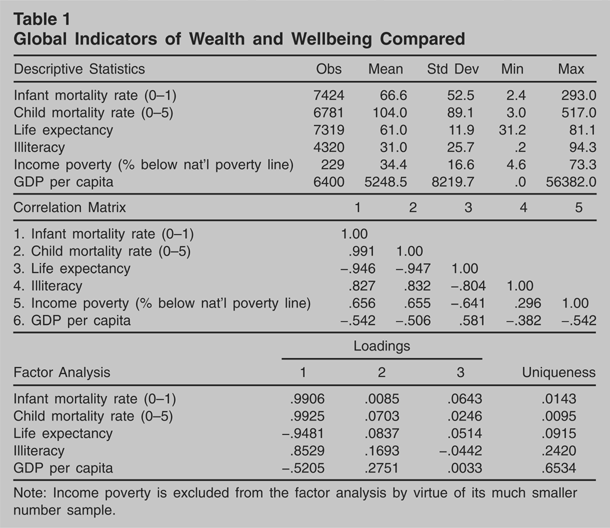
I shall briefly consider seven plausible variables as measures of global justice: gross domestic product (GDP) per capita, income poverty, life expectancy, disability-adjusted life years, illiteracy, child mortality (ages 0–5), and infant mortality (ages 0–1). Descriptive statistics, a correlation matrix, and a factor analysis for these variables are listed in Table 1. I consider, finally, the pros and cons of aggregate indices that combine several of the foregoing variables into a single index.
Global Indicators of Wealth and Wellbeing Compared

The focus of most work on global justice and associated concepts such as international development is economic growth (e.g., Rodrik 2003). The progress of nations—development—is understood primarily as economic progress, and the generally recognized marker of that progress is per capita GDP. Thus, we customarily contrast “rich” countries with “poor” countries. Most academic work in the fields of political science and economics is focused on trends in economic growth. Most policy discussions are similarly focused on the question of how to enhance growth. And growth performance is probably the most prominent measure of political success or failure in the realm of electoral politics. On this issue, governments rise and fall.
Yet, this ubiquitous indicator suffers from an obvious shortcoming: GDP per capita registers the mean (average) income among countries with diverse income distributions. Consequently, the status of the poor may be quite different in countries with the same per capita GDP. An additional problem is that the life-conditions of poor people are dependent on many things other than income. For both these reasons, a country's GDP per capita is not necessarily reflective of human welfare at the bottom of these societies.
This simple point is not contested. It is, in fact, largely definitional. The relevant question is whether we can do better. Is there an indicator that is sensitive to the life-conditions of the less advantaged and is, at the same time, crossnationally comparable, widely available, and historically informative? Complaints about the GDP-centric nature of academic and policy debate must come equipped with an alternative. After all, outcome-indicators are essential. Even a bad indicator of social progress is, arguably, preferable to no indicator at all.
One alternative approach to the measurement of social justice is to focus on income measures of poverty—usually understood as the number of individuals who live on less than one or two dollars a day. Yet, while useful for measuring poverty in first-world environments, income-based measures of poverty are not terribly reliable in the third world, where many people labor in the informal economy and thus may have no income per se. (Consumption-based measures of income provide some correction for this problem.) When examining incomes across societies, one faces additional problems of currency comparability. “Purchasing power parity” is an attempt to overcome this problem, though it is not entirely successful. Such comparisons must also rely upon poverty thresholds, which are inevitably arbitrary and inevitably controversial. What income threshold should define a person who is poor? Another difficulty is that surveys of income-poverty are conducted infrequently and do not include many countries or historical data for those countries where data are available. Thus, income-based measures of poverty tend to suffer from poor quality and poor coverage. Moreover, census-based and survey-based studies often reach very different conclusions about the income of the poor, results that are difficult to reconcile. Finally, income poverty is not a direct measure of human capabilities, since, as Michael Ross (2006) points out, families with very low incomes sometimes have assets they can use during periods of duress. Additionally, income poverty measures access to private goods, not public goods. Insofar as poor people benefit from government- or NGO-provided assets, these will not be reflected in income-poverty measures. For all these reasons, income-based poverty measures are flawed (Deaton 2003; Dreze and Sen 1989; UNDP 2003, 42; Moon 1991; Moon and Dixon 1985; Morris 1979; Nissan 1993; Reddy and Pogge 2003; Sahn and Stifel 2000).
A better alternative is found in mortality statistics, which are widely available, crossnationally comparable (a death is a death is a death), and reasonably accurate.2
On the virtues of mortality statistics see Sen (1998).
This last characteristic deserves comment for it is central to our theoretical concern. If global justice is concerned centrally with the life-conditions of the less advantaged, then we must find an empirical indicator that replicates this critical feature. Most of the variation in mortality that one observes from population to population is a product of the status of the less-advantaged groups within those populations. The United States, for example, has slightly lower life expectancy and slightly higher infant mortality rates than other rich countries largely because poor people (whom we regard as less advantaged) die at a faster rate in the U.S. than in other rich countries. This is a general characteristic of mortality rates worldwide. Middle class citizens in most of the world benefit from the goods that preserve life—education, modern medical facilities, nutritious diets, and so forth. Consequently, the mortality rates of the middle classes do not vary as much as the mortality rates of the poor across countries.3
A recent study of six developing countries compared infant mortality rates among different income groups to gauge this question. In the first decile it was found that the mortality rate varied from .18 (Pakistan) to .49 (Tanzania). In the tenth decile, by contrast, all countries inhabited a narrow range, from .04 to .09 (Kanbur and Squire 1999, 12). See also Gwatkin et al. (2005).
Among mortality statistics, the most useful for our purposes is probably the infant mortality rate (IMR), understood as the number of children who perish during the first year of life, per one thousand live births. This statistic is widely available, generally reliable, and characterized by high variance, thus providing maximum leverage for causal analysis. From a moral perspective, it may also be said to enjoy priority over other mortality indicators since the loss of an infant's life represents the loss of a whole life, while mortality experienced later in the life-cycle represents the loss of only a portion of a life.
Child mortality (U5MR), which counts the number of deaths in the first five years of life, is a very similar statistic and, as one might expect, is highly correlated with IMR (Pearson's r=0.98). Its drawback, for present purposes, is that data for U5MR is not available in historical time-series for most countries. In other respects, it is equal or superior to IMR as a measure of welfare among the less-advantaged citizens of the world.4
One disadvantage of IMR is that data points tend to “bunch” at year one, since survey respondents may not remember whether a death occurred at 11 or 13 months. This gives the IMR statistic, which is bounded at 12 months, a lumpy quality. U5MR faces the same problem at year five. However, since the mortality rate is much lower at that age, the issue has little effect on the reliability of the statistic. (I am indebted to Kenneth Hill for this point.)
Life expectancy is not as highly correlated with IMR, and suffers from other difficulties. This statistic, note Dean Filmer and Lant Pritchett (1999, 1312), is often based on data that is actually a series of “extrapolations using child mortality and assumptions about countries' characteristic life tables (e.g., ‘North’ or ‘South’ models).” Consequently, statistics on life expectancy are notoriously unreliable for most countries prior to recent years (Murray 2004). Finally, IMR forms a more useful outcome variable since its year-to-year and country-to-country variance is considerably greater than life expectancy. This, of course, is a product of the greater vulnerability of human beings during the first year of life, where subtle differences in environment (health care, nutrition, shelter, and so forth) are likely to translate into great differences in mortality rates.
A variant of life expectancy seeks to adjust life years by the quality of a person's life. The intuition is that since our ultimate concern is with wellbeing, we must consider not simply the quantity of life but also its quality. John Broome (2004, 261) suggests a concept that he calls “wellbeing-adjusted life years.” This would be calculated by multiplying a person's total life (or life expectancy) by the average quality of her life across that span of time, represented by a fraction between 0 and 1. This seems simple enough until one contemplates the problem of how to arrive at such a measurement of wellbeing throughout the life course. One such approach reduces the complex issue of wellbeing to the relatively simple dimension of health, hence the concept of “quality-adjusted” or “disability-adjusted” life-years (DALYs) (Broome 2004, 261; Murray 1996). Even so, the health of populations is exceedingly difficult to measure, requiring many assumptions. These assumptions are multiplied if the base concept is life expectancy, for reasons noted above. Scholars have managed to produce estimates of DALYs for a wide range of countries in recent years. However, there is little prospect of extending this data back in time, thus precluding a historical analysis (Mathers et al. 2001). Other, equally complex measures of wellbeing that attempt to judge levels of morbidity through the life-cycle are subject to similar problems of data-availability, reliability, and aggregation (an issue addressed below).
A final option consists of various composite indicators with diverse components (not limited to mortality and morbidity), for measuring wellbeing. Primary among these is the well-known Human Development Index (HDI), which combines indicators of mortality, education, and income (per capita GDP). A forerunner of the HDI is the Physical Quality of Life Index (PQLI), which combined indicators of mortality and education.5
On the HDI, see the Human Development Report (various years); Ul Haq (1995); Streeten (1995); Streeten et al. (1981). The PQLI combines infant mortality, life expectancy, and literacy into a single index (Morris 1979; see also Moon 1991; Moon and Dixon 1985; Nissan 1993). It is of course highly correlated with the single indicator, infant mortality, chosen for use here. I prefer IMR, rather than the PQLI, because it has higher variance (thus providing greater leverage on causal issues) and because I think that infant mortality ought to be granted higher moral priority than life expectancy or literacy. But these are very small quibbles. The results of a PQLI approach and an IMR approach to social justice are virtually identical since the indicators themselves are so highly correlated. For extensive commentary on various composite indicators see Hagerty et al. (2001).
The problem with a composite view of human wellbeing is the aggregation problem encountered by all composite indices. Which components shall we choose and how shall we weight them?
It turns out that the three components of the HDI are only moderately correlated with one another (Pearson's r = .5–.8) and certainly not equally valuable, even though they are equally weighted (life, I presume, is more important than education and income). Moreover, as I have already pointed out, per capita GDP draws on aggregate economic output and is not directly reflective of the wellbeing of the less-advantaged citizens in a society. Thus, the HDI, like any aggregate index, is problematic if regarded as a single-shot indicator of social justice (Hicks and Streeten 1979; Sagar and Najam 1998; Silber 1983).
For these reasons, it may be preferable to focus on a single indicator that measures that dimension of human wellbeing which is judged to be most essential, rather than a potpourri of indicators. If one prefers a basket of indicators then it is advisable to choose a set of variables that are highly correlated, such as the elements of the PQLI. But this approach offers no real advantage over the IMR-centered approach, precisely because these other human development indicators are so highly correlated.
Thus, from a moral and empirical perspective, IMR (and U5MR) may be regarded as the single-best indicator of global justice in the modern era. It is more important, morally speaking, than other indicators; it is widely available for most countries of the world; it is crossnationally comparable; it is at least as reliable as other indicators; and it is highly correlated with other human development indicators (child mortality, life expectancy, illiteracy, and income poverty).6
The contemporary (1960–2001) IMR data used here are drawn from the World Development Indicators (WDI) dataset. The other commonly used dataset is the United Nations dataset, compiled by Kenneth Hill and others. Reassuringly, these two data sources correlate at .99 (Jamison et al. 2003). For further discussion of sources, methodology, and reliability of infant mortality statistics, see Adetunji (1995); Ahmad et al. (2000); Bos, Vu, and Stephens (1992); Hill (1991); Hill et al. (1999); United Nations (1991; 1999).
To be sure, IMR does not reflect every right and wrong. A life averted—e.g., by abortion, birth control, or abstinence—is not reflected in this statistic.7
Philosophers and lay writers argue over whether these potential lives merit consideration (Broome 2004; Parfit 1984; Singer 2000). I shall not attempt to resolve this debate, but simply note it in passing.
It must be reiterated that we are not searching for a comprehensive indicator of global justice. Comprehensiveness is not an achievable goal since the number of issues that might be considered issues of justice are more or less infinite. (If one takes the concept of wellbeing as one's point of departure, then anything that affects human wellbeing is also, at least potentially, an issue of justice.) What we are attempting to delineate is a “single-best” indicator of global justice. Arguably, issues that are not reflected in the IMR statistic—such as political and civil rights—are less central to human wellbeing, and therefore need not be encapsulated in a single-best indicator of global justice. Arguably, being alive is more valuable than enjoying political and civil rights. A dead person enjoys no rights. (He or she may be granted rights, as a corpse, but they will not be able to enjoy those rights, for obvious reasons.) My claim, then, is not that the quality of a life is irrelevant to justice. Some lives, and some deaths, may be more worthwhile than others. My point is that it is extraordinarily difficult to measure the quality of a human life even if we limit ourselves to medical conditions (e.g., DALYs). For all these reasons, measuring global justice by infant survival rates is a reasonable empirical move.
Patterns of Social Injustice
Having settled on an empirical indicator, we may now track progress or regress on this statistic across countries and through time. In this way, the abstraction of “global justice” becomes palpable.
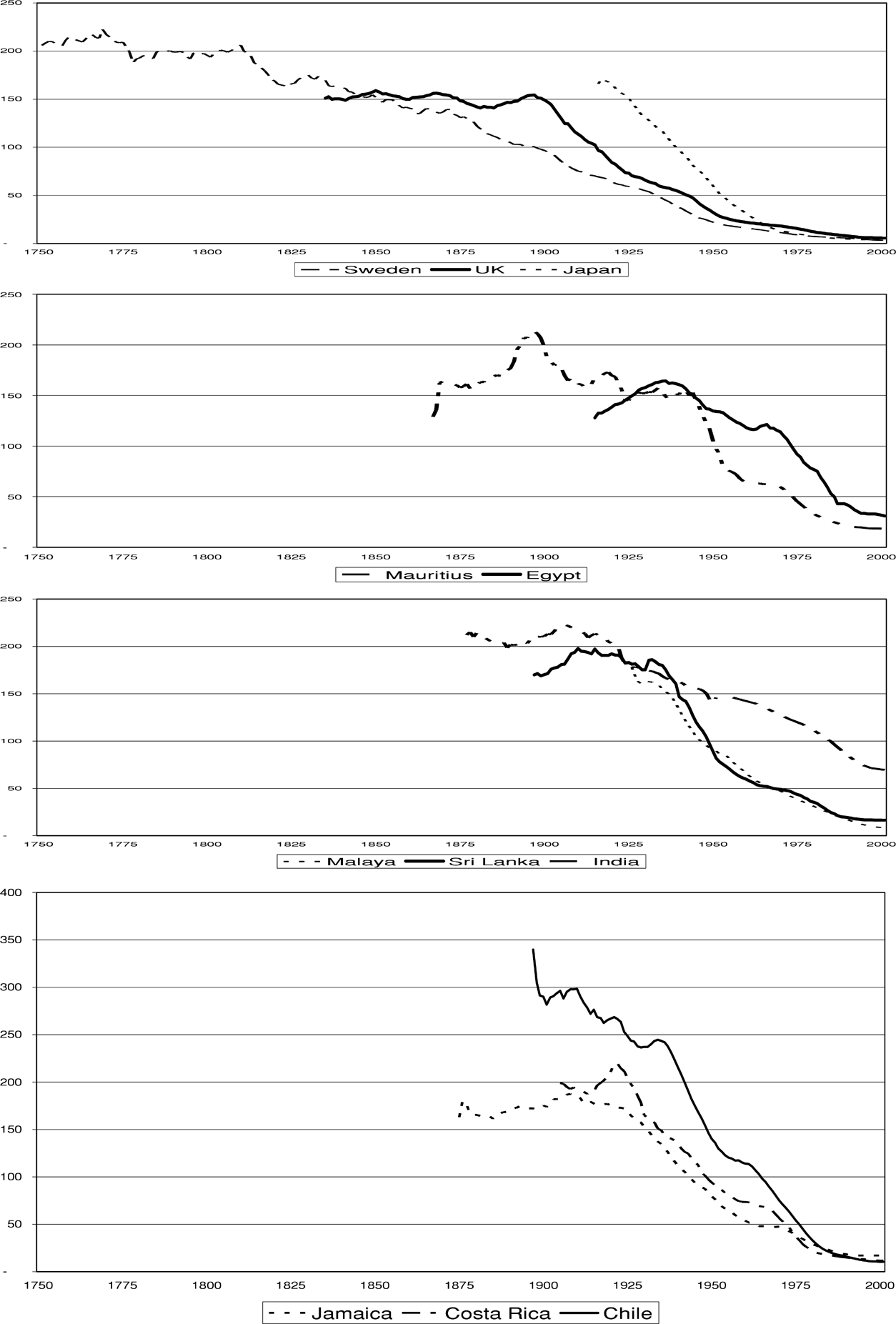
Let us begin by taking a quick look at secular-historical patterns in IMR. Figure 1 depicts long-run IMR statistics in Sweden (from 1751), England and Wales (from 1837), Japan (from 1918), Mauritius (from 1869), Egypt (from 1917), Malaya/Malaysia (from 1928), Sri Lanka (from 1899), India (from 1879), Jamaica (from 1877), Costa Rica (from 1907), and Chile (from 1899).8
Historical data from Mitchell (2003a; 2003b; 2003c) and Dyson (1997). Contemporary data (1960–2001) from WDI.

Secular-historical Trends in IMR
First, we may assume that IMR rates in excess of 150 (per 1,000 live births) were typical across the world in the 19th century. Readers should keep in mind that this sample is strongly biased toward good performers, since they are the countries most likely to have accurate records of IMR. (Keeping track of IMR trends is a crucial ingredient in an effective public health program.) Thus, it seems likely that most countries experienced IMR rates in excess of 200 prior to the 20th century.
Second, the Anglo-European world—including Sweden, the UK, and various other countries in Europe, North America, and the Australasian continent (not shown)—began experiencing significant declines in infant mortality in the 19th century. Of course, there were important trends prior to this point but these trends were probably not as durable, and/or as significant, as those that began in the 19th century.
Third, improvements in IMR began to appear in the non-Anglo-European world in the early-to-mid 20th century. Precisely when such improvements began, and the steepness of the decline, varies from country to country and, we presume, from region to region. But in all cases, it is quite dramatic. Note, for example, Chile's astonishing performance in decreasing its IMR rate over the course of the 20th century—from 340 in 1899 to 10 in 2001. Putting these patterns together, we can surmise that the greatest disparity (in absolute numbers) between high- and low-performers occurred in the mid-20th century, a period when the Anglo-European world, joined by Japan, attained IMR rates of less than 50 while most other countries had rates that were still above 100, and in many cases closer to 150.
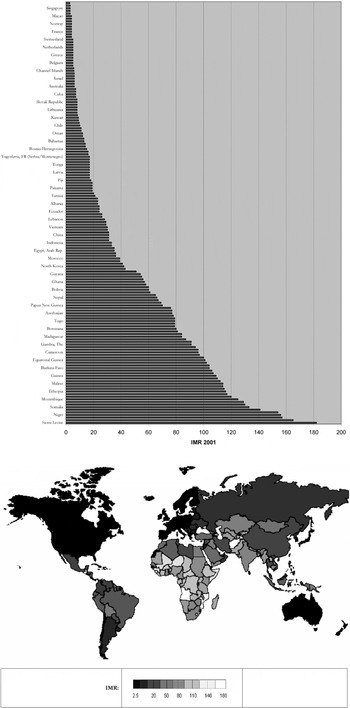
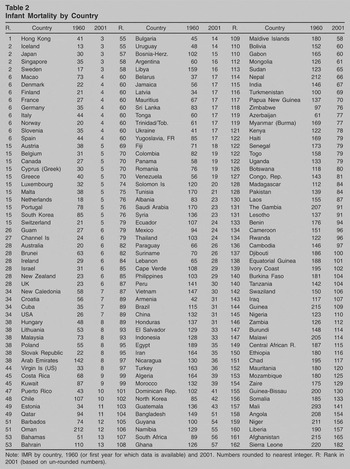
From 1960 to 2001 it is possible to track IMR performance across most of the sovereign and semi-sovereign countries of the world. Figure 2 arrays all the countries in the world according to their infant mortality rate in 2001—depicted as bars on a graph and as a global map, with various shades of black representing different thresholds of infant mortality around the world (approximate values). (Space limitations prevent us from listing all country names along the Y-axis.) Table 2 presents the same information in tabular format, beginning with Hong Kong, at roughly 2.7 infant deaths per 1,000 live births, and ending with Sierra Leone at roughly 182 deaths per 1,000 live births.9
All contemporary (1960–2001) graphs and tables include all countries for which relatively complete IMR data is available over this period. Excluded are 25 countries with a total of 6–8% of the world's population in this period (it varies slightly by year), most of which are very small: American Samoa, Andorra, Anguilla, Antigua & Barbuda, Aruba, Bermuda, Bhutan, Cayman Islands, Comoros, Croatia, Cyprus (Turkish), Dominica, East Timor, Eritrea, Faeroe Islands, French Guiana, French Polynesia, Georgia, Greenland, Grenada, Guadeloupe, Isle of Man, Jordan, Kazakhstan, Kiribati, Kyrgyzstan, Liechtenstein, Macedonia, Marshall Islands, Martinique, Mayotte, Micronesia, Monaco, Nauru, Netherlands Antilles, Northern Mariana Islands, Palau, Reunion, San Marino, São Tomé and Príncipe, Seychelles, St. Lucia, St. Kitts and Nevis, St. Vincent and the Grenadines, Taiwan, Tajikistan, Tuvalu, Uzbekistan, West Bank and Gaza, Western Samoa, Yemen (AR), Yemen (PDR), Yemen (REP). The analyses conducted in the next section of the paper include all countries for which data is available on relevant variables, which may include some of the foregoing.
The sole exception is Azerbaijan, whose performance deteriorated from 61 (in 1991) to 77 (in 2001).

IMR in 2001
Infant Mortality by Country

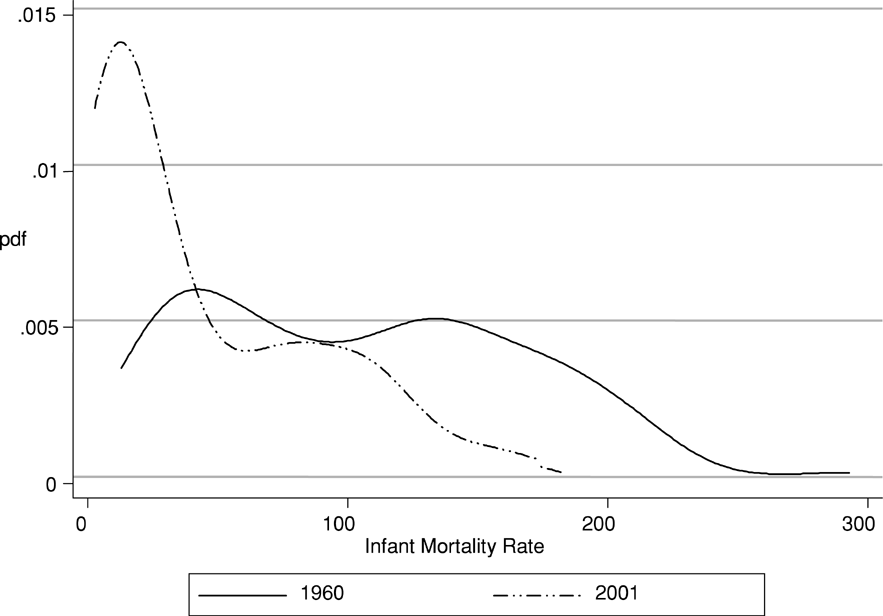
A kernel density plot allows us to examine both dispersion and absolute levels of IMR in 1960 and 2001 (see Figure 3). The X axis is the IMR and the Y axis is the probability density function, which can be thought of as the number of persons (as a share of all persons in the world) living in countries that have an IMR of that particular level. (The kernel density plot is a smoothed version of a histogram.) The solid line represents the distribution of IMRs in 1960 and the broken line represents the same data in 2001. The area under each line is equal to 1. (For a general description of the procedure see Kennedy 2003, 383–8.) Here we can see quite clearly that two things have happened over the past four decades. First, infant mortality rates have shifted substantially to the left (i.e., toward zero). Second, the dispersion between extremes has narrowed. In 1960 the difference between the best- and worst-performing countries was nearly 300; in 2001 it was nearly 200. (Note that the dispersion between extremes—the range of IMRs across the world—is quite different from a ratio or gini coefficient measurement of dispersion, which I have not explored here.)

Kernel Density Plot
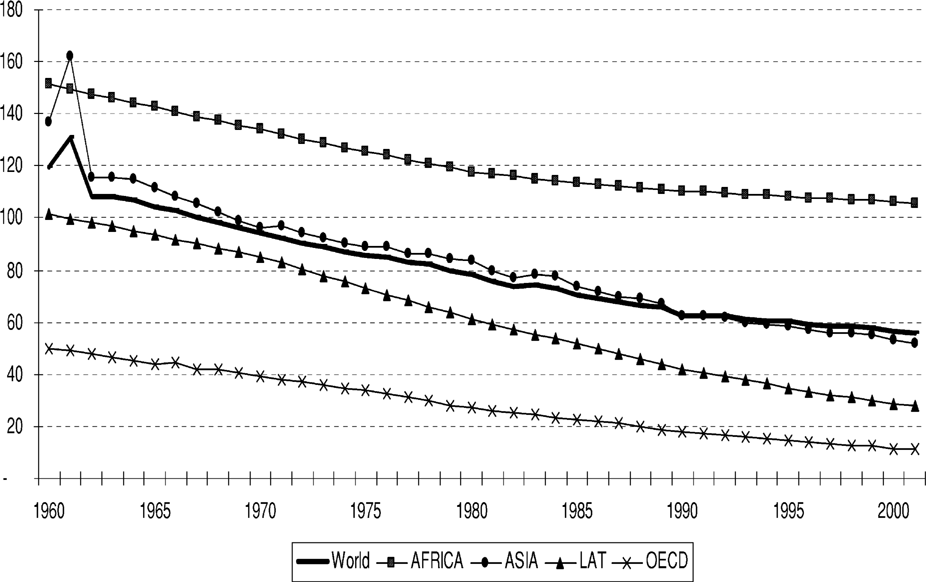
Finally, we examine current trends in absolute levels of IMR across the world. Figure 4 shows IMR rates globally and by region since 1960. Although Africa has lagged behind other regions over the postwar decades, all regions of the world have experienced dramatic improvements. (The sharp spike in 1961 registers the catastrophic after-effects of China's Great Leap Forward as well as a series of natural disasters [Riskin 1995].) In 1960, the world IMR stood at 120. By 2001, the global IMR had been reduced to 56. In other words, the probability of infant death has decreased by more than half over the past four decades. This reinforces the secular-historical trends observed for several countries in Figure 1. By all accounts, infants are healthier today than they have been at any previous point in human history.

Contemporary Trends in IMR, by Region and the World
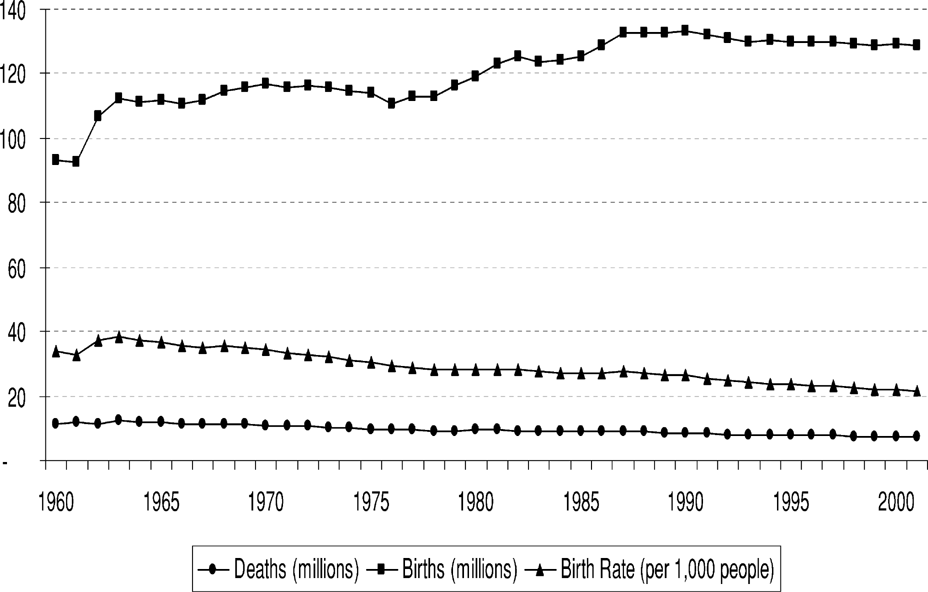
Figure 5 examines the same period (1960–2001) according to the total number of births and deaths among infants registered in each year (approximate values). Here, it can be seen that the number of births has remained virtually constant over the past four decades. Total population has been increasing, of course, but since the birth rate has decreased dramatically throughout this period the total number of births per annum has stabilized. And because the rate of infant death (IMR) has declined, the absolute number of infant deaths globally has declined from just over 11 million in 1960 to just over seven million in 2001.

Contemporary Trends: Births and Deaths
In sum, both the rate of infant death and the absolute numbers of infant deaths have declined virtually everywhere, and in most countries substantially, over the postwar period (see Table 2). Statistics for other human development indicators such as literacy and life expectancy show the same aggregate picture. Life is getting better, so far as we can tell, for the world's less-advantaged citizens.
Granted, the rate of improvement has slackened in recent years, partly because of the global scourge of AIDS and partly because many countries are bumping up against the natural limits of these human development statistics (the lower the infant mortality rate, the harder it is to make further gains). More recent data (which was not possible to obtain for a larger sample) show a marked decline in some parts of the world, notably in sub-Saharan Africa. Even so, the overall trend is still markedly positive on this important dimension of human well-being. Whether human welfare continues to improve in the future depends, in no small degree, on what humans do, a matter to which I now turn.
From Empirics to Action
The cause of global justice has scarcely been addressed by the academic community, and when it has the result has tended to be rather polemical. The primary reason for this, I suggest, is that we have not developed the proper empirical tools to analyze this vast subject. Yet, these tools are not obscure. In fact, they are already at-hand in the form of mortality statistics—in particular IMR (and U5MR). In this paper, I have shown why these indicators offer reasonable estimates of social justice across countries, i.e., global justice. (It should be noted that they are also amenable to within-country investigation.) Intelligent public action begins with the prosaic tasks of conceptualization and measurement, tasks that have been largely neglected in our collective rush to assign blame for apparent global injustices.
In this spirit, I caution readers against drawing moral judgments from the trend-lines shown in previous figures and tables. For optimists, improving trends can be enlisted as evidence that things are going well. Things appear to be getting better, and therefore there is no cause for worry. But consider also another sort of trend—a dramatic increase in IMR (a trend which is beginning to manifest itself in sub-Saharan Africa as a result of the AIDS pandemic). Or, for that matter, no change at all—perfect stability in IMR through time. These trends might also lead to complacency, in the one case because matters are too daunting (leading to hopelessness), and in the other because they seem resistant to human intervention. In short, trends are mute on morals. They do not, by themselves, connote blame or suggest appropriate action.
The relevant moral and political question is not whether things are getting better or worse, but rather whether people are suffering and, if so, to what extent we—as individuals and communities—can help. It is of little comfort to a child dying right now in South Asia that the long-term mortality trend on the continent is favorable. Granted, if the trend-line were so dramatically positive that all significant human deprivations would be relieved in the next decade without further action on our part, complacency might be justified. This is by no means the case. Trend-lines depend on actions that we are currently taking and are likely to take. The future depends on the present. We should also keep in mind that dramatic reversals are possible. The impact of AIDS today, and the possible impact of global warming and natural resource depletion tomorrow, is sobering. The point at which population growth stabilizes is another issue of immense consequence in any calculation of global justice in the future. A difference of slight degrees in fertility rates translates into a difference of a billion people or more that the world will have to feed, clothe, house, educate, and employ.
The purpose of this paper has been descriptive and analytic, not hortatory (except in the sense of advocating attention to these issues). Without some generally agreed-upon measure of global justice, I have argued that we are unable to come to grips with this immense moral issue. With such a measure, it becomes possible not only to track changes through time but also to contemplate causal interventions. One can interrogate causal facts, for one has an outcome that is measurable through time and across space.
Author Bio
John Gerring is associate professor of political science at Boston University, where he teaches courses on methodology and comparative politics. His forthcoming books include Case Study Research: Principles and Practices (Cambridge University Press, 2007), A Centripetal Theory of Democratic Governance (with Strom Thacker; Cambridge University Press, 2008), Concepts and Method: Giovanni Sartori and His Legacy (ed. with David Collier; Routledge, forthcoming), Global Justice: A Prioritarian Manifesto (under review), and Democracy and Development: A Historical Perspective (with Strom Thacker and Mushfiq Mobarak; in process). He is the president-elect of the APSA Organized Section on Qualitative Methods and former editor of the section's newsletter.