Introduction
Titanium dioxide (TiO2) is one of the extensively studied photocatalyst, which can be synthesized by various processes, such as physical vapor deposition,[ Reference Xiang, Zhang, Wang, Luo, Zhu, Zhang and Yu 1 ] chemical vapor deposition,[ Reference Ou, Tadytin, Steirer, Placencia, Nguyen, Lee and Armstrong 2 ] sol–gel,[ Reference Antonelli and Ying 3 ] hydrothermal,[ Reference Nakahira, Kubo and Numako 4 ] anodic oxidation,[ Reference Paulose, Prakasam, Varghese, Peng, Popat, Mor, Desai and Grimes 5 ] and cathodic deposition.[ Reference Huang, Hsu, Hu, Chang and Lee 6 – Reference Lin, Chen, Chang, Hsu and Sone 9 ] The fabrication processes usually involve prolonged reaction time or high-temperature environment. The high-temperature environment is needed because TiO2 synthesized in an aqueous solution is usually amorphous, and an additional heat treatment is needed to improve the crystallinity.
Among the various synthetic methods, cathodic deposition provides a relatively simple, low-cost, and low-temperature process for production of TiO2. Similar to electroplating of metallic materials, thin films of TiO2 can be deposited on conductive substrates with complicate surface geometry in an aqueous electrolyte. Such a feasibility of obtaining TiO2 thin films has significant implications in the aspect of electrochemical and photoelectrochemical (PEC) applications. Also, cathodically deposited TiO2 films are porous, which is beneficial to the applications requiring high surface area, such as catalysis,[ Reference Wang, Guo, Zhang, Zhang, Han and Wu 10 ] sensing, [ Reference Bao, Li, Zang, Cui, Qiao and Guo 11 ] electrochemical energy conversion,[ Reference Fujishima and Honda 12 ] and solar energy conversion.[ Reference O'Regan and Grätzel 13 ]
On the other hand, as mentioned before, TiO2 fabricated is usually amorphous, and an additional heat treatment, such as 400 °C for 1 h, is needed to have crystalline TiO2. The crystallinity can greatly affect performance of the TiO2 in applications, and the photoactivity is highly influenced by the crystallinity.[ Reference Yu, Yu, Cheng, Zhao, Yu and Ho 14 ] This implies that the as-deposited TiO2 would have very low photoactivity. However, the high-temperature process would limit selection of the substrate used to deposit the TiO2. For example, substrates used for stretchable and wearable devices are usually weak against high temperature because of its polymer features.[ Reference Yan, Kang, Wang, Cui, Wang, Foo, Chee and Lee 15 ]
In a previous study, properties of the metal oxides prepared by cathodic deposition with an aqueous electrolyte are reported to be affected by the applied pressure, and effect of the applied pressure (baric) in a reaction takes place in an aqueous (hydro) solution is named the hydrobaric effect.[ Reference Lin, Chen, Chang, Hsu and Sone 9 ] Crystallinity of the TiO2 films is reported to be improved with an increase in the applied pressure. In this work, the hydrobaric cathodic deposition process will be applied in preparation of TiO2 thin films and effect of the applied pressure on the corresponding PEC water-splitting performance will be investigated.
Experimental
The aqueous electrolyte used in this study was comprised 25 mM TiCl3, 0.47 M NaCl, and 75 mM NaNO3. The cathodic deposition was conducted in a high-pressure electrochemical cell, which is a three-electrode configuration cell consisted of Ti substrate as the working electrode, Pt foil as the counter electrode, and Pt wire as the reference electrode. Detailed configuration of the apparatus is provided in a previous study.[ Reference Lin, Chen, Chang, Hsu and Sone 9 ] The deposition was conducted by sweeping the applied potential from the open-circuit potential to −3.0 V versus Pt at a scan rate of 25 mV/s for five times. For the deposition at atmospheric atmosphere, the temperature was ranged from 40 to 70 °C, and the TiO2 deposited at atmospheric pressure and various temperature were demoted as ATM–40C, ATM–50C, ATM–60C, and ATM–70C. For the hydrobaric cathodic deposition, the applied pressure was controlled by pressurizing CO2 into the reaction cell, and the applied pressure was varied from 5 to 35 MPa. The temperature for all hydrobaric cathodic deposition was 70 °C, and the samples were denoted as 5 MPa–70C, 15 MPa–70C, 25 MPa–70C, and 35 MPa–70C.
The crystal structures were investigated by x-ray diffraction (XRD, Ultima IV, Rigaku). Raman spectra (HR800, Horiba Jobin Yvon) were recorded by Ar laser with an excitation wavelength of 514.5 nm. For photoluminescence (PL) spectra (IK3001R-G, Kimmon), a He–Cd laser with 720 W power was used as the excitation source.
PEC properties of the samples were examined in a three-electrode configuration cell with a Pt counter electrode, an Ag/AgCl reference electrode and 1 M NaOH aqueous electrolyte. The PEC data were collected in an electrochemical station (660D, CH Instrument) under white light illumination (Xe lamp, 100 mW/cm2). The monochromatic incident photon-to-electron conversion efficiency (IPCE) spectra of TiO2 were collected under illumination of Xe lamp coupled with a monochromator.
Results and discussion
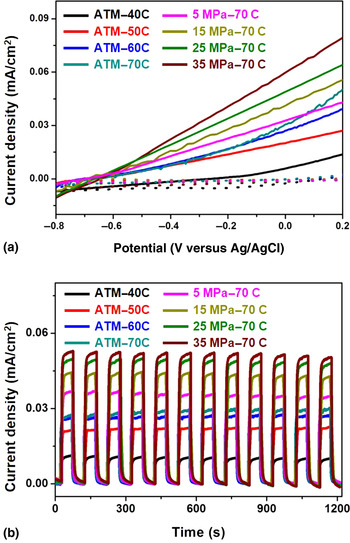
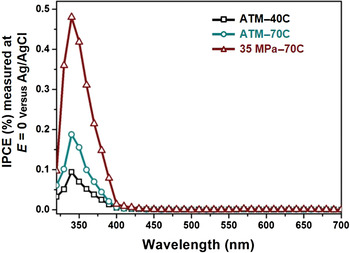
The results obtained from the XRD, the Raman spectra, and the PL spectra confirmed that the hydrobaric effect has a positive contribution to crystallinity of the TiO2 prepared by cathodic deposition in an aqueous solution, shown in Fig. S1. Average grain sizes of the TiO2 prepared at 70 °C were estimated using the XRD results and the Scherrer equation. As shown in Fig. S2, grain coarsening effect was observed with an increase in the applied pressure. With the improved crystallinity, TiO2 films prepared by the hydrobaric cathodic deposition can find promising potentials in practical photoconversion applications. To demonstrate the applicability, performance of the as-deposited TiO2 films as the photoanode in PEC water splitting was evaluated. Figure 1(a) shows linear sweep voltammagrams of all of the TiO2 films evaluated in 1 M NaOH in the dark and under the white light illumination. It is important to note that all the TiO2 films showed negligible dark current density in the entire scanning region. This phenomenon ruled out possibility of undesired redox reactions occur on the electrode surface. Upon illumination with the white light, all of the TiO2 electrodes showed pronounced photoresponses, which reflects notable photoactivity of the TiO2 toward water oxidation. Significantly, the exertion of high pressure led to much enhancement in the photocurrent generation. Among all of the electrodes tested, The electrode composed of the 35 MPa–70C achieved the highest photocurrent density of 52.7 mA/cm2 at 0 V versus Ag/AgCl, which was five folds of the value obtained from the ATM–40C (10.4 mA/cm2) and almost doubled the value of the ATM–70C (29.3 A/cm2). This outcome further demonstrated the positive role of the hybrobaric effect in enhancing the photoactivity of TiO2. To evaluate stability of the samples within the PEC cell, chronoamperometic I–t curves were collected under chopped light illumination. As shown in Fig. 1(b), all the electrodes were prompt in generating photocurrents with a reproducible response to over 12 on/off cycles of the light illumination, which revealed high stability for the TiO2 during the water oxidation process. Furthermore, the photoactive wavelength regime of the samples was explored by performing IPCE measurements. In Fig. 2, the 35 MPa–70C displayed a remarkably enhanced IPCE value when compared with the two TiO2 samples deposited at atmospheric pressure, which is in conformity with the observations from Fig. 1(a). Most importantly, the IPCE enhancement of the 35 MPa–70C was dominated by photoactivity of the TiO2 in the UV region. We suggest that the high crystallinity given by the hydrobaric process would improve the charge carrier transfer in the deposited TiO2, therefore, enhances the resulting PEC performance.
(a) Linear sweep voltammograms and (b) chronoamperometric I–t curves collected at 0 V versus Ag/AgCl for different TiO2 films under the white light illumination.

IPCE plots collected at 0 V versus Ag/AgCl for the ATM–40C, the ATM–70C, and the 35 MPa–70C.

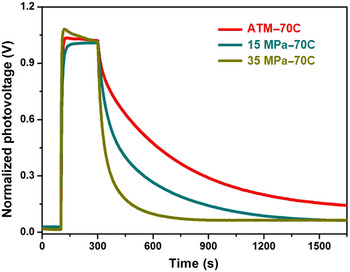
Photovoltage decay measurements were further conducted to reveal the enhanced PEC performance in the TiO2 fabricated by the hydrobaric cathodic deposition. Note that photovoltage decay has been considered as a viable analytical method to study the trap states of photoanodes.[ Reference Pu, Wang, Chang, Ling, Lin, Fitzmorris, Liu, Lu, Tong, Zhang, Hsu and Li 16 ] It is known that the hole-transfer to bound water species is the rate-limiting step of water oxidation on semiconductor photoanodes.[ Reference Cowan, Barnett, Pendlebury, Barroso, Sivula, Grätzel, Durrant and Klug 17 ] Specifically, photogenerated holes are easily trapped by the surface states and recombine with electrons, which deteriorate the hole-transfer to the electrolyte and demote the PEC performance. Figure 3 shows the photovoltage–time spectra of three representative TiO2 samples. Notably, electrodes composed of the TiO2 deposited at high pressure exhibited fast photovoltage decay. The rapid photovoltage decay can be attributed to the fact that the number of surface states was significantly reduced as a result of the improved crystallinity. The fewer surface states may further reduce the loss of photogenerated holes via electron–hole recombination, consequently leading to the enhanced PEC performance as observed. In addition, the trend observed in the photovoltage decay for the TiO2 deposited at high pressure was in good agreement with the corresponding IPCE results. Such consistency further confirmed that TiO2 prepared by the hydrobaric cathodic deposition possessed less surface states and thus displayed enhanced photoactivity.
Photovoltage–time spectra of the TiO2 deposited at 70 °C and various pressures.

Conclusions
In this study, PEC performance of the TiO2 fabricated by the hydrobaric cathodic deposition was evaluated. When compared with the TiO2 obtained at ambient atmosphere, the TiO2 films deposited under high pressure exhibited significantly enhanced photocurrents from water oxidation reaction. The XRD and photovoltage results suggested that the enhanced photoactivity of the TiO2 was a result of the improved crystallinity caused by the exerted high pressure, which suppressed trap state-mediated charge recombination to facilitate the interfacial charge transfer, and thus improve the overall carrier utilization. The current study is designed to demonstrate the hydrobaric effect and its significant implications in the solution-phase synthesis of TiO2.
Acknowledgments
This work was supported by CREST Project operated by the Japan Science and Technology Agency (JST). Y.-J. H. acknowledges the financial support from the Ministry of Science and Technology of Taiwan under grant NSC-102-2113-M-009-005-MY2.
Supplementary Material
The supplementary material for this article can be found at https://doi.org/10.1557/mrc.2017.21