

Introduction
Farm animals, like wild animal species, are recognized as important genetic resources in the World Conservation Strategy (International Union for the Conservation of Nature and Natural Resources, 1980). They have played significant roles in the sectors of agriculture, economy, culture and religion in earlier and current societies. Nevertheless, different from wild animal species, farm animals have been deeply affected by human interference in the history of their development, particularly because of the industrialization of animal agriculture and the rising ubiquity of a few efficient and productive breeds during the second half of the twentieth century. These have led to dramatic reduction in the population sizes of a large number of breeds and even to the extinction of many breeds (e.g. Hall and Ruane, Reference Hall and Ruane1993; Felius, Reference Felius1995; Li et al., Reference Li, Tapio, Vilkki, Ivanova, Kiselyova, Marzanov, Cinkulov, Stojanović, Ammosov, Popov and Kantanen2007; Oldenbroek, Reference Oldenbroek2007). As a result, conservation of farm animal genetic resources becomes important not only for their biological role, but also for their economic, social and cultural values (e.g. Barker, Reference Barker2001; Oldenbroek, Reference Oldenbroek2007). Rare and endangered breeds have a high priority in conservation programmes because the genes and gene combinations they carry may be commercially applicable in the future (Hall and Ruane, Reference Hall and Ruane1993).
To prevent the erosion and the loss of farm animal genetic resources, great efforts have been undertaken by various institutions at global and regional levels during the decades since the 1960s when the conservation awareness for farm animals arose (Hodges, Reference Hodges2002). The Society for Conservation Biology has highlighted the vital importance of both natural and social sciences in conservation activities. In conservation work, social sciences can augment the motivation for application of biological sciences in new ways, for example, by documenting the sociocultural and spiritual value of biodiversity (Mascia et al., Reference Mascia, Brosius, Dobson, Forbes, Horowitz, McKean and Turner2003). Moreover, multidisciplinary collaborative studies have been advocated as an important yet little-studied strategy for effective conservation outreach, attracting new audiences, increasing awareness, introducing new perspectives and creating a dialogue among a wide range of people (Jacobson, Mcduff and Monroe, Reference Jacobson, Mcduff and Monroe2006, Reference Jacobson, Mcduff and Monroe2007). The close association between farm animals and humans over many centuries makes it necessary to incorporate social sciences and humanities studies into the conservation efforts that have been based mainly on biological science investigations.
The Yakutian cattle are the last native cattle population remaining in Siberia, Russia and are critically endangered (Dmitriev and Ernst, Reference Dmitriev and Ernst1989; FAO, 2007). In this study, we report a multidisciplinary collaboration in the conservation of this cattle breed involving biological, social and art sciences. This multidisciplinary conservation practice has provided us, as well as domestic animal conservation organizations, with many insights that will be useful in developing strategies for working with other endangered populations of livestock, wild animals or even plants.
Breed history and description
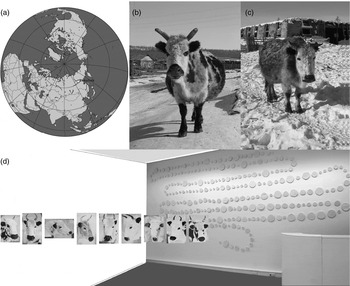
The Yakutian cattle, which are the last remaining variety of the indigenous Siberian cattle (Dmitriev and Ernst, Reference Dmitriev and Ernst1989; Scherf, Reference Scherf2000), are a unique population of the Turano-Mongolian type of Bos taurus in the northern territory of the Republic of Sakha of the Russian Federation (Figure 1a). They were bred pure until 1929 and their recent ancestors can be traced back to Siberian cattle which had wandered and migrated over centuries with other domestic animal species and the Yakutian people. This migration was northwards from the south, probably the Cis-Baikal region, to the middle Lena basin, the lower Vilyui and Aldan as early as in the thirteenth century before finally settling down in small fragmented villages beside the Yana River (Forsyth, Reference Forsyth1992; Puzyrev et al., Reference Puzyrev, Stepanov, Golubenko, Puzyrev, Maksimova, Khar'kov, Spiridonova and Nogovitsyna2003; Granberg, Partanen and Soini, Reference Granberg, Partanen, Soini and Ahmed2006). However, in the vast territory of the Yakutia (the Republic of Sakha) they have been preserved pure only at the Leninski state farm in the Verkhoyansk district (see Kantanen et al., Reference Kantanen, Ammosov, Li, Osva, Popov, Granberg, Kantanen and Soini2009a).
(a) Geographic origin of the Yakutian cattle; (b) a cow on the frozen land covered with snow, photo Anu Osva; (c) a cow standing on snow in the front of a cowshed built using manure, photo Anu Osva; (d) two artworks in the exhibition “Yakutian Cattle – A Research Expedition to Siberia in 2000's” by Anu Osva. Yakutian Cattle, nine portraits, 2007, oil on canvas, 60 × 55–65; Mother's Pearls, 2007, plaster, acrylic colour, about 25 m. The pearls, i.e. circles, represent nucleotides in a mitochondrial control region of the Yakutian cattle. In a multiple sequence alignment of mtDNA control region of Eurasian cattle (Bos taurus) breeds (see Kantanen et al., Reference Kantanen, Edwards, Bradley, Viinalass, Thessler, Ivanova, Kiselyova, Cinkulov, Popov, Stojanović, Ammosov and Vilkki2009b), the nucleotide mutations are presented by pearls that reflect red light and the consensus nucleotides are represented by pearls that reflect green light.

Owing to the industrialization and modernization of animal production during the last century, as well as the privatization of the collective production systems from the early 1990s onwards, the Yakutian cattle only had 28 bulls and 525 cows in a total population of 1 212 heads at the 2007 census (Kantanen et al., Reference Kantanen, Ammosov, Li, Osva, Popov, Granberg, Kantanen and Soini2009a). Therefore, the breed has been categorized as “endangered”, as listed by the FAO (Felius, Reference Felius1995; Scherf, Reference Scherf2000).
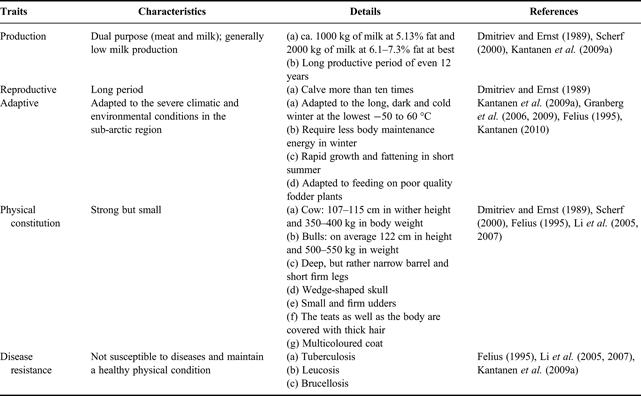
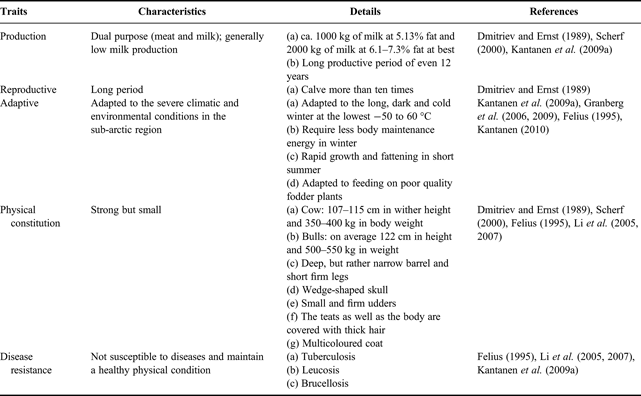
The physical constitution of Yakutian cattle is strong in general, characteristic of dual-purpose (milk and meat) animals (see Figure 1b and c and Table 1). They have the typical features of the Turano-Mongolian Bos taurus cattle (Dmitriev and Ernst, Reference Dmitriev and Ernst1989; Felius, Reference Felius1995) and have high adaptation to the extreme environment and climate of the sub-arctic region. They are capable of thriving on the poor feed of fodder plants native to the northern environment. It has also been reported that the Yakutian cattle exhibit resistance to tuberculosis, leucosis and brucellosis (Scherf, Reference Scherf2000; Kantanen et al., Reference Kantanen, Ammosov, Li, Osva, Popov, Granberg, Kantanen and Soini2009a). In the northern villages of Sakha, it is not extremely unusual to find cows of more than 20 years. It is common that a Yakutian cow calves more than ten times during its life (see Kantanen et al., Reference Kantanen, Ammosov, Li, Osva, Popov, Granberg, Kantanen and Soini2009a). However, a modern dairy cow typically calves two to three times until the age of 4–5 years.
Phenotypic characteristics and adaptive traits of the Yakutian cattle.
These phenotypic traits, on the one hand, resulted in a large-scale commercial crossbreeding between Yakutian cattle and imported breeds such as Khmologory and Simmental to obtain animals with both increased production efficiency and good adaptability (Li et al., Reference Li, Nogovitsina, Ivanova, Erhardt, Vilkki, Popov, Ammosov, Kiselyova and Kantanen2005). On the other hand, they have led to a dramatic population decrease of the native purebred Yakutian cattle (Scherf, Reference Scherf2000; Granberg, Partanen and Soini, Reference Granberg, Partanen, Soini and Ahmed2006; Granberg, Kantanen and Soini, Reference Granberg, Kantanen and Soini2009). The factual official conservation programme, “The law to protect the genetic heritage of Yakutian cattle and use it”, was initiated in the late 1990s and came into force in 2001 (Granberg, Partanen and Soini, Reference Granberg, Partanen, Soini and Ahmed2006; Partanen and Kantanen, Reference Partanen, Kantanen, Granberg, Kantanen and Soini2009). At present, a minimal viable population size for the safety of Yakutian cattle has been maintained, but many threats can be posed to their survival into the near future, and thus activities for their conservation are urgently needed.
Multidisciplinary collaborative study
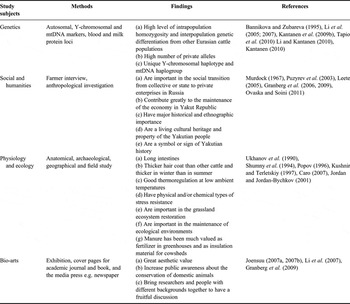
Integrating social, economic and biological data into community-based conservation efforts has been urged over many years by conservationists (e.g. Western and Wright, Reference Western and Wright1994; Berkes, Reference Berkes2004; Chan et al., Reference Chan, Pringle, Ranganathan, Boggs, Chan, Ehrlich, Haff, Heller, Al-Khafaji and Macmynowski2007). Despite many efforts, this strategy has seldom been successfully practised in conservation projects because of the complications of economic, social and biological perspectives, as well as the divergent philosophies and research styles of these disciplines (e.g. Terborgh and van Schaik, Reference Terborgh, van Schaik, Terborg, van Schaik, Davenport and Rao2002). To our knowledge, this study on the Yakutian cattle by the Finnish research team (Granberg, Kantanen and Soini, Reference Granberg, Kantanen and Soini2009) is one of the very few interdisciplinary explorations of the dilemmas and unique solutions in the management of endangered farm animal genetic resources (see Table 2). Parallel to the genetic studies, the socio-economic and cultural values of this local breed and the demographic indicators of rural societies where the unique cattle have been traditionally raised were also investigated. In addition, earnest efforts were made to publicize the conservation value of the breed through the Bio-art exhibition, articles in newspapers and academic literature as well as the cover illustration in a scientific journal (see Table 2).
Summary of the multidisciplinary study on conservation of the Yakutian cattle genetic resource.

Genetic studies
By employing autosomal, mitochondrial and Y-chromosomal DNA markers, molecular and population genetic analyses identified the Yakutian cattle to be of a Near Eastern genetic origin (Li et al., Reference Li, Tapio, Vilkki, Ivanova, Kiselyova, Marzanov, Cinkulov, Stojanović, Ammosov, Popov and Kantanen2007; Kantanen et al., Reference Kantanen, Edwards, Bradley, Viinalass, Thessler, Ivanova, Kiselyova, Cinkulov, Popov, Stojanović, Ammosov and Vilkki2009b; Li and Kantanen, Reference Li and Kantanen2010). Our studies presented genetic evidence for the particular patterns of the domestication process and demographic history of the breed from different genetic perspectives. Genetic distinctness of the Yakutian cattle breed has also been clearly characterized in an earlier study based on blood and milk protein polymorphism (Bannikova and Zubareva, Reference Bannikova and Zubareva1995).
Social and humanities studies
In traditional societies, social and cultural aspects are closely connected to farm animal husbandry. The Yakutian cattle, which lived through the Russian transition, have witnessed the entire process of privatization of the sovkhozes and chaotic changes of agricultural structure as a whole (Granberg, Kantanen and Soini, Reference Granberg, Kantanen and Soini2009; Ovaska and Soini, Reference Ovaska and Soini2011), and vice versa the privatization processes have largely affected the farming system of the Yakutian cattle. During the transition, the coexistence of collective and private production was the typical production type in cattle farming. The small-scale family-based production form prevailed in Yakut through the communist era. During transition such a subsidiary production relieved the shortage and poverty, and cattle production has been continued by many families as such. Also, some other families increased their cattle number in order to produce for the local market, and registered themselves as “fermers” (Russian expression for farmer) (Granberg, Kantanen and Soini, Reference Granberg, Kantanen and Soini2009; Ovaska and Soini, Reference Ovaska and Soini2011).
In addition, the original Yakutian cattle have a major historical and ethnographic importance and are regarded as an important product of the national culture. The cattle are a living cultural heritage and property of the Yakutian people and a symbol or sign of the Yakutian history (e.g. Murdock, Reference Murdock1967). They are highly valued in maintaining the local traditions and retaining the people's rituals. For example, massive slaughtering of cattle has been a form of strong protest against the colonizers or the hegemonization of power in Yakut (Leete, Reference Leete2005). The cattle are also very relevant in the legends of immigration of Yakutians to the north and have significant impact on fine arts, literature and motives of handcraft and decorations (Puzyrev et al., Reference Puzyrev, Stepanov, Golubenko, Puzyrev, Maksimova, Khar'kov, Spiridonova and Nogovitsyna2003; Granberg, Kantanen and Soini, Reference Granberg, Kantanen and Soini2009).
Physiological and ecological studies
The extant Siberian fauna represents important sources for studying the influence of climatic changes on extinction of the big ice age mammals, for example, the mammoths. There is evidence that animal species in Siberia were all affected during the same period by climate changes and glacial retreat (e.g. Shumny, Kushnir and Tikhonov, Reference Shumny, Kushnir and Tikhonov1994). There is now an opportunity, even from a global perspective, to study the ecological adaptation and the immunogenetic monitoring by investigating the contemporary animal species. Cattle, the traditional domesticated animal in Siberia, have adapted to the extreme arctic ambient conditions and are a good animal model for the studies.
The physiological characteristics of very long intestines (42 times of the length of the body) enable the Yakutian cattle to digest coarse forage. Comparative morphological and physiological investigations have revealed that the coat hair of the Yakutian cattle is on average three or four times thicker than that of the Simmental cattle and it is six times thicker in winter than in summer (see Ukhanov et al., Reference Ukhanov, Berendiaeva, Kovalenko and Istomin1990). The basic mechanisms of thermoregulation at low ambient temperatures and their association with the physical and/or chemical types of stress resistance have been determined (e.g. Shumny, Kushnir and Tikhonov, Reference Shumny, Kushnir and Tikhonov1994; Popov, Reference Popov1996; Kushnir and Terletskiy, Reference Kushnir and Terletskiy1997). The animals can live solely on hay. Thus, the Yakutian cattle have had an important function in the past and will do so in the ongoing attempts to restore the rich grassland ecosystem and to maintain the ecological environment in Siberia (e.g. Caro, Reference Caro2007). The cattle manure has been much valued as fertilizer in greenhouses and as insulation material for cowsheds (e.g. Jordan and Jordan-Bychkov, Reference Jordan and Jordan-Bychkov2001; Granberg, Partanen and Soini, Reference Granberg, Partanen, Soini and Ahmed2006).
Bio-arts
The work of artists is essential in the community-based conservation efforts to increase public awareness. The exhibition Yakutian Cattle – A Research Expedition to Siberia in the 2000s consisted of 17 artworks at the Gallery Katariina, one of the highly valued galleries in Helsinki, Finland. Afterwards the exhibition was presented in Kotka, Finland and in Stockholm, Sweden. We describe here two art works (Figure 1d), that is, Yakutian cattle in portraits and the construction “Mother's Pearls” on the opposite wall which is a representation of the genetic code in a specific mitochondrial DNA sequence unique to the Yakutian cattle. The portraits and “Mother's Pearls” refer to genetic history and identity of Yakutian cattle. On their faces they have it all, their genome, individual history and their moments of individual expression.
The exhibition raised questions about mankind's responsibility for domesticated animals, nature's strength and animals' adaptation to the environments. It moulds our perceptions about ourselves, and about life on the earth. It also makes us see, feel and experience the world differently. Particularly, the exhibition brought out a good discussion about the important roles of different disciplines such as genetics, ecology, physiology, humanities, aesthetics and ethics in preserving farm animals and saving biodiversity on the planet. The responses from the diverse group of visitors were overwhelmingly positive. The two articles in “Maaseudun Tulevaisuus” (“The Rural Future” in English), a newspaper with the third-largest readership in Finland, documented the exhibition and brought attention to the plight of the native cattle population more widely and with great profundity for the general public (Joensuu, Reference Joensuu2007a, Reference Joensuu2007b).
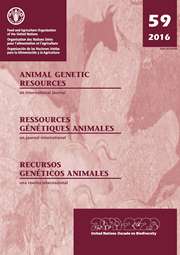
Besides these, the appearance of a Yakutian cow as a cover illustration of the scientific journal Molecular Ecology Vol. 16, No. 18 in the year of 2007 (see also http://www.blackwell-synergy.com/toc/mec/16/18) is expected to further increase the awareness about Yakutian cattle particularly among conservation biologists.
Conservation implications
We conclude by overviewing the recommendations that can be considered in the current and future conservation of the Yakutian cattle as follows:
(1) Because the population size has fluctuated widely in its history, the data that should be collected include the overall number, the number of breeding bulls and cows, number of subpopulations and trends in population size, so as to allow monitoring the changes in numbers on an ongoing basis.
(2) Since the cattle are of significant sociocultural, spiritual and anthropological value to the Yakutian people, an in situ conservation strategy should be prioritized with special emphasis on preserving such values.
(3) The Yakutian cattle experience suggests that the sociodiversity in terms of a coexistence of different types of public and private farms is a safeguard for farm animal biodiversity.
(4) Development of viable ex situ breeding programmes at a proper scale by emphasizing the phenotypic characteristics of the breed can create a long-term and sustainable conservation programme.
(5) As the production efficiency of the cattle is relatively low, added value by linking the breed maintenance with the Siberian natural or cultural tourism and farm visits can help to improve profitability and thus facilitate their conservation.
(6) An integration of Yakutian cattle conservation with conservation programmes for other species, for example, the Siberian landscape conservation and the conservation of Siberian Tiger, would be beneficial and effective.
(7) Cryopreservation of spermatozoa, oocytes and preferably embryos of animals is a viable method to conserve Yakutian cattle breed in Siberia.
(8) When kept as live animals or/and as frozen material, more than one location is needed, because natural disasters, accidents and changes in financial resources can result in instant loss of a stock, especially in Siberia (Patterson and Silversides, Reference Patterson and Silversides2003).
Conclusions
In conclusion, this study has demonstrated the important roles of natural and social sciences and arts in conservation biology, which at its best should be an integrative and collaborative science. Our study promoted the collaboration between geneticists, social scientists/philosophers, artists and the public, and generated new opportunities for public discussion on and interaction with conservation biology. Although joint actions by arts, natural and social sciences are a new phenomenon in the conservation of farm animal resources, all the participants have been intrigued and found the collaboration beneficial. There is common agreement that interdisciplinary activities work towards better success in conservation efforts. Thus, the multidisciplinary collaborative study reported here has proven to be effective and successful. Similarly, the multidisciplinary collaborative study applied here can easily find its application in the conservation of genetic resources of other domestic animals, wild animals or even plants.