Introduction
‘Now you see it, now you don’t’.
That’s a common enough expression in everyday speech, implying that we do not always register everything that is going on around us. It is not unlike the smart remark ‘heads I win, tails you lose’ that induces us to realise that we haven’t quite grasped the situation. That is often followed by the withering feeling that we are being taken for a ride – or even fooled.
This brings us to the world of illusion and hallucination, reminding us that we are continually subject to similar events in our day-to-day existence. Some, like the convergence of railway lines at the distant horizon, are trivial and are of little concern. For the neurophysiologist, the concept of illusion resides in disturbed perceptual interpretation resulting from an imbalanced integration of two rival afferent (incoming) signals. For Richard Gregory,Reference Gregory1 writing in The Oxford Companion to the Mind, illusions are discrepancies from the truth. He points out that it is only ‘when certain inconsistencies arise, or when there is a clear departure from how we expect things to be, that we sit up and take notice’.
‘How we expect things to be’: that is an important phrase and one we shall meet again in our exploration of the realms of illusory phenomenology. Nonetheless, seen from that particular viewpoint, illusions could be envisioned as pointers to the truth, and therefore the obverse of what we believe – or expect – to be true.
A great deal of illusory phenomenology pertains to visual effects and their misperceptions. There was a recent sense of unease in the UK (involving those, supposedly, who actually knew) that the government’s Ministry of Defence was closing the desk whose function was to record all sightings of unidentified flying objects (UFOs). For some, this came as an amusing end to a somewhat idiosyncratic British pursuit, but perhaps for others, it was the inevitable realisation that everything cannot be taken for granted and is not always what it might seem to be. Even worse has been the penchant for regarding ‘crop circles’ as manifestations of some kind of other-worldly activity and a sign of life beyond the territorial confines of the known universe. We need not talk about little green men from Mars – or even the Indian Rope Trick. How easy, it seems,Reference Loxton and Prothero2 that so many people can be duped by these and many other alleged happenings!
In this article, I wish to delve more deeply into the concept of illusion, its important borderline with hallucinations, briefly how the brain is involved, and that the outcome of many of these phenomena does condition certain beliefs – or misunderstandings. Such beliefs and assertions can result in a minority counter-cultural revelation or way of life which, for the rest of us, seems either untenable, a waste of time, or frankly stupid.
Sensory Aspects of the Illusory State
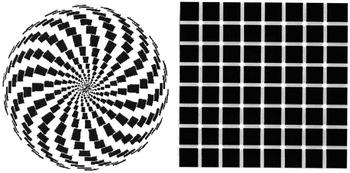
As we saw above, the majority of illusions are visual in nature, simply because for humans, vision is largely the predominant modality in our lives (Figure 1). By illusion, I mean an event which, although weird, is perceived or demonstrated to be false. Conversely, I take hallucinations to be cerebrally-engineered phenomena that are viewed by recipients as true happenings. However, the distinction is by no means absolute, nor clear-cut.
These are two, common visual hallucinations accessible on the internet. The left-hand panel appears to be a spiral, but really comprises a series of concentric circles that diminish in size towards the centre. The right-hand panel depicts a grid. How many bright spots at the inter-sections of the grid are present?

In order to perceive as well as understand commonplace illusory phenomena, we must understand how things really are: for example, apart from knowing that distant railway lines never converge, we know we can neither walk through a rainbow nor slide down a sunbeam.
Perceptions of nature usually occur within our brains and not necessarily at the point of sensory input, whether the eye, ear or nose. Of course, if conditions are not appropriate, we may misconstrue signals impinging on sensory receptors such as the eye (retina) because there is not enough light or the object viewed is too far away or – alternatively – because a sound is reflected in a particular manner we erroneously believe that its origin is located elsewhere.
A film consists of a series of consecutive ‘stills’, yet when projected at an appropriate speed, it provides an uninterrupted sense of continuity and a real portrayal of a seemingly natural world that can convey intense feelings of terror, fear, love and anger. And although stereo sound and 3D vision are abstract constructs, we enjoy the music or depth of visual field as something real and current, and not as a series of digitally-encoded signs that, for example, could have been assembled years previously. Moreover, we have no difficulty in accepting that the sound of filmstars’ speech comes from their mouths, and not from the loudspeakers hanging on either side of the screen. But again, for the illusion to work, the visual and auditory components must be in perfect synchrony, otherwise we immediately sense the artificiality of the event. And we pay little regard to the wheels of a vehicle seemingly turning in reverse, despite its forward motion during the filming sequence.
We should note that the act of looking – or, more properly, the acquisition of observational skills – enters into the equation here, and is relevant to every incoming sensory system. The good detective can always pick up a key background sound that immediately locates the source of the taped recording, and which is the clue to discovering the villain and securing his conviction.
Yet the acquisition of good observational skills requires diligent practice. A useful exercise involves spotting the ten differences between two apparently similar pictures. This is a good exercise for children as it teaches them to carefully observe, thus to learn how to use their seeing critically. In general, people are very poor witnesses to events, and if such happenings are associated with high levels of anxiety, such as an armed burglary or violent assault,Reference Morgan, Hazlett, Doran, Garrett, Hoyt, Thomas, Baranoski and Southwick3 attempts at recall or identifying the likely criminal from a line-out can be very difficult and thus unreliable. And given that during a waking day our retinal fields are bombarded with countless stimuli, many of which never reach conscious awareness, it can be appreciated how trained observation is critical for good discernment and the acquisition of good recall (memory) of key events that otherwise would have little chance of entering conscious-awareness.
In one study,Reference Marsh4 experimental subjects watched a staged crime scene. Afterwards, one group of observers was asked to write down a description of the perpetrator. Both groups then faced a line-up of random characters and were asked to identify the suspect. Those initially required to compose written descriptions of the suspect fared worse in a subsequent identity parade compared with those who went straight from the scene of the crime to the line-up. In other words, recall is not the same as retelling, the latter being adversely influenced by a previously-noted, and hence selectively-biased – even skewed – ‘memory’ of the event under consideration. Such a difference may well influence the later retelling, for example, of near-death experiences.
The Cerebral Nature of Illusory Phenomenology
Having briefly considered the external sensory perception, and misperceptions of sight and sound, we now need to consider the cerebral, or central, basis of illusory perceptions. This can be pursued from physiologically-contrived occurrences to those associated with common pathologies affecting the brain – especially migraine and epilepsy.
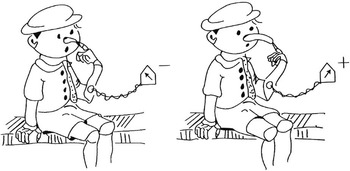
Perceptions of the shape, orientation and position of one’s body can be instantaneously altered by various experimental manoeuvres, indicating how normal people with normal brains can easily be deluded about their location or movement. One interesting outcome is the ‘Pinocchio effect’. A small electric current when applied to a muscle tendon, say the biceps, induces the brain to think the muscle is moving. If, simultaneously, the fingers are in contact with the nose, the dual rivalry between each stimulus makes the subject feel as though his nose is growing – to accommodate both the nose-touching and the sense that the elbow is being extended (Figure 2).Reference Goodwin, McCloskey and Matthews5, Reference Lackner6 For some subjects, the illusory elongation of their noses reached 30 cm. Likewise, if you cross your fingers and run them down your nose, it seems as if there are two noses.
Instances of sensory conflict may produce erroneous and illogical outcomes. With the ‘Pinocchio Effect’, the current applied to the biceps tendon at the elbow induces the subject to believe his arm is being extended. But, in order to accommodate the additional sensory information that the fingers of that hand are in contact with the nose, the illusion of nose extension obtains as well.

Distortions of body shape and position occur in ~15% of migraine sufferers, are depicted in migraine artReference Podoll and Robinson7 and may involve the presence of a double (or ‘doppelganger’), or the actual experience of owning two bodies. In one instance, a 37-year-old housewife was able to observe herself dealing with her family but from another apparent location: ‘it was as if I was in another dimension,’ she declared. ‘There was “I” and there was “me”’.Reference Lippman8 There may be sensed changes in body or limb size (microsomy and macrosomy), or a perception as if the body, pendulum-like, were swinging into and out of the adjacent phantom. These observations clearly have a bearing on the concept of self as a supposed unified experience
A feature of temporal lobe epilepsy is the ‘aura’ which precedes the actual fit. Auras may comprise a vast array of disordered sensations, bodily dispositions and other aberrant phenomena. Here is a typical case report.Reference Devinsky, Feldmann, Burrowes and Bromfield9 A 29-year-old man felt himself to be ascending to the corner of the room, thence to view his motionless body, followed by his ‘mind’ moving freely around the house and viewing family members in other rooms.Reference Brugger, Regard and Landis10
From all this, it is not too difficult to envisage how literature has become replete with characters of varying size – the so-called ‘Alice-in-Wonderland’ effect based on Charles Dodgson’s (alias Lewis Carroll) personal experiences as a migraineur, or Dostoevsky’s epilepsy, and so on. From these personal phenomenologies we derive the origins of a fabulous literary world of elves, dwarves, giants and beasts, whether benign or of a frightening disposition.
These brief excursions acquaint us with varied mechanisms whereby otherwise normal subjects undergo illusory events where the mind seems to escape corporeality so as to freely wander around, or in which the body is wholly or partly reduplicated. Some of these experiences are extremely real – that is, they are hallucinatory and fully believed, if only momentarily. Stories or dreams can be very frightening for children, yet we eventually grow out of these false beliefs even though they may colour our personalities, beliefs and preferences for the rest of our lives.
The Phantom Limb Phenomenon
These sentiments lead us to consider the situation in which the body reconstructs a body part that no longer physically exists – known as the ‘phantom limb’ phenomenon. But there is a strict difference. During moments of illusion or frank hallucinatory experience, any form of visual, auditory, kinetic or ethereal ‘reality’ can be engineered through the brain’s almost infinite compositional resources. Conversely, the phantom is a precise, specific memory of the part that no longer physically remains as a functional attribute of the body.
This curious terminology and phenomenon of the phantom limb arose from the experiences of amputees after the American Civil War. Although most commonly associated with loss of a leg or arm, the surgical removal of a womb, bladder or rectum may give rise to a persisting phantom engendering cramping pains, a need to evacuate, or lower abdominal bloating. A similar phenomenon obtains in the case of paraplegia where, because of a break in continuity of the nerves within the spinal cord, the subject does not know the disposition of his limbs unless he looks and remembers their position.
More interesting is the position regarding children born without one or other limb. Once they become articulate, they recall transient memories of part of a finger, palm or joint. One little girl was reported to complete her mental arithmetic with her phantom fingers. All this testimony is compelling because these little ones are not simply describing what they see in other normal children. The residuum of recalled memory suggests that we are all born with a rudimentary, inbuilt body image.Reference Poeck11 Obviously, in these abnormal situations, there can be no further continuity in updating of ‘body image’ relevant to those non-existent body parts. Nevertheless, throughout normal existence, the idea of body image in all of us is continually updated as we change and become older. We grow, we experience pubertal and post-pubertal changes in various organs, and with approaching old-age, height decreases, the effects of obesity set in, and body shape alters as female hips widen while men’s abdomens protrude forwards. A sense of a body does not merely reside in sensory cortex, but has a much wider representation in the brain. Although these neurophysiological details need not detain us, they were gleaned from brain scans of an adult woman born without arms or legs.Reference Brugger, Kollias, Muri, Crelier, Hepp-Reymond and Regard12
Phantom limb phenomenology (so-called), like conscious-awareness, expresses the overwhelming belief that this is ‘me’, this is what ‘I’ am actually experiencing and perceiving, despite the imagery being engineered by the brain. This idea of corporateness and personal agency expresses the essence of body image, that is, of a self, uniquely, entirely and totally unshared with, or related to, any other individual. More interestingly, as recently demonstrated by Professor Ramachandran (University of California at San Diego), is that a phantom is a ‘learned’ situation, and, because the part is no longer seen, the brain may likewise ‘forget’ it, so that in some reported cases the phantom may become ‘paralysed’. This may result in much pain if the phantom fingers are cutting into the palm of the hand – an experience which in the absence of his right arm afflicted Lord Nelson.Reference Sacks13
Ramachandran argued that if the phantom could be ‘relived’, the brain could be re-educated into believing that the part was still viable and moveable. Thus, he contrived the idea of providing a box containing mirrors, thereby enabling the subject to manipulate the hand (by viewing an image of the other normally-functioning hand and arm), relieve the paralysis, remove the pain, and thereby improve quality of life. This was an amazing discovery and has enormous implications for the way in which the brain remembers past events, and how it can be disabused of illicit actions.Reference Ramachandran and Hurst14
This brief excursus has introduced us to certain aspects of the widespread illusory/hallucinatory nature of waking conscious-awareness. Through these various examples, I have provided illustrations as to how the brain can emulate a part no longer physically present, while also being tempted into conceiving other physiological and pathological situations that are either impossible anatomically or which locate conscious-awareness in places beyond the physical confines of the body, or even the brain.
So our next quest is to determine the cerebral localisation of our sense of body image.
The cerebral locus of body image
For brevity, we can pursue one line of evidence that has gone a long way in elucidating the answer to our quest – studies of drug-resistant epilepsy. Here, current diagnostic approaches have enabled neurophysiologists to examine the cerebral locus subserving body image. This is located in the lower part of the right parietal lobe and the junctional area with the temporal lobe (Figure 3).
The posterior (rear) aspect of the right parietal lobe comprises the superior (Brodman areas 5, 7) and inferior (Brodman areas 39, 40) parietal lobules. These together with the adjacent temporo-parietal junction create a virtual image of the body, and its relationship to the environment. This it does by synthesising incoming sensory signals from movements of the eyes, neck and head and other joints, tactile information from the skin, and a ‘vestibular’ aspect concerned with posture, verticality, and gravity derived from structures within the inner ear. This information is welded to additional motor signals, memory and affective inputs from other brain areas. This area of cortex consists of a vast collection of multi-sensory neurones that underpin the activities of this supra-modal area of the cortex. It is not surprising that disturbances to this region (through migraine, epilepsy, haemorrhage, and circulatory failure) can result in several types of illusory and hallucinatory outcomes.

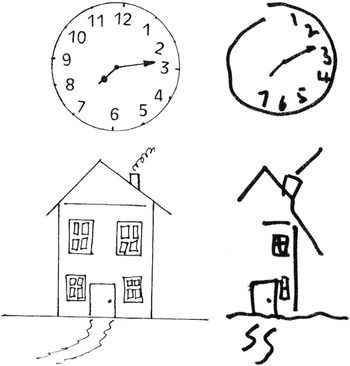
Of course, on clinical grounds it had been known for a long time that stroke damage to this area of the brain (on the right) could result in the syndrome of ‘hemi-neglect’. Such patients no longer have concern for – or even knowledge of – the left-hand side of their bodies or their environment. If recumbent, they would attempt to eject the ‘foreign’ (left) leg from the bed, or even ask a nurse why it was necessary for another patient to occupy the same bed. When asked to draw a clock-face or a human face, the numbers from 7–11, or the left-hand side of a face, are invariably omitted by such patients (Figure 4).
Spatial hemi-neglect. Patients with pathology (i.e, a stroke) involving the temporo-parietal zone of the right cerebral hemisphere draw clocks and faces lacking detail on the left. These are typical ‘textbook’ illustrations.

But to return. Critical insights have been derived from cases of severe temporal lobe epilepsy. In these subjects, multiple small electrodes are placed underneath the cranial vault overlying the region of the temporo-parietal junction. Internal brain currents identify the focus of the epileptic discharge, and this area is then removed neurosurgically. This procedure either cures the patient, or brings therapy into a more reasonable range once again.
The (experimental) converse is to apply currents of various strengths to all the underlying regions of the brain through the electrodes now in place. In one such subject,Reference Blanke, Ortigue, Landis and Seeck15 the lady reported a sense of ‘floating’ as much as 200 cm above her bed, ‘sinking’ into the bed, and ‘falling’ from a great height. At higher currents, she saw her body from an elevated position while on another occasion, in thinking that her right arm was coming towards her, she moved her head out of the way. In other words, although fully conscious and not under the influence of any mind-altering drugs, she simultaneously experienced a hallucination that was real enough for her to took evasive action. Like the migraine patients noted above, here is another example of duality of conscious experience – normal plus an aberrant state. The latter is either illusory, and perceived to be unreal, or hallucinatory and perceived to be real.
Much work on the cerebral localisation of the region concerned in generating a sense of body image has been carried out by Olaf Blanke (from Geneva) in association with many other colleagues. In a substantial review of the relevant literature, Bunning and BlankeReference Bunning and Blanke16 showed that the temporo-parietal junction (Figure 3) plays an important role (a) in coordinating multi-sensory inputs (from the eyes, joints, and skin) in respect of one’s own body and (b) integrating vestibular functions (structures within the inner ear) about corporeal and extra-corporeal space into a virtual image that portrays, to each individual, the position of the body in space (ego-centric space perception), the body’s relationship to the near environment (peri-centric space), and the feeling of self-agency.
In addition, this system allows us to overcome gravitational forces. Perhaps we are never conscious of the fact that, as we grow, the body needs to counteract gravity by maintaining anti-gravity musculature. This provides the innate ability to perceive verticality – that is, to remain upright and even balance a full cup of coffee without spillage in the dark when visual clues are absent. On the contrary, our seeming inability to use our legs during rapid eye-movement (REM) dream-sleep mode when trying to escape danger, is due to automatic paralysis of our anti-gravity muscles. This is a physiological control preventing injury arising from sleep-walking.
A lack of gravity causes considerable disorientation of the body, especially affecting astronauts during micro-gravity conditions while training or undergoing space flight. They have to learn not to over-respond when performing tasks, since less effort is required. Even on earth, we normally experience vestibular feelings of spinning or rocking when coming off a fairground roundabout or disembarking from a ship that has just weathered heavy seas.
While there are other associated areas in the brain that contribute to self-processing, it is strongly the case that the temporo-parietal junction is a key location not only in the critical integration of multi-sensory inputs, including the vestibular system (information from the semi-circular canals and gravitational sensors within the inner ear), but which together contribute to and underpin the management of the many phenomenological and cognitive aspects of selfhood.
The Out-of-Body (OB) – and Near-Death (ND) – Phenomenon
I have briefly sketched the concept of body image, its contribution to our sense of self, agency and position within the environment, and the major influence of the cortical region between the parietal and temporal lobes, particularly on the right, as its contributory focus. In passing, a few examples have illustrated how body image is vulnerable to migrainous and epileptic disturbances affecting this important integrative brain centre, while the phantom limb phenomenon informs of other cerebral mechanisms concerned with our sense of body.
On the other hand, stories of people’s apparent emergence from their bodies have been part of history and folklore throughout the ages: in this section I wish to explore some of those illusory/hallucinatory experiences (out-of-body (OB) and near-death (ND) experiences) and to relate them to current understandings of body image and the self, based on current neurophysiological research. These views are directly contradictory to those who continue to insist that OB/ND experiences represent occasions when mind, soul or consciousness escape their physical boundaries, thus to freewheel around the operating room or a hospital corridor – or other parts of the cosmos. The issue is plain: is an out-of-body experience (OBE) something ‘mystical’, or can it be construed merely as a temporary perturbation of a very complex neural system within the cerebral cortex?
Much of the reported content of OBE, and the related near-death experience (NDE), refers to apparent motion: flying, ascending, floating, spinning, and falling or bumping back into one’s body. Dreams exhibit similar phenomenology, such as skimming over water, falling from great heights, or climbing ladders that seem to be tipping the climber backwards. All such fictive movement is referable to the ‘vestibular system’, which as we have seen above, creates a virtual image within conscious-awareness of body-shape (egocentric), and of its relationship to the immediate environment (paracentric space).
The common illusory state of floating beneath the ceiling represents aberrant perceptions of body position and false localisation of conscious-awareness. Floating and weightlessness reflect a reduced sense of gravity due to the horizontal bodily position invariably imposed during medical resuscitation. Moreover, the horizontal position, which is a strong cue for precipitating OBE, reduces the sensitivity of the weighted hairs within the utricle (inner ear) to gravity. The utricle is also involved in feelings of rapid linear accelerations – another common accompaniment of OBE. If we believe that viewpoint, then we have already removed one large chunk of the so-called ‘mystical’ phenomenology attributed to these events.
But now we must delve more deeply into NDE themselves.
Over 80% OBE/NDE are the result of a severe antecedent metabolic crisis (cardiac arrest; haemorrhage or cardio-vascular collapse; inhalation of a ‘dissociating’ agent such as nitrous oxide – as commonly used obstetrically or in out-patient clinics; and so on). All NDE have to come to an end, and sometimes, very abruptly, as conscious-awareness is regained. For example, consider these accounts:
[I was]...in a crypt... waiting for my parents... Suddenly it was all gone – it ended abruptly... I felt tremendous pain and made a decision …
Or,
The thing I remember most is a falling.... I was coming down real fast and then hit... I woke up with a jolt.
That time-point is not only enormously significant, but of critical, objective value.
First, because the phenomenology recalled by subjects is obviously taking place during those final moments when consciousness is being re-established.
Second, word-counts (employed by dream researchers to estimate the length of dreams) suggest that, in the majority, most NDE last approximately only seconds – or perhaps a minute or two.
Third, the event is remembered and later recalled. But ‘dead brains’ (note: nobody actually dies during NDE, despite the appealing use of language) do not put down memories. Therefore, these events cannot occur when the brain is non-functional, but only during the ascent to full conscious-awareness, directly analogous to vivid hypnopompic dream awakenings.
Fourth, it follows that NDE are not vague celestial day-trips, nor the result of mind, soul or consciousness ‘escaping’ from their physical confines (a dreadful Cartesian slip), but brain-engineered phenomena conjured up during the recovery from antecedent metabolic stress.
There is good empirical evidence underpinning my assertions,Reference Marsh17 derived from suicide attempts off the Golden Gate Bridge, medical students purposely inducing fainting attacks and military aircrew centrifuged to unconsciousness. In these examples, we have a series of varied awakenings, but from a preceding state of reduced conscious-awareness, and over (laboratory-) measured time-frames, during which the phenomenology experienced hardly differs from NDE. When later interviewed by psychiatrists, suicide subjects recounted evocative episodes of being in the light, and at peace with themselves. Moreover, the investigating military physiologists emphasised how pilots’ brains, within such a very short period (<40 s), were able to conjure emotionally-charged scenes of great beauty and warmth, and to set them into memory. Clearly, mnemonic function returned very quickly while these subjects’ brains were recovering from each precipitating circumstance (and despite post-centrifugation confusion).
The somewhat more specialised example of movement through a ‘tunnel’ probably has a multi-layered explanation. Despite the inaccurate, conceptualised notions about OBE/NDE, which the media repeatedly caricature, the so-called tunnel phenomenon is one of its less common facets, alleged in one meta-analysis to affect only 10% OBE/NDE subjects.Reference Drab18 The experience of a tunnel invariably relies on two recalled aspects – fictive acceleration and the perception of a ‘light’ that appears to grow larger. The latter is probably related to the re-establishment of visual competence following the blackness attending the period of depressed conscious-awareness once the crisis is beginning to be overcome. So the combination of a hallucinatory phase of acceleration and the enlarging pool of light perceived by the visual cortex together are misinterpreted in terms of imagined movement through a tunnel and towards a light.
Obviously, there can be no geo-physical coordinates demonstrative of the supposed ‘tunnel’, which in the majority of accounts is informed by idiosyncratically-detailed reminiscence. Clearly, the experience of passage through this imagined phantasm is a brain-engineered hallucination.
Yet we continue to see a trickle of best-sellers exploiting the individual experiences of those subject to these events, whether through brain trauma resulting from a road-traffic accident, delirium consequent upon meningo-encaphalitis or some other bodily septicaemia, and the influence of drugs or anaesthetics, such as nitrous oxide when used in obstetric practice or in the reduction of simple fractures. Clearly, this is the kind of material that the public has an insatiable penchant for reading, irrespective of its critically contradictory explanatory base.
The Dutch cardiologist Pim van Lommel published a series of OBE/NDE accounts obtained from his patients undergoing cardiac arrests. Notwithstanding the overriding difficulty in accepting a ‘mystical’ rather than neurophysiological account, van LommelReference van Lommel19 has continued to assert that otherworldly psycho-phenomenological testimonies provided by subjects undergoing these events uphold the concept of a ‘Cosmic Consciousness’.
This emergent view, based partly on NDE reports, is additionally buttressed by those professing specific memories of being born and recalling their emergence from the womb and immediately thereafter, together with the collective deposits based on paranormal and telepathic experiences of future events and possibilities, and so on.
The binding factor for all this is seemingly based on energy-based waveforms, derivative of the micro-world of classical Quantum Mechanics, but extended into the macro-world – not only of every day existence and experience, but also firmly welded to all that exists outside normal earthly existence and experience. And it is this adherence to waveforms out of which arises the concept of a (so-called) ‘Cosmic Consciousness’.
Thus, our puny little brains are seen as mere receptors of a small bit of that universalised cosmic consciousness. However, at certain times, some people apparently find themselves beyond the physical restrictions of that brain – despite its billions of neurones, and even larger collections of synapses – so can taste reality as it actually should be tasted – with higher powers of thinking and knowing; of seeing and understanding all things in a more lucid light; and with such greater insights than when we are simply mucking around here on earth.
On van Lommel’s account, NDE’s do not need any more elaboration or critical analysis. They already constitute one certain, indelible element that ‘proves’ the afterlife, even though occurring when the subject is only ‘clinically’ dead (as they say). But, it should be noted, these subjects are not dead in the sense that they are awaiting the arrival of the undertaker’s hearse.
I simply want people, first, to be aware that van Lommel, with others, such as Mary Grey,Reference Grey20 have passed beyond any further questioning of the validity of NDE as pointers to some kind of afterlife, and second, to understand the implications of such speculative adventures, of which Cosmic Consciousness seems to be the ultimate aim – if not end.
Others, however, might wish to disagree with such tendentious assertiveness.
Inhabiting Cloud Nine
From OB/NDE, we move to another area of phenomenological interest, involving the sensing of ‘presences’ and the perception of ‘doubles’. We have already gleaned some insight into the workings of the brain and learned that if either the whole brain or a part remains unstimulated, it will conjure up its own show, which then intrudes into the subject’s conscious-awareness.
I begin with reference to the Charles Bonnet syndrome – described by an eighteenth-century naturalist. It affects those with blindness, so that few or no impulses are conveyed to the visual cortex and its other pathways within the brain. As a result, the cortex begins to serve up its own (internal) menu of the most fantastic series of optical illusions, ranging from geometric patterns to complex visual displays of people or vast panoramas. Some of this material is newly created, meaning that it does not form part of the subject’s past memory: particular creations are quite bewildering – even sensational.
From that we can consider the illusions of those whose work or pastimes involve environments lacking much in the way of sensory input or variance. These include long-distance lorry drivers, round-the-world sailors, travellers crossing deserts or polar ice-caps, high altitude pilots, mountaineers and even marathon runners. This condition is what neurophysiologists term ‘prolonged perceptual isolation’, and it has been experimentally addressed by having subjects enclosed in soundproof cubicles, using special clothing to reduce tactile stimulation, and wearing low luminescence goggles. More effective are darkened tanks of warm water which reduces considerably outside cutaneous stimuli, particularly those that inform body image or the influences of gravity.
During these periods, subjects’ visual experiences comprise geometrical forms which give way to high intensity coloured imagery whose brilliance was never previously encountered: here there is a direct analogy with the beautifully coloured pastoral scenes undergone by NDE subjects. Voices may also be heard, while an acute loss of sensory input and reduced gravitational force (through floating) can be very disabling about one’s sense of self, as well as orientation in space.
One subject, a graphic artist, was blindfolded for almost three weeks. During brain scanning (fMRI) her visual cortex and other higher centres became active during her hallucinatory episodes. However, when she was asked to imagine or recall these hallucinations, there was much more additional activity in the executive frontal regions of her brain, clearly indicating that it was the visual pathways themselves that generated the hallucinatory content.Reference Sireteanu, Oertel, Mohr, Linden and Singer21 Very fit, experienced mountaineers when ascending to altitudes exceeding 6000–8000 metres without oxygen invariably sense a ‘travelling companion’ either by their sides or behind them. These companions arise from multiple causes, principally hypoxia, loneliness and the threat of danger:Reference Brugger, Regards, Landis and Oelz22 marathon runners sometimes experience these ‘doubles’, most likely enhanced through dehydration or body sodium losses.
Techniques specifically designed to achieve ‘mystical’ states or other forms of spiritual knowledge have employed analogous methods, such as extreme fasting, isolation, sleep avoidance, retreat from all social contact, and continuous meditation on certain words or religious themes. In a detailed examination of seven ecstatic Kabbalistic writers and their methodologies from the thirteenth century, Shahar Arzy and colleagues have likened the end result to autoscopic or heautoscopic experiences.Reference Arzy, Idel, Landis and Blanke23 Autoscopy involves seeing an illusory ‘mirror-image’ double of oneself, while heautoscopy is somewhat more ambiguous since conscious-awareness now oscillates between the hallucinated double and the subject.
From that, it is not too difficult to realise that invisible ‘mystical’ presences may likewise emerge following severely restricted behavioural paradigms. Although we may therefore derive some neurophysiological insights into certain so-called ‘religious experiences’, commerce with the truly divine is by no means exhausted by such restricted anthologies. Neither do these examples provide evidence that religious belief is merely a cerebral artefact, any more than knowledge of the underlying neurochemistry of a kiss robs it of its deeply significant role in inter-personal relationships.
Now You See It, Now You Don’t: Or, What’s that Gorilla Doing over There?
Having briefly observed how the brain, through migraine, temporal lobe epilepsy, phantom limbs, and OB/ND phenomenology produces a rich variety of illusory and hallucinatory experiences, I wish to return to some of the issues I raised in the introductory paragraphs. For centuries, people have been hoodwinked into the so-called magical world of conjurors and sorcerers, but that expertise, accumulated and passed on over the years, is now attracting serious neurophysiological attention.Reference Macknik, King, Randi, Robbins, Teller, Thompson and Martinez-Conde24
When we watch a conjuror in full swing, is he really employing magic? Well, no. So, which kind of process is employed as these illusions take place? And what’s all this about gorillas?
Clearly, most of the deceit is visual and highly dependent on the manner in which we use our eyes. Indeed, it is the way in which we focus our gaze that allows us to be taken off our guard – even though we are looking hard to elicit that revelatory, tell-tale, deceitful sleight of hand. But perhaps most important is the alluring – even hypnotic – technique employed by the maestro in drawing our minds and visual attention to things that distract us, so preventing us from elucidating his or her methodology. The ‘trick’ may well have been completed long before we know it has begun.
We think we are good at viewing our environment and thus how we use our eyes. Yet that knowledge depends on repeated ocular scans (so-called ‘saccades’) of the terrain under inspection. The rest is done by the brain, which edits and creates for us a verisimilitude of those myriad stimuli hitting our retinas. If that were not so, our lives would be as bumpy as residence on a ‘bouncy castle’.25 In other words, we see with our brains, not with our eyes: our external world is but forged from cerebrally-built virtual imagery – the point of interest depending on the relative strength, or salience, of incoming signals.
Moreover, if we hold our gaze on a centre of interest, the eyes still make micro-saccades in scanning that object. Computerised technology clearly demonstrates that without saccades of either type, we hardly see anything. This has been demonstrated by asking subjects to fixate specifically on a light in the centre of a picture flashed onto a computer screen. If the subject then happens to initiate a saccade, the computer switches off the picture, and if repetitive saccades are made, the subject gains no knowledge of the view being screened. With such a fixed gaze, only 0.1% of the retinal field is actively involved. The remainder of the retina contributes scarcely anything to the subject’s visual knowledge.
So, in focusing our minds and eyes entirely towards a centre of interest, as the magician intends while he performs his trick, we see nothing else that is going on in the background – and where the deception then safely takes place.
Let’s put that knowledge to the test. The famous experiment, as a potent demonstration of these truths, was devised by Christopher Chabris and Daniel Simons from the Psychology Department at Harvard.
The set up was simple.
Two teams of students wore either white or black shirts and played basketball. Once the filmed episode had been edited to last a few minutes, other volunteers were shown the film and asked to count the number of direct or bounced passes between members of the black team only. However, during play, a female student wearing a full-body gorilla suit walked into the centre of the arena, stopped to face the recording camera, beat on her chest (as all female student gorillas are wont to do when facing the cameras), and then vanished into the woodwork.
Only ~50% Harvard students throughout the campus observed the gorilla. The others were almost disbelieving when – having declared not to have observed any other irregular occurrence – they were informed about the gorilla in their midst. On watching a replay, they insisted that the disc had been swapped.Reference Chabris and Simons26 This demonstration lucidly exemplifies how little we actually observe (yes – ‘observe’, not just ‘see’) – particularly when we are concentrating very hard on a specified task, as in the basketball counting. It also reaffirms the principle that what we do not expect to see will neither be seen – nor missed.
‘Think – Cyclist!’ This is a recently-introduced road sign warning us of the danger inherent at road junctions. Usually we only expect to see cars, and that’s what we look for, thus missing vulnerable cyclists. The other problem is that if we do not encounter many cyclists, the longer-term effect of the sign on our brains – and hence attention ultimately diminishes. Therefore, to avoid a collision, it is important that drivers school themselves to be alert at all times by asking themselves if a cyclist is in view before they accelerate and cross the junctional white or yellow road markings – and on every occasion, too.
This illustrates the important behavioural principle of ‘inattentional blindness’ – that is, in the absence of an expected occurrence, we will not see anything else in our field of view. That is borne out by computerised eye-tracking: it was subsequently demonstrated that all viewers’ eyes did alight on the gorilla while watching the filmed clip, but that its presence simply was not registered into consciousness because of the task given to the volunteers. To be good observers, we need to train our visual capacities, much like violinists or singers having to train their ears to be acutely aware of their tuning whilst performing. In order to develop any sensory skill, we need to concentrate on observation: that is the key here.
We see far less than we imagine and we are extremely poor at detecting change: our memory of things ‘seen’ is far more inaccurate than we are ready to admit, and we know much less than we think.Reference Arzy, Idel, Landis and Blanke23 These deficits do have functional outcomes and affect many other people in certain critical situations. For example, radiologists fail to detect lung cancers when evaluating chest X-rays even though the tumour was visible long before the diagnosis ultimately came into view; pilots ‘landing’ large airliners in cockpit training-simulators often miss a purposely introduced jet crossing right in front of their final descent pathway; while motorists’ driving skills are very severely compromised and hence present a threat to other road users when a phone message is being listened to.Reference Hallinan27
Clearly, the gorilla experiment points to other outcomes that are not meant simply to be funny. Indeed, ‘gorillas-in-our-midst’ articulates behavioural warnings that portend grave, morally significant outcomes.
All Smoke and Mirrors?
Through the acquisition of skills, conjurors have found out how to deceive people by diverting their attention, and convincing them that they are watching the centre of interest, while the deception actually takes place elsewhere, beyond the area of directed visual perception. It is analogous to the way in which breeders of cattle, racing pigeons or horses have successfully developed highly competitive or economically useful stock without any knowledge of genetic background. Likewise, magic is conducted in the absence of any neurophysiological understandings about the weaknesses in our visual capacities, or of the manner in which the brain (cognitive attention) – in being so easily drawn to one focus of (supposed) interest – will fail to put into consciousness less salient incoming signals. Two visual neuroscientists, Stephen Macnik and Susana Martinez-Conde (who are married to each other as well as enjoying membership of the Magic Circle) have made an issue of the parallels between neuroscience and the art of conjuring.Reference Macknic and Martinez-Conde28
During a combined congress of magicians and neuroscientists, Susana was pregnant and having to endure morning sickness. During a virtuoso performance, which was the last thing she wanted to be spending her time watching, she happened to look up casually to observe the incomparable magician stuffing a lemon into his left hand beneath a handkerchief! Unbeknown to everyone else in the hall (who were not only enthralled by the magic but also completely hoodwinked into the bargain through having their attention diverted miles away from the conjuror’s left hand), the lemon contained a playing card signed at the start of the trick by a volunteer. You need to look in the right place at the right time. But that’s the problem – we’re lured away by extraneous procedural irrelevancies that prevent us from detecting the critical operational process.
The con artist operates in a different manner. In drawing close to his subject in order to remove items of value, he must first enter the peri-centric space of that person, accomplished by sidling up to him, rather than through face-to-face encounter, which everyone finds unnerving. The trickster then specifically touches or bumps up against those areas he will invade: this produces a neural ‘afterimage’ (another example of inattentional blindness), which reassures the subject that his or her belongings are still in place – and safe, but which facilitates their undetected removal. And before you know it, he’s had your wallet, removed your wristwatch and fountain pen, and pocketed your wedding ring. If it’s a magician on stage, he usually returns the ‘stolen’ goods – to everyone’s amusement, but not the professional pickpocket who has now moved up the street or crowded train to relieve another unsuspecting victim of their credit cards and Rolex watch.
Maybe you should just check that your wallet is where you thought it was. These damned gorillas – they’re everywhere!
Michael Marsh resigned from academic clinical practice and biomedical research in the University of Manchester in 1999. Having then gained a First in Theology (BTh, Oxford, 2002) he returned to Magdalen College, Oxford, 40 years after medical graduation, to write his DPhil thesis on ‘Out-of-Body & Near-Death Experiences: Brain-State Phenomena or Glimpses of Immortality?’ (under Professor John Hedley Brooke’s tutelage), and later published in the Oxford Theological Monographs Series, (Oxford University Press, 2010). His new book, entitled On Being Human: Distinctiveness, Dignity, Disablement, Disposal, based on a series of public lectures that he convened at Regent’s Park College, Oxford, in Trinity Term 2011, is now being published. He is a member of Wolfson College, and a Fellow, The Oxford Centre for Christianity & Culture, Regent’s Park College, University of Oxford.