In 1996, the National Highway Traffic Safety Administration (NHTSA; Washington, DC USA) and the Maternal and Child Health Bureau (Health Resources and Services Administration; Rockville, Maryland USA) published the EMS Agenda for the Future, which highlighted the need for high quality, relevant, and meaningful Emergency Medical Services (EMS) research. Before the undertaking of this project, EMS research had primarily focused on a single issue within a single system.Reference Crowe, Bentley and Levine 1 In response to this call, the first Longitudinal Emergency Medical Technician Attributes and Demographics Study (LEADS) Committee meeting was held in August of 1998. This project, hosted by the National Registry of Emergency Medical Technicians (NREMT; Columbus, Ohio USA) with technical support from the NHTSA’s Office of Emergency Medical Services, involved a team of researchers that included State EMS Officials, State EMS Training Coordinators, EMS System Managers, Emergency Physicians, EMS Educators, survey researchers, and staff of the NREMT collectively referred to as the LEADS Committee. Table 1 displays the names of the individuals who have served on the LEADS Committee.
LEADS Committee Members and Staff

Abbreviation: LEADS, Longitudinal Emergency Medical Technician Attributes and Demographics Study.
a Original LEADS Committee member.
The overarching objectives of the LEADS project were to describe the attributes and demographics of the professionals providing EMS throughout the United States. Some specific questions that formed the basis of LEADS included:
-
∙ How are EMS professionals different from the US population with regards to demographic characteristics?
-
∙ Who is EMS as a profession?
-
∙ What factors affect the motivation of EMS professionals?
-
∙ What are the factors that influence attrition in EMS?
-
∙ Which EMS professionals choose to leave the profession?
In order to answer these questions, a cohort of nationally certified Emergency Medical Technician (EMT)-Basics and Paramedics was randomly selected to be followed for a period of 10 years. Data were collected through a questionnaire that was administered annually from 1999 to 2008. Each questionnaire consisted of a set of core items to allow comparisons over time. Additionally, each survey contained a “snapshot” component that focused on a specific issue of interest to the EMS community and changed each year. The core survey items focused primarily on the EMS population’s employment characteristics, working conditions, and job satisfaction. Meanwhile, snapshots targeted a variety of topics important to the EMS profession including compensation, driving safety, health risk, sleep problems, and occupational identity.
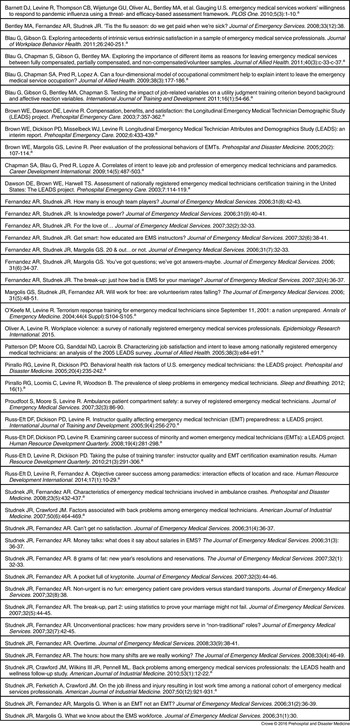
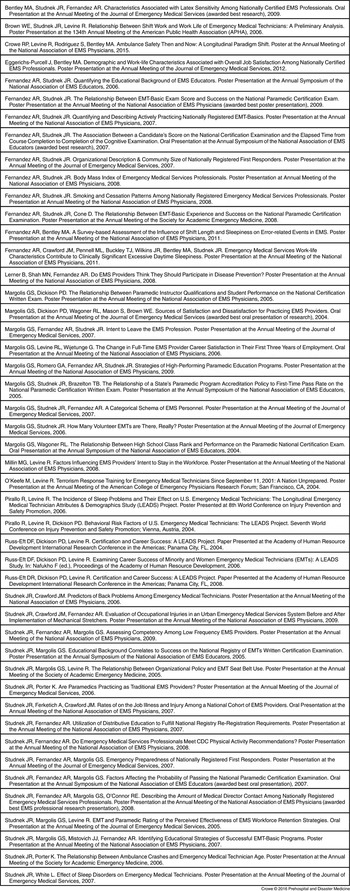
The LEADS project represents the first long-term study of EMS professionals on a national scale. To date, the LEADS project has served as the basis for 44 publications and 47 abstracts and presentations at meetings of professional societies, as well as two doctoral dissertations (Tables 2 and 3). The first seven manuscripts in this series highlight and synthesize key findings related to the profession of EMS from the first decade of the LEADS project.
Publications of LEADS I Data

Abbreviations: EMS, Emergency Medical Services; EMT, Emergency Medical Technician; LEADS, Longitudinal EMT Attributes and Demographics Study.
a Refereed journal.
Presentations of LEADS I Data

Abbreviations: EMS, Emergency Medical Services; EMT, Emergency Medical Technician; LEADS, Longitudinal EMT Attributes and Demographics Study.
The first manuscript included in this series, “LEADS study design and methodology,” describes the overall project approach including instrument development, sample selection, and data collection and analysis. The next manuscript, “The demographics and education of EMS professionals: a national and longitudinal investigation,” discusses changes in demographics, work-life characteristics, and initial EMS education experiences for EMT-Basics and Paramedics. The third, “A longitudinal description of EMS professionals by race/ethnicity” compares characteristics of white, African-American, and Hispanic EMS professionals. The fourth manuscript, “A national assessment of health and safety of Emergency Medical Services professionals,” examines 10 years’ worth of self-reported health data. Then, changes related to the remuneration of EMS professionals are explored in “Compensation of EMT-Basics and Paramedics.” The manuscript “Recruitment and retention of new EMT-Basics and Paramedics” discusses factors that are important for recruiting and maintaining EMS professionals. The last LEADS paper addresses aspects of the complicated topic of attrition in “Why do EMS professionals leave EMS?” The value of these seven studies is without doubt as their collective publication chronicles a decade’s worth of growth and is the first long-term effort on a national scale to understand and describe the nuances that distinguish the men and women who belong to the EMS profession.
In addition to presenting important findings from the first 10-year study of EMS professionals, this special supplement includes findings from a national effort to assess beliefs and opinions related to EMS professionals held by the public in the United States. The study titled “Public perception of Emergency Medical Services in the US” was conducted as the first LEADS project was coming to a close and aimed to assess the public’s beliefs and expectations related to prehospital emergency care and those who provide care in the prehospital setting. The collective contribution of these papers represents over a decade of work aimed to assess the development of the EMS profession and the public’s perception of those who provide prehospital care.