Introduction
Major depressive disorder (MDD) and social anxiety disorder (SAD) are two of the most prevalent internalizing disorders in the United States (Kessler, Petukhova, Sampson, Zaslavsky, & Wittchen, Reference Kessler, Petukhova, Sampson, Zaslavsky and Wittchen2012) and are characterized by significant impairment across multiple domains of functioning (American Psychiatric Association, 2013). Cognitive behavioral therapy (CBT) is an effective psychotherapy treatment for SAD and MDD (Cuijpers et al., Reference Cuijpers, Berking, Andersson, Quigley, Kleiboer and Dobson2013; Hofmann, Asnaani, Vonk, Sawyer, & Fang, Reference Hofmann, Asnaani, Vonk, Sawyer and Fang2012), yet treatment outcome is heterogeneous and approximately 34–60% of patients with these disorders fail to remit by the end of treatment (Cuijpers et al., Reference Cuijpers, Karyotaki, Weitz, Andersson, Hollon and Van Straten2014; Springer, Levy, & Tolin, Reference Springer, Levy and Tolin2018). One method for increasing the likelihood of treatment success while reducing trial and error in terms of treatment selection is baseline measurement of neurobiological mechanisms that underlie an ‘active ingredient’ of CBT. Cognitive restructuring is a core CBT technique (Arch & Craske, Reference Arch and Craske2009) and a proxy for situation-focused cognitive reappraisal, an adaptive emotion regulation strategy involving altering one's emotional response by changing one's thoughts about or interpretation of a stimulus (Gross, Reference Gross2015). In keeping with one of the tenets of CBT (e.g. improvement in emotion regulation contributes to improvement in symptom severity), self-reported cognitive reappraisal has been shown to increase following CBT in patients with SAD (Brozovich et al., Reference Brozovich, Goldin, Lee, Jazaieri, Heimberg and Gross2015; Goldin et al., Reference Goldin, Lee, Ziv, Jazaieri, Heimberg and Gross2014) and MDD (Forkmann et al., Reference Forkmann, Scherer, Pawelzik, Mainz, Drueke, Boecker and Gauggel2014).
Meta-analyses show that situation-focused cognitive reappraisal of negative stimuli involves the recruitment of brain regions involved in executive control and semantic processes (e.g. dorsolateral [dlPFC] and ventrolateral [vlPFC] prefrontal cortices, dorsal anterior cingulate cortex [dACC], middle temporal gyrus) (Buhle et al., Reference Buhle, Silvers, Wage, Lopez, Onyemekwu, Kober and Ochsner2014; Messina, Bianco, Sambin, & Viviani, Reference Messina, Bianco, Sambin and Viviani2015). Notably, research suggests that during reappraisal of negative stimuli, patients with SAD (Blair et al., Reference Blair, Geraci, Smith, Hollon, Devido, Otero and Pine2012; Goldin, Manber, Hakimi, Canli, & Gross, Reference Goldin, Manber, Hakimi, Canli and Gross2009; Ziv, Goldin, Jazaieri, Hahn, & Gross, Reference Ziv, Goldin, Jazaieri, Hahn and Gross2013) and MDD (De la Peña-Arteaga et al., Reference De la Peña-Arteaga, Berruga-Sánchez, Steward, Martínez-Zalacaín, Goldberg, Wainsztein and Soriano-Mas2021; Keller et al., Reference Keller, Mendoza-Quiñones, Cabrera Muñoz, Iglesias-Fuster, Virués, Zvyagintsev and Mathiak2022) may exhibit diminished activation in regions that support reappraisal (e.g. dlPFC, vlPFC, dACC) compared to healthy controls. However, group differences in these regions are not reliably observed and some studies have found increased activation of these regions in patients with SAD (Goldin et al., Reference Goldin, Manber, Hakimi, Canli and Gross2009) or MDD (Johnstone, Van Reekum, Urry, Kalin, & Davidson, Reference Johnstone, Van Reekum, Urry, Kalin and Davidson2007). For example, one study found that, compared to healthy controls, patients with SAD showed diminished dlPFC engagement when reappraising social threat stimuli (i.e. angry faces) but enhanced dlPFC engagement when reappraising violent threat stimuli (i.e. violent images) (Goldin et al., Reference Goldin, Manber, Hakimi, Canli and Gross2009). Another study found that patients with MDD exhibited greater vlPFC and dlPFC engagement when reappraising negative images, compared to healthy controls (Johnstone et al., Reference Johnstone, Van Reekum, Urry, Kalin and Davidson2007). Thus, there appears to be heterogeneity in prefrontal recruitment during reappraisal in patients with SAD and MDD, which may have important implications for treatment selection. Given that CBT is hypothesized to exert its effect by strengthening ‘top-down’ regulation at the neural level through techniques such as cognitive restructuring (DeRubeis, Siegle, & Hollon, Reference DeRubeis, Siegle and Hollon2008), individual differences in top-down neural mechanisms supporting cognitive reappraisal may provide insights into who is most likely to benefit from CBT v. other treatments that do not target regulatory ability.
Preliminary research supports the hypothesis that individual differences in prefrontal engagement may foretell CBT response in anxiety disorders, but not MDD. Specifically, less baseline dlPFC engagement during reappraisal of negative stimuli is associated with greater symptom improvement for patients with SAD (Klumpp et al., Reference Klumpp, Roberts, Kennedy, Shankman, Langenecker, Gross and Phan2017b) or panic disorder (Reinecke, Thilo, Filippini, Croft, & Harmer, Reference Reinecke, Thilo, Filippini, Croft and Harmer2014) following CBT. Yet, prior research has not observed a relation between pre-treatment reappraisal-related brain activity and change in depression symptoms following CBT (Rubin-Falcone et al., Reference Rubin-Falcone, Weber, Kishon, Ochsner, Delaparte, Doré and Miller2018, Reference Rubin-Falcone, Weber, Kishon, Ochsner, Delaparte, Doré and Miller2020). However, null findings may be due to methodological differences as these studies examined neural engagement during reappraisal of autobiographical memories (Rubin-Falcone et al., Reference Rubin-Falcone, Weber, Kishon, Ochsner, Delaparte, Doré and Miller2018) or self-focused, rather than situation-focused, reappraisal (Rubin-Falcone et al., Reference Rubin-Falcone, Weber, Kishon, Ochsner, Delaparte, Doré and Miller2020). Therefore, it remains unknown whether less baseline activation during cognitive reappraisal of negative images also foretells CBT response for patients with MDD.
The goal of the current study was to expand on this prior research by examining associations between brain response during reappraisal and psychotherapy response throughout CBT in three important ways. First, we included patients diagnosed with SAD or MDD to examine if observed relations between less baseline dlPFC activity and symptom reduction previously observed in SAD (Klumpp et al., Reference Klumpp, Roberts, Kennedy, Shankman, Langenecker, Gross and Phan2017b) extend to a transdiagnostic sample including patients with MDD. Second, as improvement in emotion regulation factors into symptom improvement according to CBT models and prior evidence suggests less prefrontal engagement during reappraisal at baseline is associated with more symptom improvement after completing CBT (Klumpp et al., Reference Klumpp, Roberts, Kennedy, Shankman, Langenecker, Gross and Phan2017b; Reinecke et al., Reference Reinecke, Thilo, Filippini, Croft and Harmer2014), we anticipated less prefrontal (i.e. dlPFC) reappraisal-related activity would also correspond with more improvement in self-reported reappraisal throughout treatment. Third, it remains unknown whether the association between baseline neural activity during reappraisal and symptom improvement is unique to CBT, or if it also associated with treatment outcomes in the context of general psychotherapy. Therefore, CBT was compared with supportive therapy (ST), which comprises factors common to psychotherapy (e.g. therapeutic alliance). We hypothesized that patients who exhibited less baseline dlPFC activity would show greater clinical improvement throughout psychotherapy, and that relations between baseline reappraisal-related neural activity and trajectories of clinical improvement would be greater in patients randomized to CBT than ST. Finally, we examined whether trajectories of improvement for clinical measures differed for patients randomized to CBT v. ST.
Materials and methods
Participants
Participants were 75 treatment-seeking patients with a principal diagnosis of MDD (n = 41) or SAD (n = 34) recruited as part of a parallel-group randomized control trial (1:1 schedule) examining transdiagnostic and diagnosis-specific neural predictors and mechanisms of CBT treatment response (ClinicalTrials.gov Identifier: NCT03175068). Inclusion criteria included being between the ages of 18 and 65 and having a current DSM-5 diagnosis of either SAD or MDD, but not both. Other diagnostic comorbidity was allowed (see Table 1). Patients were required to exhibit clinically significant symptoms (i.e. Liebowitz Social Anxiety Scale [LSAS; Liebowitz, Reference Liebowitz1987] score ⩾60 for SAD patients; Hamilton Depression Rating Scale [HAMD; Hamilton, Reference Hamilton1960] score ⩾17 or Beck Depression Inventory-II [BDI-II; Beck, Steer, and Brown, Reference Beck, Steer and Brown1996] score ⩾16 for MDD patients). The decision to base MDD inclusion criteria on either the HAMD or BDI-II was due to evidence that the HAMD and BDI-II each capture different symptoms of depression (Möller, Reference Möller2000). See online Supplementary Materials for exclusion criteria.
Patient demographic and clinical characteristics

Note. SAD, Social Anxiety Disorder; MDD, Major Depressive Disorder; Composite Symptoms = Summation of Liebowitz Social Anxiety Scale (LSAS) and Hamilton Depression Rating Scale (HAMD) proportion of maximum scaling (POMS) scores. Diagnosis-Specific Symptoms = LSAS POMS scores for patients with SAD, HAMD POMS scores for patients with MDD.
Patients' average age in years was 28.40 (s.d. = 9.91, range = 18–60). Regarding racial identity, 1.3% identified as American Indian or Alaskan Native, 10.7% as Asian, 12.0% as Black, 50.7% as White, 22.6% as multi-racial or another race, and 2.7% did not report their racial identity. Additionally, 30.7% of patients identified as Hispanic or Latino. Regarding patient sex, 68.0% were female, 30.7% were male, and 1.3% did not report their sex. Patients with SAD and MDD did not differ in racial or ethnic identity or sex (all ps > 0.46). However, patients with MDD were older than patients with SAD, t(73) = 2.35, p < 0.02. Therefore, patient age was included as a covariate in all analyses.
Study procedures
Participants were recruited from the community and a local outpatient clinic between September 2017 and September 2021. After obtaining informed consent, patients were administered a psychiatric interview by a trained staff member consisting of the Structured Clinical Interview for DSM-5 (First, Williams, Karg, & Spitzer, Reference First, Williams, Karg and Spitzer2015), LSAS, and HAMD. Study eligibility was determined by a Best-Estimate/Consensus Panel of at least three study staff members. Participants also completed a self-report reappraisal measure. Finally, patients completed an emotion regulation task comprising reappraisal during fMRI. Next, participants were informed of assignment to CBT or ST by a non-treating clinician and underwent 12 weeks of individual psychotherapy. Patients were re-administered symptom and subjective reappraisal measures every 2-weeks throughout treatment. All study and treatment procedures took place at the University of Illinois at Chicago, were approved by the University Institutional Review Board, and complied with the Helsinki Declaration. All participants were compensated for their time.
Treatment procedures
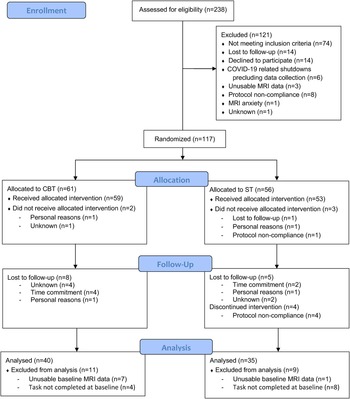
Patients were randomized to receive 12 weekly 60-minute sessions of either CBT or ST using a covariate adaptive randomization (i.e. minimization) approach. See Fig. 1 for information regarding study recruitment, treatment allocation, and patient retention. As seen, 40 CBT patients and 35 ST patients completed treatment, had usable baseline fMRI data, and were retained for analysis. Information regarding psychotherapy treatment and fidelity has been reported elsewhere (Feurer et al., Reference Feurer, Jimmy, Bhaumik, Duffecy, Medrano, Ajilore and Klumpp2021). See online Supplementary Materials for details regarding psychotherapy procedures and fidelity.
CONSORT flow diagram illustrating patient recruitment, treatment allocation, follow-up, and analysis. CBT, cognitive behavioral therapy; ST, supportive therapy.

Clinical symptoms
A trained clinician blinded to treatment administered the LSAS and HAMD to patients at baseline and every 2 weeks throughout treatment to assess social anxiety and depression symptoms, respectively. Consistent with our previous study (Feurer et al., Reference Feurer, Jimmy, Bhaumik, Duffecy, Medrano, Ajilore and Klumpp2021), the primary outcome measure was an internalizing symptom composite score created by summing patients’ LSAS and HAMD scores. Prior to summation, the LSAS and HAMD scores were transformed using the proportion of maximum scaling (POMS) method (i.e. LSAS and HAMD scores were divided by the observed maximum score) (Little, Reference Little2013).
Consistent with previous clinical trial studies comprising patients being treated for different principal diagnoses (Kuckertz, Najmi, Baer, & Amir, Reference Kuckertz, Najmi, Baer and Amir2023), diagnosis-specific symptoms were used as a secondary outcome measure. For this diagnosis-specific outcome, the POMS-transformed LSAS was the outcome measure for patients with SAD and the POMS-transformed HAMD was the outcome measure for patients with MDD. Indices of successful treatment response for SAD should reflect decreases specifically in social anxiety symptoms, whereas indices of successful treatment response for MDD should reflect decreases specifically in depression symptoms. If a patient being treated for SAD showed decreases in depression symptoms but not social anxiety symptoms, this would not be indicative of a successful treatment response, particularly if the patient's depression symptoms were not clinically elevated to begin with (which is the case in this sample). Therefore, testing for change in diagnosis-specific symptoms may provide clearer information regarding treatment response than composite scores that capture symptoms tangentially related to one's principal diagnosis. See online Supplementary Materials for correlations between patients' LSAS and HAMD scores.
Self-reported reappraisal
Patients completed the emotion regulation questionnaire (ERQ; (Gross & John, Reference Gross and John2003)) pre-treatment and every 2 weeks throughout treatment to assess self-reported reappraisal. The ERQ is comprised of two subscales that assess one's tendency to regulate their emotions using two different strategies: cognitive reappraisal and expressive suppression. Since reappraisal was the focus of the study, analysis of ERQ was limited to the reappraisal subscale.
Emotion regulation task
The emotion regulation task (ERT) has been shown to probe putative mechanisms of reappraisal in the context of negative images in individuals with or without anxiety or depression (Gorka et al., Reference Gorka, Young, Klumpp, Kennedy, Francis, Ajilore and Phan2019; Klumpp et al., Reference Klumpp, Roberts, Kapella, Kennedy, Kumar and Phan2017a, Reference Klumpp, Roberts, Kennedy, Shankman, Langenecker, Gross and Phan2017b; Phan et al., Reference Phan, Fitzgerald, Nathan, Moore, Uhde and Tancer2005). During this task, patients are presented with neutral or negative images from the International Affective Picture System (IAPS; Lang, Bradley, and Cuthbert, Reference Lang, Bradley and Cuthbert1997) and are instructed to ‘Look Neutral’ or ‘Look Negative’ by naturally viewing neutral or negative images, respectively, without changing their emotional response, or ‘Reappraise Negative’ by decreasing their emotional response to negative images using situation-focused reappraisal to reinterpret the image. Consistent with prior research (Ochsner, Bunge, Gross, & Gabrieli, Reference Ochsner, Bunge, Gross and Gabrieli2002; Phan et al., Reference Phan, Fitzgerald, Nathan, Moore, Uhde and Tancer2005), patients were trained in reappraisal strategies (i.e. thinking about the image in more positive terms or rationalizing the content of the image) prior to completion of the ERT using different IAPS images than those used during the scan. Instructions at the beginning of each task block lasted 5 s, followed by four images presented for 5 s each. After each block, participants rated ‘How negative do you feel?’ on a 5-point Likert scale. Task blocks were interspersed with 20 s ‘baseline’ blocks comprised of a fixation cross. The task consisted of 24 task blocks (eight per condition) presented in pseudo-random order across two runs.
fMRI data collection and preprocessing
Scanning during the ERT was conducted on a 3.0 Tesla MR 750 scanner (General Electric Healthcare; Waukesha, WI) using a standard radiofrequency coil. See online Supplementary Materials for information regarding scanner parameters, preprocessing pipelines, and first-level modeling. The primary contrast of interest was Reappraise Negative > Look Negative. Due to concerns about replicability in task-based neuroimaging (Turner, Paul, Miller, & Barbey, Reference Turner, Paul, Miller and Barbey2018), particularly in smaller samples, an a priori fronto-temporal mask (search volume = 383,816 mm3) was created comprising regions shown to reliably engage during our contrast of interest (Reappraise Negative > Look Negative) in other studies examining neural activation during reappraisal of negative stimuli (Messina et al., Reference Messina, Bianco, Sambin and Viviani2015). See online Supplementary Materials for AAL 3 regions (Rolls, Huang, Lin, Feng, & Joliot, Reference Rolls, Huang, Lin, Feng and Joliot2020) included in the mask. This fronto-temporal mask was applied to all second-level models in SPM12
Analytic plan
Data estimation
There were some missing data for self-reported reappraisal due to failure to complete self-report measures or random reporting (missingness: 1.3%–4.0%). Given the evidence from Little's test that these data were missing completely at random, χ2(137) = 130.02, p = 0.65, expectation maximization was used to estimate data for subsequent analysis (Schafer & Graham, Reference Schafer and Graham2002).
Treatment outcome
To examine differences in symptom severity and self-reported reappraisal improvement between patients randomized to CBT v. ST, linear mixed models (LMMs) were conducted in SPSS (Version 27). Treatment Arm, Time, age, ethnicity, and the Arm × Time interaction were entered as fixed effects, and intercepts and slope (i.e. Time) were entered as random effects. Patient composite symptom scores (i.e. LSAS and HAMD), diagnosis-specific symptoms (i.e. LSAS for SAD, HAMD for MDD), and self-reported reappraisal were independently tested as the outcome measure. We focused on linear trajectories of improvement as linear (v. quadratic, cubic, and log-linear) trajectories of symptom change best fit the data for this sample (Feurer et al., Reference Feurer, Jimmy, Bhaumik, Duffecy, Medrano, Ajilore and Klumpp2021). Of note, self-reported reappraisal did not show quadratic, t(155.91) = −0.35, p = 0.727, or cubic, t(313.04) = −0.57, p = 0.571, trajectories of change.
Calculating symptom and reappraisal trajectories
Individual random slopes for Time were extracted from LMMs to index trajectories of clinical improvement. LMMs included Time as a fixed effect and intercept and slope (i.e. Time) as random effects. LMMs were conducted separately for composite symptom scores, diagnosis-specific symptoms, and self-reported reappraisal.
Associations between clinical improvement trajectories and baseline neural engagement
To examine associations between baseline brain activity and trajectories of clinical improvement, full factorial analyses were conducted in SPM12. Analyses tested the main effects of extracted clinical improvement slopes, treatment Arm (CBT v. ST), and the Slope × Arm interaction. Patient age, ethnicity, and baseline clinical measures (e.g. composite symptoms, diagnosis-specific symptoms, or reappraisal depending on the model being tested), were included as covariates of no interest. Three separate models were conducted to test associations between neural activity during reappraisal and extracted slopes for (a) composite symptoms (LSAS and HAMD), (b) diagnosis-specific symptoms (LSAS for SAD, HAMD for MDD), and (c) self-reported reappraisal (ERQ).
Evaluation of brain activity was constrained to the a priori fronto-temporal mask for all models. However, as a test of robustness, follow-up analyses were conducted to see if results were maintained when further constraining this fronto-temporal mask to only include voxels that were sensitive to task effects in this sample (see online Supplementary Materials for details). Consistent with prior research using the ERT (Klumpp et al., Reference Klumpp, Roberts, Kapella, Kennedy, Kumar and Phan2017a; Nelson, Fitzgerald, Klumpp, Shankman, & Phan, Reference Nelson, Fitzgerald, Klumpp, Shankman and Phan2015), neural activity was considered significant if it exceeded a minimum cluster size of 271 voxels, as determined via simulation using the updated, de-bugged 3dClustSim utility (Cox, Reference Cox1996) using a threshold of α < 0.05 and a voxel threshold of p < 0.005. Specifically, we used 3dClustSim (version 19.3.16) to estimate the cluster-size threshold using the auto-correlation function (ACF), where the spatial ACF is estimated using 3dFWHMx. For significant activation, a 5-mm radius spherical region of interest (ROI) was constructed centered around peak voxels. MarsBaR (Brett, Anton, Valabregue, & Poline, Reference Brett, Anton, Valabregue and Poline2002) was used to extract activation (β weights, arbitrary units [a.u.]) from the ROI(s), which was submitted to SPSS to evaluate the direction and magnitude of significant activity and to perform follow-up simple effects analysis to interpret significant interactions.
For any significant associations between brain and symptom trajectories, post-hoc tests were conducted to examine whether associations were, at least partially, independent of baseline self-reported reappraisal (ERQ reappraisal scores). For significant associations between brain and reappraisal trajectories, post-hoc tests were examined whether associations were independent of baseline symptom severity (i.e. baseline composite and diagnosis-specific symptoms).
Associations between clinical improvement trajectories and baseline behavioral indices of reappraisal
Finally, LMMs were conducted to examine whether behavioral response during the ERT also predicted trajectories of clinical improvement. To examine behavioral indices of reappraisal, participant ratings of how negatively they felt during the ‘Reappraise Negative’ condition were regressed onto their ‘Look Negative’ ratings, and the unstandardized residual score was saved. Participant ERT behavioral residual scores, Treatment Arm, Time, Age, Ethnicity, and all 2- and 3-way interactions between ERT residual scores, Arm, and Time were entered as fixed effects. Intercepts and slope (i.e. Time) were entered as random effects. Again, patient composite symptom scores, diagnosis-specific symptoms, and self-reported reappraisal were independently tested as the outcome measure.
LMM model convergence
All LMMs successfully converged.
Results
Preliminary analyses
See Table 1 for clinical and demographic differences between patients in the CBT and ST arm. Patients in the two arms differed in ethnicity, such that patients assigned to ST were more likely to be Hispanic/Latino. Therefore, we statistically controlled for patient ethnicity in all analyses. Patients did not differ in any other demographic or baseline clinical characteristics.
Intent to treat analysis
Intent to treat analyses indicated no differences in treatment randomization for treatment completers v. non-completers, χ2(1) = 0.49, p = 0.49. Treatment completers reported lower anxiety symptoms (LSAS) than non-completers, t(115) = 1.99, p = 0.049, though when taking depression (HAMD) findings into account (i.e. Bonferroni correction; 0.05/2 = 0.025) the finding was no longer significant. No other clinical or demographic variable differed between completers and non-completers (see online Supplementary Table 1).
Treatment outcome
The LMM examining change in composite symptom scores revealed a main effect of Time, t(96.91) = −10.52, p < 0.001, indicating that overall symptom severity decreased throughout treatment. Additionally, the Time × Arm interaction was significant, t(96.43) = −2.05, p = 0.043. Follow-up analyses indicated that patients randomized to CBT exhibited greater decreases in symptom severity throughout treatment, t(46.62) = −9.35, p < 0.001, than patients randomized to ST, t(43.52) = −5.58, p < 0.001. The main effect of Arm was not significant (p = 0.760).
The LMM examining change in diagnosis-specific symptoms also indicated that symptoms decreased throughout treatment, t(79.63) = −9.37, p < 0.001. Neither the main effect of Arm nor the Time × Arm interaction was significant (ps ⩾ 0.080).
Finally, the LMM examining change in self-reported reappraisal revealed a main effect of Time, such that reappraisal increased throughout treatment, t(87.36) = 3.61, p < 0.001. Neither the main effect of Arm nor the Time × Arm interaction were significant (ps ⩾ 0.072).
Behavioral performance
A repeated measures ANOVA was conducted to confirm that participants followed ERT directions. As expected, patients reported the lowest levels of negative emotion in the Look Neutral condition, followed by the Reappraise Negative condition, and the Look Negative condition. See online Supplementary Materials for details.
Associations between clinical improvement trajectories and baseline neural engagement
No significant main or interactive effects between Arm and trajectories of composite symptom score improvement (i.e. LSAS and HAMD) were observed.
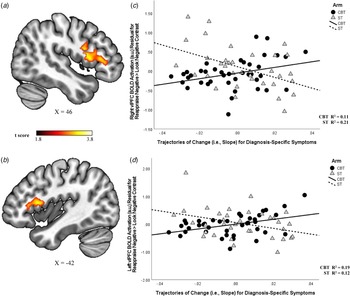
In the model examining associations with diagnosis-specific symptom trajectories (LSAS for SAD; HAMD for MDD), the Slope × Arm interaction significantly corresponded with bilateral activation in vlPFC (i.e. inferior frontal gyrus) (right peak [40, 12, 14], k = 602 voxels, z = 3.64, p < 0.001, reffect size = 0.42; left peak [−32, 20, 10], k = 406 voxels, z = 3.42, p < 0.001, reffect size = 0.40; see Fig. 2a and b). To interpret the interaction, brain activity based on spherical ROIs was submitted to Pearson's partial correlations within treatment arm in SPSS. Regarding right vlPFC (see Fig. 2c), steeper trajectories of diagnosis-specific symptom reduction (i.e. more negative slopes) were associated with less baseline activity for patients in the CBT arm, r = 0.33, p = 0.044. However, for patients in the ST arm, steeper trajectories of diagnosis-specific symptom reduction were associated with more baseline right vlPFC activity, r = −0.46, p = 0.008. Findings were similar for left vlPFC (see Fig. 2d), such that greater diagnosis-specific symptom reduction was associated with less baseline activity for patients randomized to CBT, r = 0.44, p = 0.007, but greater baseline activity for patients randomized to ST, r = −0.35, p = 0.048. Partial correlations in SPSS revealed these associations were all maintained when statistically adjusting for the influence of baseline self-reported reappraisal (all ps ⩽ 0.051).
Figure depicting significant clusters comprised of (a) right vlPFC and (b) left vlPFC that emerged during full factorial analyses examining the interaction between treatment arm and change trajectories (i.e. slopes) for diagnosis-specific symptoms controlling for patient age, ethnicity, and baseline diagnosis-specific symptoms. Scatterplots of correlations between extracted parameter estimates for (c) right vlPFC and (d) left vlPFC controlling for patient age, ethnicity, and baseline diagnosis-specific symptoms and their relation to slopes for diagnosis-specific symptoms separately for patients randomized to CBT and ST. CBT, cognitive behavioral therapy; ST, supportive therapy; vlPFC, ventrolateral prefrontal cortex.

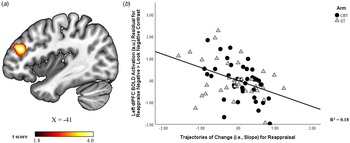
In the model testing associations with trajectories of self-reported reappraisal, there was a significant main effect of reappraisal slope on baseline activation of a cluster (peak [−42, 40, 22], k = 668 voxels, z = 3.92, p < 0.001) primarily comprised of left dlPFC (i.e. middle frontal gyrus; k = 431 voxels) extending to left dorsolateral superior frontal gyrus (k = 150 voxels) and left vlPFC (i.e. IFG; k = 87) (see Fig. 3a). To evaluate the magnitude of this relation, activity based on a spherical ROI was submitted to SPSS. As depicted in Fig. 3b, greater increase in self-reported reappraisal was associated with less baseline activity in left dlPFC, r = −0.42, regardless of treatment arm. Follow-up analysis in SPSS showed the relation between baseline activation and trajectory of self-reported reappraisal was maintained when statistically controlling for baseline symptom severity (ps < 0.001).
(a) Figure depicting a significant cluster primarily comprised of left dlPFC that emerged during full factorial analyses examining the main effect of change trajectories (i.e. slopes) for self-reported reappraisal controlling for treatment arm, patient age, ethnicity, and baseline self-reported reappraisal. (b) Scatterplot of correlation between extracted parameter estimates for left dlPFC and its relation to slopes for self-reported reappraisal controlling for treatment arm, patient age, ethnicity, and baseline reappraisal. CBT, cognitive behavioral therapy; ST, supportive therapy; dlPFC, dorsolateral prefrontal cortex.

No other main effects of Arm, Slope, or Slope × Arm interactions were significant (see online Supplementary Table 2 for full results).
As significant findings may have been driven by individual differences in neural activation during either reappraisal (Reappraise Negative) or basic affective processing (Look Negative), follow-up analyses were conducted focusing on the Reappraise Negative > Look Neutral and Look Negative > Look Neutral contrasts. Results indicated that findings were driven by individual differences in neural activation during reappraisal, rather than affective processing. See online Supplementary Materials for details.
Finally, exploratory analyses were conducted to examine whether results were maintained when examining MDD and SAD patients separately (see online Supplementary Materials).
Associations between clinical improvement trajectories and baseline behavioral indices of reappraisal
Results indicated that ERT behavioral indices of reappraisal did not interact with Time, Arm, or the Time × Arm interaction to predict patient composite symptoms, diagnosis-specific symptoms, or self-reported reappraisal (lowest p = 0.17).
Discussion
This study examined whether pre-treatment neural activity during reappraisal was associated with clinical outcomes (i.e. trajectories of symptom reduction and self-reported reappraisal increase) for patients with SAD or MDD throughout treatment with either CBT or ST. Results suggest that patients assigned to CBT showed greater improvement in overall symptom severity than patients assigned to ST, though patients across both arms exhibited similar improvement in diagnosis-specific symptom severity and self-reported reappraisal. Behavioral results showed affective state was less negative when reappraising negative images relative to viewing negative images, indicating that reappraisal implementation successfully decreased negative affective response. Regarding associations with brain activity, baseline reappraisal-related brain response differentially associated with trajectories of diagnosis-specific symptom improvement for patients randomized to CBT and ST. Baseline reappraisal-related activity corresponded with trajectories of self-reported reappraisal improvement, regardless of treatment arm. However, baseline behavioral indices of reappraisal were not associated with any trajectories of clinical improvement.
Results regarding relations between baseline brain activity and symptom improvement partially support hypotheses. We hypothesized that less baseline dlPFC activity during reappraisal would correspond with greater symptom reduction throughout treatment in SAD and MDD, and that this relation would be stronger for patients randomized to CBT than ST. Consistent with hypotheses, less prefrontal activity was associated with greater symptom improvement trajectories following CBT. However, this was observed for vlPFC, but not dlPFC. Though dlPFC was not detected, possibly due in part to methodological differences between studies (Klumpp et al., Reference Klumpp, Roberts, Kennedy, Shankman, Langenecker, Gross and Phan2017b; Reinecke et al., Reference Reinecke, Thilo, Filippini, Croft and Harmer2014), evidence of vlPFC along with previous findings suggests CBT-related clinical change may be sensitive to baseline variance in lateral prefrontal cortices during reappraisal. The vlPFC is involved in response selection and inhibition (Aron, Robbins, & Poldrack, Reference Aron, Robbins and Poldrack2014), particularly of verbal information (Nee, Wager, & Jonides, Reference Nee, Wager and Jonides2007), which includes the retrieval of semantic information from among competing options (Badre & Wagner, Reference Badre and Wagner2007; Thompson-Schill, D'Esposito, Aguirre, & Farah, Reference Thompson-Schill, D'Esposito, Aguirre and Farah1997). In the context of reappraisal, vlPFC may play a role in selecting an alternative interpretation of a stimulus from one's semantic memory to replace initial appraisals (Ochsner, Silvers, & Buhle, Reference Ochsner, Silvers and Buhle2012). Given that CBT targets reappraisal, evidence that less vlPFC activity during reappraisal corresponds with more symptom improvement suggests patients with SAD or MDD with greater baseline ‘deficiency’ in vlPFC may benefit more from CBT than ST.
In contrast to hypotheses, greater baseline activation in bilateral vlPFC corresponded with greater diagnosis-specific symptom improvement throughout treatment for patients randomized to ST. The vlPFC is a key node of a semantic control network that underlies the ability to select and manipulate context-appropriate semantic information (Jackson, Reference Jackson2021; Noonan, Jefferies, Visser, & Lambon Ralph, Reference Noonan, Jefferies, Visser and Lambon Ralph2013). This is critical for successful cognitive reappraisal, which requires patients to choose an alternative, appropriate appraisal to replace their initial appraisal of a stimulus. While further study is needed to clarify these treatment-dependent relations, it is possible that patients with greater baseline vlPFC activation may not require the psychoeducation or structure provided by CBT, but rather, benefit from the unstructured nature of ST. Consistent with prior work (e.g. Markowitz, Manber, and Rosen, Reference Markowitz, Manber and Rosen2008; Rogers, Reference Rogers1946), ST in the current study emphasized reflective listening and elicitation of affect as appropriate. Thus, in ST, patients discuss and explore their own thoughts and emotions without structure or therapist feedback. While conclusions remain speculative, evidence that more baseline vlPFC activity during reappraisal corresponds with greater symptom improvement throughout ST suggests that patients with SAD or MDD with more ‘intact’ or ‘enhanced’ baseline vlPFC activity may benefit more from ST than CBT.
Regarding subjective reappraisal improvement, no interaction with treatment arm was observed. Rather, less baseline dlPFC activity during reappraisal was associated with greater self-reported reappraisal improvement throughout CBT or ST, suggesting that less activity of this region involved top-down executive control processes (D'Esposito, Postle, & Rypma, Reference D'Esposito, Postle and Rypma2000; Nee et al., Reference Nee, Wager and Jonides2007; Owen, McMillan, Laird, & Bullmore, Reference Owen, McMillan, Laird and Bullmore2005) corresponds with more reappraisal improvement across psychotherapies. This was surprising, as CBT teaches cognitive reappraisal techniques, which is not addressed in ST. However, it is important to note that the self-report measure of reappraisal (i.e. ERQ) used in this study assessed the tendency to use reappraisal, not the reappraisal effectiveness. Therefore, it is unknown whether less baseline dlPFC activity corresponds with improvement in reappraisal tendency or ability. It may be that patients who exhibit less top-down executive control during reappraisal may not attempt to utilize reappraisal techniques until their symptoms abate over the course of psychotherapy, though this remains an area for future research.
In contrast to observed findings for neural predictors of treatment response, task-based behavioral indices of reappraisal ability did not predict trajectories of clinical improvement. This is consistent with prior evidence that neural markers may better predict treatment response than behavioral measures (Gabrieli, Ghosh, & Whitfield-Gabrieli, Reference Gabrieli, Ghosh and Whitfield-Gabrieli2015) and highlights the potential benefit of leveraging neuroimaging biomarkers to improve personalized treatment selection for MDD and SAD. However, replication is needed before conclusions about the utility of neuroimaging in clinical decision-making can be drawn.
Lastly, we found that patients randomized to CBT showed greater overall symptom improvement than patients randomized to ST, though trajectories for diagnosis-specific symptoms and self-reported reappraisal did not differ between treatment arms. We may have been underpowered to detect effects. For example, when CBT is compared to ST, the effect sizes for depression favoring CBT are small/non-significant to moderate (e.g. Hedges g = 0.1–0.26; Braun, Gregor, and Tran, Reference Braun, Gregor and Tran2013; Cuijpers et al., Reference Cuijpers, Berking, Andersson, Quigley, Kleiboer and Dobson2013). We are not aware of a study that directly compared CBT against ST for SAD. The relatively small sample size also precluded testing of whether CBT-specific findings were moderated by patient diagnosis. For example, though prior research has found that less dlPFC engagement predicted greater symptom reduction for anxious patients following CBT (Klumpp et al., Reference Klumpp, Roberts, Kennedy, Shankman, Langenecker, Gross and Phan2017b; Reinecke et al., Reference Reinecke, Thilo, Filippini, Croft and Harmer2014), this was not observed in the current study. It is possible that dlPFC activity predicts symptom improvement for patients with SAD, but not MDD, who are randomized to CBT, but not ST. Future studies with larger sample sizes are needed to test this.
In addition to sample size, other important limitations should be considered. First, as noted, the ERQ assesses the tendency, but not success, of reappraisal use. Future studies should examine real-world use and success of reappraisal to better understand the mechanisms through which pre-treatment prefrontal engagement during reappraisal foretells change in reappraisal following CBT and ST. Second, there was no waitlist control group or non-psychotherapy intervention (e.g. pharmacotherapy). Therefore, we cannot conclude findings are specific to psychotherapy. Third, effect sizes for spherical ROIs may not generalize to larger areas. Finally, our study focused on patients with SAD or MDD, but not their comorbidity. Findings may not generalize to cohorts who differ in clinical or demographic characteristics.
In conclusion, this study provides preliminary evidence that baseline reappraisal-related brain activity may differentially correspond with trajectories of symptom improvement throughout CBT and ST. Current findings build upon prior research in SAD (Klumpp et al., Reference Klumpp, Roberts, Kennedy, Shankman, Langenecker, Gross and Phan2017b) and extend these findings to patients with MDD. Furthermore, findings suggest that less baseline prefrontal activity during reappraisal is associated with more improvement in self-reported reappraisal following either CBT or ST. Questions remain regarding the precise mechanisms through which less v. more activity of brain regions supporting reappraisal differentially interacts with CBT or ST. Further research is needed to provide important insights into treatment-specific mechanisms for psychotherapies. If replicated in future studies, current findings may contribute to the development of brain-based biomarkers of treatment outcomes aimed at guiding treatment decisions for patients with SAD or MDD.
Supplementary material
The supplementary material for this article can be found at https://doi.org/10.1017/S0033291724001120.
Funding statement
This work was supported by NIH/NIMH R01-MH112705 (H.K.) and the Center for Clinical and Translational Research (CCTS) UL1RR029879. CF is supported by NIH/NIMH K23-MH129564.
Competing interests
The authors declare no competing interests.
Ethical standards
The authors assert that all procedures contributing to this work comply with the ethical standards of the relevant national and institutional committees on human experimentation and with the Helsinki Declaration of 1975, as revised in 2008.