Introduction
In Western-focused countries, extensive research has been conducted on the development of children’s singing behaviour, such as in the UK (e.g., Welch et al., Reference WELCH, HIMONIDES, PAPAGEORGI, SAUNDERS, RINTA, STEWART, PRETI, LANI, VRAKA and HILL2009a, Reference WELCH, HIMONIDES, SAUNDERS, PAPAGEORGI, VRAKA, PRETI and STEPHENS2009b), the USA (e.g., Moore, Reference MOORE1991; Rutkowski, Reference RUTKOWSKI1996, Reference RUTKOWSKI, BURTON and REYNOLDS2018), Australia (Barrett et al., Reference BARRETT, ZHUKOV, BROWN and WELCH2020), mainland Europe (e.g., Mecke & Sundberg, Reference MECKE and SUNDBERG2010), Japan (Welch & Murao, Reference WELCH and MURAO1994) and Latin America (IIari, Reference ILLARI2006). However, until now, there has been limited published research on children’s singing in China – particularly within the context of economic migration from rural to urban settings. The focus of the current article is to explore the nature of children’s singing in China, drawing on an established protocol from an earlier English study in order to investigate any similarities or differences, such as those related to age and sex. A second reason for the comparative study is that the English research embraced a large number of children from diverse ethnic backgrounds, but it is not clear if the resultant data are comparable to the singing of children who are actually growing up in another culture.
Literature review
In related research in Hong Kong and England, Mang (Reference MANG2006) and Welch et al. (Reference WELCH, HIMONIDES, SAUNDERS, PAPAGEORGI, VRAKA, PRETI and STEPHENS2009b) assessed singing behaviour based on the perspectives of vocal register use and vocal pitch-matching accuracy for songs. Their studies applied similar singing tasks and measurements. Vocal register use and vocal pitch-matching accuracy of these singing performances were measured by applying Rutkowski’s (Reference RUTKOWSKI1996, Reference RUTKOWSKI2015, Reference RUTKOWSKI, BURTON and REYNOLDS2018) Singing Voice Development Measure (SVDM) and Welch’s (Reference WELCH1998) Vocal Pitch-Matching Development (VPMD) scale, respectively. These two rating scales had been used together initially by Mang (Reference MANG2006), who tested N = 120 aged 7 and 9 Primary school students in Hong Kong. Her participants were asked to sing Happy Birthday. In England, Welch et al. (Reference WELCH, HIMONIDES, SAUNDERS, PAPAGEORGI, VRAKA, PRETI and STEPHENS2009b) invited N = 8,162Footnote 1 aged 6+ to 12+ Primary school children to participate in their initial evaluation of the English National Singing Programme, Sing Up. The children were asked to sing two contrasting well-known songs, Twinkle, Twinkle and Happy Birthday. Having similar singing tasks and measurements can provide a more direct comparison of the singing behaviour of these two groups of Primary school students in Hong Kong and England. The singing behaviour in both studies was defined by the mean scores based on a combination of the above two rating scales.
In their large participant population, Welch et al. (Reference WELCH, HIMONIDES, SAUNDERS, PAPAGEORGI, VRAKA, PRETI and STEPHENS2009b) reported a statistically significant age difference for English Primary school students. Older English students generally showed more competent singing behaviour than younger English students. However, Mang (Reference MANG2006) did not find a significant age difference among her participants in Hong Kong, although there was a tendency for older students to be assessed as singing more competently. She assumed that the absence of an age difference might be because the singing task, Happy Birthday, was equally difficult for both ages, as it involved an upward octave (the interval of an eighth) in the penultimate line. It might also be because of the different age groups between these two sets of students, as studies (e.g., Davies & Roberts, Reference DAVIES and ROBERTS1975; Guo, Reference GUO1999; Pereira & Rodrigues, Reference PEREIRA and RODRIGUES2019) involving a wider range of age groups may be more likely to note a significant age difference. However, Mang (Reference MANG2006) and Welch et al. (Reference WELCH, HIMONIDES, SAUNDERS, PAPAGEORGI, VRAKA, PRETI and STEPHENS2009b) agreed that there was a statistically significant sex difference in singing behaviour, in which girls generally showed better singing behaviour (in terms of vocal register use and vocal pitch-matching accuracy for songs) than boys of the same age.
Furthermore, Mang (Reference MANG2006) and Welch et al. (Reference WELCH, HIMONIDES, SAUNDERS, PAPAGEORGI, VRAKA, PRETI and STEPHENS2009b) agreed that Primary school children’s singing behaviour varied statistically significantly by local culture. In more detail, Mang (Reference MANG2006) reported that n = 60 Cantonese monolingual children showed statistically significantly better singing behaviour than n = 60 English bilingual children. This might imply that children speaking a tonal language have an advantage in singing behaviour. In England, Welch et al. (Reference WELCH, HIMONIDES, SAUNDERS, PAPAGEORGI, VRAKA, PRETI and STEPHENS2009b) reported that the overall singing behaviour for both BlackFootnote 2 (n = 526) and WhiteFootnote 3 (n = 6,550) children was statistically significantly higher than that for Asian children (n = 1,223) – including those identified on the English Ministry’s official school census data as Indian, Pakistani, Bangladeshi or other (cf. Welch et al., Reference WELCH, HIMONIDES, SAUNDERS and PAPAGEORGI2010). However, it is uncertain whether the singing behaviour of these Asian children living in England would be representative of children living in their parents’ original home culture. For instance, the singing behaviour of Chinese children living in China might be different from that of Chinese children living in England, not least as the aims of the experienced music curriculum in Primary schools in the two countries, as well as musical experiences in the home, may well be different.
To implement the National Compulsory Education Quality Monitoring Scheme (⟪国家义务教育质量监测方案⟫), the Department of Basic Education under China’s Ministry of Education conducted its second national arts learning quality monitoring in May 2019. The monitoring was based on the 2011 edition of the music and fine arts curriculum standards for compulsory education, following a methodology established during the initial national arts tests in 2016. It aimed to assess the quality of arts learning, monitor the development of student interest in arts and evaluate attitudes toward participation in arts activities. The 2019 tests also examined available teaching resources for arts education and the status of arts teachers. The collected data provides insights into the implementation of arts curricula across the country and compliance with relevant national policies. The 2019 national arts learning assessment in China was conducted among n = 116,578 4th-grade students and n = 79,086 8th-grade students from n = 4,097 Primary schools and n = 2,522 junior secondary schools. These schools were located in 331 sampled counties (districts and cities) across 31 provinces (autonomous regions and municipalities directly under the central government), also including the Xinjiang Production and Construction Corps. Students were randomly selected from diverse socio-economic backgrounds across all provinces in China (The Monitoring Centre for Compulsory Education, Ministry of Education of the People’s Republic of China, 2020).
As part of the 2019 national assessment, the music evaluation measured the singing ability of 4th-grade students (9yo) from five dimensions: vocal pitch-matching accuracy, rhythm, fluency, expression and clarity of lyrics. They reported an overall mean score of 78.5% for assessed singing behaviour, which was above the second rating on a four-point scale. However, vocal pitch-matching ability was relatively the poorest feature among the five assessed singing perspectives (mean = 73.0%) (The Monitoring Centre for the Compulsory Education, Ministry of Education of the People’s Republic of China, 2018). The national tests showed an overall picture of Chinese Primary school students’ singing behaviour in this age group. However, they did not assess other grade levels due to cost and the large population size in China.
Drawing on these previous studies in China and a large-scale investigation in the UK, Lu (Reference LU2024) conducted a doctoral study on the Chinese mainland (see methodology below). Overall, N = 1,193 Chinese Primary school students aged from 6+ to 11+ from Hunan Province, China, were invited to participate in two years of data collection (2017–2019). All students were asked to sing three familiar songs: Twinkle, Twinkle, Little Donkey and Happy Birthday. Their singing products were measured by the SVDM and the VPMD scales – as used in earlier Hong Kong and English studies – in order to assess their vocal register use and vocal pitch-matching accuracy for songs, respectively. Using the same testing materials and measurements as Welch et al., Lu’s study investigated the singing behaviour of Chinese Primary school students, thereby extending the earlier work into a new cultural context.
Overall, there were n = 1,539 recorded performances of three target songs, with n = 346 participants tested twice in consecutive years to create a longitudinal perspective of their singing behaviour (to be reported elsewhere, as this is not the focus of the current article). The children’s singing behaviour was defined based on the combined mean scores of the two singing development tools (Rutkowski and Welch), normalised out of 100. In line with the study of Welch et al. (Reference WELCH, HIMONIDES, SAUNDERS, PAPAGEORGI, VRAKA, PRETI and STEPHENS2009b), Lu (Reference LU2024) found that older Chinese Primary school students and girls generally showed more competent singing behaviour compared to younger students and boys (cf. Lu & Welch, Reference LU and WELCH2025).
Although the results of the studies of Lu (Reference LU2024) and Welch et al. (Reference WELCH, HIMONIDES, SAUNDERS, PAPAGEORGI, VRAKA, PRETI and STEPHENS2009b) could provide a general comparison between the singing of Chinese and English Primary school students, it should be noted that there were at least two differences between the two studies, besides the children’s local cultural backgrounds and any national country differences.
Firstly, students in the two studies were not equal in the opportunity provided for singing education. In Welch et al.’s (Reference WELCH, HIMONIDES, SAUNDERS, PAPAGEORGI, VRAKA, PRETI and STEPHENS2009b, Reference WELCH, HIMONIDES, SAUNDERS and PAPAGEORGI2010) English studies, the participants were divided into two main groupings based on whether or not they and their schools had experience of the government-funded Sing Up programme. In 2010, most of the English singing performances (n = 7,891 in 2010, 69.29%) were collected from participants who had experienced some aspect(s) of the national Sing Up programme. They had received extra professional support for their singing skills. In contrast, other singing performances (n = 3,498 in 2010, 30.71%) were provided by participants without any Sing Up programme experience at the time of assessment. These were treated as a comparative group as part of a national evaluation of the effectiveness of the Sing Up programme. Consequently, given that none of the Chinese participants involved in the study of Lu (Reference LU2024) had any extra singing support, either from the researcher or elsewhere, these Chinese children’s singing behaviours should best be compared with those of the English participants without Sing Up experience, and this is the focus of the current article.
It should also be noted that two identical children’s songs, Twinkle, Twinkle and Happy Birthday, were used in both English and Chinese studies. As mentioned above, the singing tasks in the Chinese study also included a Chinese nursery song – Little Donkey – that was selected as being specific to the Chinese context. However, data related to that song has not been included in the current analyses in order to be able to make a more direct comparison between English and Chinese Primary school students.
As a part of Lu’s doctoral study, the research question for the current analyses was as follows: what are the similarities and differences in the general singing behaviour captured in the data from the Chinese and English studies? Children’s singing behaviour in the current comparison is related to vocal register use and vocal pitch-matching accuracy for the two common target songs. Comparing the singing behaviour of Primary school students between these two cultures may help us to understand any possible cultural influences on children’s singing behaviour and development.
Methodology
Participants
As mentioned earlier, Welch and colleagues collected n = 3,498 singing performances from pupils at n = 49 schools across England who had not experienced any extra singing education under the National Singing Programme, Sing Up, from 2007 to 2010 (Welch et al., Reference WELCH, HIMONIDES, SAUNDERS and PAPAGEORGI2010). These performances were selected as a baseline, which was used to compare with n = 7,891 singing performances collected from English Primary school students who did have Sing Up programme experience.
From 2017 to 2019, Lu (Reference LU2024) collected n = 1,539 singing performances from n = 1,193 Chinese Primary school students. This data was gathered from six schools of varying socio-economic status (four rural and two urban schools) in Hunan Province, China, Lu’s home province. The gross domestic product (GDP) of Hunan Province is close to the median level across China (国家统计局 (stats.gov.cn)). Based on Chinese studies (e.g., Fan, Reference FAN2015; Zhou, Reference ZHOU2018), socio-economic development is positively correlated with the availability of local teaching resources for music education – such as the specialisation of music teachers – within the Chinese context. Previous studies have reported that advanced teaching resources for music education, such as professional singing instruction (Welch et al., Reference WELCH, HIMONIDES, SAUNDERS, PAPAGEORGI, VRAKA, PRETI and STEPHENS2009b), can improve the musical behaviour of Primary school students. Therefore, data collected from Hunan Province can be viewed as likely to be somewhat representative of the mean singing behaviour of Primary school children in other Chinese provinces with a similar GDP. Although each of the four rural participating schools employed music specialists, six of the seven teachers were not able to focus solely on teaching the music curriculum because they were expected to cover other subjects as well. In contrast, all the music teachers in the two urban participating schools were music specialists who could teach the music curriculum only.
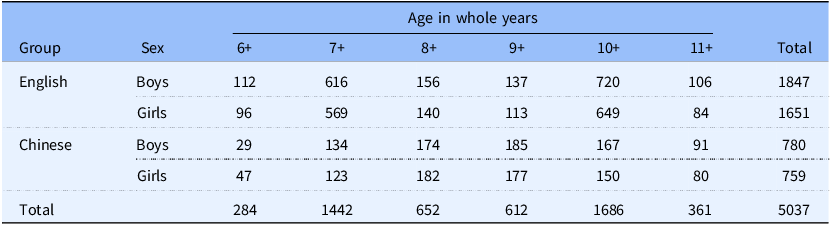
When combined, the English (Welch et al., Reference WELCH, HIMONIDES, SAUNDERS and PAPAGEORGI2010) and Chinese (Lu, Reference LU2024) study data created a dataset of n = 5,037 singing performances across the two countries (n = 3,498 & n = 1,539). The number of singing performances for Chinese and English participants by age and sex interaction is shown in Table 1. The reason that the total numbers of singing performances for aged 7+ and aged 10+ students were greater than those of other age groups was that the initial English study conducted by Welch et al. (Reference WELCH, HIMONIDES, PAPAGEORGI, SAUNDERS, RINTA, STEWART, PRETI, LANI, VRAKA and HILL2009a) focused on comparing English Primary school children’s singing behaviour between these two contrasting age groups.
The number of singing performances by age and sex interaction based on English students without Sing Up experience and all Chinese singing performances

Table 1. Long description
The table presents the number of singing performances by age and sex for English and Chinese students. It has 6 rows and 8 columns. The columns are labeled as follows: Group, Sex, Age in whole years (6+, 7+, 8+, 9+, 10+, 11+), and Total. The rows are labeled as follows: English Boys, English Girls, Chinese Boys, Chinese Girls, and Total. Row 1: English, Boys, 112, 616, 156, 137, 720, 106, 1847. Row 2: English, Girls, 96, 569, 140, 113, 649, 84, 1651. Row 3: Chinese, Boys, 29, 134, 174, 185, 167, 91, 780. Row 4: Chinese, Girls, 47, 123, 182, 177, 150, 80, 759. Row 5: Total,, 284, 1442, 652, 612, 1686, 361, 5037.
Singing tasks
Two familiar songs, Twinkle, Twinkle and Happy Birthday, were set as singing tasks for these English Primary school students in Welch et al.’s (Reference WELCH, HIMONIDES, SAUNDERS and PAPAGEORGI2010) study. These were also included as two of the three songs in Lu’s (Reference LU2024) study of Chinese Primary school students.
The rationale for the song choice was that Happy Birthday is considered to be more difficult to vocally match than Twinkle, Twinkle due to the former’s wider pitch range and more complex combination of musical intervals. The relative pitch ranges for Twinkle, Twinkle and Happy Birthday were a major sixth and an octave (the interval of an eighth), respectively. Nearly half (42.86%) of the musical intervals in Twinkle, Twinkle were unisons (the interval of the same pitch). However, only n = 4 (16%) of the musical intervals of Happy Birthday were unison. According to Lu (Reference LU2024), unison was the easiest musical interval to be matched accurately among other types of intervals of the two target songs. Consequently, it is believed that the greater percentage of unison intervals in Twinkle, Twinkle compared to Happy Birthday reduced the difficulty in the vocal pitch-matching accuracy for the former song.
Measurement
All singing performances in both studies of Welch et al. (Reference WELCH, HIMONIDES, SAUNDERS and PAPAGEORGI2010) and Lu (Reference LU2024) were measured by two existing rating scales, Rutkowski’s (Reference RUTKOWSKI1990, Reference RUTKOWSKI1996, Reference RUTKOWSKI2015) SVDM scale and Welch’s (Reference WELCH1998) VPMD scale.
The SVDM scale was originally designed to assess young children’s vocal register use by noticing the use of a vocal range and specific register shifts when singing songs or patterns (Rutkowski, Reference RUTKOWSKI1990, Reference RUTKOWSKI1996) (see Figure 1). For instance, Rutkowski used A3 to C4 to define the speaking voice range. The singing voice would generally be higher and could be divided into a limited singing range (usually up to F4), an initial singing range (typically D4 to A4) and an extended singing range (singing beyond the register lift: Bb4 and above). When applying the scale to measure Chinese participants’ singing behaviour, the specific lift points suggested by Rutkowski (Reference RUTKOWSKI1990, Reference RUTKOWSKI1996), such as C4, might vary slightly due to age and individual differences. Nevertheless, the proposed vocal ranges, such as the speaking range (A3 to C4) characterised by a minor third and low pitches, could still provide useful guidance for assessing Chinese participants’ use of vocal registers.
The singing voice development measure (svdm) and the vocal pitch-matching accuracy (vpmd), based on Rutkowski (Reference RUTKOWSKI1996, Reference RUTKOWSKI2015) and Welch (Reference WELCH1998).

The SVDM scale has been applied in many previous studies, mainly in Western cultures, such as in America (Guerrini, Reference GUERRINI2006; Levinowitz et al., Reference LEVINOWITZ, BARNES, GUERRINI, CLEMENT, D’APRIL and MOREY1998; Rutkowski, Reference RUTKOWSKI1990; Rutkowski & Chen-Hafteck, Reference RUTKOWSKI and CHEN-HAFTECK2001; Rutkowski et al., Reference RUTKOWSKI, CHEN-HAFTECK and GLUSCHANKOF2002, Reference RUTKOWSKI, CHUANG and GLUSCHANKOF2007; Rutkowski & Miller, Reference RUTKOWSKI and MILLER2003), England (Welch et al., Reference WELCH, HIMONIDES, PAPAGEORGI, SAUNDERS, RINTA, STEWART, PRETI, LANI, VRAKA and HILL2009a, Reference WELCH, HIMONIDES, SAUNDERS, PAPAGEORGI, VRAKA, PRETI and STEPHENS2009b), Portugal (Pereira & Rodrigues, Reference PEREIRA and RODRIGUES2019) and Turkey (Çenberci & Kalkanoğlu, Reference ÇENBERCI and KALKANOGLU2023). High consistency and interrater reliability have been commonly reported for the SVDM scale (e.g., Guerrini, Reference GUERRINI2006; Rutkowski, Reference RUTKOWSKI1990, Reference RUTKOWSKI1996). However, Levinowitz et al. (Reference LEVINOWITZ, BARNES, GUERRINI, CLEMENT, D’APRIL and MOREY1998) suggested that its reliability was lower for Grade 6 students. To improve the reliability of the results, the singing performances of any participant, pubertal Chinese boys whose voices were changing or had changed at the time of assessment (n = 12), are not included in this analysis.
The VPMD scale was developed by Welch (Reference WELCH1998) to assess children’s vocal pitch-matching accuracy for songs at four levels, from (i) singing in a speaking manner; (ii) singing generally following the general contour of the melody of a target song, but with most musical intervals matched inaccurately; (iii) most musical intervals matched accurately and a more consistent key centre; and (iv) no significant pitch errors (see Figure 1). This scale has also been applied to test vocal pitch-matching accuracy for children from various areas or countries, such as Hong Kong (Mang, Reference MANG2006), England (Welch et al., Reference WELCH, HIMONIDES, PAPAGEORGI, SAUNDERS, RINTA, STEWART, PRETI, LANI, VRAKA and HILL2009a, Reference WELCH, HIMONIDES, SAUNDERS, PAPAGEORGI, VRAKA, PRETI and STEPHENS2009b, Reference WELCH, HIMONIDES, SAUNDERS and PAPAGEORGI2010) and Australia (Barrett et al., Reference BARRETT, ZHUKOV, BROWN and WELCH2020). A related study of adult singing by Wise and Sloboda (Reference WISE and SLOBODA2008) updated the VPMD scale to an 8-point rating scale to describe varied levels of sung key centre consistency. However, it is believed that the original four-rating VPMD scale is effective in describing children’s singing.
When Mang (Reference MANG2006) used both ratings for Primary school students in Hong Kong, her findings suggested that the SVDM and VPMD scales could be used in a different culture, such as Asia.
Process
Overall, the processes of data collection for the studies of Welch et al. (Reference WELCH, HIMONIDES, SAUNDERS and PAPAGEORGI2010) and Lu (Reference LU2024) were similar. Before any data collection, audio recordings for both target songs in the two studies were sent to music teachers. They were expected to teach the songs to participants for two weeks prior to the research assessment to help participants become familiar with the songs. Ethical approval processes for the studies of Welch et al. and Lu were both designed under BERA ethical guidelines (2011Footnote 4 ; 2018Footnote 5 ). The information and consent forms were completed under local ethical practices in participant schools.
Participants from whole school classes were invited to join the research in both studies to avoid any negative feelings about a participant being ignored (Welch et al., Reference WELCH, HIMONIDES, SAUNDERS and PAPAGEORGI2010). Children were allowed to withdraw from the assessment process for any or no reason in both studies under the ethical procedures. During the singing performances, participants in both studies sang individually within a group of around five peers in a familiar room in their school to help them feel relaxed and understand the testing process. No starting pitch was given for either song, which allowed individual children to start within their natural, comfortable singing range. Participants sang the two target songs with lyrics, as this is more natural when singing a familiar song from memory.
One of the differences in the data collection between the two studies was that Welch et al. (Reference WELCH, HIMONIDES, SAUNDERS and PAPAGEORGI2010) assessed English participants’ singing behaviour simultaneously as participants sang the songs, while Lu (Reference LU2024) audio-recorded all singing performances and measured them later. The main difference was because the English data collection (Welch et al., Reference WELCH, HIMONIDES, SAUNDERS and PAPAGEORGI2010) was part of a national study of over 11,000 children across four years (subsequently). The programme was conducted by a team of experienced music educators, with inter-judge variability measured at the beginning of the programme to ensure a commonality of approach. The Chinese data (2024) were collected as part of a doctoral study. The recording of the Chinese singing performances allowed the author to measure these singing performances several times to ensure consistency and to have these assessments validated by members of the supervisory team.
Data analyses
To increase the reliability of scores measured by the two relatively subjective rating scales, Lu (Reference LU2024) measured all Chinese singing performances three times. Scores measured for the third time were used for the final analysis, as they were seen to be the most consistent. Furthermore, n = 20 participants’ singing performances for both target songs were randomly selected and measured by the two authors simultaneously to check inter-rater agreement in applying the SVDM and the VPMD scales. Kendall’s tau statistics showed that the agreement between the two judges for both songs was relatively high (for Rutkowski’s SVDM – Twinkle, Twinkle: Kendall’s tau = 0.801; Happy Birthday: Kendall’s tau = 0.736; for Welch’s VPMD – Twinkle, Twinkle: Kendall’s tau = 0.743; Happy Birthday: Kendall’s tau = 0.855).
The mean scores based on vocal register use and vocal pitch-matching accuracy for the two target songs as measured by the SVDM and VPMD scales were normalised out of 100 for the final analyses within and across both studies. For instance, if a participant were assessed as 4 and 3.5 for Twinkle, Twinkle and Happy Birthday for vocal register use as measured by the SVDM scale, respectively (the full score is 5), their normalised scores for vocal register use for each of the songs would be 0.80 (4/5) and 0.70 (3.5/5). The mean score for vocal register use would be 0.75 [(0.80 + 0.70)/2]. If they were assessed as 3 and 2 for each of the songs for vocal pitch-matching accuracy as measured by the VPMD scale (the full score is 4), their normalised scores for the songs would be 0.75 (3/4) and 0.50 (2/4), respectively. The mean score for their vocal pitch-matching accuracy would be 0.63 [(0.75 + 0.50)/2]. Their final normalised singing score would be 0.69 [(0.75 + 0.63)/2], noted as 69 for statistical analyses by SPSS.
The normalised singing score (NSS) was the dependent variable. As Lu (Reference LU2024) illustrated, the singing scores of both Chinese and English participants were considered to be sufficiently normally distributed. Consequently, a series of parametric tests was undertaken to analyse the combined Chinese and English dataset. When comparing singing behaviour by the NSS data between Chinese participants in the study of Lu (Reference LU2024) and English Primary school students without Sing Up experience in the study of Welch et al. (Reference WELCH, HIMONIDES, SAUNDERS, PAPAGEORGI, VRAKA, PRETI and STEPHENS2009b), only the differences by age and age * sex interaction effect were tested, as these two independent variables were the only two shared variables between the two studies.
Results
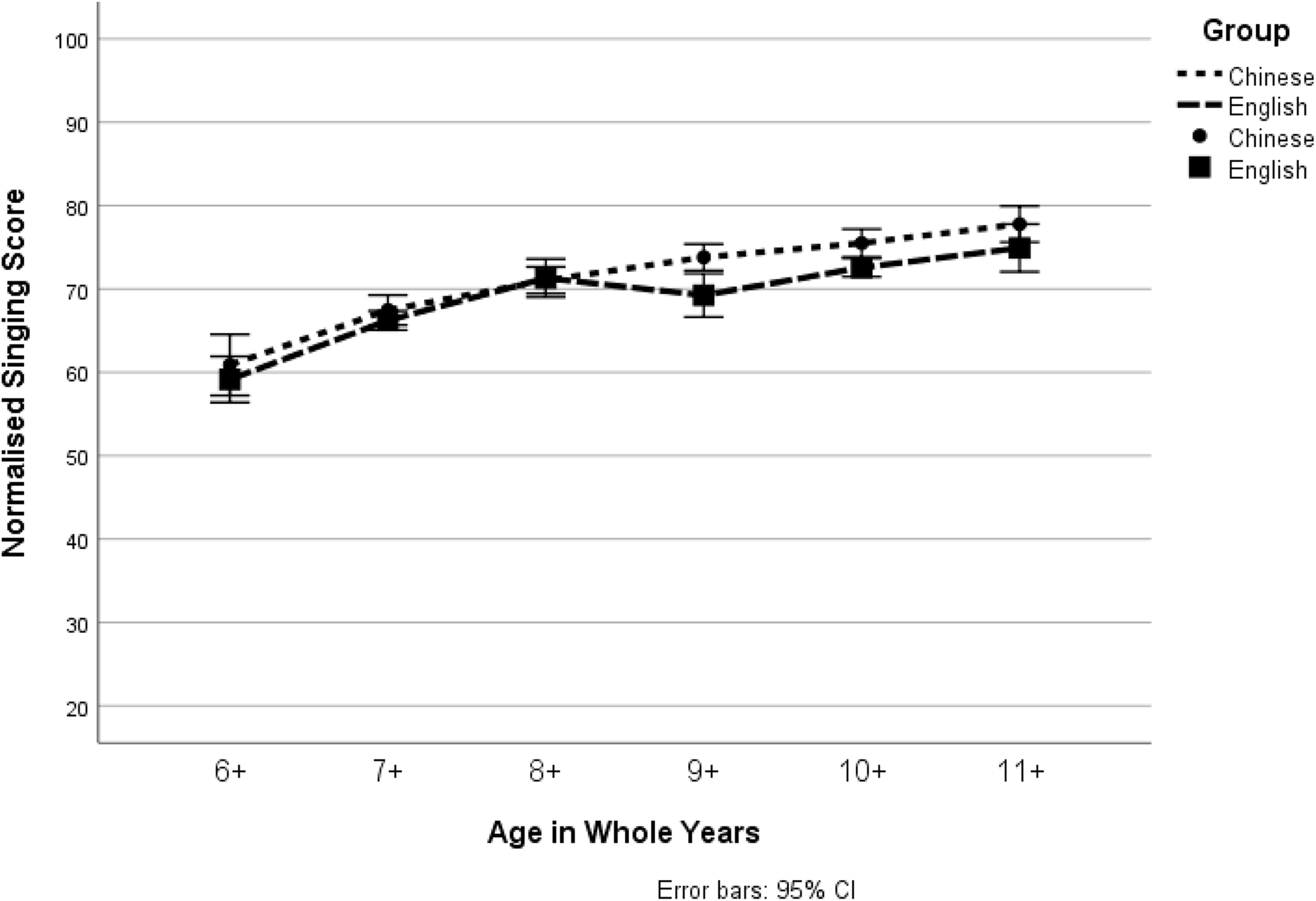
Two Pearson coefficient correlations were conducted to explore (i) the relationship between age in whole years and the NSS of all the Chinese singing performances and (ii) the relationship between age in a whole year and the NSS of all the English singing performances provided by English Primary school students without Sing Up experience. Both relationships were positively significant – for age and Chinese performances (r = .252, n = 1,539, p < .001) and for age and English performances (r = .176, n = 3,498, p < .001) (see Figure 2). This suggests that the NSS mean score rose statistically significantly with increasing age for children in each country group.
Relationship between age and the NSS of each of the groups.

Furthermore, as Figure 2 shows, the mean NSS scores for each Primary school age group were close between Chinese and English participants. A two-way ANOVA was conducted to examine the interaction effects of nationality and age on NSS scores. The sample sizes for each combination of nationality and age group could be observed in Table 1. The analysis revealed a non-statistically significant interaction effect between nationality and age, F(5, 5025) = 1.78, p = .112. As the interaction was not significant, this indicates that the relationship between age and NSS scores did not differ statistically significantly between the two countries. Therefore, the development of NSS with age was similar between Chinese participants and English children without Sing Up experience.
When all the children were divided into a younger (ages 6–8) and an older (ages 9–11) group, a two-way ANOVA was then conducted to determine if NSS scores differed between these age groups and the two countries. The sample sizes for each group are presented in Table 1. There was no statistically significant interaction between age group and country, F(1, 5033) = 0.82, p = .366. The result suggests that the development of singing behaviour (as measured by NSS) was similar between Primary school students from Mainland China and England.
A three-way ANOVA was conducted to compare the development of NSS among Chinese and English boys and girls across age. The sample size for each group is shown in Table 1. The three-way interaction (age × sex × country) was not statistically significant, F(5, 5013) = 0.69, p = .628. As shown in Figure 3, NSS scores generally increased with age in both countries, and girls had statistically significantly higher NSS scores than boys in both countries.
Normalised singing scores and age in whole years, differentiated by nationality and sex.

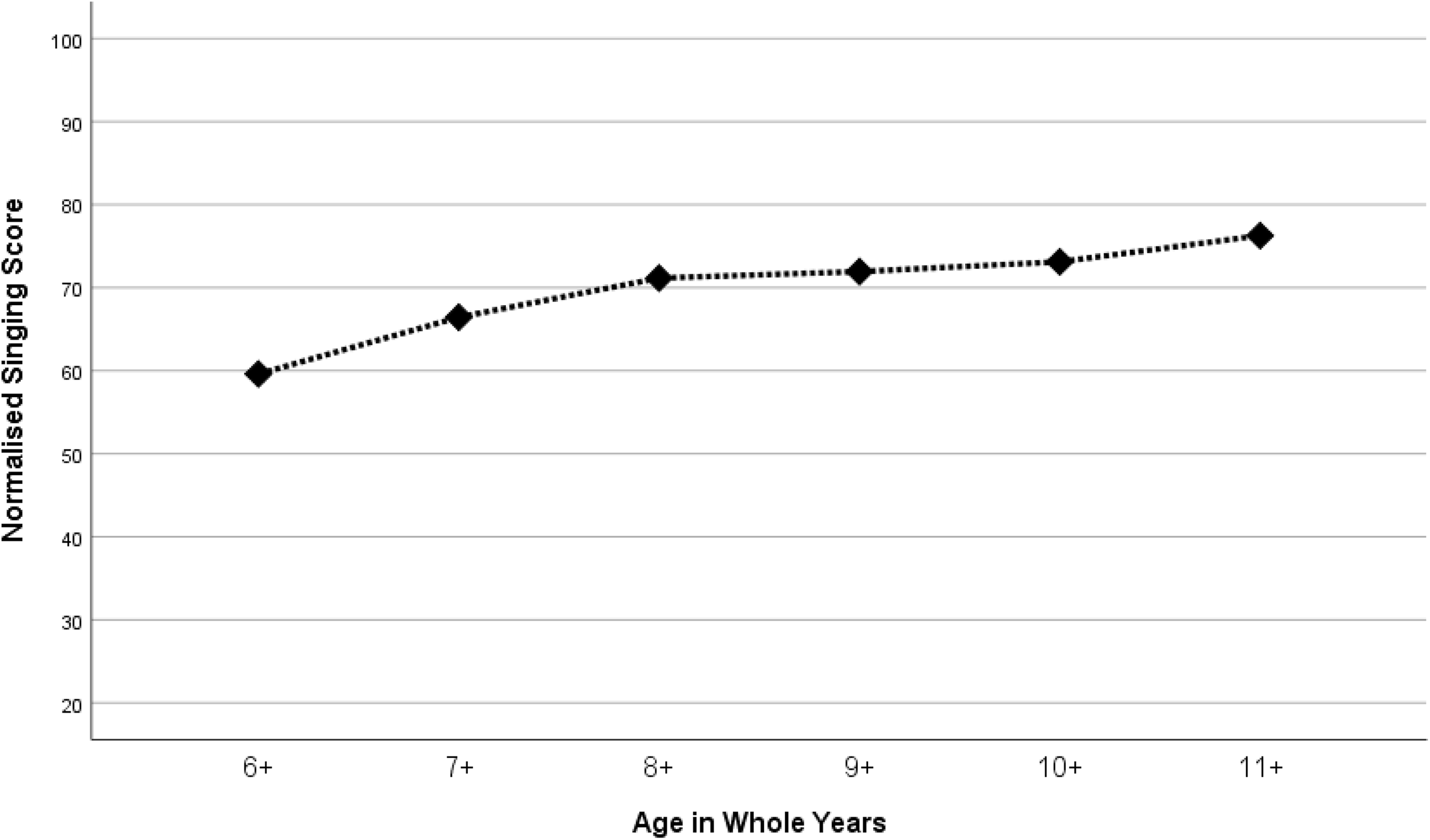
Next, singing performance data from all Chinese and English participants were combined to create an overview of singing behaviour for Primary school students across nationalities. A Pearson correlation coefficient was computed to assess the relationship between age clusters and the means of the NSS. There was a positive correlation between the two variables (r = .195, n = 5037, p < .001).
A one-way ANOVA was conducted on the combined dataset to explore the development of NSS across age groups during the Primary school period. The sample size for each age group is presented in Table 1. Overall, children’s NSS increased statistically significantly with increasing age, F(5, 5031) = 45.43, p < .001. Post hoc comparisons using the Bonferroni-adjusted p-value = .003Footnote 6 showed that the mean score for age 6 children (M = 59.61, SD = 19.17) was statistically significantly lower than that for age 7 children (M = 66.44, SD = 19.28). The mean for children aged 7 was statistically significantly lower than that for age 8 students (M = 71.16, SD = 17.69). Furthermore, the mean for age 8 was statistically significantly lower than that for age 11 students (M = 76.27, SD = 17.56). However, the means for other paired age groups were not statistically significant. Overall, these results suggest that the effects of age on singing development were more marked with younger Primary school children (age ≤ 8) (see Figure 4).
Normalised singing scores and age in whole years based on singing performances of all Chinese participants and English students without Sing Up experience.

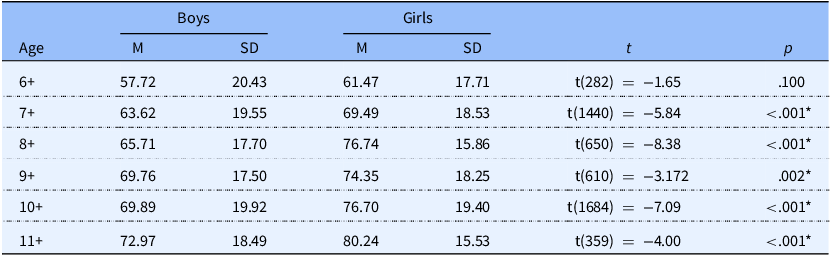
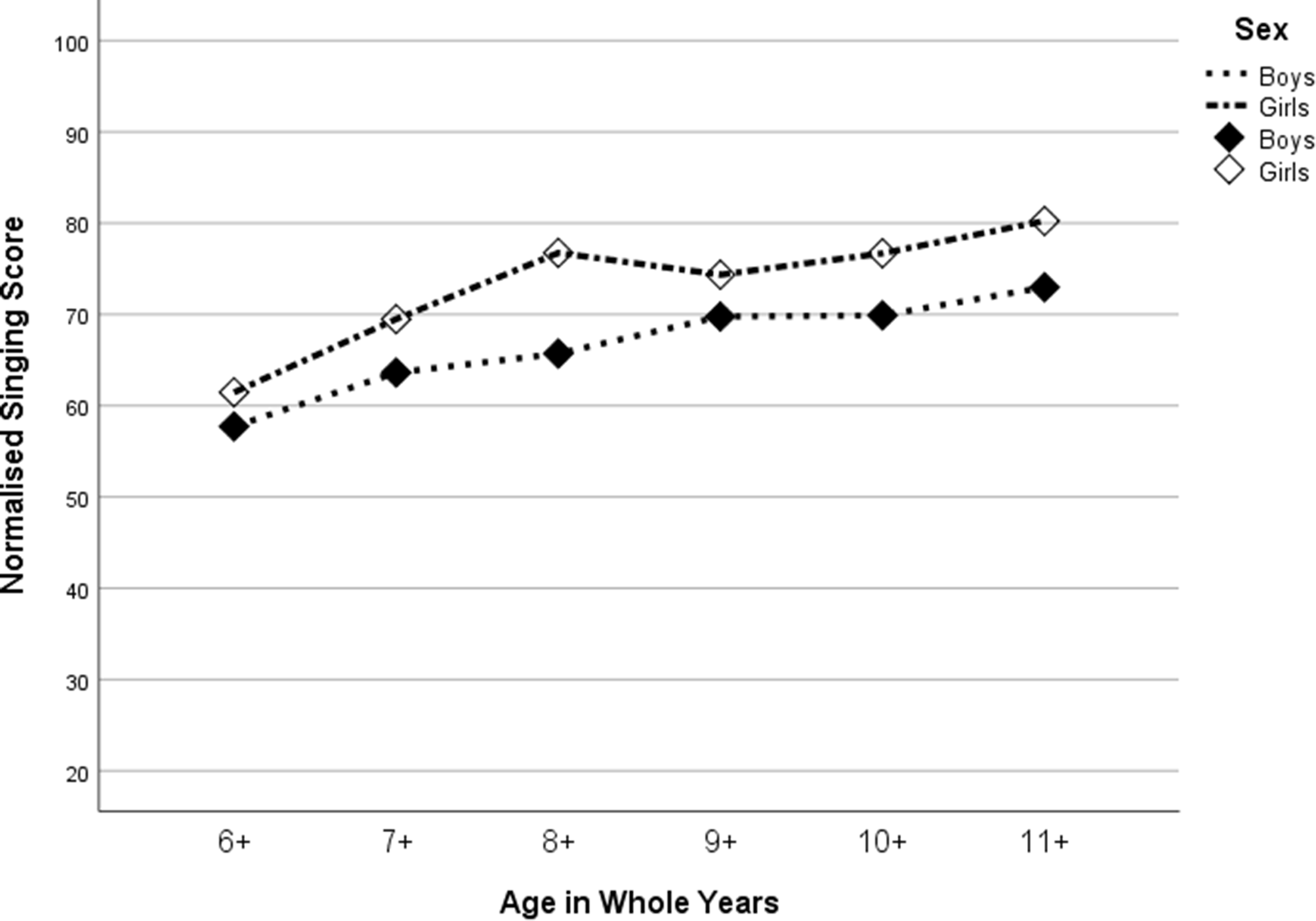
Finally, a two-way ANOVA was conducted on the combined dataset to explore the change of the NSS with increasing age during the Primary school period between boys and girls. There was also a statistically significant difference by age and sex interaction effect, F(5, 5025) = 2.65, p = .021. Then, six independent sample t-tests were conducted to compare the means between boys and girls for each of the age groups, using the Bonferroni-adjusted p-value = .008 (0.05/6). As Table 2 shows, while the sex difference in the NSS was not statistically significant for students aged 6, it was statistically significant for other age groups. The means for the older girls were statistically significantly higher than those of the older boys (see Table 2 and Figure 5).
Results of independent sample T-tests comparing mean differences in the NSS between boys and girls for each of the age groups

Table 2. Long description
The table presents the results of independent sample T-tests comparing mean differences in the NSS between boys and girls for each age group. It includes six rows for different age groups (6+, 7+, 8+, 9+, 10+, 11+) and columns for mean (M) and standard deviation (SD) for boys and girls, along with t-values and p-values. Row 1: Age 6+, Boys M 57.72, Boys SD 20.43, Girls M 61.47, Girls SD 17.71, t(282) -1.65, p .100. Row 2: Age 7+, Boys M 63.62, Boys SD 19.55, Girls M 69.49, Girls SD 18.53, t(1440) -5.84, p <.001. Row 3: Age 8+, Boys M 65.71, Boys SD 17.70, Girls M 76.74, Girls SD 15.86, t(650) -8.38, p <.001. Row 4: Age 9+, Boys M 69.76, Boys SD 17.50, Girls M 74.35, Girls SD 18.25, t(610) -3.172, p .002. Row 5: Age 10+, Boys M 69.89, Boys SD 19.92, Girls M 76.70, Girls SD 19.40, t(1684) -7.09, p <.001. Row 6: Age 11+, Boys M 72.97, Boys SD 18.49, Girls M 80.24, Girls SD 15.53, t(359) -4.00, p <.001.
Note: *. The mean difference is significant at the .008 level.
Analysis of the normalised singing scores by age (in whole years) and sex, based on singing performances of all Chinese participants and English students without Sing Up experiences.

Discussion
Firstly, in line with a large range of research literature, the evidence suggests that children’s singing competency customarily develops with age – as first summarised in a review by Welch (Reference WELCH1979) – and this appears to transcend cultural settings. Secondly, in terms of possible sex differences as well as age effects in children’s singing, the current study of n = 5,037 children from two countries is in line with the findings reported by Mang (Reference MANG2006), Welch et al. (Reference WELCH, HIMONIDES, SAUNDERS, PAPAGEORGI, VRAKA, PRETI and STEPHENS2009b, Reference WELCH, HIMONIDES, SAUNDERS and PAPAGEORGI2010) and Pereira and Rodrigues (Reference PEREIRA and RODRIGUES2019). Each of these studies reported that girls generally show more developed singing behaviour than boys. The children in these three studies were from Hong Kong, England and Portugal, respectively. Taken together with the findings from the current analyses of children from Hunan Province in China, this suggests that a sex difference in singing behaviour is likely to be a shared characteristic for Primary school children in varied cultures where regular music lessons are provided in the Primary school system and in a context where the culture outside school supports a wide exposure to different forms of popular vocal music with both male and female vocal models (e.g., Ho, Reference HO2017; Youth Music, 2024). This sex difference might be because music teachers in the current study were predominantly female, and their vocal products in singing are close, acoustically, to those of girls, particularly as children get older when singer sex becomes much more readily identifiable (Sergeant et al., Reference SERGEANT, SJÖLANDER and WELCH2005; Sergeant & Welch, Reference SERGEANT and WELCH2008; Welch Reference WELCH and MCPHERSON2015, Reference WELCH, WELCH, HOWARD and NIX2019). For instance, across the six participating Chinese schools, there was only one male music teacher. Welch et al. (Reference WELCH, HIMONIDES, SAUNDERS, PAPAGEORGI, VRAKA, PRETI and STEPHENS2009b) considered whether this sex difference in singing behaviour might be because boys thought that singing was a female activity, which led to them being involved in fewer singing-related activities. However, the current study also found that boys and girls aged 6 may have no sex difference in their singing behaviour (cf. see Figure 15 of Welch et al., Reference WELCH, HIMONIDES, SAUNDERS, PAPAGEORGI, VRAKA, PRETI and STEPHENS2009b). This might be because of their similar size of vocal mechanism (Titze, Reference TITZE1994) and similar vocal characteristics in the speech of young children.
Overall, these findings propose that Chinese participants and English Primary school pupils without Sing Up training show similar development of singing behaviour by age and sex. This suggests that national culture may have a limited impact on any differences in children’s singing competencies – unless there is a specific intervention programme, as was the case in England from 2007 to 2011. However, it should be noted that Primary school children from both countries generally received some form of regular music curriculum in Primary schools based on equal temperament tuning.
The studies of Mang (Reference MANG2006) and Welch et al. (Reference WELCH, HIMONIDES, SAUNDERS, PAPAGEORGI, VRAKA, PRETI and STEPHENS2009b, Reference WELCH, HIMONIDES, SAUNDERS and PAPAGEORGI2010) reported that Primary school children’s singing competency, including vocal register use and vocal pitch-matching accuracy for songs, varied statistically significantly by local cultural variables. Mang (Reference MANG2006) explored the influence of tonal language on children’s singing behaviour, while Welch et al. (Reference WELCH, HIMONIDES, SAUNDERS, PAPAGEORGI, VRAKA, PRETI and STEPHENS2009b, Reference WELCH, HIMONIDES, SAUNDERS and PAPAGEORGI2010) compared the singing behaviour of varied ethnic groups. However, this was not the focus of the current article, as the Chinese participants from Hunan Province were considered to be a more homogenous group in terms of language and culture.
While English bilingual children in Hong Kong (whose ethnicity is not reported) showed a lower level of singing behaviour than Cantonese monolinguals in the study of Mang (Reference MANG2006), the singing behaviour of black and white children in England generally showed more competent singing behaviour than their Asian peers in the study of Welch et al. (Reference WELCH, HIMONIDES, SAUNDERS, PAPAGEORGI, VRAKA, PRETI and STEPHENS2009b, Reference WELCH, HIMONIDES, SAUNDERS and PAPAGEORGI2010). One difference in these contrasting findings may be that the English bilingual children were a minority group in the community of Hong Kong in Mang’s (Reference MANG2006) study, whereas white children were the majority group in England in the studies of Welch et al. (Reference WELCH, HIMONIDES, SAUNDERS, PAPAGEORGI, VRAKA, PRETI and STEPHENS2009b and Reference WELCH, HIMONIDES, SAUNDERS and PAPAGEORGI2010). Given the larger dataset in the English study, this seems to suggest that the singing behaviour of children may vary by ethnicity depending on the context. Perhaps when they are in the majority in their local community, they may be more likely to show more advanced singing behaviour, at least as measured by these target songs.
However, when comparing the singing competence of the Chinese (2024) and English (Reference WELCH, HIMONIDES, SAUNDERS, PAPAGEORGI, VRAKA, PRETI and STEPHENS2009b, Reference WELCH, HIMONIDES, SAUNDERS and PAPAGEORGI2010) children, it is important to note that the majority ethnic group in both groups was representative of their respective local populations. All participants in Lu’s (Reference LU2024) study, located in the northeast and east of Hunan Province, were Han Chinese. All participants were encouraged to speak Mandarin in their schools, although they might speak their local language at home, and the two song tasks were in Mandarin. It should be noted that over 90% (91.10% in 2024) of the population in China is Han.
Consequently, it can be conjectured that these children from their relative majority ethnic groups were comparable. Although music is part of the school curriculum in both China and England, it was not a main Primary school subject in either country. The standard amount of available time used to teach music in a state Primary school in both ChinaFootnote 7 and England seems similar, being notionally nearly one to one and a half hours per week across an academic term. The singing environment out of school for both groups might also be similar, as listening to and singing songs from recordings are popular in both countries (ChinaFootnote 8 and England – Welch et al., Reference WELCH, HIMONIDES, SAUNDERS, PAPAGEORGI, VRAKA, PRETI and STEPHENS2009b). Lastly, Primary school children from different cultures seem to share similar physical development. For instance, the length of vocal folds increases with age (Titze, Reference TITZE1994) and leads to increasing vocal range (Welch, Reference WELCH1979), irrespective of different ethnicities. It should be noted that Asian children in the English Sing Up study tended to have a higher speaking pitch compared to their Black and White peers (Welch et al., Reference WELCH, HIMONIDES, SAUNDERS, PAPAGEORGI, VRAKA, PRETI and STEPHENS2009b), implying that their vocal folds were physically smaller at the time of testing.
Conclusion
When comparing these Chinese participants’ singing behaviour (as measured by vocal register use and vocal pitch-matching accuracy for the two target songs) with that of English Primary school children who did not receive Sing Up training, the trend was for children from both cultures to have more competent singing behaviour, significantly with age. Furthermore, the current comparison found that the means of singing behaviour across age groups between both cultural groups were similar. While boys and girls aged 6 showed similar singing behaviour in China and England, older girls generally showed more skilled singing behaviour (used more vocal registers and vocally matched pitches of the target songs more accurately) than older boys. Overall, there was no statistically significant difference in singing behaviour by participants’ age and culture interaction or the age, sex and culture interaction. By comparing the singing ability between the current Chinese participants and English students without Sing Up experience, the current study found that children from both cultures showed similar singing ability and behaviour.
Singing is one of the key music activities in many countries, such as China (Ministry of Education of the People’s Republic of China, 2022) and EnglandFootnote 9 . Welch et al.’s (Reference WELCH, HIMONIDES, SAUNDERS, PAPAGEORGI, VRAKA, PRETI and STEPHENS2009b) study showed that English Primary school students receiving Sing Up training showed significantly better singing behaviour than peers who did not receive the training. Moreover, these effects were observable for both boys and girls, thus implying that a child’s singing ability is not fixed but open to development in an appropriately nurturing context (Welch, Reference WELCH, WELCH, HOWARD and NIX2019). Teachers in China, as in England, should be educated to expect differences in children’s singing competency and be prepared to differentiate their pedagogical strategies accordingly. This could be achieved by delivering specialised vocal training to both current and future music teachers in China.
Although the GDP of Hunan Province is above the mean level compared with national statistics (e.g., 9/31 provincial levels in 2022Footnote 10 and 2024Footnote 11 ) and Primary school children’s singing behaviour is significantly influenced by socio-economic status, at least in this Chinese dataset (Lu, Reference LU2024), we caution whether singing data based on Hunan Province in Lu’s (Reference LU2024) study should be taken to represent Primary school children’s singing behaviour in the top or bottom GDP areas in China. Furthermore, while no significant cultural differences in Primary school children’s singing behaviour were evidenced in this comparison between Chinese and English Primary school children, it is unclear whether this would be the case in a third culture, especially one where a music curriculum is not provided statutorily in school and/or in a musical culture which is not based on equal temperament. Overall, such variables could be explored fruitfully in future studies.
Author contributions
Can Lu: data curation, formal analysis, investigation, methodology, project administration, resources, software, validation and visualisation. Graham F. Welch: conceptualisation, formal analysis, methodology, project administration, software, supervision and validation.
Financial support
The authors received no financial support for the research, authorship and/or publication of this article.
Competing interests
The authors declared no potential conflicts of interest with respect to the research, authorship and/or publication of this article.
Ethical standards
This study was approved by the Research Ethics Committee of the Institute of Education, University College London, in March 2017.
Statements and declarations
The authors declare that the research is original and has not been published elsewhere.
Consent to participate
All participants provided written informed consent prior to participating.
Consent for publication
Written informed consent for the use of anonymised collective data for publication was given at the time of data collection.