Risks in livestock marketing in Kenya's northern borderlands are neither few nor new. New risks emerge on a regular basis, to which traders respond by inventing new ways to cope with these challenges. Cattle traders portray distinct behaviours under various constraints, such as market uncertainty, macro-economic decline and political instability (Little Reference Ensminger1996b; Teka et al. 1999). Faced with myriad risks and uncertainties, they forge various social relationships and adopt diversification strategies to avert or cope with those constraints (Little Reference Kerven1992a; Little et al. 2001; Smith et al. 2000). Basing his study on cattle traders in southern Somalia, Little found that in times of political and economic volatility traders who had diversified markets prospered more than others, while those who focused only on one outlet, such as export trade, suffered the most (Little Reference Kerven1992b, 1996a, 2003). Little's studies indicate that diversification of business is an effective survival strategy under uncertain circumstances.
This article examines innovations in livestock marketing that traders in northern Kenya use to overcome a host of obstacles. Although theirs is one of the toughest and most risk-prone jobs in the region, livestock traders have been able not only to transform the ways in which trading is conducted through ‘home-made’ innovations, but also to mitigate the risks they face. The article demonstrates how they have become resilient to these risks and have been able to succeed in a trade that many in the past have abandoned. The article focuses on the broad field of pastoral risk management to illustrate how an innovative risk management strategy can be used to create a successful business entrepreneurship in such an environment.
I argue that livestock traders in northern Kenya use social relations based on trust to reduce and in some cases eliminate trading risks. Two major strategies are key to achieving this objective: (1) the creation of individual-based trading arrangements; and (2) the establishment of livestock trader associations.
The Burji ethnic group dominates livestock trade in northern Kenya, making up 50 per cent of traders. Most risk management strategies discussed in this article are innovations of this particularly enterprising group (see Mahmoud 2003). Their successes are attributable to their extensive use of trust-based business strategies to enhance survival in an area best known for its political and economic volatility. This is a similar scenario to the ethnic domination of Maasai livestock trading in Kajiado District of Kenya (see Quarles van Ufford and Zaal 2004).
The article makes an important departure from previous studies of social relations pertaining to dyadic personalized trading relationships: for example, clientelism (Little Reference Kerven1992b), ‘clientelization’ (Geertz Reference Geertz1978), onibara (Trager Reference Trager1981) and patron–client relations (Ensminger Reference Ensminger1996). While these studies focus on trading relations between buyers and sellers, the central focus of this article is on trading relations between sellers themselves, while a peripheral reference to relations between other actors is maintained.
THE STUDY AREA AND A NOTE ON METHODOLOGY
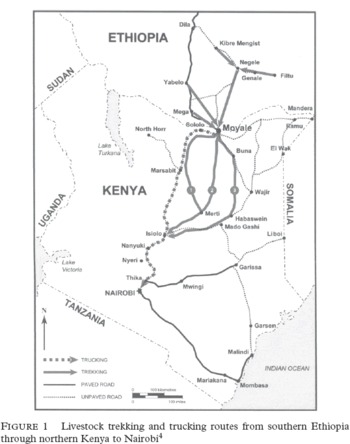
Present-day northern Kenya was a constituent of the Northern Frontier District (NFD) that the British colonial administration designated to demarcate its northern frontier from Ethiopian territories. Moyale town is located right on the border between Kenya and Ethiopia. It is a dual town separated by what was once a permanent stream that has been reduced to a moist riverbed with hardly any water flowing in it. Moyale acquired district status in July 1995 following the splitting of the extensive former Marsabit District. The district covers an area of 9,390 square kilometres and shares borders with Marsabit District to the south-west, Wajir District to the east and (an international boundary) Ethiopia to the north. The district is divided into several divisions, locations and sub-locations. The ecology of northern Kenya is remarkably diverse, stretching across barren expansive deserts to undulating cool and wet hills and mountains (see Figure 1, p. 567).
I draw on fieldwork conducted during 2001–2 among cattle traders in northern Kenya and Nairobi and recent work among Somali livestock traders in north-eastern Kenya. It is a district whose economy is dependent solely upon livestock production and marketing, with few alternative economic activities. Interviews with herders, livestock traders, livestock wholesalers, brokers and the staff of the Ministry of Livestock Development were a main source of information. Spending time with market actors in livestock markets in Moyale and Nairobi and travelling on livestock trucks on the Moyale–Nairobi road provided ample opportunities for participant observation. Travelling on these trucks not only provided valuable insights into the transport risks involved in the trade in this particular part of the country, but was also a great opportunity to have a usually busy livestock trader on hand throughout a 48-hour journey to talk about all aspects of the trade – from institutional to infrastructural issues, covering in the process all the problems that traders have to bear and how they manage to endure. Several case histories were used to highlight details of livestock trader relations and how the dynamics of the trade were managed through trust-based relations.
LIVESTOCK MARKETING RISKS IN NORTHERN KENYA
Cattle marketing risks and constraints are widespread in pastoral areas of Africa (Barrett et al. 2003; Bonfiglioli Reference Bonfiglioli1993; Kerven Reference Kerven1992; Little Reference Kerven1992b; Quarles van Ufford Reference Quarles van Ufford1999; Sandford 1983). While most constraints are similar across the continent, some are unique to specific areas and specific market actors. Cross-border issues, notably stock thefts, especially hamper cattle marketing in certain parts of Africa: examples include the borders of Kenya/Tanzania (Fleisher Reference Fleisher2000); Algeria/Tunisia (Homewood Reference Homewood1993); Lesotho/South Africa (Kynoch and Ulicki Reference Kynoch and Ulicki2000); Kenya/Somalia (Little Reference Little2000, Reference Barrett, Chabari, von Bailey, Little and Coppock2003); and Ghana/Burkina Faso (Tonah Reference Tonah2000). Certain cross-border zones frequently incur ethnic conflicts, human and livestock movement controls and border closures, which can all constrain marketing activities. In East Africa, the Ethiopia/Kenya borderland is crucial because it connects prime cattle-producing areas of southern Ethiopia to the region's largest market, Nairobi. Cross-border constraints may have slowed down the pace of cattle commerce in the area, but are not a permanent deterrent to the trade. Nevertheless, the severity of certain trading constraints during certain periods has forced several Ethiopian and Kenyan traders to abandon cross-border commerce.
Herders and livestock traders in northern Kenya operate in unpredictable circumstances with risks and uncertainties all around. Formal contract law to protect against business fraud does not exist. Trade is made easier by the existing network of relations based on kinship and ethnic values and by local institutions like the dilaal. Dilaal is an Arabic word generally meaning ‘a go-between’. The term is widely used in the Horn of Africa in several languages including Boran, Kiswahili and Somali. (See Little 1992b, 1996b and 2000 for a detailed explanation of the primary duties of dilaals in the Somali and Kenya–Somalia borderlands context.) The general role of the dilaal is to facilitate livestock trade between producers and traders by matching sellers with buyers, and also to help minimize fraud. The specific functions of a dilaal include, among other things, assessment of the carcass weight of the live animal and its price and advising the producer or the trader accordingly. In the following sections I will discuss the problems of insecurity, excessive transport costs, the infamous credit system and the culture of loan defaults as experienced by northern cattle traders in Nairobi livestock market.
Insecurity and cattle trading in northern Kenya
Insecurity is not a new phenomenon in livestock production and trade in East Africa. The problems of insecurity and raids in the livestock sector have been discussed in the literature on African pastoralism and particularly on pastoral livestock marketing (examples include Fleisher Reference Fleisher2000; Little Reference Little2000; Nunow Reference Nunow2000; Quarles van Ufford 1999). Insecurity in cattle marketing along the Kenya–Somalia borderlands is rampant, but traders assert that the problem is more acute on the Kenyan side of the border than on the Somali side. The establishment of a sound relationship or pact with clans on trade routes is a fundamental consideration in trekking livestock over long distances in Somalia (Little Reference Little2003). In Benin, West Africa, risks increase not in the small rural markets but as traders approach the terminal markets. Common forms of insecurity in West Africa include cattle theft on treks and in urban areas, theft by herders, and cattle loss because of unfamiliarity with urban areas.
Insecurity in northern Kenya, in all forms, is a potentially devastating fact of life for traders, the government, private organizations and the public. It affects all facets of social and economic life and every sector of the local economy. For cattle traders of northern Kenya, insecurity is disguised in numerous ways and manifests itself in several forms – ethnic conflicts, highway robbery (also called banditry or shifta in local expressions), livestock theft in Moyale and to a lesser extent in Nairobi, and cash theft in Nairobi.
Livestock theft in Moyale is a thorny issue for traders. It occurs because traders must graze the purchased animals for one or more days while awaiting trucking to Nairobi. These animals are sometimes stolen from the outskirts of the town. The period between purchasing and trucking cattle is a very critical time: traders worry about local security against livestock thefts, the availability and high costs of trucking, insecurity on the highways, road conditions and uncertainty about market trends in Nairobi. The provision of extra security for cattle while in Moyale increases transaction costs. The following excerpts from trader interviews underscore the seriousness of livestock theft in Moyale.
Cattle cannot graze far from town because of fear of theft. If my cattle were stolen while grazing in Moyale, I would not dare go looking for them for fear of my own life. Therefore, the security of my cattle must be tightened day and night; this, of course, increases my expenses. (Trader S, Moyale, northern Kenya)
Ethnic tensions and lack of security around Moyale town force our cattle to graze on a poor pasture, consequently losing weight dramatically. I have to buy pasture for my cattle and this increases the transaction costs. (Trader NM, Moyale, northern Kenya)
I have been a victim of banditry thrice. I have been robbed of a watch, money and other valuables. I travel on the road with a lot of fear and at my own risk. (Trader DW, Moyale, northern Kenya)
As a group of affluent businessmen and an ethnic minority, the Burji especially feel threatened and targeted in and around Moyale and on the Moyale–Nairobi highway. Trust-based trader relations keep them going. Ethnic conflicts in northern Kenya can hinder the operations of cattle markets, but may not necessarily stop cattle from moving to Nairobi. Cattle supplies to Moyale dwindle a little during conflicts but this usually is only for a few days. Moreover, after ethnic feuds are over, traders return to trading routines because market actors recognize the centrality of cattle trading in their livelihood systems. Burji traders usually maintain an extra stock of cattle so that livestock movement to Nairobi is adequately protected against conflict-instigated shocks. However, the eruption of serious conflict in the area can paralyze all forms of business and the movement of people, livestock and goods.
Exorbitant transport costs
Trucking is a costly item in cattle trade in northern and north-eastern Kenya. In the period 1996–8, transport costs increased by 52 and 72 per cent along the major market routes of Garissa–Nairobi and Garissa–Mombasa, respectively (Little Reference Little2000: 25). Similarly, trucking costs in northern Kenya have increased dramatically in the past few years. In the past, transport costs were based on the number of animals transported from northern Kenya to Nairobi, but the current pricing system is based on hiring an entire truck irrespective of the number of animals making the journey. This has led to escalation in trucking costs in the area. Livestock transportation costs in northern Kenya are a function of several factors, including distance between markets, mode of transportation and cattle supply. Trekking cattle to markets can be a cheaper way of transportation, yet a different set of factors influence the decision to trek: security, availability of water and pasture on the trekking route, and the relationship between the trader and the ethnic groups residing en route.
Trucking is usually for traders who are well established, have a high turnover and, most importantly, can afford the costs of trucking. However, some cattle traders cannot afford the high trucking costs that sometimes account for as much as 33 to 40 per cent of the price of cattle in the Moyale market. Transport costs in Moyale range from Ksh1,500–3,500 (US$19–45) per head of cattle.Footnote 1 The main commodity transported from Moyale to Nairobi is livestock, while a variety of merchandise – used clothes, construction materials, foodstuffs, timber, plastic ware and household goods – are back-hauled from Nairobi to Moyale. Figure 1 shows the study area and the livestock trekking and trucking routes in northern Kenya.
The costs of hiring a truck from Nairobi to Moyale average about Ksh20,000 (US$256), while the costs of transporting livestock from Moyale to Nairobi ranged between Ksh30,000 and Ksh70,000 (US$385 and US$897) per trip during March 2001–February 2002. Confronted with such circumstances, transporters make up for losses by charging cattle traders exorbitantly high trucking costs.
Security for transit animals is an important cost element in cattle trekking and its provision is always given adequate consideration. Although the cost of security may be insignificant in some instances, it usually depends on two major factors. The first consideration is the region through which livestock is trekked. If hostile groups and bandits are known to inhabit the transit areas, the appropriate precautionary measure is the hire of adequate security men to accompany the animals. This increases trekking costs. Second, the volume of animals being trekked determines the type and size of security hired. If the volume of livestock trekked is high –in excess of, say, 200 head of cattle – more security men are hired. Trekking a high volume of livestock is riskier even if the route passes through lands occupied by friendly clans or ethnic groups. Cost components of the two major forms of livestock transportation in northern Kenya generally include the following items: trucking costs include truck hire, veterinary movement permit, drover's wage, and police ‘tips’;2 trekking costs include the wages of trekkers, food, and the hire of armed security guards.3
Loan defaults and the culture of cattle credit in Nairobi
Credit defaults have long been threats to the survival of northern Kenya livestock traders. While loaning is a vital feature of livestock marketing in Africa (see Cohen Reference Cohen1969; Quarles van Ufford Reference Quarles van Ufford1999; Quarles van Ufford and Zaal Reference Quarles van Ufford and Zaal2004), it is a business nightmare in Nairobi's cattle markets. Butchers in Benin markets lure traders with higher prices to obtain cattle on credit (Quarles van Ufford Reference Quarles van Ufford1999), while cattle traders in Nairobi set higher than usual prices if they intend to sell their cattle on credit (Mahmoud Reference Mahmoud2003). In both scenarios, the main goal of traders is to complete sales of their cattle as soon as they can, so that arrangements to purchase another consignment of cattle can begin without delay.
In another context, merchants in northern Nigeria establish trust relationships with their urban landlords when dealing with butchers in the south of the country. In such circumstances, landlords play a dual role. First, they provide accommodation to traders and, second, they act as intermediaries to help traders sell their cattle. Indeed, landlords in southern Nigerian cities are the first contact for traders from northern Nigeria. Landlords appoint a commission agent for traders, whose duties are to facilitate the sale of animals and collect money. The commission agent charges a fee called lada. Cattle are sold on credit, hence the duration of the money collection period can extend for a period of two to four weeks (Cohen Reference Cohen1969). Unfortunately, these luxuries are not available to northern Kenya livestock traders in Nairobi. Instead, these traders deal with cattle wholesalers through the mediation of brokers: they neither obtain hospitality and accommodation, nor can they confidently expect to collect their money in two to four weeks. If they are lucky, they will collect their money in that period; in the worst-case scenario, they may not receive their money at all.
Terminal markets for cattle from northern and north-eastern Kenya are generally located in large cities where incomes and demand for meat are higher than in rural areas. In an effort to reduce living expenses and the risk of robbery, cattle traders are often under pressure to dispose of their cattle as soon as possible. Such circumstances not only compel businessmen to sell cattle on credit, but also deny them the opportunity to explore different options in the market. Cattle wholesalers in Nairobi are fully aware of the predicament of cattle traders. Consequently, they do not hesitate to exploit the situation. They customarily operate in networks and collude against traders.
Why do northern Kenya traders sell cattle on credit in Nairobi when most business enterprises largely operate on a cash basis, including cattle sales in the large Dagoreti market? What forms of collateral can be used to protect cattle traders against loan defaults? Can northern businessmen survive over the long term in a market dominated by credit and loan defaults? These questions do not have easy answers, as several livestock traders acknowledge. Northern Kenya cattle traders gamble with their businesses and only source of livelihood by lending out large parts of their lifetime investments, in the form of cattle, to total strangers. Consequently, traders have become victims in the absence of trust. The stranger's identity and collateral are only his or her initials painted on the acquired cattle, initials that cannot even be verified. Under such frightening trading circumstances, the entire working capital of northern businessmen and women is put at risk. In addition, the livelihood systems of traders’ entire families are endangered. Many cattle traders have gone out of business in this way and many more continue to do so. In surveys done among 58 livestock traders in northern Kenya and Nairobi in 2001/2, 97 per cent of the traders stated that their business is based solely on a credit system. The remaining 3 per cent said that they do not provide credit under any circumstances because they have been victims of credit defaults in the past (Mahmoud Reference Mahmoud2003: 192).
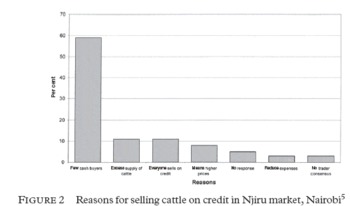
Several reasons compel Kenyan traders to sell cattle on credit in Nairobi (see Figure 2). Of the sample of traders, 59 per cent said they provide credit because there are no cash buyers in the market. Second, selling cattle on credit in Nairobi's Njiru market has become the norm: hence, deviation from the ‘custom’ is perceived as an anomaly and traders may have trouble finding buyers. Many traders express concern about credit relations, but exclaim that ‘everyone sells on credit’. A general lack of consensus persists among cattle traders in Nairobi's market regarding the elimination of credit. They have occasionally agreed verbally to insist on cash payment. However, some businessmen secretly violate the verbal agreement. Under these circumstances, traders who have tried to comply with the agreement feel deceived. Several businessmen are sceptical about stopping the credit culture at the market, because they say that it has become an institution: ‘How would you deny credit to your customer of ten years?’ Some cattle wholesalers manipulate certain traders and lure them into selling their cattle on credit (Mahmoud Reference Mahmoud2003: 192).
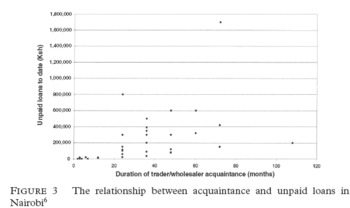
My data show that the willingness to provide loans in Nairobi's cattle market corresponds to the duration of acquaintance between the trader and the wholesaler. Indeed, the correlation between unpaid loans and duration of acquaintance between northern traders and Nairobi wholesalers (see Figure 3) is 0.469, which is a statistically significant relationship (Mahmoud Reference Mahmoud2003: 200). Thirty-five traders were interviewed about their credit experiences in Nairobi. They indicated that they had collectively sustained losses of about Ksh8,167,500 (US$104,712) over the past several years. Figure 3 thus provides a glimpse of the deeper and looming livestock marketing crises not only in northern Kenya but also in Kenya's livestock industry.
The common risks that northern traders run arise from physical insecurity throughout the study area and high rates of loan defaults in Nairobi. Both risks can be categorized as graduated risks and catastrophic risks.Footnote 7 The former refers to a situation where a trader faces a gradual risk, such as in slow loan defaults. Traders can live with this kind of risk because it does not necessarily push them out of business. However, if a trader offers his/her entire working capital, tied up in cattle, to a wholesaler in Nairobi who then disappears with the loan, this event amounts to a catastrophic shock, instantly throwing the northern trader out of business. Similarly, if a truck load of cattle is stolen, and that is all a trader has in terms of working capital, the loss is a catastrophic shock from which he/she may not be able to recover. On the other hand, a trader can cope with the loss of one or two head of cattle from a herd of 20 or more animals. While northern Kenya traders express concern at the high number of defaulting wholesalers, they can work with this level of risk, which is far lower than the loan defaults experienced in most micro-credit institutions in Kenya (Osterloh Reference Osterloh2001).
RESPONSES TO RISKS–INDIVIDUAL-BASED ARRANGEMENTS
Ensminger states that, while ‘commercialization has meant monopolization (at least until recently) and led to proletarianization’ among the Orma pastoralists of Tana River District in Kenya, ‘the Orma case offers data that confirm economists’ hunches about the benefits of transition to the market' (1996: 3). This transition is not occurring without daunting risks, as argued earlier. The creation of vertical integration among different livestock market actors in Kenya's Tana River District to reduce transaction costs is a response to a weak institutional structure (Ensminger Reference Ensminger1996). While it is a fact that state institutions to improve and facilitate livestock trade are lacking in Kenya's pastoral areas, institutions based on individual traders and small trader groups have sprouted – and are not only doing a good job but also changing the way livestock marketing is done in northern Kenya.
It was shown in the previous section that cattle trading in the northern Kenya–Nairobi corridor faces myriad risks stemming from multiple sources. A meticulous assessment of the full extent of cattle business risks in the study area is certainly an overwhelming task. Certain forms of risk can be linked to institutional failures (Ensminger Reference Ensminger1996), market forces (Barrett et al. 2003) and/or local and cross-border politics (Little Reference Little2003; Mahmoud Reference Mahmoud2003). Others stem from weather-related infrastructural breakdowns. A combination of interrelated issues in the marketing chain generates various constraints for cattle traders and other participants in the market. While improvement of security in the market and on the highways, together with the upgrading of roads and telecommunication facilities, are responsibilities of the state, cattle traders are capable of addressing certain constraints.
In situations where market forces pose unfavourable circumstances, such as low demand and low prices of cattle in Nairobi, or lack of choice for cash transfers from Nairobi to northern Kenya, cattle traders often turn to their social relationships to manage risks. These strategies have multiplied as the intensity of risk increases. In their efforts to minimize and where possible eliminate risks, merchants act individually and collectively, thus utilizing social capital at the local and regional levels. Individual and collective, as well as local and regional risk-reducing mechanisms not only curb recurrence of trading risks, but also help improve cattle exchange at all levels of the trading chain, thereby enhancing the livelihood systems of businessmen and women and other market actors. In essence there are two major types of risk management strategy in the trading circle: (1) individual-based arrangements; and (2) collective efforts (see Mahmoud 2003). Under the first kind of strategy I will discuss trading partnerships, which emphasize seller–seller relationships and the Burji cash transfer system. The second approach is principally concerned with establishment of trader associations in the trading corridor. Here two livestock trading associations are discussed – the Moyale Livestock Traders’ and the Northern/Nairobi Livestock Dealers’ associations.
Cattle trading partnerships: forging seller–seller relations
Partnerships in livestock trading have not been studied adequately in Africa in general and in the Horn of Africa in particular. A chain of livestock market actors, for example, has sometimes been said to comprise ‘trading partners’. The producer–broker–trader–butcher–consumer chain of livestock marketing is a typical scenario in Kajiado District of Kenya and Oudalan and Seno provinces of Burkina Faso (Zaal Reference Zaal1998: 146; see Little 1992b and Nunow 2000 for a similar description of the livestock trading chain in Somalia and Garissa District of north-eastern Kenya, respectively). While risk evasion and working capital limitations provide some of the motives in cattle trader partnership formations in northern Kenya, there are also a host of other reasons that encourage businessmen and women to take up trading partnerships. In some partnerships in northern Kenya large-scale traders personally have huge working capital and enormous trading operations. They need trading partners to help with procuring livestock and securing markets. On the other hand, new entrants with minimal capital seek guidance and trading tips from experienced traders and often serve as trading apprentices to the latter. Data from 83 livestock traders in northern Kenya show that 78 per cent of traders had at least one trading partner, while 22 per cent had none (Mahmoud Reference Mahmoud2003: 215).
The need for trading partnerships is confidently articulated in the words of traders themselves:
Trading partnerships are crucial because of the cumbersomeness of cattle trading. One of the trading partners resides in Moyale and the other in Nairobi. In this way, purchasing and selling duties are shared out between us, which make the business easier to handle. (Trader K001, Moyale, northern Kenya)
I decided to go into a partnership with a colleague for our benefit, which is primarily to safeguard our trading interests from the uncertain future. (Trader A002, Nairobi)
Partnerships in cattle trading are a valuable asset for a trader because livestock trading is a risky undertaking in which one can lose one's entire working capital at one go. (Trader H026, Nairobi)
With the exception of apprenticeships, these partnerships entail relatively equitable forms of collaboration: equal work sharing, equal profit sharing and a division of labour based on specialization and expertise. The common type of partnership involves two traders, though it is not uncommon for partnerships to involve more than two partners. The typical residence pattern of partners indicates a dual model: one end (with one or more partners) is based in Moyale (the cattle procurement area), while the other end is in Nairobi (the terminal market). This dual residential pattern of traders stems from the Veterinary Department's requirement that all livestock originating from northern Kenya must be slaughtered immediately on arrival in Nairobi. Accordingly, trading partners must be based at both supply and demand ends to facilitate trade.
The primary duties of the partner stationed in Moyale are to monitor market conditions, including cattle prices, supply and condition of animals, and periodic trading constraints. After buying animals, he/she hires a truck and sends them to Nairobi. Written instructions are handed to the truck driver to deliver to the Nairobi partner. These instructions are about the number of cattle purchased and loaded, buying prices and cattle descriptions, including the colour, size, sex and any peculiar features that would identify individual animals. Information about purchase prices is particularly important because selling prices in Nairobi determine trader profit margins. The truck driver is responsible for animals until he hands them over to the dealer based in Nairobi. Traders, when not accompanying their livestock, also give money to the driver to pay for the police ‘tips’ mentioned earlier.
Soon after trucks depart from Moyale, the Moyale-based partner calls his/her counterpart in Nairobi on the latter's mobile phoneFootnote 8 to alert him/her that the animals should arrive in about 48 hours. In the context of northern Kenya, partnerships between traders are stronger than those between traders and other actors in the market. Individual traders establish trading partnerships for convenience and out of necessity.
Prior to the increase in telephone use, businessmen relied on information transmitted by word of mouth between northern Kenya and Nairobi. With subsequent expansion of telephone facilities in Moyale, particularly the introduction of mobile phone services in the town, traders are increasingly using this medium to communicate with their counterparts in Nairobi. This contact is a vital source of information about changing market conditions. While those traders who have partners in Nairobi acquire market information from their partners, solitary traders often have contacts with friends and clansmen.
Moreover, partnerships are crucial in the management of credit defaults, and this is one of the main reasons why they are popular among northern Kenya cattle traders. An important aspect of this strategy is in the commitments that traders make while in partnerships. Some partnerships are operated on a rotational basis while others maintain permanence with regard to residential arrangements between Moyale and Nairobi. In rotational cases, some trading partners switch residence after six months, or some other convenient period. Interaction on a daily basis with a wholesaler enhances traders’ understanding of the wholesaler's business style and other traits. During the long period of acquaintance with wholesalers, traders screen wholesalers’ payment patterns and trustworthiness. During this time, reliable trading relationships are forged between traders and wholesalers while adverse ones are evaded.
Informal cash transfer mechanisms – the Burji system
Cattle commerce in northern Kenya involves a comparatively large amount of money. Ordinary trucks can haul about 18–22 head of cattle, 100–120 goats, or 10–12 camels. At average market prices, a truckload of cattle may be worth Ksh180,000–300,000 (about US$2,308–3,846). After cattle sales have been finalized in Nairobi, traders are confronted with the task of repatriating cash to Moyale for further animal purchases. Several means, with varying degrees of flexibility and risks, are available to accomplish this task. Each of the methods involves different fee payments and limitations. The seemingly easiest and obvious method of cash transfer is to carry the cash oneself, but this method has become increasingly unpopular because of the worsening security situation on the Isiolo–Moyale road. Traders have progressively become targets of bandit attacks. The Kenya Commercial Bank (KCB) and the Postal Corporation of Kenya, both government-owned, are conventional but costly and bureaucratic systems. The privately owned and operated Somali cash transfer system, commonly known as hawala, and the Burji system are the favoured options for livestock traders. While the hawala system is an extension of a money transfer system used worldwide principally by Somalis in the diaspora, what I refer to as the Burji Cash Transfer System (BCTS) is an institution that northern Kenya livestock traders have developed exclusively for livestock cash transfers.
Burji livestock traders and merchants, among whom the practice has grown considerably, devised this unique system and are its principal users. It operates purely on the basis of mutual trust between merchants and cattle traders. Soon after receiving their cash from cattle sales in Nairobi, traders arrange to meet with Moyale wholesalers, retail merchants and used-clothes dealers. The cattle trader hands over his/her cash to one of these merchants in Nairobi. Both traders (for example the used-clothes dealer and the cattle trader) have partners in Moyale and they call them for instructions on how to pay and receive the money that has just changed hands in Nairobi. The used-clothes dealer instructs his/her business partner in Moyale to pay the cattle trader's business partner in Moyale, giving out the identity details that the cattle trader provides, such as the recipient's full names and telephone numbers. At the same time, the cattle trader in Nairobi calls his/her business partner to confirm whether he/she has received the stated amount of cash from the used-clothes dealer's business partner in Moyale. The deal is over once the cash transfer in Moyale has been confirmed. The used clothes dealer uses the cash to purchase used clothes from Nairobi and transport the cargo to Moyale, while the cattle trader in Moyale uses the cash to procure another consignment of cattle. Cattle traders who do not have trading partners transfer their money to a merchant or a shop owner and collect it when they arrive in Moyale. This cash transfer arrangement is highly rated by those who use it, as illustrated in the following trader statements:
Sometimes I use telegraphic transfer through KCB to transfer my money to my bank account in Moyale. I stopped doing that because their fees are very high. Sometimes I use businessmen who have shops in Moyale to transfer my cash. There are no commissions charged by either of us because both of us benefit from the arrangement. There are no contracts, no signatures and we only use the telephone to instruct our partners in Moyale. (Trader 013, Moyale, northern Kenya)
Because of insecurity, I give the cash to someone who has a shop in Moyale and I collect my money from here (Moyale). He must be a good friend whom I can trust. On very rare occasions, I take the cash with me to Moyale. (Trader 015, Moyale, northern Kenya)
The advantages of this method of cash transfer are numerous as indicated in the above statements. First, security risks are minimized since traders rarely travel with large amounts of cash between Nairobi and northern Kenya. Second, any amount of cash can be transferred as required by the needs of traders. Third, cash transfers are effected the same day through telephone calls. Cattle traders praise the method highly for helping to reduce trader transaction costs and increasing trader confidence in dealing with someone they know and trust, rather than dealing with strangers and a banking system that they hardly understand. According to traders, it operates with minimal fraudulent incident. Social relations and acquaintances help reduce occurrences of deceptive behaviour. As far as the cattle trade is concerned, this system of cash transfer may be the only one of its kind in the Horn of Africa. The key to it is trust and the relationships between the persons engaged in the transfer. Those involved are mostly members of the same ethnic group or close friends: in this case, they are predominantly Burji. In addition to these criteria, the persons must trust each other on the basis of previous business experiences.
In short, to avoid the hassles of existing cash transfer systems with their expensive fees, northern livestock traders have devised an indigenous system that rests on trust and personal relations: it is not only safe, but also fast, flexible and free of charge.
RESPONSES TO RISKS – COLLECTIVE EFFORTS
Livestock trader associations are rare in Kenya and particularly in the northern and north-eastern parts of the country. In the recent past, however, there has been an escalation in the number of associations and organizations in northern Kenya involved with pastoralism in general and livestock rearing and trade in particular. These associations can easily be identified in Moyale town from the names written on the doors of their ‘offices’ – with titles that include terms like herders, pastoralists, pastoral women, pastoral youths, cowboys and brokers – to mention only the most prominent ones. Some of these associations sprang up almost overnight in anticipation of funding following the workshops that non-governmental organizations (NGOs) in the area organize regularly. Stakeholder initiatives to improve their own conditions present the best options. In a similar context, livestock traders in Moyale and those based in Nairobi have initiated their own associations. These are the Moyale Livestock Traders’ and Northern/Nairobi Livestock Dealers’ associations, which are discussed in the following sections. These associations are credible and operate out of their own pockets and for the welfare of their members.
The Moyale Livestock Traders’ Association
The Moyale Livestock Traders’ Association (MLTA) was established in September 1998 with 31 registered members, who meet on a monthly basis to discuss matters of importance to the association. Although membership is open to all interested livestock traders from northern Kenya, the association does not have women members and all of the members belong to the Burji ethnic group. The association is financially and organizationally stable, being active in awarding monetary assistance to its needy members. For example, one member was awarded Ksh50,000 (US$641) as general support, while another member was awarded Ksh200,000 (US$2,564) from the association and a further Ksh100,000 (US$1,282) from clansmen when he suffered bankruptcy. While assistance from the former source (the association's bank account) is repayable, the latter is a form of gift. Although repayment is not mandatory on the beneficiary, reciprocity is expected in the future and the recipient should extend a helping hand to another needy member of the association and the community. Association members contributed Ksh30,000 (US$385) as a goodwill gesture to a livestock trader who lost his cattle to thieves. The association maintains its own bank account created from members’ subscriptions and monthly contributions. Elected officials manage the funds and accounts are checked by all during regular meetings. Other forms of contributions from clansmen are on a voluntary basis.
The association has a long-term development programme for its members and the Burji community at large. The establishment of a school for the community is one aspect of this agenda. In 2002, the association purchased a prime plot in Moyale town for a school project and has put up a private primary school; it has excellent management and teaching staff, and its own school bus. In the longer term, the association plans to start a livestock-fattening project similar to the one Somali cattle traders-cum-ranchers have initiated in the Mombasa area of Kenya's Coast Province (Mahmoud Reference Mahmoud, McPeak and Little2006).
In the absence of credit facilities for livestock traders in northern Kenya and the undesirability of loans incurring interest in a predominantly Muslim area, an association of this kind offers a suitable alternative source of capital. This assistance is a crucial avenue for traders faced with uncertainty and unforeseen shocks.
Northern/Nairobi Livestock Dealers' Association
The Northern/Nairobi Livestock Dealers' Association (NNLDA) was officially registered in Nairobi on 1 June 2001. The group's membership is open to livestock traders from northern Kenya regardless of age, ethnicity, gender, or religion, but members must be based in Nairobi. The objectives of the association are broad-based and encompass many issues that are important to all members. For example, the association seeks to foster the socio-economic progress of its members and empower them economically through active participation. In addition, the association seeks ways and means to improve livestock marketing opportunities for its members in Nairobi; to provide advisory services to members in matters related to livestock diseases, livestock transportation and marketing; and to seek professional training and advice on improved livestock production and management methods for the benefit of its members. Despite being in its infancy, the association has begun tackling the credit culture that, as we have seen, is limiting marketing prospects for northern traders.
To reiterate, the two associations discussed above are de facto mono-ethnic groups, which helps maintain a certain degree of trust among members. It will be a long and strenuous struggle to tackle a credit institution that has become embedded in the Nairobi market and enjoys the backing of powerful businessmen. Through these two associations, northern Kenya livestock traders – whether they are based in Moyale or Nairobi – appear to have found a potential mechanism in the absence of any other organization, including the government, to assist them in periods of crisis.
CONCLUSIONS AND POLICY RECOMMENDATIONS
Risk levels in the livestock trade between cattle-producing areas in northern Kenya and Nairobi increase with distance. Conducting any form of business in northern Kenya is an intimidating affair. While this is the case, these findings have shown that risks can be managed successfully if correct measures are taken. Through heavy investment in social relations and trust, traders have been able to avoid more risky trading ventures. But they can only go so far. Avoiding bandits by using less risky routes or alternative means of livestock transportation does not eliminate the danger. That task lies in the domain of the state, which has the resources to undertake such a project. Thus, the perennial insecurity problem in the area will continue to haunt northern Kenya livestock producers and traders unless the government resolves to undertake stern measures against bandits to end the menace or curtail its effects on traders and trade significantly.
Similarly, infrastructure improvement such as road building is a state responsibility. High transport costs are a function of poor road conditions. The paving of the main Isiolo–Moyale road could dramatically reduce not only trucking costs but also trucking time to Nairobi, facilitating the timely arrival of animals at terminal markets. Besides increasing efficiency, the improvement of road infrastructure would help to minimize occurrences of roadside banditry by increasing vehicular traffic and travelling speeds. Cattle supply disruptions caused by collapsing bridges and roads in torrential rains would become less frequent. Above all, the wear-and-tear costs of trucks will be reduced, and savings on maintenance expenses will benefit livestock traders and other consumers.
Why the livestock sector in Kenya's pastoral areas in general – and in northern and north-eastern parts of the country in particular – is plagued with risks and uncertainties continues to be of considerable research and policy interest. At the policy and practical level, overcoming those risks has generated more engagement and investment from traders themselves than from the state and other organizations. The failure on the part of the state and prominent NGOs operating in the area to address the plight of pastoral populations stems from a lack of interest in and understanding of the vibrant pastoral economy and its potential contribution to the national economy and beyond. I have argued that livestock trading risks in northern Kenya are not only numerous, but increasingly complex. In response, home-made innovations to circumvent those risks are being actively and imaginatively conceived to defend the livelihoods of people whose major income earnings come from livestock and livestock-based products.
Pastoral livestock marketing systems are fragile as are their production systems. Within the policy framework of uninterested partners, such as the state and the ethnically skewed NGO world, it is unlikely that livestock trading woes will be addressed at the national level with the urgency and vitality they deserve. This article has aimed to contribute to the understanding of these complexities and has shown how livestock traders have approached marketing problems facing the sector in northern Kenya. What remains is for the state to play its part in maximizing national benefits from livestock and livestock product sales.
Kenya's policy toward pastoral livestock marketing has not always been attractive to pastoral communities because policy makers are seldom aware of the predicament of livestock producers and traders from the country's pastoral areas, particularly the northern and north-eastern segments. Some time ago Evangelou (1984) highlighted the government's commitment to livestock sector development by quoting from the National Livestock Development Policy of 1980:
The most basic objective will be to increase productive investment and growth in output of livestock products. In the short term (1980–1983), the objective will be to avert the projected shortages in meat and milk. In the long run, the objective will be to increase animal products to feed an increasing population.
This policy is obviously biased toward increased production of livestock and livestock products while overlooking the markets and marketing aspect of these commodities. Today, northern Kenyan livestock producers and traders worry more about government livestock marketing restrictions and red tape, on the one hand, and market disorganization on the other.
Nearly three decades after the National Livestock Development Policy of 1980, the Draft Sessional Paper of 2007 on National Livestock Policy acknowledges the importance of the marketing sector in the livestock industry, but fails to articulate the best ways in which pastoral livestock marketing problems and policy challenges will be addressed. While the policy document states that ‘livestock marketing is in the hands of the private sector with the government only offering regulatory and facilitation services’ (Kenya 2007: 32) northern and north-eastern Kenyan livestock traders stress that the government offers restrictive and frustrating policies instead (see Mahmoud Reference Mahmoud2003, Reference Mahmoud, McPeak and Little2006). The involvement of the state in the pastoral livestock marketing sector is not entirely negative, but needs to be overhauled to match and empathize with the needs and aspirations of herders, livestock traders and all those who depend on livestock and livestock products marketing for their livelihoods. To reiterate, the state needs to identify and act on those needs in the marketing chain that are beyond the reach of herders, livestock traders and other marketing participants, such as the improvement of security (in all aspects of the marketing chain, including in and around the markets in northern Kenya and on the highways) and the upgrading of roads. It might start by removing its draconian livestock movement and marketing regulations, thus boosting the stressed sector and conveying the message that it is finally seeking to integrate the region into the national economy.
ACKNOWLEDGEMENTS
The research on which this article is based was carried out in northern Kenya in 2001–2 and was supported by grants from the Pastoral Risk Management (PARIMA) Project of the Global Livestock-Collaborative Research Support Programme (GL-CRSP), the University of Kentucky and the National Science Foundation, USA, who are not responsible for opinions expressed here.
Livestock trekking and trucking routes from southern Ethiopia through northern Kenya to Nairobi4

Reasons for selling cattle on credit in Njiru market, Nairobi5

The relationship between acquaintance and unpaid loans in Nairobi 6