Since the emergence of human infections by avian influenza A (H7N9) virus in 2013, China has experienced 5 waves of epidemics to date. Reference Wang, Jiang and Wu1 Avian influenza A (H7N9) virus infection also occurs in animals. Reference Bertran, Perez-Ramirez and Busquets2 Illness caused by the avian influenza A (H7N9) virus is characterized by a sudden onset of high fever (≥39°C) and respiratory symptoms, followed by a progressive decline in lung function. The Avian influenza epidemic has caused a heavy burden of disease in China. Reference Wang, Jiang and Wu1,Reference Ke, Mok and Zhu3
According to previous epidemiological investigations, most of the patients infected with the avian influenza A (H7N9) virus had exposure history to live poultry markets or contact with poultry before the onset of the disease, indicating that the sources of infection were likely to be infected poultry or the contaminated environment. Reference Ke, Mok and Zhu3-Reference Chen, Liang and Yang5 Although there have been occasional clusters of cases, some likely caused by limited human-to-human transmission, no evidence of sustained human-to-human transmission has been reported. 6 Here, we report a cluster of avian influenza A (H7N9) virus infections among family members in Wuxi, China, and explore what factors influenced the transmission of avain influenza H7N9 virus from person to person.
METHODS
Possible Infective Source and Timelines of Events
Public health staff from the local centers for disease control and prevention interviewed the 2 patients as well as both patients’ family members and health-care providers. The possible exposure history before the onset of illnesses was collected, such as visiting live poultry markets, purchasing live poultry, and contact with febrile patients. Then, we investigated all potential exposure sources, including the residential district where the 2 patients lived, live poultry markets that the index patient visited and the second patient worked near, and the supermarket where the second patient worked. In addition, we also reviewed all medical records from the hospitals where the 2 patients visited to verify the timelines of onset and progression of the illness.
Close Contacts
The close contacts were placed under medical observation for 7 days. Their throat swab specimens and paired serum samples were collected to detect H7N9 virus and specific antibodies against H7N9 for evaluating asymptomatic and subclinical infections, respectively.
Specimen Collection
Throat swab samples were separately obtained on February 19 and 24 from the index patient and on February 22 and 24 from the second patient. In addition, public health staff from the Peixian (belonging to Xuzhou city) Center for Disease Control and Prevention went to the live poultry market where the index patient purchased 4 chickens and collected 7 samples, including throat swabs from chickens, chicken feces, sewage samples, etc. We also collected 15 samples from the live poultry market downstairs from where the second patient worked in the supermarket, including swabs from chicken cages, chicken feces samples, throat swab samples from pigeons, etc.
Laboratory Test
Nasopharyngeal swabs were collected from the 2 patients and then processed in the secondary biosafety laboratory. Viral RNA was extracted using the kit (Roche, Germany) on the Roche MagNA Pure LC2.0 platform in accordance with the manufacturer’s instructions. Beijing gold Hao kit was used for real-time reverse transcriptase-polymerase chain reaction (rRT-PCR) to detect influenza A/B, H3, 2009 (H1N1), H5, H5, and H9. The cycling parameters for PCR were 1 × 30 min at 50°C, 1 × 5 min at 95°C, 5 × 15 s at 95°C, 30 s at 5°C, 1 min at 72°C; 40 × 10 s at 95°C, 40 s at 55°C, and fluorescence acquisition at 55°C.
Ethics Approval and Consent to Participate
This investigation was conducted by public health agencies as part of their legally authorized mandate and, therefore, was considered a minimal risk research and was exempted from ethical approval by the institutional review boards.
RESULTS
Description of the 2 Patients
The index patient was 26 years old and worked at a local company in Wuxi, China. He was otherwise healthy without any underlying illnesses. He developed flu-like symptoms and self-administered cold capsules at 8:00 PM on February 13, 2016, in Xuzhou, China. At 9:00 AM on February 14, he went back to Wuxi in a car with 3 other people (cousin, cousin’s wife, and a friend). On the way to Wuxi, he developed a fever and cough. The next day, he developed a high fever (39.2°C) and yellow expectoration and sought medical care at the Community Health Service Center of Qianzhou (hospital A), where he received infusion treatment with ceftazidime, levofloxacin, and dexamethasone. On the following day, he was treated with the same therapy, but did not get better. He visited the People’s Hospital of Huishan country (hospital B) on February 17. His situation was further exacerbated because a computed tomography scan revealed a left lower lobe inflammation. On the afternoon of February 18, he received methylprednisolone at hospital B to control infection, cough, and anti-virus therapy with oseltamivir as well as antifebrile treatment, etc.
On the afternoon of February 19, he was transferred to the People’s Hospital of Wuxi city (hospital C), where he was diagnosed with dual pneumonia lesions and consolidation of the inferior lobe of left lung. He received oseltamivir and noninvasive assisted ventilation treatment, etc. At the moment, his throat swab sample was negative for influenza A viruses by the RT-PCR test. He was transferred to a respiratory medical ward on February 22, diagnosed with severe pneumonia and respiratory failure, and treated with electrocardiogram monitoring, oseltamivir, methylprednisolone, etc. Retesting with another throat swab sample was still negative for influenza A and B viruses by RT-PCR assay.
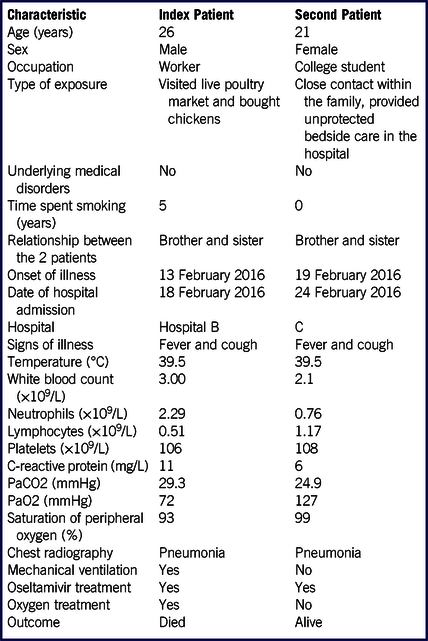
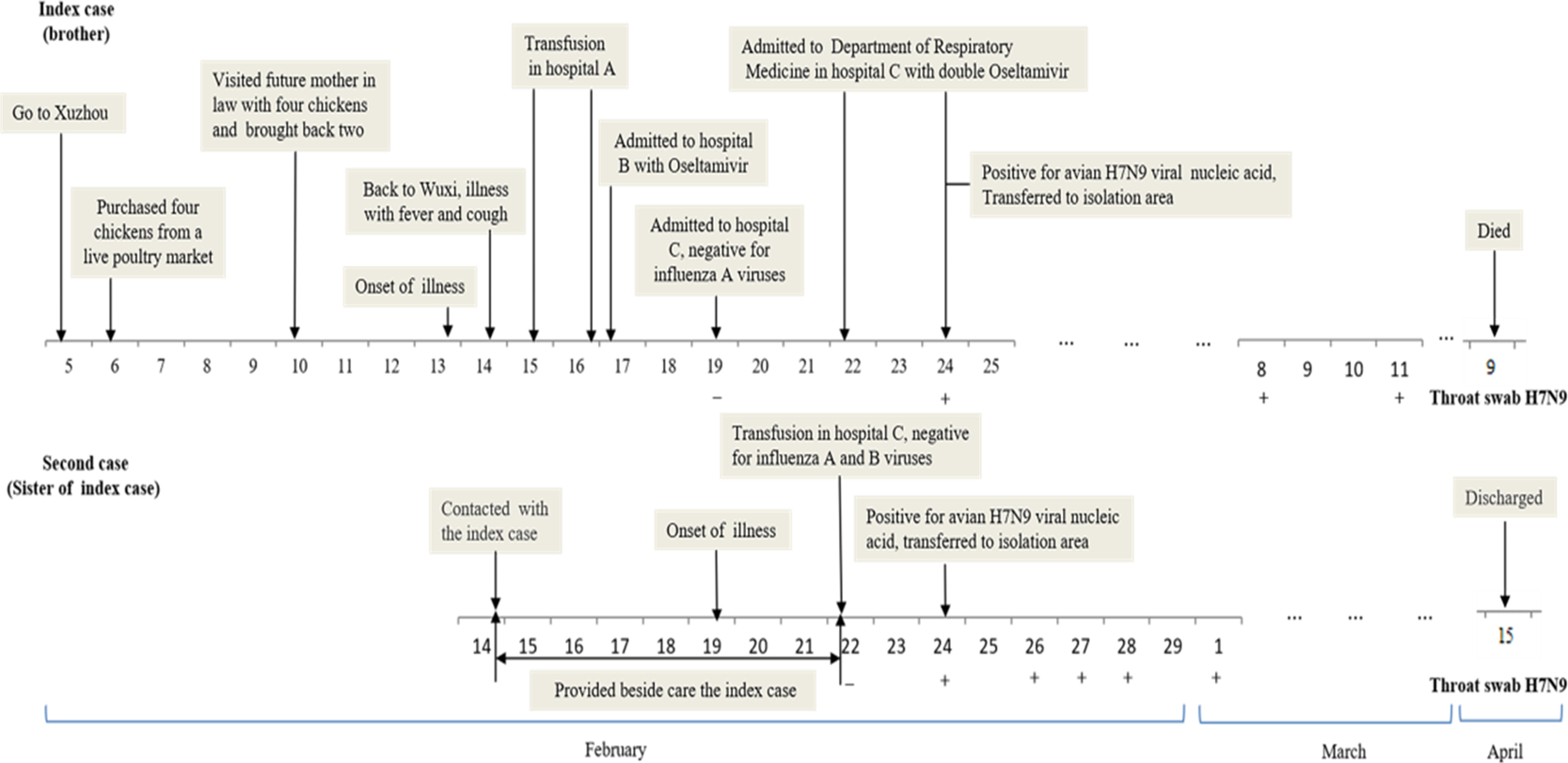
His throat-swab sample was positive for avian influenza A(H7N9) virus on February 24. After confirmation of the diagnosis, the patient was transferred to the isolation area. Eventually, he died on April 9, despite diverse advanced treatments. The main epidemiological exposures, clinical features, laboratory findings, and treatments during the disease course were presented in Table 1 and Figure 1.
Clinical Characteristics of 2 Patients With Confirmed Influenza A (H7N9) Virus on Hospital Admission

Timeline of 2 Patients With Avian Influenza A (H7N9) Virus Infection in Wuxi, Jiangsu Province, China.

The second patient was a 21-year-old undergraduate student without any underlying illnesses; she was the sister of the index patient. She developed a fever and felt cold on the evening of February 19, 2016; however, this did not get her attention. Because of a high fever (39.5°C) and cough, sometimes spitting yellow purulent sputum, she self-administered oral ibuprofen on February 21, which had no effect. On the following day, she sought medical care at hospital C. A computed tomography scan revealed right middle lobe inflammation, and amoxicillin sulbactam, oseltamivir, levofloxacin, and xiyanping were administered; her symptoms were not relieved. Her throat-swab sample tested negative for influenza A viruses by RT-PCR. On February 24, a computed tomography scan revealed double lung infection that was worse than before. She was identified as having the H7N9 virus by use of RT-PCR from a throat-swab specimen taken on February 24. After that diagnosis, the patient was transferred to the isolation ward. In addition, she was diagnosed with severe pneumonia, leukopenia, and continued to be treated with oseltamivir. On April 15, 2016, she recovered from the disease and was discharged from the hospital (Table 1; Figure 1).
Epidemiological Investigation
The index patient lived in a residential district of enclosed management with his mother, father, and sister, and the surrounding environment was clean. Neither live poultry nor wild birds were raised or found in the residential district. There were 2 bedrooms and 2 hallways in their house, which had a good amount daylight and proper ventilation. The index patient went back to his hometown in Peixian, Xuzhou, alone on February 5, 2016. On the morning of February 6, he purchased 4 chickens from the local live poultry market of Weimiao town with his uncle (his mother’s brother) and uncle’s wife. After that, they went back to his uncle’s home with the chickens and kept them until February10. On the morning of February 10, the index patient took the 4 chickens to his quasi mother-in-law’s home and left 2 chickens; of the remaining 2 chickens, 1 was given to his uncle (his father’s elder brother) and 1 was given to his aunt (the wife of his mother’s brother). During this period, he did not come in contact with any cases of avian influenza H7N9 or other febrile respiratory patients.
The second patient worked a part-time job as a cashier in a supermarket that was on the second floor of the business district and where frozen chicken was sold. Downstairs from the supermarket was the Qianzhou farmer’s market, which had 3 live poultry stalls. She never bought frozen chickens, passed by the near-by live poultry stalls, had contact with other live poultry or birds, or ate any poultry meat in the past 1 month before onset.
After the index patient went back home in Wuxi on the evening of February 14, the second patient was in close proximity with him in the bedroom, and they chatted about checking the swab exam results. The following day, she consumed the half bowl of leftovers of the index patient and only heated it for 3 min with a microwave oven. On February15 and 16, respectively, she took the index patient to hospital A by electric bike for transfusion treatment. From the time the index patient was admitted to hospital B on February 17, she was in charge of looking after him. During that time, she provided bedside care for him before midnight, and her father took over after midnight on February17. The father returned home on the evening of February 18, and then attended to him most of on February 19.
During the index patient’s hospitalization, he coughed frequently, and she had close contact with him. She was in charge of giving the plastic bags and tissues to him when he spit and vomited. Most of the time, she was responsible for cleaning the sputum and vomitus with her father. She neither wore a mask nor took any protective precautions during this period. After the index patient was admitted to hospital C on the afternoon of February 19, although she wore masks, she did not cover her nose with them. On the morning of February 22, she began to wear the masks normally. Until February 23, before she was transferred to the fever clinic for isolation treatment in hospital C, she and her parents looked after her brother together.
We ascertained a total of 37 close contacts of the index patient in Wuxi, including his parents and sister (the second patient), his cousin (the son of his mother’s brother), cousin’s wife and friend, 1 health-care worker in hospital A, 27 health-care workers and 1 person shared the same ward in hospital B, and 2 health-care workers in hospital C. Among them, their parents were close contacts of both patients. During the medical observation of 7 days, only their mother developed a light fever and recovered quickly; the other 35 close contacts did not develop any febrile respiratory symptoms or receive prophylactic antiviral drugs after exposure. Except for the second patient, among the other 36 close contacts, samples were collected from 31 people. No throat swab samples were positive for influenza A and B virus (nucleic acid) by RT-PCR assay, and no seroconversion of antibodies against H7N9 virus was identified by either the hemagglutination inhibition or microneutralization assays from paired serum samples. Furthermore, the 11 close contacts of the index patient in Xuzhou were all in good condition.
Laboratory Investigation
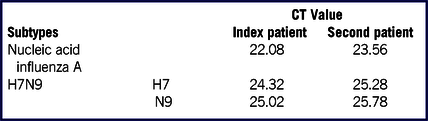
The swabs of the index patient were positive for nucleic acid influenza A and H7N9. The swabs of the second patient were positive for nucleic acid influenza A and H7N9 (Table 2). One throat swab specimen from the silkie chicken was positive for the H7N9 virus, which was sold in the live poultry market where the index patient purchased the 4 chickens in Peixian, Xuzhou. In the 7 samples collected from the Peixian live poultry market, 2 throat swabs from chickens and 1 from chicken feces were positive for the H7N9 virus. The other samples were all negative for influenza A and H7N9.
Laboratory test results of the 2 Patients

Abbreviations: CT value: C on behalf of the Cycle, T on behalf of the threshold, CT value is the meaning of each reaction tube of fluorescence signal reaches the set of domain values of Cycle number. H7: Influenza A virus subtype H7; N9: Influenza A virus subtype N9.
DISCUSSION
We describe 2 confirmed cases of H7N9 virus infection among family members, involving the index case (died), and his younger sister (survived). The index patient most likely acquired the infection directly from the poultry market where he bought 4 chickens before his illness onset. This assumption is based on the following findings: First, during the 12 days before illness onset of the index patient, apart from purchasing 4 chickens in the live poultry market, he had no direct contact with other live poultry markets and was not exposed to any cases of avian influenza H7N9 or other febrile respiratory patients. Second, the interval between exposure (February 6) and illness onset (February 13) was approximately 7 days for the index case, with a single poultry-related exposure history, which corresponds to the incubation period of H7N9 virus infection. 7,Reference Huang, Xu and Ren8 Third, 1 throat swab of the silkie, which he bought from the live poultry market, and 2 throat swabs from chickens and 1 from chicken feces from another chicken were positive for the H7N9 virus by RT-PCR. Additionally, genetic evidence and results of epidemiological investigations indicated that the main sources of influenza A (H7N9) virus infection were likely to be either contaminated poultry markets or infected poultry. Reference Bao, Cui and Zhou4,Reference Chen, Liang and Yang5,Reference Han, Jin and Zhang9,Reference Han, Niu and Jin10
The second patient likely acquired the influenza A (H7N9) virus infection from her sick brother because of the following facts: First, the sister had intensive and unprotected close contact with the index case, even after the index case had severe symptoms, such as high fever and cough. Approximately 1 to 2 days after illness onset in the index patient, the sister closely chatted a lot with him alone and ate his leftovers. During his stay at hospital A, she was in charge of taking him to transfuse and provided care to him. From the time the index patient visited the People’s Hospital B until he was admitted to the hospital C’s isolation area, a period of approximately 8 days, the sister provided much of the care for him. More importantly, aside from conventional care and bedside care, she was in charge of cleaning her elder brother’s sputum and vomitus without any personal protective equipment. Prolonged and direct exposure to her critically ill brother made person-to-person spread of the virus possible. Second, she was exposed to the index patient within a putative maximum incubation period of 6 days (initial exposure on February 14 and onset on February 19), which corresponds to the results of previous studies. 7,Reference Huang, Xu and Ren8 Third, she had no direct contact with other live poultry markets and was not exposed to any other case of avian influenza H7N9 or other febrile respiratory patients.
In our study, the H7N9 virus was likely transmitted directly from the index patient to his sister; however, the other close contacts were all in good condition, which indicates that the ability for efficient transmission from person to person was still limited for the H7N9 virus.
It is worth further discussion of how avian H7N9 is transmitted between the 2 cases. After the index patient hospital B stay, the second patient took turns looking after her brother with her father. After her brother’s hospitalization in hospital C, she and her parents looked after him together, yet she and her father mainly handled her brother’s sputum, but the mother was not able to because of foot problems. In hospital B and C, she and her parents looked after her brother together, her nursing duties were basically the same as her father’s. She and her parents did not take effective precautions. Their parents did not get infected with the avian H7N9 virus. The reason may be that the second patient had more contact with the index patient at the early stage than the parents did.
Our findings suggest that the sister becoming infected with the H7N9 virus may be associated with the point in time when she came in close contact with her infected brother, which was likely the time when his viral shedding was high. A report showed that human influenza viral shedding increased sharply between 0.5 and 1 day after challenge and consistently peaked on day 2, Reference Carrat, Vergu and Ferguson11 which was consistent with the second patient’s contact time with the index patient. On the first day of the index patient’s illness, 3 persons who were in the same vehicle for 12 h were not infected, indicating that sustained close contact with the H7N9 virus was more significant than airborne transmission. Our findings may clarify that transmission occurs at close range rather than over long distances. Reference Brankston, Gitterman and Hirji12 Furthermore, like H5N1, the H7N9 virus was more likely to be transmitted between individuals with a genetic connection. Reference Abdel-Ghafar, Chotpitayasunondh and Gao13,Reference Horby, Nguyen and Dunstan14
Weaknesses of the Study
Although a likely transmission between 2 related persons was identified based on a series of epidemiological and clinical characteristics and RT-PCR laboratory results, no virus was cultured to further perform phylogenetic analysis of the aligned sequences for 8 genomic segments.
Acknowledgments
The authors are thankful for the support from Xuzhou Center for Disease Control and Prevention.
Funding Statement
This research was supported by National Natural Science Foundation of China (No. 81402732), Wuxi Mega-project of Science and Technology (No. Z201718), Wuxi Key Medical Disciplines (No. ZDXK009), Wuxi Project of Key & Youth Talent (No. ZDRC003 & No. QNRC008), Project of Wuxi Commission of Health (No. Q201711), Wuxi Suitable Technical Project of Health and Family Planning (No. T201819), and Jiangsu Provincial Major Science & Technology Demostation Project (No.BE2017749).
Conflict of interest
None.
Author Contributions
Drs C. Shi and P. Shi contributed equally to this work.