Introduction
Sensitive questions are asked in social surveys with the aim of estimating the attitudes, behaviours, opinions and daily life activities of respondents (Krumpal, Reference Krumpal2011). Questions associated with sensitive issues such as illegal behaviour, sexual activities, stigmatized conduct and undesirable attitudes in society are prone to being affected by social desirability bias and thus are more likely to have extreme outcomes. In other words, respondents have a greater tendency to give socially desirable answers to sensitive survey questions by misreporting, over-reporting or under-reporting their actual situations.
The desire of respondents to provide socially desirable answers to questions related to family planning issues such as sexual activities, use of contraception and induced abortions is a common problem (Stuart & Grimes, Reference Stuart and Grimes2009). Furthermore, questions concerning induced abortion, whether the procedure is illegal or not in a country, are usually answered reluctantly by respondents; as a result, responses in demographic surveys tend to be inaccurately reported (Casterline, Reference Casterline1989; Barreto et al., Reference Barreto, Campbell, Davies, Fauveau, Filippi and Graham1992; Tennekoon, Reference Tennekoon2017). Social desirability bias is thought to explain the under- or misreporting of abortions (Jones & Kost, Reference Jones and Kost2007; Astbury-Ward et al., Reference Astbury-Ward, Parry and Carnwell2012). While some women do not report their abortion experience at all (see, for example, Anderson et al., Reference Anderson, Katus, Puur and Silver1994; Magnani et al., Reference Magnani, Rutenberg and McCann1996; Shah et al., Reference Shah, Hossain, Noonari and Khan2011), others might misreport their induced abortion as a spontaneous abortion due to social desirability bias. Thus, studies aimed at estimating actual induced abortion rates are important to correctly inform abortion and family planning services. In other words, examination of the validity of women’s responses to questions on abortion is crucial to make accurate predictions of induced abortion rates. Complete and accurate information from other data sources, such as medical records and external data sources, can ensure more dependable comparisons of types of terminated pregnancies. Using survey data, the correct classification of terminations as spontaneous or induced is possible with a detailed examination of the abortion characteristics. Similarly, the identification of women who tend to give socially desirable answers to sensitive questions would be helpful for the planning of reproductive health policies. It is also necessary to develop strategies to increase the validity of responses by limiting social desirability bias during data collection.
Abortion was legalized in Turkey in 1983 with the enactment of a new population planning law offering safe abortion to every woman seeking the service upon request during the first 10 weeks of gestation. During the period 1983–1993, the number of reported induced abortions per 1000 pregnancies increased from 120 to 180, then stabilized at around 100–120 per 1000 pregnancies from 1998 to 2008. Although abortion is still legal in Turkey, as a consequence of politicians’ intense statements against induced abortion on religious grounds since 2005, the number of reported induced abortions halved from 100 to 47 per 1000 pregnancies between 2008 and 2013. In the same period, the number of reported spontaneous abortions increased substantially from 105 to 150 per 1000 pregnancies (Adali et al., Reference Adali, Koç and Eryurt2014, Reference Adali, Cavlin and Berktas2015). This unexpected decline in induced abortions and increase in spontaneous abortions in the last decade suggests that induced abortions have been misreported as spontaneous abortions.
The aims of this study were to: (1) investigate the extent of misreporting of induced abortions for the years 1993 and 2013 based on a probabilistic classification model: namely, a modified version of the World Health Organization model; (2) determine the linkages between social desirability bias and increasing trend in the misreporting of induced abortion; (3) identify the subgroups of women that are more affected by social desirability bias.
Literature review and theoretical framework
Respondents’ answers to sensitive questions in social surveys are likely to be affected by social desirability bias. Misreporting or under-reporting is quite common for sensitive social issues such as wealth, religious participation and voting behaviour (Lee, Reference Lee1995; Tourangeau et al., Reference Tourangeau, Rips and Rasinski2000). Furthermore, there is evidence for a direct relationship between under-reporting and misreporting and the sensitivity level of questions (Ong & Weiss, Reference Ong and Weiss2000). The German General Social Survey evaluated the relationship between sensitivity level and data quality based on questions on household net income, voting intentions, religious denomination, educational achievement, membership of a trade union, employment status and age by examining item-level non-responses (Lensveldt-Mulders, Reference Lensvelt-Mulders2008).
The literature on social desirability bias has mostly focused on differentiating between data collection modes with the aim of obtaining honest answers from respondents by reducing the effect of social desirability bias on the estimates. The presence of an interviewer during the data collection process is commonly considered to be the biggest trigger factor for respondents giving socially desirable answers (Groves & Khan, Reference Groves and Khan1979; Holbrook et al., Reference Holbrook, Green and Krosnick2003; Krysan & Couper, Reference Krysan and Couper2003; Kreuter et al., Reference Kreuter, Presser and Tourangeau2008; Mavletova, Reference Mavletova2013; Mavletova & Couper, Reference Mavletova and Couper2013). In addition, the social distance or rapport between interviewers and respondents, based on the selected interviewing technique, is also often considered to be an influencing factor (Dijkstra, Reference Dijkstra1989).
The under-reporting of abortions in health surveys is a frequent subject of discussion in abortion studies. There is empirical evidence that abortion-related questions are widely affected by social desirability bias, and thus under-reported by survey respondents (Anderson et al., Reference Anderson, Katus, Puur and Silver1994; Jagannathan, Reference Jagannathan2001; Jones & Kost, Reference Jones and Kost2007; Tourangeau & Yan, Reference Tourangeau and Yan2007; Scott & Lindberg, Reference Scott and Lindberg2016; Zamanian et al., Reference Zamanian, Baneshi, Haghdoost and Zolala2016). For example, Jones and Kost (Reference Jones and Kost2007) concluded that only 47% of all abortions were reported in face-to-face interviews in the 2002 USNSFG (United States National Survey of Family Growth) when comparing survey data with information gathered from abortion patients and providers. The NSFG therefore warns data users to be cautious (USNSFG, 2014). Missing information on questions on abortion has also been discussed within the context of under-reporting (Tierney, Reference Tierney2017). Abortion is such a sensitive issue that abortion-related questions can be considered ‘threatening’ to survey respondents (Bradburn et al., Reference Bradburn, Sudman, Blair, Locander, Miles, Singer and Stocking1980). Privacy matters, interview settings and unwillingness to share information about abortion with others, negative stigmatization in a society and lack of confidentiality were among the factors resulting in social desirability bias in abortion-related estimates (Anderson et al., Reference Anderson, Katus, Puur and Silver1994). The existence of under-reporting in retrospective fertility surveys, regardless of the legality issues related to abortion, has also been reported (Basu, Reference Basu2003).
The misreporting of abortions due to social desirability bias can be considered a form of under-reporting (Anderson et al., Reference Anderson, Katus, Puur and Silver1994; Shah et al., Reference Shah, Hossain, Noonari and Khan2011). There is evidence that induced abortions are sometimes misreported as miscarriages (Anderson et al., Reference Anderson, Katus, Puur and Silver1994). Potter et al. (Reference Potter, Ford and Moots1975) stated the reason for the misreporting of induced abortions as competition between induced and spontaneous abortions. Keogh et al. (Reference Keogh, Kimaro, Muganyizi, Philbin, Kahwa, Ngadaya and Bankole2015) put forward the view that fear of legal sanctions might be behind the misreporting of induced abortions, as well as the similarities between the complications of induced and spontaneous abortions. Similarly, social courtesy bias has been suggested as a reason for the misreporting of induced abortions in population-based surveys, together with recall bias (Johnston et al., Reference Johnston, Edmeades, Nyblade, Pearson, Serbanescu, Stupp, Singh, Remez and Tartaglione2010). The possibility of misreporting was also emphasized by Shah et al. (Reference Shah, Hossain, Noonari and Khan2011) when attempting to explain the similar mortality and morbidity levels of the babies of women who have induced abortions through a traditional birth attendant and those visiting a doctor for post-miscarriage care.
Comparisons of self-reported survey data and external medical records on abortions have allowed the level of under-reporting of abortions to be estimated (Udry et al., Reference Udry, Gaughan, Schwingl and van den Berg1996; Jagannathan, Reference Jagannathan2001), although data sources might be upwardly biased (Jones & Forrest, 1992). However, comparison of a respondent’s answers on abortion-related questions in the same questionnaire or in a series of surveys, or with the answers of another respondent in the same family, is the main approach for detecting the under-reporting or misreporting of abortions (Anderson et al., Reference Anderson, Katus, Puur and Silver1994). Rossier (Reference Rossier2003) reviewed all the methods of estimating induced abortion levels, including using data on illegal abortion providers, complications statistics, mortality statistics, self-reports, prospective studies, anonymous third-party reports and estimates from experts. Furthermore, direct and indirect estimation techniques (such as probabilistic classification schemes, the residual method, the network scale-up method and a binomial-thinned zero-inflated Poisson model) have been used to provide accurate abortion incidence rates after the data collection process (WHO, 1987; Magnani et al., Reference Magnani, Rutenberg and McCann1996; Bendavid et al., Reference Bendavid, Avila and Miller2011; Zamanian et al., Reference Zamanian, Baneshi, Haghdoost and Zolala2016; Tennekoon, Reference Tennekoon2017).
Barreto et al. (Reference Barreto, Campbell, Davies, Fauveau, Filippi and Graham1992) drew attention to the potential risk of data misrepresentation by identifying the subgroups of women who were least likely to participate in a survey and reluctant to answer questions. They found that certain subgroups of women may answer more freely than others, even though they had given their informed consent. Fertility level, demographic characteristics, survey implementation and emotional repression were ranked as possible factors affecting the risk of under-reporting abortions (Hammerslough, Reference Hammerslough1987; London & Williams, Reference London and Williams1990; Jones & Forrest, Reference Jones and Forrest1992; Huntington et al., Reference Huntington, Mensch and Toubia1993; Anderson et al., Reference Anderson, Katus, Puur and Silver1994; Udry et al., Reference Udry, Gaughan, Schwingl and van den Berg1996). Ethnicity, marital status, education, age, number of previous live births, number of previous abortions and gestational age (in weeks) are among the demographic factors influencing the under-reporting of induced abortions (Anderson et al., Reference Anderson, Katus, Puur and Silver1994). The impact of respondents’ attitudes towards abortion and childbearing experiences have been examined by taking physical, social, psychological and moral values into account, in addition to demographic characteristics, survey implementation and fertility-related factors (Jagannathan, Reference Jagannathan2001). The sensitivity level of abortion-related questions has also been discussed in terms of how respondents viewed the risk of providing accurate answers. Another study investigated the impact of the interview environment on the under-reporting of induced abortion based on the varied mode of data collection, interviewer characteristics and presence of family members during the interview (Rasinski et al., Reference Rasinski, Baldwin, Willis and Jobe1994).
Studies on the under- and misreporting of abortions are creating awareness of the problem of social desirability bias in surveys. The common focus of abortion methodological studies has been to suggest various strategies to increase the validity of abortion-related answers, as well as to suggest methods of calculating accurate abortion incidence rates. Direct and indirect question styles have been discussed within the context of a higher rate of abortion reporting. The importance of the randomized response technique has been discussed by comparing face-to-face interviews, CASI (Computer Assisted Self-interviews) and self-administrated questionnaires as ways of increasing the validity of answers to abortion-related questions (Hammerslough, Reference Hammerslough1987; Huntington et al., Reference Huntington, Mensch and Toubia1993; Lara et al., Reference Lara, Strickler, Olavarrieta and Ellertson2004; Coutts & Jann, Reference Coutts and Jann2011). Anderson et al. (Reference Anderson, Katus, Puur and Silver1994) suggested using a life history chart in the data collection process to minimize errors in the reporting of abortions. Similarly, a new data collection approach, namely the ballot-box technique, has been recommended to ensure valid responses to abortion-related questions (Medeiros & Diniz, Reference Medeiros and Diniz2012).
Methods
Data source
The main data sources for the study were the 1993 and 2013 Turkish Demographic and Health Surveys (TDHSs) conducted by the International DHS Programme. These data sets provide comprehensive information on the reproductive health characteristics of women for the two survey years, gathered by face-to-face household and women’s interviews. Women of reproductive age (between 15 and 49 years) were considered eligible for interview. The calendar part of the questionnaire enabled indications of abortions to be followed on a month-by-month basis during approximately 5 years prior to the survey date. This revealed pregnancy outcomes: whether a pregnancy ended in an induced abortion, spontaneous abortion, stillbirth or live birth. Other characteristics required to classify abortions were utilized from elsewhere in the data sets.
The length of the calendar period, namely the number of months that were followed retrospectively, varied between 69 and 72 depending on the month of the interview. The numbers of induced abortions and spontaneous abortions were taken from the complete calendar period of the women to capture all their abortions prior to the survey date. The questionnaire and sampling designs of the TDHSs allowed a comparison of survey estimates to be made across the survey years. Overall, the variables used for the analyses were common to both data sets to ensure comparability. All descriptive and multivariate analyses were performed using SPSS Version 21.0.
Prior to the TDHS data collection process, the Ethics Committee of Hacettepe University evaluated the data collection stage of the research and approved the questionnaires used in the fieldwork. Furthermore, informed consent was received from each respondent immediately before interview.
Classification of abortions
The World Health Organization has developed an algorithm to classify hospitalized women’s terminations based on self-reporting or a verbal autopsy (when a woman had died), women’s contraceptive use in terms of planned pregnancy, desire for pregnancy and other medical signs such as trauma or sepsis related to the abortion (WHO, 1987; Muchova, Reference Muchova2013). This WHO classification scheme was based on women who had informed hospitals about complications resulting from their terminated pregnancies. A modified version of the WHO classification scheme was employed in this study to classify pregnancy terminations in the data sets as ‘probably induced’ or ‘probably spontaneous’. (The word ‘probably’ was used rather because the model was a modification of the clinic-based WHO classification model.) Ongoing pregnancies on the date of the survey were excluded as their outcomes (induced abortion, spontaneous abortion, stillbirth or live birth) were unknown, as were terminations with missing information (pregnancy duration, reason for method discontinuation, parity number at time of termination and desired number of children). These excluded terminations were labelled as ‘unclassifiable’.
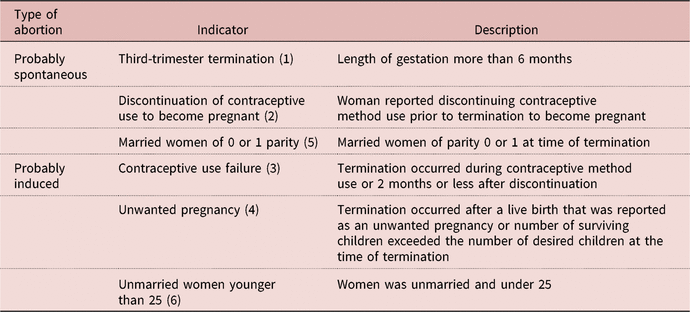
The following characteristics were used to classify terminations: (1) the basic properties of the terminated pregnancy, including length of gestation, contraceptive use prior to the termination and reason for contraceptive discontinuation; (2) the woman’s age, parity and marital status at the time of the termination; and (3) a woman’s desire for children prior to the termination (Table 1). The classification criteria are listed sequentially according to their probable accuracy, as described by Bendavid et al. (Reference Bendavid, Avila and Miller2011), Muchova (Reference Muchova2013) and especially Magnani et al. (Reference Magnani, Rutenberg and McCann1996).
Description of modified model for the classification of abortions
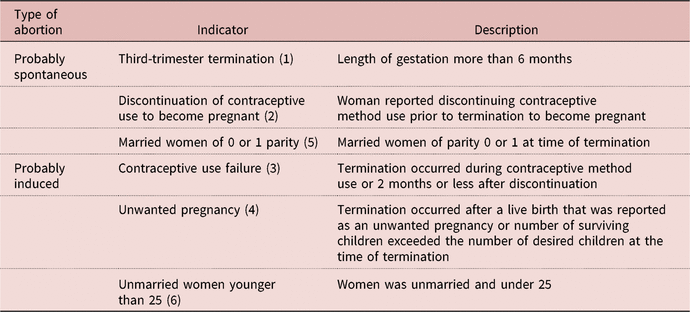
Classification is based on the criterion that is assumed to have the highest probability of accuracy.
(1), (2), …, (6) illustrate the sequence of probability, from highest to lowest.
Third-trimester terminations (gestation length of more than 6 months) were classified as spontaneous abortions, as these had a high probability of being spontaneous. Similarly, a termination occurring after the discontinuation of contraceptive use due to the desire to conceive was also considered to be a spontaneous abortion. Lastly, terminations of married women with a parity of 0 or 1 at the time of termination were classified as spontaneous because of the general desire of women to have more than 0 or 1 child in the Turkish context.
Terminations that occurred any time during a woman’s contraceptive use period were classified as induced abortions. Furthermore, a termination that occurred within 2 months of discontinuation of a modern or traditional contraceptive (withdrawal, rhythm or folkloric methods) was assumed to be an induced abortion, based on the forward effects of contraceptives. Women who used contraception for spacing or limiting were accepted as being unwilling to have an additional child or no more children at all. Another sign of an induced abortion was the lack of desire of women to have one more child. Thus, a termination that occurred after a live birth was considered to be an induced abortion if the woman admitted that the live birth had been an unwanted pregnancy. Furthermore, if the number of a woman’s surviving children at the time termination was more than her declared ideal number of children, as stated by her at the time of survey, the termination was classified as an induced abortion. Finally, the terminations of unmarried women under 25 were classified as induced abortions due to the social stigma attached to unmarried motherhood in many societies around the world.
The outcomes produced by the model were accepted as ‘accurate’ despite the limitations, whereas the outcomes reported by women were accepted as ‘suspicious’. This assumption was made in order to determine the extent to which induced abortions were misreported by women because of social desirability bias. Briefly, all assessments on the level of misreported induced abortions were made under the assumption that this classification model was accurate.
Definition of concepts
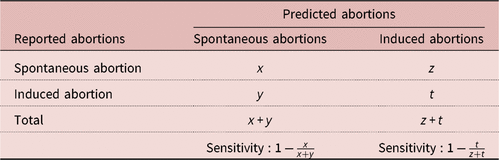
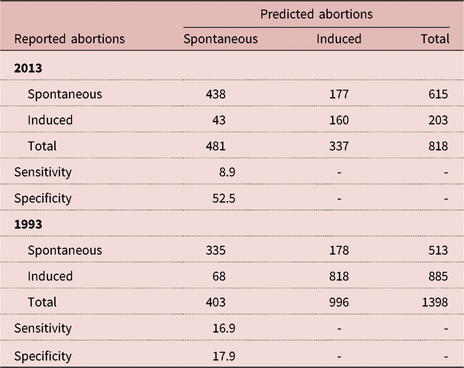
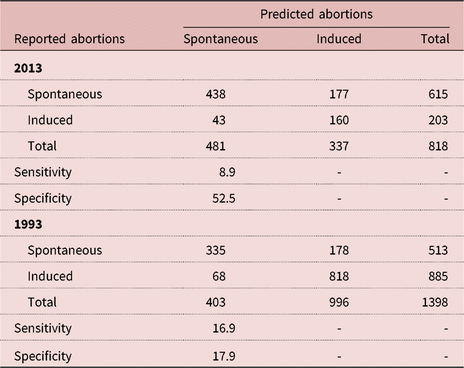
Two proportion-type indicators – ‘sensitivity’ and ‘specificity’ levels – were created to describe the gap between reported and predicted abortions. The ‘specificity’ level indicates the level of misreporting of induced abortions due to them being labelled as miscarriages. The ‘sensitivity’ level indicates the level of misreporting of spontaneous abortions due to labelling them as induced abortions (Table 2). These two indicators were used to determine the level of misreporting of abortions, and to identify women with a higher tendency to misreport their induced abortions. The specificity level that resulted from the comparison of the classification model outputs and reported terminations was used to determine the extent of misreporting of induced abortions within all terminated pregnancies in the study.
Description of specificity and sensitivity levels used to describe the gap between reported and predicted induced and spontaneous abortions
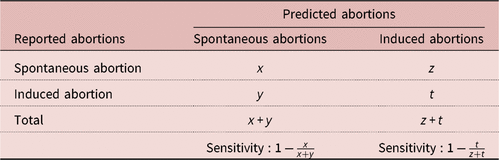
To explain the gap between induced abortions reported by women and induced abortions predicted by the model, induced abortion rates per 1000 pregnancies were calculated for both conditions as follows:
 $${\rm{Induced\;abortion\;rat}}{{\rm{e}}_{{\bf{reported}}}} = {{{\rm{number\;of}}\;{\bf{reported}}\;{\rm{induced\;abortions\;during\;the\;calendar\;period}}} \over {{\rm{number\;of\;all\;completed\;pregnancies\;during\;the\;calendar\;period}}}}$$
 $${\rm{Induced\;abortion\;rat}}{{\rm{e}}_{{\bf{predicted}}}} = {{{\rm{number\;of}}\;{\bf{predicted}}\;{\rm{induced\;abortions\;during\;the\;calendar\;period}}} \over {{\rm{number\;of\;all\;completed\;pregnancies\;during\;the\;calendar\;period}}}}$$
where ‘completed pregnancies’ included those that resulted in induced abortions, spontaneous abortions, stillbirths and live births. Miscarriages and stillbirths were included under spontaneous abortions.
Descriptive and multivariate analyses
In the descriptive analysis, the distribution of terminations based on the classification scheme, the sensitivity and specificity levels, abortion rates on the basis of reported and predicted induced abortions and the identification of women’s characteristics that indicate a higher tendency to misreport, were determined in order to inform the multivariate analyses on the identification of the risk of misreporting induced abortions.
A series of logistic regression analyses were employed to determine the factors behind the misreporting of induced abortions. A set of covariates, including women’s age, type of residence, region, education, mother tongue and wealth status, were used to identify women most affected by social desirability bias and thus more prone to misreport their induced abortions. All variables included in the TDHS women’s data set were considered to potentially have an impact on the misreporting of induced abortions.
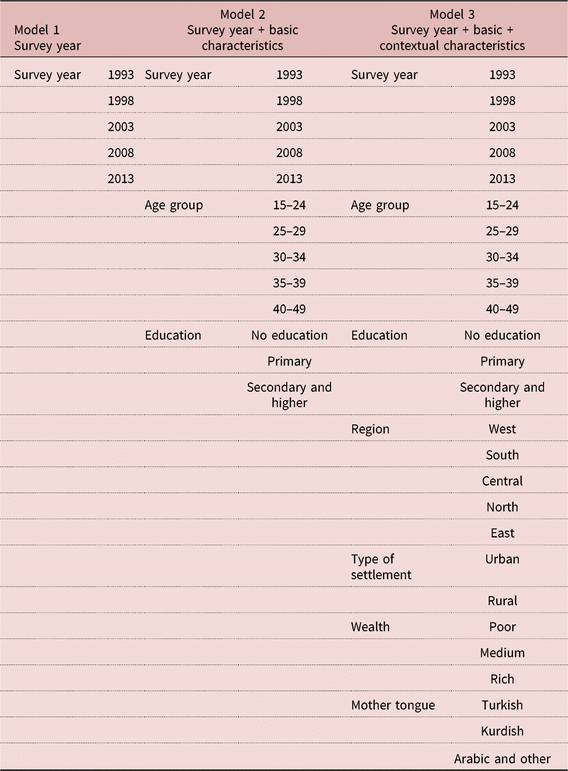
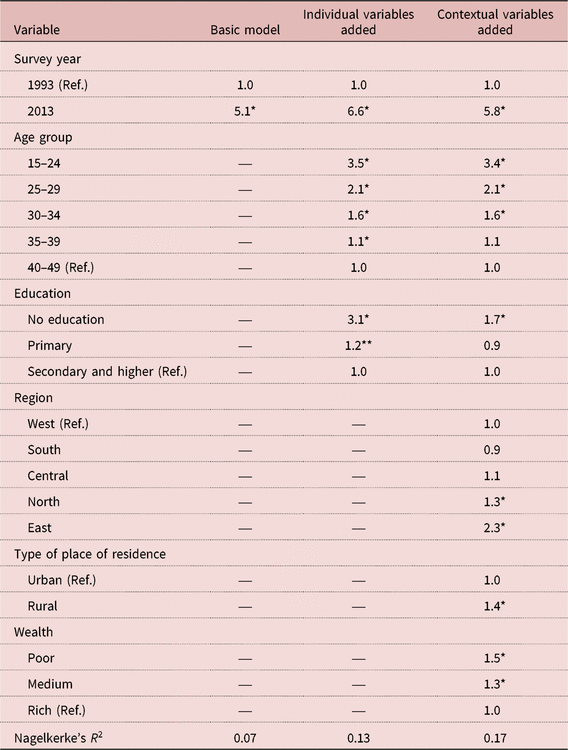
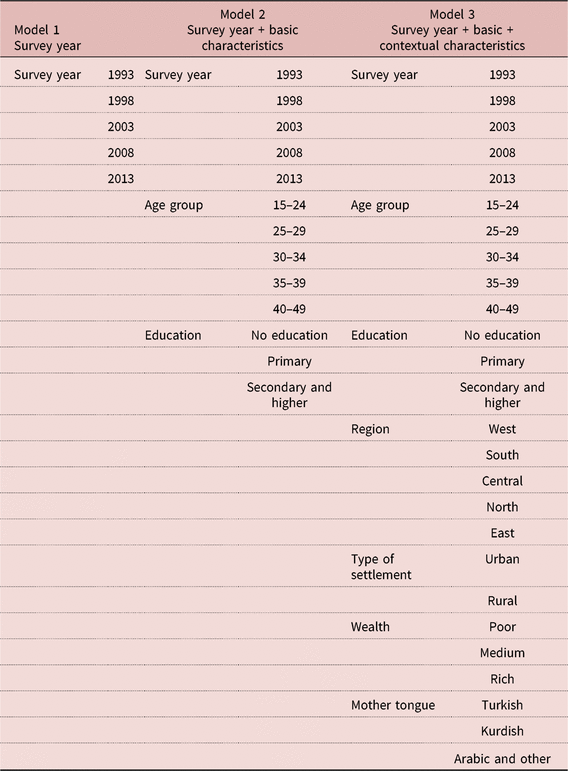
The multivariate models were conducted on the pooled data set constructed from surveys in 5-year intervals over the period 1993–2013. Therefore, a variable ‘survey year’ was included in all models to measure the time effect in misreporting levels over the survey years. The multivariate regression models were conducted in three estimation stages. Model 1 only included the time effect variable, whereas Model 2 also included basic characteristics of the women, such as age and education. Finally, Model 3 included the contextual characteristics of women such as mother tongue, region, type of settlement and wealth status, in addition to the variables included in the previous models (Table 3).
Covariates used in the three models of the multivariate analysis
Some of the factors behind the misreporting of induced abortions were not included in the multivariate models since they were used to classify terminations. For instance, method of contraception and women’s marital status were used for the classification, but were not included in the logistic regression models, even though these have been found to be significant factors in the misreporting of induced abortions in previous studies (Jones & Forrest, Reference Jones and Forrest1992; Anderson et al., Reference Anderson, Katus, Puur and Silver1994).
Independent variables
The ages of the women were re-coded as ‘15–24’, ‘25–29’, ‘30–34’, ‘35–39’, and ‘40–49’ years. The region variable refers to the five demographic regions in Turkey, classified according to development level: ‘West’, ‘North’, ‘Central’, ‘South’ and ‘East’ according developmental levels. West and Central are the most developed regions, South and North are known as the medium-developed regions and the East region is ranked as the least-developed region in Turkey. Type of settlement was categorized as urban (population of 10,000 or more) or rural (population of less than 10,000). Education of women was categorized as ‘none’, ‘primary’ and ‘secondary and higher’. The variable ‘mother tongue’ was categorized as ‘Turkish’, ‘Kurdish’ and ‘Arabic and other’ (the languages spoken in Turkey). Lastly, the household wealth variable, based on household assets, and categorized as ‘poor’, ‘medium’ and ‘rich’.
Results
Descriptive results
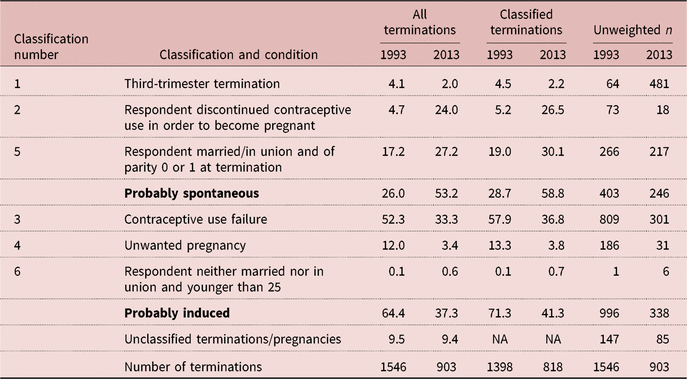
The percentage of all terminations that were ‘unclassified’, i.e. with unknown termination outcomes, was around 9.5% for both survey years (1993 and 2013). As for the rest, the predicted percentage of spontaneous abortions decreased as the probability of conditions classifying them as spontaneous abortions increased. For instance, third-trimester terminations had the lowest percentage among predicted spontaneous abortions for both survey years. The percentage of women who had discontinued contraceptive use in order to become pregnant before the termination increased from 5% to 27% from 1993 to 2013. This may be because of the increase in the conscious use of contraception among couples over this period. A similar increase was observed in married women with 0 or 1 living children at the time of termination. This increase may be related to the decline in fertility rates in Turkey over the same period. Overall, spontaneous abortions predicted by the model almost doubled, from 29% to 59%, in the period 1993 to 2013 (Table 4).
Percentage distribution of pregnancies according to classification scheme
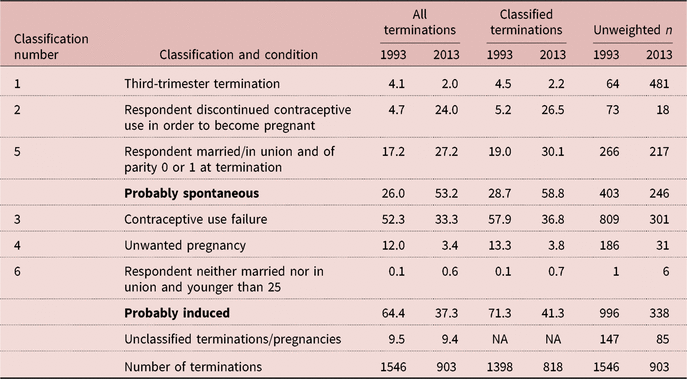
In contrast to spontaneous abortions, the percentage of predicted induced abortions increased with the increased probability of conditions that classify them as induced abortion. For instance, the percentage of terminations that came after the discontinuation of contraceptive use constituted a major proportion of the predicted induced abortions. The percentage of terminations resulting from contraception failure decreased from 58% to 37% from 1993 to 2013. This may be associated with the increase in the effective use of contraception among women in Turkey over the survey years. Unwanted pregnancies that resulted in live births prior to termination(s), and which came after a woman’s number of living children corresponded to her ideal number of children, declined from 13% to 4% over the period. The percentage of unmarried women under the age of 25 in the month of termination increased slightly from 0.1% to 0.7% over the study period. Overall, the classification model predicted many more spontaneous abortions as a proportion of all terminations in 2013 compared with 1993. This may be attributed to two factors: (1) the number of spontaneous abortions as a proportion of all terminations may have increased markedly over time; and (2) the misreporting of induced abortions may have increased. Conversely, the number of induced abortions predicted by the model decreased from 71% to 41% over this period (Table 4).
The specificity and sensitivity levels, produced by comparing predicted and reported abortions, indicated the misreporting of induced abortions and spontaneous abortions, respectively. The specificity rate was found to be 18% in 1993, implying that some of the reported spontaneous abortions were probably induced abortions according to the model. Looking at the year 2013, the percentage of misreported induced abortions (the specificity rate) increased to 53% of all abortions. The increase in the specificity rates over the period confirmed the increasing impact of statements against induced abortion by influential politicians, as well as the ability of the model to capture induced abortions misreported as spontaneous abortions (Table 5).
Number of reported and predicted abortions and sensitivity and specificity levels
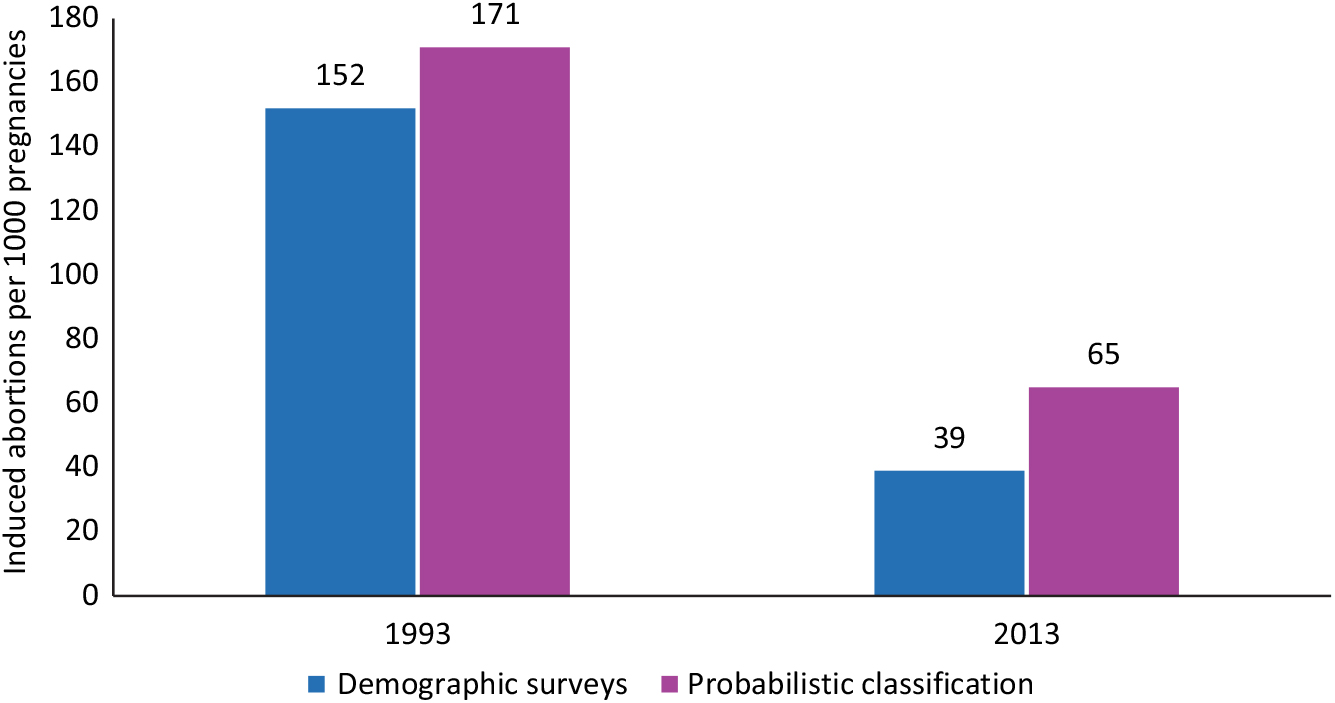
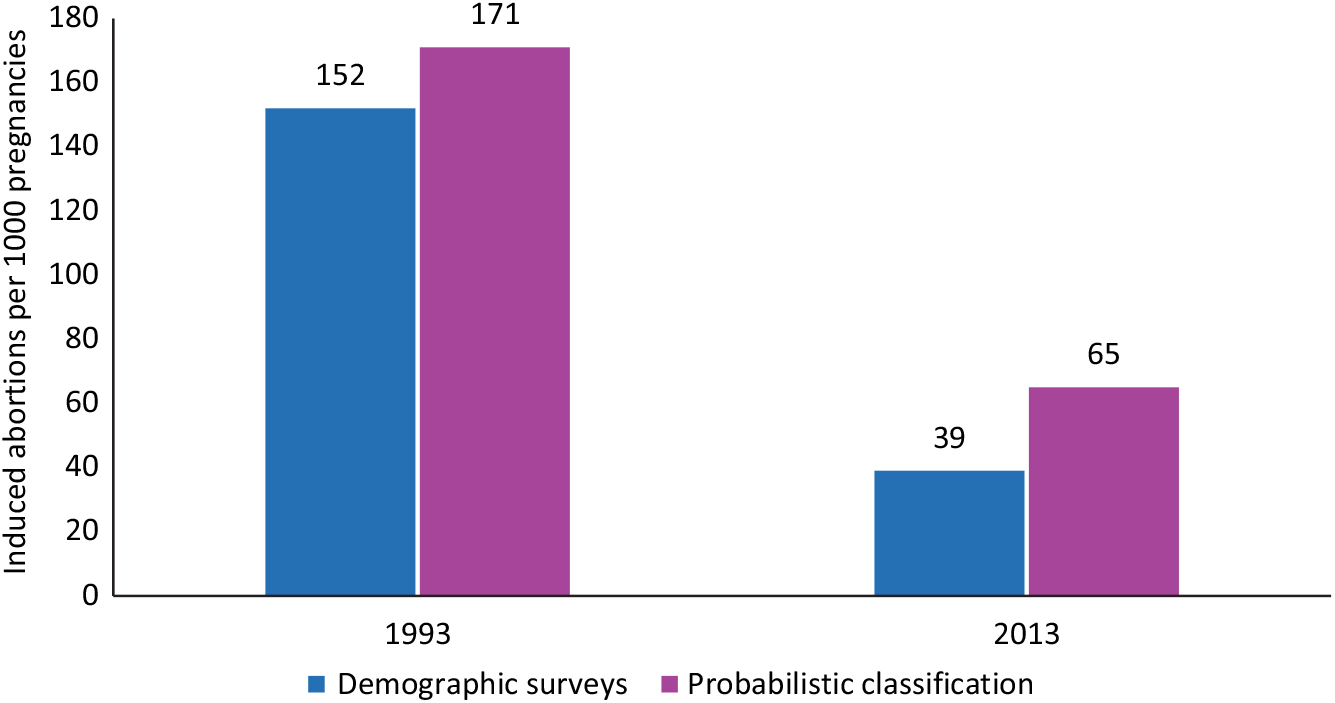
The impact of the misreporting level, namely labelling induced abortions as spontaneous abortions, had a direct effect on the induced abortion rate. According to the reported number of induced abortions, the induced abortion rate for the whole calendar period declined from 152 to 39 per 1000 pregnancies from 1993 to 2013. On re-calculation of the induced abortion rate based on the model assumptions, this declined from 171 to 65 per 1000 pregnancies over the same period (Fig. 1). These figures imply that the adjusted induced abortion rate in 2013 was approximately 35% higher than the reported level, due to social desirability bias.
Comparison of predicted and reported induced abortion rates per 1000 pregnancies, TDHS 1993 and 2013.
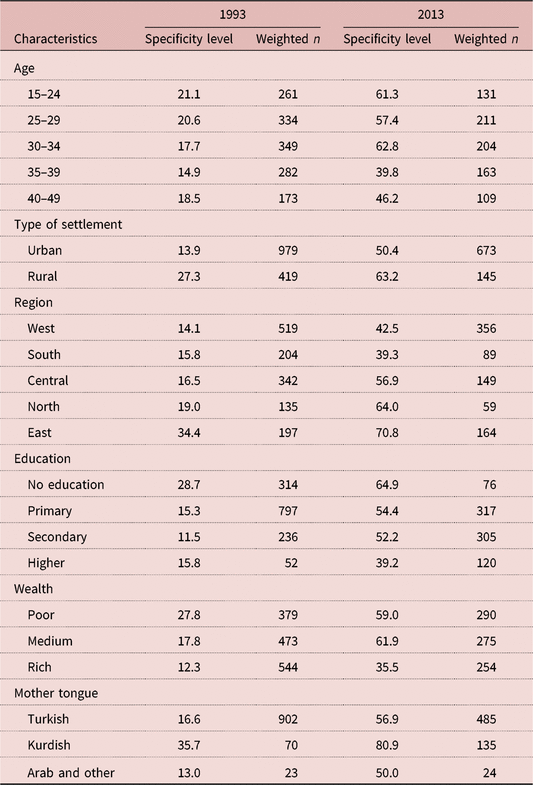
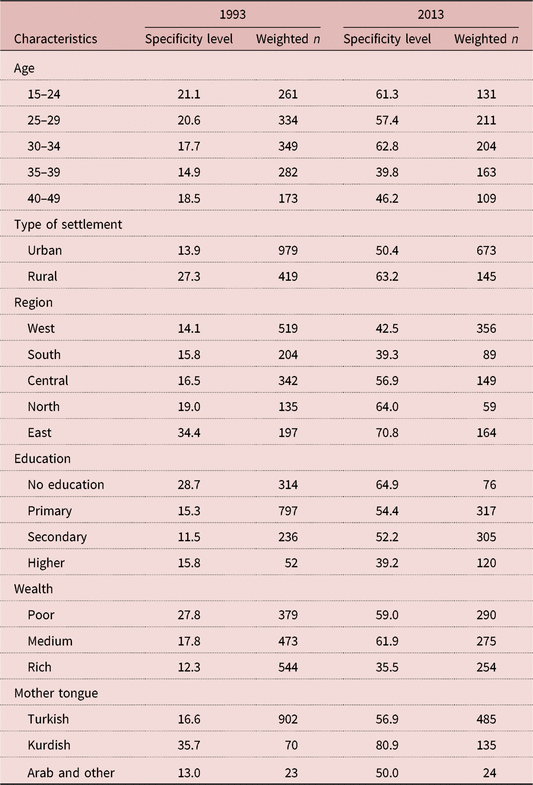
In line with the specificity rates found at overall level, the levels of misreporting by all the women’s characteristics were much higher in 2013 as opposed to those in 1993. In both surveys, women aged between 15 and 24, women living in rural areas, women living in the East region of Turkey, uneducated women and women living in poor households had a higher tendency to misreport their induced abortions. Overall, the specificity levels imply that the misreporting behaviour of women regarding their induced abortions declines as their age increases, and younger women are more likely to misreport their abortions. Similarly, women living in urban and Western parts of Turkey misreported their induced abortions less often than did women living in the East region. Women with higher education and higher wealth had a lower likelihood of misreporting induced abortions. In line with these findings, Kurdish women had a higher tendency to misreport their induced abortions compared with Turkish and Arabic women in both years (Table 6).
Specificity levels of abortions by women’s characteristics
Multivariate results
The final model of the logistic regression analysis suggested that the risk of misreporting induced abortions was associated with a time effect and women’s age, educational level, region of residence and wealth status. The impact of mother tongue was found to be insignificant. The risk of misreporting was approximately 6 times higher in 2013 compared with 1993. Women aged 15–24 had a 3.4 times higher risk of misreporting induced abortions compared with women aged 40–49. Similarly, uneducated women had a higher tendency to misreport their induced abortions compared with women with secondary and higher educations. Women living in the East and North regions of Turkey had a higher risk of misreporting than women living in the West region. Multivariate results showed that the odds ratio of misreporting among women living in rural areas was 1.4 times higher than among women living in urban areas. Furthermore, women of poor and medium levels of wealth had a significantly higher risk of misreporting than women living in richer households. These results confirm that women in the lower segments of society feel pressure from the political environment in the country around induced abortion much more than do women in the higher segments of society (Table 7).
Logistic regression models for the risk of misreporting of induced abortions, 1993–2013
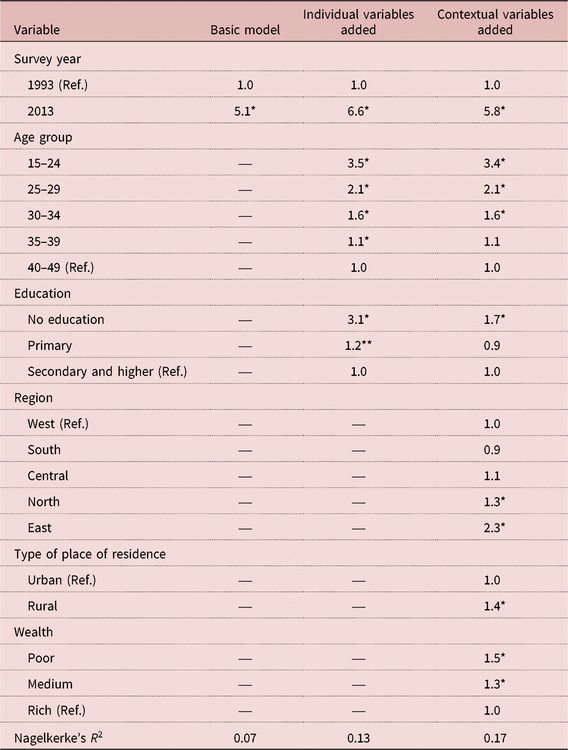
Ref., reference category.
* p<0.01; **p<0.05.
Discussion
The findings of this study, based on a probabilistic classification of abortions, confirmed that the misreporting level of induced abortions in Turkey has increased from 18% to 53% of all terminated pregnancies over the period 1993–2013. In other words, women who participated in the TDHSs increasingly preferred to label their induced abortions as miscarriages. The significant increase in the level of misreporting of induced abortion appeared to be related to social desirability bias, with induced abortion becoming an increasingly sensitive issue in Turkey. Influential politicians are making intense statements against induced abortion, with some describing it as ‘murder’ on religious grounds, and there has been a hidden prohibition of the practice of induced abortion, especially in public health facilities, in recent years. Although the 1983 abortion law is still in force in Turkey, induced abortion was described as murder by the Prime Minister of the country in 2012 (Ozdemir, Reference Ozdemir2012; O’Neil, Reference O’Neil2017). There is growing evidence that access to induced abortion services is being narrowed down in Turkey, especially in public health facilities. Previous studies have emphasized that, although no new legislation restricting abortion services has been enacted, public health facilities are reducing the provision of abortion services (O’Neil et al., Reference O’Neil, Aldanmaz, Quiles and Kılınc2016; O’Neil, Reference O’Neil2017; MacFarlane et al., Reference MacFarlane, O’Neil, Tekdemir and Foster2017). As a result of this political intervention only 16% of public health facilities provide abortion services without any restrictions as to reason in Turkey (O’Neil et al., Reference O’Neil, Aldanmaz, Quiles and Kılınc2016; O’Neil, Reference O’Neil2017).
The increase in the reported level of spontaneous abortions may be partly related to the increase in the use of assisted reproductive techniques in the period 2005 to 2010 (Koç & Saraç, Reference Koç, Saraç, Kapella, Schneider and Rost2017; Saraç & Koç, Reference Saraç and Koç2017), together with the increasing tendency to label induced abortions as spontaneous abortions, especially in the period 2008 to 2013, with the increasing impact of social desirability bias. The demographic surveys conducted during the 1993–2013 period pointed out that all reproductive health indicators that elevated the risk of the spontaneous abortions (e.g. perinatal mortality rate, contraceptive prevalence rate, rate of postnatal care) were getting better in Turkey (HUIPS, 2014). As a consequence of this, the increase in the spontaneous abortion rate in the study period cannot be explained by the deterioration in these reproductive health indicators.
The findings on the level of misreporting induced abortions in Turkey for 1993 are mostly in line with those of a previous study by Magnani et al. (Reference Magnani, Rutenberg and McCann1996). To the best of the authors’ knowledge, there has only been one other study in Turkey that has focused on the level of under-reporting of induced abortions. Tezcan and Omran (Reference Tezcan and Omran1981) compared the results of two techniques, namely RRT (randomized response technique) and DQT (direct question technique), and found that RRT was much more successful at catching induced abortions as opposed to DQT, with 59% more induced abortions being found by RRT. Some other studies conducted in the context of Turkey have shown the prevalence of induced abortion and its covariates (Senlet et al., Reference Senlet, Cagatay, Ergin and Mathis2001a, Reference Senlet, Curtis, Mathis and Raggers2001b; Altun, Reference Altun1995; Cavlin, Reference Cavlin2007). Other qualitative studies discussed the perception and sensitivity of induced abortion in Turkey at societal and individual levels (Gursoy, Reference Gursoy1996; Cavlin et al., Reference Cavlin, Tezcan and Ergocmen2012). It should be pointed out that none of these studies in Turkey focused on determining the risk factors behind the misreporting of induced abortions in a multivariate manner.
There is only limited information on the reasons for induced abortion in Turkey. The 2003 TDHS data pointed out that non-preference for another child, the closeness between the pregnancy and previous pregnancy, child and women health related issues, economic problems and problems in the family were the main reasons behind induced abortion (HUIPS, 2004). Other studies (Senlet et al., Reference Senlet, Cagatay, Ergin and Mathis2001a, Reference Senlet, Curtis, Mathis and Raggers2001b; Ergocmen et al., Reference Ergocmen, Koç, Senlet, Yigit and Roman2004) showed the high failure rates associated with the withdrawal method to be the main reason behind induced abortion in Turkey. Between 1993 and 2013, the proportion of induced abortions in Turkey resulting from use of traditional methods declined significantly. While this is encouraging, according to the 2013 TDHS withdrawal failure still accounts for 37% of all abortions (HUIPS, 1994, 2014).
The final logistic regression model indicated that the time effect was one of the most significant variables affecting the level of misreporting of induced abortions. The likelihood of misreporting induced abortions was found to be 6 times higher in 2013 compared with 1993. This once more implies that the political environment against induced abortion during the 2010 s increased the sensitivity level of abortion questions dramatically. This in turn appeared to create greater pressure on the respondents in the way of social stigmatization at the time of the 2013 survey. Considering misreporting as a special type of under-reporting of induced abortions, the incidence of misreporting was influenced by social desirability bias in Turkey as a consequence of its highly sensitive nature, as well as the cultural, religious and political considerations as mentioned in different studies for different social settings (Anderson et al., Reference Anderson, Katus, Puur and Silver1994; Magnani et al., Reference Magnani, Rutenberg and McCann1996; Jagannathan, Reference Jagannathan2001; Tourangeau & Yan, Reference Tourangeau and Yan2007; Shah et al., Reference Shah, Hossain, Noonari and Khan2011; Zamanian et al., Reference Zamanian, Baneshi, Haghdoost and Zolala2016). In other words, the marked increase in the misreporting of induced abortions may be associated to a great degree with the prevailing political environment and social stigmatization against induced abortions in Turkey. In addition to the time effect, the final model of the logistic regression showed that the risk of induced abortion misreporting was associated with women’s age, type of settlement, region, educational level and wealth level. The differences may be due to women’s views on having an abortion within the context of stigmatized behaviours (Anderson et al., Reference Anderson, Katus, Puur and Silver1994). The effect of the age of a woman on the likelihood of misreporting or under-reporting induced abortions has been well-documented in other studies (Anderson et al., Reference Anderson, Katus, Puur and Silver1994; Lara et al., Reference Lara, Strickler, Olavarrieta and Ellertson2004; Jagannathan, Reference Jagannathan2001).
This study found that the risk of misreporting induced abortions was significantly inversely related to the educational level of women and their wealth status. This relationship between educational level and the risk of misreporting has been found by other studies (Anderson et al., Reference Anderson, Katus, Puur and Silver1994; Udry et al., Reference Udry, Gaughan, Schwingl and van den Berg1996; Jagannathan, Reference Jagannathan2001; Lara et al., Reference Lara, Strickler, Olavarrieta and Ellertson2004; Jones & Kost Reference Jones and Kost2007; Tennekoon, Reference Tennekoon2017). Similarly, the risk of misreporting induced abortions among women living in poor households was 1.5 times higher compared with women living in richer households. A similar result was found in studies with different definitions of wealth, such as short-term and long-term welfare recipients (Fu et al., Reference Fu, Darroch, Henshaw and Kolb1998; Jagannathan, Reference Jagannathan2001, Lara et al., Reference Lara, Strickler, Olavarrieta and Ellertson2004). The risk of misreporting induced abortions had a distinct relationship with the region and type of settlement where women lived. Regional and residential differences have been found to be significant factors behind the misreporting of abortions in other studies as well (Mosher Reference Mosher1985; London & Williams, Reference London and Williams1990; Jones & Forrest, Reference Jones and Forrest1992; Anderson et al., Reference Anderson, Katus, Puur and Silver1994; Hammerslough, Reference Hammerslough1987; Jagannathan, Reference Jagannathan2001; Lara et al. Reference Lara, Strickler, Olavarrieta and Ellertson2004; Jones & Kost, Reference Jones and Kost2007; Tennekoon, Reference Tennekoon2017). These findings, yet again, suggest that women from lower segments of the society are more affected by social desirability bias in Turkey.
In conclusion, the classification model used in the present study may be considered as a reasonable tool to detect the misreporting of abortions, despite its inadequacies. There are claims that the classification model tends to overestimate the number of induced abortions (Rossier, Reference Rossier2003; Muchova, Reference Muchova2013). However, as Muchova (Reference Muchova2013) pointed out, under-reporting or misreporting of induced abortions can be evaluated in spite of the shortcomings of the classification model where no precise data are available for comparison. Another limitation of the classification model could be that it ignores survey implementation tactics (such as interviewer behaviour, the directness of the abortion question, mode of administration and length of interview) as well as psychological depression (Huntington et al., Reference Huntington, Mensch and Toubia1993; Udry et al., Reference Udry, Gaughan, Schwingl and van den Berg1996; Fu et al., Reference Fu, Darroch, Henshaw and Kolb1998; Jagannathan, Reference Jagannathan2001; Lara et al., Reference Lara, Strickler, Olavarrieta and Ellertson2004). Such variables could not be included in the model and thus in the study due to the lack of this information.
It should be noted that there are no other sources or precise data such as medical records or clinical registrations in Turkey to use for comparison with survey data. For that reason, the probabilistic classification model used here is unique and the most appropriate way to classify terminations for comparison purposes in the country. This implies that the survey data in Turkey needs an external data source to make reasonable inferences by comparing alternative data sources and making accurate interpretations on abortion rates. This study’s use of a probabilistic classification model to determine the level of misreporting of induced abortions fills a gap in the literature. The determination of the risk factors for social desirability bias, which affects the misreporting of induced abortions in the Turkish context, is another contribution of the study. It also introduced a new perspective that could help determine the influence of time, age, educational, regional and wealth factors on the increasing levels of misreported induced abortions due to social desirability bias. Furthermore, as Scott and Lindberg (Reference Scott and Lindberg2016) emphasized, women who misreport their abortions are more likely to misreport their other reproductive health events such as use of contraception and reproductive histories. This calls for further studies aimed at examining the extent to which other reproductive health information is misreported or under-reported in Turkey.
Funding
This research received no specific grant from any funding agency, commercial entity or not-for-profit organization.
Conflict of Interest
The authors have no conflicts of interest to declare.
Ethical Approval
The authors assert that all procedures contributing to this work comply with the ethical standards of the relevant national and institutional committees on human experimentation and with the Helsinki Declaration of 1975, as revised in 2008.