Introduction
Nasal tip surgery, be it aesthetic or reconstructive, represents one of the most complex and challenging areas of plastic surgery. The surgical anatomy of the nasal tip varies profoundly from patient to patient, and is determined by the intrinsic factors of nasal tip volume, shape, definition and symmetry. These factors are intimately related to the morphology of the lower lateral cartilages. In addition, the position of the nasal tip in relation to the face, measured as rotation and projection, may also be affected by extrinsic anatomical factors as well as by factors intrinsic to the lower lateral cartilages themselves. Extrinsic factors refer to the shape and size of the cartilaginous nasal septum, the mid-third, and the associated soft tissue ‘ligaments’.
Nasal tip sculpture can be achieved by a variety of techniques. These include: radical tissue excision and division of tip cartilage and supporting structures; graft insertion to either reinforce supporting structures or alter shape; tip suturing techniques which remodel the shape of the nasal tip by altering the configuration of, and the relationship between, the tip cartilages and their supporting structures; or any combination of these methods.
Over the years, facial plastic surgeons have learned that better long-term results are more likely to occur when the supporting structures of the tip are preserved or reinforced. The long-term support of the nasal tip is determined by three main factors:Reference Tardy, Heinrich and Lindbeck1 (Reference Tardy, Heinrich and Lindbeck1) the size, shape and strength of the medial and lateral crura; (Reference Guyuron and Behmand2) the attachment between the medial crura and the caudal end of the nasal septal cartilage; and (Reference Tebbetts3) the soft tissue attachment between the lower and upper lateral cartilages. Traditional tip reduction using cephalic rim strip removal of the lower lateral cartilages through a closed approach disrupts all three nasal tip supporting factors. The transfixion incision disrupts the attachment between the medial crura and the nasal septum. The inter-cartilaginous incision disrupts the attachment between the lower and upper lateral cartilages. Cephalic resection reduces the strength of the lower lateral cartilages. In particular, in noses with tip bifidity and in the presence of thin skin and/or strong cartilage, tissue excision and resection of tip cartilage by means of cephalic resection may result in tip buckling and asymmetry as well as loss of support.
In this article, common nasal tip suture techniques will be reviewed, and the indications and side effects of each technique will be discussed. The nasal tip suture algorithms designed by various authors will be examined. The senior author's own experience will also be summarised.
Methods and materials
The review was based on a Pubmed and Google search of literature up to July 2006, using the key words ‘nasal tip’, ‘suture’, ‘sculpture’, ‘rhinoplasty’ and ‘septorhinoplasty’. Some additional references were identified by searching through the authors' files. Literature focussing on nasal tip sculpture using suture techniques was identified.
Results and analysis
Medial crural sutures
Sutures placed between the medial crura will achieve changes in tip bifidity or medial crural flare, depending upon their positions of insertion. The medial crura flare control suture and the medial crura fixation suture are described below.
Medial crura flare control suture
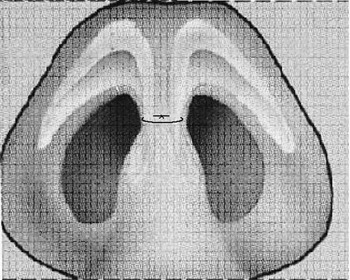
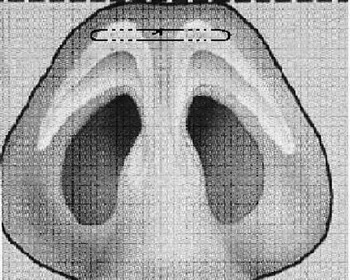
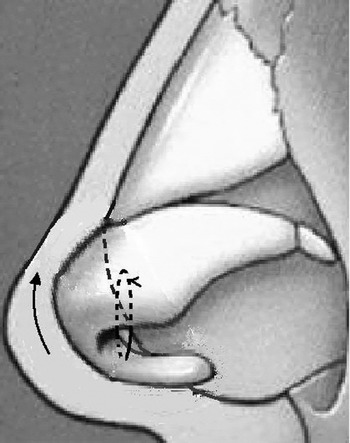
This suture narrows the nasal tip, and reduces columella flare by narrowing and strengthening the columella. It is placed in the middle third of the medial crura length, and forms a loop over the caudal edge of the medial crura, with the knot embedded between the two crura (Figure 1).Reference Guyuron and Behmand2 The final divergent angle between the medial crura is determined by the width of the medial crura included in the suture. In the presence of intact supporting mechanisms for the tip cartilages, by approximating the caudal edge of the two medial crura with a caudally placed medial crura suture, caudal rotation of the lower lateral cartilages may occur. To avoid distortion of normal anatomical relationships, this suture can be placed in the intercrural space without encircling the caudal edge of the crus.Reference Tebbetts3,Reference Tebbetts and Tebbetts4
Medial crura flare control suture.

Medial crura fixation suture
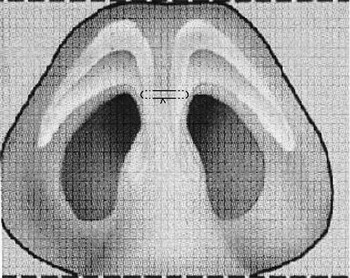
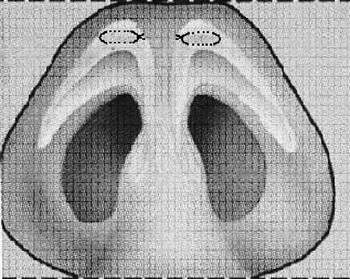
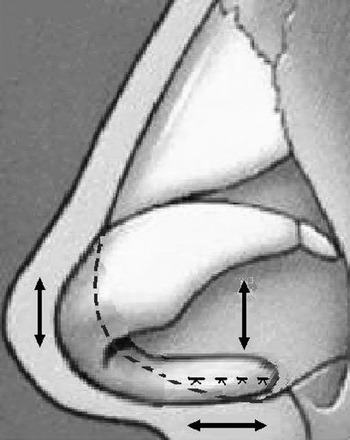
The medial crural suture is placed as a loop in the most anterior part of the medial crus, at its junction with the middle crus, with the knot embedded between the two medial crura (Figure 2).Reference Tebbetts and Tebbetts4 It reduces bifidity of the nasal tip by decreasing the interdomal distance. It may also increase lobule protrusion and size, depending on where it is placed.
Medial crura fixation suture.

Interdomal suture
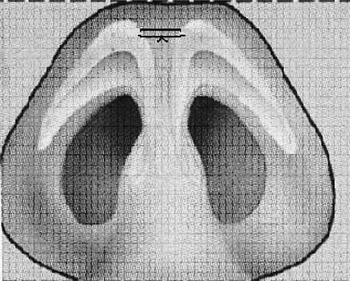
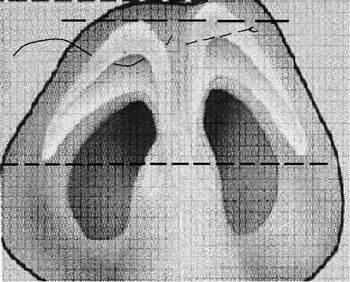
The interdomal suture, also know as the intermediate crural spanning suture or dome binding suture, is a loop suture placed between the lobular segments of the middle crura (Figure 3).Reference Sheen and Sheen5 By bringing the domes together, it narrows the nasal tip and increases the lobule length and tip projection. The positioning of the sutures, placed through the domes, can affect the lateral crura; the latter rotates caudally when the sutures are placed close to the caudal margin of the domes, and rotates cephalically when the suture is placed towards the cephalic margin. In a twisted nasal tip, it is therefore possible to untwist the tip by placing the interdomal suture cephalically in one dome and caudally in the other, although it may be necessary to trim a small strip of caudal lateral crura to achieved symmetry. Sutures placed more laterally in the middle crura increase the tension within the lateral crura and reduce its convexity. However, excessive tension may cause over-narrowing of the interdomal distance.
Interdomal suture.

Double-dome unit suture
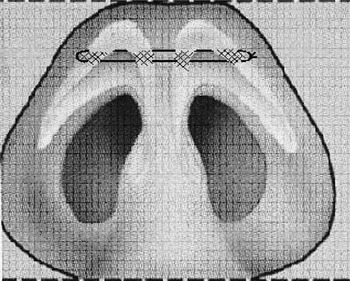
McCollough and English described the double-dome unit suture.Reference McCollough and English6 Following morselisation of the domal and lobular segments of the middle crura, the suture is passed as a single, horizontal mattress suture through both medial and lateral crura of both alar cartilages just below the dome, bringing together all four crura and effectively transforming the medial and lateral crura of both sides to become a single, double-dome unit (Figure 4). This suture will reduce tip bifidity, as will the previous sutures; however, because of the mattress element of the pass across each dome, it will also narrow the domes and increase tip definition.
Double-dome unit suture following morselisation of medial and lateral crura.

Transdomal suture and dome definition suture
Tardy et al. originally described the transdomal suture as a horizontal mattress suture that traverses the domal and lobular segments of both middle crura, with the knot placed deeply between the domes (Figure 5).Reference Tardy, Patt and Walter7 This brings into close proximity the domal and lobular segments of each individual dome. It therefore narrows the nasal tip, by reducing the angle between the domal and lobular segments of both middle crura, and reduces interdomal distance. This suture is suggested to be most favourable in correcting a broad, trapezoid nasal tip with the typical firm, divergent alar cartilages with broad arches. The additional presence of thin overlying skin and delicate alar sidewalls should persuade the surgeon to use this technique, and avoid trimming the lower lateral cartilages to avoid alar rim collapse. One must be aware that excessive tension of this suture may over-narrow the domes, causing an abnormal angle of domal divergence (interdomal angle), and may also increase lateral crus concavity, with subsequent alar rim retraction. The latter can be offset by the use of an alar contour graft.
Transdomal suture.

The term ‘transdomal suture’ as used today often refers to the dome definition suture described by Daniel.Reference Daniel8 This consists of an individual, horizontal mattress suture placed across each middle crus and tied medially (Figure 6). This decreases the angle of dome definition and creates an adjacent, concave lateral crura. To transform the two domes into a single dome unit, the right and left dome units can be brought together with the interdomal suture. The advantages of this suture, compared with Tardy's transdomal suture and the double-dome unit suture, is that it can precisely tailor the anatomy of each dome individually, and correct any asymmetry between the two domes without the need for cartilage excision. In addition, by combining the interdomal suture and the dome definition suture, it is possible to achieve the precise intended interdomal angle and angle of dome definition.
Dome definition suture.

Lateral crural steal
The lateral crural steal technique is a further variant of the dome definition suture.Reference Kridel, Konior, Shumrick and Wright9 When the horizontal mattress domal sutures include a larger portion of the lateral crus, part of the lateral crus is ‘borrowed’ by the middle crus. This suture technique requires a stable nasal base, often necessitating fixation of the two medial crura or reinforcement with a columellar strut. Plumping grafts may be placed to create the desired nasolabial angle. Once the stability of the middle crural complex is achieved, the lateral crura can be medialised. The lateral crus is first sutured to the lobular segment of the middle crus, and then continued to the contralateral side as a horizontal mattress suture across the tip (Figure 7). As a result, the central medial crural leg is lengthened, whilst the lateral crura on the sides are shortened. This results in increased nasal tip projection and rotation. Tip refinement can also be achieved, as with a standard domal suture.
Lateral crural steal. When a larger proportion of the lateral crus is included (left), the lateral crus is advanced to the dome medially, and the medial crus is lengthened. Subsequently, nasal tip projection and rotation are increased.

Lateral crura spanning suture
The lateral crura spanning suture is a horizontal mattress suture placed from the middle two-thirds of the lateral crus, crossing over the nasal dorsum and reaching the contra-lateral lateral crus, with the knot tied in the middle over the dorsal midline (Figure 8).Reference Tebbetts3,Reference Tebbetts and Tebbetts4 As the tension of this suture is increased, the lateral crura are medialised, the convexities of both lateral crura are reduced, and the domes are rotated caudally. The interdomal distance and subsequent angle of domal divergence are also reduced, depending on how close the suture is placed in relation to the domes. This suture may be placed at different positions to correct asymmetries, alar and internal valve collapse, and over-projected tips.
Lateral crura spanning suture.

This suture must be very carefully positioned at the point of maximum lateral crural convexity. It should be tied loosely, with no more than approximately 2 to 3 mm of medial displacement. Excessive tension of this suture may lead to two potential undesirable effects. Firstly, notching of the alar rim may arise. Secondly, this suture may bring the lateral crura anteriorly over the septal cartilaginous dorsum, especially if the suture is placed above the light-defining points. As a result, blunting of the supratip, with an appearance resembling a pollybeak, may occur.
Medial crura-septal suture
The medial crura-septal suture, also known as the projection control suture, is indicated when adjustment of nasal tip projection is required but without disruption of the integrity of the lobule.Reference Tebbetts and Tebbetts4 This suture anchors the exposed medial crus footplate to the denuded caudal septum (Figure 9). In addition, it may provide some tip rotation, alter nasolabial angle, reduce columella show, maintain a straight caudal septum and reinforce tip strength. The position of the suture on the medial crura and septum dictates nasal tip projection and columella position. Unintended changes associated with this suture technique are therefore associated with poorly positioned sutures which may cause over- or under-projection, columella retraction, and wide columella.
Medial crura-septal suture.

Tip rotation suture
The tip rotation suture is passed from the cephalic edge of the middle crus to the anterocaudal septum (Figure 10).Reference Baker10 Subsequently, the nasal tip is rotated cephalically with an increase of the columellar lobular angle.
Tip rotation suture.

Tongue-in-groove technique
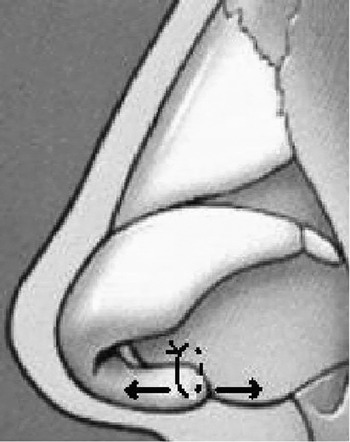
This suture technique is used to correct excessive columellar show.Reference Kridel, Scott and Foda11 It may also be indicated for controlling nasal tip rotation and projection while preserving the lobular cartilaginous complex. The denuded caudal septum is positioned into the surgically created space between the two medial crura by a series of sutures, in a through-and-through fashion (Figure 11). To avoid columellar widening, soft tissue may be removed from the dissected pocket.
Tongue-in-groove technique. As well as reducing excessive columellar show, the position of sutures on the caudal septum can alter tip projection and rotation.

Placement of multiple sutures
Multiple suture placement is often required to achieve the desired results. When a nasal tip suture is placed to achieve a specific effect, this effect may change during the course of the operation when further steps alter the configuration or position of tip cartilages. Hence, the systematic use of multiple sutures with specific sequences and with the appropriate amount of tension is essential.
Tebbetts was one of the earliest advocates of suture algorithms, and described a four-stage technique to approach the nasal tip.Reference Tebbetts3,Reference Tebbetts and Tebbetts4 Firstly, symmetrical lateral crural cephalic rim strips are excised conservatively. In the second stage, a cephalically placed medial crural suture is used to stabilise and correct any asymmetry of the central structures. Further medial crural sutures, combined with a medial crural footplate flare control suture, are used to correct caudal flare, or to hold in place an inter-crural strut. In the third stage, a columellar strut is positioned when required. A lateral crural spanning suture is then used to improve lateral crural convexity. This is followed by the transdomal sutures to refine dome definition and projection. In the fourth stage, a medial crural anchor suture and a tip rotation suture are used to determine the final tip projection.
Daniel described a simplified algorithm for a three-stitch tip suture technique which addresses both primary and secondary rhinoplasties.Reference Daniel12,Reference Daniel13 Firstly, a columella strut is fixed by a strut suture between the medial crura. This is followed by bilateral domal definition sutures to create tip definition. Finally, a domal equalisation suture, a variant of the interdomal suture, is used to narrow and align the domes. An additional columellar-septal suture may be used for rotation and/or projection.
Rohrich and Adams Jr proposed a suture algorithm which specifically addresses the boxy nasal tip.Reference Rohrich and Adams14 They classified boxy nasal tips into three categories. Their method included conservative domal and lateral crural cephalic trim, followed by transdomal and/or interdomal sutures.
Gruber and Friedman described a four suture algorithm for the broad or bulbous nasal tip.Reference Gruber and Friedman15 Following excision of the cephalic portion of the lateral crus, the transdomal suture is the first to be placed. The second suture is the interdomal suture, although it is not always required. If the convexity persists after the interdomal suture is placed, the lateral crural mattress suture is used. Finally, the columella-septal suture is used to alter tip projection, to reduce columella show and to effect tip rotation.
Guyuron and Behmand recommended the fixation of central structures using a medial crural suture first, followed by the medial genu suture.Reference Guyuron and Behmand2 Tip definition is then addressed with the interdomal or transdomal suture. This is followed by the placement of the lateral crura suture to reduce crura convexity. If nasal tip projection needs addressing, then a medial crural septal suture is added. Finally, a tip rotation suture is then placed to provide cephalic rotation of the tip. The degree of rotation can be further enhanced by removal of the membranous septum and a wedge of caudal septal cartilage.
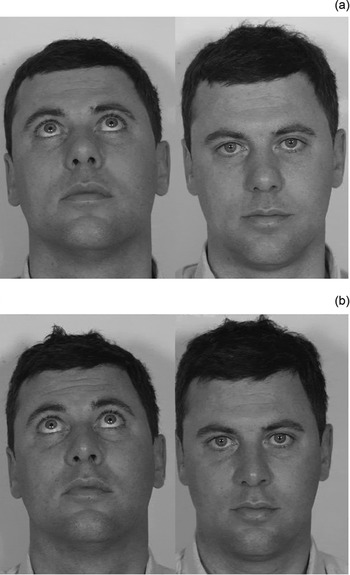
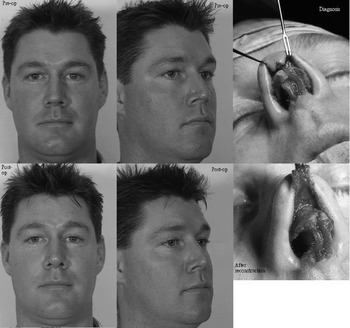
In our practice, we advocate the use of sutures to reshape the nasal tip whenever possible, which allows a more conservative approach to volume reduction. We employ a three stage suture technique. We rarely perform conservative excision of the cephalic portion of the lateral crura alone. Our first suture usually involves reinforcement of central support by fixation of the medial crura. This provides a strong foundation and a centre point of reference for all subsequent sutures. A columellar strut is inserted if sutures alone do not provide adequate support. The second stage addresses the shape of the nasal tip, which can be sculptured by the dome definition suture and/or the interdomal suture. In the third stage, if fine adjustments of tip rotation or projection are desired, a tip rotation suture or medial crura-septal suture may be used, respectively. We always employ sutures to restore anatomical relations that may have been disrupted by the open approach. We use sutures as a vital part of our armamentarium in open or closed rhinoplasty, in order to restore or maintain nasal tip support when indicated. Figures 12 and 13 show examples utilising our concepts of rhinoplasty.
Closed delivery approach rhinoplasty. Following domal and interdomal sutures, a medial crura-septal suture is inserted to maintain tip projection. In this case, conservative excision of the cephalic portion of the lateral crura is required. (a) Pre-operative; (b) post-operative.

Nasal tip sutures: other considerations
Each suture technique is associated with multiple, complex variables. All of the potential effects of each technique should be considered in the decision-making process. Some of these effects may be considered as negative, and should be remembered. Suture techniques completely preserve nasal tip anatomy and are completely reversible. Therefore, any undesirable effects associated with suture placement can be addressed intra-operatively. Many negative effects occur only through a lack of thorough understanding of all the characteristics of each suture technique, poor decision-making and inadequate attention to detail. Tebbetts suggested that many potentially undesirable suture effects concerning the shape and position of the medial crura, lobule length and volume can be prevented by the placement of a columellar strut prior to suture placement.Reference Tebbetts16 Because sutures do not disturb the structural integrity of the alar cartilages, nasal tip sculpture using fixation sutures is more likely to withstand the distorting forces of wound-healing, compared with techniques involving radical tissue excision and division of the tip cartilage and supporting structures. Tip sutures should therefore be considered instead of tissue excision whenever possible.
Open approach rhinoplasty is indicated in this asymmetrical nasal tip. Following reconstruction of the lobular segment of the right middle crus, interdomal and medial crura fixation sutures have been inserted. The result is a more refined symmetrical nasal tip, with desirable columellar show, infratip lobule and tip rotation. Pre-op = pre-operative; post-op = post-operative

In addition, when considering the use of suture techniques in rhinoplasty, several fundamental principles should be taken into account. Firstly, the cartilage into which sutures are placed must have sufficient strength and volume. If the cartilage is too weak, it will not support the new shape created by the sutures. If the cartilage is too narrow, for instance, following excessive cephalic resection of the lateral crus, there will be too little cartilage to manipulate, and the suture may not hold or may even cut through. It is recommended that at least a 6 mm width of lateral crus should remain following cephalic resection.Reference Gruber and Friedman15 The importance of the caudal cartilaginous septum in contributing to tip position is well recognised, especially in the application of cruro-septal sutures, tongue-in-groove sutures and tip rotation sutures, all of which are used to move the nasal tip on a foundation that is formed by the nasal septum.
Suture techniques in nasal tip surgery can use either the open (external) or the closed delivery approach. For the lateral spanning suture and tip rotation suture, we favour the open approach to access the nasal tip. We also prefer the open approach when using sutures for asymmetrical nasal tips or revision tip surgery, as this approach enables precise intra-operative assessment of the tip framework morphology. Otherwise, a closed delivery approach can be employed to insert all other sutures.
In terms of suture material, we prefer to use a non-dyed, monofilament, absorbable polydioxanone suture, in sizes 4.0, 5.0 or 6.0. The suture size is dependent on the size and strength of the cartilage into which the suture is placed.
Pitfalls of nasal tip suture techniques
The potential undesirable effects associated with the various nasal tip suture techniques, and the means of preventing these, have been discussed. Occasionally, in order to achieve a particular desired result, it may be necessary to accommodate an undesirable side effect. For example, dome sutures are often used to reduce the convexity of the lateral crura and to improve the bulbous nasal tip. However, in order to achieve the desired tip definition, a pinched nasal tip may occur, with the characteristic demarcation between the tip and the alar lobule as well as notching of the alar margin.Reference Tebbetts16 This is a result of altered lateral crura anatomy and caudal displacement of the caudal margin of the lateral crura. To eliminate alar margin notching, alar rim grafts can be placed into pockets along the caudal margin of the marginal incision.Reference Rohrich, Raniere and Ha17,Reference Toriumi18 Subsequently, the contour of the alar margins is recreated, along with the desired elevated ridge along the alar margin that transitions from the nasal tip to the alar lobule.
The use of sutures to obtain a particular change in lower lateral cartilage shape may produce a synchronous vector force change which results in an undesirable concomitant change in tip position. Therefore, a compromise of desirable versus undesirable change must be considered. There are also situations in which nasal tip sutures alone are inadequate. When it is not possible to satisfactorily reduce the bulbous tip, despite using domal sutures and cephalic trim, lateral crural strut grafts can be placed to abolish lateral crura convexity and to prevent future deformity.Reference Toriumi19
It may not always be possible to achieve the desired tip projection, despite the combination of various suture techniques (such as the domal suture and lateral crural steal suture), taking into account the fact that excessive tension of these sutures will cause undesirable effects. When there is an excess or deficiency of lower lateral cartilage, although adjuvant grafting, cartilage resection, or division and overlap with suture reconstruction may be necessary, sutures may help to optimise and fine-tune tip shape and position.
Conclusion
Every nasal tip is different, and there is no single, universal technique or algorithm applicable to all cases. Indeed, various world-leading surgeons, such as Tardy, Becker and Pastorek, and Sheen, have demonstrated excellent and consistent results without necessarily using algorithms.Reference Tardy, Patt and Walter7,Reference Becker and Pastorek20,Reference Sheen21 No technique can replace a thorough understanding of both nasal anatomy and the characteristics of each suture placement.