Characterizing the Problem of Food Waste in the USA
In the present study, we review present public policy and private action toward the mitigation of food waste in the USA. This work updates information about public policy and private-sector initiatives to address issues of food waste, food insecurity, biogas production and composted soil production. The review also focuses upon initiatives that take a unified view toward these related issues. Unlike previous studies of food waste and food insecurity (see, e.g., Godfray et al., Reference Godfray, Beddington, Crute, Haddad, Lawrence, Muir, Pretty, Robinson, Thomas and Toulmin2010 or Gunders, Reference Gunders2012), we discuss policies and actions related to each potential destination of value for (edible and inedible) rescued food waste.
To dispose of an article is not necessarily wasteful. If the article retains potential value, however, disposal is wasteful in that it denies someone from realizing this value. As a direct and indirect consequence of his/her actions, a typical American wastes much more than his/her weight in food each year. In 2013, for example, Americans generated 133 billion pounds of retail and consumer food waste or 417 pounds per person according to the US Department of Agriculture Environmental Research Service (see, e.g., Buzby et al., Reference Buzby, Farah-Wells and Hyman2014) [Consistent with this value, Seattle Public Utilities estimates approximately 400 pounds of annual food waste per citizen (Thompson, Reference Thompson2015). These estimates do not consider farm-level food waste.]. This estimate suggests that 31% of food produced for consumption in the USA in 2013 was wasted at some stage. The disposal of uneaten food qualifies as waste on several levels. Each year, a large proportion of food disposed of by grocery stores and restaurants has exceeded its recommended ‘sell-by’ date but remains edible at the time of disposal. Such food can be donated to soup kitchens for the immediate preparation and provision of a meal to a hungry person. Food that is inedible at the time of disposal also holds potential value in that it serves as a rich input in the production of biofuel and soil amendment. There is at least one additional aspect of food disposal that is wasteful. Without generating any offsetting benefit, food rotting in landfills releases methane (CH4)—a greenhouse gas more than 20 times as potent as carbon dioxide (CO2) in rendering climate change over a 100-year frame. Approximately 60% of CH4 emissions on earth derive from human activities and landfills are the third largest source of CH4 emissions in the USA (EPA, 2010a). In other words, we have a literal reason to sweat our rotting masses of uneaten food long after we have discarded them.
Yet, per capita food waste has consistently risen in the modern USA. Deriving their data from Food and Agriculture Organization (of the United Nations) food balance sheets, Hall et al. (Reference Hall, Guo, Dore and Chow2009) find that US per capita food waste has risen by 50% in the 30 years following 1974. Given that the US population increased by 37% over that same time period, it follows that total annual food waste in the USA more than doubled from 1974 to 2004. Moreover, Hall et al. report that the percentage of our (increasing) stock of food that is wasted has consistently risen from 30% in the 1970s to approximately 40% today. Note that this FAO-based estimate is larger than the previously cited estimate of Buzby et al. (Reference Buzby, Farah-Wells and Hyman2014). According to these estimates, we are wasting a higher percentage of an increasing stock of food over time. Given this compounded effect, Ferdman (Reference Ferdman2014) reports that wasted food accounts for more than 20% of total waste, more than any other single waste category. This value has risen from <10% in 1980. According to a USDA (2016b) report, an estimated 80% of our current freshwater use derives from food production. Given that an estimated 40% of this production is wasted, it follows from these estimates that nearly one-third of our freshwater use supports the production of food that is eventually wasted. The state of Iowa reports a 62% increase in food waste disposal from 1998 to 2011 alone (Iowa Department of Natural Resources, 2011). As aquifer reserves—such as those in the Ogallala Aquifer—deplete in many arid and semi-arid regions of the USA, the efficient production and use of food will become increasingly critical to our ability to conserve and preserve freshwater sources.
Similarly, a large proportion of greenhouse gas emissions (13%) are attributed to food production, distribution and disposal (EPA, 2016). Using the food waste proportion estimate of Hall et al. (Reference Hall, Guo, Dore and Chow2009), a baseline estimate would suggest that the production, distribution and abandonment of wasted food is responsible for more than 5% of US greenhouse gas emissions. The true value may be a good measure >5%, as the CH4 footprint of a unit of wasted food is much greater than that of a unit of consumed food. Meanwhile, the US adult obesity rate more than tripled (from roughly 10 to 35.7%) from 1960 to 2010 (Ogden et al., Reference Ogden, Carroll, Kit and Flegal2014). Over the same time period, the rate of extreme obesity rose from <1% to 6.3%, while the proportion of US adults who are overweight remained steady at 33.0%. As such, 75% of American adults were overweight, obese, or extremely obese as of 2010. These figures collectively tell a disconcerting story. We are growing more food for three basic reasons: (1) to sustain a growing population, (2) to sustain a population of people many of whom are growing in size and (3) to sustain our growing propensity to waste food after purchase. Primarily, the last source of food demand contributes to our production of food waste. The EPA (2014) reports:
More food reaches landfills and incinerators than any other single material in municipal solid waste. In 2012 alone, more than 36 million tons of food waste was generated, with only 5% diverted from landfills and incinerators for composting.
In response to these trends, organizations and government agencies in the USA have developed and scaled methods to beneficially repurpose food waste toward human consumption, energy production and compost material. The remainder of the present study considers what has been done and provides further prescriptions for the synthesis of food waste policy and action.
Grassroots Food Rescue in the USA: Origins and Recent Scaling
The process of large-scale food rescue was pioneered largely by City Harvest, a New York City non-profit organization that opened in 1982. Later that decade, several other US food rescue organizations—such as Inter-Faith Food Shuttle in North Carolina—took form. To rescue a given food resource is to prevent its disposal toward a valuable end (e.g., in providing a meal to a hungry person). Stores, restaurants and households often dispose of large quantities of food that have exceeded their recommended ‘sell-by’ date. When a piece of salmon at a grocery store exceeds this date, it is typically thrown away by the store. Such action stands to reason, as a grocery store is in the business of selling food. From a social perspective, however, the salmon retains value. It can be safely, and often deliciously, consumed for a period of time. Early food rescue organizations identified this ephemeral value and partnered with grocery stores, and later restaurants, to rescue foods that had surpassed their respective sell-by dates. Once secured, the rescued food is typically distributed to a soup kitchen for quick preparation and disbursement. Food rescue generates a veritable societal free lunch in that it reduces the amount of CH4 emissions in landfills, while addressing the widespread problem of food insecurity [US Department of Agriculture defines food insecurity as a self-assessed ‘household-level economic and social condition of limited or uncertain access to adequate food’ (USDA, 2016a).]. Moreover, the act does not result in significant direct or indirect revenue loss for the donating business, while accruing an enhanced tax deduction under Section 170 of the Internal Revenue Code (along with any additional tax credits at the municipal and state level).
It is difficult to obtain aggregate data on food rescue in the USA. Most large-scale food rescue organizations, however, are a member of a common network of hunger alleviation organizations known as Feeding America. Each year, this network provides at least some food to each of 46.5 million unique Americans (Feeding America, 2014a). By comparison, Coleman-Jensen et al. (Reference Coleman-Jensen, Nord, Andrews and Carlson2014) estimate that the total number of food insecure (or low secure) Americans is roughly 49 million. Still, Feeding America holds a strong belief that further scaling of food rescue can eliminate hunger in the USA. The EPA (2010b) reports that food rescue can be scaled significantly, as only 3% of wasted food is currently recovered or recycled. Moreover, the majority of this 3% is composted such that <1.5% of wasted food is recovered to alleviate hunger. Given the value of rescued food in addressing hunger, why is this percentage so modest? Part of the reason is that a great deal of food waste has been rendered inedible before its disposal. The redistribution of all half-eaten hamburgers to soup kitchens does not represent a savory (or legal) solution to the problem of food insecurity. Moreover, perishable food waste can be difficult to rescue. In the case of perishables, there is often a shorter lead time in identifying waste-jeopardized foods and, consequently, a shorter period of potential use following rescue. Surely, however, our society is not at the frontier of edible food waste recovery.
One obstacle in food recovery is the difficulty in coordinating those wasting food and those in need of food. Without such coordination, it often becomes overly burdensome for those wasting food to contribute to food rescue. As will be discussed in a subsequent section, municipal and state policies are beginning to address this coordination issue by mandating that food waste be recovered or separated. As wasted food generates large (external) environmental costs, such policies are justified from the standpoint of economic theory. There also exist market-based solutions to the low food recovery rate. Food rescue organizations are presently expanding their food rescue networks and applying supply chain management tools to deal with the challenging issue of perishable food waste. Feeding America (2014b) states, ‘[We are] presently investing in new, innovative programs that will allow us to rescue billions of pounds of food. We will ensure the carrots left unharvested, the apple still on the tree and the carton of milk sitting in a warehouse refrigerator become the staples of a family's dinner or a child's lunch.’ Supply chain management tools allow food rescue organizations to understand, at any point in time, in which food program(s) a given body of rescued food will generate the most recipient value. An experienced organization such as Inter-Faith Food Shuttle, for example, understands the unique needs and capacities of each of its approximately 200 recipient food programs.
Even in their present state, food rescue organizations are incredibly efficient and resourceful social scavengers. City Harvest has rescued more than 500 million pounds of edible food waste in New York City since 1982 (City Harvest, 2015a). In 2015, the organization will rescue and redistribute an estimated 50 million pounds of food in the New York City area (City Harvest, 2015b). City Harvest has had unprecedented success in the formidable task of produce rescue, with fruits and vegetables comprising approximately 60% of the organization's rescued food stock. Part of this success derives from the immense population and population density of New York City. It is not as difficult to beat the produce expiration clock when there are approximately 1.4 million hungry individuals within a single municipality. Moreover, the high population density of New York City creates a similarly dense base of food rescue sources. More things happen per area in a place like New York City, and this includes food waste. In economic terminology, there is a ‘thick market’ for food rescue in New York City. To its own vast credit, however, City Harvest has developed an extensive network of food waste suppliers. The organization functions like an ant colony, sending workers to all parts of New York City to secure food resources. The organization's Food Council comprises more than 75 area food industry professionals such that City Harvest has institutional connections throughout New York City (City Harvest, 2015c). Owing greatly to these connections, the organization rescues food from grocery stores (large and small), farms, corporate cafeterias, restaurants, bakeries and food manufacturers. City Harvest then delivers the food to more than 500 municipal food programs via bicycle and truck. The organization states,
City Harvest is the product of common sense. In the early 1980s, a group of ordinary citizens became troubled by the large number of fellow New Yorkers who didn't have enough to eat. When they saw that local restaurants were discarding perfectly good food, these volunteers responded by enlisting friends and borrowing cars to transport the leftover food to where it was needed most. This idea led to the creation of City Harvest in 1982 (City Harvest, 2015d).
Like so many other food rescue organizations, City Harvest likes to deal with multiple problems in one efficient stroke. Their focus upon fruits and vegetables allows them to challenge the (perhaps paradoxical) link between food insecurity and incidence of diseases such as diabetes and heart disease [see, e.g., Gucciardi et al. (Reference Gucciardi, Vahabi, Norris, Del Monte and Farnum2014) and Ford (Reference Ford2013), respectively, for evidence of these links]. Moreover, Grutzmacher and Gross (Reference Grutzmacher and Gross2011) find a low incidence of fruit and vegetable intake among food insecure individuals. City Harvest (2015d) states,
City Harvest's common-sense, cost-effective approach remains unchanged, because by working efficiently we can help the greatest number of people possible. Picking up and delivering food the same day keeps costs down and allows us to focus on fresh, perishable foods that are often in short supply at soup kitchens and food pantries. Currently, our cost to deliver a pound of food is just 24 cents, making City Harvest a smart, simple solution to ending hunger in New York City.
Inter-Faith Food Shuttle (IFFS) rescues and distributes more than 7 million pounds of edible food per year (IFFS, 2015a). The IFFS serves a seven-county region of North Carolina that like New York City, contains a stark level of income inequality. Five of the seven counties served by IFFS lie within the famed Research Triangle, a dense collection of technology, medical and otherwise scientific companies that lie within the geographic triangle created by Duke University, the University of North Carolina at Chapel Hill and North Carolina State University. These companies draw a dense collection of advanced degree holders. In Durham, North Carolina, for example, more than 1 in 22 citizens over the age of 25 holds a doctoral degree (U.S. News and World Report, 2011). The region also houses a high incidence of poverty. The IFFS (2015b) reports that 274,000 individuals in its service area are food insecure. For better or worse, income inequality—along with other key demographic factors—appears to be a catalyst for charitable contributions such as food donations. Daniels and Narayanswamy (Reference Daniels and Narayanswamy2014) find that a given middle-income or upper-income individual is expected to give a higher proportion of income to support the needs of the community's poor as the level of income inequality increases, ceteris paribus.
Like City Harvest, the IFFS places a significant emphasis upon the provision of nutritious foods. Fresh produce constitutes more than 40% of its rescued food stock (IFFS, 2014). Much of the food stock rescued by the IFFS is distributed directly to recipient homes. The organization also provides a culinary job-training program for unemployed or under-employed adults. Students of the program cook more than 40,000 pounds of recovered food per week (IFFS, 2015c). The food is then frozen and delivered to area soup kitchens and children's food programs. Since 1998, the Culinary Job Training Program has prepared (previously) disadvantaged adults in North Carolina for significant positions in the food industry. Second Helpings, a food rescue organization in Indianapolis, Indiana, has rescued more than 19 million pounds of food from area restaurants and grocery stores. The organization produces 3500 hot meals per day from rescued food. These meals are then distributed to 70 hunger relief programs throughout the city (Second Helpings, 2013). Like IFFS, the process of food preparation at Second Helpings operates upon a two-for-one principle in that it also serves as a culinary job training program for (previously) disadvantaged adults. The organization writes, ‘More than 500 adults have graduated from this program, and Second Helpings alumni are now working in Central Indiana as cooks, executive chefs, business owners and culinary instructors’ (Second Helpings, 2015).
These profiled organizations stand out among food recovery organizations; in that each formed and scaled at an early time within their respective regions. Therefore, they have had a relatively long period of time with which to troubleshoot problems in the food recovery process (including those specific to their respective region). Moreover, each company has exhibited innovative approaches to the food recovery process. For example, City Harvest has taken on the challenge of scaling perishable food recovery. This pioneering effort has allowed the organization to provide a rescued food stock that consists primarily of fruits and vegetables. Both IFFS and Second Helpings have incorporated (and scaled) a job training component into the food recovery process. As such, IFFS and Second Helpings have managed to address related community problems while concurrently providing recovered food to food-insecure individuals.
Scaling Food Rescue to Further Address Hunger
In a National Resources Defense Council issue paper, Gunders (Reference Gunders2012) builds upon annual US food loss and food consumption estimates from Hall et al. (Reference Hall, Guo, Dore and Chow2009) to estimate that a redirection of 15% of our presently-wasted food would be sufficient to sustain 25 million Americans. In 2015, 42.2 million Americans lived in food insecure households, while 11.4 million lived in very low food security households according to self-report survey data collected by the USDA (USDA, 2015). Unfortunately, not all wasted food remains in edible form. To support an approximate calculation, let us assume that 75% of food wasted in the USA remains edible upon its disposal. This estimate is derived from Costello et al. (Reference Costello, Birisci and McGarvey2016), who estimate that 80% of post-consumer food waste and 73% of pre-consumer food waste at a campus dining facility was edible at the time of disposal. This value is further (roughly) corroborated by a United Nations report that 1.3 of 1.6 gigatons of global food waste (81.25%) is edible upon disposal (Food and Agricultural Organization, United Nations, 2013).
If we rescue enough additional food to reduce edible food waste by 15%, then this newly-salvaged food would be sufficient to fully sustain an estimated 18.45 million individuals. This estimate is based upon the previously cited estimate of Gunders (Reference Gunders2012), who assumes a sustenance level of 2500 kcal(kilocalorie) day−1 for the average American and an average of 150 trillion kcals of food waste per year in the USA. Gunders’ (Reference Gunders2012) calculation is represented as follows:
 $$\eqalign{&{\rm Food}\;{\rm Shares}\;{\rm from\;} \;{\rm additional\;} \;{\rm rescue} = \cr&\quad \displaystyle{\matrix{1.5{\rm \;} \times 10^{14} \;{\rm annual\;} \;{\rm kcals}\;{\rm wasted\;} \;{\rm in\;} \;{\rm US\;} \times 0.15{\rm \;} \cr {\rm waste}\;{\rm \; reduction\;} \;{\rm factor}} \over {2500\;{\rm kcals}\;{\rm per}\;{\rm food\;} \;{\rm share} \times 365{\rm \;} \;{\rm days}}}{\rm \;} \cr {\rm \;} \approx & 24.6\;{\rm million}\;{\rm annual}\;{\rm food}\;{\rm shares}} $$
We build upon this calculation by considering a 15% reduction in the estimated stock of edible food waste. Our calculation is achieved as follows:
 $$\eqalign{&{\rm Food}\;{\rm Shares}\;{\rm from\;} \;{\rm additional}\;{\rm edible}\;{\rm rescue} = \cr&\quad \displaystyle{\matrix{1.125 \times {\rm \;} 10^{14} \;{\rm annual}\;{\rm edible\;} \;{\rm kcals\;} \;{\rm wasted\;} \;{\rm in\;} \cr {\rm US} \times 0.15\;{\rm waste}\;{\rm reduction}\;{\rm factor}} \over {2500\;{\rm kcals\;} \;{\rm per}\;{\rm food\;} \;{\rm share} \times 365\;{\rm days}}}{\rm \;} \cr \approx & 18.45\;{\rm million}\;{\rm annual\;} \;{\rm food\;} \;{\rm shares}} $$
Our estimate recognizes that only approximately 112.5 trillion kcals of this waste remains edible at the time of disposal such that a 15% reduction in edible food waste would have the effect of fully feeding an approximately (24.6 million × 0.75) or 18.45 million Americans. Divided among 42.2 million Americans in food insecure households and 11.4 million Americans in very low food insecurity households, these 18.45 million food shares would provide each American in one of these categories with roughly 35% of his or her daily food needs. Given available data, we cannot precisely assess the nutritional characteristics of this potential stock of food.
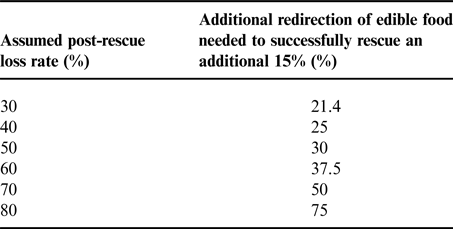
Successful edible food rescue presents logistical challenges. For example, some proportion of fresh produce spoils during the rescue process. Assuming a 30% loss rate for rescued food (i.e., a loss rate that is roughly proportional to the loss rate of pre-rescued food), a society must redirect an additional 22.5% of edible food waste in order to successfully rescue an additional 15%. Table 1 below presents the necessary percentage of additional redirection for different rescued food loss rates.
Additional redirection of edible food needed to successfully rescue an additional 15%.

Let us approach this calculation in a more straightforward manner for the purpose of cross-checking our first result. Buzby et al. (Reference Buzby, Farah-Wells and Hyman2014) estimate that 141 trillion kcals of food are wasted in the USA each year. Given a US population of more than 320,000,000, this represents approximately 1200 kcals wasted daily per American. Applied to the US population living in food insecure households (42.2 million), this represents more than 9000 kcals wasted per food insecure person in daily food waste. Let us again estimate 75% of this waste is edible at the time of disposal. Then, we generate approximately 5775 calories of daily edible food waste per food insecure person in the USA. A 15% reduction in this value would free up an additional 866 calories per food insecure person or roughly a 37.5% share of a 2300 cal day−1 diet [According to the US Department of Agriculture (2016a), a moderately active male between the ages of 26 and 45 should consume 2600 cal day−1, whereas a moderately active adult female between the ages of 26 and 50 should consume between 2000 calories. The average of these values is 2300 cal day−1. Across all adult ages, a moderately active female is recommended to consume between 1800 and 2200 cal day−1, whereas a moderately active male is recommended to consume between 2200 and 2800 cal day−1. Averaging the mid-points of these guidelines, we again obtain a value very close to 2300 (2250).]. These two approaches lead us to the same result: that a fairly small proportional reduction in edible food waste could address the problem of US food insecurity on a large scale (from a caloric deficit perspective). More research is required to assess the ability of food waste redirection to meet the overall nutritional needs of food insecure individuals.
Some readers may consider food redistribution from political or ideological perspectives. Some might believe, for example, that food security is a personal responsibility. In the USA, however, the problem is disproportionately linked to children (particularly of single parents). Nearly one-third of food insecure Americans are under the age of 18. In 2012, a US household with at least one child had a 20% chance of enduring periods of food insecurity. In US households without children, this percentage dropped to 11.9% (USDA, 2015). It is therefore not relevant to think of personal responsibility as a panacea for the problem of food insecurity in the USA.
Inedible Food Waste Initiatives
We have considered the issue of edible food waste in some detail. What, however is to be done of inedible food waste? Though one's half-eaten hamburger is not a savory solution to the war on hunger, it can be applied to the problem of generating energy outside of the human body. Namely, inedible food waste—when dumped into an anaerobic digester—serves as a rich input in the production of biofuel. An anaerobic digester is essentially a chamber that denies oxygen to organic materials, providing an optimal environment by which bacteria can break them down. The process transforms organic solids and liquids into CH4 gas that can be used to create electricity or heat for homes and industrial processes. Alternatively, the process of anaerobic digestion can be implemented as an environmental approach to capture CH4 as an end in itself. After the anaerobic digestion process is completed, solid residuals can be composted or otherwise used directly as a soil amendment. It is apparent, then, that food waste possesses several layers of value if diverted from a landfill. Anaerobic digesters are often found at wastewater treatment facilities, where they have traditionally been used to reduce the volume of sewage sludge. The anaerobic chamber is typically maintained at a high temperature (between 95° and 105°) that amplifies the natural stench of the sewage. In recent years, there has been a trend toward supplementing sewage sludge with inedible food waste. This modification has rendered the process much more productive in generating biofuel or in capturing CH4. The EPA (2008) writes.
Unlike biosolids and animal manures, post-consumer food scraps have had no means of prior energy capture. In fact, in a study done by East Bay Municipal Utility District it was revealed that food waste has up to three times as much energy potential as biosolids …When facilities start digesting food waste, the increased energy production allows them to offset the amount of energy they are using and potentially sell excess energy back to the grid.
The anaerobic digestion of food waste and biosolids as a means to produce biofuel is a greenhouse gas neutral activity. Whether ending up in a landfill or in an anaerobic digester, food waste and biosolids are broken down by bacteria in a process that releases CH4 gas. Anaerobic digesters simply speed up the process so that the CH4 can either be put to use or efficiently captured. The application of food waste to anaerobic digestion, though still fairly new, is spreading quickly. National Public Radio (2014) reported on the construction of a large anaerobic digester at the Newtown Creek Wastewater Treatment Plant in Brooklyn, New York. The plant uses eight digestion chambers (i.e., eggs) to combine sewage sludge and inedible food waste to generate biofuel. The plant manager, Jimmy Pynn, points out similarities between the anaerobic digesters and humans, ‘The digesters like to be fed like us: three times a day. They like to be kept warm, 98 degrees. And whether we want to admit it or not, we all make gas. And that's what we have these guys for: to make gas.’
Composting represents a more traditional use of inedible food waste. A compost pile can improve soil health and drought resistance, while reducing the need for inorganic pesticides, inorganic fertilizers and irrigation. Composting with inedible food supplements also reduces the greenhouse gas footprint of food waste. In the case of (buried) food waste in landfills or food waste processed in anaerobic digesters, the waste decomposes anaerobically and the bacteria aiding in such decomposition generate CH4 gas as a by-product. Compost piles, on the other hand, have access to oxygen (i.e., by being turned or by being exposed to worms and other organisms). Therefore, food waste that decomposes in a compost pile primarily emits CO2 rather than MH4, which constitutes a net environmentally-friendly trade-off.
Public and Corporate Initiatives to Reduce Food Waste and Increase Recovery
Recently, the Environmental Protection Agency launched the Food Recovery Challenge and, with the US Department of Agriculture, the Food Waste Challenge. These initiatives seek to provide education and infrastructure to businesses and other organizations toward more efficient purchasing of foods, additional food donations and additional composting. They also set a goal of reducing food waste to US landfills in half by the year 2030. These programs help to bridge the often sizable problem of discoordination between food wasting organizations and food recovering organizations. During his time as Mayor of New York City, Michael Bloomberg led a movement toward separated food waste collection. The Commercial Organic Waste Law, which took effect in 2015, requires large-scale food waste generators (e.g., sufficiently large-scale grocery stores and restaurants) to recycle organic materials or to arrange for their recycling. As of January 2017, the City of New York Department of Sanitation provides separate food waste service to more than 11% of New York City residents (i.e., to more than 961,000 people) according to Goldstein (Reference Goldstein2017). In coordination with these efforts, the state of New York has funded increases in anaerobic digestion capacity (Voegele, Reference Voegele2015). Federal subsidies also exist for anaerobic digestion systems that generate usable biofuel.
In 2014, Massachusetts became the first state to enact a commercial food waste disposal ban. The law requires organizations that generate at least one ton of organic waste per week to donate, re-purpose, or otherwise divert the waste from landfills (i.e., by sending it to an anaerobic digester, to a composting facility, or to an animal-feed operation). The law is well-designed in that it allows businesses to decide their most efficient route to eliminate food waste. The policy will help both food rescue organizations and anaerobic digestion facilities in the state. Businesses generating edible food waste will view food rescue organizations as a source of free food waste removal, and businesses generating inedible food waste will find it necessary to separate such waste for distribution to an anaerobic digester. On January 1, 2015, Seattle became the first US city to fine any citizen who does not separate food waste. The City also shames those not in compliance by placing a red tag on their garbage can (Thompson, Reference Thompson2015). One worker reported a compliance rate of approximately 80%. Moreover, the town of Seattle anticipates an annual diversion of food waste (from landfill to composting facility) in the amount of 38,000 tons. By comparison, Seattle generates approximately 100,000 tons of food waste per year (Seattle Public Utilities, 2017). Conscientious corporate citizens have been voluntarily addressing the issue of wasted food for years. Prior to any sort of regulation, inedible food waste generated at both Disney World and Fenway Park was diverted from landfills to composting facilities and anaerobic digesters.
Policy Discussion and Conclusions
As our cultural norms and technologies slowly change, sparked by progressive individuals and communities, we are gaining the ability to reduce food waste in greater volume. Kantner (Reference Kantner2015) writes, ‘If all AD projects planned through 2017 come online, stand-alone facility capacity will increase by over 4.5 times. This could provide a potential endpoint for one-fifth of the food waste that must be diverted to meet the new landfill reduction goal.’ Such potential can, in turn, address other problems such as energy production. However, the ultimate scale of our food recovery endeavor will rest upon coordination between public policy and private action. Specifically, public policy and sympathetic corporate citizens will create opportunities for the scaling of food recovery through policies that facilitate such coordination. Given well-designed coordination policies at several levels of government, non-profit organizations and sympathetic corporate citizens will seize upon the opportunities generated. Given our current (high) levels of discretionary food waste, policies that change social and cultural norms (e.g., the food waste separation law in Seattle) will likely be important in effecting sustained decreases in food waste.
As garbage is typically collected at the municipal level, separated (inedible) food waste disposal incentives and infrastructure on the part of municipal governments are essential toward the reduction of unrecovered food waste. As in the case of New York City, municipal governments—as the party that typically provisions or contracts for the provision of waste disposal—are in a unique position to coordinate those businesses and individuals disposing of food waste with those public utilities and agricultural composting projects that can utilize food waste in large scales. The infrastructural framework for successful separated food waste disposal includes: (a) an identifiable food waste bin, (b) an end use destination for food waste that is disposed of and (c) an automated sorting mechanism to account for disposal of non-food waste in a food waste bin. Perhaps the highest hurdle is represented in item b. Without increased anaerobic digestion capacity in many cities and regions or additional, large-scale composting projects, a portion of separated food waste may (circuitously and ironically) reunite with non-food waste in the landfill. The 30% US Investment Tax Credit for anaerobic digestion projects expired on December 31, 2016. Similarly, the US Production Tax Credit for these same projects expired on the same day. While the existence of these credits was central to the development of anaerobic digestion capacity in the USA, a number of state programs remain to incentivize these projects (see, e.g., OpenEI, 2017).
The most straightforward municipal or supra-municipal policy by which to reduce unrecovered food waste is to mandate food separation on the part of individuals and businesses, as has been done in Scotland as well as in California, New York City, Austin (TX), Rhode Island, Connecticut, Vermont, San Francisco (CA) and in Massachusetts. For an overview of these food separation mandates, see, e.g., The Institute for Local Self-Reliance (2016) or The Food Waste Network (2017). Such mandates can be effective in that: (a) governments can sell or otherwise provide food waste to public utilities or large-scale agricultural composting projects, (b) (imperfect) enforcement of food waste separation is not prohibitively costly, (c) the act of food separation is not prohibitively costly and has, in fact, taken place for centuries on farms throughout the world and (d) revenues from food waste separation may, in principle, be passed on to individuals (e.g., in the form of waste disposal subsidies or public utility subsidies). Just as individuals commonly have financial incentives to recycle metals and plastics, the same sorts of incentives can arise toward improved food waste separation. Therefore, a food waste separation mandate may only be needed as a temporary measure to change city-wide norms regarding food waste disposal. It is also important to note that separated food waste mandates may generate decreases in both inedible and edible food waste within an area. For example, grocers that are required to separate food waste anyhow would likely be more willing to donate edible food waste to food recovery programs.
Separation mandates need not lead to small-scale reductions in aggregate food waste. In Scotland, for example, separation mandates are anticipated to eliminate food waste reaching landfills by 2021 (Food Waste Network, 2017). Such solutions generate Pareto efficiencies—net gains to all parties—in that they coordinate a reduction in the externally costly act of food waste. Such restrictions can improve environmental quality by reducing unnecessary food production. These restrictions can also serve as a boon for biofuel production and the fight against hunger. Given the scale of waste removal in the USA, municipal laws can be particularly effective in curbing food waste. Food waste is collected at the municipal level and can be curbed or otherwise channeled at this level.
Future research might focus upon the efficacy and value of food rescue, as well as the destination(s) of rescued food. Additional empirical case studies at the city level might allow for clear calculations as to the efficacy and value of a food separation mandate (in terms of reduction in food waste reaching landfill, market value of edible food rescued and redirected to hungry individuals, market value of biofuel production and market value of compost materials generated). Such an empirical analysis could also be used to predict the efficacy and value of state mandates or of mandates in additional cities.
Acknowledgements
We would like to acknowledge Editor Rick Welsh and two anonymous referees for their help and guidance throughout the review process.