


Is a legal advantage an important source of bargaining leverage for state leaders as they negotiate over security issues in international disputes? Does international law provide the foundation for the peaceful settlement of security-related disputes? In a system defined by anarchy, there are reasons to question whether international law can play a central role in the orderly and peaceful resolution of disputes when security issues are at stake for leaders. Indeed, many would argue that the shadow of military power is an ever-present influence over such bargaining processes and that international law is, therefore, not a viable substitute for military strength and credible threats of force to secure the peace. As a result, although law may have an important role to play in governing international economic relations (e.g., Goldstein, Rivers, and Tomz Reference Goldstein, Rivers and Tomz2007; Simmons and Hopkins Reference Simmons and Hopkins2005; von Stein Reference von Stein2005; Zangl Reference Zangl2008), where the parties will often have strong incentives to coordinate their behavior, the role of law in settling disagreements over security-related issues is a far more contentious question among scholars and policy makers.
In such situations, leaders will often have divergent preferences over how the issue should be resolved, making the identification of a mutually acceptable solution difficult. The security aspect of the dispute compounds this problem because leaders will be reluctant to sign any agreement that they believe might decrease the safety of their state or make them appear weak to future adversaries. Finally, interstate security disagreements often capture the attention of domestic audiences, making compromises or concessions costly propositions for leaders. For these and other related reasons, many scholars have concluded that international law is not a primary explanation of state behavior, especially in the high-stakes realm of international security (e.g., Goldsmith and Posner Reference Goldsmith and Posner2005; Mearsheimer Reference Mearsheimer1994; Waltz Reference Waltz1979).
Nevertheless, in recent years, political scientists and legal scholars have sought to explain how international law can be effective under these conditions (e.g., Guzman Reference Guzman2008; Morrow Reference Morrow2007; Simmons Reference Simmons2000). Specifically, scholars working in the rational choice tradition have drawn on theoretical arguments regarding the role of international institutions in promoting cooperation between states to provide a foundation for theorizing as to how international law might lead to cooperation (e.g., Abbott and Snidal Reference Abbott and Snidal1998, Reference Abbott and Snidal2000; Goldsmith and Posner Reference Goldsmith and Posner2005; Keohane, Moravcsik, and Slaughter Reference Keohane, Moravcsik and Slaughter2000; Martin and Simmons Reference Martin and Simmons1998; Morrow Reference Morrow2007; Simmons Reference Simmons2000).Footnote 1 For scholars working in this literature, international law is of instrumental value to leaders when it helps them overcome hurdles in achieving cooperation on pressing issues.
In this article, we apply this approach to explain the role of international law in the resolution of territorial disputes from 1945 to 2000. In doing so, we ask three related questions. First, when leaders are unsatisfied with the territorial status quo, why do some allow it to persist, whereas others actively challenge it through either force or negotiations? Second, if both sides agree to negotiate, then under what circumstances is a settlement most likely to materialize? Finally, if the parties decide to pursue a settlement, then when do leaders prefer to have an international legal body determine the final terms as opposed to negotiating the terms themselves? Answering these questions, we believe, requires an understanding of the strength of a state's legal claim to the disputed territory relative to its adversary's. More specifically, we argue that international law will facilitate the dispute resolution process when one of the parties has a clear legal advantage. Under such circumstances, the allocation of the contested territory suggested by international law will emerge as a focal point and, for reasons we discuss later, will encourage both parties to work toward a final settlement.Footnote 2
This article offers at least four important contributions. First, we identify when international law will be most capable of helping states resolve disputes. In doing so, we advance existing theories on international law and focal points, which do not fully address how or why international law's ability to serve as a focal point varies across disputes in systematic ways. We posit that the bargaining solution suggested by international law will only emerge as a focal point for states if two conditions are present: namely, if the legal principles relevant to the dispute are clear and if one state has an unambiguous legal advantage over its adversary. As we argue in more detail later in the article, if either or both conditions fail to hold, then international law is far less likely to contribute to the peaceful settlement of territorial disputes.
Second, this article represents one of the few attempts to measure the concept of a legal advantage. This allows us to undertake a rigorous test of theoretical claims regarding the role played by international law in settling international security-related disputes peacefully. The majority of the existing theoretical literature, even within the rationalist paradigm, has focused on studying compliance with international law and treaties regarding human rights, international trade, or the environment (e.g., Hafner-Burton and Tsutsui Reference Hafner-Burton and Tsutsui2007; Hathaway Reference Hathaway2002; Lutz and Sikkink Reference Lutz and Sikkink2000; Mitchell Reference Mitchell1994; Simmons Reference Simmons2000). Only recently have scholars such as Legro (Reference Legro1995); Mitchell and Hensel (Reference Mitchell and Hensel2007); Morrow (Reference Morrow2007); Simmons (Reference Simmons and Diehl1999, Reference Simmons2002); and Valentino, Huth, and Croco (Reference Valentino, Huth and Croco2006) begun to address theoretical questions about the effect of international law on state compliance in the realm of security policy. Given the early state of this literature, there is a clear need for more focused theoretical and empirical analyses of the role international law might play in the resolution of international security disputes.
The context of territorial disputes is an appropriate proving ground in this regard because it provides an especially “hard test” of the potential for international law to influence state behavior. Territorial disputes are often highly salient to domestic political audiences, regardless of the strategic or economic value of the land in question. The potential backlash for a leader who would offer even limited concessions creates a strong incentive for many leaders to refrain from compromise in any form. It is largely for this reason that interstate disputes centering on disagreements over territory are more likely to escalate to war than disputes over other issues (e.g., Hensel Reference Hensel and Vasquez2000; Senese and Vasquez Reference Senese and Vasquez2008). Territorial disputes, therefore, provide a high bar for theories of international law to clear because they represent a bargaining situation in which many scholars would expect the likelihood of compliance with law among all parties in a given dispute to be low.
Third, focusing on the context of territorial disputes allows us to broaden what we mean by “international law.” As the literature currently stands, much of the research centers on state compliance with formal treaties. Although this is a logical and important topic to study, treaties are far from the only source of international law. In fact, there are several others sources, such as customary international law, rulings from international judicial bodies, and the writings of legal scholars. Despite this, Goldsmith and Posner (Reference Goldsmith and Posner2005, 21) argue that scholars have written “practically nothing” about international law other than treaty law. Moreover, with respect to territorial disputes, customary international law and rulings from international judicial bodies are particularly important sources for understanding what legal principles are central to the legal claims states make to contested territory. Moving beyond examining whether a state either signed or did not sign a treaty, therefore, permits a deeper theoretical and empirical investigation of how international law affects state behavior.
Fourth, as many scholars have noted, problems of selection bias create substantial inference problems for researchers interested in determining the effectiveness of international law (e.g., Downs, Rocke, and Barsoom Reference Downs, Rocke and Barsoom1996; Simmons and Hopkins Reference Simmons and Hopkins2005). We avoid issues associated with selection effects by incorporating multiple sources of international law into our analysis. Because states do not actively “select into” the many sources of international law that are relevant to territorial disputes, the probability that they will strategically observe the law only when it does not require major policy changes on their part is relatively small. Instead, leaders will be forced to reckon with the legal standing of their states’ claims, even if they do not align with their territorial goals.
Overall, we find strong support for our hypotheses regarding the pacifying effect of international law. More specifically, leaders with strong legal claims who are dissatisfied with the territorial status quo are more likely to challenge it by opening negotiations and less likely to resort to threats or the use of force. Furthermore, disputes in which one of the states enjoys a clear legal advantage relative to its opponent are more likely to be resolved through negotiations than disputes where neither side has strong claims to the territory in question.Footnote 3 Finally, we also find support for the notion that the lack of a legal advantage will cause democratic leaders to prefer a settlement arranged by international legal bodies to one that is a product of direct, bilateral negotiations.
The rest of this article consists of five sections. In the next section, we discuss the three stages of peaceful territorial dispute resolution. In the second section, we develop our theory by elaborating on the circumstances under which a focal point based on international law is most likely to emerge, as well the rationale for why the focal point should affect the behavior of both parties. We also present hypotheses regarding the effect of the focal point across the three stages. The third section discusses our research design, where we describe the operationalization of our legal variables in greater detail, whereas the fourth presents our results. The final section concludes with the implications of our findings.
TERRITORIAL DISPUTES AND THE PEACEFUL PATH TO SETTLEMENT
Following Huth and Allee (Reference Huth and Allee2002), we determined the set of territorial disputes by systematically searching for instances in which two conditions are met.Footnote 4 Namely, when (1) official executive state leaders lay claim to the territory of another state or contest its very sovereignty; and (2) in response, the targeted government's leadership rejects the territorial claims of the adversary. For each dispute, we identify a challenger, the state that is dissatisfied with the current territorial status quo, and a target, the state that would prefer to maintain the territorial status quo.Footnote 5 In some disputes, both parties lay claim to the territory in question and are therefore both coded as challengers.Footnote 6 Although there are several different outcomes to territorial disputes (e.g., no resolution, settlement via a bilateral treaty, or military conquest and annexation), we focus on the process by which leaders end these disputes through either negotiated settlements or a formal process of international legal dispute resolution.
Our analyses focus on three interrelated yet distinct stages of this “peaceful pathway” to dispute resolution. The first stage, which we term the “challenge the status quo” phase, involves three possible choices available to the challenger: he or she can challenge the present border by either calling for negotiations or threatening military force, or he or she can maintain the status quo without actively confronting the target with diplomatic or military challenges.Footnote 7 To construct this variable, we observed the challenger state on a monthly basis; the 165 cases of territorial disputes in our data set produced 3,840 observations for the first stage. If the challenger decided to either open negotiations or issue a military threat in month X, then we considered month X to be an instance of either seeking talks or initiating a military confrontation, respectively, in our data set.Footnote 8 If, however, the challenger made no direct attempts to revise the territorial status quo in the 12 months prior to and including month X, then we coded his or her choice as “maintain the status quo” for that month's observation.Footnote 9 In this first stage, therefore, the key theoretical question we focus on is how the strength of the challenger's legal claims to the disputed territory influences his or her decisions on whether and how to seek a change in the territorial status quo.Footnote 10
If a challenger pursues talks, then the dispute moves into the second stage, which we refer to as the “negotiations” phase. Importantly, the unit of observation changes from a challenger-month to a round of talks between challenger and target, of which there are 1,140 in our data set. This change also entails moving from the challenger-centric setup that we had in the first stage to a dispute-centric setup in the second. A framework that is designed to capture behavior at the dispute level is more appropriate for this second stage because the outcome of interest is whether both parties to the rounds of talks can reach an agreement to settle the dispute peacefully. In our data set, 96 disputes are resolved peacefully in one of two ways: an agreement that is the product of bilateral negotiations or an agreement to settle the dispute by a formal process of legal dispute resolution.Footnote 11 Theoretically, the central question we address is whether an asymmetry in the relative strength of the states’ legal claims affects the probability of the dispute being resolved peacefully through either type of agreement. Put differently, for this particular stage, we are only interested in whether the parties can agree to end the dispute peacefully, not the venue in which they end it.
We consider the choice of settlement venue in the third stage (“mode of settlement”), which models the decision to end the dispute through either (1) direct negotiations or (2) an agreement to settle the dispute by a formal process of legal dispute resolution in which an arbitration panel or the International Court of Justice (ICJ) resolves the dispute by issuing a ruling on competing territorial claims.Footnote 12 Theoretically, the key issue is whether the strength of a state's legal claims influences the leader's choice of settlement venue. Therefore, the relevant cases in this third stage are the 96 rounds of talks that end with either a final bilateral settlement agreement (78 cases) or an agreement to seek a legal ruling that will settle the dispute (18 cases).Footnote 13
THEORY
Our argument consists of two related parts. The first part, which focuses on the first and second stages, speaks to how international law can help state leaders identify a solution to the problem of how to divide the contested territory, thereby enabling them to move toward a settlement agreement. We posit that international law will facilitate a peaceful path to settlement when it is able to help leaders solve distribution problems—that is, when it is able to provide a clear and precise solution for how the contested land should be allocated between the parties. International law will be most likely to perform this role when two conditions hold. First, the relevant legal principles must be unambiguous, or, put differently, capable of suggesting a single way to divide the disputed territory. Second, one state must have a definitive legal advantage over its opponent.Footnote 14 If these two conditions are met, we argue, a focal point based on international law is likely to emerge as both parties investigate the strength of their legal claims. This focal point, in turn, will shape the course of the dispute by granting the legally advantaged leader substantial bargaining leverage.Footnote 15
The second part, centers on the third stage, which examines which mode of settlement disputants opt for: bilateral negotiations or third-party adjudication. This portion of the analysis focuses on the potential domestic costs for some leaders in making concessions to reach a settlement, and how the mode of settlement might mitigate these settlement costs. We also consider the regime type of the state that has a weak legal claim to the contested territory. If the state is a democracy, then the leader should prefer a more formal process of legal dispute resolution instead of a negotiated settlement. This preference exists because the former option better insulates the leader from domestic criticism over the territorial concessions contained in a settlement agreement.
The remainder of this section proceeds as follows. First, we discuss our general theoretical framework and the bargaining obstacle of distribution problems, which often prevent leaders from reaching settlements, even when both have an interest in cooperating. Second, we elaborate on the role of a focal point and specify in more detail the conditions under which we expect one to emerge. Following this, we specify our hypotheses about how the focal point will affect leader behavior in the first and second stages, which examine whether and how a leader will challenge the status quo and whether states are able to reach a peaceful resolution, respectively. Finally, we expand on the domestic constraints logic outlined previously and present a hypothesis regarding the effect of a state's regime type on its preference for a particular settlement venue.
Bargaining and Focal Points
To develop our argument on the role of international law in the peaceful resolution of territorial disputes, we draw on the rationalist bargaining literature on international cooperation (e.g., Blaydes Reference Blaydes2004; Fearon Reference Fearon1998; Koremenos, Lipson, and Snidal Reference Koremenos, Lipson and Snidal2001; Morrow Reference Morrow1994). Specifically, we focus on how leaders must solve distribution problems if they are to reach an agreement (e.g., Fearon Reference Fearon1998; Garrett and Weingast Reference Garrett, Weingast, Goldstein and Keohane1993; Keohane and Martin Reference Keohane and Martin1995; Koremenos, Lipson, and Snidal Reference Koremenos, Lipson and Snidal2001; Krasner Reference Krasner1991; Martin and Simmons Reference Martin and Simmons1998; Morrow Reference Morrow1994). Leaders have incentives to solve the problem and reach an agreement because, as other scholars have argued, allowing a dispute to continue can carry considerable political and military costs (Simmons Reference Simmons1998).Footnote 16
Distribution problems are central to territorial disputes for several reasons. First, any piece of contested territory can be divided an infinite number of ways. Second, leaders will have conflicting preferences over which of these possible solutions they would accept as the final settlement. In addition, because there is usually private information over the minimum amount of territory a leader is willing to accept, it is possible for states to misrepresent their bargaining positions. In light of these three common aspects, it is not surprising that disputes are often resolved over time through a series of offers and counteroffers as leaders try to avoid concessions while holding out for a better deal.
We argue that when legal principles are able to act as a focal point, they can help resolve the distribution problem and break the bargaining impasse by indicating how the disputed territory should be divided between the two states. This is true for at least two reasons. First, international law can help leaders identify which legal principles are relevant to the dispute. In doing so, international law provides a way to frame the problem by focusing on evidence and arguments that establish the legal merits of each state's claims to the territory in question. Once these legal principles have been identified, states can then begin to craft an agreement based on the merits of legal claims.
Second, as Schelling (Reference Schelling1960, 71) argues, focal points help leaders overcome distribution problems by providing them with a way for leaders to “coordinate their expectations.” The need for convergent expectations is critical because many failures to settle stem from the fact that bargaining “includes maneuver, indirect communication, jockeying for position, or speaking to be overheard, or [a confusion of] a multitude of participants and divergent interests” (74). If parties are to reach an agreement, Schelling posits, then they must identify a single point (or a narrow range of points) within the bargaining range that neither side expects the other to reject. Recognizing this strategic element of bargaining wherein one state attempts to predict what its adversary expects it to offer, as well as how this facilitates the convergence of expectations, is crucial to understanding how focal points can help parties overcome distribution problems.
On a related point, the ability of the focal point to narrow the range of acceptable outcomes also helps make negotiations more productive by limiting the ability of a state with weak legal claims to persist in misrepresenting the strength of its bargaining position in negotiations over a possible settlement. Leaders with weak legal claims are less able to make credible bluffs about the terms they are willing to accept if those terms are inconsistent with the distribution of territory called for by the focal point. For instance, if a focal point indicates the leader of state A should receive 75% of the territory, whereas the leader of state B is only entitled to 25%, then state B's leader knows that the leader of state A will not accept B's preferred settlement of an even split. Given this, leader B knows he or she must offer a division to A that is closer to 75% than to 50% to reach an agreement and avoid the costs of allowing the dispute to continue. The focal point also curtails the ability of the disputants to misrepresent what they think they are entitled to. That is, the leader of state B cannot credibly demand 90% of the disputed good when the focal point allocates only 25% to him or her. By narrowing the set of possible agreements, the focal point solves both the coordination and distribution problems by identifying which of the infinite number of potential settlements to start with. It also makes negotiations more efficient by deterring states from offering terms their adversaries would reject. Consequently, even though the existence of a distribution problem necessarily implies that parties have divergent preferences regarding the terms of the final settlement, having a focal point that identifies a particular solution can still influence leader behavior.
Focal Points and International Law
Several scholars, drawing on the insights of Schelling and others, have argued that international law is capable of providing a focal point to help leaders divide a valuable good (e.g., McAdams Reference McAdams2000; McAdams and Nadler Reference McAdams and Nadler2005, Reference McAdams and Nadler2008; Norman and Trachtman Reference Norman and Trachtman2005; Powell and Mitchell Reference Powell and Mitchell2007; Swaine Reference Swaine2002; Trachtman Reference Trachtman2008).Footnote 17 This notion rests on two assertions about the characteristics of international law.
First, international law and legal principles are common knowledge among states (McAdams and Nadler Reference McAdams and Nadler2005, Reference McAdams and Nadler2008), having been established through either formal channels (e.g., treaties, agreements, court rulings) or less formal means (e.g., customary international law, general principles, writings of legal scholars).Footnote 18 Consequently, they are a well-known source of third-party expression for leaders to reference when they disagree. Indeed, leaders will have strong incentives to invest the time and resources necessary to determine the strength of their state's legal claims.Footnote 19 For instance, if a leader suspects he or she has a legal advantage relative to his or her adversary, then he or she will want to investigate the relevant legal principles to support his or her claim. Leaders who are unsure about the strength of their state's claim will also have an incentive to determine their standing to prepare themselves against a possible legal challenge. Leaders that know they are at a legal disadvantage will, obviously, want to avoid drawing attention to specific legal principles that undercut their territorial aspirations. Their opponents, of course, will have every incentive to draw attention to the state's legal disadvantage, especially when they have strong legal claims. In sum, leaders will want to investigate and assess the merits of their legal-based claims to disputed territory, and, typically, at least one disputant per dispute will want to make the legal merits of rival claims to disputed territory known to third parties. The process of exchanging offers and counteroffers enables leaders to become more aware of how their adversary conceives of the legal issues and the possible merits of its legal claims. In doing so, information about the relative strength of the parties’ legal claims that was initially private becomes common knowledge as the disputants update their legal assessments based on new information.
Second, international law provides a common set of standards to assess the relative merits of competing claims. This feature is particularly important for resolving the distribution problems because it provides a means of identifying which of the many potential ways to divide the contested territory the leaders should choose. Some have questioned whether international law is capable of acting as an exogenous force on state behavior because critics claim it is often created by powerful states to further their own interests (Danilenko Reference Danilenko1993; De Visscher Reference De Visscher and Corbett1968; Goldsmith and Posner Reference Goldsmith and Posner2005). Although we recognize this concern, we second the claims of other scholars that it is possible for law to play a role independent of the states that created it (e.g., Abbott and Snidal Reference Abbott and Snidal1998; Byers Reference Byers1999, 17; Chayes and Chayes Reference Chayes and Chayes1995; Franck Reference Franck1990; Henkin Reference Henkin1979; Ikenberry Reference Ikenberry2000; Keohane and Martin Reference Keohane and Martin1995; Slaughter, Tulumello, and Wood Reference Slaughter, Tulumello and Wood1998). We have at least three reasons for arguing this.
First, many of the legal principles relevant to territorial disputes predate the territorial disputes we examine here. Therefore, although the great powers may have originally crafted specific legal principles to serve their interests in a particular dispute, it is possible that those same principles will work against the interests of the leaders of those same states in the future when new disputes arise. Second, international law is not simply a reflection of past or current great power preferences; the roster of great powers changes over time through war and other types of power shifts, and the number of new, smaller states has grown considerably in the post−World War II era. Third, the rulings from international courts and other legal bodies are seen by states as largely unbiased, or at least, not partial to a particular disputant before a decision is made.Footnote 20
Conditions for a Focal Point
Having established international law's potential to provide a focal point for state leaders engaged in territorial disputes, we now turn to identifying the conditions under which we expect it to serve this function. In the existing literature, scholars have not specified when international law will be best equipped to provide a focal point. To address this lacuna, we posit that a focal point will most likely emerge if two conditions hold. First, the relevant legal principles must be clear and well-established. Second, and what is often overlooked, is that the relative strength of the disputant's legal claims must be asymmetric.Footnote 21 With regard to the first condition, without clarity, multiple interpretations of the law become possible, making it difficult for a single focal point (i.e., solution) to exist. With regard to the second condition, if neither state can make a superior legal case for their preferred solution, there is no reason to believe that international law will help them overcome the distribution problem. Thus, a compelling focal point is only likely to emerge if both conditions hold.Footnote 22
As other scholars have noted (e.g., Chayes and Chayes Reference Chayes and Chayes1995; Fisher Reference Fisher1981), clarity in the relevant legal principles is often a necessary aspect for establishing a focal point. Although several legal principles may be relevant to a given dispute, there is no reason for us to expect them to be equally clear. Some laws may provide well-established standards for leaders to evaluate legal claims, whereas others might be more vague and therefore incapable of offering common standards for how states should interpret their claims. In addition, changes in the clarity of legal principles, although rare, are possible because a select number of legal issues relevant to territorial disputes have evolved over longer periods of time.Footnote 23 This pattern of change is a product of the interaction between the compliance patterns of states, the terms of new international treaties, and the interpretation of legal principles by both legal bodies and experts.
In some cases, consistent and reinforcing patterns develop across these different sources of law, which promote future compliance. Other legal principles, however, may be subject to significant disagreement and different interpretations both by legal bodies and among states. As a result, the interpretations of some legal principles at any given time will vary in both their clarity and consistency. We expect those legal principles that are well developed and interpreted by states and courts in a consistent fashion to play a larger role in promoting dispute resolution. Conversely, legal principles that are subject to considerable debate and conflicting interpretations are unlikely to be helpful in resolving disputes peacefully.
The thalweg provides an example of a clear and well-established legal principle in the context of territorial disputes. The thalweg is the legal notion that a boundary line should lie in the center of the main navigable channel of the river. This general principle is both well known and clearly understood by leaders because customary state practice has used the thalweg as a guideline for establishing river boundaries for hundreds of years. By establishing a clear focal point, the thalweg helps leaders solve the distribution problem. Instead of debating over a large number of possible dividing lines across the entire width of the river, the parties can focus on identifying the main navigation channel and then situating the boundary line accordingly. In contrast, customary state practice is less clear and consistent in relying on the thalweg to determine sovereignty over islands in rivers. Consequently, although the thalweg is helpful in locating boundaries that correspond with rivers, it is less so with respect to settling disputes regarding sovereign rights to river islands.
Clear legal principles, however, although important, cannot resolve the distribution problem entirely. For a focal point to emerge that resolves the distribution problem, the legal principles must also favor one state. Only when the legal principles are clear and one state's legal claims are unquestionably stronger than the other's can international law help leaders find the bargaining solution that most accurately reflects the parties’ relative legal standing. If neither party has strong legal claims to the territory, then neither side will enjoy the bargaining leverage that comes with legal superiority. A mutual lack of bargaining leverage is consequential because it lessens the probability that the dispute will end in a settlement (and heightens the possibility of a stalemate) because neither leader will be able to muster a compelling reason for his or her opponent to make concessions. Consequently, without the backing of a focal point from international law, leaders will be less confident that they will be able to bring negotiations to a successful conclusion. They may instead be tempted to try to achieve their goals by issuing coercive threats or using force.Footnote 24 A focal point, therefore, has a large role to play in guiding states down the path of peaceful dispute resolution. A focal point will also prompt states with weak legal claims to act in accordance with the legal-based distribution of territory because they lack the credibility to hold out for a better bargain.Footnote 25
Hypotheses Regarding the Effect of the Focal Point
The preceding logic suggests two hypotheses for leader behavior in the first and second stages. For the first stage, the existence of a focal point should encourage leaders with a legal advantage to press for negotiations. There are at least two reasons for them to choose this option over either revising the status quo by force or leaving it unchallenged. First and foremost, because the terms of settlement suggested by international law align with their preferences for how their respective disputes should be resolved, they will be bargaining from a position of strength. Because a strong legal claim on their part necessarily implies that their opponents have weak legal positions, they should enter negotiations confident that they will be able to secure favorable settlements, via either a bilateral treaty or a formal legal ruling. As a result, once negotiations begin, they will be motivated to push their opponents to either accept agreements that reflect the legal superiority of their claims or consent to a formal process of legal dispute resolution. By a similar logic, they will also resist making significant territorial concessions to their adversaries.
The second reason legally advantaged leaders should prefer negotiations to revising the status quo through violence has to do with the clear legal principle against acquiring title to territory by force (e.g., Jennings Reference Jennings1963, 53–67; Korman Reference Korman1996; Oppenheim Reference Oppenheim1955, 570–75; Zacher Reference Zacher2001; but see Hensel, Allison, and Khanani Reference Hensel, Allison and Khanani2009). Since the end of World War II, a cornerstone of international law has been the illegality of changing borders through force. Although international boundaries routinely changed due to war in centuries past, resorting to military means in the post−World War II era would likely be an unproductive move for a challenger state with an otherwise strong legal claim to disputed territory. Not only might his or her aggression be countered by other states with sanctions or even direct military action, but it would also likely undermine the bargaining leverage he or she would have enjoyed had he or she pursued a more peaceful course of action and relied on his or her strong legal claims to the disputed territory in negotiations.Footnote 26 The preceding logic implies the following hypothesis:
H1: Leaders of challenger states with relatively strong legal claims are more likely to challenge the status quo by pursuing talks instead of threatening force or maintaining the status quo. These leaders are also less likely to threaten force compared to the status quo.
The existence of a focal point will also inform the behavior of both leaders in the second stage, where they must decide (collectively) to either end the dispute through some type of agreement or allow the dispute to continue. To understand why both leaders will have reason to accept a settlement that is grounded in international law, it is instructive to examine the strategic choices of each leader. For the leader of the state with the legal advantage, settling the dispute is the best option. As we argued previously, any settlements that materialize will likely favor leaders in this position. In light of this, they should have a strong preference to end the disputes rather than let them continue.
The asymmetric distribution of a legal advantage (and the associated focal point) will also affect the leader of the state with a weaker claim to the territory. If a focal point exists that favors the adversary, then the disadvantaged leader will be unable to marshal a compelling legal counter to the terms of settlement implied by international law because his or her claim to the disputed territory is, by definition, weak. He or she will also have a difficult time misrepresenting his or her reservation level regarding the distribution of territory. Although the leader of the weaker state could rebuff the stronger state's claims with military action, doing so is unlikely to further the weaker state's territorial goals. As we argued previously, in addition to the standard costs of conflict, using force could prompt other states to check such aggression with military retaliation or strong economic sanctions, making this a costly choice for the leader of the weaker state.
Moreover, the disadvantaged leader may also have incentives to accept the focal point, even if the associated terms of settlement will not favor him or her. As Fearon (Reference Fearon1998) points out, the military costs of continued disagreement between states can be substantial. Even if the states do not have a history of military confrontations, discordant relations stemming from an ongoing dispute can entail several other types of costs (e.g., political, economic) that the leader may want to avoid (Simmons Reference Simmons1998).Footnote 27 Settling the dispute creates the possibility of a peaceful future and the associated benefits that come with it. Making peace with an adversary can free up resources that would otherwise be tied up in the dispute, allowing the leader to redistribute them to other domestic sectors (e.g., health care, education). Ending a dispute can also lead to a more collaborative and mutually beneficial relationship with the former adversary.Footnote 28 In short, there are multiple reasons why a disadvantaged leader would choose to abide by the terms suggested by the focal point. The previous logic suggests the following hypothesis:
H2: Rounds of talks in which one state has superior legal claims are more likely to end in settlement agreements than talks in which neither side has a clear legal advantage.
Domestic Cover
The preceding logic suggests that when international law can serve as a focal point, it can contribute to the peaceful settlement of territorial disputes through either bilateral negotiations or the formal process of dispute resolution (i.e., international adjudication or arbitration). We recognize, however, that a focal point cannot by itself predict which settlement venue disputants will choose for arbitration.Footnote 29 In this section, we posit that the decision to pursue formal legal dispute resolution compared to bilateral settlements can be explained by identifying which leaders face higher political costs for making territorial concessions. Because territorial disputes are typically salient for the domestic public, leaders that are more accountable at home must consider the response of domestic actors before they agree to make concessions. Given this, we argue that leaders who require more domestic cover will be more likely to pursue legal dispute resolution. More specifically, we hypothesize that legally disadvantaged leaders of democracies will more often prefer a formal process of legal dispute resolution, whereas their autocratic counterparts will be more likely to accept a settlement brokered in bilateral negotiations.Footnote 30
We believe that democratic leaders with weak legal claims require greater domestic cover because of two domestic political institutions that exist in modern democracies: a viable opposition and an electoral check. The combination of these two factors encourages the executive to distance him- or herself from politically unpopular decisions. Failing to do so will leave him or her open to accusations of policy incompetence that opposition elites will have every incentive to make as part of their effort to weaken the executive's hold on power. Such policy missteps will also trigger a negative reaction from domestic audiences, who prefer leaders who demonstrate political acumen, thereby decreasing the probability of reelection for the incumbent. This potential for domestic punishment is especially high for concessions made in the context of territorial disputes because nationalism is often linked to maintaining state borders, making leaders who agree to concessions vulnerable to charges of sacrificing national interests.
In light of this heightened likelihood of punishment, we expect that a democratic leader facing probable concessions as part of a territorial settlement will attempt to disassociate him- or herself from the terms of settlement as much as possible to insulate against any domestic political fallout.Footnote 31 As other scholars have argued (Allee and Huth Reference Allee and Huth2006; Simmons Reference Simmons and Diehl1999), pursuing a settlement through a formal process of legal dispute resolution is capable of providing a leader with useful political cover for at least three reasons that stem from the nature of the legal institutions involved in the settlement.
First, as many scholars have argued (e.g., Eyffinger Reference Eyffinger1996; Franck Reference Franck1990, Reference Franck1995; Voeten Reference Voeten2008), international legal bodies that would undertake the dispute resolution process are generally able to serve as unbiased third parties.Footnote 32 Second, within these legal bodies, it is customary to place a primacy on the importance of following formal procedures and giving both parties an equal chance to state their case. Third, and perhaps most importantly from the executive's perspective, the fact that both parties must agree in advance to the arbitrator's or court's terms of settlement helps to absolve the legally disadvantaged leader of any direct responsibility for the final outcome. This advantage is apparent when one considers the more direct and obvious role the executive would play if the settlement emerged from bilateral negotiations, where the leader would have had more control over the terms of the agreement.
Taken together, these institutional characteristics imply that domestic opponents of the executive will have a difficult time questioning the agreement on grounds of fairness or neutrality, or attributing the settlement as a failure on the part of the leader.Footnote 33 This logic suggests the following hypothesis:
H3: Leaders of democracies with weak legal claims are more likely to reach agreements to settle disputes by a formal process of legal dispute resolution than by direct bilateral negotiations.
Control Variables
In addition to the variables of theoretical interest, we also control for several factors that may also influence leader behavior at the various stages. First, we control for whether both parties to the dispute are democracies. We expect joint democracy to exert a pacifying effect on states in the first stage, and encourage leaders to settle in the second. (e.g., Dixon Reference Dixon1994; Mitchell Reference Mitchell2002; Raymond Reference Raymond1994; Russett and Oneal Reference Russett and Oneal2001). Second, we control for the challenger's military capabilities relative to the target. We include this variable because we expect that, all else equal, stronger states will be more likely to take action in the first stage, be it thorough opening negotiations (and seeking to secure concessions in the shadow of power) or initiating a militarized dispute. In the second and third stages, because we are interested in behavior at the dispute level, we measure the military imbalance between the states (i.e., how far they are from parity). We expect that disputes characterized by an imbalance of forces are more likely to reach an agreement (on terms favoring the stronger party) and less likely to go to arbitration as the stronger party should prefer bilateral talks as the venue for reaching a settlement.
We also include a variable that captures whether the disputants have an alliance. We expect that, when interacting with an ally, the leader of a challenger state is more likely to pursue talks in the first round and will avoid using force. Likewise, in the second stage, we expect that allied states are more likely to resolve the dispute. We also control for the presence of coethnics. In the first stage, if the challenger state has ethnic ties to the population living in the contested territory, then we expect that the leader will challenge the status quo by either opening talks or threatening force. In the second and third stages, if both states lack ethnic ties to the disputed territory, then they will be more likely to reach a resolution and to do so through direct, bilateral negotiations.Footnote 34 We also controlled for a history of stalemates between the disputants. When a dispute is marked by a lack of progress, challengers are less likely to pursue negotiations in the first stage. In the event that negotiations materialize and both disputants proceed to the second stage, they are unlikely to reach a final settlement. We also expect that disputes comprised of enduring rivals are more likely to have challengers use force in the first stage, fail to reach agreement in the second and opt for a process of international legal dispute resolution in the third. In the third equation, we also include a variable to highlight disputes in which the merits of each state's legal claims are either uncertain or highly complex. We expect this legal uncertainty to encourage states to favor either arbitration or adjudication over direct negotiations to reach a final agreement. Finally, to account for the possibility of duration dependence, we control for the effects of time by including a cubic polynomial of time (Beck, Katz, and Tucker Reference Beck, Katz and Tucker1998).
RESEARCH DESIGN AND DATA ANALYSIS
We investigate each stage and test our hypotheses through a series of quantitative tests using our data set on 165 territorial disputes from 1945 to 2000.Footnote 35 In this section, we first describe how we operationalized each stage and the estimators we used to test our hypotheses, including those used to determine whether our models were robust to selection effects. Following this, we discuss how we assessed the relative strength of a state's legal claims in greater detail. Finally, we explain how we converted these assessments into the variables we used in each stage of the final analysis.
As we noted, in the challenge the status quo stage, leaders of challenger states have three options available to them: diplomatic initiatives to hold talks, initiation of militarized disputes, and periods of inactivity. Our data consist of 3,840 observations for the challenge the status quo stage. The decision to maintain the status quo is the most common choice, accounting for 2,459 (64%) of the observations. When they choose to attempt to revise the status quo, challenger states call for talks 1,140 times (or 30%) and threaten force in 241 observations (6% of the time).
We identified rounds of talks by looking for instances of executive branch officials and representatives from each state holding meetings in which territorial claims and proposals were discussed. We discovered instances of military action by looking for threats or uses of force that were initiated by the challenger over disputed territory; we coded this on the basis of verbal actions or direct military actions that were undertaken by the executive leadership. For both courses of action, we relied on the sources listed previously to identify and collect historical data on each territorial dispute. We use a multinomial logit estimator in our analysis because of the nominal nature of our three outcomes.Footnote 36
In the second stage, we model the decision of both parties to end the dispute peacefully, an event that occurs in 96 of the 165 disputes (nearly 59%). Because this stage focuses on the decision to reach an agreement, we test our hypotheses on the 1,140 cases of negotiations during talks in our data set. As noted, it is necessary to examine this phase before considering the choice of settlement venue because the joint decision to end the dispute, through either bilateral negotiations or a process of international legal dispute resolution, can only come about in the course of negotiations. We code the dependent variable as a 1 if the sides reach any type of agreement, and 0 otherwise. Due to the relatively small number of final agreements among the 1,140 rounds of negotiations, we use the rare events logistic regression estimator (King and Zeng Reference King and Zeng2001; Tomz et al. Reference Tomz, King and Zeng1999).Footnote 37 Finally, because the unit of analysis is the rounds of talks, selection bias may be an issue because the decision to reach a final agreement may be related to the challenger's decision to initiate talks in the first stage. To test for this possibility, we estimated a Heckman or “censored” probit model.Footnote 38 We found no evidence that selection effects biased our results, and our results remained consistent.Footnote 39
In the third stage, we are interested in whether leaders choose to settle the dispute via a bilateral negotiated settlement or pursue a formal process of international legal dispute resolution. Across the 96 final agreements, there are 78 negotiated settlements and 18 decisions to pursue a resolution through either adjudication or arbitration. The dependent variable takes on a value of 1 if the sides chose international legal dispute resolution, and 0 if the disputants decided to solve the dispute through a bilateral agreement. Given the binary nature of the dependent variable, we use a logistic regression model to estimate our results. Finally, because the choice of settlement venue is plausibly related to the decision to settle, we also estimate a Heckman model that incorporates both choices simultaneously. Again, our results remained nearly identical, and we found no evidence of bias in our results.
Measurement
Given both the novelty and importance of the international law variable, it is worth discussing the process we used to construct it in more detail. First, once the disputes were identified using the process described previously, we needed to assess the strength of each state's legal claims. To do so, we first searched systematically for expert legal assessments from scholars, rulings from international legal bodies, and government documents and archival materials for every territorial dispute.Footnote 40 Next, we identified multiple expert sources for each territorial dispute and coded the legal judgments presented in the sources for each legal principle raised by the expert source.
We followed several guidelines when determining what constituted the superior legal claims of the state in question. First, we generally did not use public documents or statements by governments that were parties to a dispute to determine the merits of legal claims.Footnote 41 These public sources were often useful for understanding the legal claims put forward by states, but we did not use them for assessing the merits of those legal claims. However, when we were able to identify internal government sources that contained legal analyses and conclusions, we included them to determine the majority views among the expert sources.Footnote 42
Second, we had to be aware of the potential for bias in legal assessments by scholars who are citizens of one of the countries in the dispute. When these scholars gave uniformly supportive analyses of their country's legal claims and uniformly negative assessments of the adversary country, we considered that source to be too biased to use in assessing the merits of legal claims. We often used this type of source, however, to identify what legal issues are relevant to the dispute and what kinds of legal arguments the country advanced in the dispute. If a national source is critical in some respects of its own state's legal claims, then we regarded that source as sufficiently balanced to include it when drawing conclusions about the majority position as represented in the expert sources.
To ensure intercoder reliability across the entire data set, a sample of 20 territorial disputes was initially examined independently by two coders who then exchanged their codings and discussed any differences and problems that arose in order to increase consistent coding of the cases. After this preliminary round of codings, we updated and clarified the coding rules and definitions. We then randomly assigned the population of territorial disputes to three different coders, while we randomly coded 80 of the cases that the three other coders were working on. Intercoder reliability on these 80 double-coded cases was quite high. The independent coding decisions were identical 84% of the time (67 cases).
Once we collected the necessary information, we aggregated the legal principles to establish state-level legal claims for both disputants. We considered a country's legal claim to be superior relative to its adversary if at least a majority of the following conditions was metFootnote 43: (1) a history of customary state practice supported its legal claim and opposed the adversary's claim; (2) existing legal principles, as deemed by previous court rulings, backed the validity of the state's claim and found the adversary's claim lacking; and (3) the historical evidence and facts of the case clearly and consistently supported the state's claim when compared to the claim of its adversary. Importantly, not all criteria are relevant to every case. For example, in disputes where customary state practice is the key source of law backing legal principles (e.g., river boundaries and the thalweg principle), then past and recent international court rulings are less relevant. In contrast, when a state's legal claims failed to meet a majority of the preceding criteria, we coded the state as having weak legal claims.Footnote 44
We operationalized this variable using a 3-point scale for each state, where 3 represented strong legal claims, 2 mixed legal claims, and 1 weak legal claim. If a state received a 3 on all legal issues relevant to the dispute, this state's position is either (1) strongly supported by existing legal principles according to the legal sources and experts or (2) a majority of the state's legal claims are judged to be strongly backed, whereas any remaining legal claims are judged as no worse than mixed. In short, a coding of strong legal claims requires that expert sources regarded at least a majority of the state's legal claims very favorably and saw none of its claims as weak.
For example, in the dispute between Ecuador and Peru over the Maranon border region, two legal principles are relevant to the dispute—pacta sunt servanda and rebus sic standibus.Footnote 45 Several expert sources all rated Peruvian claims as strong except one source, which assessed the merits of Peru's claims on grounds of pacta sunta servanda as mixed (e.g., Barreto Reference Barreto1995). Ecuador sought to challenge the border established by the treaty of 1942 on the grounds that they were forced to sign it under duress. Moreover, new evidence from aerial photography in 1946 during demarcation indicated that the location of the border as presented in the Rio Protocol of 1942 was in error. As a result, Ecuador argued that the Rio Protocol was null and void. Legal sources, however, do not support this claim for two reasons. First, even after invoking the aerial photography evidence in 1946, Ecuador nevertheless recognized the validity of the Rio Protocol in official communications with both Peru and the United Nations. Second, scholars point out that the Ecuadorian Congress ratified the treaty after Peruvian troops left, which indicates that Ecuador accepted it willingly. Given this, rebus sic standibus does not apply, and Ecuador is bound by the principle of pacta sunt servanda (e.g., Barreto Reference Barreto1995; Puyo Reference Puyo1995).
The dispute between Afghanistan and the Soviet Union provides another example of clear legal principles giving one side a decisive advantage. In this case, the challenger, Afghanistan, had a stronger claim to the disputed territories in the Oxus River, based on the fact that Afghan claims to the location of the land border were based on previously agreed-on terms in the Treaty of Friendship signed by both states in 1921. Thus, the Afghans emphasized that their territorial claims were consistent with prior treaty obligations, whereas the Soviet's were not. In addition, Afghanistan pushed for the location of river boundaries based on the long-established customary principal of the thalweg. These legal advantages served Afghanistan well in negotiations; as our theory would predict, the final terms of the settlement in 1946 favored Afghanistan (Biger Reference Biger1995; Brownlie Reference Brownlie1979; Sharma Reference Sharma1997).
A state has mixed legal claims if, on balance, the expert sources determined that a state's legal claims to the contested territory are strong in some areas and either ambiguous or weak in others. Ambiguous claims are those in which the expert sources deem the relevant evidence to be either incomplete or contradictory, making the state's legal claims subject to qualification and reservations. Furthermore, the expert sources must agree that any strong legal merits of the state's claim do not compensate for the legal principles associated with the weaker legal claims. In the event that a majority of sources agree that a single legal principle outweighs the others, then the coding of the case rests on that legal principle.
Finally, a state received a coding of one if on the majority of the relevant legal issues, the legal sources believed that the state's position was either weak or was based on legal merits that were no better than “uncertain.” Put differently, a weak coding implies that legal experts do not judge a state's claims strong on any relevant legal principles. Returning to the Ecuador-Peruvian dispute, all expert sources agreed that Ecuador's legal claims were weak with respect to the principles of pacta sunt servanda and rebus sic standibus.
To illustrate the coding process more fully, it is useful to consider another example where states’ legal claims were either mixed or weak. Between 1934 and 1974, Britain/the United Arab Emirates (UAE) and Saudi Arabia were involved in a territorial dispute over claims to and around the Buraimi Oasis and other bordering territories along what has become the Qatari coastline. The relevant legal principles and issues in the dispute include (1) effective control, (2) the validity of the Blue Line found in the 1913 Anglo-Ottoman Convention and the 1914 Treaty, and (3) territorium nullius.Footnote 46
First, legal scholars are divided on whether Saudi Arabia demonstrated continuous and effective control over the Buraimi Oasis and the tribes living in this area. Specifically, from 1800 to 1869, Albaharna (Reference Albaharna1975) argues that Saudi Arabia exhibited effective control over the disputed area. After 1869, however, the legal scholars note that the Saudis’ control was less certain than it had previously been. For instance, Albaharna claims that from 1869 to 1952, Saudi Arabia did not conform to the standards of “peaceful and continuous control,” which is necessary to demonstrate effective control. In addition, Wilkinson (Reference Wilkinson1991, 265) argues that Saudi Arabia's application of shari'a law in collecting zakat (taxes) was inconsistent until 1955, when it realized that it needed to conform to effective control to support its legal claim over the disputed territory. With respect to the other issues, scholars agree that Saudi Arabia was not bound by the Blue Line because Saudi Arabia was not party to the original convention between Great Britain and the Ottoman Empire, and the preceding treaties were never formally ratified. In addition, Great Britain did not consistently rely on the boundaries of Blue Line in its dealing with other states until the 1930s, when oil became an issue. As a result, this area was terra nullius, leaving Saudi Arabia free to extend its control. Nevertheless, because Saudi Arabia failed to fully comply with the requirements of effective control, we coded their legal claims as mixed.
However, the scholars were unanimous in their assessment of the British/UAE case as weak (Albaharna Reference Albaharna1975; Kelly Reference Kelly1956; Leatherdale Reference Leatherdale1983; Wilkinson Reference Wilkinson1991). The Blue Line was not a legal and binding boundary and Britian/UAE never demonstrated effective control east of it (Leatherdale Reference Leatherdale1983, 230). Scholars also determined that Britian/UAE legal claims were weak based on territorium nullius. In sum, then, neither state had strong legal claims to the disputed territory. The legal scholars were mixed regarding Saudi Arabia's legal claims and clearly believed that Britian/UAE had weak legal claims.
Once we had collected and coded these state-level data based on the 3-point scale provided the means for coding the final variables used in our statistical analyses. Table 1 presents all possible combinations of our coding scheme, the actor-level codings for the challenger and target's legal claims, and the resulting dispute-level coding for the final variables used in the first two stages.Footnote 47 For example, with regard to the distribution of the state-level codings, in the 165 disputes, we code challengers as having strong legal claims 16 times, mixed legal claims 77 times, and weak legal claims 72 times. Targets, however, have strong legal claims in 56 disputes, mixed legal claims 80 times, and weak legal claims 29 times.Footnote 48
Coding Scheme and Descriptive Statistics for Legal Claims Variables

In the first equation, we created a dummy variable (“challenger strong legal claims”) to capture the relative legal merits of the challenger's claims to the territory in question.Footnote 49 This variable received a 1 if the challenger had superior legal claims compared to the target and a 0 otherwise (three and one in the state-level coding, see row 7, Table 1). The zero category for this variable, therefore, consists of all cases in which the challenger had weak or mixed legal claims in the state-level codings, irrespective of the target's legal claims. The point of this coding scheme is to create a variable that identifies instances in which a legal-based focal point favoring the challenger is most likely to emerge—that is, cases in which the challenger has a legal claim that is clearly superior to the target. As shown in Table 1, the challenger has strong legal claims in 14 disputes (8.5%).
In the second equation, we used the state-level codings to create a dispute-level variable (“asymmetric legal claims”) that identifies cases in which one party has a legal advantage over its adversary. This variable is not only similar to the variable used in the first equation, but it also highlights instances in which the target has a legal superiority, which occurs in 48 disputes in our data set. This variable, therefore, takes on a value of 1 if either the challenger or the target has strong legal claims, whereas their opponent has weak or mixed claims in the state-level codings (a condition that holds in 62 disputes, or roughly 38% of the time—see rows 3 and 7 in Table 1). The variable equals zero when both sides have mixed or weak claims (which happens in 103 disputes, or 62% of the time).
For the final equation, we created a variable to integrate a disputant's regime type with the asymmetric legal advantage variable used in the second equation. This variable received a coding of 1 if the dispute had an asymmetry in terms of legal advantage and the weaker state (be it the challenger or target) was a democracy. We do not restrict the regime type of the state with strong legal claims because we expect that the leader of such a state will be indifferent to the settlement venue. This is the case because any agreement, regardless of its source, will reflect his or her legal advantage. The zero category of this variable, therefore, includes disputes in which the state with weak legal claims was a nondemocracy and disputes in which both states had mixed or weak legal claims, regardless of their regime type.
Although this variable may strike some as a simple interaction term between the “asymmetric legal claims” variable and a democracy variable, this is not the case; the former describes the dyad, whereas the latter captures a characteristic of an individual party. Because the asymmetric legal claims variable does not tell us which party is legally disadvantaged, the product of it and a regime-type dummy variable would not highlight the cases of interest (i.e., where the democratic state was the party with the weaker legal claims). Although one could, theoretically, create the necessary components for a true interaction (i.e., two variables that highlight instances where the challenger and target have weak legal claims, whereas their adversaries have strong claims, which would then be interacted with variables capturing the states’ regime types), data limitations prevent us from doing so for both states.Footnote 50
RESULTS
International Law
Overall, we find strong support for our international law hypotheses across the three equations we test. In the first stage (Table 2), we find statistically significant relationships for two of the three pairwise comparisons. Specifically, as expected (H1), challenger states with strong legal claims are more likely to pursue negotiations over maintaining the status quo. These same states are also more likely to open negotiations rather than threaten force. Finally, challenger states with a legal advantage are less likely to threaten force compared to the status quo, although this result is not statistically significant. In Table 3, we see that the differences between challenger states with a legal advantage compared to those without are substantively large as well. Leaders of challenger states with strong legal claims are 58% more likely to seek negotiations than leaders of states that lack a clear legal advantage.
Statistical Results for Strong Legal Claims and Territorial Dispute Resolution

Notes: Clustered standard errors for Equations 1 and 2 and robust standard errors for Equation 3 are in parentheses. N = 3,840 in stage 1; N = 1,140 in stage 2; and N = 96 in stage 3.
aAs discussed previously, we operationalize military capabilities and ethnic ties differently for stage 1 and for stages 2 and 3 (see the supplementary online Appendix at www.journals.cambridge.org/psr2011008 for specific coding rules).
*p < .1; **p < .5; ***p < .01 (one tailed); +p < .1; ++p < .05; +++p < .01 (two tailed).
Impact of Changes in Variables on Predicted Probabilities across Three Stages of Peaceful Dispute Resolution

Notes: To estimate the predicted probabilities, we move the covariate of interest from low to high while holding the other covariates at mean or modal values. To compute the first difference, we subtract the baseline predicted probability (covariate at low values) from the predicted probability following the change in the covariate of interest. We then divide the discrete change by the baseline probability and multiply that by 100 to get the percentage change.
By way of comparison, these leaders are 16% less likely to maintain the status quo and 18% less likely to threaten force. Overall, then, we see how leaders of challenger states with strong legal claims are much more likely to pursue a peaceful route compared to leaders without such claims to the disputed territory. This finding supports our theoretical claim that when a clear legal advantage on the part of the challenger allows for a focal point to emerge, the leader of the challenger state will try to maximize the bargaining leverage this affords him or her by pursuing negotiations and eschewing violence. The finding that legally advantaged challengers are less likely to accept the status quo and pursue talks also aligns with our theoretical predictions. Leaders in this position, recognizing that any settlement should reflect their preferences, have good reasons to pursue a resolution by entering into negotiations.
Indeed, based on an examination of the raw data, challengers with strong legal claims only initiate 8 military confrontations and pursue talks 77 times, whereas challengers with mixed or weak legal claims initiate force 233 times and seek negotiations 1,063 times.Footnote 51 Put differently, challengers with strong legal claims are almost 10 times more likely to open negotiations over using force compared to states without such claims, which are only 4.5 times more likely to pursue talks over fighting.
In the second stage (Table 2), we find that leaders are more likely to reach a final agreement when there is an asymmetry in the strength of the disputants’ legal claims. Specifically, disputes in which one party has a clear legal advantage over the other are 57% more likely to be resolved than disputes where neither party has a compelling legal claim to the contested territory (Table 3).Footnote 52 This finding offers strong support for our hypothesis (H2) that a focal point based in international law helps facilitate the process of reaching a final agreement.Footnote 53 Once again, the raw data are consistent with our findings (Table 4). When at least one state had a legal advantage, the sides reached a final agreement almost 12% (37/309) of the time. In contrast, when both sides lacked strong legal claims, the disputants only reached an agreement 7% (59/831) of the time. As a result, territorial disputes are around 70% more likely to end peacefully when at least one of the sides has strong legal claims.
Descriptive Statistics

As we argued previously, leaders with a legal advantage have incentives to bring the dispute to a close because they expect that the terms of settlement will reflect their preferences. Although this is not a focus of our study, data on the terms of bilateral settlement agreements support this logic. For example, across the 78 negotiated settlement agreements, the challenger has strong legal claims in 8 of them. He received favorable terms in 6 of them and mixed terms in the remaining 2. Put differently, there are no cases in which the challenger has strong legal claims and he or she received unfavorable terms of settlement. A similar pattern holds for the cases in which the target enjoyed a legal advantage. In these 20 cases, leaders of target states received favorable terms in 13 settlements. In the remaining 7 cases, they receive mixed terms in 4 of them and unfavorable terms in only 3. In sum, then, the raw data provide strong support for our argument that asymmetric legal claims provide leaders with the necessary incentives to reach a final agreement.
It is instructive to compare this to the relationship between military strength and favorable terms. For example, across the 78 negotiated settlements, the challenger has military superiority over the target (at least 75% of the summed capabilities of both parties) in 11 cases; he or she receives a favorable settlement only one time. When the target state is strong militarily (again, at least 75% of the total capabilities), he or she receives favorable terms 11 out of 33 times. It is clearly better, then, to have a legal advantage than to have a major military advantage in order to secure better terms of settlement. Specifically, legally strong challengers receive favorable terms 75% of the time compared to 9% for militarily powerful challengers, whereas target states with strong legal claims receive favorable terms 65% of the time compared to 33% for targets with a clear military advantage.
In our final equation, we find strong support for our hypothesis (H3) that leaders of democratic states with weak legal claims are significantly more likely to opt for the process of international legal dispute resolution over negotiating with the adversary directly (Table 2). For example, in Table 3, we see that leaders who have a more pronounced need for domestic cover are 307% more likely to prefer a settlement that resulted from a process of international adjudication or arbitration over settlements that were a product of bilateral negotiations. We find a similar pattern in the raw data. For example, democracies with weak legal claims pursue the formal process of legal dispute resolution 44% (4/9) of the time. However, leaders that require less domestic cover only go to these institutions 16% (14/87) of the time (Table 4). Given this, democratic leaders with weak legal claims are 175% more likely to pursue legal dispute resolution compared to bilateral settlements. Moreover, across the 96 final agreements, democracies with weak legal claims agree to a negotiated settlement in 6% of the cases compared to 22% for decisions to pursue the process of legal dispute resolution.
Finally, and although we focus on and find a strong relationship between asymmetric legal claims and the decision to reach a final agreement, it is also important to note the pacifying effects of international law even when there is no final agreement. To understand this relationship, we considered the 72 territorial disputes where there was no final agreement and looked at how the presence of strong legal claims affected the number of militarized disputes initiated by leaders of challenger states.Footnote 54 For example, leaders of challenger states have strong legal claims in only 3 of the 72 unresolved disputes (further supporting our general argument regarding strong legal claims and dispute resolution), and there is only one dispute in which the challenger with strong legal claims threatens or uses force. In contrast, the 69 disputes in which leaders of challenger states lack strong legal claims they initiate at least one militarized dispute in 41 of them. Indeed, there are 11 disputes where the leaders of such challenger states threaten or use force on at least three occasions.
Control Variables
In the first stage, we find strong support for our control variables.Footnote 55 First, when both states are democracies, leaders of challenger states are more likely to choose negotiations, and less likely to threaten force and maintain the status quo. In contrast, as leaders of challenger states increase in terms of military strength, they are more likely to initiate a militarized dispute, as well as less likely to pursue negotiations and maintain the status quo, than weaker states. Finally, when the disputants are enduring rivals or the challenger has ethnic ties to the disputed territory, challenger states are more likely to both threaten or use force and choose negotiations, and less likely to do nothing.
With respect to the decision to reach a final agreement of any type, we find mixed support for our control variables. Specifically, parties are less likely to reach an agreement if they either are enduring rivals or had a stalemate in negotiations within the previous 5 years. In contrast, leaders are more likely to reach a final agreement when they are allies. Finally, we find strong support for our control variables in our model of settlement venue choice. Specifically, as the disputants move away from parity with one another, they are less likely to pursue a process of international legal dispute resolution, whereas disputants who are enduring rivals are more likely to do so. Finally, when there is some legal uncertainty about key legal principles in a dispute, the parties are more likely to agree to either adjudication or arbitration over a bilateral settlement agreement.Footnote 56
Finally, it is instructive to compare the substantive effects of our legal claims variables with the control variables that we use in our equations. For the sake of brevity, we focus on the percentage change (Table 5). In the “challenge the status quo” equation, the strong legal claims variable has the largest magnitude of change among the variables with respect to the decision to pursue negotiations (58% to 26% (joint democracy)). Among variables that are associated with a lower probability of using of force, strong legal claims only trails the effect of joint democracy (–26% to –18%). The substantive effect for enduring rivalry is also larger (174%), but it predicts a higher likelihood of using force.
Impact of Changes in Control Variables on Percent Change across Three Stages of Peaceful Dispute Resolution

Notes: To estimate the predicted probabilities, we move the covariate of interest from low to high while holding the other covariates at mean or modal values. To compute the first difference, we subtract the baseline predicted probability (covariate at low values) from the predicted probability following the change in the covariate of interest. We then divide the discrete change by the baseline probability and multiply that by 100 to get the percentage change.
In the second equation, the substantive effect for strong legal claims is greater than the alliance variable (57% to 41%), but it is less than the percent change for the rivalry variable (–65%). Once again, however, rivalry is associated with less peaceful outcomes. In our final equation, the magnitude of democracies with weak legal claims is second only to rivalry for predicting the decision to pursue the formal process of legal dispute resolution (307% to 332%). In sum, then, in our first two equations, strong legal claims is the most consistent variable and has the largest substantive effect of any variable that is associated with talks and the decision to reach a final agreement. In the final equation, the substantive effect, as noted previously, is larger than all variables in the equation except for one. Given this, we can safely conclude that the effect of international law, under the conditions that we specify, is both statistically and substantively related to the peaceful resolution of territorial disputes.
CONCLUSION
As Morgenthau (Reference Morgenthau1967, 3) claims, “the actions of states are determined not by moral principles and legal commitments but by considerations of interest and power. Moral principles and legal commitments may be invoked to justify a policy arrived at by other grounds, but they do not determine the choice among different courses of action.” More recently, other scholars have argued that international law is, at most, epiphenomenal to state interests (e.g., Goldsmith and Posner Reference Goldsmith and Posner2005; Mearsheimer Reference Mearsheimer1994; Waltz Reference Waltz1979). In this article, we attempt to determine whether the critics of international law are right or, in contrast, whether international law can play a central role in peaceful dispute resolution.
Our results are unambiguous. In all three dispute stages, the relative strength of a state's legal claims (conditional on regime type in the third stage) was a strong predictor of a leader's behavior. Leaders with strong legal claims are more likely to push for negotiations and less likely to resort to force when they are dissatisfied with the status quo than are leaders who lack a clear legal advantage. Similarly, disputes that are marked by an asymmetry in the strength of the parties’ legal claims are more likely to be resolved than disputes where neither side can marshal a compelling legal case for the contested territory. Furthermore, we also found support for our domestic cover argument in that democratic leaders with weak legal claims are significantly more likely to pursue a settlement through a process of formal dispute resolution than are other types of states. Finally, even when asymmetric legal claims did not lead to a final agreement, territorial disputes where one side had a legal advantage were less violent.
The strong and consistent performance of the international law variables, even in the presence of several important controls, such as relative military strength, poses a clear challenge to theoretical approaches that question the impact and importance of international law. That we were able to obtain such results in the context of territorial disputes—which are known for their intractability and high propensity for violence—further bolsters the importance of our findings. Our theoretical framework and findings, therefore, suggest that although the shadow of power is one important consideration for students of world politics to study, the rule of law must not be ignored. Indeed, we would argue that based on our results, a legal advantage is more beneficial to state leaders than is a decisive military advantage in securing territorial interests in the process of peacefully settling such disputes. As such, one can view our findings as suggesting that international law under the right conditions is a more powerful force for order and peaceful change than is military strength.
Our theoretical framework and research design also advance the current state of the literature on the effectiveness of international law. For instance, identifying the circumstances under which a focal point will emerge from international law to help states resolve the problem of how to allocate disputed territory (i.e., when the relevant legal principles are clear and unambiguously favor one side) constitutes an important theoretical contribution. Specifying these conditions allows us to move beyond the assumption that international law's effects are uniform. The coding scheme we designed, which allowed us to codify and aggregate several legal principles in a systematic way across all disputes, is complimentary in this regard because it gives us the ability to highlight cases in which a focal point is most likely to materialize with respect to the specific legal principles in question. In doing so, our article provides the means to evaluate empirically insights from bargaining theory that are underexamined in the literature, such as the importance of distribution problems and the role of focal points in the dispute resolution process.
The theory's ability to explain state behavior in response to a variety of sources of law, instead of simply focusing on treaties, is also significant. As we point out at the beginning of the article, doing so not only helps mitigate any selection issues, but also allows us to move beyond questions that are limited to compliance with only one source of international law. Instead, as the preceding analyses demonstrate, taking other forms of law under consideration (e.g., customary international law) in addition to our research design based on the three stages of dispute resolution can help us explain a leader's decisions at several points throughout the process of attaining international cooperation—not just whether states will comply with the final agreement. Consequently, our findings avoid problems of selection bias that have hampered the empirical literature on international law.
In general, this article is one of the first to demonstrate empirically that international law, broadly speaking (i.e., not just treaty law), has the ability to shape leader behavior, even in the realm of security where many would expect law's influence to be minimal. Our findings also suggest several avenues for future research. First, because the conditions for our legal-based focal point theory are not specific to territorial disputes, we believe that other scholars should apply our logic to other contentious issues in world politics. Second, comparisons across the different sources of international law are also possible. Although we aggregated the sources of international law into one variable, it might be useful to disaggregate them to compare, for example, the effectiveness of customary international law compared to treaty law. Third, using large N empirical methods, we find that the need for domestic cover helped predict the decision to pursue international legal dispute resolution. Scholars should now confirm this finding using survey research and other related methodologies such as experiments, in which domestic audiences can explicitly be queried about the role of arbitration and adjudication in providing domestic cover. Finally, as our study focused on how international law can lead to a final agreement, scholars should study whether final settlements grounded in international law can provide the basis for bringing about closer economic, political, and military ties between former disputants compared to settlement without the backing of international law.
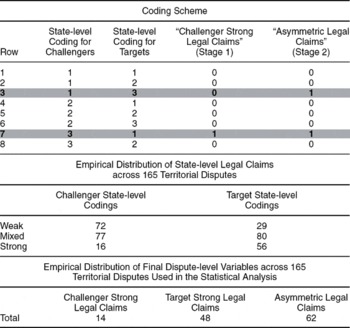
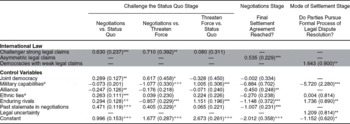
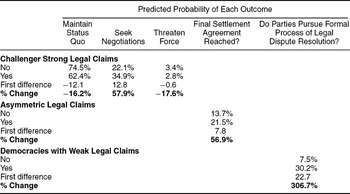

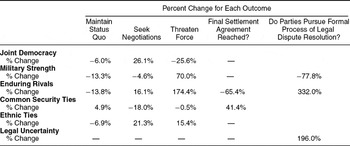




Comments
No Comments have been published for this article.