Introduction
Tonsillectomy, one of the oldest types of operation, is today the most routine surgical procedure performed worldwide.Reference McNeill1 However, the morbidity associated with this operation, mainly haemorrhage and post-operative pain, remains high, and therefore various techniques have evolved over the years with the hope of improving the outcome.Reference Linden, Gross, Long and Lazar2,Reference Messner3 All of the different techniques have their advantages and disadvantages. A safe and effective tonsillectomy technique with minimal pain remains elusive, despite decades of investigation.
Cold steel dissection tonsillectomy has been the ‘gold standard’ technique for many years. A knife, scissors or snare are the instruments traditionally used to perform tonsillectomy. One current innovative technique is coblation tonsillectomy, which is claimed to reduce post-operative pain by avoiding excessive heating of the tissue. The coblator device works by passing a bipolar radiofrequency current through a medium of normal saline, creating a plasma field of sodium ions. As the energy is transferred to the tissue, ionic dissociation occurs, resulting in the vaporisation of tissue and coagulation of vessels at low temperatures (40–70°C), with minimal thermal damage to surrounding tissues.Reference Timms and Temple4–Reference Metcalfe, Muzaffar, Daultrey and Coulson6
Several studies have compared coblation tonsillectomy with other surgical tonsillectomy techniques. However, the results of these reports are controversial. Plasma coblation tonsillectomy was found to have advantages, as it decreased post-operative pain and generally improved the quality of post-operative recovery.Reference Roje, Racić, Dogas, Pisac and Timms5,Reference Wiltshire, Cronin, Lintern, Fraser-Kirk, Anderson and Barr7–Reference Elbadawey, Hegazy, Eltahan and Powell13 Other studies have shown no clear clinical advantage of coblation tonsillectomy,Reference Metcalfe, Muzaffar, Daultrey and Coulson6,Reference Bäck, Paloheimo and Ylikoski14–Reference Álvarez Palacios, González-Orús Álvarez-Morujo, Alonso Martínez, Ayala Mejías and Arenas Brítez18 and some papers have even reported adverse results such as a high incidence of post-tonsillectomy secondary haemorrhage following coblation tonsillectomy.Reference Praveen, Parthiban and Terry19–Reference Windfuhr, Deck and Remmert21
Given the inconsistency of investigative results regarding coblation tonsillectomy efficiency, this study aimed to compare the impact of two different tonsillectomy methods – conventional cold steel and coblation techniques – on tissue damage, with particular emphasis on pathomorphological changes in the removed tonsils.
Materials and methods
The design of this prospective study was reviewed and approved by the Ethics Review Committee on Human Research of the University of Tartu (protocol number: 183/T-7 (29 June 2009)).
The study group comprised 38 patients: 20 patients underwent cold steel dissection tonsillectomy and 18 patients underwent coblation tonsillectomy. Informed consent was obtained from each patient involved in the study. The operations were performed in the period 2008–2010, in the Department of Otolaryngology – Head and Neck Surgery of Tartu University Hospital, Estonia. All operations were performed by the same surgeon, under general or local anaesthesia. The patients were not specifically selected, but all had an anamnesis of recurrent chronic tonsillitis; the study groups were formed randomly.
Surgical techniques
Cold steel dissection tonsillectomy
Twenty patients underwent traditional cold steel dissection tonsillectomy. Sixteen of them were adults (aged 17–44 years) and four were children (aged 4–8 years). All the adults underwent the operation under local anaesthesia; all received the same anaesthesia protocol with pre-medication using sedative and analgesic agents (Dormicum®, Paramax-Cod and Ketonal®). The children underwent the operation under general anaesthesia with endotracheal intubation; all received the same standard anaesthesia protocol.
The surgical technique was the same regardless of the anaesthesia method (either general or local anaesthesia). Under local anaesthesia, patients are awake and able to co-operate with the physician. The time from pre-medication to commencing surgery was 20 minutes. Before starting the operation, surface analgesics (10 per cent Xylocaine® spray) and infiltration injections (2 per cent Sterocain) were used.
The mucosa of the anterior pillar was incised with a scalpel (number 10 blade). The dissection proceeded along the plane of the tonsillar capsule, using a flat-tipped tonsil elevator, starting at the superior tonsillar pole and proceeding towards the lower pole. The dissected tonsil was removed using a tonsil snare. Bipolar electrocautery was used to control bleeding sites. The operation time was 10–15 minutes.
Children underwent the operation under general anaesthesia with endotracheal intubation. They were placed in the supine position, using a shoulder roll and with their head slightly extended. All children received the same standard anaesthesia protocol. Access to the operation field (mouth) was achieved with a Boyle–Davis mouth gag (Karl Storz, Tuttlingen, Germany). The dissection technique was the same as in the local anaesthesia operation. The operation time under general anaesthesia was 5–15 minutes.
Coblation tonsillectomy
Eighteen patients (aged 6–41 years) underwent coblation tonsillectomy. All the operations were performed under general anaesthesia with endotracheal intubation. The patients were placed in the supine position, using a shoulder roll, with their head slightly extended. All patients received the same standard anaesthesia protocol. Access to the operation field was achieved with the Boyle–Davis mouth gag (Karl Storz).
In coblation tonsillectomy, the wand EVAC-70 handpiece (ArthroCare, Austin, Texas, USA) was applied. The tonsil was gently medialised using grasping forceps with non-cutting edges. Ablation was carried out with the wand skimming the tonsil under continuous saline irrigation, starting with tissue melting at the inferior tonsillar pole and proceeding towards the upper pole, with the wand on the ‘coblate 9’ setting. Haemostasis was obtained with the wand on the ‘coagulate 5’ setting. The operation time for coblation tonsillectomy was 15–35 minutes.
Clinical assessment
Intra-operative bleeding was assessed, as was the post-operative use of analgesics and post-operative episodes of nausea. All the patients were additionally examined on the 10th post-operative day.
Histology of removed tonsils
All the removed tonsils were fixed in 10 per cent formalin solution and embedded in paraffin by standard methods using a vacuum infiltration processor (Tissue-Tek VIP 5 Jr; Sakura Finetek Europe, Alphen aan den Rijn, Netherlands). Four-micrometre thick sections were cut using an Ergostar HM 200 microtome (Microm, Walldorf, Germany).
Haematoxylin and eosin stained slides were used to evaluate the epithelium of the surface and crypts of tonsils, lymphatic follicles, and the structure of tonsillar capsules. On 1 per cent toluidine blue stained slides, the mast cells in the connective tissue of the tonsillar capsules were determined and the percentage of cell degranulation was calculated. Slides were photographed using a Zeiss Axiophot 2 microscope (Carl Zeiss, Oberkochen, Germany).
Planimetry
The amount of muscle tissue in the capsules of removed tonsils was determined by a commercial computer program (Adobe Photoshop® CS2), using methods described by Lehr and colleagues.Reference Lehr, Mankoff, Corwin, Santeusanio and Gown22 In the digitised images, the muscle tissue areas were determined and the exact percentage of muscle tissue in the whole capsular area was calculated.
Statistical analysis
Data are presented as mean ± standard error of the mean. A Student's t-test was applied to evaluate the significance of differences between the two groups (conventional cold steel and plasma coblation tonsillectomy). Statistical analysis was performed using the software GraphPad InStat 3 (GraphPad Software, San Diego, California, USA).
Results
Intra-operative period
The main clinical difference between the two tonsillectomy methods (conventional cold steel vs plasma coblation) concerned intra-operative bleeding. In the coblation group, there was clearly less intra-operative bleeding; the operation field was quite clean. In cases of bleeding, the vessel or bleeding site was coagulated immediately and the loss of blood was minimal. However, in the cold steel dissection group, tonsillectomy was often associated with greater bleeding; good control over bleeding was not always achieved (this dissection technique produces a mechanical trauma, which may sometimes cause diffuse bleeding). Final haemostasis takes place after the total removal of a tonsil. Intra-operative blood loss is definitely greater with the conventional tonsillectomy method.
Early post-operative period
In the coblation group, there was less early post-operative pain (in the first hours after the operation); patients needed fewer analgesics compared to patients in the traditional tonsillectomy group.
Only five patients from the conventional tonsillectomy group complained of post-operative nausea. No post-operative nausea was reported by the coblation group patients.
Late post-operative period
During the first 10 post-operative days, general pain, swallowing-related pain and activity limitations were similar in both groups, with no clinical differences. Overall, the tonsillectomy methods seemed to be equivalent regarding the total post-operative need for analgesics.
No other clinical differences were found between the groups. In both groups, fibrin coating on the surface of the wounds was seen. There was no early or late post-operative bleeding in any of the patients. Furthermore, none of the patients were readmitted to the hospital because of bleeding or other complications.
Histology
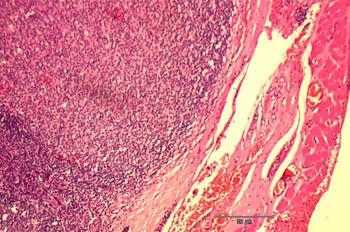
The histological investigation of 20 tonsils removed via conventional cold steel dissection tonsillectomy showed extensive haemorrhage and hyperaemia in the tonsillar capsules (Figure 1). The surface epithelium of the removed tonsils was normal, except in one case where there was strong lymphocytic infiltration in the epithelium. In 18 tonsils, there were variably sized lymphatic follicles, with large and well expressed germinal centres; in 2 tonsils, the surface of lymphatic follicles was indistinct and their shape was irregular. In some tonsils, lymphatic tissue had been replaced by connective tissue.
Tonsil removed by cold dissection, showing considerable haemorrhage and skeletal muscle tissue in the tonsillar capsule. (H&E; ×100)

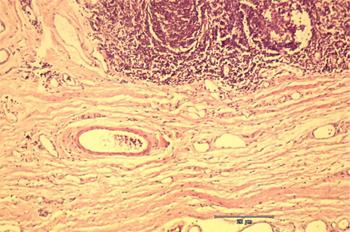
In the coblation tonsillectomy group, the surface epithelium of the removed tonsils was normal in 16 cases; in 2 cases, there was strong lymphocytic infiltration in the epithelium. The epithelium of crypts contained moderate lymphocytic infiltration in all cases. The lymphatic follicles were of different sizes and irregularly shaped, and germinal centres were not always distinguishable. The capsules and trabeculae were normal in 10 patients; in 8 patients, lymphocytic infiltration in capsules was observed. No haemorrhage was seen in the tonsillar capsules (Figure 2). There were no signs of high temperature effects; no tissue carbonisation or changes in the structure of collagen fibres caused by the denaturation of collagen were found.
Tonsil removed by coblation technique, showing no visible haemorrhage or skeletal muscle tissue in the tonsillar capsule. (H&E; ×100)

Skeletal muscle tissue in tonsillar capsules
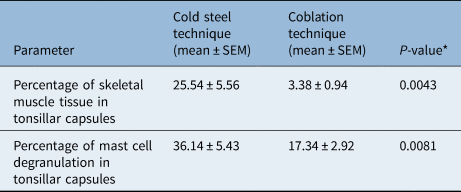
The capsules of the removed tonsils contained, in addition to connective tissue, skeletal muscle tissue, indicating some muscle loss during the operation. The planimetrically estimated amount of skeletal muscle tissue in the tonsillar capsules of both groups is shown in Table 1. In the coblation tonsillectomy group, the amount of removed skeletal muscle tissue was minimal compared to the cold steel tonsillectomy group, and the planimetrical estimations were statistically lower (Table 1, and Figures 1 and 2).
Estimations of muscle tissue and mast cell degranulation in tonsillar capsules

*Evaluated by t-test. SEM = standard error of the mean
Mast cell degranulation in tonsillar capsules
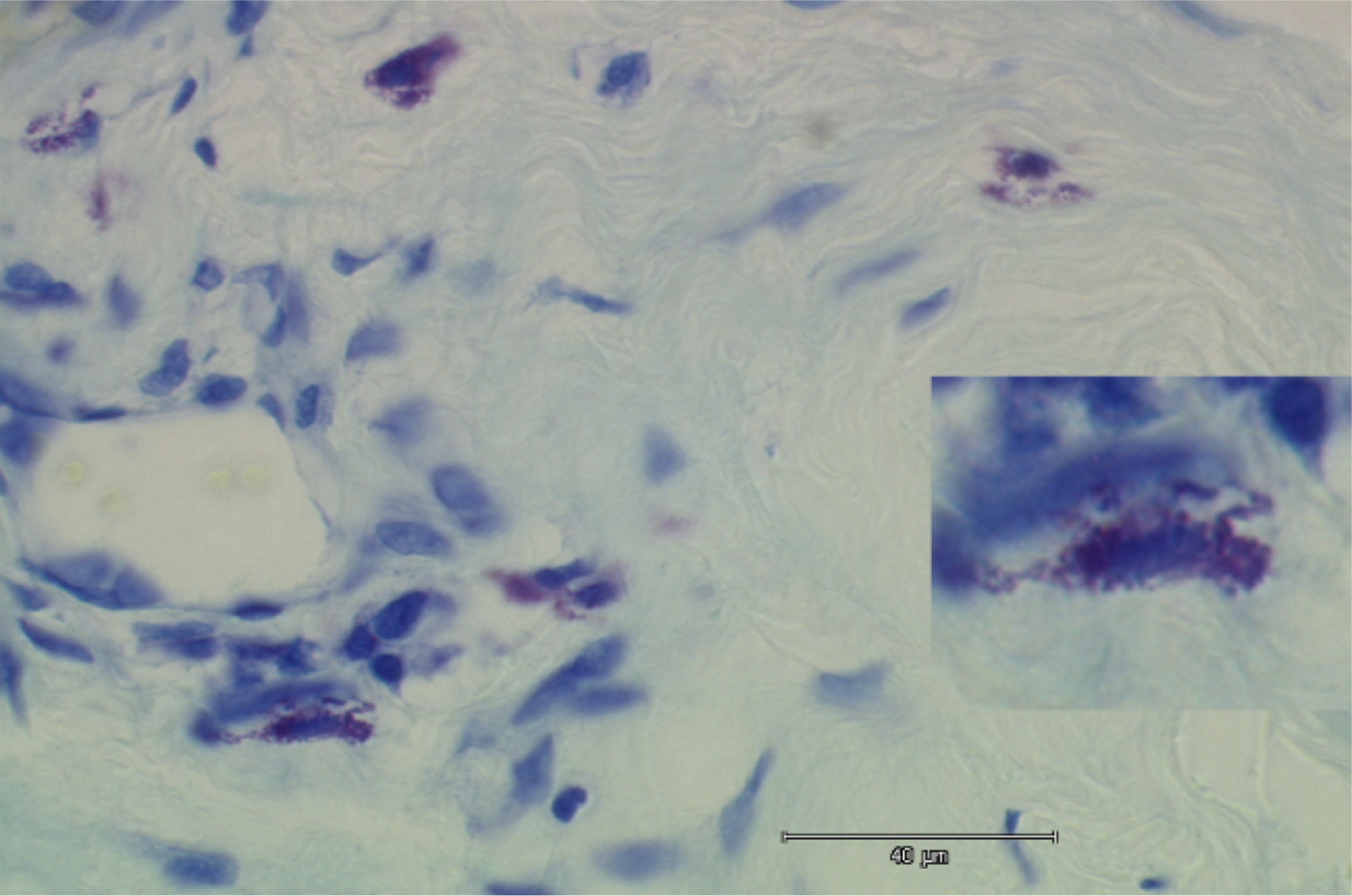
The reaction of capsular connective tissue mast cells to the operation was estimated by determining cell degranulation. Mast cell degranulation for both groups is shown in Table 1. The values were significantly lower in the coblation tonsillectomy group compared to the cold dissection group. An illustrative micrograph is provided in Figure 3.
Mast cell degranulation in the capsule of a tonsil removed by cold dissection. Mast cell degranulation seen in the left corner of the micrograph is enlarged in the inset. (Toluidine blue; ×400)

Discussion
Cold steel dissection has been the gold standard tonsillectomy method for many decades, and it remains the most frequently used technique in many ENT centres. Despite the long period of developing modern tonsillectomy techniques, the new methods still have limitations in terms of post-operative pain and bleeding. New, less traumatic tonsillectomy techniques are continuously being developed in the hope of reducing pain and gaining better control of peri- and post-operative bleeding. Many new tonsillectomy methods apply a high temperature to achieve good haemostasis; however, high temperatures damage tissues and cause pain that is similar to or even stronger than that associated with conventional cold steel tonsillectomy. In addition, the risk of post-operative bleeding remains high.Reference Lowe and van der Meulen23 One of the newest alternative methods is coblation tonsillectomy, which produces moderate heat.
In this study, a plasma coblation method was compared to conventional cold steel dissection. In the coblation technique, instead of mechanical tissue dissection, the medium is dissociated into free sodium ions, which are responsible for the destruction of intercellular bonds, resulting in tissue dissociation. This is achieved at low temperatures (40–70°C), with minimal collateral thermal tissue damage. Furthermore, the presence of isotonic saline in the operative field helps to reduce heat transmission to the surrounding structures.Reference Timms and Temple4,Reference Roje, Racić, Dogas, Pisac and Timms5,Reference Parsons, Cordes and Comer24
Our study showed that the coblation technique produced less intra-operative bleeding and resulted in less pain in the early post-operative period. Histological investigation of the removed tonsils showed intensive haemorrhage and hyperaemia in the tonsillar capsules following conventional tonsillectomy, but not in the tonsils removed by the coblation technique. The difference in bleeding between the two tonsillectomy methods was supported by the fact that nausea was reported by five patients in the traditional cold tonsillectomy group, which was likely caused by the blood swallowed during the operation. No post-operative nausea was recorded in patients who underwent coblation tonsillectomy.
• Tonsils removed by cold dissection showed intensive haemorrhage and hyperaemia in tonsillar capsules that was not seen in coblation tonsillectomy
• Coblation tonsillectomy allows more precise separation of the capsule from peritonsillar tissues; skeletal muscle tissue was minimal, unlike with cold dissection
• Compared to cold steel tonsillectomy, coblation resulted in less mast cell degranulation in tonsillar capsules, indicative of minimal tissue damage
Reduced nausea after intracapsular coblation compared to conventional electrosurgery was also found in a randomised multisite study of children (aged 3–12 years) with obstructive tonsillar hypertrophy.Reference Chan, Friedman, Allen, Yaremchuk, Wirtschafter and Bikhazi25 A lack of intra-operative bleeding has been described in most studies of coblation tonsillectomy, particularly when compared to cold dissection.Reference Magdy, Elwany, el-Daly, Abdel-Hadi and Morshedy8,Reference Izny Hafiz, Rosdan and Mohd Khairi11,Reference Pelishenko, Vishniakov and Klimenko26,Reference Sadikoglu, Kurtaran, Ark, Ugur, Yilmaz and Gozdemir27 Only Bäck and co-authorsReference Bäck, Paloheimo and Ylikoski14 reported greater intra-operative blood loss with plasma coblation as compared to cold dissection combined with diathermia. Studies investigating the haemorrhage rate after coblation tonsillectomy have revealed no differences in post-operative bleeding between coblation and non-coblation techniques.Reference Divi and Benninger28,Reference Mösges, Hellmich, Allekotte, Albrecht and Böhm29
Another important problem related to tonsillectomy is pain. In our study, it was evident that patients experienced less pain after plasma coblation, as fewer analgesics were required during the early post-operative period (in the first hours after the operation), as compared to patients who underwent cold dissection tonsillectomy. This is in line with most studies investigating the outcomes of coblation tonsillectomy, where the main benefit is considered to be significantly lower post-operative pain. It has been reported that, compared with cold dissection tonsillectomy, plasma coblation produces less pain at 6 hours post-operatively,Reference Divi and Benninger28 on the first post-operative dayReference Di Rienzo Businco and Coen Tirelli9 or on the first post-operative days,Reference Polites, Joniau, Wabnitz, Fassina, Smythe and Varley30 and/or analgesic use is discontinued earlier and there are less post-operative days with pain syndrome.Reference Pelishenko, Vishniakov and Klimenko26 However, some studies found no clear difference in the intensity of pain experienced by patients who underwent cold dissection or coblation tonsillectomy.Reference Magdy, Elwany, el-Daly, Abdel-Hadi and Morshedy8,Reference Bäck, Paloheimo and Ylikoski14
One of the significant disadvantages of several alternative tonsillectomy techniques, including electrocautery and laser tonsillectomy, is the concomitant high temperature, which causes damage to the surrounding tissues. This does not seem to be a problem for plasma coblation, as a more moderate temperature is applied. In our study, the low heat produced by the plasma coblation device (40–70°C) did not cause significant thermal injury to tissues: no tissue carbonisation or changes in the structure of collagen fibres caused by the denaturation of collagen were seen. Furthermore, mast cell degranulation was not increased in the capsular tissue.
Mast cell degranulation can be induced by several factors, including mechanical trauma and high temperatures. An animal experiment clearly showed that skin thermal damage stimulated mast cell degranulation.Reference Santos, Arroyo, García, Blasco, Obispo and Hamann31 The importance of higher temperatures in the acceleration of mast cell degranulation has been demonstrated by experiments involving carbon dioxide (CO2) laser induced wounds, wherein mast cell degranulation was found to be higher as compared to wounds produced by the conventional ‘cold’ scalpel. Moreover, mast cell degranulation was reduced when cooling was applied prior to wounding with a CO2 laser.Reference Pinheiro, Browne, Frame and Matthews32,Reference Pinheiro, Browne, Frame and Matthews33 In our study, mast cell degranulation was greater in the conventional cold tonsillectomy group, which reflects more extensive tissue damage as compared to coblation tonsillectomy. Furthermore, the less intensive mast cell degranulation in the coblation tonsillectomy group may also explain the reduction in early post-operative pain in our study, as many substances released during degranulation (e.g., proteases, biogenic amines and cytokines) can contribute to pain.Reference Gupta and Harvima34
Our study highlighted another advantage of plasma coblation over the conventional cold steel technique. Coblation tonsillectomy turned out to be more exact and less traumatic; unlike in conventional dissection, only a small amount of muscle tissue was found in the capsules of the removed tonsils (i.e. plasma coblation allows more precise separation of the capsule from peritonsillar tissues).
Based on our limited study, we can conclude that plasma coblation is an effective and safe alternative to existing tonsillectomy methods. Compared to the cold steel technique, plasma coblation is superior in terms of less peri-operative bleeding, lower early post-operative pain and less damage to surrounding tissues. However, several other published studies have compared plasma coblation with other tonsillectomy methods and reported controversial results, particularly concerning post-operative bleeding. As recently stated in the systemic reviews by Pynnonen et al.Reference Pynnonen, Brinkmeier, Thorne, Chong and Burton35 and Metcalfe et al.Reference Metcalfe, Muzaffar, Daultrey and Coulson6 on the efficiency of plasma coblation compared to other tonsillectomy techniques, there is insufficient evidence to conclude that coblation tonsillectomy is superior to other surgical tonsillectomy methods, and large, well-designed randomised trials are needed. Thus, to paraphrase the title of the recent publication comparing coblation and bipolar tonsillectomy techniques,Reference Wiltshire, Cronin, Lintern, Fraser-Kirk, Anderson and Barr7 the debate continues.
Acknowledgement
This work was supported by target financing (project number: 0180012s11) from the Ministry of Education and Research of Estonia.
Competing interests
None declared.