Introduction
Functional recovery of the upper limb after stroke is notoriously poor. Up to 80% of stroke survivors experience some degree of upper limb disability early after stroke onset. Only 5% to 20% go on to demonstrate completely useful functional recovery (Hendricks, van Limbeek, Geurts, & Zwarts, Reference Hendricks, van Limbeek, Geurts and Zwarts2002; Kwakkel, Kollen, Van der Grond, & Prevo, Reference Kwakkel, Kollen, Van der Grond and Prevo2003; Nakayama, Jorgensen, Rasschou, & Olsen, Reference Nakayama, Jorgensen, Rasschou and Olsen1994) and 30% to 66% are left with a non-functional upper limb (Dean & Mackey, Reference Dean and Mackey1992; Parker, Wade, & Langton Hewer, Reference Parker, Wade and Langton Hewer1986; Sunderland, Bradley, Tinson, & Hewer, Reference Sunderland, Bradley, Tinson and Hewer1989). Thus, a large proportion of stroke survivors will require upper limb rehabilitation.
To drive functional recovery after stroke, a high dose of activity-related therapy is recommended (French et al., Reference French, Thomas, Leathley, Sutton, McAdam, Forster and Watkins2007; Kwakkel et al., Reference Kwakkel, van Peppen, Wagenaar, Dauphinee, Richards, Ashburn and Langhorne2004; National Stroke Foundation, 2010). Such practice is advocated to be used during stroke rehabilitation (Lindsay et al., Reference Lindsay, Gubitz, Bayley, Davies-Schinkel, Singh and Phillips2010; National Stroke Foundation, 2010; Royal Dutch Society for Physical Therapists, 2008) with a view to promoting both behavioural and neural plasticity, as it encourages use of the affected limb in specific, meaningful and appropriately challenging functional tasks (Kleim, Reference Kleim2012; Kleim & Jones, Reference Kleim and Jones2008). However, observational studies indicate that the actual dose of therapy provided during inpatient rehabilitation is limited. Physiotherapy-administered activity-related upper limb therapy accounts for as little as 3–7 minutes (6–11%) of the total therapy time (Ada, Canning, Carr, Kilbreath, & Shepherd, Reference Ada, Canning, Carr, Kilbreath, Shepherd, Bennett and Castiello1994; Kuys, Brauer, & Ada, Reference Kuys, Brauer and Ada2006) and as few as 33 functional movement repetitions per session (Lang et al., Reference Lang, Macdonald, Reisman, Boyd, Jacobson Kimberley, Schindler-Ivens and Scheets2009). Such a dose is unlikely to exploit the potential for recovery of upper limb function after stroke. The dose of upper limb therapy provided during in-patient rehabilitation by occupational therapists has not been reported. As occupational therapists aim to enable people to participate in activities of daily living (ADLs) (World Federation of Occupational Therapists, 2010), tasks that often involve the upper limb, it would appear reasonable to hypothesise that they would administer a greater dose of upper limb therapy as compared to physiotherapists. This may, in turn, increase the dose of activity-related therapy and thus the potential for functional recovery.
In the presence of severe motor disability, the prospect of undertaking a high dose of activity-related therapy is likely to be lower than in those who are more able after stroke. A lack of underlying movement has been identified as a critical barrier to rehabilitation of functional tasks (Barker & Brauer, Reference Barker and Brauer2005). Furthermore, there are limited opportunities to access interventions that make activity-related practice possible, such as robotic and non-robotic devices, but excluding electrical stimulation (Hayward, Barker, & Brauer, Reference Hayward, Barker and Brauer2010b). As a result, it would appear reasonable to suggest that therapy is more likely to focus on the use of impairment-related interventions to prevent and/or reduce secondary changes (e.g., stretches), and compensatory strategies to perform functional tasks and ADLs (e.g., one-handed dressing) (Garraway, Reference Garraway1985; Olsen, Reference Olsen1989; Taub et al., Reference Taub, Crago, Burgio, Groomes, Cook and DeLuca1994). As these practices minimally engage the affected upper limb, the potential for behavioural or neural plasticity is thus limited. Therefore, despite clinical practice guideline recommendations (Lindsay et al., Reference Lindsay, Gubitz, Bayley, Davies-Schinkel, Singh and Phillips2010; National Stroke Foundation, 2010; Peppen et al., Reference Peppen, Kwakkel, Wel, Kollen, Hobbelen and Buurke2004), it would appear to be difficult to achieve a high dose of activity-related therapy in those with severe upper limb disability. However, this remains speculative and no studies have evaluated the dose or content of upper limb therapy provided during inpatient rehabilitation.
Therefore, the primary aim of this study was to quantify the dose and content of upper limb therapy provided to stroke survivors with severe upper limb disability during physiotherapy and occupational therapy within an inpatient stroke rehabilitation service. Evaluation of these variables was undertaken to highlight gaps in current practice, which may be contributing to the poor profile of upper limb recovery after stroke. The secondary aim was to evaluate the influence of some compared to no residual movement, in either the upper or lower limb, on dose of upper limb therapy, as residual movement has been reported to be a critical element to engagement in therapy (Barker & Brauer, Reference Barker and Brauer2005), dose of upper limb therapy performed (Kuys et al., Reference Kuys, Brauer and Ada2006) and functional recovery after stroke (Chen & Winstein, Reference Chen and Winstein2009).
Methodology
Participants
All participants were concurrently enrolled in a three-arm randomised clinical trial (RCT) registered on the Australian and New Zealand Clinical Trials Registry (ACTRN12608000457347). This trial was conducted at two metropolitan, general rehabilitation units in Brisbane, Australia. Participants were eligible to be enrolled in the RCT if they were first-ever, adult stroke survivors with severe upper limb disability (Motor Assessment Scale item 6 score of ≤3 out of a possible 6 points), who were able to follow single-stage commands with either verbal or non-verbal cues. Participants were excluded if they had upper limb comorbidities with the potential to limit function, e.g., arthritis; had a contraindication to the use of, or were unable to tolerate, electrical stimulation; were medically unstable, as defined by the medical officer or located in an acute medical ward; or were unable to sit without support. Stroke survivors enrolled in the RCT between 1 May 2010 and 31 December 2011 were included in the current study.
Procedures
Irrespective of random allocation, all participants were engaged in physiotherapy and occupational therapy. The dose and content of usual upper limb therapy provided to this cohort was the subject of this study. Usual therapy consisted of attendance at individual and group physiotherapy and occupational therapy sessions up to 5 days per week. For a period of 20 consecutive therapy days, ideally during a 4-week period, the physiotherapist and occupational therapist treating the participants completed a daily log of all upper limb therapy provided. The therapy log was used to capture dose, frequency and content of upper limb therapy administered per weekday. Individual and group sessions were recorded on separate logs.
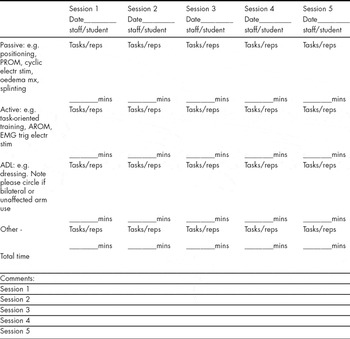
Therapists were asked to document the dose of therapy to the nearest 5-minute interval and total repetitions where applicable; the frequency of therapy sessions per day; and a description of the content of the task/intervention administered, which was classified as either passively (e.g., passive range of motion, cyclic electrical stimulation) or actively (e.g., active range of motion, functional reach training) performed by the stroke survivor. An example of the data collection sheet is provided in Appendix 1. All lower limb interventions that targeted both the upper and lower limb, e.g., stepping and reaching for cones were also logged. Electrical stimulation interventions for subluxation purposes only were excluded, as duration of this intervention (up to 6 hours per day) would have influenced the dosage results. A therapy session was defined as attendance by a participant at a scheduled physiotherapy or occupational therapy session, irrespective of whether upper limb therapy was provided. If no upper limb therapy was provided within a session, therapists were encouraged to document the contributing reasons, e.g., lower limb therapy prioritised. If no therapy was provided and no reason was documented (e.g., patient illness, therapist absent), it was assumed that upper limb therapy was not the priority during the session.
Group therapy offered at each site consisted of an upper limb group (duration approximately 60 minutes), a breakfast group (duration approximately 60–90 minutes), a lunch group (duration approximately 60–90 minutes) and a balance group (duration approximately 60 minutes). Participants were included in group therapy as relevant, up to five times per week.
To increase accuracy of recording, all therapists were encouraged to record their workload data on the log as soon as possible following a therapy session. To increase consistency of recording, logs were collected on a weekly basis by the researcher, who provided feedback to therapists with regard to missing or potentially incorrectly recorded data. At no point did the researcher provide comment on the content of usual therapy.
All participants were assessed at baseline on a range of impairment-, activity- and participation-related measures, including triceps brachii strength, range of upper limb movement, Ritchie Articular Index, Tardieu Scale, Cognitive Linguistic Quick Test, Nottingham Sensory Assessment, Motor Assessment Scale (MAS) and Motor Activity Log-28 (MAL-28). Measures were collected by an independent assessor, blinded to therapy dose and content.
Data Analysis
Dose of therapy
All data were analysed using SPSS version 20.0 (SPSS Inc., Chicago, Illinois, USA). Individual and group therapy were analysed separately. The total minutes of individual and group therapy were collated, but movement repetitions completed were not, as they were infrequently reported. The total dose of individual or group therapy was calculated for each participant by discipline (physiotherapy and occupational therapy). To determine the average total dose per participant, the total dose of physiotherapy or occupational therapy was averaged across participants. To determine the average daily dose by discipline, the dose per participant was averaged across the 20 weekdays. Similar calculations were performed to determine the dose of impairment- (passive or active) or activity-related (passive, active, ADL) therapy provided per participant, per day for individual therapy only, as there was insufficient description of the content of group therapy.
The impact of residual movement to dose of therapy was analysed. For both individual and group therapy, to determine if there was a difference in dose administered when no residual upper limb movement (MAS6 = 0) was present at baseline between (a) physiotherapy versus occupational therapy and (b) impairment-related versus activity-related interventions, a paired-sample t-test (p < 0.05) was performed. The same comparisons were explored for participants with some residual upper limb movement (MAS6 > 0) at baseline. For individual and group therapy, to determine if there was a difference in dose of therapy administered to a participant with no residual upper limb movement (MAS6 = 0) as compared to a participant with some residual upper limb movement (MAS6 > 0) at baseline, an independent-samples t-test (p < 0.05) was performed. Similarly, the dose of upper limb therapy administered to a participant with no walking ability (MAS5 = 0) as compared to some walking ability (MAS5 > 0) at baseline, was also analysed. For individual therapy, comparisons according to discipline (physiotherapy, occupational therapy) and functional domain (impairment- and activity-related) were explored. For group therapy, comparisons according to discipline only were explored.
Content of therapy
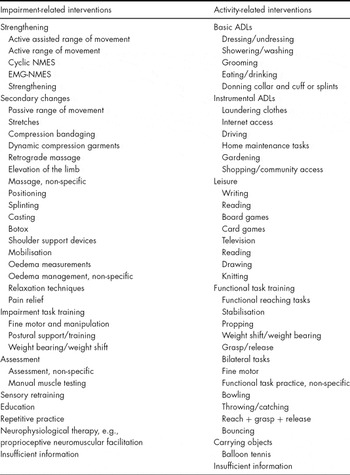
Therapist-documented descriptions of therapy content were classified by the research team as impairment- or activity-related. The coding list (detailed in Appendix 2) was developed by K.S.H., A.H.W. and R.N.B. and was guided by the National Stroke Foundation of Australia Clinical Practice Guidelines (National Stroke Foundation, 2010) and ICF (World Health Organisation, 2001). When categorisation of an intervention was unclear, a consensus was achieved through discussion (A.H.W. and K.S.H.). A third researcher was consulted (R.N.B.) if a consensus was not reached. The content of therapy was analysed using descriptive statistics. The frequency of an intervention category was calculated as the sum of all episodes of an intervention category across all participants and disciplines. The total amount of time spent on each intervention category was calculated, along with the proportion of participants who received an impairment- or activity-related intervention within physiotherapy, occupational therapy or both combined. No comparisons were made between impairment- versus activity-related content of group therapy, due the lack of data available.
Results
Participants
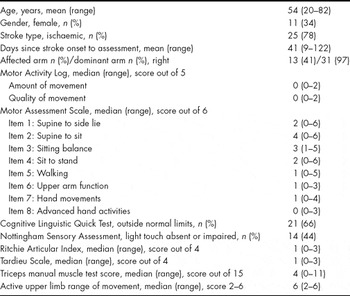
Thirty-four stroke survivors were enrolled in the RCT, of whom 32 had sufficient data available for extraction. More than 75% of dose and content of sessions were not recorded for the two excluded logs. As seen in Table 1, at baseline, participants were on average 54 years old (SD = 15, range = 20–82 years) and 41 days post-stroke (SD = 29, range = 9–122 days). All participants had severe upper limb disability at baseline, evidenced by a mean score of 0 for triceps brachii strength and a median score of 0 on the MAL-28 and 1 on the MAS6. A substantial proportion of participants also presented with an impairment in cognition (66%) and sensation (44%).
Baseline Characteristics (N = 32)

n, number of participants; SD, standard deviation.
Dose of Individual Upper Limb Therapy
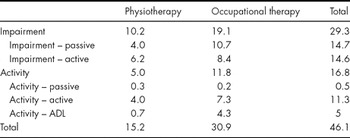
On average, participants received upper limb therapy from physiotherapy and occupational therapy for 13 out of the 20 weekdays. When all participants were examined, it was found that a greater dose of upper limb therapy was administered during occupational therapy (mean = 628.4 minutes, SD = 259.6) as compared to physiotherapy (mean = 309.2 minutes, SD = 214.1) during the recording period (mean difference = 319.2 minutes, 95% confidence interval (CI) = 182.9–455.6), t = 4.775, p < 0.0005, η2 = 0.42). This equated to an average of 46.1 minutes of upper limb therapy during an individual session per participant per day, which was comprised of 30.9 minutes of occupational therapy and 15.2 minutes of physiotherapy (Table 2). Participants were administered a greater dose of impairment-related (mean = 602.1 minutes, SD = 282.2) as compared to activity-related (mean = 335.5 minutes, SD = 239.1) upper limb therapy over the 20-day recording period (mean difference = 266.6 minutes, 95% CI = 109.4–423.9, t = 3.458, p = 0.002, η2 = 0.28). This equated to an average of 29.3 minutes of impairment-related and 16.8 minutes of activity-related therapy per participant per day.
Average Minutes per Participant per Day Spent in Impairment- and Activity-Related Upper Limb Interventions, by Discipline

ADL, activities of daily living.
Over the recording period, participants with no residual upper limb movement at baseline (MAS6 = 0, n = 17) received a significantly greater dose of upper limb therapy during occupational therapy (mean = 573.2 minutes, SD = 194.4) as compared to physiotherapy (mean = 319.6 minutes, SD = 259.7) (mean difference = 253.6 minutes, 95% CI = 68.5–438.5, t = 2.904, p = 0.010, η2 = 0.53). Further, they received a significantly greater dose of impairment-related (mean = 631.1 minutes, SD = 262.7) as compared to activity-related (mean = 261.7 minutes, SD = 165.8) upper limb therapy (mean difference = 369.4 minutes, 95% CI = 197.2–541.4, t = 4.549, p = 0.0005, η2 = 0.40).
Participants with some residual upper limb movement at baseline (MAS6 > 0, n = 15) received a significantly greater dose of upper limb therapy during occupational therapy (mean = 691.0 minutes, SD = 313.2) as compared to physiotherapy (mean = 297.3 minutes, SD = 155.3) (mean difference = 393.7 minutes, 95% CI = 173.9–613.4, t = 3.842, p = 0.002, η2 = 0.32). There was no significant difference between the dose of impairment-related as compared to activity-related upper limb therapy (p > 0.05).
When participants were compared according to residual upper limb movement at baseline (MAS6 = 0, very severe, n = 17; versus MAS6 > 0, severe, n = 15), there were no significant differences between the dose of physiotherapy, occupational therapy, impairment-related (or subcategories) or activity-related (or subcategories) therapy provided (p > 0.05). This was consistent when participants were compared according to walking ability at baseline (MAS5 = 0, no walking, n = 20; versus MAS5 > 0, some or more walking, n = 12).
Content of Individual Upper Limb Therapy
A total of 1767 interventions were logged and coded. This equates to approximately three interventions per participant per day (two impairment- and one activity-related). More interventions were impairment- compared to activity-related (1218 versus 549) and performed actively as compared to passively (1085 versus 682).
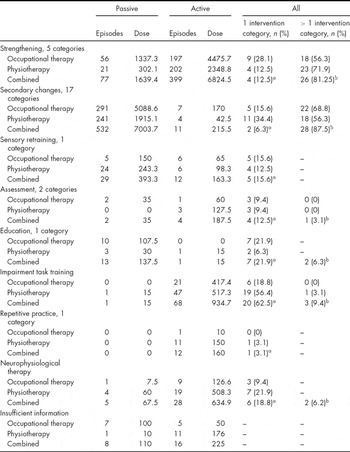
Table 3 outlines the dose and frequency of impairment-related interventions. The most common impairment-related intervention performed passively was prevention of secondary changes (532 episodes, approximately 37.3 minutes per episode). The most common impairment intervention performed actively was strengthening (399 episodes, 36.4 minutes). The most common impairment-related intervention administered by physiotherapy was strengthening (e.g., active or active-assisted range of motion, strength-specific exercises), with 71.9% of participants found to receive two or more interventions to improve strength (Table 3). The most common impairment-related intervention administered by occupational therapy was prevention of secondary changes (e.g., passive range of motion, stretches, compression bandaging), with 68.8% of participants found to receive two or more interventions to prevent secondary changes (Table 3).
Impairment-related Therapy: Dose and Frequency of Passive and Active Interventions, along with Number of Interventions Provided per Participant by Discipline

Note: episodes refer to each individual intervention episode administered; dose is the amount of time administered for the episodes of intervention.
a1 intervention across either physiotherapy or occupational therapy.
b >1 intervention across either physiotherapy or occupational therapy.
n, number of participants.
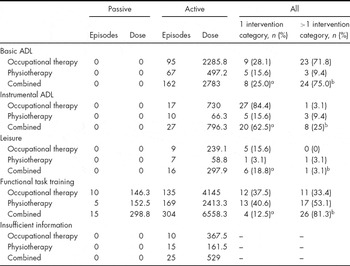
Table 4 outlines the dose and frequency of activity-related interventions. Functional task training was the most common activity-related intervention, performed passively (15 episodes, approximately 2.8 minutes per episode) and actively (304 episodes, 61.1 minutes per episode). The most common activity-related intervention administered by physiotherapy was functional task practice (e.g., reach to grasp, manipulation, stabilisation), with 40.6% of participants found to receive only one functional task intervention and 53.1% of participants found to receive two or more functional task interventions (Table 4). The most common activity-related intervention administered by occupational therapy was basic ADL practice (e.g., dressing, grooming, showering), with 28.1% of participants found to receive only one basic ADL intervention and 71.8% of participants found to receive two or more basic ADL interventions (Table 4).
Activity-related Therapy: Dose and Frequency of Passive and Active Interventions, along with Number of Interventions Provided per Participant by Discipline

Note: episodes refer to each individual intervention episode administered; dose is the amount of time administered for the episodes of intervention.
a1 intervention across either physiotherapy or occupational therapy.
b>1 intervention across either physiotherapy or occupational therapy.
ADL, activities of daily living; n, number of participants.
Group Upper Limb Therapy
A total of 20 participants (62.5%) attended at least one of the four groups offered. The most frequent group therapy logged to provide upper limb therapy was upper limb (35% of all group sessions), followed by lunch (28%), breakfast (27%) and balance (11%) group.
Group therapy was more often administered by occupational therapy (86% of groups, mean = 3.5 group sessions, SD = 4.4) as compared to physiotherapy (14% of groups, mean = 0.5 group sessions, SD = 1.4) (mean difference = 3.0 group classes, 95% CI = 1.5–4.4, t = 4.172, p < 0.0005, η2 = 0.36). Participants received a greater dose of upper limb therapy administered during group sessions within occupational therapy (mean = 188.9 minutes, SD = 223.0) as compared to within physiotherapy (mean = 40.2 minutes, SD = 72.5) (mean difference = 148.7 minutes, 95% CI = 81.6–215.9, t = 4.517, p < 0.0005, η2 = 0.40). This equated to, on average, 11 minutes of upper limb therapy during a group format per participant per day, which was comprised of 9 minutes administered during occupational therapy and 2 minutes administered during physiotherapy.
Participants with no residual upper limb movement at baseline (MAS6 = 0, n = 17) received a significantly greater number of group sessions and dose of group upper limb therapy during occupational therapy (mean = 2.6 group sessions, SD = 3.1; mean = 153.9 minutes, SD = 193.4) as compared to physiotherapy (mean = 0 group sessions, SD = 0; mean = 17.7 minutes, SD = 42.5), (sessions: mean difference = 2.6 group sessions, 95% CI = 1.0–4.2, t = 3.484, p = 0.003, η2 = 0.28; dose: mean difference = 136.2 minutes, 95% CI = 49.8–222.5, t = 3.344, p = 0.004, η2 = 0.27). Similar results were found for participants with some residual upper limb movement at baseline (MAS6 > 0, n = 15). This less-impaired group received a significantly greater number of group sessions and dose of group upper limb therapy during occupational therapy (mean = 4.5 group sessions, SD = 5.5; mean = 228.7 minutes, SD = 253.7) as compared to physiotherapy (mean = 1.2 group sessions, SD = 1.9; mean = 65.7 minutes, SD = 91.0), (sessions: mean difference = 3.3 group sessions, 95% CI = 0.6–6.1, t = 2.630, p = 0.02, η2 = 0.18; dose: mean difference = 163.0 minutes, 95% CI = 46.6–279.4, t = 3.003, p = 0.009, η2 = 0.23).
Participants with some residual upper limb movement received a significantly greater number of physiotherapy group sessions (mean = 1.2 group sessions, SD = 1.9) when compared to those with no residual upper limb movement at baseline (mean = 0 group sessions, SD = 0) (mean difference = 1.2 group classes, 95% CI = 0.1–2.3, t = 2.402, p = 0.031, η2 = 0.16). There were no significant differences between the number of occupational therapy group sessions, the dose of group physiotherapy or the dose of group occupational therapy (p > 0.05) on the basis of residual upper limb movement at baseline (MAS6 = 0 versus MAS6 > 0).
Participants with some walking ability received a significantly greater number of physiotherapy group sessions (mean = 1.5 group sessions, SD = 2.1) as compared to those with no walking ability at baseline (mean = 0 group sessions, SD = 0) (mean difference = 1.5 group sessions, 95% CI = 0.2–2.8, t = 2.514, p = 0.029, η2 = 0.17). Participants with some walking ability received a significantly greater number of occupational therapy group sessions (mean = 5.8 group sessions, SD = 5.5) as compared to those with no walking ability at baseline (mean = 2.1 group sessions, SD = 2.9) (mean difference = 3.7 group sessions, 95% CI = 0.1–7.4, t = 2.184, p = 0.045, η2 = 0.13). Participants with some walking ability (mean = 86.7 minutes, SD = 92.4) received a significantly greater dose of group physiotherapy as compared to those with no walking ability at baseline (mean = 12.3 minutes, SD = 38.1) (mean difference = 74.4 minutes, 95% CI = 14.0–134.8, t = 2.656, p = 0.019, η2 = 0.19). There was no significant difference for dose of group occupational therapy on the basis of walking ability (p > 0.05).
Discussion
This study evaluated the dose and content of upper limb therapy provided to stroke survivors with severe upper limb disability during inpatient stroke rehabilitation. All participants received physiotherapy and occupational therapy. Consistent with our hypothesis, occupational therapists provided a higher dose of upper limb therapy as compared to physiotherapists. Similarly, across both disciplines, greater time was spent administering impairment- as compared to activity-related therapy. Individual therapy sessions appear to be the service delivery model of choice, with participants receiving only a small dose of group therapy.
Previous reviews have indicated that the dose of therapy provided within inpatient rehabilitation is limited (Foley et al., Reference Foley, McClure, Meyer, Salter, Bureau and Teasell2012; Kaur, English, & Hillier, Reference Kaur, English and Hillier2012). Comparison to studies included in these reviews is difficult due to differences in the model of service delivery (inpatient versus out-patient), data collection methods (database audit versus observational) and remuneration policies (e.g., Medicaid versus Medicare) (Foley et al., Reference Foley, McClure, Meyer, Salter, Bureau and Teasell2012). Further, only two studies recorded upper limb dose and only within physiotherapy (Ada, Mackey, Heard, & Adams, Reference Ada, Mackey, Heard and Adams1999; Kuys et al., Reference Kuys, Brauer and Ada2006). Facilitating comparison to the findings of this study, both studies were performed in Australia. The dose of activity-related upper limb physiotherapy described in this study (5 minutes) is comparable to these two studies (2.9 and 7 minutes) (Ada et al., Reference Ada, Mackey, Heard and Adams1999; Kuys et al., Reference Kuys, Brauer and Ada2006). Of concern is that despite the recognised poor recovery of upper limb function after stroke (Kwakkel & Kollen, Reference Kwakkel and Kollen2007; Kwakkel et al., Reference Kwakkel, Kollen, Van der Grond and Prevo2003; Nakayama et al., Reference Nakayama, Jorgensen, Rasschou and Olsen1994), there appears to have been little change over the past decade in dose of upper limb physiotherapy provided during inpatient rehabilitation. Unfortunately, there are no previous reports with which to compare the dose of occupational therapy.
While a high dose of therapy is recommended after stroke, there is no consensus on what is considered to be the optimal dose to promote functional recovery. The dose of upper limb therapy reported by this study would be considered high (46 minutes per day) when compared to national and international clinical practice recommendations (Lindsay et al., Reference Lindsay, Gubitz, Bayley, Davies-Schinkel, Singh and Phillips2010; National Stroke Foundation, 2010; Royal College of Physicians of London, 2008). However, it remains unlikely to be sufficient to adequately exploit the full potential for upper limb recovery after stroke, especially considering that the cohort investigated had severe upper limb disability. Furthermore, while 46 minutes of therapy were recorded, the proportion of time that the stroke survivor was engaged in training as compared to resting remains unknown. A previous report indicated that inactivity can account for up to 24% of a physiotherapy session during inpatient rehabilitation (Kuys et al., Reference Kuys, Brauer and Ada2006). Highly repetitive practice is also considered to be a critical training element (French et al., Reference French, Thomas, Leathley, Sutton, McAdam, Forster and Watkins2007). How repetitive the practice undertaken by this cohort was remains unknown as therapists did not record repetitions, even with continual prompting. This suggests that repetitive practice was not a key objective of their therapy interventions. Exploration of these dose-related elements is a critical topic for future research.
Use of the affected upper limb in meaningful task practice has been found to encourage behavioural changes in function and to contribute to neuroplasticity in rat models (Kleim, Barbay, & Nudo, Reference Kleim, Barbay and Nudo1998; Kleim & Jones, Reference Kleim and Jones2008; Kleim et al., Reference Kleim, Hogg, VandenBerg, Cooper, Bruneau and Remple2004; Plautz, Milliken, & Nudo, Reference Plautz, Milliken and Nudo2000) and stroke models (Winstein et al., Reference Winstein, Rose, Tan, Lewthwaite, Chui and Azen2004; Wolf et al., Reference Wolf, Winstein, Miller, Taub, Uswatte and Morris2006). Contrary to this evidence, participants in this study received a greater dose of impairment- as compared to activity-related therapy. This confirms stroke survivors’ reports that not enough ‘movement to work with’ is a key barrier to activity-related therapy (Barker & Brauer, Reference Barker and Brauer2005). This highlights a critical gap in current practice, that is, activity-related therapy is not routinely available to stroke survivors with severe upper limb disability. This is interesting considering that participants performed more therapy actively as compared to passively. Thus, there is a need to improve access to strategies that make activity-related practice possible for people with severe upper limb therapy. Currently such strategies may include robotic therapy, e.g., MIT-Manus, and non-robotic therapy, e.g., SMART Arm (Hayward et al., Reference Hayward, Barker and Brauer2010b) and triggered methods of neuromuscular electrical stimulation (NMES), e.g., electromyogram-triggered, accelerometer-triggered (Hayward, Barker, & Brauer, Reference Hayward, Barker and Brauer2010a).
This study found that a large number of different interventions were provided to participants within a single session. This likely reflects the large number of upper limb functions to be retrained as compared to the lower limb. However, it has been suggested that unfocused practice is likely to limit the potential for functional gain, and is inconsistent with the requirements of experience-dependent plasticity (Kleim & Jones, Reference Kleim and Jones2008). Novice learners need to undertake intensive and repetitive practice of a meaningful task for that task to be learnt (Kleim, Reference Kleim2012). In contrast, training logs demonstrated that participants were often performing ‘a little bit of everything’ rather than a lot of one meaningful task. Furthermore, as there was considerable variability between therapy sessions and the majority of interventions sought to reduce impairments rather than increase activity, the potential to practice a salient task intensively and repetitively was further reduced. Previous research has highlighted that lower-functioning stroke survivors appear to achieve greater benefit from participation in repetitive task practice (continuous performance of a single functional task) as compared to adaptive task practice (part and whole practice of tasks that are progressively increased in difficulty) (Wolf et al., Reference Wolf, Newton, Maddy, Blanton, Zhang, Winstein and Light2007). This is consistent with the principles of motor learning (Magill, Reference Magill2007). Thus, the discrepancy between clinical practice and the evidence highlights the need to provide education to therapists around how best to structure therapy for stroke survivors with severe upper limb disability, which is in line with motor learning literature.
Few participants with severe upper limb disability engaged in group therapy. The basic premise of a group class is to increase the amount of time people spend engaged in therapy (Ada et al., Reference Ada, Mackey, Heard and Adams1999; Carr & Shepherd, Reference Carr and Shepherd2003). There is an implied level of independence in task practice during group therapy, as the class is usually under the direction of a single therapist (English, Hillier, Stiller, & Warden-Flood, Reference English, Hillier, Stiller and Warden-Flood2007). Therefore, involving multiple stroke survivors with severe upper limb disability within a group may reduce the efficiency of the group. However, there is a need to engage those with severe upper limb disability in more group therapy as there are potential direct (e.g., increased intensity of practice, cost-saving to the healthcare system by reducing staff to patient ratios during therapy) and indirect benefits (e.g., peer support and social interaction) (Dean, Richards, & Malouin, Reference Dean, Richards and Malouin2000; English et al., Reference English, Hillier, Stiller and Warden-Flood2007). Thus, there is a need to explore how to best use and structure group therapy for stroke survivors with severe upper limb disability.
This is the first study to evaluate the dose and content of physiotherapy and occupational therapy provided to stroke survivors with severe upper limb disability receiving inpatient rehabilitation. However, it does have some limitations. As therapy time was captured using self-report rather than independent observation, it is possible that recall bias may have occurred. Therapists may have under-reported or overestimated the true amount of time spent with participants. Previous studies have reported up to 21% overestimation when therapy is self-reported as compared to independent observation (Bagley, Hudson, Green, Forster, & Young, Reference Bagley, Hudson, Green, Forster and Young2009). Additionally, the log did not ask therapists to comment on whether the aim of training was compensatory or recovery focused. Further, as the researchers imposed the impairment and activity rating on the therapist's reports, there is the potential for misinterpretation and misclassification of their description. To overcome this limitation a subsequent observational study is planned. As only two sites were evaluated, the generalisability of these findings is limited. Lastly, a proportion of participants were concurrently receiving SMART Arm training, which may have negatively influenced the usual therapy dose they received. However, only one therapist recorded it as a limitation on their workload log. To limit this bias, future studies should be undertaken independent of concurrent intervention trials.
Conclusion
In conclusion, inpatient upper limb therapy for stroke survivors with severe motor disability currently appears to be aimed at reducing impairment-related deficits. This highlights the need to explore interventions and models of service delivery that efficiently increase the intensity and task-related nature of training for stroke survivors with severe upper limb disability during inpatient stroke rehabilitation.
Declaration of Interest
K.S. Hayward, R.N. Barker and S.G. Brauer are currently involved in the commercialisation of a non-robotic device (SMART Arm).
Acknowledgments
K.S. Hayward was supported by an Australian Postgraduate Award scholarship and a co-funded National Heart Foundation National Stroke Foundation of Australia Biomedical Postgraduate Scholarship (PB 09B 4847). A.H. Wiseman was supported by a summer research scholarship administered by the University of Queensland. This study was supported by a National Health and Medical Research Council Project Grant (ID511241).
Example of the data entry sheet for usual therapy

Coding options for impairment- and activity-related interventions