

Introduction
Obtaining reliable population size estimates for globally threatened bird species is of vital importance for conservation status assessments, the implementation of appropriate conservation actions and effective management. A number of survey (sampling) and census methods for estimating population size are available (Bibby et al. Reference Bibby, Hill, Burgess and Mustoe2000, Sutherland et al. Reference Sutherland, Newton and Green2004, Denés et al. Reference Denés, Tella and Beissinger2018), such as complete counts, mark-recapture or mark-resighting methods and distance sampling (e.g. point counts, line transects). While these methods have been widely used (e.g. Marsden Reference Marsden1999, Ganter and Madson 2001, Newson et al. Reference Newson, Evans, Noble, Greenwood and Gaston2008), their application can be unsuitable, unfeasible or cost-prohibitive in remote, inaccessible and heterogeneous landscapes and for species such as parrots, which are highly mobile or difficult to capture, and whose traits and behaviours can lead to violations in the assumptions of methods such as distance sampling (Denés et al. Reference Denés, Tella and Beissinger2018). A case in point is the ‘Critically Endangered’ Blue-throated Macaw Ara glaucogularis, a large and potentially highly mobile macaw, for which only limited, mostly unpublished information on movement ranges exists and that is endemic to the Llanos de Moxos, or Beni savannas, one of South America’s largest grassland floodplains, in the lowlands of northern Bolivia.
The Llanos de Moxos are a c.120,000 km2 enclave of open vegetation formations (Sabanas Inundables de los Llanos de Moxos and Cerrado Beniano ecoregions of Ibisch et al. Reference Ibisch, Beck, Gerkmann, Carretero, Ibisch and Mérida2003) surrounded by south-west Amazonian forests. Situated between the Andes to the west and the Precambrian Shield to the east, they occupy the extremely flat Beni-Mamoré-Iténez/Guaporé river basin. Much of the region is seasonally inundated during the extensive rainy season from about October to May (Hamilton et al. Reference Hamilton, Sippel and Melack2004). Largely owing to variations in micro-topography, the Llanos de Moxos are a complex mosaic of treeless grasslands, cerrado-like savannah and woodland, palm savannah, palm forest islands, gallery forest along white-water rivers, herbaceous wetlands and shallow lakes (Erickson Reference Erickson, Balée and Erickson2006, Erickson and Balée Reference Erickson, Balée, Balée and Erickson2006, Mayle et al. Reference Mayle, Langstroth, Fisher and Meir2007, Langstroth Plotkin Reference Langstroth Plotkin2011, Larrea-Alcázar et al. Reference Larrea-Alcázar, Embert, Aguirre, Ríos-Uzeda, Quintanilla and Vargas2011). While natural in origin, this grassland- and savannah-dominated region has been shaped by centuries, if not millennia, of landscape modifications such as earthworks by pre-Hispanic indigenous people, followed by large-scale cattle ranching since the late 17th century (Mayle et al. Reference Mayle, Langstroth, Fisher and Meir2007, Walker Reference Walker2008, Langstroth Plotkin Reference Langstroth Plotkin2011). Extensive annual burns during the dry season have been used throughout the region as a management tool by indigenous people and post-Conquest cattle ranchers alike (Yamashita and Machado de Barros Reference Yamashita and Machado de Barros1997, Erickson Reference Erickson, Balée and Erickson2006, Langstroth Plotkin Reference Langstroth Plotkin2011). Despite extensive ranching activities, road infrastructure is poorly developed in the Llanos de Moxos, rendering many areas difficult to access.
Within the habitat mosaic of the Llanos de Moxos, the Blue-throated Macaw frequents forest islands dominated by motacú palms Attalea princeps, palm savannah, moriche palm Mauritia flexuosa swamps and rarely or only locally small sections of gallery forest where palms are abundant (Jordán and Munn Reference Jordán and Munn1993, Yamashita and Machado de Barros Reference Yamashita and Machado de Barros1997, Hesse and Duffield Reference Hesse and Duffield2000, Herrera et al. Reference Herrera, Vargas, Sandoval, Perkins and Rendón2007, Berkunsky et al. Reference Berkunsky, Simoy, Cepeda, Marinelli, Kacoliris, Daniele, Cortelezzi, Díaz-Luque, Friedman and Aramburú2015, Cardador et al. Reference Cardador, Díaz-Luque, Hiraldo, Gilardi and Tella2018, Boorsma et al. unpubl. data). Unlike other habitats, motacú palm forest islands often occur on elevated ground (palaeo-levée remnants or, to a lesser degree, small pre-Columbian earth mounds; Langstroth Plotkin Reference Langstroth Plotkin2011) not affected by seasonal flooding. The species depends heavily on palm trees for food and breeding, feeding primarily on the mesocarp of motacú palm fruits and nesting mainly in cavities of dead motacú, moriche and grugru Acrocomia totai palms (Jordán and Munn Reference Jordán and Munn1993, Yamashita and Machado de Barros Reference Yamashita and Machado de Barros1997, Hesse and Duffield Reference Hesse and Duffield2000, Herrera et al. Reference Herrera, Vargas, Sandoval, Perkins and Rendón2007, Berkunsky et al. Reference Berkunsky, Daniele, Kacoliris, Díaz-Luque, Silva Frias, Aramburu and Gilardi2014, Baños-Villalba et al. Reference Baños-Villalba, Blanco, Díaz-Luque, Denés, Hiraldo and Tella2017). Nonetheless, the Blue-throated Macaw also feeds on the fruit of other palm species as well as fruit and flowers of some dicotyledon trees (Yamashita and Machado de Barros Reference Yamashita and Machado de Barros1997, Herrera et al. Reference Herrera, Vargas, Sandoval, Perkins and Rendón2007, Boorsma et al. unpubl. data), and it also has been reported to nest in cavities in live hardwood trees (Berkunsky et al. Reference Berkunsky, Daniele, Kacoliris, Díaz-Luque, Silva Frias, Aramburu and Gilardi2014). The species is most often found in pairs during the breeding season from November to March but becomes more gregarious and often forms flocks, including mixed flocks with Blue-and-yellow Macaws Ara ararauna, during the dry season, especially at communal roost and feeding sites.
The Blue-throated Macaw is considered ‘Critically Endangered’ due to an extremely small population as a result of the cage-bird trade and habitat loss due to large-scale cattle ranching (Hesse and Duffield Reference Hesse and Duffield2000, BirdLife International 2020a). Its potential distributional range was estimated to have an extent of only 43,500 km2 (BirdLife International 2020a) to 52,300 km2 (Herzog et al. Reference Herzog, Maillard, Embert, Caballero and Quiroga2012), whereas the extent of suitable habitat is thought to range between 9,236 km2 (Herzog et al. Reference Herzog, Maillard, Embert, Caballero and Quiroga2012) and 19,249 km2 (Cardador et al. Reference Cardador, Díaz-Luque, Hiraldo, Gilardi and Tella2018). The species’ range is divided into two or three disjunct, potentially isolated subpopulations, and it is patchily distributed even within each subpopulation’s small range extent (Yamashita and Machado de Barros Reference Yamashita and Machado de Barros1997, Berkunsky et al. Reference Berkunsky, Cepeda, Marinelli, Simoy, Daniele, Kacoliris, Díaz Luque, Gandoy, Aramburú and Gilardi2016). Intensive trade of wild-caught birds in the 1970s and 1980s, along with hunting to provide feathers for indigenous headdresses, is thought to have caused an extremely rapid population decline. Due to successful conservation actions over the past 20 years (Hesse and Duffield Reference Hesse and Duffield2000, Waugh Reference Waugh2007, Berkunsky et al. Reference Berkunsky, Kacoliris, Daniele, Milpacher, Gilardi and Martin2012, BirdLife International 2020a) and near elimination of trade (Herrera and Hennessey Reference Herrera and Hennessey2007, but see Berkunsky et al. Reference Berkunsky, Díaz Luque and Daniele2011), the population is currently thought to be stable (BirdLife International 2020a), but no systematically collected monitoring data exist to verify this assumption. Knowledge about the macaw’s global population size is similarly vague, with estimates ranging from 115–125 (Milpacher Reference Milpacher2013, Berkunsky et al. Reference Berkunsky, Daniele, Kacoliris, Díaz-Luque, Silva Frias, Aramburu and Gilardi2014, Reference Berkunsky, Cepeda, Marinelli, Simoy, Daniele, Kacoliris, Díaz Luque, Gandoy, Aramburú and Gilardi2016) to 250–350 (Waugh Reference Waugh2007) individuals. However, none of these estimates was based on a systematic or stringent population survey, and the most conservative ones are considered mere speculation (Herzog et al. Reference Herzog, Bürger, Troncoso, Vargas, Boorsma and Soria-Auza2018).
The aim of this study was to obtain the first rigorous, accurate conservative estimate of the Blue-throated Macaw’s global population size based on a systematic range-wide survey during the late dry season (minimum flooding levels) of 2015, combined with a quantitative analysis of the extent of suitable forest habitat using remote sensing environmental data. The species’ presumed high mobility, limited knowledge about its movement ranges (no published analyses exist) and difficult access to many areas required careful survey design, and adaptation of standard bird survey protocols to the constraints imposed by local conditions to avoid or at least minimize the problem of double-counting specific individuals and the concomitant inflation of population estimates. These methodological considerations are of relevance beyond this particular study and likely apply to surveys of other highly mobile bird species especially in tropical regions, where road infrastructure and accessibility is often limited. Finally, we discuss the implications of our findings for the conservation status of the Blue-throated Macaw.
Methods
Survey area selection
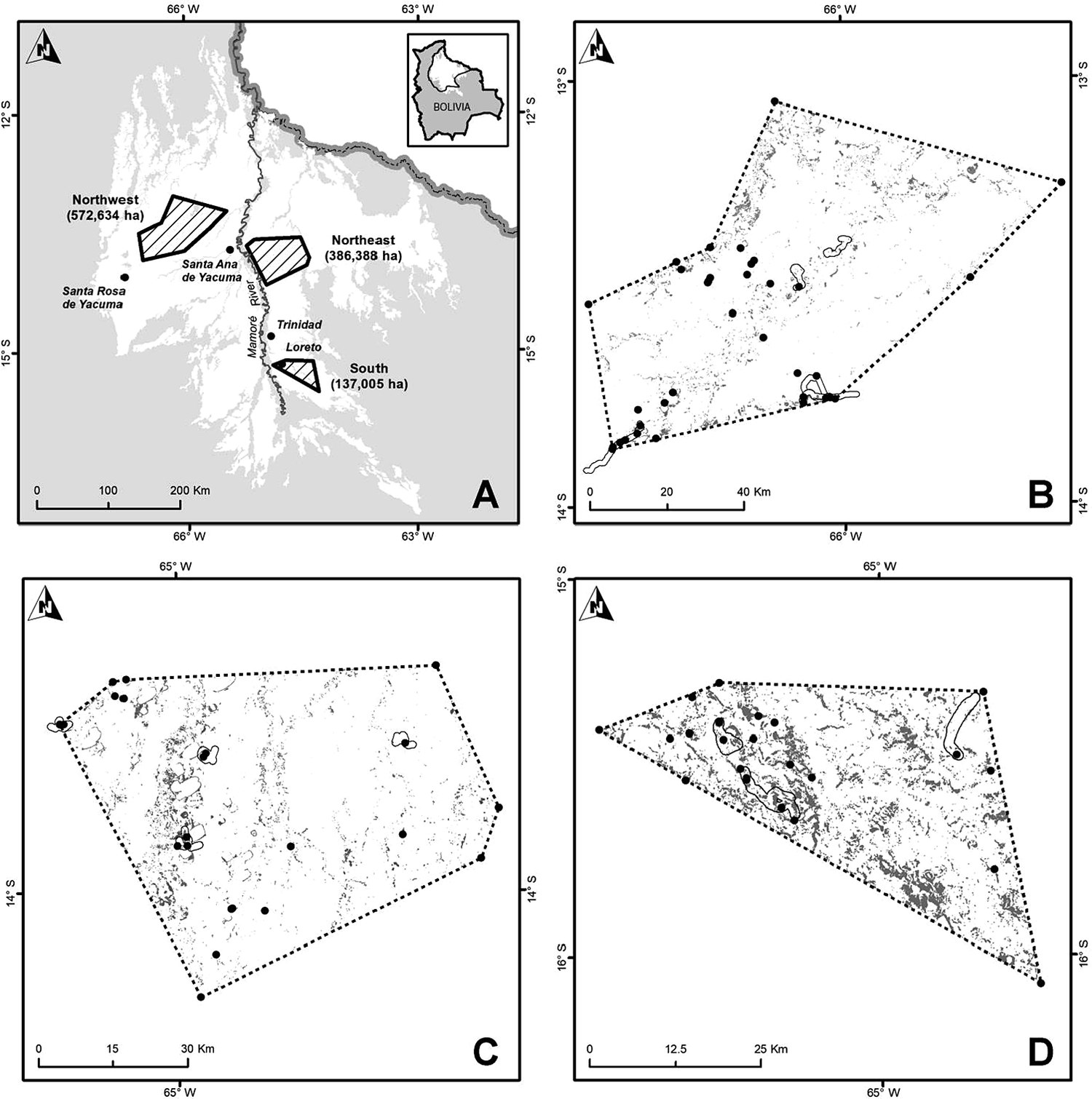
The known present-day distributional range of the Blue-throated Macaw can be divided into three disjunct regions or subpopulations based on the occurrence records currently available for the species (Figure 1): 1) the north-western subpopulation west of the Mamoré River between the towns of Santa Rosa de Yacuma and Santa Ana de Yacuma (Yacuma and José Ballivián provinces); 2) the north-eastern subpopulation east of the Mamoré River and north of Trinidad, the capital city of the Beni department (Mamoré province); and 3) the southern subpopulation south of Trinidad, around and south of the town of Loreto (Marbán province). BirdLife International (2020a) considered the two northern subpopulations as a single population, but for the purpose of this study we opted for the more conservative approach of excluding areas between those two subpopulation polygons (i.e. the wide Mamoré River channel and its associated floodplain forests; Figure 1), which are almost certainly uninhabited by the species. The nearest distance between the north-western and north-eastern subpopulations was 55 km (distance between the two closest locality records), 107 km between the north-eastern and southern subpopulations and 205 km between the north-western and southern subpopulations.
Extent of occurrence polygons of the Blue-throated Macaw’s three subpopulations (north-west, north-east, south) in the Llanos de Moxos (white areas in panel A), Beni department, Bolivia. Panels B-D show the distribution of suitable forest habitat (grey areas), reliable and georeferenceable locality records (black dots) and survey areas (polygons) in the north-western (A), north-eastern (B) and southern (C) subpopulation. For better visibility, suitable forest areas appear more extensive and continuous than they actually are.

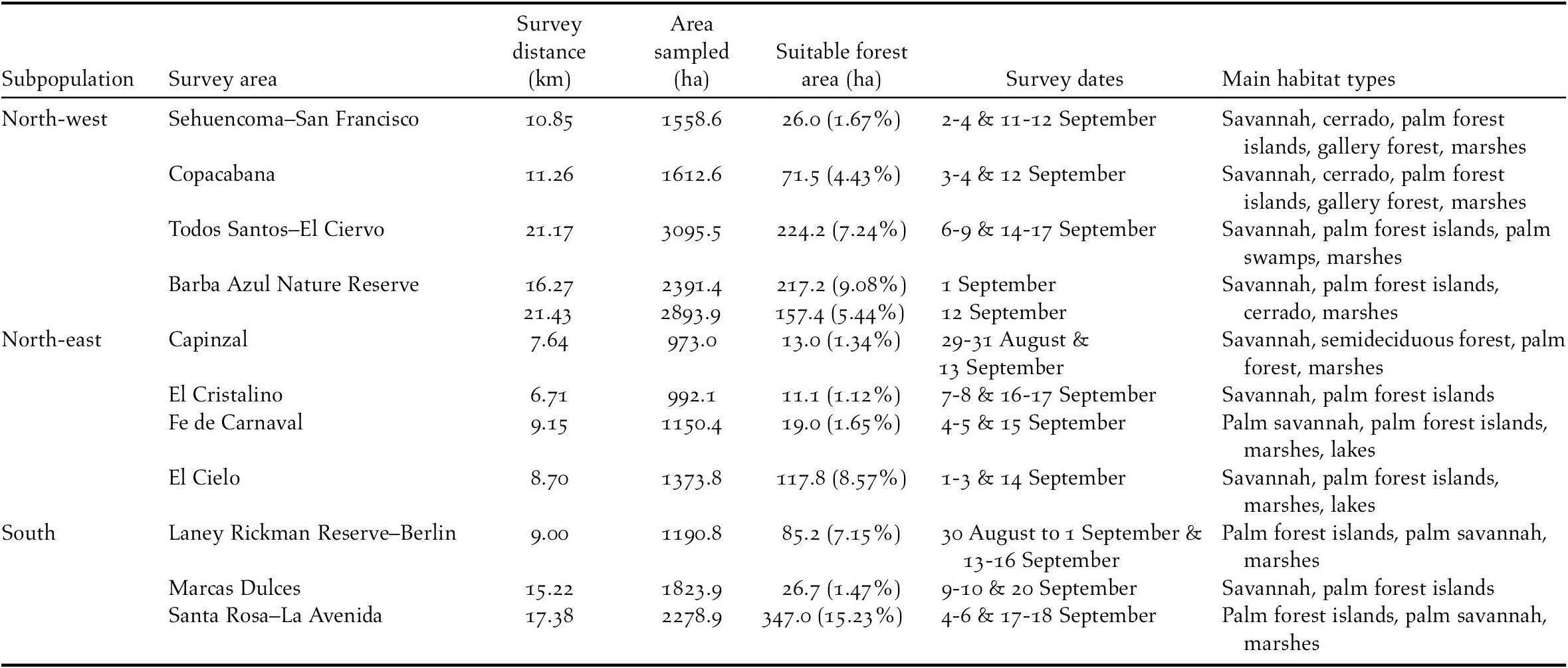
To obtain local Blue-throated Macaw density estimates within each subpopulation, we sampled three to four survey areas (11 in total; Figure 1, Table 1), which were chosen based on prior knowledge of the local occurrence of the species and logistical considerations such as accessibility and cooperation of landowners (ranchers). Four survey areas (two in the north-western and one each in the north-eastern and southern subpopulation) were the most inaccessible and located >10 km from the nearest secondary road, thereby avoiding spatial survey bias towards more accessible areas as documented by Cardador et al. (Reference Cardador, Díaz-Luque, Hiraldo, Gilardi and Tella2018). Areas of both high and low Blue-throated Macaw abundance or frequency of occurrence as determined by prior qualitative surveys, anecdotal and incidental observations obtained between 2005 and 2014 were included. The size and shape of each survey area varied (Figure 1, Table 1) in accordance with local conditions, i.e. the spatial configuration of habitat types and pre-existing trails or narrow dirt roads, which were used as survey routes, and means of transportation during surveys (see below). The minimum distance between survey areas was 12 km, the only exception being a distance of 4 km between Laney Rickman Reserve–Berlin and Santa Rosa–La Avenida in the southern subpopulation due to the comparatively small size of that region and logistical complications in reaching more distant areas within the time frame of the survey.
Survey areas sampled during the Blue-throated Macaw population survey in the dry season (austral winter) of 2015 in the Llanos de Moxos, Beni department, Bolivia.

Survey approach and methods
Obtaining quantitative population size data on potentially highly mobile species such as the Blue-throated Macaw in remote, inaccessible and heterogeneous landscapes such as the Llanos de Moxos requires the adaptation of standard bird survey protocols (e.g. point counts, line transects) that were developed for less challenging circumstances to the constraints imposed by local conditions. To complicate matters further, movement ranges of individual Blue-throated Macaws have not been studied adequately and can only be estimated based on anecdotal data. Berkunsky et al. (Reference Berkunsky, Cepeda, Marinelli, Simoy, Daniele, Kacoliris, Díaz Luque, Gandoy, Aramburú and Gilardi2016) reported a mean home range for breeding pairs of 232.7 km2 (equivalent to a circle with a diameter of 17.2 km), but provided no information on sample size, variability among pairs, time period or methods used to obtain home range estimates. Therefore, the degree of representativeness of this estimate for the population as a whole cannot be evaluated. It also seems likely that home ranges during the non-breeding season, when this study took place, differ from those of breeding pairs.
To minimize the potential problem of double-counting specific individuals, we applied two approaches jointly. First, surveys were carried out simultaneously by three teams, one in each of the three subpopulations, plus one additional surveyor at Barba Azul Nature Reserve (hereafter BANR) in the northwestern subpopulation. In addition, the species’ two largest known roost sites, one at BANR and one at Laney Rickman Reserve (hereafter LRR) in the southern subpopulation, were visited at least once during each survey period, and all birds present were counted in early morning or late afternoon. The LRR roost was monitored daily during the first survey period. Prior to this study, all surveyors were thoroughly familiar with the identification by sight and sound of the Blue-throated Macaw and the similar Blue-and-yellow Macaw.
Second, survey duration was restricted to at most 12 days, which also was intended to minimize the possible influence of temporal changes in behaviour such as flocking propensity and movement ranges on survey results. Although such a fairly short survey period limits the number of areas that can be reached and sampled even by three simultaneously operating teams, we considered it a reasonable compromise between the geographic representativeness and coverage of the survey and the accuracy of the data obtained. In order to determine the reliability and repeatability of this untested sampling approach, we carried out a second (repeat) survey directly after completion of the first survey period in each subpopulation in the same areas and in the same sequence as during the first survey.
Surveys were conducted at the height of the dry season (29 August to 20 September 2015) when flooding levels were lowest and terrain accessibility greatest. Each survey area was sampled between dawn and dusk for one to four days (Table 1), depending on area size, means of transportation during surveys and local conditions. Berkunsky et al. (Reference Berkunsky, Cepeda, Marinelli, Simoy, Daniele, Kacoliris, Díaz Luque, Gandoy, Aramburú and Gilardi2016) reported a high detection probability for Blue-throated Macaws that was not associated with sampling effort (survey duration). This suggests that our sampling effort in each survey area was sufficient to detect the species where present. Surveys were carried out on foot or on horseback (Table 1) along pre-existing trails and narrow dirt roads. The establishment of sufficiently long (several kilometres) straight line transects was not feasible due to the ubiquity of aquatic habitats and the presence of near-impenetrable terrestrial habitats in most survey areas. Survey routes focused on palm forest islands, palm swamps and palm savannah, but included treeless savannah areas and aquatic habitats between forest islands. All routes were georeferenced using hand-held GPS units.
All birds detected and identified with certainty as Blue-throated Macaws were recorded regardless of distance from the observer (see Data analysis below). We did not attempt to estimate distance from the observer due to the difficulties of obtaining accurate visual estimates in open savannah habitat for macaws that are at distances greater than about 100–150 m from the observer. More importantly, the underlying assumptions of distance sampling are often violated when surveying parrots, particularly for detections of flying parrots, which should be excluded from density estimation, which in turn often leads to insufficient sample size and the need for large numbers of sampling points in the case of rare species (Dénes et al. Reference Denés, Tella and Beissinger2018 and references therein).
Surveyors carefully scanned tree crowns for perched Blue-throated Macaws using binoculars and constantly listened for the species’ perch or flight calls. Once one or more birds were detected, their surroundings were screened carefully to determine whether additional individuals or other macaw species were present. Time of day, habitat type, type or species of tree that macaws were perched in, the birds’ general behaviour (roosting, feeding, preening, etc.) and association with other macaw species were noted for each detection. If macaws were flushed, their flight direction was noted. Macaws detected directly in flight also were counted and flight direction was noted. To minimize the risk of double-counting, birds in flight were observed for as long as possible to determine potential changes in flight direction or whether they alighted nearby. All observations of Blue-throated Macaws were georeferenced using hand-held GPS units.
For each survey area, two values were determined: 1) the highest single count (HSC) of Blue-throated Macaws observed simultaneously at any point; and 2) a conservative estimate of the total number (CETN) of macaws detected, excluding likely repeat observations of the same individuals, after careful consideration of the sequence of observations, flight directions of macaws, directions of movement of the surveyors, field marks uniquely identifying some individuals (e.g. moulting flight feathers) and other clues such as repeated observations of the same number of individuals at a particular location. Counts from the roost sites at BANR and LRR were excluded from these values.
Data analysis
For each survey area we determined the effectively covered surface area in hectares using the georeferenced survey routes and a distance of 700 m perpendicular to each side of the route (1,400-m fixed transect width). Survey area polygons were generated in Google Earth Pro (version 7.1.8.3036), and polygon area was determined using ArcGIS 10.2. The assumption that Blue-throated Macaws can be identified with certainty (and reasonably well detected) up to an average distance of 700 m was derived from field trials at BANR. These field trials indicated that the species’ vocalisations can be heard and identified unequivocally (separated unequivocally from the vocalisations of other parrot species, especially those of the similar Blue-and-yellow Macaw) at distances of up to 900–1000 m (see also Jordán and Munn Reference Jordán and Munn1993), whereas reliable visual identification (and unequivocal separation from Blue-and-yellow Macaw) of birds in flight or on exposed perches was difficult at distances greater than c.450–500 m (depending on weather conditions).
To determine the extent of occurrence (EOO) of each of the species’ three subpopulations we compiled a data base of all reliable and georeferenceable records known to us up until June 2019 (Figure 1). Data sources included the published literature, eBird (Cornell Lab of Ornithology, www.ebird.org; only confirmed records from two observers), Asociación Armonía’s distributional bird data base (Herzog et al. Reference Herzog, Maillard, Embert, Caballero and Quiroga2012, Reference Herzog, Terrill, Jahn, Remsen, Maillard, García-Solíz, MacLeod, Maccormick and Vidoz2016) and unpublished observations of the authors. For each subpopulation, a minimum polygon with convex or concave borders was constructed around the outermost locality records using ArcGIS 10.2 (Figure 1).
To estimate the extent of suitable forest habitat in each EOO polygon and in each survey area we performed a habitat classification analysis using Landsat 8 satellite images (OLI/TIRS sensor, 30x30 m resolution; downloaded from: https://libra.developmentseed.org) with less than 10% cloud cover from July (232-069, 232-070, 232-071) and August (233-069, 233-070) 2016. We used two programs to identify forest areas: CLASlite 3.3 (Asner et al. Reference Asner, Knapp, Balaji and Paez-Acosta2009) and the Single Date Classification algorithm of IMPACT Toolbox 3.3 (Simonetti et al. Reference Simonetti, Marelli and Eva2015). In CLASlite, fractional cover of photosynthetic vegetation and bare substrate was set to the standard thresholds of > 80% and < 20%, respectively, recommended by Asner et al. (Reference Asner, Knapp, Balaji and Paez-Acosta2009). A qualitative validation of classification results based on Google Earth Pro images and ground-truth data indicated that both programs classified substantial wetland areas as forest, especially those with dense growth of common water hyacinth Eichhornia crassipes. Therefore, we also computed the Normalized Difference Water Index (NDWI) from the Landsat 8 images and eliminated all areas with values between -1.0 and -0.255 using ArcGIS 10.2; the -0.255 threshold value was determined experimentally by comparing results obtained by different thresholds with Google Earth Pro images and ground-truth data. Finally, because Blue-throated Macaws rarely use large forest areas or continuous riverine or gallery forest (Jordán and Munn Reference Jordán and Munn1993, Yamashita and Machado de Barros Reference Yamashita and Machado de Barros1997, Hesse and Duffield Reference Hesse and Duffield2000, Herrera et al. Reference Herrera, Vargas, Sandoval, Perkins and Rendón2007, Berkunsky et al. Reference Berkunsky, Simoy, Cepeda, Marinelli, Kacoliris, Daniele, Cortelezzi, Díaz-Luque, Friedman and Aramburú2015, Cardador et al. Reference Cardador, Díaz-Luque, Hiraldo, Gilardi and Tella2018), we eliminated all continuous forest areas > 200 ha and all forest within 100 m of principal and within 50 m of secondary rivers. The remaining forest areas were considered suitable forest habitat, and we calculated the absolute and relative extent of this habitat for each EOO polygon and survey area.
To evaluate the accuracy of the two forest classifications, prior to the elimination of large forest areas and riverine forest we compared classification results manually with Esri’s World Imagery Map (https://services.arcgisonline.com/ArcGIS/rest/services/World_Imagery/MapServer) based on 200 verification points. Points were selected randomly with a minimum distance of 100 m between points using the Geospatial Modelling Environment tool (www.spatialecology.com/gme). Following Congalton and Green (Reference Congalton and Green2009), we assigned 100 points to areas classified as forest and 100 points to non-forest areas, and for each point we determined whether or not it was located in forest according to Esri’s World Imagery Map. The resulting true positive, true negative, false positive and false negative values were entered into a confusion matrix and Cohen’s Kappa coefficient was used to determine accuracy (Congalton and Green Reference Congalton and Green2009). CLASlite obtained a higher Kappa than IMPACT Toolbox (0.81 versus 0.74, respectively). In addition, qualitative comparison of final forest maps with Google Earth Pro images and ground-truth data revealed a higher occurrence of false positive and false negative errors in IMPACT Toolbox results than in CLASlite results. False negative errors of IMPACT Toolbox were particularly evident in the southern EOO polygon, where the extent of suitable forest habitat identified by IMPACT Toolbox was 55.5% lower than that identified by CLASlite. Therefore, we used only CLASlite results in all further analyses.
The number of Blue-throated Macaws detected in each survey area (both the highest single count and the conservative estimate of the total number of macaws) was expressed as the number of individuals per 100 ha of suitable forest habitat within each area. Based on these values, we estimated the species’ global population size in two ways. First, we added up the area of suitable habitat and the number of macaws from all survey areas, determining the number of birds per 100 ha of suitable habitat for the survey as a whole (additive computation method). Second, we determined the median number of birds per 100 ha of suitable habitat across all 11 survey areas; we did not use the mean due to the presence of outliers or an asymmetric distribution of values in most data sets as a result of the fairly small sample size. Also, mean values (data not shown) were consistently higher than the median (2.73–2.98 times higher for the first and 1.04 times higher for the second survey period), leading to less conservative population size estimates. Both values were then extrapolated to the entire area of suitable habitat in the three EOO polygons combined by cross multiplication.
Because the Blue-throated Macaw is patchily distributed within each of its three EOO polygons, a final analytical step was applied to account for the species’ relatively low range occupancy and to correct global population size estimates accordingly to avoid overestimation. To quantify range occupancy, we overlaid EOO polygons with a conservative 10x10 km (100 km2) grid, which corresponds to 43% of the mean home range estimate of 232.7 km2 reported by Berkunsky et al. (Reference Berkunsky, Cepeda, Marinelli, Simoy, Daniele, Kacoliris, Díaz Luque, Gandoy, Aramburú and Gilardi2016) as the basis for the size of their sampling units (hexagons) to model occupancy and detection probability of macaws in the Beni savannahs. We then counted both the total number of grid cells that overlapped at least 30% with an EOO polygon and the number of grid cells with georeferenced occurrence records of the species. At EOO polygon borders, all cells that contained an occurrence record were included in both counts regardless of the proportion of overlap with the polygon. The fraction of range occupancy was then multiplied with the values resulting from cross multiplication to obtain the final estimates of the species’ global population size. Thus, in essence, we extrapolated density samples obtained from 11 survey areas known to be occupied to all areas known to be occupied by the Blue-throated Macaw, entirely excluding those areas within the species EOO polygons that lack occurrence records.
Results
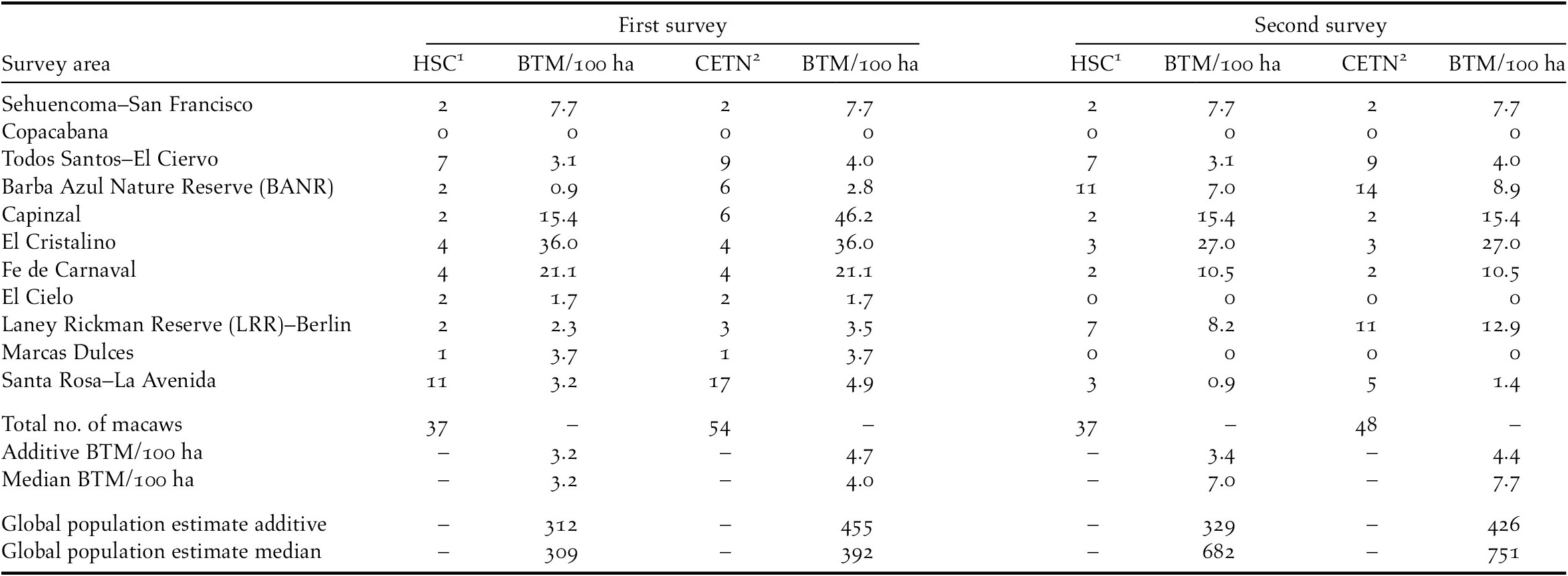
A total of 54 Blue-throated Macaws (conservative estimate of the total number of macaws detected – CETN) were detected in the 11 survey areas during the first survey period and a total of 37 macaws when considering only the highest single count (HSC) in each survey area (Table 2). Corresponding values for the second survey period were 48 and 37, respectively (Table 2). Broken down by subpopulation, CETN values were 17 (first survey) and 25 (second survey) in the north-west; 16 and 7, respectively, in the north-east; 21 and 16, respectively, in the south. Highest single counts at roost sites were 72 (first survey) and 78 (second survey) at BANR in the north-western subpopulation and 16 and 13, respectively, at LRR in the southern subpopulation. Daily high counts at the LRR roost during the first survey period ranged from 5 to 16 (n = 9, mean ± SD: 10.0 ± 4.4).
Number of Blue-throated Macaws detected, number of macaws per 100 ha of suitable forest habitat (BTM/100 ha) and estimated global population size corrected for range occupancy (34.3%) in the 2015 dry season (austral winter) in the Llanos de Moxos, Beni department, Bolivia. Computation methods for determining the range-wide number of BTM/100 ha: additive = area of suitable habitat and number of macaws from all survey areas were added up; median = median calculated across all 11 survey areas.

1 Highest single count of Blue-throated Macaws
2 Conservative estimate of the total number of Blue-throated Macaws
Combining survey and roost site counts for the first survey period (when the LRR roost was monitored daily), the conservative estimate of the total number of Blue-throated Macaws detected in all three subpopulations combined was 136. For the north-western subpopulation, observations at BANR away from the roost were not included in this total as all birds in this survey area are likely to have used the local roost site. At Todos Santos-El Ciervo, repeated observations of the same numbers of birds at the same spots during both survey periods indicated high site fidelity, suggesting that these individuals did not commute to the BANR roost situated 43–52 km farther to the east. Similarly, the two macaws at Sehuencoma-San Francisco were detected in late afternoon in fast, directional flight in a north-easterly direction, whereas the BANR roost was situated 22 km to the south of the observation spot. In the north-eastern subpopulation, observations of perched pairs just after sunrise and just before sunset indicated that these birds did not gather at nocturnal roost sites. For the southern subpopulation, count values reported in Table 2 for LRR-Berlin, Marcas Dulces and Santa Rosa-La Avenida coincided in date and time of day with LRR roost site high counts, allowing for direct summing-up of values.
In one survey area (Copacabana), no Blue-throated Macaws were detected at all, and two additional areas (El Cielo, Marcas Dulces) had no detections during the second survey period (Table 2). CETN values for the remaining survey areas varied from 1 (Marcas Dulces) to 17 (Santa Rosa–La Avenida) for the first survey period and from 2 (Sehuencoma-San Francisco, Capinzal, Fe de Carnaval) to 14 (BANR) for the second period (Table 2). CETN values obtained during the first survey period were correlated significantly with those obtained during the second survey period (Spearman rank correlation: r = 0.71, P = 0.014).
When expressed as the number of macaws per 100 ha of suitable forest habitat in each survey area for a fixed transect width of 1,400 m, CETN values ranged from 0 to 46.2 for the first and from 0 to 27.0 for the second survey period, with a median of 4.0 and 7.7, respectively (Table 2). When adding up the area of suitable forest habitat and the number of macaws in all survey areas, resulting values were 4.7 and 4.4 individuals per 100 ha of forest for the first and second survey period, respectively (Table 2). For the HSC method, values ranged from 3.2 to 7.0 individuals per 100 ha of forest (Table 2). Comparing all results between the first and second survey, the additive computation method produced more consistent density estimates per 100 ha of suitable forest habitat (range: 3.2–4.7) than the median (range: 3.2–7.7) (Table 2). For the first survey period, both methods produced rather similar results, but for the second survey period median values were 1.8–2.1 times higher than the respective values resulting from the additive computation method (Table 2).
The extent of suitable forest habitat was highest in both absolute and relative terms in the species’ southern subpopulation (11,104 ha; 8.10%) and lowest in its north-eastern subpopulation (6,645 ha; 1.72%) (Figure 1). The total area of suitable forest habitat in all three subpopulation polygons combined (1,096,027 ha) was 28,446 ha (2.60%). A total of 140 10x10 km grid cells each overlapped by at least 30% with the three subpopulation polygons. Forty-eight of these cells contained georeferenced occurrence records of the species, corresponding to a range occupancy of 34.3%. Broken down by subpopulation, range occupancy was 29.0% in the north-western, 34.7% in the north-eastern and 50.0% in the southern subpopulation.
Extrapolating values of the number of macaws per 100 ha of suitable forest to the entire extent of this habitat within the three occurrence polygons (28,446 ha), and correcting the resulting values by a range occupancy factor of 0.343, yielded estimates that ranged from 309 to 751 individuals for the size of the Blue-throated Macaw global population in the wild (Table 2). Population size estimates based exclusively on the HSC method ranged from 309 to 682 individuals, whereas those based only on CETN values ranged from 392 to 751 individuals (Table 2). The additive computation method produced more consistent and conservative estimates of 312-455 individuals than the median (309-751), but for the first survey period estimates based on the median were slightly lower than those obtained by additive computation (Table 2).
Discussion
This is the first-ever, rigorous range-wide approach to estimate the global population size of the ‘Critically Endangered’ Bolivian endemic Blue-throated Macaw, incorporating both systematic field sampling and remote-sensing habitat availability data. The species’ range is divided into three potentially largely isolated subpopulations with a total extent of 10,960 km2. This corresponds to only 25.2% of BirdLife International’s (2020a) extent of occurrence estimate of 43,500 km2, which includes extensive areas between the three subpopulations where the species is absent. Our estimates based on the additive computation method, which was more consistent and conservative overall than the median, indicate that the species’ global population in the wild falls in the range of at least 312–455 individuals. Both surveys produced rather similar total numbers of birds observed, and for the additive computation method, estimates of the overall number of macaws per 100 ha of suitable forest habitat. This, combined with the significant correlation between count values obtained during the first and second survey period, confirms the reliability and repeatability of our methodological approach, indicating that it may be relevant beyond this particular study and could be applied to surveys of other mobile bird species especially in tropical regions.
Our conservative global population estimate is slightly higher than the 250–350 individuals estimated by Waugh (Reference Waugh2007) and substantially higher than the estimate of 115–125 individuals by Milpacher (Reference Milpacher2013) and Berkunsky et al. (Reference Berkunsky, Daniele, Kacoliris, Díaz-Luque, Silva Frias, Aramburu and Gilardi2014, Reference Berkunsky, Cepeda, Marinelli, Simoy, Daniele, Kacoliris, Díaz Luque, Gandoy, Aramburú and Gilardi2016). This may in part be due to our extrapolation of local Blue-throated Macaw densities to the total area of suitable habitat within the species’ range, albeit corrected for range occupancy. However, the work of Berkunsky et al. (Reference Berkunsky, Kacoliris, Daniele, Milpacher, Gilardi and Martin2012, Reference Berkunsky, Daniele, Kacoliris, Díaz-Luque, Silva Frias, Aramburu and Gilardi2014, Reference Berkunsky, Cepeda, Marinelli, Simoy, Daniele, Kacoliris, Díaz Luque, Gandoy, Aramburú and Gilardi2016) was restricted to the north-eastern and southern subpopulations (with emphasis on the former), excluding the numerically largest (see below) and spatially most extensive north-western subpopulation, and the origin and methodological basis for their estimate of 115–125 individuals is uncertain, rendering it mere speculation (Herzog et al. Reference Herzog, Bürger, Troncoso, Vargas, Boorsma and Soria-Auza2018). The existence of the north-western subpopulation, on the other hand, was essentially unknown to ornithologists until 2007, when a roost site with 70 Blue-throated Macaws was discovered 83 km west of the Mamoré River (now part of the privately owned Barba Azul Nature Reserve), which prompted Waugh (Reference Waugh2007) to postulate a global population size of 250–350 birds. Nonetheless, given uncertainty over the number of mature individuals, BirdLife International (2020a) placed the Blue-throated Macaw population in the band 50–249 until better data became available.
Knowledge about the species’ distribution and status west of the Mamoré River has improved substantially since 2007, including numerous additional localities (see Figure 1B) and breeding records (Boorsma et al. unpubl. data). In addition, up to 155 Blue-throated Macaws have been observed simultaneously at the BANR roost, which is occupied primarily during the dry season (mostly May to October; Boorsma et al. unpubl. data). However, numbers at this roost can fluctuate substantially between years, within a given dry season and even between consecutive days (Boorsma et al. unpubl. data), indicating that undiscovered and perhaps less frequently used roosts may exist nearby or that the species’ communal roosting propensity is temporally variable. These data will be presented in detail elsewhere. A breeding season survey in February and March 2017 west and north of our Sehuencoma-San Francisco and Copacabana survey areas indeed discovered new roost sites and breeding areas (Boorsma et al. unpubl. data), which resulted in a northward extension of the species’ known range by about 40 km and increased its known extent of occurrence by about 1,500 km2 (the corresponding records and area of occurrence were included in the north-western subpopulation polygon used in this study). The northern portion of the range of this subpopulation still is poorly explored and appears to hold substantial areas of suitable habitat, making discoveries of new breeding and roost sites likely in the near future. Overall, these findings indicate that the north-western subpopulation alone probably consists of at least 160–200 individuals, well exceeding the global population estimates of 115-125 individuals by Milpacher (Reference Milpacher2013) and Berkunsky et al. (Reference Berkunsky, Daniele, Kacoliris, Díaz-Luque, Silva Frias, Aramburu and Gilardi2014, Reference Berkunsky, Cepeda, Marinelli, Simoy, Daniele, Kacoliris, Díaz Luque, Gandoy, Aramburú and Gilardi2016).
In the southern subpopulation, Asociación Armonía’s nest box programme (https://www.birdendowment.org/annual-reports-1) has resulted in the successful fledging of 41 Blue-throated Macaw chicks over the last five breeding seasons (2014/2015 to 2018/2019) and a total of 81 fledglings since 2007, five of which were breeding in three nest boxes during the 2018/2019 reproductive season (many chicks were marked with metal leg rings prior to fledging; authors’ unpubl. data). This possibly has halted or perhaps even reversed the probable decline of this subpopulation caused by the wild bird trade in previous decades, even when assuming high mortality rates of 30% for 1–2-year-old and 15% for 2–5-year-old macaws (Strem and Bouzat Reference Strem and Bouzat2012). In July 2017, a flock of 67 Blue-throated Macaws was observed in our Laney Rickman Reserve–Berlin survey area by a trained, experienced parabiologist (C. Flores pers. comm. 2017); to our knowledge, this is the highest single count of Blue-throated Macaws ever made in the southern subpopulation. Overall, these recent findings from the north-western and southern subpopulations provide strong support that our conservative global population size estimate of 312–455 individuals is realistic and not an artefact of errors or uncertainties in study design or unmet assumptions that may flaw results and thereby inflate estimates (also see below).
Our analyses further revealed considerable differences in range occupancy between the southern and the two northern subpopulations. Range occupancy in the southern subpopulation was 1.7 times higher than in the north-western and 1.4 times higher than in the north-eastern subpopulation. This is probably partly due to the greater relative and absolute extent of suitable forest habitat in the southern subpopulation but is most certainly also influenced by logistical factors and sampling effort and coverage. The southern subpopulation has the smallest extent and greatest ease of access of the three subpopulations, and it is located closest to the capital city of the Beni department, Trinidad. This has resulted in greater sampling coverage and relative sampling effort as compared to the two northern subpopulations, and range occupancy in these regions is probably somewhat underestimated, especially in the north-western subpopulation. Therefore, future work should extend our systematic sampling approach to the subpopulation level to obtain a larger, more representative sample of survey areas, a better understanding of range occupancy and to estimate population sizes separately for each subpopulation.
Potential biases, shortfalls and uncertainties
Selection of sampling areas was based on prior knowledge of the local occurrence of the species. Although we included areas of both high and low Blue-throated Macaw abundance or frequency of occurrence, it could be argued that areas with the lowest densities or areas that are occupied only infrequently (temporal occupancy) were excluded or underrepresented, which could lead to inflation of population size estimates. Our count data (Table 2), however, prove otherwise. No macaws were detected during either survey period in one of the 11 sampling areas, and during the second survey three out of 11 sampling areas (27%) appeared not to be occupied by the species. Our set of sampling areas is therefore likely to appropriately represent the variance among all areas occupied permanently or temporarily by the species throughout its range.
Our survey transect width of 1,400 m (700 m perpendicular to each side of the survey route) was selected through field trials at BANR and based on the average maximum distance at which Blue-throated Macaws can be reasonably well detected and identified with certainty by sight (450–500 m) or sound (900–1000 m). Selection of a greater transect width would have resulted in lower macaw densities and global population estimates, selection of a smaller width in higher densities and population estimates (data not shown). Two assumptions inherent in this approach are that (1) macaw detectability does not decline notably with distance up to the 700-m limit; and (2) that visual and auditory detections each make up approximately 50% of all detections and that no systematic differences exist between sampling areas in the proportion of visual versus auditory detections. Whether these assumptions are met satisfactorily requires further study. Despite the shortcomings of distance sampling outlined in the Methods section (especially when surveying rare parrot species; Dénes et al. Reference Denés, Tella and Beissinger2018 and references therein), when combined with laser rangefinder technology this method could help improve the accuracy of local density and global population size estimates. Laser rangefinders have become increasingly affordable in recent years, now allowing for their use in field research projects with limited funding. However, it remains to be determined whether adequate sample sizes can be obtained from a sufficiently large number of Blue-throated Macaw sampling localities by laser-rangefinder-assisted distance sampling.
The double-counting of specific individuals is a potentially serious problem that leads to inflated population size estimates. To systematically avoid or minimise the risk of double-counting, data on the spatial ecology and movement ranges of the study species are crucial, but such knowledge is highly limited for the Blue-throated Macaw. Berkunsky et al.’s (Reference Berkunsky, Cepeda, Marinelli, Simoy, Daniele, Kacoliris, Díaz Luque, Gandoy, Aramburú and Gilardi2016) anecdotal mean home range estimate of 232.7 km2 (equivalent to a circle with a diameter of 17.2 km) for breeding pairs may not be representative of movement ranges during the non-breeding season, of young adults that have not reached sexual maturity (which is obtained at an average age of five years in captivity; Bueno Reference Bueno2000, Voss Reference Voss2005) or of sexually mature but reproductively suppressed individuals (which are likely to exist and have been documented for other parrot species such as the Red-fronted Macaw Ara rubrogenys in the Bolivian Andes; Tella et al. Reference Tella, Rojas, Carrete and Hiraldo2013). Published data for other species of macaw are similarly scarce and anecdotal. Scarlet Macaws Ara macao in Amazonian rain forest of south-east Peru were found to have 9-month home ranges of 1,730 km2 (Olah et al. Reference Olah, Smith, Asner, Brightsmith, Heinsohn and Peakall2017). It seems highly questionable, though, whether the extensive home ranges of this larger and much more widespread macaw (extent of occurrence: 10,200,000 km2; BirdLife International 2020b) apply to the locally endemic Blue-throated Macaw with a total known range extent of 10,960 km2, whose spatially smallest and most isolated subpopulation does not exceed 1,400 km2 and whose principal food resources (palm fruit) are somewhat patchily distributed but ubiquitous throughout its range.
Based on distances between survey areas, the risk of double counting was highest in the southern subpopulation, where the Laney Rickman Reserve–Berlin and Santa Rosa–La Avenida survey areas were separated by only 4 km. Respective distances from the Marcas Dulces survey area were 30 km and 24 km. As stated in Results, count values reported in Table 2 from the first survey period for LRR-Berlin, Marcas Dulces and Santa Rosa-La Avenida coincided in date and time of day with LRR roost site high counts, ruling out any inflation of local population estimates by double counting. For the second survey period, count values reported in Table 2 were made on different dates (two days apart) at Berlin and Santa Rosa with a distance of 11 km between observations, so double counting cannot be ruled out with certainty. However, given the highest single count of 13 macaws at the LRR roost site (with a total of 20 birds estimated at and in the immediate vicinity of the roost for the same date), the combined conservative estimate of 16 macaws in these two survey areas is unlikely to have resulted in any bias or inflation of population estimates. Distances between survey areas in the north-western and north-eastern subpopulations were greater than those in the southern subpopulation, ranging from 22 to 66 km (when excluding Copacabana, where no Blue-throated Macaws were detected) and from 14 to 65 km, respectively. As detailed under Results, birds in these areas either showed high site fidelity or did not commute to roost sites, substantially reducing double-counting risks. At the very least, highest-single-count values should not suffer from any inflation due to double counting.
Biases in the analysis of range occupancy can have substantial effects on population size estimates: with increasing grid cell size, range occupancy also will increase almost invariably. Our 10 x 10 km (100 km2) grid cells are less than half the size of, and therefore much more conservative than, the mean home range estimate of 232.7 km2 reported by Berkunsky et al. (Reference Berkunsky, Cepeda, Marinelli, Simoy, Daniele, Kacoliris, Díaz Luque, Gandoy, Aramburú and Gilardi2016) for breeding pairs. Surveying a total of 29 hexagons of the same size (232.7 km2), Berkunsky et al. (Reference Berkunsky, Cepeda, Marinelli, Simoy, Daniele, Kacoliris, Díaz Luque, Gandoy, Aramburú and Gilardi2016) determined a range occupancy of 24% for the Blue-throated Macaw (i.e. they recorded the species in seven hexagons). However, at least eight of these 29 hexagons were situated entirely outside the species’ three subpopulation polygons. When excluding these hexagons from the analysis, range occupancy increases to 33% – rather similar to our range occupancy estimate of 34.3%. To examine the effect of even smaller grid cells on occupancy estimates, we applied 5 x 5 km cells in the same way as done for 10 x 10 km grid cells, resulting in 14.9% range occupancy. This lower range occupancy would result in a global population size estimate of 135–198 individuals (for the additive computation method), much lower than the corresponding 312–455 macaws for a range occupancy of 34.3%. Nonetheless, given the single highest count of 155 Blue-throated Macaws at the BANR roost and an estimated 160–200 birds in the north-western subpopulation alone as detailed above, a global population estimate of 135–198 individuals and the corresponding range occupancy of 14.9% clearly can be considered as unrealistically low.
Finally, an assumption inherent to our approach to estimating the Blue-throated Macaw’s global population is that during each 12-day survey period the three subpopulations are effectively isolated, i.e. that no or only a negligibly small number of macaws commute between these subpopulations. No field observations exist that would support such long-range movements of flocks commuting across distances of up to over 200 km between subpopulations on a daily or weekly basis, and given ubiquitous food resources throughout the three subpopulation ranges, there appears to exist no need for macaws to undertake such energetically costly movements on a regular basis. The lack of sightings of leg-ringed birds, which fledged from nest boxes in the southern subpopulation, outside of that subpopulation supports this notion. For example, despite hundreds of systematic and opportunistic observations of Blue-throated Macaws at BANR since 2015, many of which were made at sufficiently close range to detect a metal ring if present, not a single ringed bird has ever been detected at BANR.
Conservation implications and research priorities
The Blue-throated Macaw is currently listed as ‘Critically Endangered’ based on the IUCN Red List criterion A2 (BirdLife International 2020a), i.e. “an observed, estimated, inferred or suspected population size reduction of 80% over the last 10 years or three generations, whichever is the longer, where the reduction or its causes may not have ceased or may not be understood or may not be reversible.” Further, BirdLife International (2020a) placed the Blue-throated Macaw population in the band of 50–249 mature individuals until better data are available. While our results strongly indicate that the total global population exceeds 249 individuals, whether the number of mature individuals exceeds this value is uncertain. Too little is known still about range-wide numbers of breeding pairs and productivity, age at first breeding in the wild, age at breeding senescence and mortality rates of fledglings, pre-adult and adult birds.
For two other globally threatened macaw species, Tella et al. (Reference Tella, Rojas, Carrete and Hiraldo2013) and Pacifico et al. (Reference Pacífico, Barbosa, Filadelfo, Oliveira, Silveira and Tella2014) reported that only about 20% of their global populations were reproductively active during a single breeding season. Berkunsky et al. (Reference Berkunsky, Daniele, Kacoliris, Díaz-Luque, Silva Frias, Aramburu and Gilardi2014), on the other hand, found that over a period of five consecutive breeding seasons, 50% of all Blue-throated Macaws identified in their study area (32 out of a total of 64 individuals) were reproductively active at least once and that most pairs that bred successfully in a given year did not attempt to nest the following year, which resulted in substantial interannual variation in the non-breeding portion or ghost fraction (Negro Reference Negro2011) of the local population (see Table 3 in Berkunsky et al. Reference Berkunsky, Daniele, Kacoliris, Díaz-Luque, Silva Frias, Aramburu and Gilardi2014). Although these results have to be considered preliminary due to small sample size and the geographically limited scope of the work of Berkunsky et al. (Reference Berkunsky, Daniele, Kacoliris, Díaz-Luque, Silva Frias, Aramburu and Gilardi2014), based on our conservative global population size estimate of 312–455 individuals, the number of adult Blue-throated Macaws that breed or attempt to breed at least in some years may amount to 156–222 (78–111 pairs). The results of Berkunsky et al. (Reference Berkunsky, Daniele, Kacoliris, Díaz-Luque, Silva Frias, Aramburu and Gilardi2014) further suggest that the 80% ghost fractions reported by Tella et al. (Reference Tella, Rojas, Carrete and Hiraldo2013) and Pacifico et al. (2014) may overestimate the non-breeding component of each species’ population because of the short duration (one breeding season) of these studies.
In addition to the uncertainty revolving around the current number of mature individuals in the global population, we similarly lack sufficient understanding of population sizes prior to the trade of wild-caught birds in the 1970s and 1980s and the number of birds removed from the wild population since the 1970s (see Yamashita and Machado de Barros Reference Yamashita and Machado de Barros1997, Hesse and Duffield Reference Hesse and Duffield2000, Strem and Bouzat Reference Strem and Bouzat2012). On the other hand, based on current knowledge, it can be argued that the population reduction and its causes are now fully understood, have largely ceased (near elimination of trade and hunting for feathers, which were by far the greatest causes of the species’ presumed rapid population decline; BirdLife International 2020a) and, contrary to Cardador et al. (Reference Cardador, Díaz-Luque, Hiraldo, Gilardi and Tella2018), probably are reversible.
Cardador et al. (Reference Cardador, Díaz-Luque, Hiraldo, Gilardi and Tella2018) postulated that, based on Berkunsky et al. (Reference Berkunsky, Daniele, Kacoliris, Díaz-Luque, Silva Frias, Aramburu and Gilardi2014), the Blue-throated Macaw population appears not to be recovering despite intensive management actions to improve breeding success and even though current trade (and hunting for feathers) is negligible and therefore unlikely to impede recovery. The success of Asociación Armonía’s nest box programme, however, clearly indicates the opposite, i.e. that appropriate management actions indeed have been improving the species’ reproductive success. The average of 8.2 nestlings per year that fledged successfully over the past five breeding seasons (2014/2015 to 2018/2019; authors’ unpubl. data) is almost twice as high as the average of 4.3 fledglings per year reported by Berkunsky et al. (Reference Berkunsky, Daniele, Kacoliris, Díaz-Luque, Silva Frias, Aramburu and Gilardi2014). Whereas Berkunsky et al. (Reference Berkunsky, Daniele, Kacoliris, Díaz-Luque, Silva Frias, Aramburu and Gilardi2014) found that no new adults were recruited into the breeding population, five adult macaws that fledged from Armonía nest boxes were occupying three nest boxes during the 2018/2019 breeding season (authors’ unpubl. data). We can only speculate about possible reasons for these differences. Perhaps the number of nest boxes employed by Berkunsky et al. (Reference Berkunsky, Daniele, Kacoliris, Díaz-Luque, Silva Frias, Aramburu and Gilardi2014; 25 wooden and 12 PVC nest boxes) was too small (see below), or environmental conditions such as a limited extent of suitable forest habitat (6,645 ha or 1.72%) in the north-eastern subpopulation, where 68% of the nesting attempts reported by Berkunsky et al. (Reference Berkunsky, Daniele, Kacoliris, Díaz-Luque, Silva Frias, Aramburu and Gilardi2014) occurred, were less conducive to Blue-throated Macaw reproduction and population recovery than those in the southern subpopulation (11,104 ha or 8.10% of suitable forest habitat).
In an attempt to explain the alleged lack of recovery, Cardador et al. (Reference Cardador, Díaz-Luque, Hiraldo, Gilardi and Tella2018) discussed a number of hypotheses, including habitat loss, behavioural, demographic or genetic-related Allee effects (Courchamp et al. Reference Courchamp, Clutton-Brock and Grenfell1999), availability of tree cavities for nesting, reduced food availability due to forest island deterioration and interference competition for nesting cavities with other macaws, particularly Blue-and-yellow Macaws. Cardador et al. (Reference Cardador, Díaz-Luque, Hiraldo, Gilardi and Tella2018) rejected only the habitat loss hypothesis on the basis of their species distribution modelling results with forest cover as an environmental variable, which showed that the current extent of suitable habitat could hold a much larger Blue-throated Macaw population. Our much more direct and detailed analysis of habitat extent confirms that much of the available suitable habitat is currently not known to be inhabited by the species (see Figure 1). By extension, it seems unlikely that food availability is a limiting factor given the amount of uninhabited suitable habitat and the ubiquity of palms trees in the Llanos de Moxos. Suitable tree cavities, on the other hand, may indeed be in short supply in areas where the species is known to breed given the ready acceptance of nest boxes by Blue-throated Macaws. However, only a relatively low proportion (< 20%) of nest boxes installed are actually used by Blue-throated Macaws (Berkunsky et al. Reference Berkunsky, Daniele, Kacoliris, Díaz-Luque, Silva Frias, Aramburu and Gilardi2014, authors’ unpubl. data). Further research is needed to determine whether this is the result of general interspecific competition (nest boxes also are occupied not only by other parrot species, but also by ducks, opossums or wasps, among others; authors’ unpubl. data), direct interference competition with Blue-and-yellow Macaws, preference for specific microhabitat conditions, small-scale behavioural Allee effects or even social learning (de Waal and Tyack Reference de Waal and Tyack2003, Davies and Welbergen Reference Davies and Welbergen2009). To complicate matters further, the underlying causes of low nest box occupancy rates may vary between subpopulations. Allee effects, for example, in combination with the limited extent of suitable habitat, may influence nest box occupancy, reproductive output and population recovery in the north-eastern subpopulation, but not or much less so in the southern subpopulation.
In light of inherent differences between subpopulations, it is surprising that Cardador et al. (Reference Cardador, Díaz-Luque, Hiraldo, Gilardi and Tella2018) failed to mention the north-western subpopulation in their discussion on alleged limits to population recovery. They were aware of this population, including three occurrence records in their distribution modelling analysis (see their Figure 4), which correspond to our Todos Santos–El Ciervo and Barba Azul Nature Reserve survey areas. Cardador et al. (Reference Cardador, Díaz-Luque, Hiraldo, Gilardi and Tella2018) further were aware that Berkunsky et al. (Reference Berkunsky, Daniele, Kacoliris, Díaz-Luque, Silva Frias, Aramburu and Gilardi2014) did not search for nests in the north-western subpopulation (the existence of which became known in 2007; Waugh Reference Waugh2007), and that their work in the southern subpopulation was restricted to a small area (two clumped breeding pair locations in Figure 1 of Berkunsky et al. Reference Berkunsky, Daniele, Kacoliris, Díaz-Luque, Silva Frias, Aramburu and Gilardi2014). Thus, the results and conclusions of Berkunsky et al. (Reference Berkunsky, Daniele, Kacoliris, Díaz-Luque, Silva Frias, Aramburu and Gilardi2014) can hardly be considered representative for the entire Blue-throated Macaw population, yet they were portrayed as such by Cardador et al. (Reference Cardador, Díaz-Luque, Hiraldo, Gilardi and Tella2018). This may seem like a small oversight when in fact it lends unjustified support to inappropriate, costly and, in light of the new findings presented here, unnecessary conservation management efforts such as reintroduction and population reinforcement programmes (Maestri et al. Reference Maestri, Ferrati and Berkunsky2017, Herzog et al. Reference Herzog, Bürger, Troncoso, Vargas, Boorsma and Soria-Auza2018, BirdLife International 2020a). Cardador et al. (Reference Cardador, Díaz-Luque, Hiraldo, Gilardi and Tella2018) specifically stated that their “SDMs should also help the optimal design of potential reintroduction or population reinforcement programmes that are projected for the species,” implicitly endorsing reintroduction or population reinforcement for the species. Reinforcement and reintroduction are still controversial subjects in conservation genetics (Amato et al. Reference Amato, Ryder, Rosenbaum and DeSalle2009, Dresser et al. Reference Dresser, Ogle and Fitzpatrick2017) and, for the Blue-throated Macaw in particular, are a highly debatable management action that could pose an additional threat to the recovery of the species (Herzog et al. Reference Herzog, Bürger, Troncoso, Vargas, Boorsma and Soria-Auza2018).
In conclusion, our population estimates and other recent discoveries discussed above indicate that the Blue-throated Macaw has a larger global population and is more widely distributed than previously thought, and that the positive effects of successful conservation actions (e.g. Asociación Armonía’s nest box programme) over the past 15–20 years (see BirdLife International 2020a) are now becoming apparent. Several priorities exist for future research and conservation actions. To monitor the population trend of the Blue-throated Macaw and the potentially positive effects of conservation actions, our systematic survey approach should be repeated regularly every three to five years and, as already stated above, should be extended to obtain solid size estimates separately for each subpopulation. To that end, the suitability of laser-rangefinder-assisted distance sampling as a method for estimating local Blue-throated Macaw population densities more accurately should be tested in field trials. In addition, monitoring of known nesting sites and further searches for new breeding and roosting sites, especially in the north-western subpopulation, are a clear priority. Likewise, monitoring is needed in the southern subpopulation to determine the fate of nest box fledglings and how many of these birds eventually recruit into the breeding population. Studying the movement ecology of Blue-throated Macaws through telemetry would contribute to a more accurate analysis and interpretation of population survey data. Finally, expansion of nest box programmes especially to the north-western subpopulation along with restoration of palm forest islands impacted by cattle ranching (see Hordijk et al. Reference Hordijk, Meijer, Nissen, Boorsma and Poorter2019) probably are the two most important conservation actions to ensure the species’ long-term recovery.
Acknowledgements
We are grateful to all landowners for allowing us to work on their properties and to the following individuals for their support during field work or for providing information: Rudy Alarcón, Agustín Bejarano, Tania Caballero, Dennis Camacho, Teodoro Camacho, Yamil Castro, César Flores, Mixael Gilagachi Caumol, Mauricio Herrera, Danny Messes Cholima, Miguel Ángel Montenegro, Luis Miguel Ortega, Pedro Ortega, Alejandro Sagone, Hernán Vargas, Cindy Veizaga and Julián Q. Vidoz. Thanks to G. Asner for granting a CLASlite license and D. Simonetti for providing IMPACT Toolbox technical support. This study was made possible thanks to the generous funding provided by the Zoological Society for the Conservation of Species and Populations (ZGAP; special thanks to René Wüst), the Conservation Leadership Program (Future Conservationist Award to GSA) and Loro Parque Fundación (special thanks to David Waugh).