INTRODUCTION
The World Health Organization (WHO) estimated worldwide mortality from cancer at 8.2 million in 2012 (International Agency for Research on Cancer, 2012). Most cancer patients experience the point at which doctors must “break the bad news” to them, about such things as disclosure of their cancer diagnosis or their life expectancy (Buckman, Reference Buckman1984). Although these events can cause psychological distress, providing information and/or delivering bad news is necessary for cancer patients in order for them to be able to make values-based decisions. They cannot act with self-determination or enjoy a high quality of life without being aware of their true condition. In recent years, the percentage of patients who want to be told the truth about their diagnosis, prognosis, or curative potential has been increasing (Fetters, Reference Fetters1998; Kaplowitz et al., Reference Kaplowitz, Campo and Chiu2002). In a recent Japanese study, 86.1% stated that they wanted full disclosure of their diagnosis (Miyata et al., Reference Miyata, Takahashi and Saito2005).
Despite this, almost half of patients are given insufficient information about their projected life expectancy (Kaplowitz et al., Reference Kaplowitz, Campo and Chiu2002). Especially in Asian countries like Japan, physicians tend not to disclose information to their patients directly about advanced or terminal cancer because they fear the consequences of telling the truth (Horikawa et al., Reference Horikawa, Yamazaki and Sagawa1999; Kawakami et al., Reference Kawakami, Arai and Ueda2001; Pang et al., Reference Pang, Ho and Lee2013).
Cancer has been the leading cause of death in Japan since 1981, and the number of annual cancer fatalities is now more than 300,000 (Ministry of Health, Labour, and Welfare, 2011). The Japanese Cancer Control Act was enacted, which led to the issuance of the “Basic Plan to Promote Cancer Control Programs” by the Ministry of Health, Labour, and Welfare (Ministry of Health, Labour, and Welfare, 2007a ; 2012). In recent years, the “SHARE” program (Supportive Environment, How to Deliver the Bad News, Additional Information, and Reassurance and Emotional Support) was developed as a positive style for sharing bad news (Fujimori et al., Reference Fujimori, Akechi and Akizuki2005; Reference Fujimori, Shirai and Asai2013). The “Palliative Care Emphasis Program on Symptom Management and Assessment for Continuing Medical Education” (PEACE) was begun in 2008, based on a similar U.S. program—Education in Palliative and End-of-Life Care for Oncology (EPEC-O)—to educate postgraduate physicians in palliative care (Japanese Society for Palliative Medicine, 2008). The main goal of these training programs was to improve physicians' skills in communicating with cancer patients. Since the beginning of the PEACE program through to 2012, a total of 2006 training workshops have been held, and it has become a useful approach in palliative medicine education (Fujimori et al., Reference Fujimori, Shirai and Asai2013; Japanese Society for Palliative Medicine, 2008). Additionally, these programs influence not only the satisfaction of physicians but also that of cancer patients with the quality of communication with each other (Fujimori et al., Reference Fujimori, Shirai and Asai2014). However, little work has been done to examine whether these measures have had an impact on communicating bad news.
Additionally, the Ministry of Health, Labour, and Welfare has developed guidelines for decision making in end-of-life care that above all recommend respecting the will of patients in all aspects of cancer care (Ministry of Health, Labour, and Welfare, 2007b ). Japanese physicians commonly put the wishes of family members first when it comes to sharing bad news (Hirai et al., Reference Hirai, Miyashita and Morita2006; Morita et al., Reference Morita, Akechi and Ikenaga2004; Seo et al., Reference Seo, Tamura and Shijo2000). There is little information available as to whether patients have begun to receive the bad news more directly as a result of the various recent projects.
The purposes of our study were to (1) calculate the current percentage of bad news delivery in each of four situations, (2) determine the most common recipients of such news at the end of life, and (3) compare our findings with those of the 2006 survey. Our results will shed light on recent changes in procedures for delivering bad news, as well as provide useful information that could be employed to create concrete measures to improve care.
METHODS
Design
This study was a nationwide retrospective cross-sectional survey of the Japanese hospitals that provide cancer treatment. We disseminated the questionnaire in 2012 and compared our present results with those from 2006.
Participants and Procedure
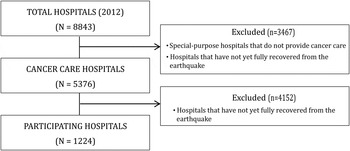
Of the 8843 general hospitals in Japan, we selected only those engaged in cancer treatment. We excluded special-purpose hospitals that do not provide cancer care (e.g., rehabilitation hospitals, maternity hospitals, or psychiatric hospitals) and hospitals that have not yet fully recovered from the Great East Japan Earthquake in 2011. We mailed questionnaires to 5376 hospital directors during January and February of 2012 along with instructions and a return-mail envelope, and an anonymous reply was requested. We had used the same questionnaire in 2006, with the help of funding from the Ministry of Health, Labour, and Welfare (Matsushima, Reference Matsushima2008). In that survey, we collected 4911 hospitals that provided cancer care from a total of 9239 hospitals, selected using the same exclusion criteria.
Ethics
Our current study was designed in accordance with the tenets of the Helsinki Declaration. We processed the questionnaires in such a way as to assure anonymity, and considered a reply as consent to participate. Our study was thus approved without undergoing assessment by the ethics committee of Tokyo Medical and Dental University in Japan.
Questionnaire
There were three types of questions. One set inquired about the characteristics of their hospitals. The second group asked physicians how much percentage they delivered bad news in four different situations. The third set inquired about to whom the news was delivered (the patient, family members, or both). The questionnaire items were developed based on “Guidelines for the Decision-Making Process in End-of-Life Care” in Japan (Ministry of Health, Labour, and Welfare, 2007b ).
Hospital Characteristics
We asked about the number of beds available to patients, the average length of hospital stay, the number of annual hospitalizations, the number of annual discharges owing to death, the percentage of hospitalized patients in the terminal phase of cancer, if their hospital was a hub medical institution or a specialist hospital for cancer care, and if their hospital had a palliative care unit. In 2006, we had no data for the latter two items: being hub or specialist and presence of palliative care unit.
Percentages on Breaking Bad News
We then asked, “On average, how much percentage of the following types of bad news do you disclose to cancer patients in your hospital?” There were four options on type of news within this question: “disclosure of cancer diagnosis,” “therapeutic options for treatment,” “a life-prolonging treatment,” and “disclosure of life expectancy.”
The Most Common Recipient of Bad News at the End of Life
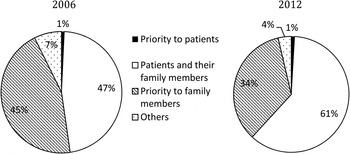
We also asked, “Who do you give priority to when it comes to delivering bad news about the impending end of life?” with the following choices: “priority to patients,” “patients and family members equally,” “priority to family members,” and “others.”
Statistical Analysis
We summarized the characteristics of the hospitals participating in our study utilizing standard descriptive statistics. The differences between 2006 and 2012 in terms of disclosure of bad news in four various situations were subjected to a t test and calculated using Hedges's g and 95% confidence intervals for continuous variables. Differences in terms of the most common recipients of bad news were evaluated using a chi-square test for categorical variables. We conducted all analyses using R version 2.15.1 with the R package “rpsychi” (R Development Core Team, 2011).
RESULTS
Hospital Characteristics
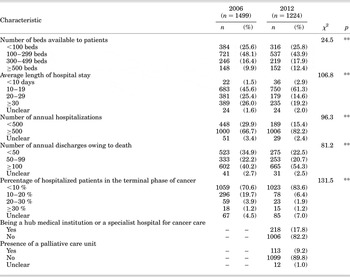
The participation flowchart is depicted in Figure 1. Some 1224 of the 5376 hospitals contacted (22.8%) returned the questionnaires. The total number of hospitals in the 2006 comparison group was 1499 (Matsushima, Reference Matsushima2008). Table 1 shows the hospital characteristics for 2006 and 2012. Standard descriptive statistics revealed significant differences in hospital characteristics between the two timepoints.
Participant recruitment flow diagram (2012).

Hospital characteristics

**p < .01.
Percentages on Breaking Bad News
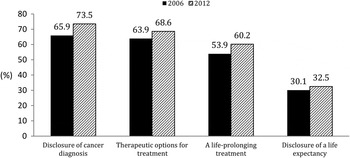
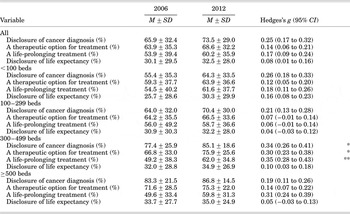
Figure 2 shows the differences between 2006 and 2012 in terms of percentage of disclosure of bad news in each of four situations. One can see that there was no significant difference between all four items: “disclosure of cancer diagnosis,” “therapeutic options for treatment,” “a life-prolonging treatment,” and “disclosure of life expectancy.” Additionally, Table 2 shows the differences in the percentage of disclosures of bad news according to the number of available beds. According to the t test, significant increases from 2006 were observed in the providing information about “disclosure of cancer diagnosis” (77.4 ± 25.9% to 85.1 ± 18.6%, p < 0.05), “therapeutic options for treatment” (66.8 ± 33.0% to 75.9 ± 25.6%, p < 0.05), and “a life-prolonging treatment” (49.2 ± 38.3% to 62.0 ± 34.8%, p < 0.01) in hospitals with 300–499 beds. However, “disclosure of life expectancy” did not change from 2006 to 2012 (32.0 ± 28.8% to 34.9 ± 26.9%). There was no significant difference in terms of bad news disclosure rates between 2006 and 2012 for other hospital sizes.
Percentage of bad news disclosed for four different situations during cancer care in 2006 vs. 2012.

Differences in percentage of breaking bad news by number of available beds

*p<.05, **p < .01, M = mean, SD = standard deviation, CI = confidence interval.
Most Common Recipient of Bad News at the End of Life
Figure 3 presents a depiction of the recipients of bad news in 2006 and 2012. According to the chi-square test, there was a significant change in the percentage of recipients receiving bad news (χ2 = 75.8). The percentage of physicians who provided information to both patients and family members increased from 2006 (n = 704, 47%) to 2012 (n = 746, 61%). The percentage providing information as a priority to family members decreased during this time period (2006: n = 674, 45%; 2012: n = 422, 34%).
Recipients of bad news regarding cancer care at the end of life in 2006 vs. 2012.

DISCUSSION
Our results indicate that the percentage of doctors delivering bad news to cancer patients increased in hospitals with 300–499 available beds, except in cases of disclosure of life expectancy. We suggest three possible reasons for this outcome.
First, the opportunity for attending training workshops may have fostered this increase. Particularly in Japan, many physicians fear telling the truth, as they sense that it may have a harmful impact on patients or cause other severe problems (e.g., increase the risk of suicide) (Horikawa et al., Reference Horikawa, Yamazaki and Sagawa1999). Cherny (Reference Cherny2011) reported that the likelihood of breaking bad news was associated with the extent of a physician's training and the will of family members. Communication skill training programs, including PEACE and SHARE in Japan, have demonstrated value in improving the communication skills of physicians (Fujimori et al., Reference Fujimori, Shirai and Asai2013). These programs may increase physician self-confidence and lead to increased willingness and ability to break bad news to patients. In addition, PEACE workshops have been held mainly in hub medical centers for cancer care that have more than 300 beds. The expansion of this program may have contributed to the increased percentage of doctors in hospitals with 300–499 available beds delivering bad news in various situations.
Second, the extension of life expectancy from cancer diagnosis may influence a physician's likelihood of disclosing information about the cancer diagnosis and therapeutic options for treatment. With the recent developments in early detection and curative treatments, the survival rate from cancer is gradually increasing (National Cancer Center of Japan, 2006). This means that patients and their families have higher expectations for medical treatment, and thus physicians may not find it as necessary to conceal a diagnosis. We believe that the opportunities for physicians to present a range of therapeutic options have increased, and this has also made it easier for them to communicate bad news.
Third, length of hospital stay could possibly affect the provision of information about therapeutic treatment options and life-prolonging treatments. The results of our study indicate that the average length of hospital stay has become progressively shorter since 2006. Shorter hospital stays have recently been promoted to enhance the cost-effectiveness of the Japanese health system, though our public healthcare system is ranked higher than that of any other developed nation (Ministry of Health, Labour, and Welfare, 2013; Organization for Economic Co-operation and Development, 2011). With the reduced length of hospital stays, cancer patients and their family members have been required to learn how to care for themselves at home and use local resources more effectively. It has thus become very important for physicians and other health providers to provide accurate information to patients about their condition.
By contrast, there was little change on the item “disclosure of life expectancy” from 2006 to 2012. Many physicians and nurses around the world still have difficulty in talking to patients about life expectancy (Arbabi et al., Reference Arbabi, Roozdar and Taher2010; Kumar et al., Reference Kumar, Goyal and Singh2009; Mackenzie et al., Reference Mackenzie, Carey and Paul2013; Rogg et al., Reference Rogg, Aasland and Graugaard2010), but particularly in Japan there is considerable reluctance to provide information about the end of life (Horikawa et al., Reference Horikawa, Yamazaki and Sagawa1999; Kawakami et al., Reference Kawakami, Arai and Ueda2001). The results of our study are thus consistent with recent research. Additionally, some studies have shown that patients suffer from psychological distress and need emotional support when they discuss life expectancy (Cripe et al., Reference Cripe, Rawl and Schmidt2012; Gao et al., Reference Gao, Bennett and Stark2010). In most cases, however, an environment of psychological care has not been sufficiently prepared. According to one national study, many hospitals suffer from a lack of specialists in psychiatric care (e.g., psychiatrists, clinical psychologists, psychiatric occupational therapists, and psychiatric social workers) (Committee Reviewing Medical Problems of the Japanese Society for General Hospital Psychiatry, 2012). In fact, the substandard mental health systems in Japanese hospitals may be a risk factor for lack of disclosure related to life expectancy.
In terms of the most common recipients of bad news, it is generally accepted that the will of the patient and their family members should be given equal priority in decision making about end-of life care. Japanese physicians have in the past given more weight to the wishes of family members within the context of cancer palliative care (Hirai et al., Reference Hirai, Miyashita and Morita2006; Morita et al., Reference Morita, Akechi and Ikenaga2004; Seo et al., Reference Seo, Tamura and Shijo2000). The “Guidelines for the Decision-Making Process in End-of-Life Care” (Ministry of Health, Labour, and Welfare, 2007b ), which recommended respecting a patient's wishes in palliative care, and the PEACE workshops may have increased the likelihood of Japanese doctors being willing to break bad news to patients as well as to family members. Some studies have suggested that physicians should provide the true diagnosis or prognosis first to the patients, so as to promote development of their self-determination (Ngo-Metzger et al., Reference Ngo-Metzger, August and Srinivasan2008; Tang et al., Reference Tang, Liu and Lai2006). Japanese families tend to place a high value on cohesiveness and a sense of harmony/togetherness (Saito et al., Reference Saito, Nomura and Noguchi1996), so it would stand to reason that respecting the wishes of both patients and their family members would be the best choice within the culture of Japanese cancer care. However, another Japanese study found that many physicians disclose their prognosis optimistically to patients, but more pessimistically to family members (Akabayashi et al., Reference Akabayashi, Kai and Takemura1999). Further study is certainly needed to examine whether it is patients or family members who should receive true information about end-of-life care.
According to a national survey of medical institutions and hospital reports (Ministry of Health, Labour, and Welfare, 2011; 2013), in 2006 the percentage of hospitals with less than 100 available beds was 39.5%; 100–299 beds, 42.8%; 300–499 beds, 12.4%; and ≥500 beds, 5.4%. By contrast, in 2012, 36.7% of hospitals had less than 100 beds, 45.3% had 100–299 beds, 12.7% had 300–499 beds, and 5.3% had more than 500 beds. The average length of hospital stay decreased from 19.8 days in 2006 to 17.5 days in 2012. Fewer hospitals had less than 100 beds in 2012 than in 2006, because we recruited only hospitals that provided cancer care. Therefore, the participants in our study appear to be representative of those currently being treated in Japanese hospitals for cancer.
STUDY LIMITATIONS
Our study has two important limitations. First, we had to request answers from physicians in retrospect. This could lead to recall bias if their institutions had already introduced approaches or made efforts to increase physician skill in breaking bad news. Second, it is not clear whether any causal associations exist owing to the cross-sectional nature of our study. However, the anonymity of the results may have increased the their accuracy. The sample size is sufficient to ignore random error as a result of a high return percentage.
SUMMARY
Our study provides new and important information on areas to work on so as to promote the disclosure of bad news to cancer patients in palliative care. However, given that it has been reported that 87% of patients with a life expectancy of less than one year in the United States had end-of-life discussions with their healthcare providers (Mack et al., Reference Mack, Cronin and Taback2012), Japan and other countries with similar social and legislative rules may need to improve their abilities to break bad news, especially with respect to disclosure of life expectancy.
CONCLUSION
Our results suggest that delivery of bad news by physicians has increased since 2006, especially in hub cancer care medical institutions, and the most common recipients of bad news at the end of life have changed from family alone to both patients and family members. These changes may be influenced by advances in treatment options or implementation of domestic legislation. To further increase the percentage of doctors who deliver bad news to their patients at critical moments in the course of their disease, further studies should be conducted to examine the effectiveness of mental health care support for patients who receive troubling news.
ACKNOWLEDGMENTS
This study was supported by a 2006 Health Labour Sciences Research Grant (H16-Medical-General-001). We state that we have no conflicts of interest to declare. We are grateful to Kenji Hayashi and Tomoko Kodama at the National Institutes of Public Health for their helpful advice about research planning. We also thank all the participants who completed questionnaires.