INTRODUCTION
The field of palliative care related to contemporary healthcare is becoming increasingly important. It has been said more than once that the mark of a civilized society is how it responds to its most vulnerable members (e.g., Pearl S. Buck quotes, n.d.). According to the World Health Organization (WHO) definition,
Palliative care is an approach that improves the quality of life of patients and their families facing the problem associated with life-threatening illness, through the prevention and relief of suffering by means of early identification and impeccable assessment and treatment of pain and other problems, physical, psychosocial, and spiritual. (WHO, 2014)
Palliative care clients and caregivers have many needs: physical, mental, psychosocial, emotional, and spiritual. One of the principles of palliative care is the careful attention given to formal and informal caregivers. Palliative care recognizes that caregivers are also affected to varying degrees by the dying experience and may require just as much understanding and support as the client.
While there is sufficient literature available on the physical needs of people with terminal illnesses, more research is required on the other aspects of care and support for clients as well as caregivers. The findings from an integrative literature review (Oliver et al., Reference Oliver, Penman and Ofner2005) and metaanalyses revealed that there is a lack of clarity about psychosocial and emotional needs, about what is meant by psychosocial and emotional support and care, and about what constitutes high-quality psychosocial and emotional care. Moreover, healthcare professionals often lack knowledge and awareness of how to provide such support to families and caregivers. In addition, the constraints of enormous workloads as well as staff and funding shortages have meant that support for caregivers has been limited and informal. The literature clearly suggests that there is inadequate psychosocial and emotional support extended to people at the end of life, to their families, and to their caregivers, including bereavement and beyond (Kaut, Reference Kaut2002; Steinhauser et al., Reference Steinhauser, Alexander and Byock2008).
A university palliative care research group, in undertaking research on improving access and education in palliative care among rural South Australian communities and healthcare professionals (the Caring Communities Program, funded by the Department of Health and Ageing), recognized the psychosocial and emotional support and care needs of families and caregivers (Oliver et al., Reference Oliver, Penman and Ofner2005; Reference Oliver, Penman and Ofner2006).
The literature on informal caregiving has focused on the burdens of caregivers and only recently has shifted to the benefits of caregiving (Coeling et al., Reference Coeling, Biordi and Theis2003). Others have corroborated this observation, saying that few studies have examined the totality of the relationship between caregiver and care receiver (Dunne, Reference Dunne2001; Byrne, Reference Byrne2002; Tang, Reference Tang2009). According to Skilbeck and Payne (Reference Skilbeck and Payne2003), the literature reveals confusion about the terms “emotional care” and “support”; there is a mistaken assumption that a shared understanding of these abstract terms exists. The area of spiritual needs and care appears to be more problematic. Spirituality is a part of the healthcare continuum and a part of holistic care, but, despite many documented studies, the concept of spiritual care, while certainly not new, remains poorly understood among healthcare professionals (Ross, Reference Ross1994; Kociszewski, Reference Kociszewski2003). Though recognizing spirituality as an essential dimension of health, most are unable to discuss spirituality with others, let alone assist others spiritually. In summary, what the present literature seems to point out is that there is a dearth of understanding among healthcare professionals about psychosocial, emotional, and spiritual support and care, and how best to meet these needs of those at the end of life and their caregivers.
This is not to say that palliative care has not advanced. On the contrary, much attention has been given to the field, with improvements including: emphasis on family-centered (Kissane et al., Reference Kissane, Bloch and Burns1994) and home-based care (Hudson & Richmond, Reference Hudson and Richmond2003); development of the partnership approach with stakeholders; improvement in relationships and communications; and systematic psychosocial assessment and utilization of comprehensive assessment tools (Harding & Higginson, Reference Harding and Higginson2003). Moreover, palliative care teams have received specialized training and employ a broader multidisciplinary approach (Michelson & Steinhorn, Reference Michelson and Steinhorn2007; WHO, 2014). Their contribution to the care of the terminally ill has been acknowledged, though Forcina Hill (Reference Forcina Hill1993) and others stressed the need for palliative care professionals to address the diverse cultural beliefs and values of their clients (Cosgrove et al., Reference Cosgrove, Nesbitt and Bartley2006; Chaudhry, Reference Chaudhry2008).
Psychosocial support may be required from the time of diagnosis and should be an intrinsic part of caring throughout the course of the illness (Sherman, Reference Sherman2001; Payne et al., Reference Payne, Hawker and Kerr2007). Cosgrove and colleagues (Reference Cosgrove, Nesbitt and Bartley2006) articulated five domains of palliative care: pain and symptom relief, avoidance of inappropriate prolongation of dying, sense of control, relief of burdens, and strengthening of relationships with loved ones. These summarize what palliative care is all about: better care at the end of life, from the time of diagnosis to death, bereavement, and beyond.
The experience of a life-limiting illness creates emotional distress for many patients and caregivers. Emotion has particular relevance to palliative care, and fear is one of the most difficult emotions to deal with. Fear is a disconcerting feeling in anticipation of a physical or psychological threat that causes doubt of one's abilities to manage what is to come (Reeve, Reference Reeve2001). It is an unpleasant feeling linked with psychological and/or physical stress, arousing the person's bodily defenses and provoking the fight-or-flight reaction (Huether & McCance, Reference Huether and McCance2004), potentially causing a breakdown of compensatory mechanisms and balance.
Of those fears closely associated with palliative care patients, healthcare professionals readily identify and alleviate the fear of pain, the most acute and realistic of fears. However, many are unable to allay the fear associated with being alone, dying and dying alone, being separated, leaving loved ones behind, losing track of the meaning of life, the unknown, losing one's abilities, and suffering. For some, the process of dying can be more disconcerting than death itself. Whatever the type of fear, people are deeply affected because of the close relationships among the psychosocial, emotional, and physical dimensions. Healthcare professionals require the appropriate knowledge and skills to enable them to provide the emotional care and support needed by clients and caregivers.
In conquering fears, identifying, grading, redefining, and working through fears are important steps to undertake. Many theories have been proposed, including Plutchik's (Reference Plutchik1985) feedback loop, which conceptualizes emotion as a chain of events that aggregate into a complex feedback system: cognition, arousal, feelings, preparation for action, expressive displays, and overt behavioral activity. To influence emotion, one can intervene at any point of the feedback loop. On the other hand, Wolpe (1958, as cited in Niven & Robinson, Reference Niven and Robinson1994, p. 218) cites four stages when dealing with phobias and fears: “learning how to relax,” “listing all your fears,” “constructing a hierarchy of threatening scenes,” and “working through the scenes.” Anxiety is rated and help is given with relaxation and positive reinforcement. Weiten and Lloyd (Reference Weiten and Lloyd2008) discuss three adaptive tasks focusing on appraisal, problem, and emotion. These tasks relate to dividing the situation into manageable units, gaining a new perspective on the situation through problem-solving skills, and having a degree of control in order to facilitate acceptance of the situation.
The present paper focuses on the emotion of fear that emerged from our research study, and examines the different kinds of fear within the dying process from the perspective of individuals with terminal illnesses and their caregivers. There is a need to understand the fears experienced by clients and their families to assist them in allaying those fears. This will help the client and family in their journey toward death, as well as all those involved with the client, including healthcare professionals. The significance is to stimulate debate regarding strategies by which fear may be addressed in palliative care, and to add to the literature that might better inform healthcare professionals in their understanding of fear and the ways of dealing with it within clinical settings.
METHODOLOGY
Research Orientation
A descriptive interpretative approach was employed for a study of how to increase access to palliative care and palliative care education among rural communities and healthcare professionals (Oliver et al., Reference Oliver, Penman and Ofner2005). Qualitative data were obtained through in-depth nonstructured interviews. The findings relevant to the topic of this article were drawn from that larger study. A secondary analysis of the data addressed these questions: “What is the nature of fear from the palliative care clients' and caregivers' perspectives?” and “What strategies help them overcome fear?”
Research Participants
Participants were residents of various rural South Australian regions; all had experience as palliative care clients and caregivers. They included clients, families, and caregivers, the latter including spouses, partners, family members, and unpaid caregivers, residing in the target areas, who were directly and/or indirectly involved with caring for people with life-limiting conditions.
Ethical Considerations
Project activity commenced after approval was obtained from the university's human research ethics committee. Steps were taken to ensure that the project met all requirements for undertaking human research. Participants' confidentiality was preserved, pseudonyms being used in reporting the interview data. Access to data was limited to researchers. Deidentified findings were made available to participants upon request.
Procedure
Community members of the various localities were recruited to participate in home-based interviews through existing palliative care teams and support groups. Interested individuals were asked to share with the interviewers their experiences of life-limiting conditions or of caring for people with such. Probing questions then sought an understanding of those experiences.
Participants gave their written consent for the interviews to be audiotaped. Verification of the contextual meaning of text representing common themes was undertaken and validated by the researchers. Interpretations were shared with and validated by participants.
Method of Analysis
Participants' responses were transcribed verbatim, the transcripts forming the text for thematic analysis. The data-management package NVivo 7 assisted in identifying recurring themes (Richards, Reference Richards2000; QSR International, 2013). For the present paper, secondary analysis was conducted to investigate interviewees' perceptions of fear.
RESULTS
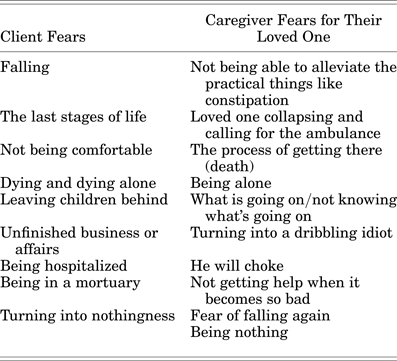
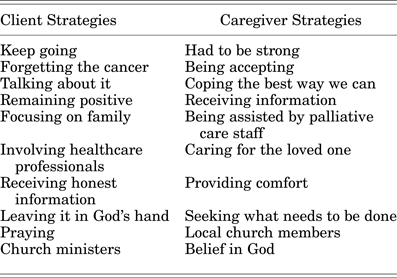
Some 75 palliative care clients and caregivers were interviewed. The number of participants varied from one rural area to another. Of these interviewees, 14 individuals mentioned fear, and many others alluded to such related emotions as anxiety, worry, panic, and shock and shared their experiences and how they dealt with these emotions. Table 1 summarizes the fears expressed by palliative care clients and caregivers. Clients and caregivers also identified a variety of strategies by which they conquered their fears (see Table 2).
Different types of fear

Strategies to cope with fear

DISCUSSION
Emotions are always with us, “forever changing, and constantly motivating us to adapt to the situations and challenges we face” (Reeve, Reference Reeve2001, p. 403). There is an emotion for every situation. Dying elicits a host of emotions, including fear. As deduced from the findings, there is a wide range of fears brought about by impending death. The complexity of the emotion is encapsulated in one palliative care client's experience:
My worst one [fear] would just be worrying about the wife and probably the grandkids, because we have just been giving them [grandchildren] a lot of support [parents are dysfunctional] (. . .) But you just got to leave it [fear of dying, fear of leaving the grandchildren, fear of uncertainty] in God's hands. [Client narrates the roles they play and the plans they have for the grandchildren.]
As well as fears of dying, leaving the family, and uncertainty for the loved ones, this client was also concerned about unfinished business and unfulfilled wishes.
Why the need to understand fear? Life-threatening illnesses can have devastating effects on emotions. Terminal illness, associated with various fears, is often accompanied by mental health disturbances and may interact with other physical symptoms (Mitchell et al., Reference Mitchell, Bowman and McEniery1999). There is a need to understand how clients and caregivers contextualize fear and how they express it. Individuals may have different ways of expressing emotions, and fear may direct behavior in a way that proves to be effective or maladaptive. Emotions can possess an inherent coping function. Also, understanding emotion may provide relevant and appropriate organizational and managerial responses for clients and staff.
Clients' fears of not being comfortable, dying alone, being in hospital, and turning into nothingness might be addressed by reassuring them of comfort through various means, of not dying alone, of dying at home if they chose, and of a life well lived and remembered. Fear of dying alone might be addressed by reassuring the person that, though he/she is dying, they are not alone, because family will be present or there will always be someone present. The caregivers' fears for the clients of not coping with constipation, collapsing, the dying process, what is going on, choking, dribbling, and falling may be addressed through information, assurance of symptom control, effective preparation, and interprofessional care. In short, a “good death” may be planned and achieved (Griggs, Reference Griggs2010).
Fear can be useful—it creates a motivation to do something about a circumstance. According to Plutchik (Reference Plutchik and Arnold1970; Reference Plutchik1980), emotions serve eight distinct purposes: protection, destruction, reproduction, reunion, affiliation, rejection, exploration, and orientation. These fears of palliative care clients and caregivers need to be expressed, however (Stedeford, Reference Stedeford1981; Lugton, Reference Lugton2003). Anger must be legitimized and disarmed, and fear addressed, so that others may understand their circumstances and then know how to provide emotional support. Clients and caregivers may need help to adopt personal methods for coping with death and dying (Lugton, Reference Lugton2003).
Tangible and Intangible Measures by Which People Manage Their Fears
Study participants, while identifying their fears, also talked about their ways of alleviating them. Four major themes related to strategies for addressing fear were identified: drawing on resilience and inner resources, maintaining relationships, gaining the ability to “keep one step ahead,” and engaging in spirituality and religion. The fundamental experience of coping with fear for palliative care clients appeared to be similar to that of caregivers.
Theme 1: Drawing on Resilience and Inner Resources
When confronting fear, clients' and caregivers' reactions focused on adapting to their current life-changing circumstances. They gathered past experiences and considered their strengths, resolve, and resources to meet impending death. Personal resilience and connectedness are means by which individuals can claim a good quality of life despite life-threatening illnesses (Denz-Penhey & Campbell Murdoch, Reference Denz-Penhey and Campbell Murdoch2008). The following extracts support this theme:
I am a pretty strong woman. I cope pretty well with most things. Everything happened slowly, and so I knew what was to happen, so I was prepared. (. . .) It is in my nature to be able to pick things myself and to keep going. [palliative care client 1, regional center A]
I try not to get depressed with cancer. I have wiped off the cancer out of my thoughts, and I forget about it! [palliative care client 2, regional center A]
I try not to be afraid. I try to remain positive—there is a cure, and it will be beaten. [palliative care client 3, rural town A]
I had to be strong for my husband, or at least appear to be strong in front of him. I only shed tears when he could not see me. We did not talk openly about death and dying, but I have had previous experience with death when I lost two babies. I am well aware of the pain and what grief and loss is all about. [caregiver 1, rural town B]
I just keep going on my own. My husband was dying, and we just accepted it and coped the best way we can. [caregiver 2, rural town C]
The above responses reflect a hierarchical approach to coping according to Menninger and colleagues (as cited in Lazarus, Reference Lazarus1993). The clients and caregivers manifested varying reactions in encountering the reality of death, some healthier than others, their responses depending on personal traits. Responses such as “I am a pretty strong woman” and “I had to be strong for my husband” reflect a confrontative type of coping (Folkman & Lazarus, Reference Folkman and Lazarus1988) where individuals stood their ground and prepared for what was to come. “We just accepted it” and “try to remain positive” responses depicted a self-controlling type of coping. Moos (Reference Moos1993) sees this “resigned acceptance” as representing a conscious decision to accept the reality, that is, the inevitability of death. Remaining positive is paramount, lest the individual be consumed by fear of what is happening (Lugton, Reference Lugton2003). On the other hand, the “I forget about it” dismissive response is a defense, an attempt to distance the self from the stressor. All these, however, draw on resilience and inner resources, which are healthy for adaptation, even “forgetting,” because this distracts the individual from the disease.
Theme 2: Maintaining Relationships
Maintaining relationships is the second theme associated with transcending fear. Several palliative care clients mentioned that their relationships with spouses, children, extended family, and healthcare professionals, as well as with strangers for some, did help overcome their fears, specifically about their present situation. The extracts below illustrate this way of managing fear:
Talking about it [dying] helps. (. . .) I have a very young family who loves me and who I love so much. They are my inspiration. (. . .) I am not really frightened of dying, but not yet. [palliative care client 3, rural town A]
Much of our issues of concern are addressed because our daughter is an RN, and we have much family support. There is also an outreach nurse who comes and assists mum, but there are no GPs [here]. [caregiver 3, rural town D]
We were fortunate that some members of a local church would come and sing worship songs for my husband. These visits consoled and made him happy—he didn't feel alone. [He feared being alone.] He slept well after the singing. [caregiver 4, regional center A]
Hence, seeking social support is an important coping mechanism. Talking to someone, focusing on family, consulting someone who could help or give valuable advice and enjoying the company of others are strategies by which to address the fear of dying and assuage being alone. In these cases, coping is not viewed as a trait or style of the individual but rather a process: “Coping changes over time and in accordance with the situational contexts in which it occurs” (Lazarus, Reference Lazarus1993, p. 235). Maintaining relationships is an adaptive type of response, as the actions improve outcomes in terms of fresh resolve to live, increased morale, not feeling alone, improved social functioning, and better sleep.
Theme 3: Gaining the Ability to “Keep One Step Ahead”
This theme refers specifically to the need for clients and caregivers to be informed of what is happening in order to have some semblance of control of the situation. It also encompasses the need for healthcare professionals to be transparent and responsive to the needs of clients and caregivers. The following extracts provide evidence:
I was appreciative of the information provided about my condition, services available, treatments, and so on; receiving honest information is important. [palliative care client 4, regional center B]
The palliative care [staff] were wonderful; seemed they were one step ahead. They were there with information; they knew when you desperately needed it. Everything was explained to us and organized for us. These helped with our concerns and fears. [caregiver 5, regional center A]
This strategy is powerful in coping with all types of fear, because it helps those concerned how to plan, problem solve, explore options/courses of action, and gain some control of the situation. Forewarning individuals helps them to put things into perspective and unmask the unknown. For instance, one might be afraid of “getting there” (dying), which might be addressed by describing how this process occurs peacefully for many clients. In short, honesty about what is coming is productive. Lugton (Reference Lugton2003) concurs, stating that a defined threat is usually less frightening because knowledge makes coping easier.
Theme 4: Engaging in Spirituality and Religion
The final theme embodies the search for greater meaning and purpose in life and adherence to organized beliefs and practices within a faith tradition. It appears that spirituality and religion help conquer the fears of palliative care clients and caregivers. Others similarly allude to the impact of spirituality and religion on mental and physical health (see Katerndahl, Reference Katerndahl2008; Campbell, Yoon & Johnstone, Reference Campbell, Yoon and Johnstone2010):
I was experiencing a number of problems [respite, meals and pain, especially pain], but I just prayed quietly and asked God to make me feel better, one more day. (. . .) Some church ministers came to give blessings and prepare me for a peaceful death. [palliative care client 5, regional center A]
I have a strong belief in God, who gives me my strength even up till now. I just lift my husband to Him together with our worries. [caregiver 4, regional center A]
Mum needed to see the priest often now till she died. She is a devout Catholic and had requested staff to call on the priest. Good that the RN obliged the request. [caregiver 6, regional center C]
Baetz and Toews (Reference Baetz and Toews2009) and Schultz and colleagues (Reference Schultz, Tallman and Altmaier2010) suspect that there are elements and mechanisms functioning that mediate the effects of spirituality/religiosity on health. Spirituality has been linked to a belief in God and religion, the concept of self, meaning and purpose in life, and connectedness (Cayetano-Penman, Reference Cayetano-Penman2012). Religiosity refers to the degree of participation in, or adherence to, the beliefs, rituals, and traditions of a religion. The relationships between spirituality and religiosity and better clinical health outcomes may be explained through the impact of biological, biopsychosocial, and behavioral mechanisms (Ironson & Hayward, Reference Ironson and Hayward2008; Brammer, Reference Brammer2009). Moreover, spirituality and religiosity may facilitate social support, existential meaning, a sense of purpose, a coherent belief system, and a clear moral code promoting health and well-being.
The Implications for Health Professionals and Organizations
With the experience of a life-limiting condition, individuals respond with their own style of coping, which is influenced by a number of factors such as personality, previous experiences with illness, and experiences with relationships. Crucial for healthcare professionals and organizations is how to help them explore their feelings, fears, and anxieties, identify and confront them, and point to previous ways of coping. More importantly, healthcare professionals need to help them identify their strengths and resources that may better enhance coping (Lugton, Reference Lugton2003). Furthermore, the appreciation of emotional problems and initiatives such as looking for an opportunity to engage with the client and/or caregiver, and allowing expression and exploration of one's own solution(s) and courses of action, are emphasized. Thus, Lugton (Reference Lugton2003) stresses that giving total attention to what the other person is thinking and feeling is creating a climate of empathy and trust.
In addition, it is essential to provide ways of coping with challenges and threats (Johnson-Laired & Oatley, Reference Johnson-Laired and Oatley1992), and to deal with emotions rationally. One of the positive results of fear is providing motivation to learn new coping responses to ameliorate a situation. Fear activates coping efforts and facilitates the learning of adaptive responses (Reeve, Reference Reeve2001). The growing preference to die at home, for example, is a challenge requiring creative solutions.
Support from family and healthcare professionals cannot be underestimated. Clients with life-limiting conditions may need the concentrated effort of a multidisciplinary team to help them with their complex needs and issues. This coordinated care is personal, holistic, and encompassing. Community involvement is an important factor in the dying experience. Support from specific groups or the general community is well appreciated, as discerned from the interviewees. Community members who are generally keen to help are a big resource to tap into in order to mitigate some fears.
In relating to clients and caregivers, healthcare professionals attempt to identify the strengths and resources available for helping the family cope with their situation. Some relatives have the fear of being unable to cope with the terminal illness and with their own future during bereavement. Timely intervention is paramount; referral to palliative care workers who are trained and experienced in the area is recommended.
It is realized that palliative caregivers require as much understanding and support, as they also experience the various stages of dying. In fact, in various palliative care team formats, team members are instructed to respect the choices, not only of the person concerned, but of the family members as well. The interdisciplinary team may assist clients and family by affirming life, finding meaning in their illness, relieving suffering, and providing emotional and spiritual support (Sherman, Reference Sherman2001). Incidentally, most of the interviewees were very happy with the services provided in this area. Statements such as “could not have done it without the palliative care team” resounded. They were satisfied with the service, from the supply of equipment to information and encouragement given by staff. One said, “They forewarned us of the events that would come.”
The theories relating to dealing with fears and phobias described earlier (Plutchik, Reference Plutchik1985; Wolpe, 1958, as cited in Niven & Robinson, Reference Niven and Robinson1994) are relevant in this study as they resonate with participants' approaches to coping with fear. More specifically, talking about fear, using clergy and community members, thinking positively, and belief in God have been cited. Healthcare professionals may achieve adaptational outcomes if they encourage their clients to draw on their spirituality or draw on sources for spiritual support (Easton & Andrews, Reference Easton and Andrews2000), maintain a positive outlook, find comfort from others, and find strength and resilience from within. In all these adaptive tasks, healthcare professionals can intervene, from assisting in gaining a new perspective and remaining positive, to utilizing social networks. Various resources have been developed that can assist multidisciplinary healthcare professionals and all those working with palliative care clients and caregivers to contribute to overcoming such fears (e.g., Oliver et al., Reference Oliver, Ofner and Penman2007; Oliver & Penman, Reference Oliver and Penman2011; Ellis & Penman, Reference Ellis, Penman and Gregory2013).
CONCLUSION
Palliative care clients and caregivers deal with intense emotions, fear especially associated with death and dying being one of them. These emotions, however, have a purpose. From a functional point of view, they help with individuals' adaptation when dealing with changing realities and environments by developing new coping strategies. The strategies for conquering fear identified in our study involve building on resilience and accessing inner resources, maintaining relationships, gaining information about what is to come, and focusing on spirituality and religion. An emphasis on interpersonal and transpersonal relationships may help clients develop competence when conquering fear.
Healthcare professionals are challenged to explore these strategies with their clients and their relatives. Forewarning clients and caregivers by equipping them with information and techniques to assist in their coping, and identifying, redefining, and working through fears are suggested. Gaining a deeper understanding of the experience of fear is imperative to appropriately assisting people in coping with this emotion, which is integral to providing comprehensive, high-quality, and holistic care.
ACKNOWLEDGMENTS
We acknowledge former colleagues involved in the research on which this article is based: research team leader Dr. Mary Oliver (then Associate Dean, Teaching and Learning) and Ms. Cynthia Ofner (Project Officer). The original project was funded by the Australian Government's Department of Health and Ageing under its Caring Communities Program.
The topic of this paper was the focus of a poster presentation at the Ninth Asia Pacific Hospice Conference, “Palliative Care in Mainstream Medicine,” Penang, Malaysia, July 14–17, 2011.