Introduction
Global oceanic pCO2 is increasing in response to an ongoing increase in atmospheric CO2 (Gattuso et al. Reference Gattuso, Magnan, Bille, Cheung, Howes, Joos, Allemand, Bopp, Cooley, Eakin, Hoegh-Guldberg, Kelly, Portner, Rogers, Baxter, Laffoley, Osborn, Rankovic, Rochette, Sumaila, Treyer and Turley2015). Since the pre-industrial age, atmospheric CO2 has increased from 278 ppm to 400 ppm (IPCC 2014). As pCO2 in oceanic waters increases it causes a reduction not only in seawater pH but also in the saturation state (Ω) of calcium carbonate (CaCO3) (Gattuso et al. Reference Gattuso, Magnan, Bille, Cheung, Howes, Joos, Allemand, Bopp, Cooley, Eakin, Hoegh-Guldberg, Kelly, Portner, Rogers, Baxter, Laffoley, Osborn, Rankovic, Rochette, Sumaila, Treyer and Turley2015). Together, these alterations in seawater chemistry are termed ocean acidification (OA; Caldeira & Wickett Reference Caldeira and Wickett2003). Since the onset of the industrial revolution, the average pH of ocean surface waters has fallen 0.1 pH units and it is predicted to fall another 0.3–0.4 pH units by the end of the century (Orr et al. Reference Orr, Fabry, Aumont, Bopp, Doney, Feely, Gnanadesikan, Gruber, Ishida, Joos, Key, Lindsay, Maier-Reimer, Matear, Monfray, Mouchet, Najjar, Plattner, Rodgers, Sabine, Sarmiento, Schlitzer, Slater, Totterdell, Weirig, Yamanaka and Yool2005). This decline in pH is equivalent to a 150% increase in H+ concentration and a 50% decrease in carbonate (CO3 2-) concentration (Orr et al. Reference Orr, Fabry, Aumont, Bopp, Doney, Feely, Gnanadesikan, Gruber, Ishida, Joos, Key, Lindsay, Maier-Reimer, Matear, Monfray, Mouchet, Najjar, Plattner, Rodgers, Sabine, Sarmiento, Schlitzer, Slater, Totterdell, Weirig, Yamanaka and Yool2005). Although such estimates are based on a global average of the world’s oceans, the sea surrounding Antarctica is uniquely susceptible to OA (Orr et al. Reference Orr, Fabry, Aumont, Bopp, Doney, Feely, Gnanadesikan, Gruber, Ishida, Joos, Key, Lindsay, Maier-Reimer, Matear, Monfray, Mouchet, Najjar, Plattner, Rodgers, Sabine, Sarmiento, Schlitzer, Slater, Totterdell, Weirig, Yamanaka and Yool2005, Fabry et al. Reference Fabry, McClintock, Mathis and Grebmeier2009, McClintock et al. Reference McClintock, Angus, McDonald, Amsler, Catledge and Vohra2009, Reference McClintock, Amsler, Angus, Challener, Schram, Amsler, Mah, Cuce and Baker2011). The Southern Ocean (the oceanic region south of 60°S latitude) accounts for c. 40% of overall global CO2 uptake (Fabry et al. Reference Fabry, McClintock, Mathis and Grebmeier2009). Accordingly, it is estimated that year-round calcite and aragonite undersaturation will occur in the Southern Ocean by 2100 or even earlier (Orr et al. Reference Orr, Fabry, Aumont, Bopp, Doney, Feely, Gnanadesikan, Gruber, Ishida, Joos, Key, Lindsay, Maier-Reimer, Matear, Monfray, Mouchet, Najjar, Plattner, Rodgers, Sabine, Sarmiento, Schlitzer, Slater, Totterdell, Weirig, Yamanaka and Yool2005, McNeil & Matear Reference McNeil and Matear2008, McNeil et al. Reference McNeil, Tagliabue and Sweeney2010).
Marine calcifying invertebrates inhabiting the Southern Ocean will be among the first to exhibit the negative impacts of OA. This is because the Southern Ocean is cold and atmospheric CO2 is more soluble at low temperatures. The low pH in polar seas is also a function of seasonal primary production, with annual variability in pH quite large and especially low in the winter months when there is little CO2 uptake (McNeil & Matear Reference McNeil and Matear2008). Moreover, there is a naturally low saturation state (Ω) for CaCO3, along with unique patterns of ocean mixing (Fabry et al. Reference Fabry, McClintock, Mathis and Grebmeier2009). When Ω>1 the formation of CaCO3 is thermodynamically favoured, but when Ω<1 seawater becomes corrosive to CaCO3 and dissolution of its polymorphs calcite and aragonite is favoured. Since calcite is 1.5 times less soluble than aragonite (Mucci Reference Mucci1983), the saturation horizon for calcite in the Southern Ocean will be deeper than that for aragonite. And importantly, as in representatives of Echinodermata, incorporation of magnesium in place of calcium can significantly increase the solubility of calcite. ‘High magnesium calcite’ (defined as ≥ 4% MgCO3; Bøggild Reference Bøggild1930) is even more soluble than aragonite and will therefore exhibit a shallower saturation horizon than either aragonite or calcite (Morse et al. Reference Morse, Andersson and Mackenzie2006). Accordingly, echinoderm skeletons, which are considered ‘high magnesium calcite’, are highly susceptible to OA.
The high magnesium content of calcite in the skeletal components of echinoderms is generally linked to phylogenetic history (Chave Reference Chave1954). Nonetheless, for the past half century data collected from a diversity of geographical locations have supported the hypothesis that an inverse relationship exists between levels of skeletal magnesium calcite and latitude in echinoderms (Chave Reference Chave1954, Andersson et al. Reference Andersson, Mackenzie and Bates2008, McClintock et al. Reference McClintock, Amsler, Angus, Challener, Schram, Amsler, Mah, Cuce and Baker2011, Smith et al. Reference Smith, Clark, Lamare, Winter and Byrne2016). Despite the recent inclusion of mineralogical data for a suite of Antarctic echinoderms localized in the vicinity of 66–67°S latitude (McClintock et al. Reference McClintock, Amsler, Angus, Challener, Schram, Amsler, Mah, Cuce and Baker2011) and one species of regular echinoid (Sterechinus neumayeri (Meissner)) and a sea-star (Odontaster validus (Koehler)) collected at 77°S (McClintock et al. Reference McClintock, Amsler, Angus, Challener, Schram, Amsler, Mah, Cuce and Baker2011, Lebrato et al. Reference Lebrato, Andersson, Ries, Aronson, Lamare, Koeve, Oschiles, Iglesias-Rodriguez, Thatje, Amsler, Vos, Jones, Ruhl, Gates and McClintock2016, Smith et al. Reference Smith, Clark, Lamare, Winter and Byrne2016), this hypothesis remains largely based on data for tropical, temperate and some Northern Hemisphere polar latitudes. Prior to considering environmental factors (e.g. temperature, salinity, water chemistry, etc.) that may drive this intriguing latitudinal pattern, extending the analysis of echinoderm mineralogy to latitudes above 70°S is important. Moreover, filling gaps in our knowledge of skeletal composition in high latitude Antarctic echinoderms is important for understanding organismal vulnerability to the impacts of OA.
The purpose of the present study was to evaluate intra-class as well as intraspecific differences in Mg/Ca ratios of the skeletal components of three classes of Antarctic echinoderms to evaluate their differential susceptibility to near-future OA. Moreover, the potential for intraspecific geographical variability in Mg/Ca ratios was evaluated by comparing the mineralogy of identical skeletal elements or whole body skeletons in a variety of taxa spanning regional collecting sites. Finally, our data was used to extend the analysis of the proposed inverse correlation between echinoderm skeletal magnesium content and latitude.
Methods
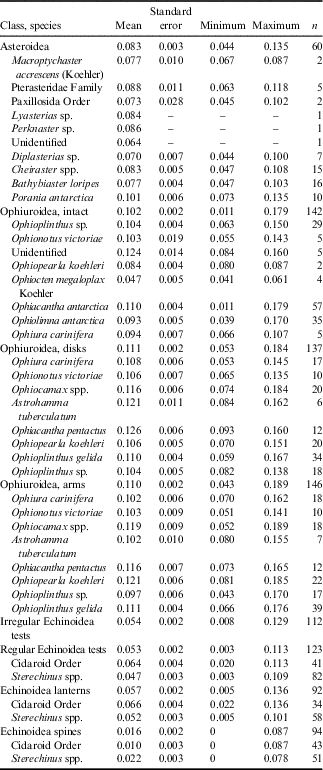
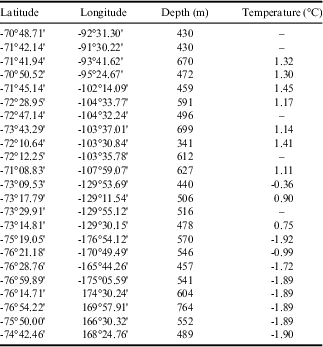
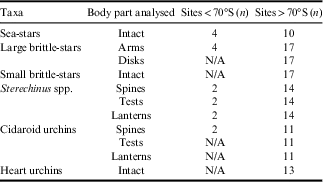
Echinoderms were collected during two Antarctic cruises and encompassed 20 taxa representative of Echinoidea, Ophiuroidea and Asteroidea (Table I). The majority of the species were collected on National Science Foundation (NSF) research cruise NBP12-10 aboard the US RV Nathaniel B. Palmer (1 January – 9 February 2013). During this cruise, collections were initiated at 70°S latitude at sites along the Bellingshausen and Amundsen seas and then extending to the Ross Sea to a latitude of 76°S. Individuals were collected using a Blake Trawl (1.5 m width) at 23 different collecting sites and bottom temperatures were collected using Seabird SBE3 oceanographic temperature sensors on a CTD rosette that were maintained by the US Antarctic Program (Halanych Reference Halanych2015). The mean±1 standard error (s.e.) depth of sampling sites was 534±20.5 m (range 341–764 m; Table II). Echinoderms were initially sorted to morphospecies aboard the ship and vouchers for each photographed, labelled and either fixed in 70% ethanol or frozen for post-cruise shipment and subsequent identification to the lowest taxon possible.
Mean Mg/Ca ratio and total number of individuals for each taxon examined in the present study.

Latitude, longitude, temperature (°C) and depth (m) of the 23 collection sites above 70°S from January 2013 research cruise.

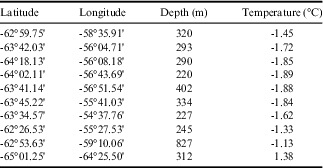
A smaller collection of additional species of echinoderms was carried out on a second NSF research cruise (LMG13-12) aboard the US RV Laurence M. Gould (22 November – 20 December 2013). Collection methods were identical to those described above. During this second cruise echinoderms were sampled from ten additional geographical sites, but at lower latitude sites (62–65°S) in close proximity to the northern tip of the western Antarctic Peninsula (Table III). Again, bottom temperatures were collected using Seabird SBE3 oceanographic temperature sensors on a CTD rosette that were maintained by the US Antarctic Program (Halanych Reference Halanych2014). Echinoderms were photographed, frozen and then shipped post-cruise to Auburn University, AL, USA. Intact individuals or body components of individuals of these species were added to the much larger collection of species collected on the earlier cruise, and included several species of sea-stars, arms of a large brittle-star, the spines of a cidaroid urchin and intact individuals of the regular sea urchin Sterechinus spp.
Latitude, longitude, temperature (°C) and depth (m) of the ten collection sites along the western Antarctic Peninsula from the November 2013 research cruise.

During the NBP12-10 cruise in January 2013, echinoderms were processed aboard the ship. Brittle-stars with disk diameters > 1.5 cm were dissected with a scalpel into central disks and arms. Smaller brittle-stars were analysed intact. Spines, test and Aristotle’s lantern were dissected from all regular sea urchins. Sea-stars and irregular heart urchins were analysed intact.
To prepare skeletal material, intact individuals or their body components were placed in a drying oven for 24 h at 35 °C and then digested in a 10% NaClO solution to remove all tissue (McClintock et al. Reference McClintock, Amsler, Angus, Challener, Schram, Amsler, Mah, Cuce and Baker2011). The NaClO solution was exchanged as needed to facilitate complete digestion of organic material. Cleaned skeletal elements were rinsed generously with distilled water, vacuum dried and then placed in a drying oven for 24 h. Each resultant skeletal sample was folded within a sheet of aluminium foil, placed into a labelled zip-lock bag and shipped to the University of Alabama at Birmingham, AL, USA. Skeletal material from intact individuals or body components was then ground into a fine powder using an agate mortar and pestle with the addition of several ml of 95% ethanol to reduce heating. The resulting slurry was air dried for 12 h and the subsequent powder used in mineralogical analysis. Skeletal preparation was carried out in an identical manner for the echinoderm samples collected during the second cruise (LMG13-12, November–December 2013).
Mg/Ca ratios were determined by X-ray diffraction (XRD) using a Philips X’Pert Analytical XRD system (PANalytical, Almelo, the Netherlands). The system was set to run at 45 kV and 40 mV with a 2Θ angular scan range of 27–32°. The scan speed was 2 s per step with a step size of 0.02 to obtain accurate measurements of the calcite peak occurring at 2Θ=29.5–30.2°. Resulting diffraction patterns were used to determine the Mg/Ca ratio following the equation given in Ries (Reference Ries2011), where ‘2Θ’ is the measured location of the calcite peak on each sample’s XRD patterns:
 $${\rm Mg}\!/\!{\rm Ca }\, {\equals}\, 0.{\rm 17881}\left( {{\rm 2}\Theta } \right)^{{\rm 2}} -{\rm 1}0.{\rm 2}0{\rm 926}\left( {{\rm 2}\Theta } \right){\plus}{\rm 145}.{\rm 59368}.$$
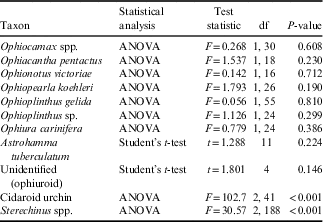
The data generated allowed two intra-taxon statistical comparisons of Mg/Ca ratios. First, comparisons were made for those taxa whose discrete body component skeletal analysis was available. These included large (>1.5 cm disk diameter) brittle-stars that were separated into a central disk and arms, as well as the regular sea urchins that had been divided into test, spines and Aristotle’s lantern (feeding apparatus). For each taxon of large brittle-star occurring at only one location, mean Mg/Ca ratio of the skeletal material of arms was compared with the central disk using a Student’s t-test (Table IV). For those collected at two or more locations, mean Mg/Ca ratio of skeletal material of arms was compared with the central disk using a two-way ANOVA (Table IV). The two-way ANOVA tested the effect of both body component and location on Mg/Ca ratios. For each taxon of regular sea urchin, the mean Mg/Ca ratios of skeletal material that comprised the test, spines and lantern apparatus were compared with one another using a one-way ANOVA (Table IV). A Tukey HSD post-hoc test was carried out to detect which components were significantly different from one another. Prior to carrying out all statistical analyses, Mg/Ca ratios were log (x+1) transformed to fit a normal distribution.
Statistical results of mean skeletal Mg/Ca ratio comparisons between body components of brittle-stars (arms and disk) and sea urchins (test, lantern and spines).

In the second intra-taxon comparison, Mg/Ca ratios were compared for each taxon that was collected at multiple geographical sites and had more than three individuals collected per site. This allowed an assessment of whether mineralogical composition of skeletons varied across sites within a given taxon or species. Mg/Ca ratios of body components for large brittle-stars and regular sea urchins, as well as intact sea-stars, brittle-stars and heart urchins were analysed accordingly. As above, species of large brittle-stars and regular sea urchins were analysed using a two-way ANOVA, looking at components and site in the same test. For other taxa not separated into body components, a one-way ANOVA was employed if three or more sites were included in a given intra-taxon geographical comparison. A Tukey HSD test was used to specify differences among specific sites. If samples from only two geographical sites were compared for a given taxon, a Student’s t-test was employed.
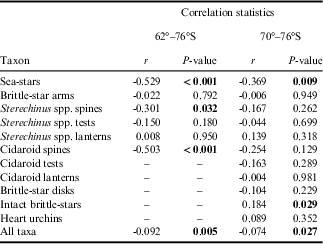
Mg/Ca ratios were used to evaluate whether or not a correlation existed between skeletal magnesium content of collective and in some cases individual echinoderm taxa (whole body or body component) and latitude. This potential relationship was analysed across two different sets of latitudes (Table V) by conducting two analyses. First, a Spearman’s correlation analysis was conducted using echinoderm taxa that were collected on both cruises (from 62–76°S). These included large brittle-star arms, Sterechinus spp. (test, lantern and spines), cidaroid spines and intact sea-stars (Table VI). A second Spearman’s correlation analysis was then conducted only for those echinoderms collected between 70–76° latitude as this represented a region lacking significant sampling of echinoderm skeletons prior to the present study.
The number of sites at which each taxon was collected either below 70°S or above 70°S latitude.

N/A=not applicable.
Statistical results of the Spearman’s correlation analysis between latitude and mean Mg/Ca ratios of echinoderm body components examined in this study.

To evaluate whether Mg/Ca ratios of echinoderm skeletal components were potentially correlated with either depth or seawater temperature at each collection site between 70–76° latitude, the R package (R Development Core Team 2013) was used to conduct multiple regression analyses. In order to avoid any confounding of differences in Mg/Ca ratios between body components of a given species, regression analyses were focussed on skeletal material from whole ophiuroids (small species), ophiuroid arms (large species), whole asteroids and echinoid tests.
Results
Mg/Ca ratios of skeletal material from body components or intact individuals of the three classes of echinoderms examined ranged from 0 to 0.189. Mean Mg/Ca ratios were highest in brittle-star disks (0.111±0.002; n=137) and arms (0.110±0.002; n=146), and lowest in regular sea urchin spines (0.016±0.002; n=94) (Table I).
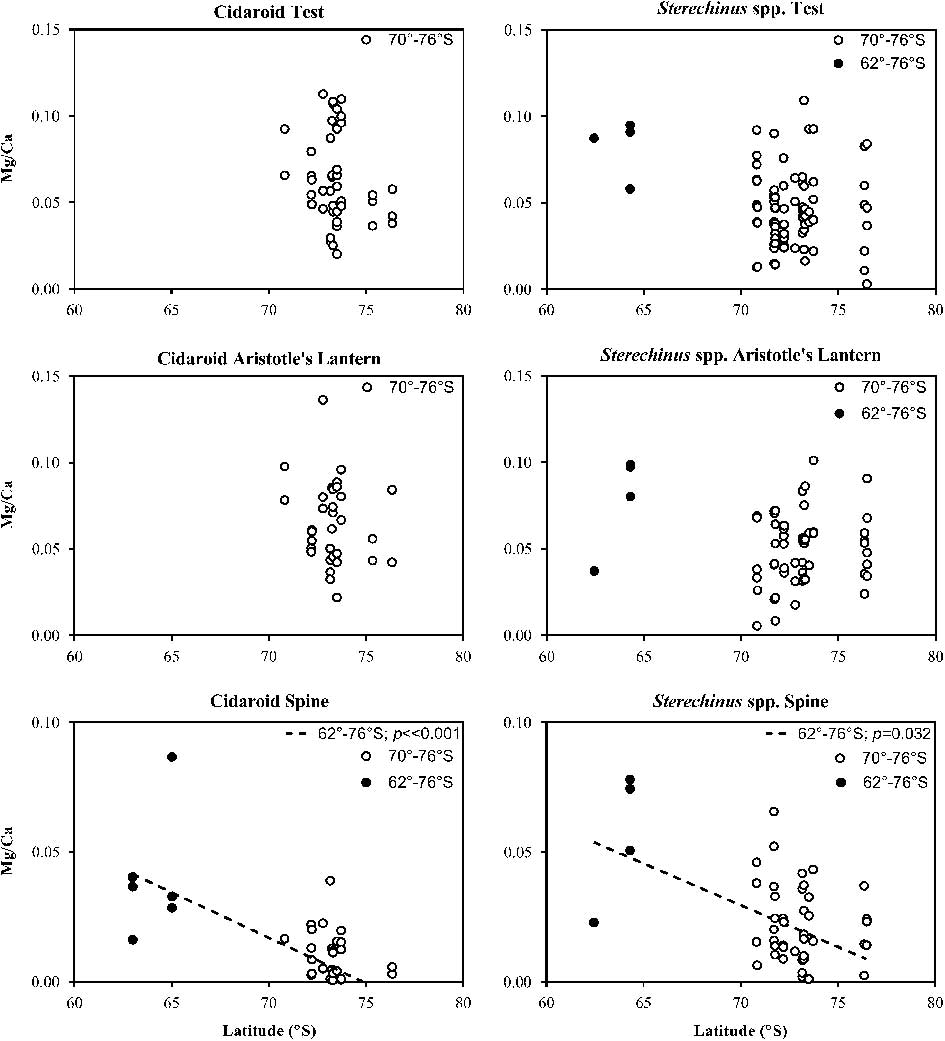
The mean Mg/Ca ratio of the central disk of large brittle-stars did not differ significantly from the mean Mg/Ca ratio of arms for any of the eight taxa examined: Ophiocamax spp., Ophiacantha pentactus Mortensen, Ophionotus victoriae Bell, Ophiopearla koehleri (Bell), Ophioplinthus gelida (Koehler), Ophioplinthus sp., Ophiura carinifera (Koehler) and Astrohamma tuberculatum (Koehler) (Table IV). In contrast, the mean Mg/Ca ratios in skeletal mineralogy in several of the body components of the two taxa of regular sea urchins examined, cidaroid urchins and Sterechinus spp., differed from one another (Table IV). Intra-taxon differences in mean Mg/Ca ratios among body components of cidaroids were attributable to spines having a significantly lower mean Mg/Ca ratio compared with the lantern and test (Tukey HSD test, P<0.001). Mean Mg/Ca ratios for the cidaroid lantern and test did not differ significantly from one another (Tukey HSD test, P=0.894). Similar significant differences in mean Mg/Ca ratios were detected among the body components of Sterechinus spp., with spines having a lower mean Mg/Ca ratio than the test and lantern (Tukey HSD test, P<0.001). The mean Mg/Ca ratio did not differ between test and lantern (Tukey HSD test, P=0.476).
When compared across all 33 sampling sites (both cruise collections combined), seven of nine taxa of large brittle-stars fit the criteria for geographical site-specific comparisons of Mg/Ca ratios: Ophiocamax spp., Ophiacantha pentactus, Ophionotus victoriae, Ophiopearla koehleri, Ophioplinthus gelida, Ophioplinthus spp. and Ophiura carinifera. Since no significant differences were found between the Mg/Ca ratios of arms and disks for each of these taxa, these data were combined for site-specific comparisons. Among the seven taxa, Ophionotus victoriae was the only taxon to demonstrate a significant site-specific difference in mean Mg/Ca ratios (ANOVA, F (1,16)=14.26, P=0.002). The two collecting sites compared for this taxon were located at 71.7°S and 76.9°S latitude, and the level of magnesium in skeletal materials was higher at the lower latitude site (Mg/Ca = 0.049) than at the higher latitude site (Mg/Ca = 0.038). Cidaroid urchins demonstrated no site-specific differences in mean Mg/Ca ratios for tests or lanterns (ANOVA, F (9,29)=0.699, P=0.705 and F (6,19)=2.515, P=0.058, respectively), but had significant differences in the mean Mg/Ca ratio for spines (ANOVA, F (9,27)=3.361, P=0.007). One site from the LMG13-12 cruise (65°01.25'S, 64°25.50'W) was found to be significantly different from the other collection sites. Similarly, Sterechinus spp. demonstrated significant differences in mean Mg/Ca ratios for spines (ANOVA, F (10,33)=3.770, P=0.002) but not for tests (ANOVA, F (14,66)=1.378, P=0.189) or lanterns (ANOVA, F (12,41)=1.792, P=0.082). Here again, a single collection site from the LMG13-12 cruise (64°18.13'S, 56°08.18'W) was driving the significant differences among spines.
Three taxa of sea-stars (Porania antarctica Smith, Cheiraster spp. and Bathybiaster loripes Sladen) were analysed for intraspecific geographical differences in skeletal magnesium content. None of these taxa demonstrated significant site-specific differences in mean Mg/Ca ratio (ANOVA, F (2,6)=1.19, P=0.365; F (3,9)=1.87, P=0.205; and F (4,11)=0.53, P=0.719, respectively). The three taxa of intact brittle-stars examined, Ophiacantha antarctica Koehler, Ophiolimna antarctica (Lyman) and Ophioplinthus sp., similarly showed no site-specific differences in mean Mg/Ca ratio (ANOVA, F (9,44)=0.585, P=0.802; F (4,30)=0.905, P=0.473; and t-test, t (27)=0.306, P=0.762, respectively). Heart urchins (analysed as a single taxon) also demonstrated no site-specific differences in Mg/Ca ratios (ANOVA, F (12,99)=1.018, P=0.439).
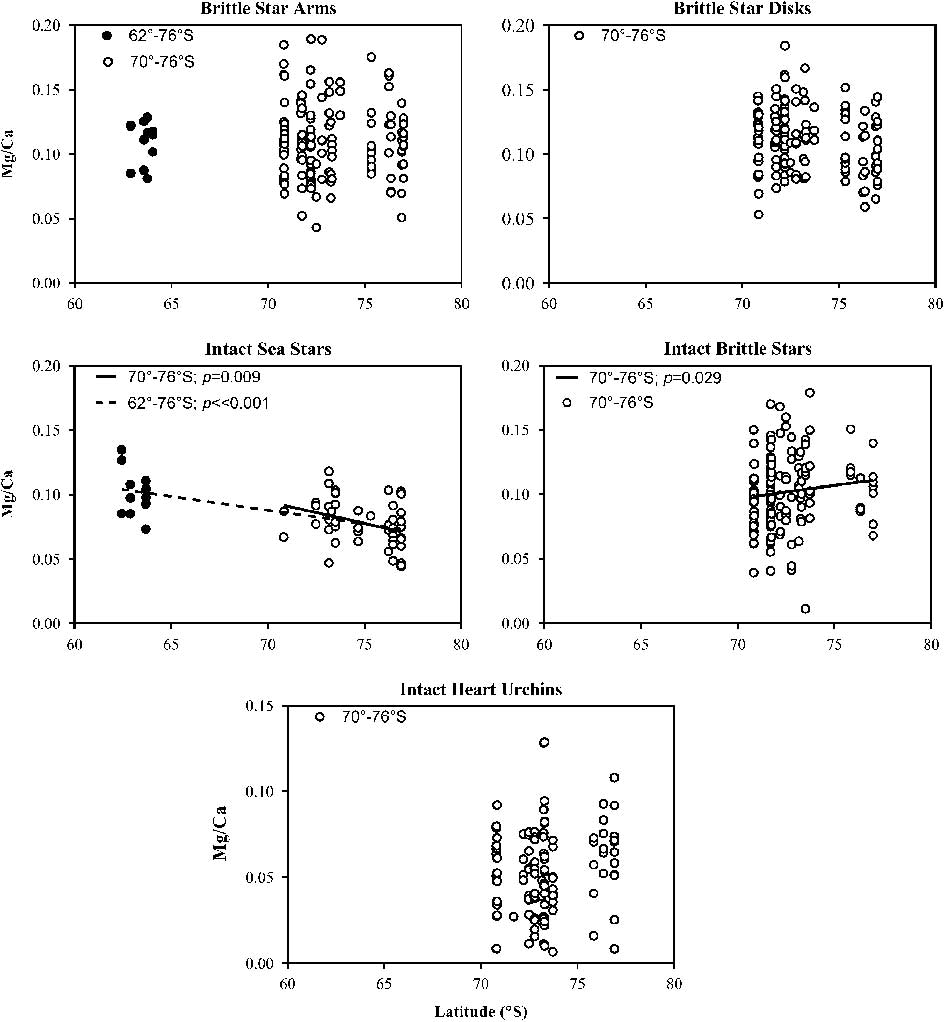
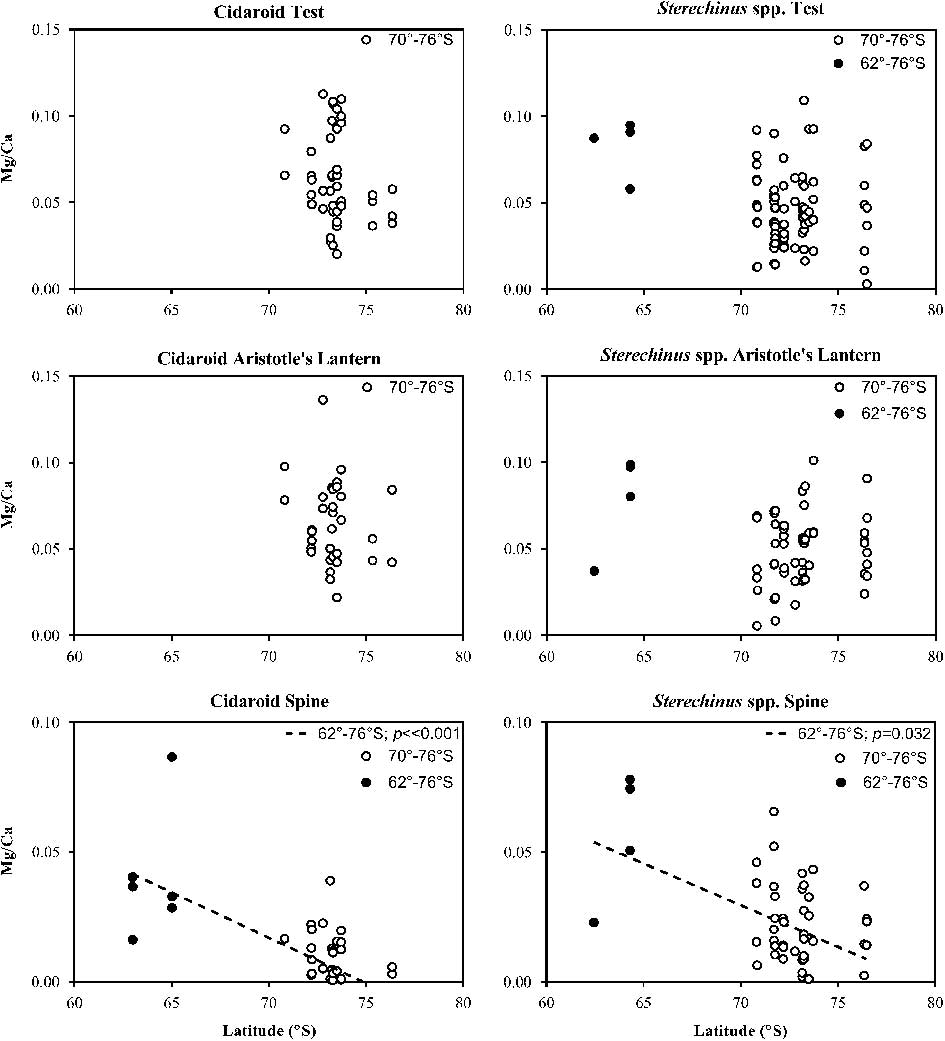
Correlation analysis was first conducted by combining echinoderm taxa collected on both cruises across a latitudinal range of 62° to 76°S. This included intact sea-stars, arms of large brittle-stars, cidaroid spines, and the test, spines and lanterns of the regular sea urchin Sterechinus spp. (Table VI). A significant inverse correlation was detected between latitude and skeletal Mg/Ca ratio in all intact individuals or body components examined with the exception of the arms of brittle-stars and the Aristotle’s lantern of Sterechinus spp. (Figs 1 & 2). The per cent variation in Mg/Ca ratio explained by variation in latitude was 1.12%. In contrast, a correlation analysis focusing on taxa collected between 70° and 76°S revealed that only sea-stars demonstrated a significant negative correlation between latitude and skeletal Mg/Ca ratio (Table VI, Figs 1 & 2). Multiple regression analysis revealed no significant relationship between skeletal Mg/Ca ratio and sample site depth (r s=0.053975, P=0.3397; n=315) or temperature (r s=-0.016413, P=0.7717; n=315) for samples collected between 70° and 76°S.
Correlation analyses between latitude and Mg/Ca ratios of skeletal components of large brittle-stars (arms and central disks), and intact sea-stars, brittle-stars and heart urchins (Table I presents distribution of taxa and replicates within a given taxa). Closed circles represent the Mg/Ca ratios for samples collected north of 70°S and open circles represent those collected south of 70°S. The solid lines represent the correlation between latitude and Mg/Ca ratios between 70–76°S latitude. The dashed lines represent the correlation between latitude and Mg/Ca ratios between 62–76°S latitude. P<0.05 indicate significant correlations between latitude and Mg/Ca ratios of skeletal material.

Correlation analyses between latitude and Mg/Ca ratios of skeletal components of cidaroid sea urchins (collective taxa) and regular sea urchins in the genus Sterechinus. Sea urchins were separated into test, spines and Aristotle’s lantern. Closed circles represent the Mg/Ca ratios for samples collected between 70–76°S and open circles represent those collected between 62–65°S. The solid lines represent the correlation between latitude and Mg/Ca ratios from 70–76°S latitude. The dashed lines represent the correlation between latitude and Mg/Ca ratios between 62–76°S latitude. P<0.05 represent significant correlations between latitude and Mg/Ca ratios of skeletal material.
Discussion
Skeletal Mg/Ca ratios of echinoderms and other calcifying marine invertebrates are highly reliant on seawater saturation state, the Mg/Ca content and temperature (Mackenzie et al. Reference Mackenzie, Bischoff, Bishop, Loijens, Schoonmaker and Wollast1983, Magdans & Hermann Reference Magdans and Hermann2004, Ries Reference Ries2004, Andersson et al. Reference Andersson, Mackenzie and Bates2008). The present study adds to a limited knowledge of the mineralogy of skeletons of Antarctic echinoderms by indicating that brittle-stars and sea-stars may be disproportionately at risk from OA because of their higher skeletal Mg/Ca ratios. Moreover, prior to the present analysis, with the exception of two species of echinoderms, little information was available for taxa collected at latitudes south of 70°S. Because of the comparatively low temperature of the Southern Ocean there is a high solubility of carbonate compared with temperate and tropical oceans, and therefore, naturally low saturation states for carbonate minerals. Accordingly, the Southern Ocean is already experiencing some of the first effects of OA (Andersson et al. Reference Andersson, Mackenzie and Bates2008, Fabry et al. Reference Fabry, McClintock, Mathis and Grebmeier2009). For example, the aragonite shells of some thecosome pteropods in regions of the Southern Ocean are displaying evidence of dissolution due to periodic undersaturation (Bednaršek et al. Reference Bednaršek, Tarling, Bakker, Fielding, Jones, Venables, Ward, Kuzirian, Lézé, Feely and Murphy2012).
The high Mg/Ca skeletons of echinoderms place them at similar high risk to OA. Understanding whether Antarctic echinoderms will be able to compensate for dissolution by redirecting sufficient energy and resources into skeletal maintenance without reducing fitness or suffering significant mortality is an important consideration (Wood et al. Reference Wood, Spicer and Widdicombe2008). Moreover, understanding how echinoderms may cope with OA is critical because they constitute a major taxa that dominates the biomass of many benthic communities throughout the Southern Ocean and contribute substantially to global carbonate cycles (Arntz et al. Reference Arntz, Brey and Gallardo1994, David et al. Reference David, Choné, Mooi and De Ridder2005, Lebrato et al. Reference Lebrato, Iglesias-Rodríguez, Feely, Greeley, Jones, Suarez-Bosche, Lampitt, Cartes, Green and Alker2010, Reference Lebrato, Andersson, Ries, Aronson, Lamare, Koeve, Oschiles, Iglesias-Rodriguez, Thatje, Amsler, Vos, Jones, Ruhl, Gates and McClintock2016, Grange & Smith Reference Grange and Smith2013). In addition to their abundance, some echinoderms in Antarctica also play key predatory roles in structuring benthic communities (Dayton et al. Reference Dayton, Robilliard, Paine and Dayton1974, Arntz et al. Reference Arntz, Brey and Gallardo1994, McClintock Reference McClintock1994).
Previous studies have largely measured mol% MgCO3 or wt% MgCO3 when evaluating the magnesium content of echinoderm skeletons. In the present study, Mg/Ca ratios were measured instead. This approach employs XRD analysis and has the added benefit of detecting only magnesium that is incorporated into the calcite crystal lattice structure of skeletal components. Former methodologies (e.g. secondary ion mass spectrometry, inductively coupled plasma mass spectrometry and energy dispersive spectroscopy) detect magnesium that is also present outside of the calcite crystalline structure, e.g. organic molecules rich in magnesium (Milliman Reference Milliman, Müller and Förstner1974), leading to overestimation of magnesium content. Although measuring skeletal Mg/Ca ratios is more accurate, it limits our ability to compare our measurements directly with those in former studies. Nonetheless, it was still possible to identify skeletal patterns in magnesium content and evaluate the proposed inverse correlation between latitude and skeletal magnesium content that had been reported using different techniques (Chave Reference Chave1954, McClintock et al. Reference McClintock, Amsler, Angus, Challener, Schram, Amsler, Mah, Cuce and Baker2011, Smith et al. Reference Smith, Clark, Lamare, Winter and Byrne2016).
The present study and that of McClintock et al. (Reference McClintock, Amsler, Angus, Challener, Schram, Amsler, Mah, Cuce and Baker2011) found that brittle-stars and sea-stars were the two classes of echinoderms with the highest magnesium content. Although these data indicate that the skeletal structures of brittle-stars and sea-stars are at greater risk of dissolution under conditions of OA, this conclusion must also be evaluated in the context of skeletal vulnerability. Sea-stars and brittle-stars lack the interconnected skeletal plates that occur in sea urchins (see Smith et al. Reference Smith, Clark, Lamare, Winter and Byrne2016) and their skeletal ossicles are often embedded within the tissues that form the body wall. Brittle-stars and sea-stars may have evolved skeletal components with high ratios of Mg/Ca because their skeletal elements are more protected from seawater pH. However, at least one study to date has found that despite a thicker body wall, sea-star skeletons remain vulnerable to OA. Gooding et al. (Reference Gooding, Harley and Tang2009) reported that upon chronic exposure to CO2 levels of 780 ppm over a 70 day period the sea-star Pisaster ochraceus (Brandt) underwent a significant reduction in calcified mass.
Similar to differences detected in Mg/Ca ratios or content among classes of echinoderms (McClintock et al. Reference McClintock, Amsler, Angus, Challener, Schram, Amsler, Mah, Cuce and Baker2011, Lebrato et al. Reference Lebrato, Andersson, Ries, Aronson, Lamare, Koeve, Oschiles, Iglesias-Rodriguez, Thatje, Amsler, Vos, Jones, Ruhl, Gates and McClintock2016, present study), variation may also occur between species within a class and within skeletal material associated with different body components of individuals (McClintock et al. Reference McClintock, Amsler, Angus, Challener, Schram, Amsler, Mah, Cuce and Baker2011, Smith et al. Reference Smith, Clark, Lamare, Winter and Byrne2016). In the present study, brittle-stars demonstrated no difference between mean Mg/Ca ratios of the central disk and arms, but regular sea urchins showed significant differences in mean Mg/Ca ratios based on body component. This variability is consistent with past and recent studies of the mineralogy of skeletons of regular sea urchins (Chave Reference Chave1954, Weber Reference Weber1969, Byrne et al. Reference Byrne, Smith, West, Collard, Dubois, Graba-landry and Dworjanyn2014, Smith et al. Reference Smith, Clark, Lamare, Winter and Byrne2016). Among regular sea urchins, the highest mean ratios of Mg/Ca were found in the test and Aristotle’s lantern, but two- and fourfold lower mean Mg/Ca ratios in the spines of Sterechinus spp. and, especially, cidaroid urchins, respectively, when compared with other skeletal body components. Smith et al. (Reference Smith, Clark, Lamare, Winter and Byrne2016) similarly found the highest content of magnesium in subcomponents of the Aristotle’s lantern (9.5–12.3% MgCO3) and modestly lower levels in the test (9.3% MgCO3) in a suite of echinoids sampled from tropical, temperate and polar latitudes. In contrast, Byrne et al. (Reference Byrne, Smith, West, Collard, Dubois, Graba-landry and Dworjanyn2014) found that the Aristotle’s lantern in the sea urchin Tripneustes gratilla (L.) had the lowest (6.5% MgCO3) and the test the highest (8.6% MgCO3) magnesium content. Such interspecific differences could be derived from functional morphology; however, more research is necessary to determine the source of this variation. Byrne et al. (Reference Byrne, Smith, West, Collard, Dubois, Graba-landry and Dworjanyn2014) attributed the increased magnesium content of tests to their function, indicating a higher magnesium content strengthens calcite making the test more resilient against crushing or drilling predators.
One unique aspect of the present study was the feasibility of making intraspecific comparisons of Mg/Ca ratios in skeletal body components and intact individuals collected from geographically separated subpopulations. For example, in one of the sea-star taxa examined, Cheiraster spp., collections spanned four different sites over a distance of c. 1500 km (western Antarctic Peninsula to Ross Sea). Our analysis indicated that intraspecific collection site differences in the Mg/Ca ratio within a given body component are rare. The vast majority of taxa (79% of 14 species) analysed across different collection sites showed no intraspecific differences in Mg/Ca ratios between given skeletal components. Rare exceptions included the spines in the echinoid Sterechinus spp. and a cidaroid sea urchin, along with the combined arms and disks of the brittle-star Ophionotus victoriae. We are unaware of other comparative studies that take a comparative geographical approach, except that of McClintock et al. (Reference McClintock, Amsler, Angus, Challener, Schram, Amsler, Mah, Cuce and Baker2011) who sampled the Antarctic sea-star Labidiaster annulatus Sladen at three sites, one at 61°S and the other two near 65°S. Here, a small but significant difference was found in the wt% MgCO3 of the skeletal ossicles at one of the three sites. Although uncommon, that magnesium skeletal content can vary intraspecifically with geographical locale for a given body component suggests the capacity for some plasticity in mineralogy. If so, this plasticity could be important for echinoderms as they become increasingly challenged by OA.
While there was generally no variation within species or individuals for sea-stars or brittle-stars, sea urchins examined in the present study exhibited considerable variation of magnesium content based on body component. The basis for the variance in the magnesium content of spines in cidaroids and regular urchins is unknown. However, unlike the test and the lantern that are constantly exposed internally to reduced pH and subsaturation states (e.g. Collard et al. Reference Collard, Eeckhaut, Dehairs and Dubois2014), the spines of cidaroid urchins lack an epithelium and are completely exposed to seawater. Moreover, the epithelium of the spines of regular sea urchins is thin and permeable. Therefore, spines may provide a more sensitive, direct measure of the impacts of saturation state than other body components. Thus, at higher latitudes where saturation state is reduced, despite the capacity for sea urchins to calcify below the saturation horizon (David et al. Reference David, Choné, Mooi and De Ridder2005), the magnesium content of spines is somewhat reduced.
The present study provides further support of the long-held postulate that there exists an inverse correlation between latitude and skeletal magnesium content in echinoderms (Chave Reference Chave1954, Andersson et al. Reference Andersson, Mackenzie and Bates2008, McClintock et al. Reference McClintock, Amsler, Angus, Challener, Schram, Amsler, Mah, Cuce and Baker2011, Smith et al. Reference Smith, Clark, Lamare, Winter and Byrne2016). Data in the present study generally support this latitudinal relationship as a significant inverse correlation was detected between latitude and Mg/Ca ratio for echinoderms sampled between 62–76° latitude. However, in species collected between 70–76° latitude, a high latitude region not previously sampled, a similar inverse correlation was detected for sea-stars but not for brittle-stars and echinoids. Saturation state does not appear to be driving the inverse correlation detected with latitude as deep water Antarctic echinoderms are currently rarely exposed to undersaturated conditions (<5%; Lebrato et al. Reference Lebrato, Andersson, Ries, Aronson, Lamare, Koeve, Oschiles, Iglesias-Rodriguez, Thatje, Amsler, Vos, Jones, Ruhl, Gates and McClintock2016). Changes in saturation state, however, will increasingly impact Antarctic echinoderms. For example, Sewell & Hofmann (Reference Sewell and Hofmann2011) speculate that as the calcite saturation horizon shallows in the Southern Ocean under OA conditions, calcification in the heavily calcified brooded juveniles of echinoids will be greatly challenged.
When the relationship between collection site temperature and depth was further examined for our skeletal samples from 70–76° latitude no significant correlations were found between skeletal Mg/Ca ratio and either variable. This suggests that neither temperature nor depth per se explain the inverse correlation in Mg/Ca ratio detected in sea-stars across this range of latitude. Temperature variation across the polar latitudinal range examined may not have been sufficient enough to be a contributing factor. Moreover, the deepest depth examined (764 m) did not approach that of the current calcite saturation horizon of c. 3000 m (Sewell & Hofmann Reference Sewell and Hofmann2011). On a broader global scale, the pattern of higher magnesium content in echinoderm skeletons at low latitudes has been postulated to be related to the warm temperatures of tropical seas increasing calcification rates resulting in increased amounts of magnesium captured by crystals growing within the organic matrix (Weber Reference Weber1969). More recently, Smith et al. (Reference Smith, Clark, Lamare, Winter and Byrne2016) speculated that since the solubility product of calcite is 1.3-times higher in cold polar seas than in warm tropical waters, incorporation of higher levels of magnesium into calcite (which further increases solubility) in polar species might make maintaining a skeleton too demanding from a physiological standpoint (Smith et al. Reference Smith, Clark, Lamare, Winter and Byrne2016).
If not seawater temperature, depth or saturation state, what other factors might be driving the inverse correlation detected between Mg/Ca ratio and latitude (62–76°) in the Antarctic echinoderms examined? A rigorous evaluation of such factors is beyond the scope of the present study but is worth consideration for future investigation. One hypothesis is that even within polar seas there is a decline in predation pressure on echinoderms with increasing latitude. As skeletal hardness increases with increased magnesium content (Kunitake et al. Reference Kunitake, Baker and Estroff2012) a decline in magnesium content with increasing latitude may reflect reduced evolutionary selection pressure for a hardened protective skeleton. A second possibility is that Antarctic echinoderms have increasingly reduced rates of growth as latitude increases across polar latitudes and this slower growth translates into a reduction in skeletal magnesium content.
Acknowledgements
First and foremost, the authors wish to thank the anonymous reviewers of this manuscript for the collective input that significantly improved the final paper. The authors also thank Gopi Samudrala and Yogesh Vohra for their assistance with XRD measurements performed in the UAB Department of Physics. We further thank Pamela Brannock for her assistance with sample collection and preparation aboard the research vessels. We extend our gratitude for logistical and personnel support to Lockheed Martin Company and the Antarctic Support Contract. We appreciate the invaluable assistance with sample preparations provided by Margaret Amsler. The present study was supported in part by NSF grants ANT-1043745 awarded to KMH and ANT-1041022 awarded to JBM, Charles D. Amsler and Robert A. Angus. JBM acknowledges UAB support provided by the Endowed Professorship in Polar and Marine Biology. This is Molette Biology Laboratory contribution 74 and Auburn University Marine Biology Program contribution 170.
Author contributions
AD and JBM conceptualized and designed the research plan. AD and KMH carried out cruise-based sample collections in Antarctica. AD conducted laboratory-based sample preparation and analyses. RAA designed and conducted statistical analyses. All four co-authors assisted in data interpretation.