Introduction
Currently, the primary two-stage arterial switch operation is accepted as the standard corrective treatment of the transposition of great vessels with intact ventricular septum (TGA-IVS).Reference Bisoi, Sharma and Chauhan 1 , Reference Sarris and Balmer 2 Left ventricle mass regression and pump failure against systemic workload are issues of primary arterial switch operation in patients beyond the neonatal period, and the upper age limit is controversial despite pre-operative echocardiographic parameters.Reference Sarris and Balmer 2 , Reference Foran, Sullivan, Elliott and de Leval 3 Perioperative problems are challenging especially in patients over 2 months of age; therefore in these late-referred cases, arterial switch operation following the left ventricle retraining period can be an alternative treatment.Reference Lacour-Gayet, Piot and Zoghbi 4 The classical method of left ventricle retraining is pulmonary artery banding with or without a Blalock Taussig shunt procedure.Reference Yacoub, Radley-Smith and McLaurin 5 , Reference Jonas, Giglia and Sanders 6 Although good results were reported in patients at 1-month-old with rapid two-stage arterial switch operation, high mortality rates related to refractory left ventricle failure despite retraining are frustrating especially beyond 3 months of age.Reference Ma, Hua and Yang 7 Left ventricle retraining is realised with pulmonary banding which increases afterload with pressure gradient to regain normal ventricular geometry combined with Blalock Taussig shunt to balance oxygen saturation. Moreover, Blalock Taussig shunt also promotes volume loading potentiating left ventricle workload.
Despite improvements in surgical and post-operative management, significant mortality and morbidity related to overflow and acute graft thrombosis are still important concerns about Blalock Taussig shunt operations.Reference Nassar, Narayan and Nyman 8 , Reference Dirks, Prêtre and Knirsch 9 On the other hand, Bidirectional Glenn shunt can promote a satisfactory level of arterial oxygen saturation without increasing pulmonary vascular resistance and producing ventricular volume overload.Reference Nassar, Narayan and Nyman 8 , Reference Dirks, Prêtre and Knirsch 9 We suggest that bidirectional cava-pulmonary anastomosis (Glenn procedure) combined with pulmonary artery banding can be a safe and equally effective alternative to pulmonary artery banding and Blalock Taussig shunt placement as the initial surgical procedure for left ventricle retraining in two-stage arterial switch operation.
The objective of this study was to evaluate the results of left ventricle retraining with bidirectional cava-pulmonary anastomosis (Glenn) and pulmonary artery banding in patients with simple TGA who are candidates for two-stage arterial switch operation because of late referral. To our knowledge, this is the first study in literature investigating the safety and efficacy of this alternative surgical approach for this special patient cohort.
Methods
The study was conducted in the Department of Pediatric Cardiology and Department of Cardiovascular Surgery of Istanbul Bilim University, Istanbul Florence Nightingale Hospital. Our centre is one of the major referral centres in the region for treatment of congenital heart diseases. We have made agreements with Ministry of Health Departments of several countries in the region, and we receive approximately 300–350 cases each year from neighbouring countries for surgical and interventional treatments of these patients. Approval of the Institutional Ethics Committee and informed written consent from parents/legal guardians were obtained prior to enrolment in the study.
Patients
Between July 2013 and April 2017, 47 patients diagnosed with TGA-IVS who had left ventricle dysfunction and underwent the two-stage arterial switch operation were analysed retrospectively.
All patients were more than two months old, and they were referred for corrective surgery from neighbouring countries. They were accepted as candidates for two-stage arterial switch operation according to previously cited criteriaReference Lacour-Gayet, Piot and Zoghbi 4 : more than two months of age at presentation with left ventricle dysfunction; left ventricle mass index < 35g/m2; and “banana-shaped” left ventricle geometry. Exclusion criteria included anatomy not appropriate for biventricular correction; patients with no follow-up during the interstage period; patients with severe non-cardiac anomalies/comorbidities; andpatients with hemodynamically significant Patent Ductus Arteriosus (PDA) or Left Ventricular Outflow Tractus Obstruction (LVOTO).
Patients included in this study were divided into two groups: There were 19 patients in Group 1, and all underwent pulmonary artery banding and an aorta-pulmonary Blalock Taussig shunt. In contrast pulmonary artery banding with a bidirectional cava-pulmonary anastomosis was performed in 28 patients in Group 2 for left ventricle training as the first stage procedure.
Echocardiography
Echocardiographic examination was performed on all patients with special reference to the left ventricle geometry (dimensions, shape, and wall thickness), interventricular septal motion, coronary artery pattern, aortic arch anatomy, ductal size, and left ventricle outflow tract obstructionReference Schiller, Shah and Crawford 10 , Reference Van Doesburg, Bierman and Williams 11 , Reference Sidi, Planch′e and Kachaner 12 (GE S5 the General Electric Medical Systems (United States of America), 3 and 7 MHz probes). All measurements were performed by the same paediatric cardiologist, and all records were evaluated as previously described by Margossian et al.Reference Margossian, Zak and Shillingford 13 Frozen end-diastolic images of the left ventricle were used to measure left ventricle end-diastolic and epicardial volumes using the bullet formula.Reference Sarris and Balmer 2 , Reference Nassar, Narayan and Nyman 8 , Reference Margossian, Zak and Shillingford 13 The left ventricle myocardial mass was calculated. The left ventricle posterior wall thickness was measured at end-diastole at the mid-cavity level. These values were indexed to body surface area. Left ventricle cavity shape was assessed from subcostal short axis views of the heart an end-systole.Reference Dirks, Prêtre and Knirsch 9 , Reference Margossian, Zak and Shillingford 13 LV cavity shape was classified as “favourable” if the lateral/anteroposterior dimension ratio was 2; “acceptable” if the ratio was between 2 and 3; and “unfavourable” if the ratio was 3. Patients with higher ratios had crescent-shaped left ventricle cavities.Reference Sarris and Balmer 2 , Reference Schiller, Shah and Crawford 10 , Reference Margossian, Zak and Shillingford 13 The presence of a patient arterial duct was considered significant if it measured ≥3 mm at its narrowest point. The pattern of coronary artery anatomy was determined using echocardiography and confirmed at surgery.
Surgical management
Both modified Blalock-Taussig (MBT) and cava-pulmonary shunt procedures were performed under normothermic cardiopulmonary bypass support. Following median sternotomy and total thymectomy, pericardiotomy was done. Then the cardiopulmonary bypass established with bicaval cannulation cardiopulmonary bypass was established. A 4 or 5-mm diameter Polytetrafluoroethylene (PTFE) vascular graft (W. L. Gore & Associates, Inc., Newark, DE, United States of America) was used according to patients’ weight in Blalock Taussig shunt group (e.g., 4 mm for weight of 4–6 kg and 5 mm for weight of 6–12 kg). Shunt graft was inserted between the subclavian or innominate artery and right pulmonary artery and MBT shunt was clamped during atrial septectomy procedure. Atrial septectomy was done under cardioplegic arrest when interatrial communication was restrictive. In Group 2, the bidirectional cava-pulmonary connection was performed using an end-to-side anastomosis between the superior caval vein and right pulmonary artery as described previously.Reference Karl, Cochrane and Brizard 14 After the cessation of cardiopulmonary bypass, the main pulmonary artery was banded distally to the valve in order to prevent the possible leaflet damage. Our protocol for pulmonary artery banding was similar in both groups. We aimed for a progressive long-term left ventricle training. We intended for an initial loose pulmonary artery band at the very most the same or slightly smaller inner diameter than the patients’ aortic valve diameter, to achieve a 15–20 mmHg peak-to-peak gradient across in the OR and a corresponding 25–30 mmHg peak early echocardiographic Doppler gradient. We were more concerned about the early left ventricle failure than an ineffective pulmonary artery banding (PAB) to train left ventricle in the long run. Since a fixed pulmonary artery narrowing was achieved, it was our expectation that the gradient across this area would increase as the patient grows and gains weight. Arterial oxygen saturation was above 75% with 21% FiO2 in all patients.
Post-operative care
All patients were followed under deep sedation for the first 12 operative hours. All ICU records were evaluated for mechanical ventilation need and support time, intravenous inotropic support, ICU stay time, need and time for Extracorporeal Membrane Oxygenation (ECMO) support.
Statistical analysis
All the statistical analyses were done using SPSS 15.0 for Windows program. In descriptive statistics mean, standard deviation, minimum, maximum, median values were cited for numeric values; categoric variables are given as numbers and percentages.
Comparative studies of numeric variables were done using the Student t-test or Mann–Whitney U-test according to the number of group members. Chi-square test or Monte Carlo simulation was used for the comparison of percentages between groups. The p-value <0.05 is accepted statistically significant in all studies.
Results
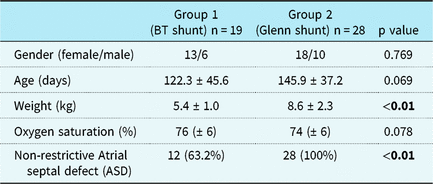
The average age was 122.3 ± 45.6 days in Group 1 and 145.9 ± 37.2 days in Group 2. There was no statistical difference between these groups in terms of age and sex, but the mean body weight was significantly higher in Group 2. All patients were palliated by local cardiology centre with balloon atrial septostomy in the first week of their life. Pre-operative characteristics of the patients were listed in Table 1.
Preoperative characteristics of patients

BT=Blalock Taussig.
Data are expressed as mean ± standard deviation or n (% of patients). The p value refers to comparison between groups; bold indicates statistical significance.
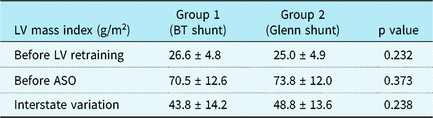
Left ventricle mass index was measured prior to each stage, and interstage left ventricle mass difference was calculated in all patients, and results were found statistically similar for two groups (Table 2).
Indexed LV mass variation before LV retraining and before arterial switch operation

ASO = arterial switch operation; BT = Blalock Taussig; LV = left ventricle.
Data are expressed as mean ± standard deviation. The p value refers to comparison between groups; bold indicates statistical significance.
Post-operative ICU stay, hospitalisation time, and inotropic support treatment time were statistically longer in Blalock Taussig shunt group; however, interstage time interval was significantly short for this group (Table 3).
Post-operative data following first stage procedure

BT=Blalock Taussig.
Data are expressed as mean ± standard deviation (range in brackets). The p value refers to comparison between groups; bold indicates statistical significance.
The only mortality was a patient with Blalock Taussig shunt who developed multi-organ failure despite ECMO support. Post-operative complications were statistically higher (p = 0.036) in Blalock Taussig shunt group with 21.1% (n = 4) reintervention rate for shunt graft revision and one ECMO support for cardiac failure and one peritoneal dialysis for excessive capillary leak refractory to diuretic treatment. One patient in Group 2 who developed pressure gradient across cava-pulmonary anastomosis and concomitant pleural effusion was successfully treated with intravenous heparin and oral antiaggregant medication, and this was the only complication recorded in this group.
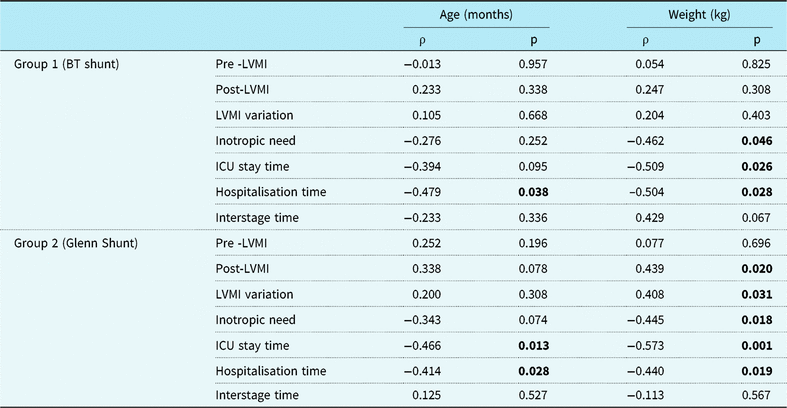
Correlation of age and weight with other parameters at left ventricle retraining surgery was also evaluated in this study (Table 4). There was a reverse correlation between age and hospitalisation time in two groups, but in Group 2 age has also a reverse correlation with ICU stay time. Moreover, the body weight was concordantly related with left ventricle mass index evolution in patients with the cava-pulmonary connection.
Effect of age and weight on post-operative parameters

BT = Blalock Taussig; LVMI = left ventricle mass index; post-LVMI = post-procedural left ventricle mass index before ASO; pre-LVMI = pre-procedural left ventricle mass index
The p value refers to comparison between groups, ρ refers to Spearman’s rank correlation coefficient, and bold indicates statistical significance.
Discussion
According to our review of the literature, this is the first study about the use of bidirectional cava-pulmonary anastomosis in combination with pulmonary banding for left ventricle retraining in candidates of two-stage arterial switch operation.
In the modern era, primary arterial switch operation is the first choice of treatment for simple TGA-IVS patients for the first month of life; moreover, it is also recommended until 8 weeks of age especially in centres with ECMO facility with an acceptable risk of prolonged ICU and hospital stay.Reference Bisoi, Sharma and Chauhan 1 , Reference Sarris and Balmer 2
All patients in this study were palliated with balloon atrial septostomy in the first week of life in their home country and referred to our clinic from abroad after 2 months of age for corrective surgery. They were appropriate candidates for two-stage arterial switch operation with left ventricle mass value <35 g/ m2 and unfavourable and/or acceptable septal anatomy according to guidelines.Reference Sarris and Balmer 2 We believe that this information is sufficient to make two-stage arterial switch operation indication. We do not use cardiac catheterization routinely to demonstrate an left ventricle/right ventricle pressure ratio of <0.6 because it is a more invasive method with no additional prognostic value.Reference Foran, Sullivan, Elliott and de Leval 3
In patients older than 2 months, a two-stage arterial switch operation or an atrial switch procedures are current surgical options.Reference Foran, Sullivan, Elliott and de Leval 3 – Reference Yacoub, Radley-Smith and McLaurin 5 Whereas 25-year survival rate of the arterial switch operation is 80%, late problems, like rhythm disturbances, systemic ventricle, and systemic atrioventricular valve failure, make the two-stage arterial switch operation the first choice in many centres. Therefore, complex coronary pattern requiring complex translocation techniques, persistent pulmonary hypertension, old age for two-stage arterial switch operation are accepted as Class 2a indications for atrial switch procedures.Reference Sarris and Balmer 2 – Reference Yacoub, Radley-Smith and McLaurin 5 As none of our patients had complex coronary patterns or pulmonary hypertension we preferred two-stage arterial switch operation procedure as a corrective surgery in all. And one should also be aware of the fact that an option for a hemi-mustard operation in the future could still be considered in these patients.
Left ventricle retraining with the combination of pulmonary banding and Blalock Taussig shunt was first proposed by Yacoub et al,Reference Yacoub, Radley-Smith and McLaurin 5 but post-operative systolic dysfunction observed in these patients motivated Jonas et alReference Jonas, Giglia and Sanders 6 for a rapid 2-stage method, and he demonstrated that left ventricle can be prepared to sustain systemic function in a few days following the retraining procedure.
But it was demonstrated that the pressure loading-induced myocyte hyperplasia capacity lowers with age especially after 6 months of age.Reference Sarris and Balmer 2 , Reference Däbritz, Engelhardt, von Bernuth and Messmer 19 Our patients’ ages were within this range, and there was no statistical difference between the two groups. Another concern about age is the success of cava-pulmonary connection in young patients. Barron et alReference Barron, Haq and Crucean 23 on 297 Hypoplastic Left Heart Syndrome (HLHS) patients demonstrate that 3 months of age was safe for bidirectional Glenn anastomosis, whereas poor somatic growth is a risk factor. According to that data, our cava-pulmonary shunt group was in safe limits for age and has a better somatic growth than Blalock Taussig shunt group.
Left ventricle contractility abnormalities occurred following left ventricle retraining procedure were explained by late procedure age and possible subendocardial ischemia due to acute and severe ventricular wall shear stress.Reference Sarris and Balmer 2 , Reference Borow, Arensman, Webb, Radley-Smith and Yacoub 21 – Reference Sievers, Lange and Onnasch 22 Tight pulmonary banding was avoided in this study to prevent this immediate deleterious period, and the pulmonary artery band gradient was kept under the advised limits for this procedure in the literature. Our aim was to perform a loose pulmonary artery band only to achieve a 15–20 mmHg peak-to-peak gradient across the PAB in the OR, which usually corresponds to a 25–30 mmHg peak early echocardiographic Doppler gradient. This modification was based also on our impression that the band gradient should increase as the patient grows, and a slower, more controlled progressive banding may have a positive effect on left ventricle function by extension of myocardial muscle adaptation time and prevent acute left ventricle failure.
Patient selection for two-stage arterial switch operation was done according to defined indications, but invasive catheterization was not done to prove the left ventricle/RV pressure ratio was under 0.6.Reference Sarris and Balmer 2 , Reference Lacour-Gayet, Piot and Zoghbi 4 , Reference Van Doesburg, Bierman and Williams 11 In the literature left ventricle retraining procedures are described as the combination of pulmonary banding with either an aortopulmonary shunt created surgically or with flow-guaranteed PDA (with PG infusion or stented). Another option described in the literature is left ventricle training with volume loading only with a stented PDA without a pulmonary artery band to avoid additional pressure load.Reference Sarris and Balmer 2 , Reference Lacour-Gayet, Piot and Zoghbi 4 – Reference Jonas, Giglia and Sanders 6 None of our patients have a PDA with significant flow pattern that can help for left ventricle retraining.
In patients with left ventricle retraining procedure follow-up with echocardiography has been the key point for decision making for timing of the arterial switch operation. The proposed criteria for arterial switch operation indication are left ventricle to RV pressure ratio>0.85, left ventricle end-diastolic volume > % 90 of normal patients’ value, left ventricle ejection fraction >%50, left ventricle posterior wall thickness > 4 mm, left ventricle mass index > 50 g/m2.Reference Lacour-Gayet, Piot and Zoghbi 4 We accept left ventricle mass volume index > 0.5 as the only criterion for an indication for arterial switch operation, and we did not find any statistical difference between two groups for this indicative value, which explains the good toleration of systemic function after arterial switch operation.
Optimal interstage time intervals have been proposed with a wide range, changing between 2 days and 6 weeks by different groups.Reference Sarris and Balmer 2 – Reference Lacour-Gayet, Piot and Zoghbi 4 In their study with 31 two-stage arterial switch operation candidates Ma et alReference Ma, Hua and Yang 7 reported systemic ventricle dysfunction especially in patients older than 3 months, but this was not observed in our patient population. The interstage time interval in our cohort was longer compared to that in the literature in both groups. This was probably due to the initial loose band protocol. However, this period was significantly shorter in Group 1 which can be related to the additional effect on left ventricle retraining with volume loading of arterial shunt.
Overflow or shunt thrombosis and mortality are still major complications for MBT shunt operations.Reference Nassar, Narayan and Nyman 8 , Reference Dirks, Prêtre and Knirsch 9 Cavo-pulmonary anastomosis was first described in 1958, and since then an effective pulmonary flow increase without volume overloading on ventricles has been reported with this procedure.Reference Calvaruso, Rubino and Ocello 15 , Reference Glenn 17 , Reference Kopf, Laks and Stansel 18 Advantages of cava-pulmonary anastomosis are satisfactory oxygen supply and low post-operative complication rate, providing pulmonary artery growth and protection of ventricular function. This better outcome was supported by our results in Group 2. Patients with Blalock Taussig shunt have longer ICU and hospital stay with higher complication and reintervention rates compared to patients with a cava-pulmonary shunt. On the other hand, oxygen saturations were higher in Blalock Taussig shunt group. In our experience, this difference in oxygen levels did not have any positive effects on clinical outcomes. But inversely this excessive pulmonary flow-causing ventricular volume overload can increase the need for the use of inotropic support and prolong ICU stays as observed in the Blalock Taussig shunt group. Another concern during the arterial switch operation may be related to the takedown of the initial cava-pulmonary anastomosis, but our experience was similar to that of Baird et alReference Baird, Myers and Borisuk 16 which reported low operation- related risks, low rate of stenosis at superior caval vein or pulmonary artery and sinus node dysfunction following Glenn takedown, and biventricular repaired patients. However, one patient with bilateral bidirectional cava-pulmonary anastamosis takedown was not performed due to severe adhesions, and risk-benefit ratio of bilateral cava-pulmonary artery anastamosis takedown was considered high. This patient did not have complications in early post-operative period.
The mortality rate of left ventricle retraining procedure can reach 15% because of the increased workload of the left ventricle, low cardiac output, aortic valve regurgitation, and hypoxemia.Reference Däbritz, Engelhardt, von Bernuth and Messmer 19 , Reference Di Donato, Fujii, Jonas and Castañeda 20 , Reference Sievers, Lange and Onnasch 22 Despite well-known long-term problems of arterial switch operation, post-operative severe and resistant left ventricle dysfunction can conduct surgeons toward taking down the initial procedure and performing an arterial switch operation in older patients. In our cohort there was only one mortality in the MBT shunt group and none of our patients needed a takedown of the initial procedure. We think the significantly low mortality and no need for a takedown of the initial procedure in this study is the result of the initial loose pulmonary artery banding strategy and using a cava-pulmonary shunt providing an acceptable increase in oxygen saturations without increasing the volume load on the left ventricle.
During the early periods of our experience with two-stageReference Barron, Haq and Crucean 23 arterial switch operation in this unique and robust patient population of d-TGA referred late from the neighbouring countries, the patients were referred for an MBT shunt combined with a loose pulmonary artery banding procedure in order to train left ventricle for a later arterial switch operation and actually constituted our Group 1. While using this approach we have noticed that as the patients were getting older (>4 months) and heavier it took longer for their left ventricles to train and they needed larger Blalock Taussig shunts. These patients as mentioned earlier were coming from abroad and the close follow-up was not possible. Our concern about possible dysfunction and deleterious effects of the larger Blalock Taussig shunts on left ventricle function during interstage follow-up diverted us to entertain the idea of using a cava-pulmonary shunt instead of a Blalock Taussig shunt to increase the oxygen saturations effectively without imposing volume overload to the left ventricle providing a more stable and longer-lasting effect on patients’ oxygen saturations.
This preliminary experience shows that age and body weight are important factors for decision making about the shunt type.
While “bigger” patients seemed to have reduced hospitalisation time in all groups, factors like age and weight had different effects on ICU stay between the two groups. Somatic growth reduced the inotropic need and ICU stay in all groups, but this effect was more prominent in the cava-pulmonary shunt patients. On the other hand, patient age seemed to be another important factor for the ICU stay in cava-pulmonary shunt patients but not for the Blalock Taussig shunt group.
Limitations of the study
We need long-term follow-up to demonstrate if this modification has any effect on late problems of two-stage arterial switch operation like left ventricle dysfunction, neo-aortic valve failure, and right ventricular outflow obstruction (RVOT).
Conclusion
Results of this study support that bidirectional cava-pulmonary anastamosis combined with a “gentle” pulmonary artery banding is safe and effective as an alternative method for left ventricle training in late-referred arterial switch operation candidates. Lower complication rates and shorter ICU and hospital stays were observed in this study with a limited group.
Author ORCIDs
Ayhan Cevik 0000-0002-2693-531X
Acknowledgements
None.
Financial Support
None.
Conflict of Interest
None.