Over 40,000 children with congenital heart disease (CHD) undergo surgery in the United States each year, with the majority requiring cardiopulmonary bypass. Reference Pasquali, Thibault and O'Brien1 Cardiopulmonary bypass is known to significantly alter haemostasis through multiple mechanisms leading to a decrease in circulating factors and platelets, platelet dysfunction, inflammation and overall haemodilution. Reference Kern, Morana, Sears and Hickey2,Reference Mammen, Koets and Washington3 The risks of cardiopulmonary bypass are more pronounced in children, with blood loss and blood product transfusion requirement inversely proportional to age and weight. Reference Williams, Bratton, Riley and Ramamoorthy4,Reference Guzzetta, Allen, Wilson, Foster, Ehrlich and Miller5 Blood product exposure has been associated with increased post-operative mechanical ventilation, longer ICU stays, increased systemic inflammatory response, increased post-operative infections and increased mortality. Reference Holst, Said, Nelson, Cannon and Dearani6
In addition to bleeding, alterations in the coagulation cascade from cardiopulmonary bypass can lead to thrombus formation. Reference Manlhiot, Menjak and Brandão7 Thrombosis is a potentially life-threatening complication, occurring in 4–15% of children with CHD undergoing surgery with cardiopulmonary bypass, and is associated with a five-fold increase in odds for post-operative mortality. Reference Manlhiot, Menjak and Brandão7–Reference Murphy, Benneyworth, Moser, Hege, Valentine and Mastropietro9 The highest risk children include those with shunted single ventricles or a Fontan circulation. Reference Giglia, Massicotte and Tweddell8 Additionally, children who have a post-operative chylothorax are at increased risk of thrombosis, due to the loss of the natural anticoagulants protein C and S, and other factors. Reference McCulloch, Conaway, Haizlip, Buck, Bovbjerg and Hoke10
To prevent coagulopathy-related post-operative morbidity and mortality, and improve outcomes, several antithrombotics are used in the post-operative setting, despite little dosing guidance and no disease-specific recommendations by the United States Food and Drug Administration. 11–13 Label guidance for appropriate indications and dosing may allow for improved efficacy with lower risk of adverse events. Studies of newer antithrombotics, such as direct oral anticoagulants or anti-platelet agents, may offer alternative options for post-operative coagulation management. However, studies to determine optimal drug and dosing strategies in children with CHD are difficult to perform, due to both limited patient numbers and disease heterogeneity, as well as the challenge of obtaining informed consent in a vulnerable population where there may be parental reluctance to enroll in placebo-controlled trials. Reference Torok, Li and Kannankeril14,Reference Zimmerman, Gonzalez, Swamy and Cohen-Wolkowiez15 This systematic review aims to summarise the existing literature of antithrombotic use following cardiac surgery with cardiopulmonary bypass in children with CHD to inform areas where further research is needed.
Materials and methods
Search strategy
We searched PubMed and EMBASE to identify studies investigating the use of antithrombotic medications in children after cardiac surgery with cardiopulmonary bypass, similarly to research previously described. Reference King, Thompson and Foote16 Studies from 2000 to 2020 were included to reflect medication use in the context of current clinical practice. We defined children as those from birth to age 18 years. The search terms “post-operative care,” “heart surgery,” “cardiopulmonary bypass,” “pediatric” and “anticoagulation” or “antithrombotic” were used to generate an initial list of studies. We excluded animal studies, studies in languages other than English and studies focused on pre- or intra-operative medication use. Case reports, letters, editorials and comments were also excluded. The search strategies are shown in the Appendix.
Study selection
Identified studies were imported into EndNote (Version X9, Clarivate Analytics, Philadelphia, PA, USA). Two reviewers independently screened and reviewed study abstracts and titles. Studies were eligible for inclusion if the primary focus was antithrombotic administration in the post-operative period for children following cardiac surgery with cardiopulmonary bypass. The full article was then reviewed to ensure appropriateness prior to data extraction.
Data extraction and synthesis
A standardised data collection form was used to extract the relevant data from each eligible study. The following data were collected: study characteristics (including study design and years of study), study population characteristics (including age and cardiac defect), intervention (including medication administered and the presence and type of control used), study endpoints and results. For each medication, the dose, frequency, timing of initiation, primary outcome and secondary outcomes were compiled and analysed.
Results
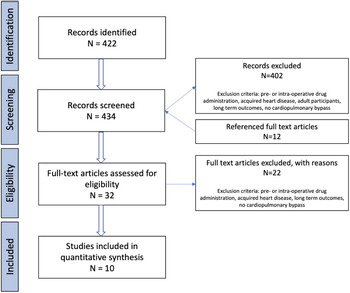
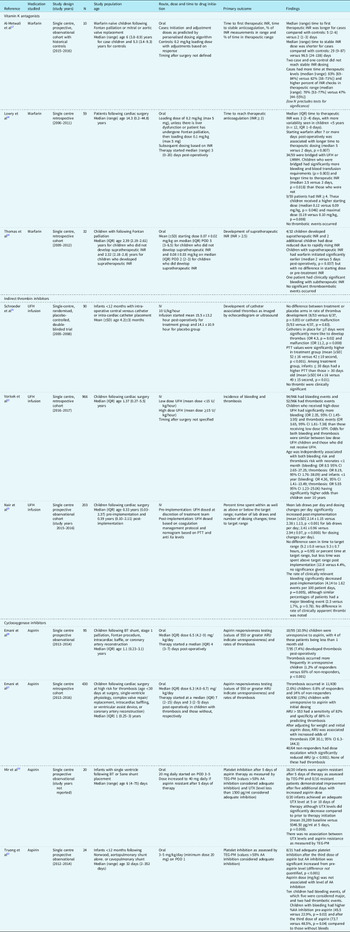
A total of 422 studies were identified using our search strategy and 10 studies in 1929 children met our inclusion criteria (Fig 1). Reference Al-Metwali, Rivers, Goodyer, O'Hare, Young and Mulla17–Reference Nair, Oladunjoye and Trenor25 Study characteristics are summarised in Table 1. All studies were performed at a single centre. Four studies were retrospective, five were prospective observational cohorts (one of which used historical controls) and one was a prospective, randomised, placebo-controlled, double-blind trial. Eight studies used surrogate biomarkers as the endpoint, such as activated partial thromboplastin time, international normalised ratio or thromboelastography with platelet mapping. The remaining two studies used clinical endpoints as the primary outcome, namely, incidence of bleeding or thromboembolism and catheter-associated thrombosis. No studies evaluated mortality as a primary outcome. One study evaluated pharmacokinetic/pharmacodynamic data. Reference Al-Metwali, Rivers, Goodyer, O'Hare, Young and Mulla17 Medications studied included vitamin K antagonists (warfarin [3/10]), cyclooxygenase inhibitors (aspirin [4/10]) and indirect thrombin inhibitors (unfractionated heparin [3/10]). Reference Al-Metwali, Rivers, Goodyer, O'Hare, Young and Mulla17–Reference Thomas, Taylor, Schamberger and Rotta24 We did not identify any studies in our patient population that evaluated platelet inhibitors (e.g. clopidogrel), glycoprotein IIb/IIIa inhibitors (e.g. abciximab), direct thrombin inhibitors (e.g. bivalirudin) or direct factor Xa inhibitors (e.g. apixaban) in the immediate post-operative period.
Summary of literature search strategy and results. This figure displays our literature search strategy, from record identification to screening, eligibility and finally study inclusion.

Characteristics of included antithrombotic studies and study populations

AA = arachidonic acid; ARU = aspirin reaction units; BT = Blalock Taussig; FFP = fresh frozen plasma; INR = international normalised ratio; IQR = interquartile range; LMWH = low molecular weight heparin; OR = odds ratio; 95% CI = 95% confidence interval; POD = post-operative day; PTT = partial thromboplastin time; SD = standard deviation; TEG-PM = thromboelastography with platelet mapping; UFH = unfractionated heparin; UTX = urine thromboxane.
Antithrombotics
Vitamin K antagonists
Vitamin K antagonists inhibit vitamin K epoxy reductase (VKORC1), an enzyme implicated in recycling oxidised vitamin K to the reduced form needed for the post-translational carboxylation of coagulation factors II, VII, IX and X, as well as proteins C and S. Reference Radulescu28 Vitamin K antagonists have no activity against coagulation factors already released in circulation. Therefore, the onset of full anticoagulation effect can take up to 7 days, and there is a transient hypercoagulable state through the inhibition of proteins C and S post-translational carboxylation early in the treatment with vitamin K antagonists. Reference Radulescu28
The most commonly used vitamin K antagonist is warfarin, which is administered enterally. Warfarin is metabolised in the liver by cytochrome P450 isozymes, predominantly CYP2C9. 11 Numerous factors affect warfarin metabolism including age, diet, concomitant medications and genetic polymorphisms. Reference Nowak-Göttl, Dietrich and Schaffranek29,Reference Nguyen, Anley, Yu, Zhang, Thompson and Jennings30 This variable metabolism combined with a narrow therapeutic index makes dosing challenging in the paediatric population and requires frequent blood draws for monitoring of international normalised ratio values. Reference Radulescu28,Reference Boris and Harris31 The main adverse events associated with warfarin use are bleeding and thrombosis, and warfarin activity can be reversed with vitamin K or, in the acute setting, with prothrombin complex concentrate. 11,Reference Lankiewicz, Hays, Friedman, Tinkoff and Blatt32 Because of age-related differences in concentrations of coagulation factors and CYP2C9 and VKORC1 enzyme activity, infants generally have the highest, and adolescents have the lowest, mg-per-kg dose requirements, but the optimal dosing, safety and efficacy of warfarin in paediatric populations are unknown due to a lack of adequate and well-controlled studies. 11,Reference Vear, Stein and Ho33–Reference Toulon, Berruyer and Brionne-François35 The usage of warfarin in paediatric populations remains off-label for all indications; in children with cardiac disease, it is often used after Fontan palliation or following mechanical valve insertion, and is typically initiated in the post-operative period. Reference Giglia, Massicotte and Tweddell8,Reference Al-Metwali, Rivers, Goodyer, O'Hare, Young and Mulla17,Reference Lowry, Moffett, Moodie and Knudson18,Reference Boris and Harris31,Reference Monagle, Chan and Goldenberg36 Three studies of warfarin in 101 children met our inclusion criteria. Reference Al-Metwali, Rivers, Goodyer, O'Hare, Young and Mulla17,Reference Lowry, Moffett, Moodie and Knudson18,Reference Thomas, Taylor, Schamberger and Rotta24
In a single centre, prospective, observational cohort of five children after Fontan or mitral or aortic valve replacement, a personalised kinetic (K)/pharmacodynamic (PD) model to predict initial and maintenance dosing was compared with five historical controls who received conventional weight-based dosing. Reference Al-Metwali, Rivers, Goodyer, O'Hare, Young and Mulla17 This study’s K/PD model included age, and CYP2C9 and VKORC1 genotypes as covariates, and was refined with bodyweight, baseline and target international normalised ratio and information about previous doses and international normalised ratio observations. Reference Al-Metwali, Rivers, Goodyer, O'Hare, Young and Mulla17,Reference Nowak-Göttl, Dietrich and Schaffranek29,Reference Hamberg, Friberg and Hanséus37 The K/PD model was first retrospectively validated in 60 patients with a median (range) age of 5.2 (1–15.9) years. The median (range) age of children in the prospective study was 6 (3.8–8.9) years for cases and 5.3 (3.4–9.3) years for controls. The starting warfarin dose for controls was 0.2 mg/kg with subsequent dosing based on response. The dose for cases was not reported. While the median time to achieve first therapeutic international normalised ratio level was longer in cases than controls (5 versus 2 days), cases achieved a stable dose sooner than controls (29 versus 96.5 days). Additionally, cases had more time and measurements in the therapeutic range (70 versus 47.4% and 83.4 versus 62.3%, respectively). There was reduced likelihood of over anticoagulation based on supratherapeutic international normalised ratio in cases. Timing of warfarin initiation was not included in this study.
A single centre retrospective cohort of 59 patients (median [range] age 14.3 [0.2–44.8] years, 20% <5 years old) undergoing cardiac surgery demonstrated that initiation of warfarin within the first week was associated with shorter time to therapeutic international normalised ratio levels compared to initiation of warfarin more than 1 week post-operatively (2 versus 5 days, p = 0.007). Reference Lowry, Moffett, Moodie and Knudson18 A heparin bridge was also associated with longer times to therapeutic international normalised ratio (2.5 versus 2 days, p = 0.018) and increased incidence of bleeding or need for blood transfusions (p = 0.003). In the overall cohort, the median time to initiation of warfarin post-operatively was 3 days. The median (interquartile range [IQR]) time required to reach a therapeutic international normalised ratio was 2 (2–4) days. A supratherapeutic international normalised ratio occurred in 15% (9/59) of patients and was associated with higher loading and maintenance dosing. Overall, 5% (3/59) of patients had a bleeding event, 7% (4/59) of patients received vitamin K as a rescue for elevated international normalised ratio and 5% (3/59) of patients were re-admitted for bleeding complications.
A single centre retrospective study of 32 children after Fontan palliation who were initiated on warfarin post-operatively showed that supratherapeutic international normalised ratio levels occurred in 12.5% (4/23) of children. Reference Thomas, Taylor, Schamberger and Rotta24 The median (IQR) age of children with non-supratherapeutic international normalised ratio values and supratherapeutic international normalised ratio values were 2.39 (2.19–2.61) years and 2.32 (2.18–2.8) years, respectively. Children at risk for supratherapeutic levels or rapid increases in international normalised ratio were started on warfarin earlier (2 versus 5 days post-operatively, p = 0.037). One child with an international normalised ratio of 1.44 (subtherapeutic) had haematochezia.
Overall, warfarin was well tolerated with low incidences of bleeding events and no thrombotic events in an overall small cohort across the age groups studied. Earlier initiation of warfarin was associated with higher international normalised ratio values, suggesting that when warfarin is started in the immediate post-operative period (within 3 days), lower doses may be beneficial to prevent supratherapeutic values. Reference Lowry, Moffett, Moodie and Knudson18,Reference Thomas, Taylor, Schamberger and Rotta24 A heparin bridge may delay time to therapeutic international normalised ratio and may increase incidence of bleeding adverse events. Reference Lowry, Moffett, Moodie and Knudson18 Concomitant administration of other medications did not predict supratherapeutic international normalised ratio values. Reference Lowry, Moffett, Moodie and Knudson18,Reference Thomas, Taylor, Schamberger and Rotta24 Individualised dosing algorithms may be beneficial in children whose polymorphisms in CYP2C9 and VKORC1 are known. No included studies compared warfarin to other antithrombotics.
Indirect thrombin inhibitors
Heparin is a naturally occurring and heterogeneous group of sulphated glycosaminoglycans that enhance the serine protease activity of antithrombin III to inactivate thrombin, plasmin and coagulation factors IX, X, XI and XII. 12,Reference Boris and Harris31,Reference Björk and Lindahl38 Medical grade heparin sodium is derived from porcine intestinal mucosa and is mainly used intravenously. Reference Radulescu28 Heparin is used as short-term prophylaxis in the post-operative setting or as a bridge until long-term anticoagulation becomes therapeutic. Reference Giglia, Massicotte and Tweddell8,Reference Boris and Harris31,Reference Monagle, Chan and Goldenberg36 Heparin is mainly eliminated via enzymatic degradation and is less susceptible to individual genetic polymorphisms than warfarin. Reference Radulescu28 Infants require higher doses per kilogram, due to increased clearance, increased volume of distribution and lower levels of antithrombin, which is required for efficacy. Reference Radulescu28 Neonates must receive a preservative-free formulation, due to toxicity from the benzyl alcohol preservative. 12
The main adverse events associated with heparin use are bleeding (particularly intraventricular haemorrhage in neonates) and, more rarely, heparin-induced thrombocytopenia. Reference Radulescu28 Drug levels are monitored by measuring activated partial thromboplastin time or anti-Xa levels, and it is also important to monitor antithrombin III levels. Reference Nair, Oladunjoye and Trenor25,Reference Boris and Harris31 Protamine sulphate can be given to reverse the effect of heparin. Similar to vitamin K antagonists, there are no randomised controlled trials on dosing in this population for treatment or prevention of thrombosis and dosing recommendations are based on clinical experience and extrapolation from historical evidence in adults. 12 Three studies in 1259 children evaluated unfractionated heparin. Reference Schroeder, Axelrod, Silverman, Rubesova, Merkel and Roth21,Reference Vorisek, Sleeper and Piekarski23,Reference Nair, Oladunjoye and Trenor25 No studies of low-molecular weight heparin (e.g. enoxaparin, dalteparin) or fondaparinux met our inclusion criteria.
A retrospective single centre review of 966 children after cardiac surgery assessed the risk of bleeding or thrombosis based on exposure to lower dose (<15 U/kg/hour) or higher dose heparin (≥15 U/kg/hour). Reference Vorisek, Sleeper and Piekarski23 In this study, 696 (72%) children, median (IQR) age 1.37 (0.27–5.5) years, were treated with heparin at least once during their ICU stay. Timing of usage after surgery was not assessed. In the entire cohort, 94 (9.7%) children had a bleeding event, and 52 (5.4%) children had a thrombotic event. Bleeding occurred most frequently within the first 36 hours after surgery without association of bleeding within 36 hours post-operatively with heparin use or intensity. However, on unadjusted analysis that included bleeding and thrombosis during the entire ICU stay, higher dose heparin was associated with increased bleeding and thrombosis compared with no heparin or lower dose heparin (bleeding: 17 versus 7 versus 8% respectively, p < 0.001; thrombosis: 12 versus 4 versus 3%, respectively, p < 0.001). Reference Vorisek, Sleeper and Piekarski23
On multi-variable analysis, higher dose heparin and younger age had higher odds of bleeding (higher dose versus lower dose heparin: odds ratio [OR] 1.97, 95% confidence interval [CI] 1.16–3.34; neonates <1 month: OR 8.5, 95% CI 2.65–27.25; infants <1 year: OR 4.36, 95% CI 1.41–13.49; 1–10 years: OR 2.34, 95% CI 0.79–6.96 versus children ≥10 years) and increased severity of bleeding (higher dose versus lower -dose heparin: OR 1.94, 95% CI 1.14–3.28; neonates <1 month: OR 8.61, 95% CI 2.70–27.39; infants <1 year: OR 4.26, 95% CI 1.38–13.13; 1–10 years: OR 2.32, 95% CI 0.78–6.85 versus children ≥10 years). Reference Vorisek, Sleeper and Piekarski23 Similarly, on multi-variable analysis, higher dose heparin, younger age and previous history of thrombosis were associated with increased odds of thrombosis (higher dose versus lower dose heparin: OR 3.65, 95% CI 1.81–7.38; neonate <1 month: OR 8.19, 95% CI 1.76–38.09; infant <1 year: OR 5.55, 95% CI 1.23–25.06; 1–10 years: OR 1.84, 95% CI 0.40–8.48 versus children ≥10 years; history of thrombosis: OR 2.98, 95% CI 1.44–6.16). Reference Vorisek, Sleeper and Piekarski23 Type of surgery was not associated with risk of bleeding or thrombosis.
A single centre prospective observational cohort of 203 patients pre- and post-implementation (pre-implementation: 87 patients, median [IQR] age 0.33 [0.03–2.37] years; post-implementation: 116 patients, median [IQR] age 0.39 [0.10–2.11] years) of an anticoagulation protocol post-cardiac surgery showed that titration using both activated partial thromboplastin time and anti-Xa levels decreased the incidence of clinically significant bleeding in heparinised children. Reference Nair, Oladunjoye and Trenor25 There were a higher number of blood samples sent (2.14 ± 1.15 versus 2.38 ± 1.13 draws per patient per day; p < 0.01) and an increased number of dosing changes after protocol initiation (2.41 ± 0.96 versus 2.94 ± 0.97 dosing changes per patient per day; p = 0.001). Time to target range and incidence of thrombus were similar before and after protocol initiation. While the incidence of clinically relevant bleeding during treatment decreased from 4.14 to 1.62 events per 100 patient-days post-implementation (risk ratio 0.39 [0.20–0.75], p = 0.005), the incidence of a major bleeding event, such as bleeding with haemodynamic instability or requiring surgical intervention, was similar before and after protocol initiation. The proportion of time spent above the target range was decreased after protocol implementation (12.8 versus 4.4% of patient hours) and the time within the target was similar. Antithrombin level was a significant predictor of anti-Xa levels (p < 0.001).
A single centre, randomised, placebo-controlled, double-blind trial evaluating the efficacy of continuous heparin infusion in preventing catheter-associated thrombosis in 90 infants (mean [±standard deviation] age 4.2 ± 3 months) showed that, while safe, heparin at low doses (10 U/kg/hour) did not reduce catheter-associated thrombus formation. Reference Schroeder, Axelrod, Silverman, Rubesova, Merkel and Roth21 In this study, children were randomised to receive continuous heparin at 10 U/kg/hour or 5% dextrose as placebo, initiated 6–24 hours after arrival to the ICU, at the discretion of the treating physician. Overall, 15% (8/53) of children receiving heparin and 16% (6/37) of children receiving placebo developed a catheter-associated thrombus (p = 0.89). Children receiving low-dose heparin had higher mean partial thromboplastin time compared to those receiving placebo (52 versus 42 seconds, p = 0.001). In multi-variable analysis, catheters in place ≥7 days were associated with increased odds of catheter-associated thrombus (OR 4.3, p = 0.02) and catheter malfunction (OR 11.2, p = 0.008). Study group assignment, single ventricle anatomy, genetic syndrome and age <30 days were not significantly associated with increased catheter-associated thrombus or malfunction. Reference Schroeder, Axelrod, Silverman, Rubesova, Merkel and Roth21 None of the identified thrombi were deemed clinically significant.
These studies show that heparin is safe at low doses, but it may not have a therapeutic advantage in the immediate post-operative period. Reference Schroeder, Axelrod, Silverman, Rubesova, Merkel and Roth21,Reference Vorisek, Sleeper and Piekarski23 High-dose heparin may increase the risk of adverse events. Reference Vorisek, Sleeper and Piekarski23 Protocol titration of heparin may decrease the occurrence of clinically relevant bleeding. Reference Nair, Oladunjoye and Trenor25 Younger children and those with a history of thrombosis may be particularly at risk for adverse events. Reference Vorisek, Sleeper and Piekarski23 No studies compared heparin to other antithrombotics.
Cyclooxygenase inhibitors
Cyclooxygenase inhibitors act by acetylating cyclooxygenase-1 in platelets and irreversibly inhibiting thromboxane A2, which inhibits platelet aggregation. Reference Boris and Harris31,Reference Mohanty and Vaidyanathan39 Since platelets cannot overcome this inhibition, the anti-platelet effects of cyclooxygenase inhibitors last for the duration of the platelet’s lifespan (roughly 5–7 days). Reference Mohanty and Vaidyanathan39 In addition to anti-platelet effects, cyclooxygenase inhibitors also provide anti-inflammatory effects via cyclooxygenase-2. Reference Mohanty and Vaidyanathan39 The most commonly used cyclooxygenase inhibitor is aspirin, which affects both cyclooxygenase-1 and cyclooxygenase-2, with a slightly higher affinity for cyclooxygenase-1. 13,Reference Warner, Nylander and Whatling40 Aspirin is only available enterally, and is typically initiated in the early post-operative period for long-term prophylaxis in children with surgical shunts, those undergoing Fontan palliation, and in combination with warfarin or other anti-coagulants in those with certain prosthetic heart valves. Reference Giglia, Massicotte and Tweddell8,Reference Monagle, Chan and Goldenberg36,Reference Mohanty and Vaidyanathan39
Aspirin is metabolised by the liver, and clearance is slower in neonates than in older children and adults. 13 Aspirin displaces warfarin from binding sites on plasma proteins, increasing free drug concentration and the risk of warfarin toxicity. Additionally, ibuprofen can antagonise aspirin’s platelet inhibition, making it less effective. 13 The main adverse effects associated with aspirin are bleeding, peptic ulcers and rarely, Reye’s syndrome. Reference Mohanty and Vaidyanathan39 Aspirin levels are not routinely monitored. Aspirin resistance can be measured using tests such as thromboelastography with platelet mapping, urine thromboxane levels or aspirin responsiveness testing. However, standard laboratory values indicating aspirin resistance may not be associated with increased risk of thrombus. Reference Mir, Frank and Journeycake20,Reference Truong, Johnson and Bailly22,Reference Emani, Trainor and Zurakowski26,Reference Emani, Zurakowski, Mulone, DiNardo, Trenor and Emani27 As with most anti-thrombotics, its safety and efficacy in paediatric patients have not been well studied. 13 Four studies in 569 children met our inclusion criteria. Reference Mir, Frank and Journeycake20,Reference Truong, Johnson and Bailly22,Reference Emani, Trainor and Zurakowski26,Reference Emani, Zurakowski, Mulone, DiNardo, Trenor and Emani27
In a single centre prospective observational cohort of 24 infants (median [range] age 32 [2–352] days) undergoing Norwood palliation or cavopulmonary shunt, conventional aspirin dosing (1–5 mg/kg/day) only achieved adequate platelet inhibition in the immediate post-operative period in 38% (8/21) of infants, as measured by thromboelastography with platelet mapping (goal ≥50% arachidonic acid inhibition). Reference Truong, Johnson and Bailly22 Aspirin was initiated on the first post-operative day. A total of 8 (33%) infants had a bleeding event, and 2 (8%) had a thrombotic event, with 80% of these events being in the first week after surgery (median [range] days after surgery 7 [1–74]). In all cases, the infants had adequate platelet inhibition measured by thromboelastography with platelet mapping proximate to the events. Reference Truong, Johnson and Bailly22
In another single centre prospective observational cohort in 20 infants (median [range] age 6 [4–75] days) undergoing shunted single ventricle palliation, 80% of infants were aspirin resistant by thromboelastography with platelet mapping (goal ≥50% arachidonic acid inhibition), even with a dose increase, and no infants achieved adequate platelet inhibition measured by urine thromboxane levels (goal <1500 pg/ml). Reference Mir, Frank and Journeycake20 All infants were started on a heparin infusion on the first post-operative day, which was continued until aspirin initiation on post-operative day 3–5. Aspirin was initially dosed at 20 mg/day and increased to 40 mg/day if the thromboelastography with platelet mapping obtained on day 5 showed <50% arachidonic acid inhibition. Urine thromboxane levels were high and decreased in response to aspirin administration, but did not reach the therapeutic goal of <1500 pg/ml. There were no bleeding or thrombotic events in this cohort.
Two studies evaluated rates of aspirin responsiveness and rates of thrombosis in children at high risk for thrombosis after cardiac surgery. Reference Emani, Trainor and Zurakowski26,Reference Emani, Zurakowski, Mulone, DiNardo, Trenor and Emani27 In a single centre prospective observational cohort of 95 children (median [IQR] age 1.1 [0.23–3.1] years), 10.5% of children were unresponsive to aspirin, as determined using a point of care aspirin responsiveness test (VerifyNow), with values of >550 aspirin reaction units indicating unresponsiveness. Reference Emani, Trainor and Zurakowski26
Across all age groups, children less than 1-month-old were more likely to be unresponsive to aspirin. Aspirin was initiated at a median (IQR) 4 (3–7) days post-operatively. In the entire cohort, 7.4% of children developed thrombus post-operatively, with thrombosis occurring more frequently in children unresponsive to aspirin (1.2% of responders developed thrombus versus 60% of non-responders, p < 0.001). Similarly, in a single centre retrospective cohort of 430 children (median [IQR] age 1 [0.25–3] years), 15% of children were unresponsive to aspirin. Reference Emani, Zurakowski, Mulone, DiNardo, Trenor and Emani27 In children who were unresponsive, the aspirin dose was doubled. This increase in dose significantly reduced aspirin reaction units (p < 0.001). Thrombus occurred in 2.6% of children, including 0.6% of responders and 14% of non-responders. Aspirin was initiated earlier post-operatively in children who did not develop thrombus compared to those who did (median [IQR] days 3 [2–5] versus 7 [2–15]). No children who had increased dose of aspirin subsequently developed thrombus. This study demonstrated that an aspirin reaction units >553 had a sensitivity of 82% and a specificity of 88% in predicting thrombosis.
Overall, early post-operative aspirin resistance is common, and may be more common in younger patients. Reference Mir, Frank and Journeycake20,Reference Truong, Johnson and Bailly22,Reference Emani, Trainor and Zurakowski26,Reference Emani, Zurakowski, Mulone, DiNardo, Trenor and Emani27 Earlier aspirin initiation may be associated with decreased risk of thrombosis. Reference Emani, Zurakowski, Mulone, DiNardo, Trenor and Emani27 The ideal laboratory tests associated with clinically meaningful aspirin resistance, optimal dose of aspirin and optimal timing of initiation remain unknown.
Discussion
We identified 10 drug trials in 1929 children after cardiac surgery across three anti-thrombotic medication classes from 2000 to 2020. Our review found that the overall evidence supporting the use of these drugs in children in the immediate post-operative setting for prevention or treatment of thromboembolism is limited. All studies were single-centre. Studies on warfarin and aspirin had small sample sizes, whereas studies on heparin included more patients. Only one study was randomised, placebo-controlled and double-blind. No studies directly compared medications.
To permit comparisons across studies and interventions in paediatric venous thrombosis, the International Society on Thrombosis and Haemostasis defined clinical and safety outcomes. Reference Mitchell, Goldenberg, Male, Kenet, Monagle and Nowak-Göttl41 However, rather than solely choosing clinical endpoints, studies included in our review generally relied on laboratory endpoints, but were not consistent. For example, when studying warfarin, outcomes included development of supratherapeutic international normalised ratio, time to therapeutic international normalised ratio, time to stable international normalised ratio and time and number of measurements in the therapeutic range. Reference Al-Metwali, Rivers, Goodyer, O'Hare, Young and Mulla17,Reference Lowry, Moffett, Moodie and Knudson18,Reference Thomas, Taylor, Schamberger and Rotta24 Clinical endpoints, such as bleeding or thrombotic events, may be more widely meaningful endpoints, but often come with confounding factors that are complex to evaluate and quantify. Measures of coagulation function that are downstream from the direct drug effect may also allow comparison across medication classes, but further studies should evaluate how these results relate to efficacy.
As in most paediatric disease processes, the relatively small number of outcomes require larger patient recruitment to ensure studies are adequately powered. This holds true for thrombosis, which affects at least 11% of children after cardiac surgery and places them at risk for severe complications. Reference Manlhiot, Menjak and Brandão7 While not exclusively in children with CHD, some recent studies with novel trial design have attempted to address this limitation. The Oral Rivaroxaban in Children with Venous Thrombosis (EINSTEIN Jr) study was a multi-phase trial evaluating rivaroxaban, a factor Xa inhibitor, versus standard anticoagulation in acute venous thromboembolism in all children <18 years old. Ultimately, rivaroxaban had a similarly low recurrence risk and reduced thrombotic burden without increased bleeding, but the study was not adequately powered to independently show non-inferiority for efficacy of rivaroxaban. Reference Male, Lensing and Palumbo42 Factor Xa inhibitors may be an attractive alternative to standard therapies in children with CHD at risk for acute venothromboembolism in the post-operative period, but disease and bypass specific effects on drug efficacy and safety should be further evaluated. The Pharmacokinetic, Pharmacodynamic, Safety and Efficacy Study of Rivaroxaban for Thromboprophylaxis in Pediatric Participants 2–8 Years of Age After the Fontan Procedure (UNIVERSE) trial took advantage of the paediatric pharmacokinetic data available through the EINSTEIN Jr trial to streamline the study of the pharmacokinetic, pharmacodynamic, safety and efficacy of rivaroxaban compared to aspirin in children 2–8 years old within 4 months after Fontan. Reference Pina, Dong and Zhang43 UNIVERSE found that physiologically based pharmacokinetic model-based dosing resulted in exposures that matched adult reference exposures, and children who received rivaroxaban for thromboprophylaxis had a similar safety profile and fewer thrombotic events, although it was not statistically different than aspirin (NCT02846532).
In addition to the acute post-operative period, antithrombotic therapy is an important consideration in children with CHD receiving chronic outpatient treatment or for prevention of thromboembolism. Long-term prophylaxis with aspirin for children with shunts is associated with improved outcomes, and extrapolation of data from adult studies suggests the benefit of long-term prophylaxis with warfarin in children with mechanical valves, but timing of antithrombotic initiation in the immediate post-operative period to gain these benefits remains unclear. Reference Li, Yow and Berezny44,Reference Whitlock, Sun, Fremes, Rubens and Teoh45 There are multiple recent high quality studies of newer antithrombotics, such as direct factor Xa inhibitors or antiplatelet agents, in children with CHD from a long-term perspective that may help lay the foundation for additional therapeutic strategies in the acute post-operative setting and are discussed below. Reference Pina, Dong and Zhang43,Reference Li, Yow and Berezny46–Reference Payne, Burns and Glatz48
The Platelet Inhibition in Children on Clopidogrel (PICOLO) trial was a prospective, multi-centre, randomised, double-blind, placebo-controlled, dose-ranging study to determine the dose of clopidogrel, an antiplatelet agent, by pharmacodynamic assessment and to evaluate its safety in 73 children ≤2 years old with cardiovascular disease processes at risk for arterial thrombosis (e.g. stent placement, Kawasaki disease, systemic to pulmonary artery shunts, etc.). Reference Li, Yow and Berezny46 Children were excluded if they had ongoing bleeding, risk of bleeding or had hepatic or renal failure. This study found that clopidogrel 0.2 mg/kg/day on a background of aspirin 4 mg/kg/day achieved platelet inhibition levels (50% arachidonic acid inhibition) similar to that of standard adult doses, which is a lower dose per kilogram body weight when compared with adults.
Another study evaluating clopidogrel was the Clopidogrel to Lower Arterial Thrombotic Risk on Neonates and Infants Trial (CLARINET). This was a multi-centre, double-blind, event-driven trial evaluating the safety and efficacy of clopidogrel versus placebo in 906 infants ≤92 days of age with cyanotic CHD palliated with a systemic to pulmonary artery shunt over a 6-month time period. Reference Wessel, Berger and Li47 The dose of 0.2 mg/kg/day was derived from the PICOLO trial. Reference Li, Yow and Berezny46 Similar to the PICOLO trial, children were excluded if they had active bleeding or were at increased risk of bleeding. Study protocol allowed concomitant aspirin use, which most children received. This study showed that clopidogrel did not reduce mortality or shunt-related morbidity. Clopidogrel did not demonstrate efficacy for preventing shunt thrombosis. This was likely due to the heterogeneity of disease processes in the study population and possibly due to the concomitant use of aspirin masking the potential benefit of clopidogrel.
Two additional studies of factor Xa inhibitors with results forthcoming will also provide more data and guidance on antithrombotics in children with CHD. The Safety of Apixaban on Pediatric Heart Disease on the Prevention of Embolism (SAXOPHONE) study is an open-label, randomised, phase II trial to evaluate the safety and efficacy of apixaban versus vitamin K antagonists or low molecular weight heparin in children with congenital or acquired heart disease who require anticoagulation. Reference Payne, Burns and Glatz48 ENNOBLE-ATE is a phase 3, multi-national, open-label, prospective, randomised, clincal trial to evaluate the efficacy and safety of edoxaban for venous thromboembolism in children 6 months to <18 years with cardiac disease. Reference Bhatt, Portman and Berger49 Further study is required to identify optimal dosing strategies in the postbypass paediatric population and which children would benefit from these therapies.
Our objective was to evaluate the existing evidence for antithrombotic use in children with CHD following surgery with cardiopulmonary bypass. Significant study heterogeneity, limited enrolment and lack of validated, consistent endpoints make trial results difficult to translate into clinical practice. Studies tangentially applicable to the child with CHD in the early post-operative period have shown success in trial design and enrolment. Lessons learned from these studies, including collaboration across sites, and integrating pharmacokinetic/pharmacodynamic methods to determine dosing, can help inform future trial design focused on the immediate post-operative period. This may allow for improved evidence-based drug selection and delivery, resulting in improved outcomes in children with CHD undergoing surgery with cardiopulmonary bypass.
Acknowledgements
Erin Campbell, MS, provided editorial review and manuscript submission. Ms. Campbell did not receive compensation for her assistance, apart from her employment at the institution where this research was conducted.
Financial support
This research received no specific grant from any funding agency, commercial or not-for-profit sectors.
Conflicts of interest
Dr Thompson reports no disclosures. Dr Foote reports no disclosures. Dr Li reports serving on the scientific advisory board for Janssen R&D, LLC. Dr Rotta reports honoraria for consulting and lecturing for Vapotherm, Inc.; honoraria for participation in the scientific advisory board for Breas US; and royalties for editorial work for Elsevier. Dr Goldenberg reports no disclosures. Dr Hornik reports no disclosures.