Abbreviations
- PET
Positron Emission Tomography
- PIB
Pittsburgh compound B
- DVR
Distribution volume ratio
- AD
Alzheimer's disease
- ApoE
Apolipoprotein E
Introduction:
The incidence of dementia has increased in direct proportion to aging in the general population leading to a massive worldwide impact (Prince et al., Reference Prince, Wimo, Guerchet, Gemma-Claire, Wu and Prina2015). As 99.6% of drug therapies for Alzheimer's disease (AD) have not provided promising results (Cummings et al., Reference Cummings, Morstorf and Zhong2014), different therapeutic targets must be investigated. On the extreme opposite of the cognitive continuum, “Superaging” has become a rising subject of interest as some older adults show exceptional memory ability (Rogalski et al., Reference Rogalski2013). Accordingly, individuals that achieve a successful cognitive aging trajectory can either experience less pathological alterations in their brains or show resistance to age-related physiological decline. These older adults with high cognitive performance may exhibit structural and molecular mechanisms that ultimately lead to unusually preserved brain functioning throughout the lifespan.
Older adults tend to show an increased variability of cognitive functions during the aging process (Hedden and Gabrieli, Reference Hedden and Gabrieli2004). Currently, many theories of successful aging attempt to explain this vast cognitive variability in older age. There are two main theories regarding healthy cognitive aging: the reserve concepts (Stern, Reference Stern2009) and the brain maintenance (Nyberg et al., Reference Nyberg, Lövdén, Riklund, Lindenberger and Bäckman2012). The concept of cognitive and brain reserves has been put forward to explain differences in cognitive decline among older adults, supposed to be a consequence of increased neuronal count and size (Stern, Reference Stern2009). The amount of reserve may determine the impact of pathological age-related alterations on cognitive and structural phenotypes. However, this definition does not explain why some older adults show cognitive and brain preservation through aging (Habeck et al., Reference Habeck, Razlighi, Gazes, Barulli, Steffener and Stern2016).
As a complementary hypothesis to the notion of reserve, Nyberg et al. (Reference Nyberg, Lövdén, Riklund, Lindenberger and Bäckman2012) introduced the notion of brain maintenance. In this conception, structural and functional brain maintenance determines the preservation of memory and other cognitive functions across the lifespan. It poses the avoidance or minimization of the aging brain alterations as best predictors of successful memory abilities in late-life. However, few studies have focused on the biological basis of brain maintenance and its consequences on cognitive aging. Herein, we aim to perform a systematic literature review of studies with older adults with superior cognitive ability to investigate neurobiological findings associated with successful cognitive aging.
Methods
This review was conducted in accordance with the Preferred Reporting Items for Systematic Reviews and Meta-Analyses (PRISMA) Statement (Moher et al., Reference Moher, Liberati, Tetzlaff and Altman2009) and was registered at the International Register of Prospective Systematic Reviews, under identification number 42017053255.
Eligibility criteria
Literature search
We performed a search in MEDLINE and Web of Science for pertinent data from January 2002 to November 2017. As we aimed to provide an overview of all available literature, peer-reviewed journals, and grey literature were investigated.
The search strategy included the following key terms: “successful cognitive aging,” “high-performing older adults,” “SuperAgers,” and “exceptional memory capacity.” Search terms in Medline also included any of the following Medical Subject Headings (MeSH), and term combinations indicated by “AND” and “OR” were used as Boolean operators: successful OR exceptional OR excellent OR high-performing AND cognition OR cognitive OR memory OR brain AND aging OR superaging OR older adults OR elders OR superagers OR supernormals. The Boolean operators were not used in the Web of Science search due to the structure of its search engine. There were no language restrictions. A meta-analysis was not deemed possible in the present work because of the heterogeneity of the data and the limited number of studies.
Study selection
Two authors (LBF and LP) independently assessed potentially eligible studies for their suitability for inclusion in the review. We resolved any disagreements by discussion or by a third reviewer (WVB). During the screening of titles and abstracts, relevant papers were defined if they mentioned aspects of high cognitive ability, such as “exceptional memory,” “exceptional cognition,” “excellent memory,” and “high-performing.” Abstracts were analyzed according to the inclusion criteria, and all studies that met these criteria were included for full article reading.
To recognize subjects within the top level of cognitive capacity in older age, the inclusion criteria were rigorously determined. Articles were required to (1) show original data, (2) include a group of adults who were 70 years of age or older, (3) clearly describe the inclusion criteria for participants, and (4) include individuals in the high-performing group with cognitive score higher than age-matched peers or than that expected for their age group based on normative data. Exclusion criteria were as follows: (1) No clinical characteristics were available, (2) no standardized neuropsychological criteria were used, and (3) any qualitative study.
Extraction of data
Data extraction was conducted by two authors (LP and LBF) from papers that met the inclusion criteria and included the following: demographic characteristics of the sample, the definition used for classifying the high-performing older group, neuropsychological assessments, other inclusion criteria, and main outcomes of each study. To better suit the proposed review, we included only studies with standardized neuropsychological assessment.
Results
Characteristics of included articles
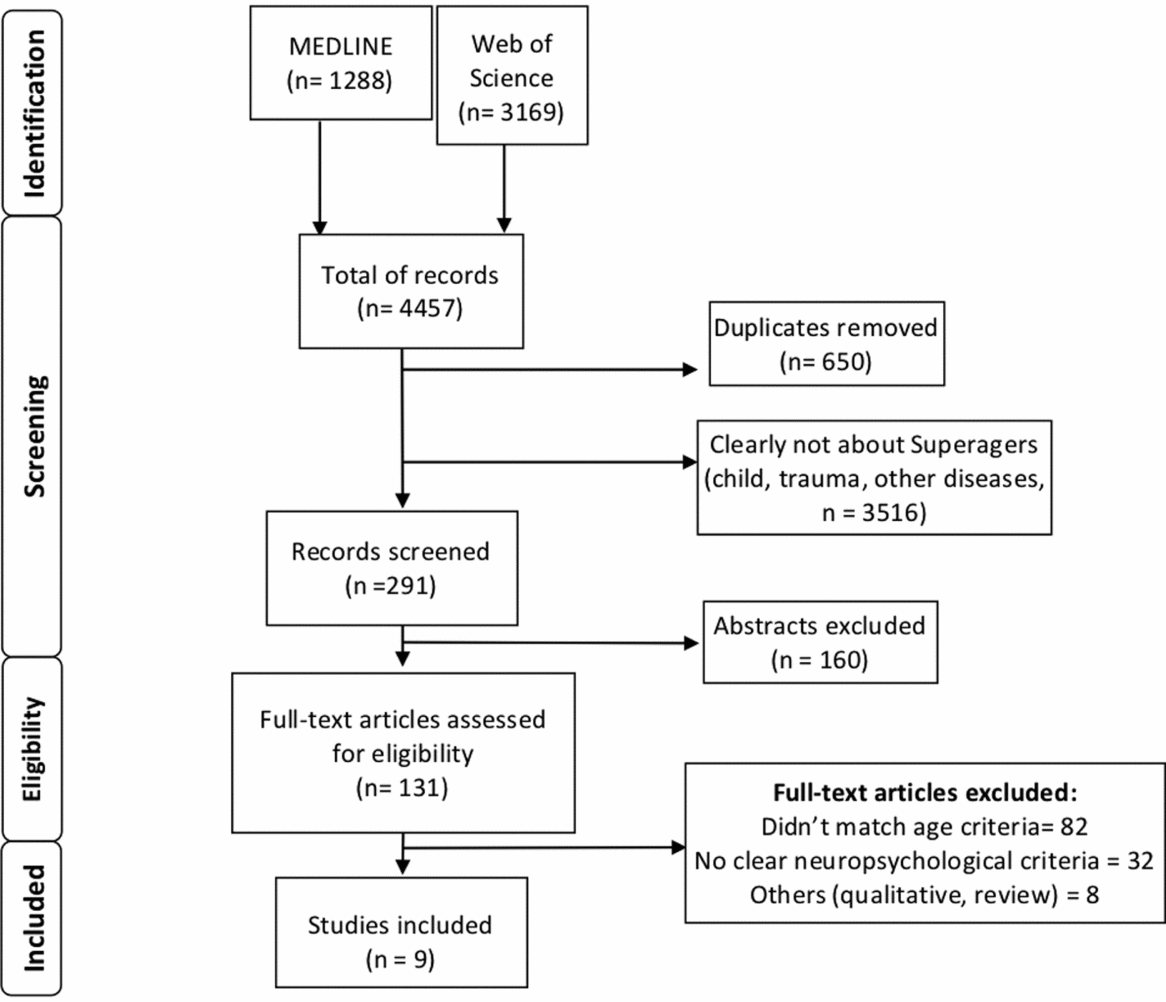
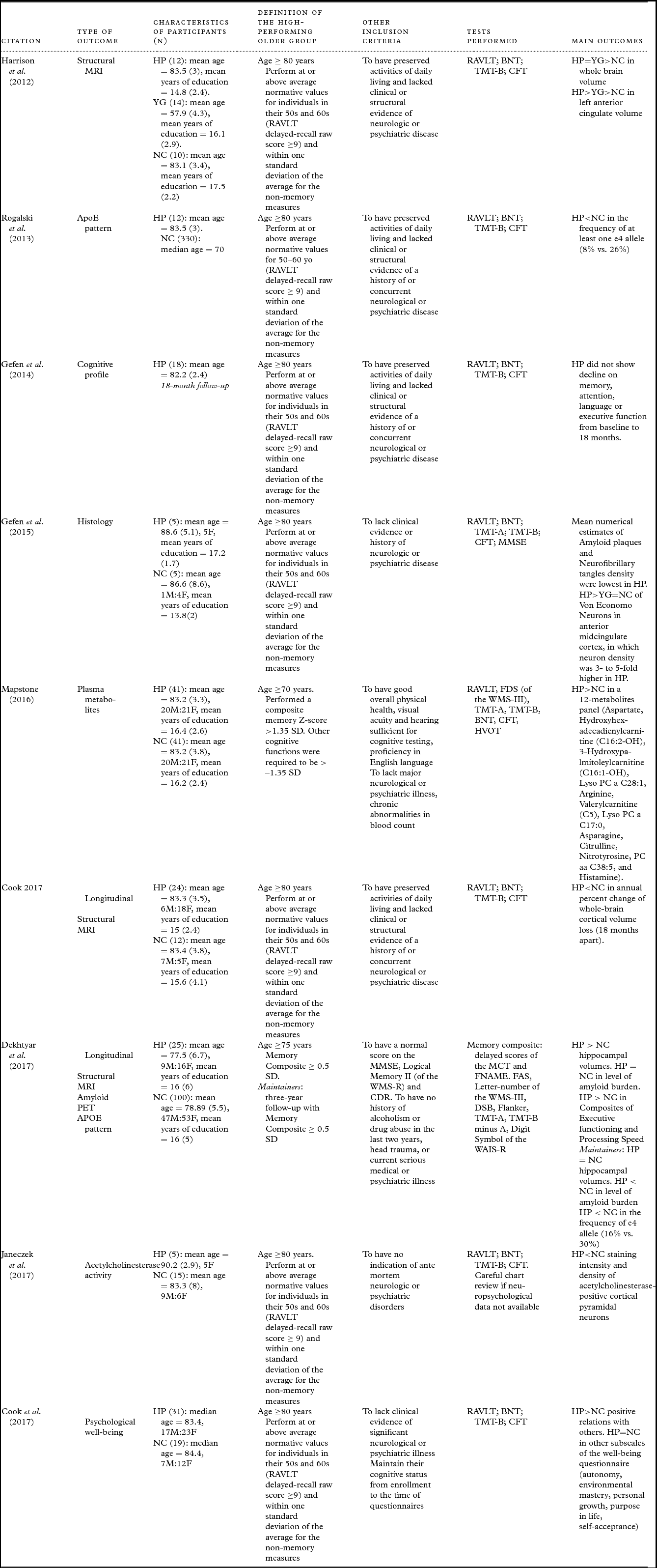
From 4,457 potentially relevant citations retrieved from electronic databases and searches of reference lists, nine (0.2%) studies met the inclusion criteria (Figure 1). There were three studies on neuroimaging (Harrison et al., Reference Harrison, Weintraub, Mesulam and Rogalski2012; Cook et al., Reference Cook2017; Dekhtyar et al., Reference Dekhtyar2017), two on histological analysis (Gefen et al., Reference Gefen2015; Janeczek et al., Reference Janeczek2017), one on plasma metabolites (Mapstone et al., Reference Mapstone2017), and two on neuropsychological profile (Gefen et al., Reference Gefen2014; Cook Maher et al., Reference Cook Maher2017). One study reported findings that had been previously published, provided another specific outcome, namely apolipoprotein E (ApoE) status (Rogalski et al., Reference Rogalski2013) (Table 1). Sun et al. (Sun et al., Reference Sun, Stepanovic, Andreano, Barrett, Touroutoglou and Dickerson2016) cited the term “SuperAgers” but did not match the age criteria.
Flow chart of the review.

Summary of included articles

Note: HP – High-performing older adults, NC – Normal older controls, YG – Normal younger controls, MRI - Magnetic resonance imaging, RAVLT – Rey Auditory-Verbal Learning Test, BNT – Boston Naming Test, TMT – Trail making test, CFT – Category fluency test, MMSE – Mini-Mental State Examination, FDS – Forward Digit Span, WMS-III – Wechsler Memory Scale – 3rd edition, HVOT – Hooper Visual Organization test, PET – Positron Emission Tomography, MCT – Memory Capacity Test, FNAME – Face Name Associative Memory Exam, WMS-R – Wechsler Memory Scale – Revised; DSB – Digit Span Backwards, WAIS-R – Wechsler Adult Intelligence Scale – Revised, M:F – male:female
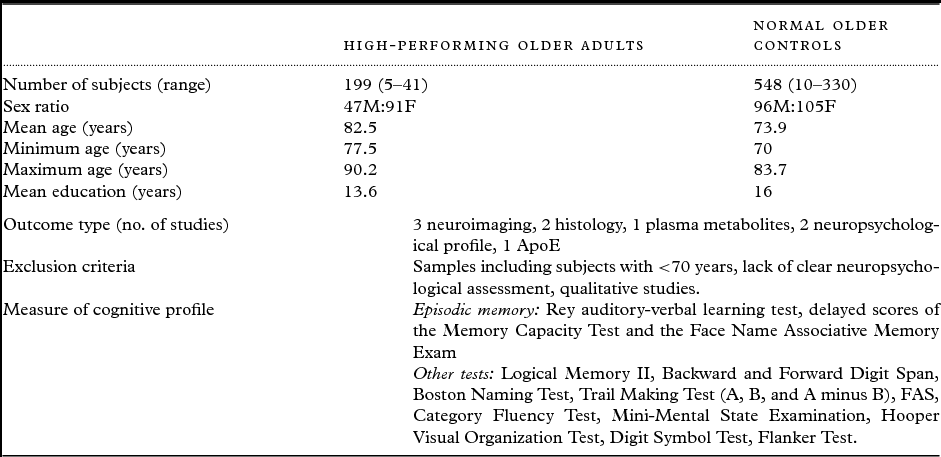
Studies that met the eligibility criteria provided a neuropsychological profile of high-performing older adults using either validated tests or at least one control group (Table 2). Sample sizes were related to the type of study (range: 5–330) and all studies reported clinical, neurological, and/or psychiatric screening criteria to confirm a healthy sample. Imaging studies were controlled for sex, age, and education, except Harrison (Harrison et al., Reference Harrison, Weintraub, Mesulam and Rogalski2012) that does not mention the gender of included individuals. Mapstone et al. (Reference Mapstone2017) used a composite Z-score adjusted for sex, age, and education. Histologic outcomes (Gefen et al., Reference Gefen2015; Janeczek et al., Reference Janeczek2017) were analyzed only in high-performing females, while the control group included both genders, and Rogalski et al. (Reference Rogalski2013) did not mention this information for ApoE analysis. As seven of the nine studies were conducted by researchers from Northwestern University, the total sample included in this review may overlap some individuals. There were a total of 199 individuals with collected data.
Characteristics of included articles

ApoE – apolipoprotein E, M:F – male:female.
Notably, high-performing older adults were described with different terms, namely “SuperAgers” (Harrison et al., Reference Harrison, Weintraub, Mesulam and Rogalski2012; Rogalski et al., Reference Rogalski2013; Gefen et al., Reference Gefen2014; Reference Gefen2015; Cook et al., Reference Cook2017; Cook Maher et al., Reference Cook Maher2017; Janeczek et al., Reference Janeczek2017), “Supernormals” (Mapstone et al., Reference Mapstone2017), and “Optimal performers” (Dekhtyar et al., Reference Dekhtyar2017). All definitions converged in classifying older adults according to their episodic memory performance. The Rey Auditory-Verbal Learning Test was employed in eight of the nine studies, and one study used a composite memory score that included the Memory Capacity Test and the Face Name Associative Memory Exam. All included studies reported non-memory tests of the high-performing group similar to normal agers, usually fluency, naming, and attention skills. A longitudinal evaluation showed that most high-performing older adults exhibited no significant cognitive decline in memory and non-memory fields after 18 months of evaluation (Gefen et al., Reference Gefen2014), but two individuals had lower memory scores at follow-up. Besides, this group showed higher level of positive social relationships when compared to age-matched controls, but both groups shared similar well-being score (Cook Maher et al., Reference Cook Maher2017).
Neurobiological findings of high-performing older adults
Three studies evaluated high-performing older adults using neuroimaging techniques. Positron emission tomography (PET) was used in one paper, while magnetic resonance imaging was performed in all three studies; one had a cross-sectional design (Harrison et al., Reference Harrison, Weintraub, Mesulam and Rogalski2012) and two used a longitudinal analysis with 18 month (Cook et al., Reference Cook2017) and three year follow-up (Dekhtyar et al., Reference Dekhtyar2017).
High-performing older adults showed global brain volume statistically indistinguishable from that of normal younger controls (average age = 57.9 years), and larger than that of normal older controls (average age = 83.1 years) (average whole-brain volume of High-performers vs. Older controls = 288.05 vs. 244.13 mm3) (Harrison et al., Reference Harrison, Weintraub, Mesulam and Rogalski2012). Moreover, the high-performing group showed increased thickness of left anterior cingulate (average thickness of High-performers vs. Older controls = 2.75 vs. 2.30 mm3), and increased hippocampal volumes in comparison to older controls (average volume of High-performers vs. Older Controls = 7,293 vs. 6,883 mm3) (Harrison et al., Reference Harrison, Weintraub, Mesulam and Rogalski2012; Dekhtyar et al., Reference Dekhtyar2017). An 18-month follow-up showed an annual percent change of the whole-brain cortical volume loss significantly smaller in the SuperAgers group compared to normal older controls (annual percent change of High-performers vs. Older controls = 1.06% vs. 2.24%) (Cook et al., Reference Cook2017). A PET evaluation with PIB (Pittsburgh Compound B) was performed by Dekhtyar et al. (Reference Dekhtyar2017) and it revealed similar amyloid burden between the high-performing and normal older groups (median Distribution Volume Ratio or DVR of High-performers vs. Older controls = 1.16 vs. 1.11). In this same sample, all high-performing individuals whose scores did not decline within three years were classified as maintainers (16 of 25 individuals). This subgroup of maintainers showed lower amyloid burden at baseline compared to non-maintainers (Median DVR of maintainers vs. non-maintainers = 1.11 vs. 1.43), but both subgroups had similar hippocampal atrophy (p = 0.850) and amyloid accumulation (p = 0.257) rate over three years of follow-up assessment (Dekhtyar et al., Reference Dekhtyar2017).
Mapstone et al. (Reference Mapstone2017) analyzed the plasma metabolome of individuals with high memory capacity. The authors found a panel of 12 metabolites that could distinguish individuals with superior memory from controls, namely aspartate, hydroxyhexadecadienylcarnitine (C16:2-OH), 3-hydroxypalmitoleylcarnitine (C16:1-OH), lysophosphatidylcholine a C28:1, arginine, valerylcarnitine (C5), lysophosphatidylcholine a C17:0, asparagine, citrulline, nitrotyrosine, phosphatidylcholine aa C38:5, and histamine. Interestingly, an index developed with all 12 metabolites showed a significant relationship to a memory composite in the three studied groups. These metabolites also discriminated individuals with cognitive impairment from controls when their signs were reverted.
Two studies evaluated postmortem brain tissues of high-performing elderly individuals (Gefen et al., Reference Gefen2015; Janeczek et al., Reference Janeczek2017). Gefen and colleagues reported the last cognitive evaluation of included individuals were within 24 months before death (range = 1–21 months). The authors showed that older adults with youthful memory scores had lower density of neurofibrillary tangles and amyloid plaques than controls in all cingulate areas, except the posterior midcingulate (Gefen et al., Reference Gefen2015). Despite the lower density of pathological deposits, the high-performing group showed mixed Braak staging (from 0 to III). Besides, the anterior midcingulate had higher density of Von Economo neurons in the high-performing group compared to the other group. Total neuronal count and size were similar between the high-performing and control groups. Janeczek et al. (Reference Janeczek2017) evaluated five older adults with high memory performance for density and intensity of acetylcholinesterase (AchE) positivity in pyramidal neurons. They showed significantly lower density of AchE-positive neurons compared to older and younger controls in four described areas, namely the supplementary motor cortex, middle frontal gyrus, middle temporal gyrus, and inferior parietal lobe. The anterior cingulate cortex did not show statistical significance, despite the tendency of decreased density of AchE-positive neurons in the SuperAgers group. The high-performing group also showed decreased intensity in the middle frontal gyrus and middle temporal gyrus in comparison to older controls.
Genotyping for ApoE was described in three studies (Rogalski et al., Reference Rogalski2013; Dekhtyar et al., Reference Dekhtyar2017; Mapstone et al., Reference Mapstone2017). Rogalski et al. found that the high-performing older group had lower frequency of at least one e4 allele than that seen in normal controls (8% vs. 26%), while the other two studies found no statistically significant differences (16% vs. 30% and 12% vs. 9%).
Discussion
To our knowledge, this is the first review evaluating literature findings of high-performing older adults. Here, we described structural and molecular brain characteristics of individuals at 70 years of age or older with high memory performance compared to age-matched peers. While several studies have focused on successful aging, this review retrieved only studies regarding older adults with superior cognitive performance compared to their cognitively average peers. To select this specific sample, we included all studies that analyzed individuals with memory score of at least one standard deviation above average.
An operationalized definition of high-performing older adults is vital for the generalization of results, including age, cognitive measures, and study design. The age restriction for this review was based on previous studies that related an average onset of age-related memory decline at approximately 60–65 years of age (Rönnlund et al., Reference Rönnlund, Nyberg, Bäckman and Nilsson2005; Schaie, Reference Schaie2005; Nyberg et al., Reference Nyberg, Lövdén, Riklund, Lindenberger and Bäckman2012). We considered 70 years of age an adequate, but not perfect cut-off. A lower limit of age would introduce a bias, while a higher limit would be too restrictive, as aging is a major risk factor for memory decline. Interestingly, episodic memory was measured in all included papers most of them (8/9 studies) used the Rey Auditory-Verbal Learning Test, though episodic memory evaluation was not an inclusion criterion. Typically, episodic memory shows a progressive decrease during the lifespan and it appears particularly vulnerable to aging (Hedden and Gabrieli, Reference Hedden and Gabrieli2004; Harada et al., Reference Harada, Natelson Love and Triebel2013). Episodic memory evaluation at a single point is not a guarantee of cognitive maintenance, as in some high-performers may decline over time (Gefen et al., Reference Gefen2014; Dekhtyar et al., Reference Dekhtyar2017). Non-memory measures were within the age-appropriate average in all included studies. Most studies compared the high-performing group to normal agers, except Harrison that also compared them to a middle-aged group (Harrison et al., Reference Harrison, Weintraub, Mesulam and Rogalski2012). As mentioned by Nyberg et al. (Reference Nyberg, Lövdén, Riklund, Lindenberger and Bäckman2012), older adults with high performance may exhibit a more youthful brain phenotype. Thus, cognitive preservation is better evaluated with longitudinal studies. Moreover, a younger control group may provide important information on brain maintenance, possibly revealing subsequent mechanisms that may replicate memory preservation during senescence.
Despite the small number of studies on older adults with high cognitive performance, this group showed unique structural and molecular features when compared to normal agers. Structural findings of included studies suggest that excellent memory ability is associated with global preservation of the cortex and decreased age-related atrophy, but it is not related to neuronal size or total count when compared to normal older controls (Harrison et al., Reference Harrison, Weintraub, Mesulam and Rogalski2012; Gefen et al., Reference Gefen2015; Cook et al., Reference Cook2017; Dekhtyar et al., Reference Dekhtyar2017). These alterations are in accordance with the brain maintenance view, but not with the brain reserve conception. Despite the hippocampal volumes were larger in high performers compared with normal performers, the hippocampal volumes and atrophy rates were similar in three years of follow-up between maintainers and non-maintainers. This finding suggests that the hippocampus is associated with the memory performance, but not with memory maintenance. At a molecular level, high-performing older adults showed lower levels of AD pathology when compared with older adults that showed a decrease in cognitive ability. Despite amyloid accumulation being similar between high-performing older adults and normal controls after three years, those that maintained an exceptional memory ability exhibited lower amyloid deposition at baseline. Neurofibrillary tangles and amyloid plaques were less present in histologic analysis of this group, especially in the anterior cingulate cortex. Moreover, high-performing older adults presented decreased acetylcholinesterase activity in a few brain regions, in contrast to the increase of this enzyme typically seen in age-related cognitive decline (Ashare et al., Reference Ashare, Ray, Lerman and Strasser2012). Also, plasma metabolites successfully distinguished the high-performing older group from normal agers, indicating peripheral alterations associated with cognitive preservation. Among all metabolites significantly increased in this group, a few were associated with neuroplasticity and cognitive reserve, such as aspartate and NO (Schuman and Madison, Reference Schuman and Madison1991; Shimizu et al., Reference Shimizu, Tang, Rampon and Tsien2000; Nikonenko et al., Reference Nikonenko, Nikonenko, Mendez, Michurina, Enikolopov and Muller2013). Consistent with the definition of brain maintenance, these findings suggest that lesser density of age-related lesions is related to better cognition in later life (de Frias et al., Reference de Frias, Lövdén, Lindenberger and Nilsson2007).
As proposed by Nyberg et al. (Reference Nyberg, Lövdén, Riklund, Lindenberger and Bäckman2012), structural and molecular preservation may mechanistically impact cognitive functioning. Combined, the findings of included studies on high-performing older adults may provide evidence toward a better understanding of cognitive aging. The maintenance of brain structures shown here may rely upon the marked similarity between brain structures of exceptional agers and younger adults, which are significantly thicker than those of typical older adults (Salthouse, Reference Salthouse2009). The persistence of high performance in older adults may result from mitigating neurobiological errors by mechanisms yet to be identified, probably associated with neuroplasticity (Heuninckx et al., Reference Heuninckx, Wenderoth and Swinnen2008; Barulli and Stern, Reference Barulli and Stern2013). The avoidance of amyloid pathology, as showed by the subgroup of maintainers (Dekhtyar et al., Reference Dekhtyar2017), may lead to decreased neurodegeneration and consequently higher cognitive functioning. It is putative that both the reserve and maintenance theories converge as complementary concepts (Barulli and Stern, Reference Barulli and Stern2013; Habeck et al., Reference Habeck, Razlighi, Gazes, Barulli, Steffener and Stern2016). As the adult lifespan is marked by greater cognitive enrichment, the cognitive reserve of high-performing older adults could protect against impairment by reducing age-related pathology to the established networks in older life (Sumowski et al., Reference Sumowski, Wylie, DeLuca and Chiaravalloti2010). However, both reserve concepts do not cover the preservation of cognitive abilities during the aging process (Habeck et al., Reference Habeck, Razlighi, Gazes, Barulli, Steffener and Stern2016). However, the current body of literature is insufficient to offer a solid conclusion, as few studies have adequately addressed this group.
Additionally, tau pathology is strongly associated with memory impairment (Riley et al., Reference Riley, Snowdon and Markesbery2002; Braak et al., Reference Braak, Alafuzoff, Arzberger, Kretzschmar and Del Tredici2006). As a single study was inconclusive on tau pathology in autopsies of high-performing older adults, future studies should target tau imaging in this group. Several studies using fMRI have indicated that individuals with age-related cognitive decline rely on compensatory brain activity to preserve function-specific memory networks (Cabeza, Reference Cabeza2002; Davis et al., Reference Davis, Dennis, Daselaar, Fleck and Cabeza2008; Park and Reuter-Lorenz, Reference Park and Reuter-Lorenz2009; O'Brien et al., Reference O'Brien2010; Eyler et al., Reference Eyler, Sherzai, Kaup and Jeste2011). Functional connectivity of high-performing older adults remains unclear, but its elucidation is essential in order to determine the optimal functioning of established neural networks. Both techniques hold great promise in solving the aging brain puzzle.
The risk of biases must be discussed. Despite our efforts, some important papers may have been omitted due to a lack of consensus on the definition of successful aging (Depp et al., Reference Depp, Vahia and Jeste2010; Depp et al., Reference Depp, Harmell and Vahia2011). Further, some studies were not controlled for basic variables, such as sex, especially those including histologic analyses. The total number of studies and the heterogeneity of their results may hinder the generalization of our findings. We performed a comprehensive search with almost no factor of limitation to minimize this bias, but seven of nine included studies were from the same group. Meta-analysis was not possible due to the restricted number of papers on this subject and their heterogeneity of existing papers. Cross-sectional studies are influenced by cohort effects, which can overestimate the study's findings. An estimated prevalence of high-performers is limited in this work because of the design of included studies. Finally, our conclusions may be affected by the small number of studies and its limitations.
In sum, this review draws attention to the study of high-performing, rather than simply healthy, older adults. Despite the insufficient number of studies to draw a consistent conclusion, the compliance of findings in this work corroborates the concept of brain maintenance. High-performing older adults exhibited particular structural and molecular characteristics, such as a preserved cortical volume and decreased AD pathology in the brain. As only few studies provided clear, objective definition criteria for high-performing older adults, further longitudinal investigations with younger controls are necessary to reach concrete conclusions.
Conflict of interest
The authors declare that they have no conflict of interest.
Author contributions
JCC coordinated, designed, and revised this study. WVB designed, analyzed, and contributed in the writing of the manuscript, and the screening of the studies. LP and LBF contributed in the methodology and the screening of the studies. GR contributed with methodological aspects. MWP and LPS contributed to the writing of the manuscript and the review of this study.
Acknowledgments
None.