I. Introduction
Suppose company A creates an electronic database of its customers and stores the digital file on the servers of cloud provider B. A owns its own computer and any intellectual property (“IP”) rights in the database content. B owns the servers and has practical control over the digital file. What about legal rights to the file itself: the collection of information stored on the server? Is that A's property? What if B refuses to let A access the file? Can A then call upon a proprietary remedy?
In this paper, we look at the property status of digital files, such as electronic documents, emails, and photographs, under English law. The topic is complicated. The concept of property can be “peculiarly difficult to define or even to describe”.Footnote 1 Further, whether an object qualifies as property depends on the legal context. As Lord Porter remarked: “‘property’ is not a term of art but takes its meaning from its context and … the document or Act of Parliament in which it is found.”Footnote 2 Applying this complex legal concept to ever-changing information technology (“IT”) is challenging. We aim to identify the relevant challenges and suggest possible solutions. We start by reviewing two possible objections to treating digital files as property. First, mere information is not property under English law. Yet digital files are not mere information. Instead, they are virtual objects that differ in relevant ways from the information they contain. Second, digital files do not fit the traditional categories of things recognised as property under English law. Nonetheless, digital files could be considered a new, third kind of thing, in line with the emerging treatment of cryptocurrencies.
In our view, recognising property rights in digital files is appropriate where: (1) their characteristics make them a good fit for property law; and (2) policy reasons support extending property rights in a given legal context. We focus on commercial law and argue that property rights could help resolve commercial disputes over interference with access to a digital file. An example would be where a cloud provider excludes a customer from a digital file which the customer has uploaded to the cloud. Property law would provide the customer with a remedy to recover the digital file, as it does for paper documents. With the Law Commission of England and Wales currently reviewing the legal status of digital assets, now is the time to consider the case for property rights in digital files.Footnote 3
II. The Boundaries of Property: Beyond “Mere Information”
A. Mere Information Is Not Property
English law does not recognise information itself as property.Footnote 4 Sir John Mummery explained this using the example of a letter as follows:
(1) The physical sheets of paper are the property of the purchaser. When the letter is sent, property in the paper passes to the recipient.
(2) The written composition contained in the letter is treated differently. That is owned by the author, in the form of a copyright. The recipient comes to own the paper, but not the copyright in the written work, which the author retains.
(3) In contrast, the information contained within that composition (the ideas, facts, etc.) is not regarded as property. It is free for anyone to use.Footnote 5
Floyd L.J. similarly considered that:
the law has been reluctant to treat information itself as property … there are sharp distinctions between the information itself, the physical medium on which the information is recorded and the rights to which the information gives rise. Whilst the physical medium and the rights are treated as property, the information itself has never been.Footnote 6
Depending on the circumstances, information can be subject to other, non-proprietary rights. For example, the recipient can have an obligation of confidentiality, which protects information from being disclosed or used for other purposes. Such an obligation can be imposed expressly by contract or impliedly. Alternatively, it can arise as an equitable duty from the relationship between the parties and the nature of the information. Yet any such obligations are enforceable against another party only as a personal matter; they are not based on property rights.Footnote 7 There are three main reasons why information is not regarded as property, namely: (1) that doing so imperils free speech; (2) that information is a poor fit for property rights; and (3) that property rights are unnecessary.
1. Free-speech concerns
The non-proprietary status of information protects each person's freedom to convey information and express ideas.Footnote 8 As Sir John Mummery said:
information is a resource that should be free for all to use. … When legislation privatises information by giving it the status of property, as in the case of … copyright …, it has done so in carefully defined terms, for set periods of time and subject to worked out exceptions and defences.Footnote 9
Gray therefore considers information “morally non-excludable”, since it would be undesirable to allow any one person to control access to its benefits.Footnote 10 In other words, property rights would grant the owner legal control over information, including the right to exclude others. This would interfere with others’ right to receive and impart information and ideas.
2. A poor fit for property rights
Property is often described as a bundle of rights that governs the relations between people with respect to a thing.Footnote 11 The owner has the exclusive right to determine the use of a thing; others have a corresponding duty of non-interference.Footnote 12 This right applies erga omnes. As Mummery L.J. noted:
“property” differentiates between things that are mine and things that are not mine. The law lays down criteria for determining the boundary between, on the one hand, those rights that are only enforceable against particular persons and, on the other hand, those rights attaching to things that are capable of being vindicated against the whole world.Footnote 13
So, what are those criteria and why does information fall short? In our experience, it can be difficult to determine the exact boundaries of property. Case law and literature suggest six relevant criteria.
In Ainsworth, Lord Wilberforce set out a four-step test for when “a right or an interest can be admitted into the category of property”; namely, it must be: (1) definable; (2) identifiable by third parties; (3) capable in its nature of assumption by third parties; and (4) have some degree of permanence or stability.Footnote 14 Gray has criticised this test, since it refers to the characteristics of property to determine whether a right is proprietary. This creates a circular definition.Footnote 15 In our view, the test might simply reflect the context of the Ainsworth case, which concerned a deserted wife's right to occupy her husband's house. If that right had four of the characteristics of property, then it should also have the fifth characteristic of applying erga omnes, including against the bank which sought possession of the house. On this view, the test is arguably useful (if somewhat circular) for distinguishing personal rights from property rights.
Yet information is a thing, not a right. So, the test does not appear directly relevant. Bennett Moses points out that since the criteria “describe property rights rather than objects of property, they are not relevant to determining what things can be owned”.Footnote 16 Indeed, Lord Wilberforce was only concerned with how to categorise an existing right, not with whether a right to a thing existed at all. (The house itself was undoubtedly a thing that could attract a property right.) Nonetheless, the test can be reformulated as: if the law recognised a property right in this thing, would that right then be: (1) definable; (2) identifiable; (3) capable of assumption by third parties; and (4) permanent.
A property right in information would not meet the first three of these criteria. Regarding the first two criteria, Sir John Mummery notes: “for the enclosure of property and the exclusion of others from it”, it must “be possible to define it with reasonable precision, so that the individual knows and others know what is and what is not the property”.Footnote 17 Yet it is difficult to give a precise definition of informational subject matter. In other words, it is difficult to determine where one piece of information ends and another begins. Take the example of a letter: it should be easy to define the boundaries of the letter's composition, which is likely to start with a greeting and end with a signature. Yet defining the ideas, facts, and opinions the letter contains is less certain and can be open to subjective interpretation. As a result, the boundaries of a property right in information would be unclear.Footnote 18 This makes information a poor fit for property law.
Information would not meet the third criterion either. Penner argues that things which have a necessary link with a particular person cannot attract a property right. To qualify as an object of property, a thing must be distinct from any person who might hold it. This is the condition of separability. Footnote 19 It has two components:
(1) The object must be transferable: the person holding the object can give control to another person. Some things are practically non-transferable, such as a friendship or reputation. Other things are considered morally non-transferable, such as a person's vital organs.Footnote 20
(2) The object must be exhaustible (also referred to as divestible): the person holding the object can be fully dispossessed of it and deprived of its benefits.Footnote 21
In sum, an object is separable if it can be transferred such that the transferor is fully dispossessed of it. As Baroness Hale noted: “[t]he essential feature of property is that it has an existence independent of a particular person.” It can be bought and sold, given and received, bequeathed and inherited, and pledged or seized to secure debts.Footnote 22 Similarly, Mummery L.J. considered “assignability” one of the criteria “that normally characterise property rights and distinguish them from personal rights”.Footnote 23
Admittedly, the requirement of assignability is not clear-cut.Footnote 24 For example, certain non-assignable contractual rights can be the subject of a trustFootnote 25 and form part of a bankrupt person's estate.Footnote 26 This might reflect the broad definition of property under insolvency lawFootnote 27 and the broad scope of assets that can be subject to a trust at equity.Footnote 28 Alternatively, contractual rights might generally be “capable in their nature of assumption by third parties” (emphasis added) and therefore qualify as property, even if a specific contractual right can be made non-assignable through a non-assignment clause. In that case, the non-assignable contractual right is still a thing in action (albeit, a non-transferable one).Footnote 29 It can be distinguished from a purely personal right under contract, which is inseparable in its nature, and so does not qualify as property, nor form part of a bankrupt person's estate.Footnote 30
In any event, information lacks separability. While it can be transferred through communication, it is inexhaustible, since it cannot be removed from the transferor's mind. Instead, the transferor always retains the information he or she transfers.Footnote 31 This makes it a poor fit for property law.
The literature suggests two further criteria for identifying things which can attract a property right. First, Gray argues that the object must be excludable, meaning it is “reasonably practicable to exclude strangers from access to the benefits of a particular resource”.Footnote 32 Second, Cutts argues that the object must be rivalrous, meaning that use by one person inhibits use by others. This quality creates a risk of conflict between individuals – and it is this risk that property law addresses.Footnote 33 Fox similarly refers to a requirement of scarcity, arguing that abundant resources or those “which can be reproduced by anyone at will” “do not naturally lend themselves to a property regime”.Footnote 34
Information is non-rivalrous. Any number of people can use it at the same time. This suggests it is a poor fit for property law. However, information is excludable – it can be kept secret and shared only amongst a closed group, thereby excluding others from its benefits. Indeed, in some cases, its value depends on such exclusion.Footnote 35 This might explain why the law protects rights in confidential informationFootnote 36 and trade secrets,Footnote 37 albeit without classifying such rights as property (although there is some conflicting case law on this point).Footnote 38 In sum, since information fails to meet four of the six criteria, it is a poor fit for property law.
3. Property rights are unnecessary
The laws of contract, confidence, and privacy all protect information. What's more, Sir John Mummery notes that “despite having no property rights in it”, a person who has practical control of information can “negotiate contractual terms for access …, disclosure and for … use”.Footnote 39 This combination of existing legal protection and practical control is deemed sufficient to protect interests in information, such that property rights are unnecessary.
Taken together, these three arguments make a compelling case against recognising property rights in mere information. They also appear to have influenced Court of Appeal rulings dealing with digital files. For example, in Fairstar, Mummery L.J. considered the property status of emails, noting that: “[t]he claim to property in intangible information presents obvious definitional difficulties” (emphasis added).Footnote 40 Further, in Your Response, the Court of Appeal held that an electronic database could not be subject to possession. Floyd L.J. considered that otherwise “one would be coming close to treating information as property”.Footnote 41
B. Digital Files Are Not Mere Information
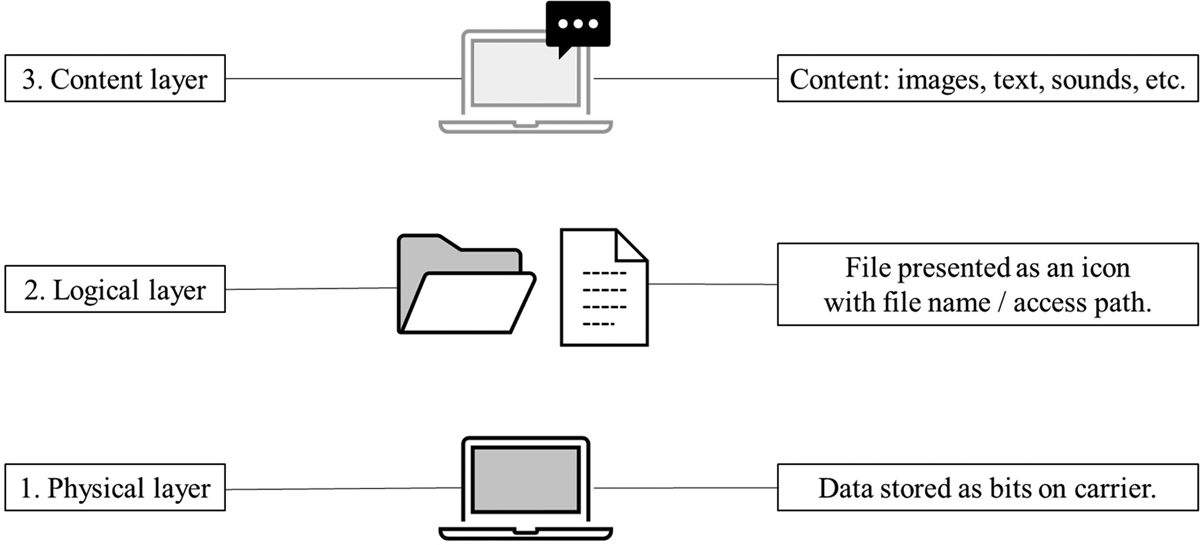
In our view, the above three arguments do not apply to digital files. To support that claim, we first describe digital files, before comparing them to mere information. The Oxford Dictionary of Computing defines a file as: “a collection of information, referred to by file name … held on backing store … in order (a) to enable it to persist beyond the time of execution of a single job.”Footnote 42 Using this definition, we propose a three-layered model of a digital file. This is admittedly a simplified representation of reality. All models are wrong, but some are useful.Footnote 43 We find this model useful for analysing digital files under property law. It is inspired by Benkler's three-layer description of an information network, like the internet:
(1) The first, or lowest, layer of a network is the physical infrastructure layer, consisting of cables, spectrum, and hardware such as computers and routers.
(2) The second, or middle, layer is the logical infrastructure layer, consisting of the software components that carry, store, and deliver content, such as the TCIP/IP protocol.
(3) The third, or highest, layer is the content layer, encompassing all materials stored, transmitted, and accessed on the network.Footnote 44
Gleason and Friedman similarly use a 10-layer model to conceptualise cyberspace: ranging from the first, or lowest, layer of physical devices, through various mid-level layers of software, to the highest content layers, including the user's interpretation of content and its impact.Footnote 45
By analogy, a digital file can also be described as existing on three layers:
(1) At the physical infrastructure layer, a digital file is stored on a hardware device (or “carrier”) in binary code, as a series of ones and zeros.Footnote 46 For example, ones and zeros can be reflected by the presence or absence of an electrical charge in a transistor on a solid-state drive (“SSD”). To read the data, a computer measures the current: a current flow means “one”; no current flow means “zero”.Footnote 47 Each one or zero is called a bit, and a set of eight bits is a byte. A megabyte (“MB”) consists of one million bytes. A file's size is measured in MB (or Giga- or Terabytes), indicating the amount of hardware storage required. For example, the manuscript version of this article is a Word document that consists of around 300 Kilobytes, or around 2.4 million bits.
(2) At the logical layer, digital files exist as virtual objects that are created and controlled through software applications that interpret the binary code at the hardware layer and let users interact with digital files. In an operating system (“OS”) like Windows or Mac OS, a digital file is typically denoted by a file name, consisting of a string of characters generated by software or set by the user. The end of a file name usually indicates the file type, such as .doc, .jpg, or .mp3.Footnote 48 The logical layer can itself be sub-divided into multiple sub-layers, from lower-level machine code, through mid-level programming languages, to high-level graphical user interfaces (“UIs”). In Gleason and Friedman's ten-layer model, the UI is the eighth layer, which serves to “mediate the individual users’ excursions into cyberspace”, allowing them to interact “with people and content”.Footnote 49 A typical UI presents files to users as icons that they can click on to “open” or drag-and-drop to “move”. For example, we interact with the digital file of this manuscript (a .doc file) using Windows OS and Microsoft Word. The UI makes it simple for users to exercise control over digital files, without having to worry about the complexity of the underlying logical sub-layers or physical infrastructure. Together, the OS and software application(s) form the virtual environment within which users perceive and interact with the file as a virtual object.
(3) Finally, at the content layer, a digital file contains a collection of information for human perception, such as pictures or music. For example, the digital file of this manuscript includes text and figures.
Digital files exist on three different layers

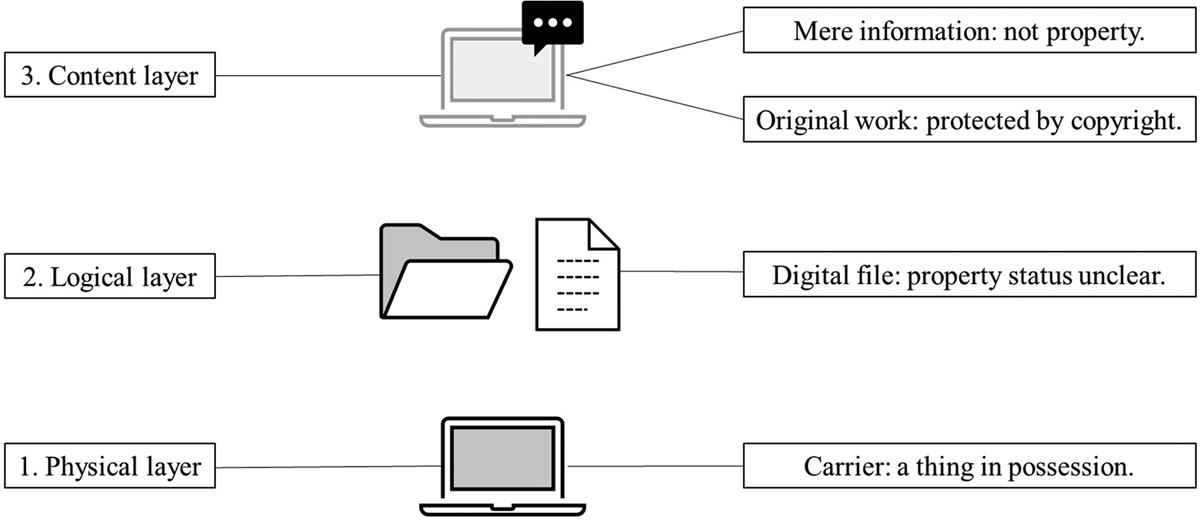
In this respect, an electronic document differs from a paper letter. The letter exists at only two layers: (1) the physical sheet(s) of paper and (2) its content (composition and information). Yet the same letter stored as an electronic document exists on three layers: (1) the physical carrier, such as a computer; (2) the digital .doc file you can open in Microsoft Word; and (3) the letter's content. Property rights at the first and third layers are clear. At the physical layer, the carrier is a thing in possession, just as the sheets of paper are. At the content layer, the information contained in the file might be mere information (which is not property) or can be protected by copyright (a thing in action). In contrast, the property status of the file as a virtual object at the logical layer is unclear. This forms the focus of our analysis. In other words, we focus on what Strate refers to as “perceptual cyberspace”, namely “the sense of space generated by the computer-user interface, through one or a combination of our senses”, as opposed to the underlying “physical cyberspace” of hardware devices.Footnote 50
The legal status of digital files at the logical layer is unclear

C. Digital Files Should Be Treated Differently
In our view, the digital file at the logical layer differs in relevant ways from the mere information at the content layer, such that the three arguments advanced above against recognising property rights in mere information do not (necessarily) apply.
1. Free-speech concerns do not apply
Property rights in digital files do not raise the same policy concerns about free expression as property rights in mere information. This is because property rights would apply to virtual objects at the logical layer, not to the information they contain. Any information or ideas contained in digital files at the content layer would remain free for anyone to use. For example, we could have a property right in the Word file of this manuscript, giving us the exclusive right to control access to it. Yet the ideas contained within the article at the content layer remain free for anyone to use (subject to existing legal rights and obligations, including our copyright in the written composition). Consequently, the free-speech concerns about treating information as property do not apply to digital files.
2. Digital files are a better fit for property law
Digital files have some of the characteristics of property that information lacks. As to the first two criteria identified above, property rights in digital files would be more readily definable and identifiable by third parties. Unlike mere information, a digital file has set boundaries, reflected in its file size. It can be identified at the logical layer through file management software, which allocates space on the carrier and maintains a directory of the file's location.Footnote 51 Each file has its own access path: the devices, directories, and file name used to retrieve the file.Footnote 52 For instance, a letter might be stored as C:\Documents\Letter to Bob.doc on Alice's computer. Admittedly, the data that comprise Alice's digital file will not typically be stored in a single “location” on her local hard drive, but will instead be scattered across it.Footnote 53 Nonetheless, the digital file is definable at the logical layer by reference to its file name. In addition, unlike mere information, users can act at the logical layer to exclude others, such as through password protection and encryption. Such measures provide notice to third parties of the user's exclusive claim to the digital file.Footnote 54 This makes digital files a better fit for property law than mere information.
Turning to the third criterion, a digital file is (at least in theory) separable, because it can be transferred such that the transferor is fully dispossessed of it. Unlike mere information, which cannot be removed from a person's mind, a digital file can be deleted from a person's carrier, by issuing a delete command through the device's OS after transfer.Footnote 55 The Supreme Court of New Zealand has recognised this distinction between mere information and digital files. In Dixon v R, an employee had obtained digital CCTV footage from the bar where he worked. The question was whether the digital video file constituted “property” in the context of a criminal offence. The Court of Appeal had decided that the file was “pure information” and therefore not property.Footnote 56 The Supreme Court disagreed, reasoning that “digital files can be identified … and are capable of being transferred to others”. It concluded that the digital file qualified as property.Footnote 57 Similarly, the New Zealand High Court in Henderson distinguished digital files from mere information. Thomas J. noted “a real difference between digital assets and the information they record” and considered that “[d]igital assets are exhaustible because they can be deleted or modified so as to render them useless or inaccessible”.Footnote 58
Nonetheless, while digital files differ from mere information in terms of separability, they also differ from tangible objects in this regard. We see three main technical differences:
(1) A person cannot transfer their digital file to another. Instead, a file transfer at the logical layer leads to a second digital file being created on the recipient's device. Suppose Alice uses a file transfer protocol to send a digital file to Bob. Alice's computer sends the instructions required to recreate the file, by sending a string of packets containing ones and zeros to Bob's computer, typically via a series of internet routers. The ones and zeros are expressed by modulating a signal, such as a beam of light across a fibre optic cable or electromagnetic waves in the case of wireless networks. Bob's computer receives the instructions and reassembles the file by storing ones and zeros on its backing store. This creates a second file with identical content on Bob's computer, with a new file name and access path. Thus, a digital transfer results in the creation of a second, separate file on the recipient's device.Footnote 59
(2) Delivery of a tangible object necessarily separates the transferor from the object, since only one person can have exclusive physical control at any given time. In contrast, deleting a digital file is a separate step which the transferor must undertake after the transfer. This means that the transferor can choose to delete the file after transfer, or to keep it. In our example, Alice could decide to keep the digital file on her device after the transfer, so that she and Bob can both enjoy access to its contents, which are non-rivalrous.
(3) When a person issues a command to delete a file through their OS, the associated data are typically not removed directly from the carrier. Instead, the “pointers” which allow the OS to locate the stored fragments comprising the file are deleted. The data itself are overwritten over time by fresh data.Footnote 60 Nonetheless, for most users, a file is practically irretrievable after it has been deleted at the logical layer. Admittedly, a skilled data recovery specialist might be able to recover deleted files from the carrier.Footnote 61 Whether such data recovery is possible in a given scenario will depend on the type of device and whether it is controlled directly by the user or managed by a third-party service provider. For example, if a customer deletes a digital file stored in the cloud, the customer cannot conduct computer forensics directly on the cloud provider's servers, but needs permission and support from the cloud provider (as well as from any underlying sub-providers in the case of so-called “layered” cloud).Footnote 62 In any event, the file should be completely irretrievable once the data have been overwritten on the carrier.
These three differences complicate the legal analysis of whether digital files are truly separable. Nonetheless, in our view, provided Alice deletes her copy of the file, the end result is largely functionally similar to physical delivery of a tangible object: Alice no longer has access to the file; Bob does (albeit, technically, to a newly created copy of the original file).Footnote 63 That said, it would be difficult for outsiders to determine whether Alice has in fact securely deleted the file from her device (at least, without forensically examining her device). This can raise uncertainty as to whether Alice has actually transferred the file and not just falsely claims to have done so. In sum, compared to tangible assets, digital files are imperfectly separable. This raises the question: are they separable enough to be a good fit for property law?Footnote 64
Finally, the legal analysis of rivalry is similarly complicated. At the content layer, the information a digital file contains is non-rivalrous, since any number of people can enjoy its benefits at the same time. Further, at the logical layer, digital files can be copied any number of times to different physical carriers, with each copy being of the same quality as the original.Footnote 65 Technically, each “copy” is a distinct digital file with its own file name and storage location. An OS's file management system does not allow two files to exist with the same access path, that is with identical names, in the same folder, on the same device. This means each copy of a digital file is itself a separate virtual object, which can typically only be enjoyed by one person at a time.Footnote 66 This makes each digital file rivalrous and differentiates digital files from mere information. That said, unlike tangible objects, digital files are clearly not scarce. Instead, provided enough hardware storage is available, they are practically infinite.Footnote 67 The result is that any number of people can easily access identical (copies of) digital files and benefit from the information they contain, without diminishing another person's use.
In this regard, digital files differ from tangible objects. The ease of copying and transferring an electronic document differs significantly from copying a paper letter. In addition, digital files also differ from other digital assets recognised as property, such as Bitcoins.Footnote 68 The design of the Bitcoin system makes a Bitcoin rivalrous, since only one person can control and transfer it at any given time.Footnote 69 Indeed, in Ruscoe, when the High Court of New Zealand considered the property status of Bitcoins, Gendall J. explicitly distinguished cryptocurrencies from information which could be “infinitely duplicated”.Footnote 70 Similarly, the UK Jurisdiction Taskforce (“UKJT”) Legal Statement, which addressed the property status of Bitcoins under English law, distinguished cryptocurrencies from other digital assets such as databases or photographs “the value of which is in the very information that they contain”.Footnote 71 Other rivalrous digital assets recognised as property include electronic carbon creditsFootnote 72 and domain names.Footnote 73 Some argue that being practically infinite makes digital files a poor fit for property law. As Cutts puts it: “digital information can be shared and used at will, without that proliferation affecting each user's enjoyment. Prima facie, then, the law of property has no place in the digital sphere.”Footnote 74
This discussion will be familiar to IP lawyers, since the ease of copying and transferring digital files has long facilitated widespread online piracy of copyright works. Further, the inability to know whether a transferor has kept their own copy has played a prominent role in court decisions prohibiting second-hand sales of digital copies of copyright works.Footnote 75 Today, property lawyers also face these features of digital files, which raise a difficult question: are digital files a good fit for property law, if they are (1) imperfectly separable and (2) practically infinite? In our view, property lawyers must answer this question directly – and cannot simply follow the law's treatment of mere information. We return to this question below, when considering the specific case of exclusion from digital files.
3. Questions of practical necessity remain
The argument that property rights are not necessary because the law provides other forms of protection, could equally apply to digital files. Duties of confidentiality and IP rights can protect the content of digital files. Such protections at the content layer can even give rise to a right to access a digital file at the logical layer. For example, a court can order delivery up of a digital file that contains a trade secret,Footnote 76 or enforce an individual's right to access their personal data.Footnote 77 Contracts can also protect digital files at the logical layer.Footnote 78 Moreover, the availability of technical measures to exclude others from the file's contents (such as encryption) can further reduce the need for legal protection. We return to the question of practical necessity of property rights in digital files below.
III. The Taxonomy of Property: A Tertium Quid After All?
A. English Property Law Traditionally Recognised Two Kinds of Things
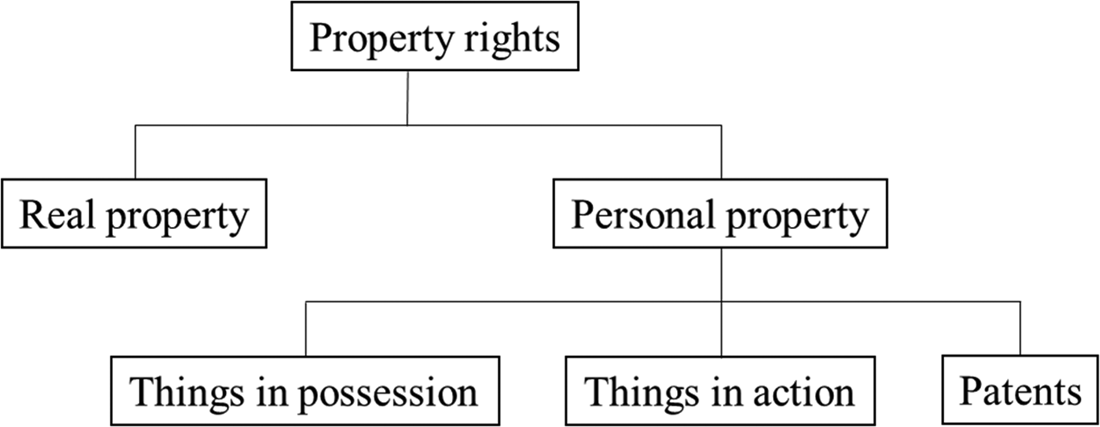
In this section, we consider a second possible objection to property rights in digital files, namely: that they do not fit the categories of things that attract property rights under English law. Personal property is split into things (or “choses”) in possession and things in action. Things in possession are tangible things of which a person can have physical possession and which are capable of transfer by delivery.Footnote 79 Things in action are rights which can only be claimed or enforced by legal action.Footnote 80 This covers a range of things including debts, rights under contract, shares, and IP.Footnote 81 (Patents are granted a separate status by law as a form of personal property without being a thing in action.Footnote 82)
On a traditional view, these are the only two categories of things which can attract a personal property right. As Fry L.J. stated in 1885: “all personal things are either in possession or in action. The law knows no tertium quid between the two.”Footnote 83 In 1930, Slesser L.J. similarly considered that “the two conditions of chose in action and chose in possession are antithetical and … there is no middle term”.Footnote 84 More recently, in 2014, Moore-Bick L.J. held that “the common law does not recognise any third kind of property”, making it difficult to recognise “the existence of intangible property other than choses in action”.Footnote 85
The things subject to property law on a traditional view

B. Digital Files Are Neither Things in Action, nor Things in Possession
This could present an obstacle to recognising a property right in digital files. On the one hand, a digital file is not a thing in action. It is a collection of information stored on a physical carrier and identified by a file name. As such, it does not comprise a legally enforceable right to anything or against anyone. On the other hand, a digital file is not a thing in possession either. In Your Response, the Court of Appeal sought to determine whether an electronic database could be subject to a possessory lien. Moore-Bick L.J. distinguished between “possession”, which applied to the physical control of tangible objects only, and “practical control”, a broader concept which applied to intangible assets as well as other, non-proprietary things. An electronic database could be subjected to practical control, but not possession.Footnote 86 In Armstrong, Stephen Morris Q.C. reached a similar conclusion when considering whether the tort of conversion could apply to EU allowances to emit carbon dioxide (“EUAs”), which are managed through an electronic register.Footnote 87 He determined that although an EUA could be considered similar to, or a modern version of, a thing in possession, the law did not allow for a thing which existed only in electronic form to be possessed.Footnote 88
Thus, possession under English law is limited to items which are (1) tangible and (2) are capable of being subjected to physical control. Digital files are neither. “Tangible” means perceptible with the sense of touch. Since digital files are reflected in the state of a carrier, they have some presence in the physical world. Take a digital file stored on an SSD: although the transistors holding the relevant electrical charges are tiny, they are physical and could in theory be touched.Footnote 89 Further, a person can exercise some level of physical control over a digital file by controlling the carrier. For instance, if Alice stores a digital file on a USB stick, she can deliver that USB stick to Bob to transfer the file; or destroy the USB stick to eliminate the file.
Yet when considered as virtual objects at the logical layer, digital files are intangible. Huguenin-Love clarifies this point using an analogy: imagine five buckets in a row. The first three buckets are full of water, the final two are not. This would represent five bits in a “11100” sequence.Footnote 90 In theory, given enough buckets, you could store any digital file this way. Yet the digital file is not the buckets, nor the water. Instead, it is a set of logical instructions as to how to fill a line of “buckets” to reflect the file's content in binary code. The buckets, or transistors, merely represent the digital file. While the buckets are tangible, the instructions are not. Similarly, a digital file is intangible: you can only touch the carrier, not the file.Footnote 91
A property law analysis should focus on digital files as virtual objects at the logical layer and particularly on the user interface, since that is where users typically interact with digital files.Footnote 92 Trying to touch or exercise control over digital files at the physical layer is both impractical and uncommon. Computer systems are not designed for us to interact directly with the bits at the physical layer. Instead, we use physical input devices (like a mouse and a keyboard) to interact with digital files through software-defined user interfaces at the logical layer. Even in the above example, Alice and Bob are not really acting upon the file itself, only upon its carrier. Their interaction is limited to total transfer or destruction. To view or amend the file's contents, they must use software. Moreover, such physical interaction only works when a single digital file exists on a single carrier. Yet a carrier often stores multiple files, meaning transfer or destruction will destroy all the files it contains. Conversely, the data comprising a single file need not all be stored on the same carrier. With cloud computing, what an individual perceives as a single file actually consists of data fragments stored across different physical servers in different locations, with software managing storage and retrieval.Footnote 93 Given the above, English courts have rightly held that digital files are not tangible items which can be subjected to physical control and so do not qualify as things in possession.
Nonetheless, Green and Randall propose that the law should treat digital control as akin to possession. They posit that possession has two features: (1) a cognitive element, namely the intention to exclude others from an object; and (2) a manual element of control over the object. The latter includes both direct physical control and indirect control over the means of access, which exists whenever a person can exclude others from accessing the object. A digital file can be subject to both elements, since a person can deliberately exercise control over it in a manner that excludes others, for instance through password protection and encryption.Footnote 94
Yet the Court of Appeal explicitly rejected this proposal. In Your Response, Moore-Bick L.J. reviewed Green and Randall's argument and accepted that there was “much force in their analysis”, which would “have the beneficial effect of extending the protection of property rights” to “take account of recent technological developments”. Nonetheless, it required “a significant departure from the existing law”, which he did not consider open to the court, and which might instead “have to await the intervention of Parliament”.Footnote 95 In sum, as neither a thing in possession nor a thing in action, it seems unlikely that, on this traditional view, a digital file can qualify as a thing recognised by property law at all.Footnote 96
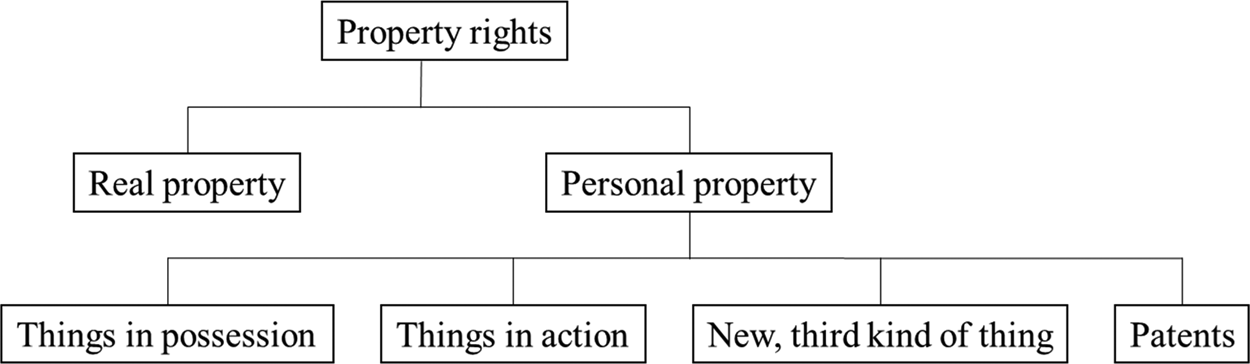
C. English Courts Can Recognise a New, Third Kind of Things
Two developments indicate that English courts might break with the above view and recognise a new, third kind of property. This could open the door to extending property rights to digital assets, including (possibly) digital files. First, in Armstrong, Stephen Morris QC was open to the existence of a third category of intangible property. He held that an EUA was either a thing in action, or at least some form of “other intangible property”. In his reasoning, Stephen Morris QC started by applying the Ainsworth test to EUAs.Footnote 97 He concluded that EUAs passed the test, since they:
(1) could be defined as the total of rights conferred on the holder under the European Emissions Trading Scheme (“ETS”);
(2) were identifiable through unique reference numbers;
(3) were transferable under ETS; and,
(4) had permanence through entries on the register.Footnote 98
EUAs could therefore be considered property. In this case, he held that it did not matter “whether an EUA is a chose in action or merely some form of ‘other intangible property’”, since the remedy of a claim of proprietary restitution was available either way.Footnote 99
Second, in 2019, the UKJT published a Legal Statement which concluded that cryptocurrency holdings were property under English law and could be classified as a new, third kind of thing. Its reasoning also applied the Ainsworth test, arguing that cryptocurrencies:
(1) could be defined and
(2) identified, because the blockchain ledger and the use of cryptography enabled participants to keep track of assets;
(3) were transferable, since they were designed to be transferred between system participants and the cryptographic authentication process meant that only the private-key-holder could control the cryptocurrency at any one time; and,
(4) were as permanent as conventional financial assets.Footnote 100
Cryptocurrencies could therefore be considered property. Many cryptocurrencies do not constitute an enforceable legal right, since participants do not undertake legal obligations to each other. The Statement therefore concluded that cryptocurrencies were not, strictly speaking, things in action. Instead, they were best treated as “another, third, kind of property”.Footnote 101
At least one English court has followed this approach. In 2020, in AA, Bryan J. held that Bitcoins were property for the purposes of granting an interim proprietary injunction.Footnote 102 He noted that the case raised “certain novel legal issues”, including whether Bitcoins were “property at all”.Footnote 103 He considered that: “[p]rima facie there is a difficulty in treating Bitcoins … as a form of property: they are neither chose in possession nor are they chose in action.”Footnote 104 However, he determined that the dichotomy between things in possession and in action was “fallacious”. He concluded, “for the reasons set out in the Legal Statement”, that Bitcoins were property, since they passed the Ainsworth test.Footnote 105
Taken together, Armstrong and AA suggest that English courts are open to recognising digital assets as a new category of things that can be subject to a property right under English law. It remains to be seen whether higher courts will follow this emerging trend.
As the Law Commission notes:
There is still uncertainty as to whether a third category of property beyond things in possession and things in action exists and, if it does, how that category should be defined.Footnote 106
The things subject to property law in future?

D. Property Rights Should Be Based on Characteristics, not Categories
The traditional view focused on the categories of things under property law. This led to a formal test, which is overly restrictive. Moon argues that the current “centuries old legal categories and classifications of ‘things’ are out of date” in the digital world; they are “inadequate and in urgent need of updating”.Footnote 107
A more modern view would instead focus on the characteristics of the object in question to determine whether it is a good fit for property law. Such a characteristics-based test provides the flexibility needed to respond to new commercial and technological developments. As illustrated by Armstrong and AA, courts can start by applying the four Ainsworth criteria.Footnote 108 These criteria can be supplemented with two additional requirements identified in the literature, namely that the object is excludable and rivalrous.Footnote 109 In our view, considering the characteristics of objects that can attract a property right is more fruitful than focusing on how to classify objects in a taxonomy of things. Admittedly, a characteristics-based test applied on a case-by-case basis might be less predictable than a categories-based test. Yet in the case of digital assets, the strictness of the current categories-based approach is itself causing uncertainty.
Further, such a test would function as a necessary, but not sufficient condition for recognising a property right.Footnote 110 It would prevent courts from recognising property rights in objects that are a poor fit for property law, for instance because property rights would be unworkable in practice. In other words, the test establishes whether an item could be subject to a property right, not whether a property right should exist at all. The first question concerns conceptual “fit” within the structure of property law, while the second question embraces consequential policy considerations.Footnote 111 The characteristics-based test therefore needs to be followed by a policy assessment. For example, there might be a market in which a certain type of digital asset is bought and sold in a manner similar to property. In that case, extending property rights would improve legal certainty and meet the reasonable expectations of asset-holders.
In sum, digital files should not be excluded from the remit of property rights for reasons of taxonomy. Instead, English courts should recognise property rights in digital assets (including digital files) whenever: (1) the assets in question meet the criteria of a characteristics-based test; and (2) there are good policy reasons for recognising a property right in a particular legal context. In the next section, we argue that digital files meet these two criteria and propose that English law recognise digital files as property. To support our proposal, the traditional categories of English property law would need amending. We therefore return to questions of taxonomy below.
IV. The Future of Property: Digital Files as Virtual Intangible Property?
A. Digital Files Have the Characteristics of Property
Unlike mere information, a property right in digital files would pass the Ainsworth test. It would be:
(1) definable, since it would apply to a digital file as a specific collection of information stored on a certain hardware carrier (or carriers) and identified by a particular file name;
(2) identifiable by third parties whenever a person has taken steps to exclude others from it, such as storing it on a password-protected device like a laptop or mobile phone; or password-protecting or encrypting the file itself. Such measures should provide sufficient notice to third parties that the person is claiming exclusive control over the digital file;
(3) transferable, since it is separable from the transferor, albeit imperfectly; and,
(4) sufficiently permanent, since the file should remain in stable existence as long as it is stored on the carrier.
As discussed above, the remaining question is whether it is enough that a digital file is (5) excludable, or whether it must also be (6) rivalrous, in the sense of finite or scarce. Admittedly, the ease of copying and transferring digital files distinguishes them from finite tangible things. Nonetheless, we submit that being excludable makes digital files a sufficiently good fit for property law. Like rivalry, exclusion can lead to conflicts over access.Footnote 112 A party with practical control over a digital file can exclude others from accessing it. In some cases, such exclusion seems unjust and contrary to the parties’ reasonable expectations. Property rights can help resolve such conflicts. We therefore focus the remainder of our analysis on a specific factual scenario in which party B excludes party A from accessing a digital file, leading to a dispute in which A seeks to recover the file or receive compensation from B. An example would be where cloud provider B excludes customer A from a digital file stored on B's servers, which A has uploaded to the cloud and which is vital to A's business. Focussing on this specific scenario also allows us to test the argument that property rights in digital files are not necessary, since other areas of the law already protect information. To illustrate our analysis, we contrast two English cases which dealt with exclusion from digital files with two cases from the United States and New Zealand.
B. The Absence of Proprietary Remedies Leaves a Gap in English Law
Property law protects owners from interference with their things. When a third party interferes with an owner's thing, the owner is generally entitled to redress. For example, under the tort of conversion, owners can sue for damages or recovery of a thing in possession from a third party who has wrongfully interfered with the possession of the thing so as to exclude its owner. Examples include taking, damage, or destruction.Footnote 113 A similar remedy applies to things in action and other intangible property in the form of a claim of proprietary restitution.Footnote 114
Yet when B excludes A from accessing a digital file, A cannot call upon proprietary remedies to seek damages or recovery. Two Court of Appeal cases illustrate what such exclusion might look like in practice. The first, Your Response, concerned a magazine publisher which had engaged a data manager to manage its database of subscribers. Following a dispute over payment, the data manager refused to let the publisher access the database. Moore-Bick L.J. considered, in passing, the applicability of conversion, opining that withholding the database could not, even if wrongful, constitute conversion.Footnote 115 Moore-Bick L.J. instead resolved the issue under contract law, through implied terms. He reasoned that transfers of electronic data would be covered by contracts, which could provide remedies for resolving disputes. Since the contract between the two parties was silent on this point, Moore-Bick L.J. concluded that the data manager had an implicit duty to send the publisher a copy of the database at the end of the contract. Refusing to do so was a breach of contract.Footnote 116 Low has criticised this ruling from a contract law perspective, arguing that if the parties’ contractual obligations were interdependent, the data manager would have had a right to withhold performance, given the publisher's non-payment.Footnote 117 The result would then resemble a possessory lien: the data manager could refuse to let the publisher access the database, pending payment. Both Moore-Bick L.J.'s ruling and Low's criticism illustrate how contract law can, in some cases, support outcomes similar to property law.
The second case, Fairstar, concerned a company which had engaged the services of an agent. Emails sent to the agent's business email address were automatically forwarded to his private email address and deleted from the company server. As a result, the emails were stored only on the agent's personal computer. When the company terminated the agreement, it requested access to the emails. The agent refused, so the company sought a court order to be provided copies of business emails, arguing that these were its property.Footnote 118 The Court of Appeal side-stepped the issue of property rights in digital files altogether and relied on the law of agency to resolve the dispute. Mummery L.J. determined that, apart from any property in the emails, the former agent was under a duty to allow the principal to inspect emails sent to or received by him relating to its business.Footnote 119 These cases illustrate how exclusion from digital files can lead to conflicts. The cases further suggest that, in practice, English courts might be able to avoid difficult questions of property rights and instead resolve disputes over digital files by looking at (implied) contractual terms or other aspects of the parties’ relationship, such as agency. This supports the argument that property rights in digital files are not necessary.
However, there are two limitations to an approach based on personal, rather than property, rights. First, a personal right would be less beneficial than a property right in case of insolvency. For example, if the data manager in Your Response had become insolvent, the magazine publisher would only have had a contractual claim against the insolvent company, instead of a right to recover its property from among the insolvent's assets. Similarly, if a cloud provider becomes insolvent, customers would have only a contractual claim, instead of a right to recover their data from the provider's servers.
Second, solutions based on personal rights do not apply to third parties who have practical control over the digital file. For example, if the data manager in Your Response had stored the database on a cloud service, then the cloud provider would also have had practical control over the file. In case of a dispute, the cloud provider could exclude the data manager from the file. The magazine publisher would have no direct contractual relationship with the cloud provider and no clear recourse to recover the file directly from the cloud provider.Footnote 120 Such “layered” arrangements are common in cloud computing, as Software-as-a-Service (“SaaS”) providers, like Apple iCloud, rely on underlying Infrastructure-as-a-Service (“IaaS”) providers, like Amazon Web Services or Google Cloud.Footnote 121 Finally, solutions based on personal rights would not apply if a third party interfered with access to the digital file in an unauthorised manner, for instance through a ransomware attack or by obtaining the file through hacking (although in the latter case, remedies based on a breach of confidence might apply).
In some cases, other remedies are available that apply erga omnes, such as under IP and data protection law. For example, a third-party could be subject to an order for delivery up if they make infringing copies of a copyright work.Footnote 122 However, that requires the digital file to contain a copyright-protected work at the content layer. This is not always the case. For example, it is unlikely that a functional database, such as the database of subscribers in Your Response, would attract copyright protection. Such a database can attract a sui generis database right, which could also give rise to a remedy of delivery up in case of infringement.Footnote 123 Yet it is not clear that the database right is infringed when a right-holder is excluded from the database. The database right protects only against transferring database content to another medium or making it available to the public.Footnote 124 Finally, while a database of individual subscribers undoubtedly contains personal data, it is the subscribers who have a right of access as data subjects under data protection law, not the company that compiled the database. In sum, there appears to be a gap in the legal remedies available under English law to party A seeking to recover a digital file from an insolvent party B or from a third-party C. In our view, this gap should be addressed through property rights since access to digital files (and the information they contain) is key to twenty-first-century commercial practices. Below, we look at two cases that illustrate how proprietary remedies can be applied to digital files.
C. Other Common Law Jurisdictions Apply Proprietary Remedies
Courts in at least two other common law jurisdictions have applied the tort of conversion to digital files. First, in Thyroff, the Court of Appeals of the State of New York applied conversion to an electronic computer record.Footnote 125 The case concerned an insurance company which had leased a computer system to an agent, who used it both for entering business data and for personal use. When the company terminated the agency agreement, it repossessed the computer. The former agent sued to recover his personal electronic records. The court held that the electronic records could be subject to conversion. It considered that society had come to rely substantially on computers and electronic data and that information was equally valuable whether stored on a physical document or in a digital file. The law should protect both forms equally.Footnote 126
Second, in Henderson, the New Zealand High Court applied the tort of conversion to digital files.Footnote 127 The case concerned a liquidator who seized a laptop from a director of an insolvent company. The director sued for the return of his personal files stored on the laptop. Thomas J. found that digital files could be subject to conversion, relying in large part on the above arguments advanced by Green and Randall regarding digital possession.Footnote 128 He further considered that there were “good policy reasons for extending the tort of conversion to digital assets”: their “immense commercial value in the modern world” provided an “important economic reason to ensure the law provides adequate protection”. Finally, he considered that the existing protection under the laws of confidence, contract, and IP was incomplete. In particular, he considered that “it would be possible to acquire digital assets in circumstances where those protections do not apply, such as if a hacker remotely deleted a … computer programme from a company's servers”.Footnote 129
In sum, courts in other common law jurisdictions have applied proprietary remedies to digital files. In both cases, the courts invoked two main policy reasons. First, digital files merit protection because of their importance to modern society. Second, a proprietary remedy should apply to a digital file, since it applies to the same record of information when recorded in physical form. As Thomas J. put it: “it would be arbitrary to base the law on the form of the medium, especially now that digital media has assumed a ubiquitous role in modern life.”Footnote 130
We think English courts should follow suit. We see five objections to applying a proprietary remedy to digital files. The first, technical, point is that a court cannot order party B to return a digital file directly to party A. Instead, as discussed above, the transfer of a digital file necessarily results in the creation of a second, identical file on A's device. Nonetheless, a court could order B to transfer the file and then delete the copy from B's own device(s). To ensure B is fully separated from the file, the court could order a secure method of deletion, such as software that overwrites the underlying data deliberately, and order B to refrain from using a data recovery specialist to retrieve the deleted file. The result is then the same as delivery of a physical object: A can access the file, B cannot.
Second, some authors would reject our proposal to focus on digital files at the logical layer. They argue that the file names and icons that represent digital files in a user interface are merely a “visual and linguistic metaphor”, designed to help users navigate a computer system. On this view, the representation of digital files at the logical layer is merely “an illusion” which cannot itself qualify as an object of property. Instead, property law should focus on the underlying carrier at the physical layer, without which no digital file could exist.Footnote 131 We disagree. As noted above, the logical layer, and particularly the user interface, is where users typically perceive and interact with digital files. Most users will never interact with, and might never even consider, the file's physical representation as bits on the carrier. Focussing on the logical layer therefore has the benefit of aligning the legal analysis with most users’ everyday experiences.
Moreover, focussing only on the physical layer leaves a gap in property rights and remedies whenever a person stores their digital files on a carrier that belongs to another party. For example, suppose that Alice stores a digital file on the server of cloud provider B. Charles deceives Alice into sharing the password to her cloud account. He then logs into the service and deletes the file. If property rights exist only at the physical layer, then only B holds a relevant property right in the server. For example, B might sue Charles for damages under the tort of conversion, for unlawfully interfering with the server.Footnote 132 Yet B has neither a direct interest in the digital file itself, nor an immediate incentive to seek damages.Footnote 133 In contrast, Alice, who has suffered a direct loss, holds no relevant property rights and so enjoys no related proprietary remedy. Suppose instead that, before deleting the file, Charles had transferred a copy of the file to cloud provider D's server. Is the file now part of D's property, since it physically resides on D's server? As before, Alice holds no property right in the file and cannot seek its return from D on that basis.Footnote 134
Third, as a matter of policy, the erga omnes applicability of new property rights raises concerns regarding the impact on innocent third parties (such as cloud provider D in our example above). The tort of conversion entails strict liability. This played a role in the House of Lord's refusal in OBG to extend conversion to contractual rights, where the defendants had acted in good faith.Footnote 135 According to Lord Hoffmann, conversion's strict liability reflected a rule that persons deal with tangible property “at their peril”.Footnote 136 In other words, people (should) know not to interfere with other people's physical objects. In contrast, other people's contractual rights are much harder to discover, making it more difficult to avoid interfering with them.Footnote 137 This makes conversion a less appropriate remedy for contractual rights.Footnote 138 Cutts warns that the same applies to digital assets, since “it is generally much easier to destroy or otherwise to interfere with digital assets accidentally than it is … for physical assets”.Footnote 139 To take a simple example, suppose that Alice stores a password-protected digital file on Bob's USB stick, without Bob's knowledge. Bob finds the file, cannot open it, and deletes it. Should Bob be liable for damages to Alice? Such policy questions require careful consideration.Footnote 140 Nonetheless, it could be argued that given the value of digital files, people should treat digital files with the same care they take when dealing with physical objects. Thus, Bob's situation could be considered as analogous to that of an involuntary bailee of a tangible object, who has a limited duty of care of the objects which have come into his possession.Footnote 141 Alternatively, the proprietary remedies applied to digital assets could make an exception for cases of accidental or good faith interference.Footnote 142
Fourth, property rights at the logical layer could clash with existing property rights in devices at the physical layer and in information at the content layer. Ownership of virtual objects at the logical layer would be separate from ownership of tangible objects at the underlying physical layer. In the above example, Bob owns the USB stick, but Alice owns the digital file. As a result, Alice's property rights curtail Bob's freedom to do what he wants with his property at the physical layer.Footnote 143 Similarly, while cloud providers own the underlying servers, customers would own the digital files stored in the cloud. That said, cloud providers (and sub-providers) can continue to use contracts with their customers to allocate risks, duties, and liabilities between the parties. This is not possible where a person's digital file comes to be unexpectedly stored on an unrelated third party's carrier, as in the case of Bob's USB stick above. Nonetheless, we expect such cases to be comparatively rare in practice.
Similarly, property rights at the content layer, such as IP rights, would curtail what owners of digital files can do with their property at the logical layer. For example, consider a .pdf file of this article. As authors, we are the first owners of copyright in its contents.Footnote 144 If Alice downloads a .pdf of this article from a website with our permission, she could own that .pdf file. Yet she could not distribute it without our permission or make copies beyond what is authorised in the license (unless permitted under copyright exemptions). This resembles the current situation in which Alice purchases a paper copy of the journal in which this article appears: she owns the paper volume but cannot copy the work contained therein. In sum, extending property rights to digital files requires careful consideration of the impact on innocent third parties and holders of existing property rights. This suggests it might be more appropriate to address this issue through legislation, than through the courts.
Fifth and finally, the courts’ arguments based on the analogy to paper documents are, in effect, arguments of substantive functional equivalence between digital files and physical objects. The argument is essentially that the law should treat a similar activity in a similar manner, irrespective of whether it takes place online or offline.Footnote 145 The difficulty with such arguments lies in determining whether the digital variant is in fact similar to its physical equivalent.Footnote 146 As noted above, electronic documents differ from paper documents because they are imperfectly separable and practically infinite. These features distinguish digital files from tangible objects. Indeed, when Baroness Hale reviewed Thyroff in OBG, she considered that applying conversion to digital files raised “formidable questions” and questioned whether digital files had “sufficient proprietary quality to attract a proprietary remedy”.Footnote 147 Nonetheless, we argue that since digital files are excludable, English courts should recognise them as objects under property law and apply a remedy for recovery or damages. Doing so would address the gap in English law identified above and provide digital files with a level of protection appropriate to their central role in twenty-first-century commerce.
D. English Law Should Recognise Digital Files as Virtual Intangible Property
In this penultimate section, we return briefly to a question of taxonomy. If digital files are to be property, what kind of property should they be? We see three options:
(1) extending the concept of possession;Footnote 148
(2) extending the concept of things in action;Footnote 149 or
(3) recognising a new, third kind of thing.Footnote 150
The existing case law on digital assets, including cryptocurrencies, provides limited guidance.Footnote 151 Armstrong and AA suggest that English courts are open to the third option. The Law Commission of England and Wales has also stated that it will consider this third option, which might better reflect “the idiosyncrasies of digital assets”.Footnote 152 In contrast, in Fetch.ai, Pelling Q.C. appeared to support the second option, finding that cryptocurrencies held in trading accounts maintained by a cryptocurrency exchange were things in action for the purpose of issuing a proprietary injunction.Footnote 153 The New Zealand High Court might also prefer the second option. In 2020, it considered whether Bitcoins were (1) property in the context of insolvency and (2) assets which could be held on trust.Footnote 154 It concluded that Bitcoins were property, since they passed the Ainsworth test, but did not decide which category of property.Footnote 155 Gendall J. did consider that Fry L.J.'s statement on the two categories of things (see above) could mean “that cryptocoins might have to be classified as choses in action”.Footnote 156 Courts in Singapore are similarly undecided. In 2020, the Singapore Court of Appeal considered whether Bitcoins were assets which could be held on trust. The International Commercial Court of Singapore had concluded that Bitcoins were intangible property, as they passed the Ainsworth test.Footnote 157 The Court of Appeal did not decide the property status of Bitcoin, noting only that “[t]here may be much to commend the view that cryptocurrencies should be … property”, while recognising “difficult questions as to the type of property that is involved”.Footnote 158
The exact categorisation might not matter in cases of exclusion from digital files, since a remedy of recovery and damages appears to be available either way. Nonetheless, on balance, we prefer the third option. As to the first option, English courts have consistently interpreted possession as relating to tangible things. Though restrictive, the concept is at least easy to understand and to apply. The second option would render “things in action” a sort of catch-all category for intangible property. Admittedly, the term has been used broadly in the past.Footnote 159 Some even argue that things in action is the appropriate category for all types of intangible property.Footnote 160 As Low and Llewelyn put it, the category of things in possession concerns “legal rights (e.g. the right to possession) over particular things (e.g. computers) that are external to the rights”. In contrast, with things in action, “abstract rights themselves are the property: there is no external thing”.Footnote 161 In other words, “the right is the res”.Footnote 162 So, when the law recognises a new form of intangible property that is “ideational and purely abstract”,Footnote 163 it must “describe fully and accurately the nature of the abstract right enjoyed by its holder”.Footnote 164 For example, Low and Teo suggest that a Bitcoin could be conceived as the legal right of the holder to have the Bitcoin “locked to their chosen … address on the blockchain”, so that they can exercise exclusive control. This right could qualify as a thing in action.Footnote 165 In sum, on this view, with intangible property, there is only a right; there is no thing.
We argue the opposite for Bitcoins and digital files: there is only a thing, but there is no right. In particular, a Bitcoin or a file is a virtual thing that can be subject to exclusive control at the logical layer of a computer system.Footnote 166 But there is no right to that virtual object that could qualify as a thing in action. To take Low and Teo's example, it is unclear whence a legal right to exclusive control over a Bitcoin would come, or who would have the related duty.Footnote 167 Neither contract, nor company documents, nor legislation creates the right. Admittedly, the right might reflect community norms. Participants in the Bitcoin system presumably accept and reasonably expect that each party can exclusively control the Bitcoins associated with their address. But there is no legal instrument which turns this norm into a right. Moreover, some participants might reject such a right, arguing that blockchain technology makes legal rights unnecessary.Footnote 168 Alternatively, the right could be argued to stem from a court decision recognising Bitcoin as property. Yet this would be entirely circular: there is a right to a Bitcoin, which qualifies as a thing in action, because a court has recognised a property right to a Bitcoin.
Instead, it would be clearer for property law to distinguish between (1) property rights that stem from legally enforceable rights such as debts, shares, contractual obligations, and IP; and (2) virtual intangible property. The former are creatures of the legal system, while the latter are creatures of technology.Footnote 169 Further, a new, third kind of thing need not be subject to possession-based remedies such as the strict-liability tort of conversion, which might not be appropriate for digital files. Finally, recognising a third category of intangible property would mirror the broad definition of property in the criminal offence of theft. The Theft Act 1968 defines property as “money and all other property, real or personal, including things in action and other intangible property” (emphasis added).Footnote 170 For example, the Hong Kong Court of Appeal concluded that textiles export quotas were a form of “other intangible property” in the context of theft.Footnote 171 Although definitions of property differ per context, consistency makes the law easier to understand. In our view, an open-ended third category of “virtual intangible property” would give courts the flexibility to recognise property rights in valuable digital assets in future, whenever the assets are a good fit for property law and where supported by sound policy reasons.
V. Concluding Remarks
We make three proposals for the treatment of digital files under property law. First, they should not be treated like mere information. Instead, a digital file should be recognised as a distinct virtual object that exists at the logical layer of a computer system. Second, property rights should not be determined by the old taxonomy of things but should be based on the characteristics of the object in question. Courts should consider whether a digital file has the characteristics that make it a good fit for property law, as well as whether policy considerations support recognising property rights in a given legal context. Third, in many cases, digital files exhibit the characteristics of property and there are strong policy reasons for recognising property rights in certain contexts. Since digital files are excludable, there can be disputes over access. In some cases, English courts can resolve such disputes without turning to property law, for instance under the laws of confidence or contract. However, such alternative remedies based on personal rights will not be effective in all cases, including if B becomes insolvent, or if a third-party C obtains control over the file. Providing a proprietary remedy would help resolve such disputes and would recognise the importance of digital files to modern commercial practices.
This third proposal is limited to digital files, as defined and described above. It would not (necessarily) apply to other types of digital assets with different features, such as social media posts. Nonetheless, the characteristics-based test we advocate should give courts the flexibility to determine the property status of digital assets more generally, including future virtual objects in new software environments.
Admittedly, property rights have traditionally applied to objects that are perfectly separable and finite. They might not be the right legal tool to regulate virtual objects which are imperfectly separable and practically infinite. If separability and scarcity are strict requirements for the objects that can attract property rights under English law, then digital files cannot qualify as property. In that case, the law should arguably be amended so as to apply a sui generis regime of protection for digital files through new legislation. For example, in 2013, Luxembourg enacted a law enabling persons to recover “incorporeal movables” from amongst the assets of an insolvent.Footnote 172 This could be used to recover customer data from cloud servers during insolvency.Footnote 173
A final question is whether courts should extend property rights to cover digital files, or whether this is best left to Parliament. On the one hand, the policy considerations are complicated and cover many legal contexts. For example, property rights also impact whether digital files form part of a deceased person's estate under succession law.Footnote 174 Further, Davis L.J. has warned of the “law of unintended consequences”: recognising property rights in digital files “may bring about unjust and unanticipated consequences in other contexts”.Footnote 175 For instance, extending property rights to digital files might result in third parties becoming strictly liable for acts undertaken in good faith. This suggests the problem might benefit from the legislator's careful consideration. Given this, the Law Commission of England and Wales's project on digital assets presents a welcome opportunity to consider the case for legislation that extends property rights to digital files, or at least provides property-like protections through a sui generis regime.
On the other hand, enacting new legislation is a time-consuming process. Courts can address issues as the need arises. Further, flexibility is often seen as a strength of the English common law. As Baroness Hale put it: “[t]he great strength of the common law is that the judges are free to develop it on a case by case basis as new factual situations arise. There comes a point when, as Scrutton L.J. once said, ‘If there is no authority for this it is time that we made one’.”Footnote 176 In practice, courts are likely to face further questions about the proprietary status of digital files before the process of legislative change has run its course. They can respond by applying the above characteristics-based test and considering the distinct features of digital files we have identified. Should a relevant case arise, then, in our view, the time would be ripe for recognising property rights in digital files.