1. Introduction
A recent trend in philosophy of science focuses on the central importance of mechanisms to scientific investigation, explanation, and understanding (Machamer, Darden, and Craver Reference Machamer, Darden and Craver2000). This is typically cast in terms of the value and role of either mechanistic explanations or strategies to scientific discovery, modeling, explanation, and understanding (Craver and Tabery, Reference Craver and Taberyforthcoming). Yet this new mechanistic account of explanation faces important challenges.Footnote 1 One such challenge regards scope. The new mechanists have done well to make their case in specialized disciplines, such as neuroscience (Bechtel and Richardson Reference Bechtel and Richardson1993/2010; Craver Reference Craver2007; Bechtel Reference Bechtel2008) and molecular biology (Darden Reference Darden2006).Footnote 2 Yet these life sciences are process oriented in that they investigate proximate systems that are highly amenable to mechanistic thinking (i.e., systems composed of interacting and organized parts). Making a similar case for the value of mechanisms to other domains of scientific investigation is the challenge of scope for the new mechanism.
This article works to resolve the challenge of scope by revealing a role for mechanisms in a paradigmatically nonmechanistic science: statistical phylogenetics. Unlike the proximate, process-oriented sciences mentioned above, phylogenetics is a ‘pattern-oriented science’ in that the explanandum phenomena are patterns in nature (e.g., phenotypic traits or nucleotide sequences) rather than underlying processes (e.g., DNA replication or protein syntheses) (see Sober Reference Sober1988; Haber Reference Haber and Tucker2009; Velasco Reference Velasco2013). Moreover, unlike the process-oriented life sciences, phylogenetics is a science driven by statistical methods and mathematical models.Footnote 3 There is no obvious sense in which practicing phylogeneticists appeal to mechanisms or mechanistic information in the manner outlined by the new mechanists. Despite this lack of explicit appeal or representation, here I show that mechanisms play a valuable role in maximum likelihood (ML) methods of phylogeny estimation. I argue specifically that molecular mechanisms (or the breakdown thereof) can be ‘embedded’ in mathematical model parameters to strengthen phylogenetic tree hypotheses. I discuss Kimura’s (Reference Kimura1980) estimation of the transition/transversion (ti/tv) rate ratio as an embedded mechanism of DNA mutation, the application of which produces stronger tree hypotheses, as measured by ML logL values.
Section 2 shows how ML methods of phylogeny estimation are enhanced by embedded molecular mechanisms, such as the ti/tv rate ratio. Section 3 fleshes out the concept of an embedded mechanism and its implications for the new mechanism and the challenge of scope. Section 4 gives conclusions.
2. From Molecular Mechanisms to Maximum Likelihood
2.1. Phylogenetics Tree Hypothesis Testing and Strengthening
Broadly, phylogenetics is a science of patterns in that it makes inferences about evolutionary history from observed patterns of biodiversity or character distribution in nature. The products of these efforts are tree hypotheses, which graphically represent evolutionary-relatedness of groups of taxa. Phylogenetic hypotheses are valuable to any scientific explanation regarding life history, such as human epidemiology (Ou et al. Reference Ou1992; Harvey and Paul Reference Harvey and Paul1994), ecology (Brooks Reference Brooks1991), and evolutionary biology (Harvey and Pagel Reference Harvey and Pagel1991). Here I focus on one prominent approach to phylogeny estimation: the ML method.
Fisher (Reference Fisher1922) developed ML as a statistical tool estimating the probability of observing the data, given the model. Modern forms construe ML as the probability of the evidence (E), given the hypothesis (H). ML methods of phylogeny estimation assign a logarithmic likelihood (logL) value to tree hypotheses given (a) observed nucleotide sequences and (b) model assumptions (parameters) of evolutionary change. In other words, ML methods allow for the construction of competing tree hypotheses, given various assumptions about evolutionary processes and observed genetic data.
The history of ML methods of phylogeny estimation is marked by an informative trend. While observed nucleotide sequences remain the same, phylogenetic tree hypotheses get stronger over time. In other words, phylogenetics improves tree hypotheses by analyzing the same data with better models of evolution. Here ‘better models’ are understood as those that more accurately accommodate subtleties of evolutionary change, often at the molecular level (Felsenstein Reference Felsenstein2004). Each tree hypothesis has a logL value, which is treated as a measure of strength. The lower the logL value, the stronger the hypothesis. These quantitative values of tree hypotheses allow for a simple method of hypothesis testing in which phylogeneticists pit competing hypotheses against one another (Huelsenbeck and Crandall Reference Huelsenbeck and Crandall1997). In effect, phylogeneticists can run the same data using different models or the same model but with different parameters. Each analysis allows for a new tree hypothesis to be assessed against the others. In short, altering model assumptions and achieving greater logL values strengthen phylogenetic tree hypotheses.
2.2. Strengthening Tree Hypotheses with Mechanistic Model Parameters
In order to compare tree hypotheses, phylogeneticists must analyze the same data using different models and assumptions. This generates competing hypotheses that phylogeneticists use to reconstruct the best phylogenetic tree. Models that estimate ti/tv rates are an excellent example of how more accurate model assumptions result in stronger tree hypotheses. One of the earliest models, JC69, made two important assumptions about fundamental evolutionary processes. It assumed both (a) equal nucleotide frequencies and (b) equal rates of change between nucleotides (Jukes and Cantor Reference Jukes and Cantor1969). Yet practicing phylogeneticists soon realized that these assumptions failed to capture real processes of DNA substitution. For example, molecular biologists recognize unique ways in which substitutions may occur as either transitions or transversions (Freese Reference Freese1959). In order to more accurately capture biological details, Kimura (Reference Kimura1980) developed a valuable method of ti/tv rate estimation for ML tree reconstruction. More importantly, analyzing the same nucleotide sequences with ti/tv rate parameters produces tree hypotheses with improved logL values (Huelsenbeck and Crandall Reference Huelsenbeck and Crandall1997, 455). Thus, phylogenetic models that accommodate ti/tv rate biases produce stronger tree hypotheses, given the data.
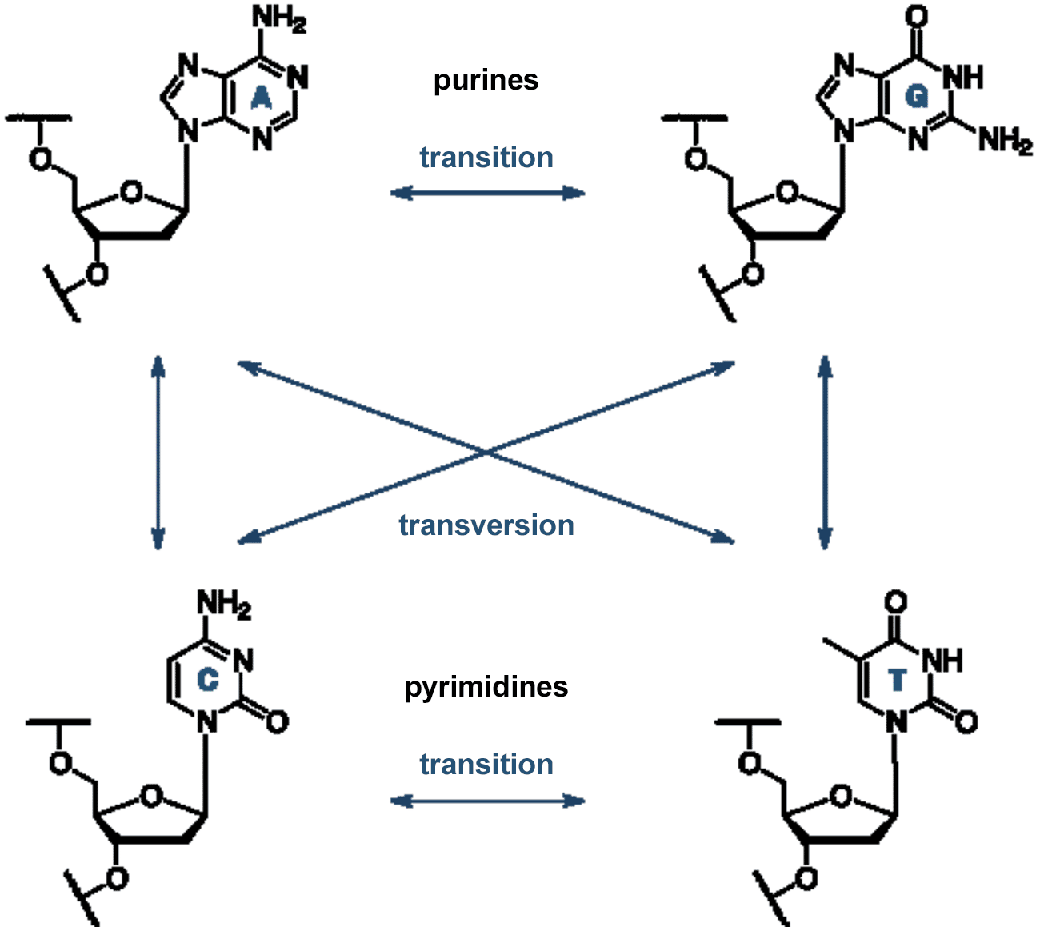
But what exactly is the ti/tv rate bias? Why does estimation of the bias strengthen tree hypotheses? Although these sorts of questions are often black-boxed by practicing phylogeneticists, their answers have important implications for the philosophy of science. A ti/tv rate bias is essentially an effect caused by subtleties of DNA substitutions, which occur at the molecular level. Transitions are spontaneous purine–purine or pyrimidine–pyrimidine substitutions. Transversions are spontaneous purine–pyrimidine or pyrimidine–purine substitutions. What distinguishes these two types of nucleotides is molecular ring structure. Purines have a double-ring structure, while pyrimidines take a single-ring structure. Moreover, these unique structural features play an important role in how molecular biologists explain ti/tv rates of DNA substitution (see fig. 1).Footnote 4
Transitions involve purine–purine or pyrimidine–pyrimidine mutations (A↔G and C↔T), while transversions involve purine–pyrimidine or pyrimidine–purine mutations (A↔C, A↔T, G↔C, and G↔T).

While various mechanisms of mutagenesis have been proposed over the years (e.g., tautomeric shifts and link slippage), most scientists today attribute DNA replication errors to Crick’s (Reference Crick1966) wobble hypothesis (Pray Reference Pray2008). While a typical base pairing involves cytosine–guanine, the wobble hypothesis explains a unique pairing of cytosine–adenine in the event that adenine contains an extra hydrogen atom, for example. While these are often referred to as ‘mechanisms’, such phenomena are more accurately described as the failure or breakdown of DNA error recognition and repair mechanisms (see, e.g., Kolodner Reference Kolodner1995; Iyer et al. Reference Iyer, Pluciennik, Burdett and Modrich2006).
While there are many subtle differences between various scientific explanations for DNA replication error, what they all have in common are mechanistic details. On this point Illari and Williamson’s catchall definition of mechanism is useful: “A mechanism for a phenomenon consists of entities and activities organized in such a way that they are responsible for the phenomenon” (Reference Illari and Williamson2012, 120). There should be little dispute that any explanation for the ti/tv bias involves appeal to entities, activities, and organization. Moreover, Darden (Reference Darden2006) offers a systematic and persuasive case for the mechanistic nature of molecular biology. For the purposes of this article, the pertinent claim is that any explanation for the ti/tv rate bias will be molecular biological and inherently mechanistic. It will either describe an explicit mechanism (or the breakdown thereof) or appeal to mechanistic details or information, such as parts/entities, activities/interactions, or organization.
In this light, explanations for the ti/tv rate bias are inherently mechanistic in the sense of interest to the new mechanists. These explanations show precisely how errors in the mechanism of DNA replication can give rise to permanent mutations. Subtle details in the manner in which various mutations occur give rise to a nearly universal bias in favor of transitions over transversions. That is, by virtue of the mechanical details of DNA replication, transitions occur at a higher rate than transversions.Footnote 5 Phylogenetic models, in turn, accommodate these mechanistic details with the addition or manipulation of parameters. The effect of this bias is then estimated, mathematically, for accurate phylogenetic modeling. Thus, the effects of molecular-level mechanisms (or the breakdown thereof) are accommodated in models using ti/tv rate parametric values. In other words, mechanisms, mechanistic details, or mechanistic explanations are ‘embedded’ in phylogenetic model parameters, such as the ti/tv rate bias. More importantly, however, models using ti/tv parametric values produce tree hypotheses with greater logL values. Thus, models embedded with mechanisms produce stronger phylogenetic tree hypotheses.
3. Embedded Phylogenetic Mechanisms
The previous section shows how models using embedded mechanisms provide stronger phylogenetic tree hypotheses. Yet this notion of embedded mechanisms raises important questions. How are embedded mechanisms distinct from those of interest to the philosophers of mechanism? How does this notion of strengthening phylogeny estimation by embedding mechanisms bear on the challenge of scope for the new philosophy of mechanisms? In this section I flesh out this new notion of mechanism and show how it affects the prospective scope of mechanistic explanation.
3.1. Understanding Embedded Mechanisms
Above I use the term ‘embedded mechanism’ to capture the fact that the mechanistic details that facilitate ML phylogeny estimation are entirely implicit; they are built into mathematical model parameters of DNA substitution (ti/tv bias). While it is not the goal of this article to construct a complete account of embedded mechanisms, here I will clarify a few important points. First, I do not mean to claim that because phylogenetics benefits from embedded mechanisms, it is a mechanistic science. There is a clear sense in which molecular biology and neuroscience are mechanistic in that their explanations often elucidate mechanisms and often use mechanistic strategies of investigation, such as decomposition, localization, and recomposition. But phylogenetics does not share these characteristics. Broadly, the new mechanists are interested in the value and role of mechanisms to scientific investigation, discovery, modeling, and explanation more generally. So the claim is not that phylogenetic methods or hypotheses are inherently mechanistic—it remains unclear whether this is the case. Rather, the claim is that mechanistic explanations elsewhere (molecular biology) positively contribute to phylogenetic tree construction.
It might also be helpful to think about embedded mechanisms in light of Salmon’s (Reference Salmon1984) ontic/epistemic distinction, which highlights a point of contention among new mechanists (Illari Reference Illari2013). That distinction is meant to capture the source of explanatory power for those thinking about mechanisms. On the ontic conception of mechanisms, it is the physically embodied mechanism ‘out there in the world’ that explains.Footnote 6 On the epistemic conception of mechanisms, however, it is the representation or exhibition of the mechanism that explains.Footnote 7 With this framework in mind, one should conceive of an embedded mechanism as a unique kind of epistemic mechanism. While it is not precisely clear that embedded mechanisms explain, the above analysis demonstrates a distinct sense in which they strengthen phylogenetic tree hypotheses. Yet proponents of the epistemic conception of mechanism make claim to the value of visuo-spatial representations to explanation and understanding (Bechtel and Abrahamsen Reference Bechtel and Abrahamsen2005). On that view, it is by virtue of the fact that visual representations can accommodate parts/entities, causal relations, and organization that they facilitate scientific explanation and understanding. Yet embedded mechanisms are unique in that they lack precisely this kind of visual representation. Rather, the embedded mechanism is—in the case described above—a mathematical model parameter. Thus, embedded mechanisms are uniquely epistemic in that they facilitate scientific understanding sans explicit representation.
It may also be useful to think about the notion of embedded mechanisms in light of Levy’s (Reference Levy2013) tripartite characterization of the philosophy of mechanisms. He distinguishes three kinds of new mechanism theses, regarding the metaphysics of causation (causal mechanism), scientific explanation (explanatory mechanism), and scientific methods of investigation (strategic mechanism):
Causal mechanism (CM) is the view that causal relations, at least outside the domain of fundamental physical phenomena, exist by virtue of underlying mechanisms. CM rivals other accounts of causation, such as regularity views. It is best seen as a contribution to metaphysics.
Explanatory mechanism (EM) is a thesis about explanatory relevance: it states that to explain a phenomenon, one must cite mechanistic information, that is, specify underlying parts and their organization. EM contrasts with other general accounts of explanation, such as the deductive-nomological model.
Strategic mechanism (SM) concerns the cognitive-epistemic power of mechanistic modeling and related scientific methods. It asserts that certain phenomena are best handled mechanistically. Discussions of SM tend to construe ‘mechanism’ fairly narrowly, in machine-like terms (Levy Reference Levy2013, 2).
My analysis of embedded mechanisms in phylogenetics is not meant as a contribution to the metaphysics of causation, nor is it clear that it has implications for such. Hence, CM does not capture the significance of embedded mechanism.
Levy’s characterization of EM represents an interesting candidate for capturing the notion of embedded mechanism. On the one hand, there is a sense in which the practice of embedding mechanisms into one’s model counts as citing mechanistic information. On the other hand, however, it remains an open question whether phylogenetic tree construction qualifies as explanation. While I believe that a case could be made for such a view, it is beyond the purview of this article. Thus, for present purposes, Levy’s characterization of EM fails to adequately capture the unique manner in which embedded mechanisms contribute to ML phylogeny estimation.
Does Levy’s characterization of SM capture my notion that embedded mechanisms positively influence phylogenetic tree construction? If one treats the practice of building mechanistic details into mathematical models—that is, embedding mechanisms—as a mechanistic method, then SM is relevant here. However, the practice of embedding mechanisms is markedly unique from exemplar SM methods, such as decomposition, localization, and recomposition. Thus, the notion of embedding mechanisms in one’s mathematical model is a good candidate for fleshing out Levy’s characterization of SM.
3.2. On the Challenge of Scope
Earlier I framed this contribution as one that works to resolve a challenge of scope. Moss (Reference Moss2012) offers the most explicit presentation of this challenge by questioning the value of the ‘mechanistic metaphor’ to some areas in biomedical research, such as intrinsically unstructured proteins:
By means of what kind of knowing can and should the biomedical scientist and biologist approach the kinds of strikingly nonmachine like empirical realities revealed in studies of the pleiomorphic ensembles and intrinsically unstructured proteins that constitute the woof and warp of systematic cellular signaling and adaptive regulation? Is it possible that where the ‘rods and pistons’ of the mechanistic metaphor have run out of steam that a transition to alternative forms of understanding will be in order? Where philosophers of mechanism, largely focused on the science of a bygone era, have yet to recognize this as a problem, it has not escaped the notice of contemporary biomedical investigators. (Moss 2012, 170)
Although Moss’s concern targets a specialized case, it hints at a more general problem for explanandum phenomena that are not amenable to mechanistic explanation. Strevens (Reference Strevens2008, chap. 2) raises a similar concern, arguing that some phenomena are inherently probabilistic, populational, and, consequently, unsusceptible to mechanistic explanation. Lastly, Woodward notes that limits of scope are a feature of all accounts of explanation: “My view is that mechanistic explanations are most likely to be successful when the systems to which they are applied satisfy certain empirical presuppositions … [yet] as one moves away from contexts in which these presuppositions are satisfied, mechanistic explanation becomes a less promising strategy. This is not intended as a criticism of mechanistic explanation in those circumstances in which it is appropriate, but rather simply reflects the point that, like virtually all explanatory strategies and structures, there are limits on its range of application” (Reference Woodward2013, 64).
The concerns expressed by Moss, Strevens, and Woodward indicate a limited scope for the new philosophy of mechanisms on the grounds that there are some explanandum phenomena to which mechanistic thinking or strategies of investigation are not applicable. How does the notion of an embedded mechanism bear on this general worry? While it does not answer these concerns directly, it does provide a different way of thinking about how mechanistic thinking facilitates scientific investigation and explanation of inherently nonmechanistic phenomena. While Moss, Strevens, and Woodward may have in mind sciences that make no explicit appeal to mechanisms or mechanistic information, it remains an open question whether these sciences implicitly appeal to embedded mechanisms in the manner of statistical phylogenetics. At the very least, the notion of embedding mechanisms extends the scope of mechanistic thinking beyond those sciences in which appeal to mechanisms is both explicit and ubiquitous.
4. Conclusion
This article makes a case for the role and value of embedded mechanisms in phylogenetics. At the molecular level, the ti/tv rate bias is an effect best explained by the mechanistic details of DNA replication error, recognition, and repair. This mechanistic effect, however, is of particular value to accurate phylogeny estimation using ML methods. Models embedded with these mechanistic details produce stronger phylogenetic tree hypotheses, as measured by logL values. In other words, implicit ‘embedded’ mechanisms strengthen the science of phylogeny estimation. That embedded mechanisms play a valuable role in phylogenetics has two important implications for the new philosophy of mechanisms. First, it suggests a unique and subtle mechanistic strategy characterized by statistical models bolstered with embedded mechanisms. Embedded mechanisms are unique to those discussed by the philosophers of mechanism in that they lack explicit, visuo-spatial representation. Second, it helps answer the important challenge of scope, extending the value and role of mechanisms to the pattern-oriented science of phylogenetics. Extrapolating from this case to additional sciences using mathematical models of mechanistic processes is the next step toward a better understanding of the scope and limits of the new philosophy of mechanisms.