This article examines the nature of gendered crime and its relation to the rural landscape and urban topography in Montgomeryshire, Wales, during the 1870s. Its main sources are the Quarter Sessions records for the county and newspaper reports. Court proceedings and witness depositions are used to study the varying experiences of men and women who were prosecuted for the offence that was most commonly seen, namely theft.Footnote 1 Peter King, Jennifer Davis and David Phillips among others have shown the criminal courts to be a theatre in which all manner of social situations were seen and discussed, and it has been said that the history of the criminal justice system is ‘central to unlocking the meanings of . . . social history’.Footnote 2 As such, the courts allow a valuable study of gender differences, as crime was fundamentally gender related.Footnote 3 This gender comparison has been under-studied hitherto, as criminality was largely a male domain, and histories of crime have concentrated on men.Footnote 4 Garthine Walker contends that, as such, few studies have dealt with gender as an analytical category, and her study into the characteristics of female property offences in the early modern period provides valuable details about the modi operandi of female offenders and their patterns of crime.Footnote 5 This article develops these themes further in a rural Welsh county that hitherto has been little studied, especially with regard to crime,Footnote 6 acknowledging Peter King's assertion that there is a need to look further afield for data with which to develop criminal justice scenarios. He would certainly have endorsed the need for more rural Welsh studies for his own work threw up many tantalizing English-Welsh contrasts that he was not able to explore further himself.
By the middle of the nineteenth century, Montgomeryshire was composed of a few heavily-industrialised, but declining, textile towns with a large agricultural hinterland that was primarily pastoral and based on small farms.Footnote 7 Both the townscapes and the countryside represented environments ripe for criminal activity. Present in the urban areas were pawnshops and close-packed dwellings, unemployment and itinerant labourers which were all recognised as genitors of crime. Present, too, were canals, roads and railways, providing thieves with opportunities for offending and getting away. The rural areas contained isolated farms, with livestock and crops in unattended fields, as well as hills across which to escape. The nature of the county thus offers scope for comparisons between the rural and the urban, and the spatial dimension of offending is investigated here both during the commission of the offence and through the getaway stage. In particular, this builds on the work of Brian Short who vividly reconstructed people's lives in the landscape, and pointed to how motives and behaviour could be heavily conditioned by topography.Footnote 8 I also wish to augment understanding of the role of gendered spheres in determining action, furthering the work of Gemma Goodman and Charlotte Mathieson who explored gender and space in rural settings.Footnote 9
A review of the cases seen in court
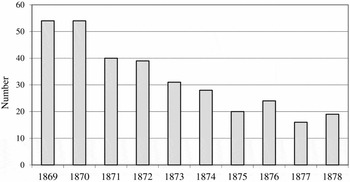
A total of 352 cases appeared before the county bench between Hilary 1869 and Michaelmas 1878. Figure 1 shows the number of cases appearing at Quarter Sessions in each year across the decade. The chart shows a generally downward trend, similar to that for the whole of Wales noted by Jones.Footnote 10
Number of offences appearing at Montgomeryshire Quarter Sessions, 1869–78 (352 in total).

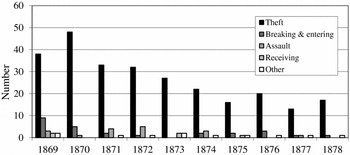
The offence most often prosecuted in court in Montgomeryshire was theft, but other notable offences were breaking and entering, which nearly always included theft of items, and assault (Figure 2). Receiving stolen items also featured, and the crimes categorised here as ‘other’ included passing counterfeit coins, animal maiming, attempted arson, the vagrancy offence of being a rogue and vagabond, deserting a child and attempted suicide.
Offences as seen in court each year (352 in total).

The downward trend continued to the end of the century and was also seen in England and elsewhere in Wales. Jones discusses the figures for different regions and concludes that the rate was lower in rural areas, and he makes comparisons between heavily industrialised areas such as Merthyr and less built up areas such as Pwllheli. Reasons given for the difference include the character of the peasantry and a cooperative mentality among members of the rural community. Deference or a ‘feudal dependence’ is also cited as a reason for a lower rate of crime in rural areas.Footnote 11 Lack of policing in rural areas may have resulted in a lower level of recorded crime. Many unskilled workers appeared in the dock, but the occupations of a third of the accused were unknown. Multiple crimes committed by individual offenders account for the disparity between the numbers of offences and offenders.
Contemporary thoughts about crime
Thinkers and writers about crime in the nineteenth century perceived it largely as an urban problem, assuming that any area ‘teeming’ with poor people was a haven for the dangerous classes.Footnote 12 There was a focus on London in much public discussion, with many of the more alarming and best-publicised nineteenth-century offences being committed there. As the century progressed, crime was increasingly publicised in the other burgeoning urban environments, where a growing proportion of the public was located.Footnote 13 Thomas Plint declared that:
The pickpocket and the thief can find no nesting place amongst the statesmen of Cumberland and Westmorland, or the miners of Durham and Cornwall. They fly to Birmingham, London, Manchester, Liverpool, Leeds. They congregate where there is plenty of plunder, and verge [greenery] enough to hide in.Footnote 14
James T. Hammick emphasised that the criminal classes were mainly found in towns, and generally crime in rural society was not considered to be so serious. Charles Brereton said:
The majority of thieves exist in gangs, practise fraud by profession, and live by a constant series of depredations. . . criminals in the country only occasionally once or twice a year steal a sheep, pig, corn hay, wood, turnips, poultry as the case may be.Footnote 15
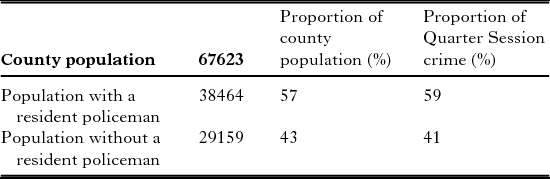
Journalist Angus Bethune Reach, however, like many others in the 1830s and 1840s, identified a ‘startling’ amount of crime in rural areas, out of proportion to the number of people living there, and believed that this was the result of rural poverty.Footnote 16 Others have identified rural dwellers as more prone to violent crime, with urban dwellers being more likely to experience property crime.Footnote 17 As Montgomeryshire was a county with both characteristics, an investigation was carried out to discover if the county showed a small-scale version of the countrywide picture described by Reach and others. Court reports and censuses have been used to establish the precise geographical locations of crimes. In a little over a third of the cases, the exact location details could not be found, but the remaining 218 produced the information shown in Table 1. The presence of a resident police officer was adopted as an indication of a settlement being of significant size. The proportions of crimes occurring in populated and isolated areas were fifty-nine per cent and forty-one per cent respectively.
Proportions of Quarter Session crimes related to population.Footnote 18
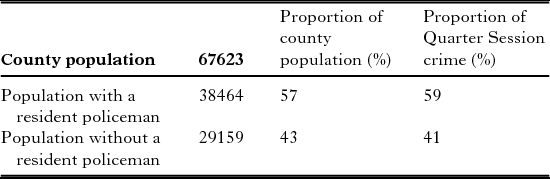
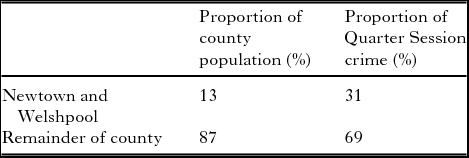
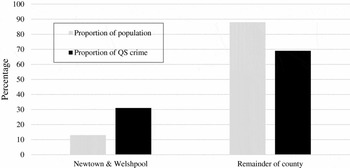
This gives an almost one-to-one correspondence between population and incidence of crime in both areas, which does not support Reach's assertions about rural crime being out of proportion to population. However, a focus on Welshpool and Newtown gives the results shown in Table 2 and Figure 3.
Proportion of Quarter Sessions crimes related to the population of Welshpool, Newtown and the remainder of the county.
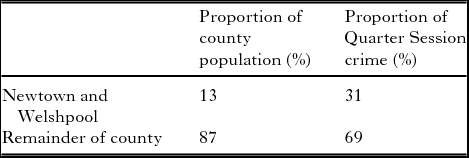
Relative proportions of population and crime.

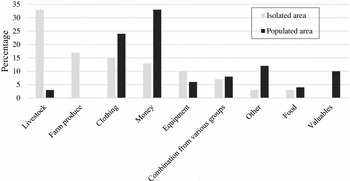
This shows that crime was disproportionately high in the two most populous Montgomeryshire towns and justifies the extra officers stationed there, with eight in Newtown and seven in Welshpool. In comparison, Llanidloes had two officers and Montgomery, the county town, had one. Brereton's comment about rural criminals stealing livestock and crops is reflected in Figure 4, with thefts of these commodities being the most common in isolated areas, but almost non-existent in urban locations.
Thefts in isolated and populated areas (172 in total).Footnote 19

Clothing and money were also widely stolen in isolated areas, but constituted only about half as many thefts as livestock and crops. Money was the biggest single target for theft in more populated areas and was approximately equal to livestock thefts in rural areas.
Location of offences and gendered difference
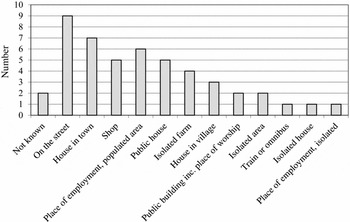
Jones briefly discusses women's contribution to crime in Wales during the nineteenth century, concentrating mainly on a statistical analysis that highlights a disproportionate amount of offending in industrial areas.Footnote 20 For example, during the middle years of the nineteenth century, forty per cent of people committed to the upper courts in the industrialised towns of Merthyr, Cardiff, Newport and Swansea were women, contrasting ‘starkly’ with Cardiganshire, where about one per cent of those apprehended were women. The present study found that in Montgomeryshire eighteen per cent of the persons appearing in the dock were female and that they were unlikely to commit offences in isolated areas (Figure 5). In general, offences took place in the woman's home area: in a house, which might be the employer's house, on the street or in a shop.Footnote 21 It has been said that the boundaries of women's lives were circumscribed, with domestic responsibilities keeping them near the home,Footnote 22 but another reason for not venturing abroad could be that isolation increased the risk of sexual assault. For example, in June 1870, Elizabeth Morris was attacked on the canal towpath near Newtown while on her way home from the market.Footnote 23
Scenes of offences involving women suspects (49 cases where the defendant pleaded not guilty).

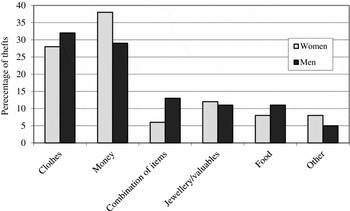
Females were largely responsible for purchasing items for the home and family, a responsibility that took them out of the house and into shopping areas. Although this journey from the home left them vulnerable, there were also temptations and opportunities which could turn women into culprits rather than victims. Some shop thefts were clearly opportunistic, as in the case of Frances Jones who was convicted of stealing money from a woman who had momentarily left her handbag on a shop counter, and two farm girls who picked up a bonnet from a shop counter while browsing.Footnote 24 But women could also show a degree of devious behaviour. Elizabeth Hughes claimed to have been sent by her employer to a draper to order a valuable shawl on approval. Little did the draper know that Hughes had recently left the employment and intended to appropriate the item herself.Footnote 25 Another woman caused a distraction in a shop while waiting to be served, and purloined several waistcoats.Footnote 26 Figure 6 shows that men and women stole clothes in approximately the same proportion, and yet the following analysis of the thefts shows a strong gender difference in subsequent handling of the stolen items, thereby indicating dissimilar motivations.
Types of thefts committed by men and women (182 in total).

When Elizabeth Hughes was found ‘on the street’ in Newtown after she had deceived the draper into giving her the shawl, she was wearing the garment. When market-stall holder Elizabeth Pilot noticed a bolt of fabric and a silk dress missing, she suspected her employee, Mary Ann Braidsdell, and obtained a warrant for the woman's lodgings to be searched.Footnote 27 The silk dress was found in Braidsdell's room, as well as a garment described as a tunic that Braidsdell had made from the stolen fabric. Ann Williams stole a bonnet and a shawl from two different women in Newtown, put them on and was apprehended wearing them, while Mary Ann Nason was found in a pub wearing a silk dress stolen from her employer.Footnote 28 Nason was not alone in her efforts to wear fine clothing: in the 1860s, Punch poked fun at working-class women who tried to follow fashion with cartoons picturing servants in ridiculous and indecent situations who insisted on wearing crinolines while cleaning.Footnote 29 In Hughes's case it might also have been a way of ‘getting even’ as her cross-examination of Mrs Pilot during her trial revealed that Pilot had made her a present of a wedding dress but had deducted the cost of it from Hughes's wages. Although the details of many of the offences are not known, there is at least some indication that the women were stealing for their own use, with little evidence that they stole for financial gain. It would have been much easier for Braidsdell simply to sell the cloth than go to the trouble of making the tunic, particularly considering the increased risk of being discovered. The fact that she did make it up into wearing apparel suggests that, for the time being at least, she intended to use it herself.
It has been argued that people ‘were moved by a desire for novel and popular fashions’,Footnote 30 and the 1870s was a decade when Newtown entrepreneur Sir Pryce Pryce-Jones was becoming increasingly famous for his tweeds. He showed his products at exhibitions and won medals for his goods. He also supplied shawls to Florence Nightingale, Queen Victoria and her daughters.Footnote 31 Newspapers often carried advertisements that described the sorts of goods available at that time, and some contemporaries considered that promotions of this type encouraged shoplifting. Also at the time of Braidsdell's case, fashion magazines were becoming popular, having been available from the late 1860s. The Month's Fashions was first published in London 1868 and paper patterns for gowns also became very popular at this time, although they had been available earlier.Footnote 32 Fashion was associated firmly with elite modes of consumption emanating from London, and different meanings might be associated with particular items or certain colours, making clothing a medium which could be used for complex sartorial elaboration within social classes.Footnote 33 Fashion was also part of the ‘social ritual’ which served to maintain class boundaries.Footnote 34 The cloth stolen from Mrs Pilot was described as ‘Parramatta’, which was originally made in Australia but had started to be made in Britain and had received exceptional reviews.Footnote 35 Perhaps the temptation of the bolts of cloth on Mrs Pilot's market stall was too much to resist.Footnote 36
Newspaper reports may have provided a further pressure to emulate, for example, from the description of High Sheriff Captain Mytton's wedding in London:
The bridal costume was of white satin, richly trimmed with lace, orange blossom and stephanotis, gold lockets, earrings and bracelets. [The bridesmaids’ dresses] were of blue and white. The skirts, made long, were of blue silk and had two wide flounces, scalloped at the edge, under which were white muslin plaits. The bodies and tunics were of blue Japanese silk, richly trimmed with Valencienne lace. Footnote 37
The ordinary, working woman did not have access to this sort of finery, and an advertisement placed by the Pilots showed that they supplied more accessible clothing, ‘cast-off’ from the higher classes, from their shop in the centre of town. Photographs of rural Welsh communities show that while the upper orders had discernible fashions which changed constantly, the costume of the lower orders was relatively static, and the history of fashion indicates that styles of expensive clothing changed almost on a year-to-year basis.Footnote 38 Thus clothing was a means of communicating status and class, and the upper classes could communicate through their wearing apparel more effectively than the working classes.
With regard to men's thefts of clothing, there is evidence of selling on. When market trader Thomas Swain helped himself to various items of clothing from Mrs Pilot's stall, he immediately hung them up on his own stall for resale.Footnote 39 Shoemaker Owen Davies stole twenty pairs of boots from his employer and took them straight to a Newtown pawnbroker who gave Davies the choice of pawning them or selling them. Davies chose to sell and then absconded to Shropshire.Footnote 40 When Thomas Burke stole a length of cloth and various pieces of apparel in Newtown, unlike Mary Ann Braidsdell, he made off to Shropshire where he sold some of the items to a lodging-house keeper.Footnote 41 Most of the clothing thefts in this study were committed by tramps who were found wearing the articles. If these tramp thefts are discounted, then a picture emerges of women stealing clothes for their own use, and men stealing for financial gain. In Phillips's analysis of Black Country clothing thefts, he makes the deduction that:
Those who stole regularly while also being employed . . . could hardly be called professional thieves since stealing clothing was not particularly lucrative. They were neither honest poor nor criminal class but an important third category – people in employment who supplemented their income with theft.Footnote 42
But this statement is the sort of generalisation criticised by Walker for omitting women. It is a generalisation that does not identify an important fourth category: women who stole clothing for their own use.Footnote 43
Street thefts committed by women were always of money or small items of value such as a watch, whereas men's street offences were often thefts of livestock on market days and rarely of money or valuables. This does not seem readily explicable by different gendered material aspirations and so is most likely to be related to contrasting opportunities.Footnote 44 A man would not be out of place browsing around animal pens or taking away a sheep in a cart, and a woman on a street, looking into shop windows or mingling with buyers inside, would not necessarily be suspicious.Footnote 45 These locations would offer her the readiest opportunities. There was one location, however, where men did carry out the sort of theft normally associated with women, and this was in public houses, a place where their mingling would not look out of the ordinary. The circumstances of most public house thefts were similar for both sexes. They were often opportunistic, involving picking the pocket of a drunk or some other person sitting nearby, or walking off with an item left carelessly.Footnote 46 Prostitutes created opportunities for such offences, as seen in the case of Sarah Lewis who picked a client's pocket,Footnote 47 and men sometimes planned thefts such as that committed by Thomas Fitzgerald when he tricked a bartender into giving him money.Footnote 48
Opportunism thus facilitated thieving, and opportunities for stealing particular items have been said to be culturally disposed, often arising from gendered activities.Footnote 49 Feeley argued that as the nineteenth century progressed, women were excluded from many forms of developing industry or work, and segregated into low-wage occupations, thereby reducing their opportunities for theft. This can be seen in Montgomeryshire. There were nine cases of women's theft from their place of employment, and in all but one they were employed either as domestic servants or charwomen in private homes or inns, and in one case, a toll house.Footnote 50 They stole a limited range of items including money, jewellery, beer and clothes. This contrasts with male offenders whose workplaces were farms, an office, a warehouse, railway station, the market place, mines, a canal wharf, coal depot, shop, hotel and boat yard.Footnote 51 The goods stolen by men included materials such as lead piping, coal and wool, horse tack, money, farm produce and livestock. Men's wider work opportunities gave them access and opportunity for temptation and dishonest activities. Women's purloining, too, was within their everyday boundaries, and the role of family shopper could provide a defence. At the Midsummer Sessions of 1869, two farm women charged with stealing a bonnet from a shop successfully argued that they had picked it up by mistake while browsing, and in 1870 Jane Jones's solicitor successfully argued that standing near the plaintiff and then walking away was no proof that she had picked the woman's pocket.Footnote 52 No woman among those charged here ever broke into a shop or stole large items involving a high degree of risk. This sort of theft from a shop was the preserve of males. William and Samuel Edwards, for example, burgled a shop and stole a side of pork that was in the process of being salted.Footnote 53 John McNamara pretended to be an agent for a Liverpool sewing machine company and swindled a shopkeeper out of six shillings by taking away a machine for ‘repair’.Footnote 54 Although male thefts were often on a larger scale, it could be argued that they too were acting within normal male boundaries: travelling about, carrying large objects, mending things.Footnote 55
Another generalisation sometimes made is that thieves were able to escape from the scene of the crime, with particular emphasis on the ease of disappearing from a lodging house, shop or pub.Footnote 56 This, however, seems relevant only to men since in all but one of the cases involving solely women, the culprit was found in the location of the theft, or within easy reach of it. When charwoman Ann Goodall was suspected of stealing a jacket on 23rd August 1871, the local police officer knew where she lived and obtained a warrant to search her home, although this was not done until twelve days later. The officer also searched Goodall's mother's house and found the item.Footnote 57 Elizabeth Davies noticed an item of her underwear missing at Christmas 1872 but did not suspect her servant of taking it until three months later. Davies then fetched the local Police Constable who searched the servant's box and found the garment.Footnote 58 This kind of evidence suggests that women were bound more strongly to domestic situations and were less likely to roam unaccompanied away from home.Footnote 59 Physiology and clothing were also relevant: a man's getaway would not be restricted by pregnancy, menstruation or long skirts, although it is fair to say that the last of these certainly enabled concealment of stolen articles.Footnote 60 When a gang of tramps, including two females, were seen near a farm in the hills above Newtown, the farmer suspected them of stealing fowls which had gone missing. Police Constable Hudson tracked them down in Shropshire where one of the men was rueful. He said to the officer: ‘If it had not been for these women, you would not have had us – we would have been well away.’Footnote 61
Male boundaries
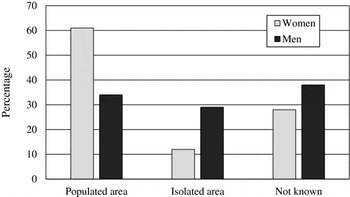
In some twenty per cent of crimes, the exact location of the offence was given in court reports. Gender analysis reveals a startling difference in the commission of crimes committed in isolated and populated areas (Figure 7).Footnote 62 Although males offended nearly equally in both populated and isolated areas, females were much less likely to offend in areas where there were few people present. In four of the eight cases where women were charged with offences in isolated areas, they were in those locations with men, either gypsies or tramps crossing the countryside.Footnote 63 In the other four cases of women offending in isolated areas, they stole from places where they were employed.Footnote 64 Workplace theft was involved in only eleven per cent of men's cases. Usually the men were opportunistically at the scene of the crime. For example, Evan Breeze claimed to have been in a drunken stupor and mistakenly went into a farmyard where he killed a hen by accident.Footnote 65 John Lewis stole leather from a lead mine in the hills where he had called looking for work. Later the same day he stole wool from a field near the mine, then made his way to Newtown where he tried to sell it.Footnote 66 In general, male movement around the country enabled and facilitated criminality. For example, boatman John Watkin agreed to transport a load of ketchup between two stops on the Montgomeryshire canal, and during the journey consumed some of the sauce himself.Footnote 67 John Wilson, an American, claimed that the boots he stole from a cottage near Newtown were a pair he had brought with him from Cardiff.Footnote 68 In a case illustrating the enabling of crime by the advent of railways, John Bowker and Josiah Beech travelled home by train to Liverpool from Newtown, and opportunistically stole fifty-nine pounds from a farmer during the journey.Footnote 69
Locations of male and female offences.

The Bowker/Beech case illustrates how criminality prompted the movement of the police. The officers would sometimes travel great distances to apprehend suspects, but probably only when the victim was a ratepayer or one who was able to pay the officer for his time. Sergeant Hudson from Newtown located Bowker and Beech in custody in Liverpool and went there to interview them.Footnote 70 Success for the police was measured in convictions, so they were motivated to make arrests. In an agricultural region such as Montgomeryshire, where farmers’ rates helped run the force, the officers needed to be seen making an effort on behalf of farmers.Footnote 71 Great trouble was taken to secure a conviction against the juvenile Mary Anne Nason, who had served time in a reformatory following criminal behaviour several years earlier. She was prosecuted for theft from a surgeon, and a sergeant from the Warwickshire force travelled to Welshpool to give evidence against her. Police Constable Edwards of Llanbrynmair travelled nearly fifty miles to apprehend Thomas Vaughan who had stolen fifteen shillings from his timber merchant employer. Footnote 72
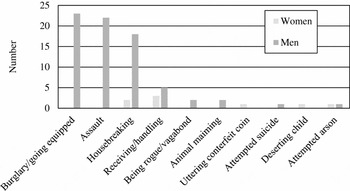
The Quarter Sessions Bench heard a wide variety of cases. The offences other than those deemed theft or stealing are shown in Figure 8. The numbers are small but show that the majority were committed by men. Burglary and assault were the two that featured most significantly, and some patterns observed in the theft analysis are seen again. Two house-breaking cases were committed by women. By definition, these took place during the day, and they both occurred in populated areas. Wearing apparel was stolen in each case. In one case it was underwear, and the woman was found wearing it, having been searched by the police officer's wife. In the other, the items included a silk scarf and an artificial flower. Significantly, neither case involved a violent or forceful entry into the premises.Footnote 73 Phillips includes breaking and entering/burglary as a violent crime as it included an element of power being used,Footnote 74 and on this basis, these two house-breaking cases by women would have been excluded from Phillips's list. Woodward argues that burglaries in Montgomeryshire were facilitated by its proximity to the border, meaning that goods could be disposed of easily, but he, like Phillips, appears to be confining his analysis to men, as the evidence for women shows that they retained the items.Footnote 75 Men's mobility is again reflected in these violent crimes. In 1874, four tramps broke windows and gained entry into a widow's house in the north of the county. They fled over the hills, first to Llanarmon and then on to Chirk. A police officer followed them and arrested the men in Wrexham.Footnote 76 Two sailors removed six panes of glass from the windows of a cottage in the south of the county, intending to commit a felony. They were noticed and, disturbed by shouting, jumped over fences and ran off up the hillside. They were stopped by field workers who held on to them until a policeman arrived.Footnote 77 Here is an example of a getaway that could hardly have been attempted by a woman in a long skirt. There is a clear difference here between this location and the route that the gang of fowl stealers, including two women, took along the Kerry Ridgeway which was flat and provided few obstacles.Footnote 78
Offences other than theft heard at Quarter Sessions.

Conclusion
The gendered nature of offending was evident in 1870s Montgomeryshire, and reflected in the county's rural and urban locations, opportunities for crime, and the apparent motivations for thefts. This was particularly notable in the case of clothing which, although stolen by both sexes, was generally moved out of the area and sold on by men but retained and worn openly by women. Females were more likely to steal within domestic settings in populated areas, rarely in isolated locations, and the goods they targeted were of a limited range. Males, however, through mobility and work, stole a wider range of items from much more disparate, more rural and industrialised locations. For both gender groups, their patterns of offending highlighted their normal patterns of life, and reflected their different, social boundaries or their ‘separate spheres’.Footnote 79 In particular, we see that the differentials between everyday opportunities provided by employment and domestic responsibilities led to offending.Footnote 80 The intangible boundaries and places of offending crucially meant that opportunities for evading the law were also gendered and had implications for the police. Law enforcement, consequently, adopted a highly mobilised and tailored form when in pursuit of male offenders that was largely unnecessary when tracking down females who were encumbered by physiology, clothing and the landscape's natural features such as hillsides and hedges.