Achievement goal (AG) theory provides a relevant framework to study differences in personal motivation (goal orientation) and how class environments influence students’ motivation and learning patterns (Meece, Anderman, & Anderman, Reference Meece, Anderman and Anderman2006). The AG construct was once defined as a competence-based objective that is used to guide behavior (Elliot, Reference Elliot1999). In the original, dichotomous model, mastery or task goals are task-based or intrapersonal, self-referenced standards of competence, while performance or ego goals focus on interpersonal, or normative standards of competence. Later, the trichotomous model accounted for two different types of valence: approach goals aimed at attaining positive possibilities, and avoidance goals aimed at avoiding negative possibilities. This produced a bifurcation of performance goals (performance-approach and performance-avoidance). Subsequently, Elliot and McGregor (2001) proposed the 2x2 achievement goal framework, which divides mastery as well as performance goals into approach and avoidance. By combining definition (self-referenced/normative) and valence (approach/avoidance), the 2x2 framework proposed four possible AG types: mastery-approach (intrapersonal and positive), performance-approach (normative and positive), mastery-avoidance (intrapersonal and negative), and performance-avoidance (normative and negative). Last, Elliot, Murayama, and Pekrum (2011) formulated the 3x2 AG model, with mastery goals bifurcating into task-based and self-based.
Thus, this approach defines competence using three standards, or points of reference: an absolute standard (task), an intrapersonal standard (self), and a normative standard (other). Applying those standards to define competence (definition) and the ways it may be characterized (valence), Elliot et al. (Reference Elliot, Murayama and Pekrun2011) proposed that this framework is comprised of six AG’s: task-approach goals (geared toward attaining task-based competence), task-avoidance goals (to avoid task-based incompetence), self-approach goals (to attain self-based competence), self-avoidance goals (to avoid self-based incompetence), other-approach goals (to attain other-based competence), and other-avoidance goals (to avoid other-based incompetence). The 3x2 Achievement Goal Questionnaire’s (Elliot et al., Reference Elliot, Murayama and Pekrun2011) structural validity and psychometric properties have been tested in different countries, languages, age groups, and contexts (i.e., Mascret, Elliot, & Cury, Reference Mascret, Elliot and Cury2015; Méndez-Giménez, Cecchini-Estrada, & Fernández-Río, Reference Méndez-Giménez, Cecchini-Estrada and Fernández-Río2014a; Urbán, Orosz, Kerepes, & Jánvári, Reference Urbán, Orosz, Kerepes and Jánvári2014), producing evidence of differential patterns of relationship between task- and self-based goals and stoking the debate about which type of goals is more adaptive (Diseth, Reference Diseth2015; Méndez-Giménez, Cecchini-Estrada, Fernández-Río, Méndez-Alonso, & Prieto, Reference Méndez-Giménez, Cecchini-Estrada, Fernández-Río, Méndez-Alonso and Prieto2017).
Like personal dispositions within the AG theoretical framework, classroom goal structures (CGS’s) were posited as the element of competence that is emphasized in a given environment, made salient in class activities, and in teachers’ messages to their students in particular (Ames, Reference Ames1992). However, the AG literature has developed fewer situational factors than personal factors. The research has only addressed environmental aspects using the original AG frameworks: dichotomous (Ames & Archer, Reference Ames and Archer1988), trichotomous (Midgley et al., Reference Midgley, Maehr, Hruda, Anderman, Anderman, Freeman and Urdan2000), and 2x2 goals (Peng & Cherng, Reference Peng and Cherng2005). From those perspectives, mastery-approach CGS (which combines task-approach and self-approach structures in the 2x2 AG framework) has been tied to adaptive patterns: performance, self-efficacy, enthusiasm, persistence, effort, and less disruptive behavior, cheating, and depressive symptoms (Kaplan & Midgley, Reference Kaplan and Midgley1999; Urdan, Reference Urdan, Meece and Eccles2010; Urdan & Midgley, Reference Urdan and Midgley2003). Meanwhile, achievement-approach CGS (homologous to other-approach CGS in the 2x2 framework) has produced more contradictory results. For instance adaptive effects have been found, such as a positive relationship with self-efficacy (Wolters, Reference Wolters2004), as well as null or maladaptive effects like increased anxiety during exams, procrastination, disruptive behavior, cheating, and depressive symptoms, and lower effort put forth in difficult tasks and persistence (Meece et al., Reference Meece, Anderman and Anderman2006; Murayama & Elliot, Reference Murayama and Elliot2009; Urdan, Reference Urdan, Meece and Eccles2010; Urdan & Midgley, Reference Urdan and Midgley2003; Wolters, Reference Wolters2004). Other studies have revealed that avoidance behaviors like self-handicapping and avoiding help-seeking are associated with students perceiving an achievement CGS (Urdan & Schoenfelder, Reference Urdan and Schoenfelder2006), but the effects of other CGS’s have not yet been well established.
Recently, Méndez-Giménez, Cecchini-Estrada, Méndez-Alonso, Prieto, and Fernández-Río (in press) designed and validated an instrument to examine 3x2 CGS’s in the context of Secondary Education. According to their analyses, the six CGS’s they tested represent different constructs, and the 3x2 model fits the data better than the six alternate models they tested (dichotomous, trichotomous, 2x2, and others). They tested these six perceived CGS’s: task-approach (CGS-TAPP; the teacher emphasizes students’ mastery of tasks); task-avoidance (CGS-TAV; encourages pupils to avoid making mistakes in their work); self-approach (CGS-SAPP; highlights improvement and intrapersonal progress); self-avoidance (CGS-SAV; discourages students from personally getting worse); other-approach (CGS-OAPP; encourages outperforming others); and other-avoidance (CGS-OAV; discourages students from doing worse than others). These findings support expanding the 3x2 AG model to include the environmental component the teacher emphasizes, and examining its patterns of relationship to other motivational, emotional, cognitive, or behavioral outcome variables in performance contexts.
The present study specifically proposes to analyze CGSs’ patterns of relationship with and prediction of motivational, emotional, and cognitive variables relevant in performance contexts, using a new 3x2 AG perspective. Regarding CGS’s, self-determination theory (SDT; Ryan & Deci, Reference Ryan, Deci, Deci and Ryan2002) maintains that people’s motivations occur on a self-determination continuum. That spectrum includes the following motivational regulation types: intrinsic motivation, extrinsic motivation (integrated regulation, identified regulation, introjected regulation, external regulation) and amotivation. Intrinsic motivation means doing an activity for its inherent interest, either for the excitement or stimulation one experiences because of it, the satisfaction of exploring and learning (knowledge), or the pleasure of overcoming challenges and attaining objectives (performance). Integrated regulation holds the highest level of determination within extrinsic motivation, but there have been problems measuring it in adolescents. In identified regulation, a person does an activity that is not interesting per se, but deems it important because it allows for attainment of a particular personal goal. Introjected regulation is a relatively controlled form of motivation in which behavior is regulated by internal pressures to avoid blame or shame, to access contingent feelings of self-esteem, or boost one’s ego or pride. External regulation is by nature purely instrumental, it is a means to an end. A person does an activity because his or her motivation is controlled by a system of reward, punishment, and coercion. Finally, amotivation refers to behaviors not motivated intrinsically or extrinsically and situated at the weak end of the self-determination continuum. This situation generally occurs when individuals experience feelings of incompetence and lack of control. Mastery CGS’s have been associated with high intrinsic motivation, and performance CGS’s have been associated with low motivation (Meece et al., Reference Meece, Anderman and Anderman2006; Murayama & Elliot, Reference Murayama and Elliot2009; Wolters, Reference Wolters2004).
Regarding the second type of variables, affect has two dimensions: positive and negative (Watson, Clark, & Tellegen, Reference Watson, Clark and Tellegen1988). Positive affect is the positive dimension of an individual’s emotionality, energy, affiliation, and mastery, while negative affect refers to the dimension of temperamental sensitivity an individual has to negative stimuli. These dimensions of affect can be conceptualized as emotional states, and as more or less stable personal dispositions toward emotionality (Robles & Páez, Reference Robles and Páez2003). There is evidence to suggest that perceiving a mastery focus in the classroom is associated with positive affect for students in school (Anderman, Reference Anderman1999). Kaplan and Midgley (Reference Kaplan and Midgley1999) showed that student perceptions of task-oriented CGS’s were associated with positive affect, whereas skill-based goal structures were tied to negative affect.
Last, regarding cognitive variables, self-concept refers to the individual’s perception of him- or herself in different spheres of life (García & Musitu, Reference García and Musitu1999; Shavelson, Hubner, & Stanton, Reference Shavelson, Hubner and Stanton1976). It is forged through experiences and relationships with a setting, in which reinforcement and significant people in the environment play a crucial role (González-Pienda et al., Reference González-Pienda, Núñez, Álvarez, González-Pumariega, Roces, González and Bernardo2002). Currently, self-concept is conceptualized as a five-dimensional construct (academic/occupational, social, emotional, familial, and physical) closely related to psychosocial development in adolescence (Fuentes, García, Gracia, & Lila, Reference Fuentes, García, Gracia and Lila2011). On the whole, research in various academic fields has shown that students who perceive a mastery-based CGS also report higher levels of academic self-concept (e.g., Fischer & Rustemeyer, Reference Fischer and Rustemeyer2007; Gray, Chang, & Anderman, Reference Gray, Chang and Anderman2015). Yet the more specific relations between different 3x2 CGS’s and the five constructs that make up self-concept are not yet known.
With those antecedents in mind, this study’s main objective is to analyze, in depth, patterns of relationship and prediction between 3x2 CGS’s, and motivational regulations, the dimensions of affectivity, and self-concept in Secondary Education students. Research has shown a drop in self-determined motivation in students during this educational stage, and suggests social or environmental factors like classroom environment or teacher-generated climate may be associated with that decline (e.g., Cecchini-Estrada, Fernández-Losa, González, Fernández-Río, & Méndez-Giménez, Reference Cecchini-Estrada, Fernández-Losa, González, Fernández-Río and Méndez-Giménez2012). Thus, conducting a study at that age is key to understand how students perceive the classroom environment, and its possible interactions with motivational regulations and other performance-related variables. First, we hypothesized that results would support the 3x2 model of CGS, specifically the bifurcation of task- and self-based CGS for approach as well as avoidance, and that they would show differential patterns of prediction (Hypothesis 1). Second, we formed the hypothesis that CGS-SAPP would be the most adaptive in terms of motivation and affect, followed by CGS-TAPP (Hypothesis 2). That hypothesis was based on results from a study by Méndez-Giménez, Cecchini-Estrada, Méndez-Alonso et al. (in press) that reported positive, direct effects of CGS-SAPP structures, and negative direct effects of CGS-OAPP, on self-determined motivation in students. Last, we hypothesized that CGS-SAPP and CGS-TAPP would positively predict academic self-concept. Furthermore, considering the specificity of each dimension and the lack of previous evidence, we did not make hypotheses about the remaining factors of self-concept (Hypothesis 3).
Method
Participants
The sample included 1,347 students in secondary education, from 10 secondary and high schools in 10 provinces of Spain. A convenience sampling technique was utilized. The sample’s gender distribution was 56.6% men and 43.4% women. They ranged in age from 12 to 16 years old (M = 13.43; SD = 1.05).
Instruments
Classroom goal structure
The 3x2 Classroom Goal Structures Questionnaire by Méndez-Giménez, Cecchini-Estrada, Méndez-Alonso et al. (in press) was used. It is comprised of 18 items that complete the signal phrase “in class, the teacher’s objective is for each student to…” and are grouped into six CGS’s (three items per construct). Sample items for each CGS follow: task approach (CGS-TAPP) “…do a good job on tasks and activities”; task-avoidance (CGS-TAV) “…avoid doing a bad job on coursework”; self-approach (CGS-SAPP): “…do classroom exercises better than usual”; self-avoidance (CGS-SAV): “…avoid doing coursework worse than usual”; other-approach (CGS-OAPP) “…do coursework better than their classmates”; task-avoidance (CGS-OAV): “…avoid doing class work and exercises worse than their classmates.” Respondents indicate their level of agreement with each statement on a 5-point Likert scale from 1 (not at all true of me) to 5 (totally true of me). In the original study, Cronbach’s alphas for goal structures in the PE context were α = .82, .72, .79, .78, .84, and .77 for CGS-TAPP, TAV, SAPP, SAV, OAPP, and OAV, respectively.
Motivation in the academic context
The Spanish version of the Academic Motivation Scale (AMS) by Vallerand et al. (Reference Vallerand, Pelletier, Blais, Briere, Senecal and Vallieres1992) was employed – the Escala de Motivación Educativa en Secundaria – validated by Núñez, Martín-Albo, Navarro, and Suárez (Reference Núñez, Martín-Albo, Navarro and Suárez2010) in a non-university context. It is made up of seven subscales, each with four items that capture reasons students attend school: amotivation (e.g., “I once had good reasons for going to school; however, now I wonder whether I should continue”), external regulation (e.g., “In order to obtain a more prestigious job later on”), introjected regulation (“Because I want to show myself that I can succeed in my studies”), identified regulation (e.g., “Because I think that a high-school education will help me better prepare for the career I have chosen”), Intrinsic motivation to know (e.g., “Because I experience pleasure and satisfaction while learning new things”), Intrinsic motivation toward accomplishments (e.g., “For the pleasure I experience while surpassing myself in my studies”), and Intrinsic motivation to experience stimulation (e.g., “For the ‘high’ feeling that I experience while reading about various interesting subjects”). Just one measure of intrinsic motivation was taken. Responses were scored on a seven-point Likert scale from (1) not at all to (7) exactly. Cronbach’s alphas for the various motivational regulations were as follows: amotivation (α = .82), external regulation (α = .75), introjected regulation (α = .82), identified regulation (α = .73), intrinsic motivation to know (α = .86), intrinsic motivation toward accomplishments (α = .88), and intrinsic motivation for stimulating experiences (α = .73).
Self-concept
The Self-Concept Form 5 (García & Musitu, Reference García and Musitu1999; García, Musitu, Riquelme, & Riquelme, Reference García, Musitu, Riquelme and Riquelme2011) was employed. It has five dimensions (six items per dimension): academic, social, emotional, familial, and physical. Academic self-concept taps respondents’ perceptions of their own quality in the role of student (i.e., “I do school/academic work well”). Social self-concept refers to respondents’ perceptions of their performance in social relations, and their ease or difficulty maintaining those relationships (i.e., “I make friends easily”). Emotional self-concept captures the respondent’s perceived emotional state and responses to specific situations that arise in daily life (i.e., “Many things make me nervous”). Family self-concept is the respondent’s perception of his or her involvement and integration in the family (i.e., “I feel happy at home”). Last, physical self-concept refers to the subject’s perception of their appearance and physical condition (e.g., “I consider myself stylish”; “I am good at sports”). In the original study, the internal consistencies (Cronbach’s α) of each subscale were .70, .88, .77, .73, and .74, respectively. A five-point Likert scale was employed, anchored at 1 (strongly disagree) and 5 (strongly agree).
Affectivity in class
The PANASN questionnaire (Positive and Negative Affect Schedule for Children and Adolescents) was utilized, which was adapted for the school population by Sandín (Reference Sandín2003) from the adult PANAS (Positive and Negative Affect Schedule) developed by Watson et al. (Reference Watson, Clark and Tellegen1988). The PANASN is a self-report questionnaire comprised of 20 items, 10 of which assess positive affect (e.g., “I am an animated person, I tend to get excited”), and 10 negative affect (e.g., “I feel nervous”). In Sandín’s (2003) study, Cronbach’s alpha coefficient for boys was .73 and .74 for positive and negative affect, respectively; and .72 and .75, respectively, in girls. As in Méndez-Giménez, Cecchini-Estrada, and Fernández-Río (Reference Méndez-Giménez, Cecchini-Estrada and Fernández-Río2014b), a 5-point Likert scale was utilized, ranging from 1 (very slightly or not at all) to 5 (extremely).
Procedure
The researchers reached out to school principals to explain the project’s objectives, and were given their authorization and consent to conduct the study. Prior to data collection, teachers at each school were furnished with supporting information about how participants were to fill out the questionnaires, which were completed online (in approximately 30 minutes) in a classroom with Internet access using Google Forms. Participants accessed the form using a link the researchers provided. Teachers were instructed to emphasize to students that completing the questionnaire was entirely voluntary, and that their responses would be anonymous and would not affect their grades. Moreover, participants were asked to respond honestly. Data were analyzed using the computer program SPSS, 22.0 (IBM, 2013).
Data Analysis
Various hierarchical multiple regression analyses (stepwise) were done to separately examine 3x2 CGS’s as predictors, and motivational regulations, types of self-concept, and affectivity as dependent variables. Taking into account the theoretical framework’s trajectory and evolution, we entered the approach 3x2 CGS’s first, and the avoidance ones in a second step. That decision took into account the results of earlier studies conducted from the perspective of 3x2 achievement goals (e.g., Méndez-Giménez, Cecchini-Estrada et al., Reference Méndez-Giménez, Cecchini-Estrada, Fernández-Río, Méndez-Alonso and Prieto2017) that demonstrated approach goals were more influential on the variables being studied; avoidance goals had a smaller impact. Preliminary analyses of collinearity indicated a variance inflation factor (VIF) between 1.007 and 2.713 (far below the VIF < 10 cut-off some authors have defined as acceptable, and even the more restricted VIF < 5 more rigorous authors prefer; Hair, Ringle, & Sarstedt, Reference Hair, Ringle and Sarstedt2013). Furthermore, tolerance values ranged from .37 to .65, suggesting the assumption of non-multicollinearity was met (there is said to be an issue of multicollinearity if tolerance < .10). The Durbin-Watson statistic ranged from 1.75 to 2.02, so we also accepted the assumption of independent errors since values between 1 and 3 are considered acceptable.
Results
Descriptive Analysis and Bivariate Correlations
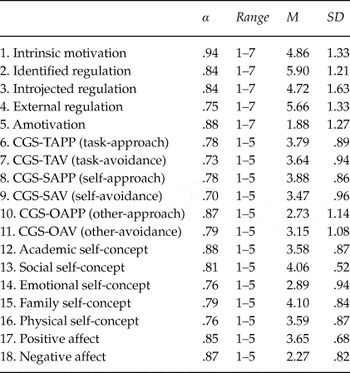
Table 1 presents the descriptive statistics, ranges, and internal consistency of each factor, which measure motivational regulations, 3x2 CGS’s, the dimensions of self-concept, and affectivity (positive and negative). Appropriate levels of internal consistency were observed on all factors. Regarding CGS’s, TAPP and SAPP were assigned the highest scores, and OAPP the lowest. Meanwhile, the high scores on motivational regulation types went to identified and external regulation, and the lowest pertained to amotivation. Familial and social self-concept were higher than emotional self-concept, but that is an inverse measure (high scores indicate poor self-concept and vice versa). Finally, positive affect was higher than negative.
Descriptive Statistics, Ranges, and Cronbach’s Alpha for All Variables

Note: CGS = Classroom goal structure
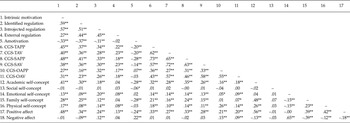
Table 2 presents bivariate correlations among the study’s variables. Similar patterns of behavior were observed in correlations between motivational regulations and the following structures: CGS-TAPP, CGS-TAV, CGS-SAPP, and CGS-SAV. All showed a negative correlation with amotivation, with incrementally more positive correlations the more self-determined the type of motivation. Nonetheless, the most adaptive CGS was SAPP. On the other extreme, CGS-OAPP had a positive (but very low) correlation with amotivation, and a higher correlation with introjected regulation. Cohen’s (1988) criteria guided our determinations of correlation size: small correlation r = .10, medium r = .30, and large = .50. His evaluations take into account the fact that correlations tend to be low in the social sciences. Finally, CGS-OAV appeared to be slightly more adaptive than OAPP. The academic, emotional, and physical dimensions of self-concept were positively correlated with all CGS’s, but social self-concept correlated with none of them. Last, positive affect correlated with all CGS’s, and negative affect correlated with all other-based CGS’s.
Bivariate Correlations between Motivational Regulations, Classroom Goal Structures, Dimensions of Self-concept, and Affectivity

Note: CGS-TAPP = Task-approach classroom goal structure; CGS-TAV = Task-avoidance classroom goal structure; CGS-SAPP = Self-approach classroom goal structure; CGS-SAV = Self-avoidance classroom goal structure; CGS-OAPP= Other-approach classroom goal structure; CGS-OAV = Other-avoidance classroom goal structure.
* p < .05; **p < .01.
Hierarchical Regression Analysis
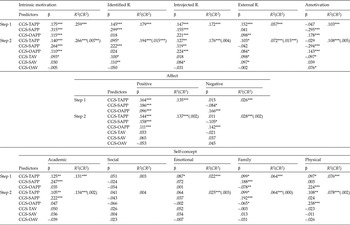
Table 3 presents the different hierarchical regression analyses, entering CGS’s as predictor variables, and types of motivation, self-concept, and affectivity as dependent variables. Regarding the regressions of the types of motivation in 3x2 CGS, we observed in all steps that CGS-SAPP was most adaptive, with prediction occurring from negative to positive and from weak to strong along the continuum of self-determination (amotivation → external regulation→ introjected regulation → identified regulation → intrinsic motivation). CGS-OAPP was a strong predictor of almost all types of motivation, including the most and least self-determined (intrinsic motivation, introjected regulation, external regulation, and amotivation); thus its impact on motivation was ambivalent. The third approach dimension, CGS-TAPP, displayed medium predictive strength in adaptive terms, with positive values on all types of motivation except amotivation. The avoidance dimensions of CGS had limited predictive power. CGS-TAV and SAV predicted more and less self-determined dimensions of motivation, while OAV only positively predicted amotivation.
Hierarchical Regression Analysis with Classroom Goal Structures Input as Predictor Variables, and Motivational Regulations, Self-concept, and Affectivity as Dependent Variables

* p < .05; **p < .01; ***p < .001; (CR2) = change in R 2.
Regressions of the affectivity dimensions indicated positive affect was positively predicted by all three approach CGS’s, while negative affect was predicted by CGS-OAPP (positively) and SAPP (negatively).
Finally, regressions of the self-concept dimensions found in 3x2 CGS showed that CGS-TAPP and SAPP predicted academic self-concept and, along with OAPP (negatively), family self-concept. Physical self-concept was predicted by CGS-TAPP and OAPP. Meanwhile, no avoidance CGS had a role in predicting any dimension of self-concept.
Discussion
The main objective was to analyze 3x2 CGS patterns of relation and prediction with motivational regulations, the dimensions of self-concept, and affectivity in the context of secondary education. Toward that end, we jointly examined the most recent postulates of AG theory (3x2) and SDT. As far as descriptive results, participants rated CGS-TAPP and SAPP highest, and OAPP the lowest; in other words, in their classrooms, participants’ teachers generally emphasize environments oriented toward task completion and personal improvement more than comparison to others. According to results, task- and self-based CGS’s displayed a similar pattern of relation with motivational regulations, with correlations going from positive to negative and high to low the lower the CGS’s level on the self-determination continuum. In exception, CGS-OAPP was positively correlated with amotivation, even more so with introjected regulation, and CGS-OAV appeared to be slightly more adaptive than OAPP. Generally speaking, these results are consistent with the specific literature of the dichotomous and trichotomous perspectives (e.g., Meece et al., Reference Meece, Anderman and Anderman2006; Wolters et al., 2004). Secondly, there were low to moderate positive correlations between CGS’s and the dimensions of self-concept (except the social factor), the highest occurring with academic self-concept (that last result reinforces Gray et al.’s findings, 2015). Third, all CGS’s were related to positive affect, but only other-based CGS’s correlated with negative affect, in keeping with Urdan and Schoenfelder’s (2006) findings. Moreover, by analyzing different regression groups, we were able to examine these relations more in depth in terms of prediction.
In the first group of regressions, intrinsic motivation was positively predicted by all three approach CGS’s, especially SAPP (explaining 25.9 % of variance). When avoidance CGS’s were entered, TAV displayed a marginally positive impact (explaining 26.6% of variance). Regarding identified regulation, just CGS-TAPP and SAPP were primary, positive predictors of approach (17.9 % of variance). Inputting avoidance structures in the second step, CGS-TAV and SAV similarly emerged as predictors (19.4 %). Introjected regulation was positively predicted by the approach CGS’s, OAPP being the strongest (17.2 % of variance). CGS-SAV also emerged, marginally, in the second step (17.6%). External regulation was predicted primarily by CGS-TAPP and OAPP (5.7% of variance); plus CGS-TAV and SAV again emerged marginally (7.2 %). Last, amotivation was predicted negatively by CGS-SAPP and positively by OAPP (10.3%), and TAV and OAV emerged as predictors in the second step positively and negatively, respectively (10.8 %). Therefore, the second step added to predict motivational variables made a smaller contribution consistent with this study’s premise, and it reaffirmed that avoidance CGS’s impact motivational variables less than approach CGS’s.
Considering these results altogether using the self-determination continuum, four distinct patterns of prediction appeared. First, the most adaptive structure was CGS-SAPP, strongly and positively predicting the most self-determined motivational regulations, and negatively predicting the least self-determined. Next, CGS-TAPP was the second-most adaptive, positively though less strongly predicting the most self-determined motivational regulations. The ambivalent influence of CGS-OAPP reflects a third pattern of prediction; it positively predicted intrinsic motivation, yet it also had a large impact in predicting the least self-determined regulations. Furthermore, while we clearly recognize that avoidance CGS’s had lower predictive power, their results provide evidence of complementary patterns. In the fourth and final pattern of prediction, CGS-TAV and SAV had subsidiary effects on these students’ motivation, but they were residual in terms of adaptiveness. CGS-OAV also surfaced only as a residual positive predictor of amotivation.
The first two predictive patterns revealed by that set of regressions were consistent with what Méndez-Giménez, Fernández-Río, and Cecchini-Estrada (Reference Méndez-Giménez, Fernández-Río and Cecchini-Estrada2017) reported in the Physical Education context. CGS-SAPP and TAPP had positive effects on motivational regulations, in that order, and their impact was differential in that only SAPP had a negative effect on amotivation. Hence, although both structures had clear advantages in terms of the most self-determined regulations, teachers emphasizing intrapersonal improvement may have a protective effect against student amotivation that is not achieved by emphasizing task completion alone. Another difference we observed between those two structures was that CGS-TAPP positively predicted external regulation whereas SAPP was not a predictor. In Méndez-Giménez et al.’s study (2017), only CGS-SAPP negatively predicted external regulation. In other words, focusing student attention on personal improvement might help them understand the reasons they attend school from a less extrinsic view of learning.
The third pattern, CGS-OAPP’s ambivalent role, diverges somewhat from the results of previous studies (Meece et al., Reference Meece, Anderman and Anderman2006; Murayama & Elliot, Reference Murayama and Elliot2009). On the one hand, it positively predicted amotivation as Méndez-Giménez et al. (Reference Méndez-Giménez, Cecchini-Estrada, Fernández-Río, Méndez-Alonso and Prieto2017) likewise reported. It also predicted controlled motivation (external, and especially introjected regulation), which is consistent with Méndez-Giménez, Cecchini-Estrada, Méndez-Alonso et al. (in press) since CGS-OAPP negatively predicted the self-determination index. In the present study, however, CGS-OAPP predicted intrinsic motivation just as much (but not identified regulation). Such results are uncommon in the literature, but some studies have reported similar relations between performance-approach goals and intrinsic motivation (e.g., Dinger, Dickhäuser, Spinath, & Steinmayr, Reference Dinger, Dickhäuser, Spinath and Steinmayr2013). It is foreseeable that CGSs’ impact on outcome variables be mediated, or interact with another type of personal variable such as personal achievement goals (Lau & Nie, Reference Lau and Nie2008; Murayama & Elliot, Reference Murayama and Elliot2009; Méndez-Giménez, Cecchini-Estrada, Méndez-Alonso et al., in press). In contexts that emphasize comparison, students who benefit the most and adopt goals produced by other-approach could raise their intrinsic motivation. Yet other students who perceive that the result of their involvement is more important than learning the material or personal improvement could lower intrinsic motivation. These positive and negative effects on intrinsic motivation should be compared in future research.
Furthermore, different studies have suggested that inconsistencies in how mastery and performance goals are conceptualized relate to their different patterns of association with motivational processes and outcomes (e.g., Grant & Dweck, Reference Grant and Dweck2003; Lemos, Gonçalves, Lens, & Rodrigues, Reference Lemos, Gonçalves, Lens and Rodrigues2014). Hulleman, Schrager, Bodman, and Harackiewicz (Reference Hulleman, Schrager, Bodman and Harackiewicz2010) identified two components that reflect how performance-approach goals are operationalized in the literature: appearance and normative, and a third (evaluative) that combines them. The appearance component focuses on demonstration and affirmation of ability or self-worth to an audience, not taking into account other people’s performance. Conversely, the normative component implies explicitly normative comparison or competition. Normative items do not require the individual to show the audience he or she is better than other people; instead, they implicitly suggest an objective norm the individual can use to judge whether or not they outperformed others (for instance, winning the game, getting the high grade on a test). The focus of the evaluative component is demonstration of ability, but it also stipulates that to adequately demonstrate ability entails performance relative to other people. These components were also identified in the performance-avoidance goal literature. Hulleman et al. (Reference Hulleman, Schrager, Bodman and Harackiewicz2010) pointed out that many studies linking performance-approach goals to maladaptive processes do not distinguish between normative and appearance components. Future studies might determine if failing to distinguish between those performance-approach goal subtypes could be responsible for the contradictory relations observed in the present study.
In relation to the fourth predictive pattern, CGS-TAV and SAV had a subsidiary, adaptive impact, though residual, on these students’ motivation, especially on identified and external regulation. Last, CGS-OAV had a small adverse effect on motivation. Until now, no study had reported the direct effect of perceived avoidance CGS’s using a 3x2 framework. Results confirmed Hypothesis 1 and supported the 3x2 CGS model (Méndez-Giménez, Cecchini-Estrada, Méndez-Alonso et al., in press), finding differential prediction of task- and self-based CGS’s in the case of approach as well as avoidance.
Shifting our attention now to the second set of regressions, the three approach CGS’s positively predicted positive affect, and SAPP (negatively) and OAPP (positively) predicted negative affect. These results complement and build on earlier research (e.g., Anderman, Reference Anderman1999; Kaplan & Midgley Reference Kaplan and Midgley1999), and reinforce the view that the two factors of affect are not in fact opposites (that is, opposite ends of the same dimension), but highly differentiated, independent dimensions. Accordingly, emphasizing any of the three approach structures could awaken positive affect in students, while a climate of normative comparison could foster disaffection in some groups of students. With that in mind, not just the positive effect of CGS-SAPP on positive affect is notable, but also its role as a protective factor against negative affect. In short, results confirmed Hypothesis 2; CGS-SAPP was the most adaptive in terms of motivation as well as affect, followed by TAPP.
As for the third set of regressions, CGS-TAPP emerged as a positive predictor of academic, family, and physical self-concept; SAPP, meanwhile, positively predicted academic and family self-concept. Last, OAPP negatively predicted family self-concept and positively predicted physical self-concept. These results confirmed Hypothesis 3. First of all, these results are coherent with Gray et al.’s (2015) finding that student perception of a mastery goal structure (CGS-TAPP and TAV) was positively associated with higher academic self-concept in students. Focusing on intrapersonal improvement on classroom tasks may increase student perception of their own performance in school. Furthermore, CGS’s can influence self-perception in other spheres of life besides the academic. Both those structures (CGS-TAPP and TAV) positively, and OAPP negatively predicted family self-concept. These results provide evidence that a classroom-generated climate based on competency can positively influence student perceptions of their involvement, participation, and integration in the family sphere. Establishing environments centered around improvement on tasks and by the individual, avoiding comparison to others, could be an important source of support for adolescents – together with what they receive in the more proximal, private sphere – to cultivate family self-concept. Third, CGS-TAPP and OAPP were positive predictors of physical self-concept. This factor taps student perceptions of their physical appearance and condition. Emphasizing successful task completion while also setting up favorable comparisons to others might help forge perceptions of both elements of self-concept. These results are aligned with earlier research findings relating task climate to self-concept in the context of physical education, and exercise-sport in competitive contexts to increases in the dimensions of physical self-concept (e.g., Contreras, Fernández, García, Palau, & Pontesi, Reference Contreras, Fernández, García, Palau and Pontesi2010; Méndez-Giménez, Fernández-Río, & Cecchini-Estrada, Reference Méndez-Giménez, Fernández-Río and Cecchini-Estrada2013).
Considering these motivational, emotional, and cognitive results altogether, we conclude that the CGSs’ SAPP, TAPP, OAPP presented patterns of prediction from most adaptive to least, respectively. Meanwhile, CGS-TAV and SAV, when associated with approach CGS’s, can positively impact the more self-determined motivational regulations, though that effect could be dissipated under certain circumstances. Future studies should elucidate the matter. These findings have implications for teachers: we recommend that they prioritize fostering classroom environments geared toward raising intrapersonal standards and successful completion of tasks. Furthermore, teachers should carefully consider under what circumstances to draw comparisons to others so as to elicit only the desired results.
Nonetheless, debate about simultaneously emphasizing multiple CGS’s continues. Several authors (e.g., Ciani, Middleton, Summers, & Sheldon, Reference Ciani, Middleton, Summers and Sheldon2010; Urdan, Reference Urdan, Meece and Eccles2010) have shown that CGS’s can be combined to try and influence motivation and performance, and that they sometimes get intertwined in the daily reality of the classroom. In terms of 3x2 CGS’s, we suggest teachers can, consciously or not, highlight TAPP, SAPP, and OAPP simultaneously. For instance, a teacher could relay the message to students that they need to get better grades to be accepted into university programs with numerus clausus, while also encouraging them to focus on task mastery or personal improvement. They could also use systems of evaluation that penalize mistakes on tests (emphasizing CGS-TAV) or drops in personal grades (SAV). Future research should use the 3x2 achievement framework to analyze to what extent these combinations coexist in the classroom, and come to understand the tangle of relations between contextual and personal aspects and relevant performance outcomes. In addition to personal performance goals, future studies could consider variables like social goals, self-regulation, academic achievement, and self-efficacy.
One limitation of the present study is that it focused solely on direct effects on outcome variables and did not address indirect or interaction effects, from personal performance goals for instance. Urdan (Reference Urdan, Meece and Eccles2010) concluded that the pattern and strength of relations between CGS’s and outcome variables – performance-based, cognitive, and motivational – depend on how those structures are evaluated, how other variables are controlled, and how one examines the results. Therefore longitudinal research is needed, as well as statistical techniques (like hierarchical linear models) that make it possible to analyze variations in parameters in depth, on more than one level of analysis.