In exploring what constitutes an optimal design for the human language faculty, the minimalist program (Chomsky, Reference Chomsky1995, Reference Chomsky, Barbosa, Fox, Hagstrom, McGinnis and Pesetsky1998, Reference Chomsky, Martin, Michaels and Uriagereka2000) maintains that, if two derivations are both capable of deriving the same grammatical sentence, the “simpler” derivation is the preferred one. That is, derivations compete. The more economical derivation, one that requires the fewest steps, least movement, and so on, is preferred (and accepted) over the more costly derivation, which is rejected. Although competition among derivations is calculated on the basis of theory-internal principles and operations, it is also assumed that economy principles strongly influence language acquisition (e.g., Platzack, Reference Platzack and Clahsen1996; Roberts, Reference Roberts and DeGraff1999) and sentence processing (e.g., Weinberg, Reference Weinberg, Epstein and Hornstein1999). For example, English do-insertion is a costly, “last resort” operation that violates minimalist economy principles. Not surprisingly, do-insertion poses an acquisitional challenge for first language (L1) learners (Santelmann, Berk, Austin, Somashekar, & Lust, Reference Santelmann, Berk, Austin, Somashekar and Lust2002), second language (L2) learners (Cancino, Rosansky, & Schumann, Reference Cancino, Rosansky, Schumann and Hatch1978), and deaf learners (Quigley & King, Reference Quigley and King1980) of English.
Ambiguous sentences, such as sentences containing English universal quantifiers (e.g., each, every, or all; see below), are unique with respect to derivational economy. Two (or more) interpretations for the identical surface syntactic form may each converge, that is, succeed at the syntactic–semantic interface (i.e., logical form) as the most economical derivation available for the intended meanings. Nevertheless, one of two derivations of the ambiguous sentence may exhibit greater economy than the other. Under these circumstances two derivations might compete, not with respect to which one succeeds and eliminates the other relative to the computational efficiency of the human language faculty, but with respect to whether one derivation (the more economical one) renders its related sentence interpretation more “learnable” during acquisition or more “preferred” under conditions of ambiguity.
The present study undertook an investigation of the role of derivational economy in the acquisition and interpretation of English sentence types such as those in Example 1.
- 1.
a. Each dog is lying on a rug.
b. A woman is smelling every flower.
Each of these “quantifier sentences” contains a universal quantifier phrase (QP), each dog in Example 1a and every flower in Example 1b, as well as an indefinite noun phrase, a rug in Example 1a and a woman in Example 1b. For each of these sentences there are at least two interpretations: a distributive interpretation and a collective interpretation. Under a distributive reading, Example 1a can mean that the members of a set of dogs are distributed individually over different rugs or, under a collective reading, that all members of a set of dogs are lying, collectively, on one and the same rug. Similarly, Example 1b can mean that all members of a set of flowers are distributed among individual members of a set of women, who are smelling them, or that a single woman is smelling all members of some set of flowers.
This investigation of the influence of economy factors on knowledge and use of English quantifier sentences targeted three diverse college-aged populations. Participants included hearing college students who are native speakers of English, deaf college students whose English acquisition has been compromised to varying extents because of restricted access to auditory linguistic input, and hearing adult speakers of other languages studying English as an L2 in preparation for college study. In addition to seeking insight into the L2 acquisition of English quantifier knowledge through a comparison with L1 knowledge, the inclusion of deaf learners provides an additional window into the acquisitional process, as explained below.
ACQUISITION RESEARCH
Deaf learners
Virtually no research exists on deaf learners' acquisition of quantifier knowledge, except for very general overviews. For example, Wilbur, Goodhart, and Montandon (Reference Wilbur, Goodhart and Montandon1983) and Wilbur and Goodhart (Reference Wilbur and Goodhart1985) assessed 187 students, aged 7–23, on their knowledge of sentences containing some, no, all, any, each, and every. Their descriptive results defined relative degrees of knowledge of the different quantifiers, ranging from a low average percentage correct of 34% for the quantifier every to 81% for some, with a developmental progression in quantifier knowledge across reading levels. Accordingly, the inclusion of deaf learners in the present study fills a void in acquisition research by seeking to understand deaf learners' acquisition of a very specific domain of spoken-language knowledge, English universal quantifier sentences. A better understanding of deaf learners' knowledge in this domain is important for understanding acquisition of spoken language knowledge under conditions of reduced or no access to auditory linguistic input. Understanding deaf (and other) learners' knowledge of this specific linguistic phenomenon is also of great educational importance because the discourse of science–technology–engineering–mathematics (STEM) education is replete with quantificational concepts expressed through natural language quantification. The educational issues relative to reading comprehension and written expression are readily apparent.
The inclusion of deaf learners in this research also contributes to the assessment of theories of linguistics and language acquisition in general. Acquisition of a language requires access to the input from that language. Under conditions of restricted auditory access to spoken language input, the acquisition process is arduous, requiring whatever visual compensation can be mustered to access the input (e.g., lip reading, facial expression, signed renditions of spoken sentences, etc.). Under these conditions, deaf learners acquire, along a broad continuum, varying levels of English language attainment, with unmarked (more learnable) aspects of English typically acquired before marked (less learnable) aspects of the language (see Berent, Reference Berent, Ritchie and Bhatia1996a, Reference Berent1996b, in press; Berent & Samar, Reference Berent and Samar1990). Accordingly, the assessment of deaf learners' knowledge of English universal quantifier sentences provides the opportunity to test specific learnability predictions formulated on the basis of derivational economy.
L2 learners
The inclusion of hearing L2 learners in this research provides the same opportunity to assess acquisition under the constraints of later, nonnative language learning, and to assess theory-based learnability predictions in another learner population. In addition to contributing further to the knowledge base on L2 acquisition per se, the inclusion of both L2 learners and deaf learners allows the comparison, relative to hearing native speakers, of acquisition by two types of learner, both of whom are acquiring English under cognitively and/or environmentally restricted access to the target language input (Gass, Reference Gass1997). It thus affords the opportunity to observe learnability-induced parallels in these two populations, which have been observed in other domains of their linguistic knowledge of the target language (Berent, Reference Berent1983, in press).
With respect to existing research on L2 quantifier knowledge, as with deaf learners, studies are rare in the literature. One study, Marsden (Reference Marsden, Beachley, Brown and Conlin2003, Reference Marsden, Cazzoli-Goeta, Mukai and Van Espen2004), investigated L1 Korean speakers' and L1 English speakers' acquisition of quantifier sentences in L2 Japanese. For the field of L2 research, a central question is the extent to which L2 acquisition is guided by universal principles of the language faculty (universal grammar) and to what extent it is offset by transfer from the L1 (see White, Reference White2003). Both Japanese and Korean are more restricted than English in the interpretation of certain types of quantifier sentences. For example, the interpretation of the Japanese sentence in Sentence 2a, from Marsden (Reference Marsden, Beachley, Brown and Conlin2003, p. 496), is derived only on the basis of the surface-syntax (surface scope) order of the sentence unlike the analogous English Sentence 2b and sentences like those in Example 1, which are ambiguous between the surface scope and inverse scope readings, to be discussed in detail below.
- 2.
a.

b. Someone reads every book.

Both Sentences 2a and 2b can mean that one particular person reads all members of a set of books, the surface scope interpretation. However, Sentence 2b can also mean that every member of a set of books is being read by different persons, the inverse scope interpretation. This option is not available in Japanese.
Because Korean is like Japanese in this regard, Marsden (Reference Marsden, Beachley, Brown and Conlin2003, Reference Marsden, Cazzoli-Goeta, Mukai and Van Espen2004) predicted that Korean-speaking learners of L2 Japanese would correctly interpret sentences like Example 2a via transfer of scope rigidity from their L1 Korean. In contrast, she predicted that English speakers would transfer English interpretations of universal quantifier sentences into Japanese and therefore assign a (non-Japanese) inverse scope distributive interpretation to Example 2a, which is otherwise available to them in the analogous Sentence 2b. Marsden's predictions were partly confirmed, supporting the possible facilitative role of transfer form L1 Korean but the negative effect of transfer from L1 English in the acquisition of quantifier sentence interpretation in L2 Japanese. Although L1 transfer is an important and prominent focus of L2 acquisition research, the present study was not designed to assess L1 transfer effects in the acquisition of L2 English quantifier sentences. The L2 participants in this study were speakers of 12 different L1s; therefore, it was not possible to directly assess possible transfer effects as it was in Marden's (Reference Marsden, Beachley, Brown and Conlin2003, Reference Marsden, Cazzoli-Goeta, Mukai and Van Espen2004) research. However, the results of the present study reveal the extent to which both L2 learners and deaf learners accept surface scope and inverse scope interpretations in English.
Deaf learners and L1 transfer
With respect deaf learners' English acquisition, the issue of L1 transfer is also a relevant topic. L1 transfer could conceivably influence the acquisition of English quantifier knowledge for deaf learners for whom American Sign Language (ASL) is their L1. Native ASL signers are generally deaf children whose parents are deaf ASL signers and who are exposed to ASL communication from birth. However, there are two factors that effectively eliminate ASL–English transfer from consideration in this study. First, 90% of deaf children are born to two hearing parents, and fewer than 10% have at least one deaf parent (Marschark, Lang, & Albertini, Reference Marschark, Lang and Albertini2002). Accordingly, most deaf individuals are not native ASL signers. The majority of deaf persons who use ASL (or other ASL-based signing) learn it in the school years or beyond. Second, transfer from a visual–spatial language to an auditory–spoken language is poorly understood. In ASL, universal quantification is commonly conveyed through agreement marked on the ASL verb through a series of distributing movements (e.g., pointing) from the space in which the verb is signed toward several locations within the space in which the noun phrase object has been signed (Crain et al., Reference Crain, Thornton, Boster, Conway, Lillo-Martin and Woodams1996, pp. 135–140). This has the effect of spatially distributing the action to members of the set of entities designated by the QP or the noun phrase. How and under what circumstances cross-modal transfer of such a phenomenon might occur is unknown. Therefore, in addition to the low likelihood of native ASL signers in the deaf participant groups, the lack of understanding of any cross-modal transfer of quantification makes its assessment impossible.
Child L1 acquisition
Unlike research on deaf learners and hearing L2 learners of English, research on child language acquisition has focused extensively on the acquisition of quantifier sentences in view of the subtle interpretive properties of these structures (see the overview in Brooks & Sekerina, Reference Brooks and Sekerina2006). A topic of intense inquiry has been the so-called “symmetry effect” in child language acquisition of universal quantifier sentences. Studies have long observed (e.g., Inhelder & Piaget, Reference Inhelder and Piaget1964) children rejecting certain depictions of quantifier sentences that adults accept. In studies employing various kinds of sentence–picture-matching tasks, children will often accept a distributive depiction of a sentence like Example 1a above when the picture shows an exhaustive one to one match between dogs and rugs but reject such a depiction if it includes an additional rug with no dog on it. Similarly, they will often accept a distributive depiction of a sentence like Example 1b when the picture shows an exhaustive one to one match between women and flowers but reject such a depiction if it includes an additional woman not smelling a flower. This observation is puzzling because the additional rug or woman does not affect the truth values of the sentences.
This puzzle is known as the symmetry effect because the children appear to require symmetry between members of the two relevant sets exclusive of any extraneous members. Diverse accounts of the symmetry effect have been offered. For example, Philip (Reference Philip1995) argued that children's symmetry preference reflects a different grammar from the adult grammar. Drozd (Reference Drozd, Bowerman and Levinson2000) explained the symmetry effect by arguing that children's inability to establish an appropriate discourse for universal quantifier sentences results in their interpreting a universal quantifier like every as an existential quantifier like some. Crain et al. (Reference Crain, Thornton, Boster, Conway, Lillo-Martin and Woodams1996) argued that children's symmetry “errors” resulted from the violation of pragmatic principles in experimental task designs. Kang (Reference Kang2001) concluded that the symmetry preference results from an interaction between linguistic and pragmatic knowledge and the cognitive difficulty, in his study, of reconciling auditory and pictorial input.
A novel analysis of the symmetry effect in children was proposed by Rakhlin (Reference Rakhlin2007a, Reference Rakhlin2007b), who attributed the effect to pragmatic factors influencing children's restriction of the domains of a universal quantifier or a noun phrase. Picture tasks generally provide a minimal, or “out of the blue,” context for linking a sentence to a depiction. Rakhlin argued, therefore, that in the absence of a rich context children lack the pragmatic flexibility that adults have to manage contextual information and to eliminate less plausible options, especially when there is a perceptually salient extra entity in a picture. She invoked Schwarzschild's (Reference Schwarzschild2002) “singleton indefinites” analysis to argue that children focus on the salient extra entity, interpreting it as denoting one specific object (a one-member set), which then derails an otherwise acceptable distributive interpretation available if the extra entity were (appropriately) ignored.
Despite Rakhlin's (Reference Rakhlin2007a, Reference Rakhlin2007b) assumption that adults have the pragmatic flexibility to eliminate less plausible options in matching quantifier sentences with depictions, the symmetry effect has actually been observed in adults, establishing that it is not a phenomenon limited to child language development. For example, Brooks and Sekerina (Reference Brooks and Sekerina2006) observed the effect among L1 English-speaking college students; DelliCarpini (Reference DelliCarpini, Liceras, Zobl and Goodluck2003) observed the effect in college-level L2 learners of English; and Berent, Kelly, Porter, and Fonzi (Reference Berent, Kelly, Porter and Fonzi2008) observed the effect in deaf and hearing students at the middle school, high school, and college levels. This study extends the investigation of the symmetry effect in L2 learners and deaf and hearing students at the college level.
TARGETED STRUCTURES
Quantifier raising (QR)
The distinct distributive and collective interpretations associated with sentences like those in Example 1 above have been captured within the generative grammar framework in the form of QR (May, Reference May1977, Reference May1985), which maps surface syntax onto logical form representations. The application of QR to sentence Examples 1a and 1b yields representations of the type shown in Examples 3 and 4, respectively, where IP is the inflectional phrase (Chomsky, Reference Chomsky1986) and DP is the determiner phrase (Abney, Reference Abney1987). Noun phrases headed by a determiner or the articles a or the are conventionally interpreted as DPs.
- 3.
a. Each dog is lying on a rug.
b.
c.
- 4.
a. A woman is smelling every flower.
b.
c.
Application of QR moves a constituent from its surface-syntactic position to the left periphery of the clause, leaving a coindexed trace (t) in the position it vacated. Thus, cosubscripting in Examples 3 and 4 indicates the antecedent–trace relations established by QR movement.
These derivations establish the scope relations between the QPs and the DPs in the respective structures. In Example 3b, the QP each dog has scope over the DP a rug; therefore, Example 3b is the logical equivalent of “For all i, i a dog, there exists a j, j a rug, such that i is lying on j.” In Example 3c, a rug has scope over each dog. It is the logical equivalent of “There exists a j, j a rug, such that for all i, i a dog, i is lying on j.” The same logic holds in Example 4 to distinguish the distributive and collective interpretations. QR will be relevant to the interpretation of the results of this study.
DERIVATIONAL ECONOMY
Scope economy
Within the minimalist program of linguistic knowledge (Chomsky, Reference Chomsky1995, Reference Chomsky, Barbosa, Fox, Hagstrom, McGinnis and Pesetsky1998, Reference Chomsky, Martin, Michaels and Uriagereka2000), conventional QR (May, Reference May1977, Reference May1985) became and has remained problematic in that it seems to involve a kind of movement that differs from most other kinds of minimalist movement motivated by feature checking. As a result, various proposals have been advanced for redefining QR within the minimalist framework (e.g., Fox, Reference Fox1995, Reference Fox2000; Hornstein, Reference Hornstein1995, Reference Hornstein, Epstein and Hornstein1999; Sato, Reference Sato2003). Consistent with minimalist assumptions concerning economy of derivation, Fox (Reference Fox1995, Reference Fox2000) proposed a principle of scope economy that in general restricts semantic interpretation of sentences containing quantifiers to their surface scope order. QR is sanctioned as a “scope-shifting operation” to move a QP or DP “across” another QP or DP, creating inverse scope, permitted only when doing so yields a semantically distinct interpretation for the same sentence under surface scope.
Fox (Reference Fox1995, Reference Fox2000) argued that the distributive reading of a sentence like Example 3a is derived off of surface scope because each dog by default takes scope over a rug; therefore, consistent with scope economy, QR does not apply to yield the distributive interpretation. However, the only way to derive the collective interpretation of Example 3a is to move a rug via QR to the left of each dog, in violation of scope economy. Similarly, the collective interpretation of Example 4a is available under surface scope, and therefore, consistent with scope economy, QR does not apply. QR must apply, however, to yield the distributive interpretation of Example 4a, in violation of scope economy. Fox's proposals contribute to derivational economy by reducing movement to the absolute minimum, a goal of the minimalist program.
All of the discussion above pertains to research where it is assumed that both universal QPs and the singular indefinite (existential) DPs of the type under consideration are generalized quantifiers (Barwise & Cooper, Reference Barwise and Cooper1981). As such, they require QR for establishing the scope relations and domain restrictions connected with intended sentence interpretations (with the exception of the simplifications introduced by Fox's, Reference Fox1995, Reference Fox2000, scope economy proposals). Whether or not the English indefinite article, and thus the singular indefinite DP, functions as a quantifier continues to be the topic of a decades-long debate within semantic theory. Below, proposals are considered in which indefinite DPs are not treated as generalized quantifiers and are thus not subject to QR. Rather, they are interpreted in their surface syntactic position (in situ). Although the fundamental semantic–theoretic issues are well beyond the scope of this study, the extent to which a theory can justify the interpretation of relevant arguments of quantifier sentences without requiring movement operations contributes to minimalist goals such as economy of derivation. Such a strategy is discussed below.
Singleton indefinites
Reinhart's (Reference Reinhart1997) choice function analysis and Schwarzschild's (Reference Schwarzschild2002) singleton indefinites analysis exploit the unique semantic properties of singular indefinite DPs to justify the interpretation of such DPs within quantifier sentences in situ, without QR. Within Reinhart's analysis, a choice function (see Reinhart, Reference Reinhart2006, pp. 81–100) selects a single member of the set represented by the DP, eliminating QR in such cases, and rendering the DP free to have any scope relation within the sentence. This singular indefinite DP thus contributes to the collective derivation of the sentence. As for those derivations that still require movement to yield a distributive interpretation, Reinhart (Reference Reinhart2006, p. 105) regards QR as “an illicit operation” that can be used only as a “repair mechanism” to extend the options permitted by the human computational system. She views such movement to create inverse scope as a costly “last resort” operation yielding an interpretation that is “harder to obtain” (even by native speakers) than a surface scope interpretation.
Schwarzschild's (Reference Schwarzschild2002) singleton indefinites proposal also justifies the in situ interpretation of the relevant singular DPs but does so without the need for a semantic mechanism requiring choice functions, an apparent simplification. Schwarzschild argued that reducing the domain of an indefinite DP to a singleton (one-member) set is always an option available to indefinites and, when this occurs, the singleton indefinite becomes “scopeless.” For example, if the domain of a rug in Each dog is lying on a rug is restricted to a singleton set, a rug becomes referential and can freely refer to one specific rug. In such a case, a rug is immune from the effects of the universal QP each dog, which would otherwise take scope over it. Because the lexical semantics of each requires each dog to denote a plural set, all the dogs in the relevant context distribute to one particular rug that has free scope, yielding the collective interpretation. This ability to interpret singleton indefinites in situ results in derivations of both QP-subject and QP-nonsubject collective interpretations that do not require QR at all, as seen in Examples 5a and 5b, respectively, in which the subscript (1) denotes a singleton indefinite.
- 5.
a. Each dog is lying on a rug(1).
b. A woman(1) is smelling every flower.
Adopting Schwarzschild's (Reference Schwarzschild2002) singleton indefinites analysis leaves only one costly derivation requiring QR as a “rescue strategy.” This is the QP-nonsubject distributive derivation of A woman is smelling every flower in Derivation 6b (cf. 5b). As for the distributive interpretation of Each dog is lying on a rug, it exhibits surface scope order but does not contain a singleton indefinite. In Example 6a, each dog takes scope over a rug (>1), where the subscript (>1) denotes a set of more than one member to which all members of the set of dogs distribute.
- 6.
a. Each dog is lying on a rug(>1).
b. [[every flower]j [[a woman]i [ti is smelling tj]]]
However, the option to semantically restrict the domain of an indefinite DP to a singleton set as in Example 5a or a multimember set as in Example 6a still carries a level of complexity with it. In Example 5a, a rug, as a singleton indefinite, is both morphologically and semantically singular; a rug in Example 6a, however, is morphologically singular but semantically plural, an inconsistency in number at the interface level of logical form. In view of this complexity caused by the lack of isomorphism in agreement at the interface as in Example 6a, to the extent that derivational economy and associated semantic factors constrain acquisition of English quantifier sentences or influence interpretive preferences, the following order, from least to most costly, emerges:
- 7.
a. QP-subject collective = QP-nonsubject collective
b. QP-subject distributive
c. QP-nonsubject distributive
The two collective derivations in Example 7a are the least costly. They do not involve QR and, because the domains of their singular indefinite DPs are restricted to singleton sets, the DPs are morphologically and semantically singular. Derivation 7b does not involve QR, but the domain of its singular indefinite DP is restricted to a multimember set, adding complexity in view of its number inconsistency at the interface level. Finally, the QP-nonsubject Derivation 7c is the most costly, requiring “last resort” QR in order for its universal QP to take scope over its syntactically singular but semantically plural indefinite DP. The ordered Prediction 7 is explored directly in this study.
METHOD
Participants
Three categories of student participants took part in this study: college-level deaf and hard of hearing students enrolled in programs at the Rochester Institute of Technology (RIT) in Rochester, New York; hearing international students enrolled in courses in English as an L2 in RIT's English Language Center; and hearing native speakers of English enrolled in bachelor's degree programs in various colleges of RIT. (The term deaf will be used to refer to both deaf and hard of hearing students.)
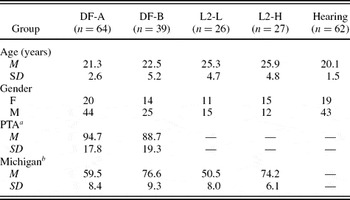
The native English-speaking participant group consisted of hearing students enrolled in baccalaureate programs at RIT and are referred to as the hearing group. The deaf and L2 participants each comprised two separate groups on the basis of overall English language proficiency as measured by their scores on the Michigan Test of English Language Proficiency (1977). Another factor distinguishing the two deaf groups is that the lower English proficiency group, Group DF-A, consisted of students pursuing (no higher than) associate's degrees at the National Technical Institute for the Deaf (NTID), one of RIT's eight colleges, whereas the students in the higher English proficiency group, Group DF-B, were enrolled in baccalaureate programs in other colleges of RIT.Footnote 1 As shown in Table 1, the mean Michigan scores (and standard deviations) of Group DF-A and Group DF-B were 59.5 (8.4) and 76.6 (9.3), respectively. The international students who participated in this study represented speakers of 12 different L1s: Japanese, Korean, Chinese, Tibetan, Russian, Kazakh, Tamil, Turkish, Arabic, German, Italian, and Spanish. They were studying English in preparation for matriculation into academic programs at universities in the United States. The Michigan scores of the lower English proficiency L2 group, Group L2-L, and the higher English proficiency L2 group, Group L2-H, were 50.5 (8.0) and 74.2 (6.1), respectively.
Demographic information on participant groups

Note: DF-A, lower English proficiency deaf group enrolled in associate's degree programs; DF-B, higher English proficiency deaf group enrolled in baccalaureate programs; L2-L, second language lower English proficiency; L2-H, second language higher English proficiency.
aPTA, pure tone average hearing loss measured in the better ear at 500, 1000, and 2000 Hz (Levitt, Reference Levitt, Wang, Reynolds and Walberg1989).
bThe Michigan Test of English Language Proficiency (1977).
Table 1 also provides available demographic information for the five participant groups, including group ns, mean ages, and gender distributions. For the deaf groups, it also provides the mean pure tone average hearing loss in the better ear measured in decibels at 500, 1000, and 2000 Hz (Levitt, Reference Levitt, Wang, Reynolds and Walberg1989). The deaf groups' averages for pure tone average hearing loss place them in the categories of “severe” to “profound” deafness. Severely and profoundly deaf students generally experience the greatest challenge to the development of spoken language grammatical knowledge compared to deaf students with mild to moderate hearing loss. Nevertheless, there is great variation in English language attainment within the range of severe to profound deafness, which is reflected in the division of the two deaf student groups according to their mean Michigan test scores.
English Sentence Picture Task—Quantifiers
Task design. The English Sentence Picture Task—Quantifiers (Berent & Kelly, Reference Berent and Kelly2005) was developed for the purpose of assessing students' knowledge of English quantifier sentences containing the universal quantifiers each, every, and all and sentences containing numeral quantifiers such as three or four. The picture task includes 50 items: 10 items each focusing on sentences containing each, every, and all, 10 items focusing on sentences containing numeral quantifiers, and 10 filler items that do not contain a quantifier. Four randomized versions of the picture task were developed to address any potential order effects among test items. The present study reports on students' performance only on the 30 universal quantifier items. Students' performance on the numeral quantifier items is reported in the results of a separate study. Half of the 30 universal quantifier items target sentences in which the quantifiers each, every, and all are contained in a QP that appears in the subject position of the sentence (QP-subject sentences). The other 15 universal quantifier items target sentences in which the QP appears in a nonsubject position (QP-nonsubject sentences).
Six items from the picture task are provided in Appendix A, one example of each of the six universal quantifier sentence types targeted. Items 1, 2, and 3 target QP-subject sentences containing each, every, and all, respectively, and Items 4, 5, and 6 target QP-nonsubject sentences containing those quantifiers. Each picture task item contained a target sentence accompanied by five artist's drawings that either do or do not represent a possible depiction of the meaning of the sentence. Participants received simplified instructions, along with two practice items in which the sentences contained no quantifiers and had no similarity to the actual sentence types included on the picture task. The instructions guided the participant to read the sentence and to study each related picture, one at a time, and to decide if the picture could represent a possible interpretation of that sentence. The instructions explained that at least one depiction in a picture set was a possible interpretation of the sentence, that at least one depiction was not a possible interpretation, and that more than one picture could depict an interpretation of the sentence. Participants had to circle YES under each picture of a five-picture set that they judged to properly represent an interpretation of the target sentence and to circle NO under each picture that they judged not to properly represent an interpretation of that sentence. Accordingly, each of the five pictures within an item required a separate judgment. All English sentences targeted in the picture task's universal quantifier items are provided in Appendix B.
Sentence interpretations. Each universal quantifier sentence on the picture task contains an agent, or performer of an action, and an object (animate or inanimate), or entity affected by the activity performed by the agent. For example, in the sentence targeted in Appendix A Item 4, A dad is carrying each baby, a dad is the agent (doing the carrying) and each baby is the object (being carried). Participants' judgments of the set of five pictures associated with each task item provided the relevant composite information for establishing the nature of their English quantifier knowledge, including their preferences among different acceptable interpretations. Pictures associated with each universal quantifier item include the following depiction types:
- 8.
a. context incompatible
b. semantically incompatible
c. collective
d. symmetrical distributive
e. asymmetrical distributive
i. extra object
ii. extra agent
Context-incompatible depictions (Type 8a) show the agent of the target sentence in the picture but not the object. For example, Item 3 Picture E includes three cooks but no pots. (All references to items and pictures pertain to Appendix A.) Accordingly, Picture E is not a possible depiction of the sentence All the cooks are stirring a pot because, without one or more pots in the picture, it is not compatible with the context established by the sentence. A participant who correctly circles NO under that picture is demonstrating an awareness that any acceptable depiction of the target sentence requires inclusion of both the agent and the object. Appropriate NO responses to these obviously flawed depictions also verify that a participant is attending to the task and not responding randomly.
Semantically incompatible depictions (Type 8b) do not satisfy the most fundamental aspect of the meaning of a universal quantifier sentence, namely, that all members of a set of quantified entities are understood to participate in the action described by the sentence. For example, Item 3 Picture B shows two cooks stirring a pot but a third cook not stirring the pot. A participant who appropriately circles NO under Picture B is demonstrating knowledge that the depiction is not compatible with the basic meaning of the target quantifier.
Collective depictions (Type 8c) portray all members of the quantified agent set acting on a single member of the object set or a single member of the agent set acting on all members of the object set. For example, Picture D of QP-subject Item 1 shows all the dogs lying on the very same rug. This is the collective interpretation of Each dog is lying on a rug. In a QP-nonsubject sentence such as the Item 6 sentence, A child is picking up all the balls, the collective depiction is Picture B, in which the single member of the agent set (a child) is picking up all the members of object set of balls.
Symmetrical distributive depictions (Type 8d) portray a one to one match between members of the agent set and members of the object set. For example, Picture B under Sentence 4, A dad is carrying each baby, shows three dads each carrying a distinct baby. That distributive depiction is symmetrical because the pairing of dads and babies is exhaustive: there is no dad without a baby and no baby without a dad.
In contrast to symmetrical depictions, the picture task contains two kinds of asymmetrical depictions (Type 8e): (i) an extra-object distributive depiction associated with QP-subject sentences, and (ii) an extra-agent distributive depiction associated with QP-nonsubject sentences. The extra-object distributive depiction for Item 2 Picture D shows an additional but irrelevant tree not being climbed (cf. Picture B). In QP-subject sentences the presence of an additional member of the object set (e.g., the trees in Item 2) does not affect the truth value of the sentence. Both Picture B and Picture D satisfy the truth value of the sentence. The extra-agent distributive depiction of QP-nonsubject Item 5 Picture E shows an additional but irrelevant member of the agent set (a woman) not smelling every flower (cf. Picture D). In this case, both Picture D and Picture E satisfy the truth value of the sentence.
A “perfect response” to an item on the picture task includes the rejection of Depiction Types 8a–b and the acceptance of Depiction Types 8c–e. The acceptance of Types 8c–e reflects recognition of the full range of ambiguity inherent in English universal quantifier sentences. In reality, native speakers' assignment of a specific interpretation to a universal quantifier sentence is influenced by the inherent meaning of the specific quantifier, the order in which QPs occur in a sentence, and discourse properties (Ioup, Reference Ioup and Kimball1975). These factors influence speakers' preferred interpretations of particular quantifier sentences. Kurtzman and MacDonald (Reference Kurtzman and MacDonald1993) defined a preferred interpretation as “the one that is consciously arrived at first or is otherwise initially considered to be more likely or appropriate” (p. 245). Thus, in ambiguity resolution an otherwise grammatically acceptable interpretation might be rejected in view of lexical, discourse, and pragmatic pressures. Nevertheless, the design of the English Sentence Picture Task—Quantifiers, in presenting multiple pictorial discourses, allowed participants to potentially demonstrate their recognition of the full range of ambiguity of the target sentences.
Hypotheses
The specific hypotheses tested in this study are articulated below. They are motivated by the theoretical and acquisitional factors introduced above, which pertain to derivational economy and associated issues of learnability and preferences among sentence interpretations and to language acquisition under conditions of restricted access to the target language input, as experienced by deaf learners and hearing L2 learners of English.
H1. In view of factors constraining ultimate attainment in L2 acquisition, including the typical course of deaf learners' acquisition of spoken language knowledge, the deaf learners and hearing L2 learner groups will exhibit overall less knowledge of English quantifier sentences than the hearing native speakers.
H2. To the extent that the deaf and L2 learners understand the meanings of each, every, and all as universal quantifiers, they will minimally exhibit knowledge of the most basic property of English quantifier sentences. Specifically, they will reject sentence depictions in which not all members of a universally quantified set participate in the proposition asserted by the sentence.
H3. Because higher overall English language proficiency implies greater internalization of English language input, the learner groups with higher overall English proficiency will exhibit relatively greater knowledge of English quantifier sentences than the learner groups with lower overall English proficiency.
H4. Variable performance relative to sentence interpretation (whether reflecting knowledge or preference) will parallel the learnability order based on derivational economy specified in Prediction 7: QP-subject collective = QP-nonsubject collective > QP-subject distributive > QP-nonsubject distributive.
H5. With respect to the symmetry effect associated with symmetrical versus asymmetrical (extra-object, extra-agent) distributive depictions, the symmetry effect will be observed in all participant groups but will decrease as English proficiency increases.
Hypothesis H5 is motivated by the fact, noted above, that the symmetry effect has been observed not only among children acquiring L1 English but also among L2 learners, deaf learners, and even hearing native speakers. However, to the extent that higher English proficiency implies greater knowledge of pragmatic principles affecting sentence interpretation and discourse management, the symmetry effect should decrease as English proficiency increases.
To test Hypotheses H1–H5, eight associated research questions were posed and guided the statistical analyses performed on the participant data. These questions addressed the hypotheses directly or in some cases were intended to contribute to the knowledge base on quantifier sentence interpretation for which no specific hypotheses were formulated at this time (e.g., differential performance on the three universal quantifiers).
Overall task performance by participant group. Three research questions addressed participants' overall performance on the picture task. Although no specific hypotheses were formulated relative to differential performance on each-sentences, every-sentences, and all-sentences separately, analyses explored the possibility that participants might perform differentially according to the specific universal quantifier employed (see Q2 below). The analysis associated with QP position (see Q3 below) addressed performance relative to the cross-linguistic universal tendency noted by Ioup (Reference Ioup and Kimball1975) for a subject QP to take scope over other (nonsubject) sentence elements. The QP-position analysis would reveal whether participants' judgments received an advantage on QP-subject items relative to QP-nonsubject items overall. However, it is the analysis associated with Q6 below, which explores the specific interaction of QP position and interpretation (collective vs. distributive) that specifically addresses Hypothesis H4 pertaining to the theoretical predictions for acquisition based on derivational economy.
Q1. How did each participant group perform overall and relative to each other on the quantifier picture task?
Q2. How did participant groups perform overall on each of the three universal quantifiers separately?
Q3. Did participant groups' overall performance vary according to the position of the QP (QP-subject, QP-nonsubject) within the target sentences?
Grammatical knowledge. Two research questions were related to participants' grammatical knowledge of quantifier sentences relative to constraints on the interpretation of quantifier sentences, for example, the fundamental meaning of universal quantifiers and domain restrictions on universal quantification:
Q4. To what extent did groups exhibit quantifier knowledge by rejecting context-incompatible depictions of universal quantifier sentences?
Q5. To what extent did groups exhibit quantifier knowledge by rejecting semantically incompatible depictions of universal quantifier sentences?
Finally, three research questions related directly to the acceptance of collective versus distributive interpretations, symmetrical versus extra-object distributive depictions, and symmetrical versus extra-agent distributive depictions:
Q6. Did participant groups exhibit different performance patterns in their acceptance of collective versus distributive interpretations of universal quantifier sentences, and how did QP position influence acceptance of these interpretations?
Q7. Did participant groups exhibit different performance patterns in their acceptance of symmetrical versus extra-object distributive interpretations of QP-subject universal quantifier sentences?
Q8. Did participant groups exhibit different performance patterns in their acceptance of symmetrical versus extra-agent distributive interpretations of QP-nonsubject universal quantifier sentences?
ANALYSES AND RESULTS
The statistical analyses performed in association with the eight research questions included one-way analysis of variance (ANOVA) and factorial ANOVA, with Scheffé's F (Scheffé, Reference Scheffé1953) conservative procedure for post hoc comparisons. Scheffé's F is a robust test for violations of the assumptions typically associated with multiple comparison procedures and for comparing means with unequal n. For examining multiple dependent measures, ANOVA with repeated measures on the dependent variables was applied. Note that post hoc multiple comparisons for independent means are not recommended with repeated measures analyses because the means are correlated because of being within subject factors (SAS Institute, 1999, pp. 88–89). The partial eta squared statistic (ηp2) is reported for each of the independent/effect variables to provide an estimate of the effect size. This statistic indicates the amount of variance in the dependent variable(s) that is attributable to the particular effect of interest (Trusty, Thompson, & Petrocelli, Reference Trusty, Thompson and Petrocelli2004, p. 108).
Overall task performance by participant group
The answer to Question Q1 pertaining to overall performance was based on participants' perfect responses on all universal quantifier items on the picture task. A “perfect score” on an item is the maximum attainable score reflected in the acceptance of all possible depicted interpretations of the sentence along with the rejection of all the incompatible depictions. Perfect scores assess the extent to which a participant not only understands the fundamental meaning of a universal quantifier but also the extent to which a participant demonstrates recognition of the inherent ambiguity of English universal quantifier sentences by accepting all possible interpretations, irrespective of any preferences for specific interpretations.
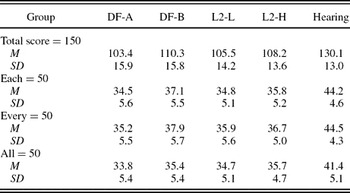
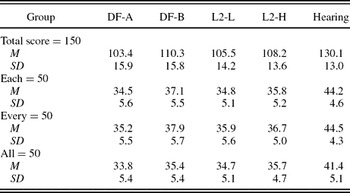
Question Q1 was addressed in a one-way ANOVA for Group (5) × Total (i.e., “perfect”) Score on the universal quantifier items. A total score on the 30 universal quantifier items was 150 (10 items × 5 pictures × 3 quantifiers). The ANOVA showed a significant difference among the groups' responses, F (4, 213) = 30.67, p < .0001, ηp2 = 36.6. Post hoc pairwise comparisons using Scheffé's F showed that the hearing group outperformed both deaf groups and both L2 groups, a result that directly confirms Hypothesis H1. The group means and standard deviations are shown in the “Total score” row of Table 2. The mean difference scores between the hearing group and each other group were as follows, where all Scheffé tests were significant at p < .0001: DF-A (M difference = −26.7), DF-B (M difference = −19.7), L2-L (M difference = −24.6), and L2-H (M difference = −21.9). None of the deaf or L2 groups differed significantly from one another. In terms of the appropriate acceptance/rejection of the full complement of quantifier item depictions, the perfect score percentages of the five participant groups were quite high: 69% for DF-A, 74% for DF-B, 70% for L2-L, 72% for L2-H, and 87% for hearing. This result does not support Hypothesis H3 predicting that the learner groups with higher overall English proficiency would exhibit greater knowledge of English universal quantifier sentences than the groups with lower overall English proficiency. That is, the predicted DF-B > DF-A and L2-H > L2-L did not occur in overall performance.
Means and standard deviations by participant group for total scores and scores on each, every, and all items separately
Note: DF-A, lower English proficiency deaf group enrolled in associate's degree programs; DF-B, higher English proficiency deaf group enrolled in baccalaureate programs; L2-L, second language lower English proficiency; L2-H, second language higher English proficiency.
As in any study that analyzes aggregate group data, averaging can disguise the grammatical performance of individual participants. Therefore, despite the high perfect score averages of the groups, the data of individual participants were examined to determine the extent to which individuals within groups accepted all three grammatically acceptable interpretations in a picture set: the collective, the symmetrical distributive, and the asymmetrical distributive depictions. For the two deaf groups, 85.9% of DF-A and 76.9% of DF-B participants accepted all three available interpretations on only one-half or fewer of all the universal quantifier items. Similarly, for the two L2 groups, 88.5% of L2-L and 81.5% of L2-H participants accepted all three available interpretations on one-half or fewer of all the universal quantifier items. In contrast, 71% of the hearing native speakers accepted all three available interpretations on more than one-half of the universal quantifier items. Despite these figures, there were still considerable numbers of individual participants in each group who demonstrated their recognition of the full range of ambiguity in the target sentences.
Question Q2 pertains to performance on each quantifier separately. This question was addressed in a Group (5) × Quantifier (3) ANOVA with repeated measures on the three universal quantifiers. A perfect score on each set of 10 items targeting a specific universal quantifier was 50 (10 items × 5 pictures). The ANOVA revealed significant main effects for the independent variable group and for the repeated measures on the three dependent quantifier variables. However, a significant Group × Quantifier interaction occurred, F (8, 426) = 3.23, p = .0014, ηp2 = 25.82, indicating that the participant groups exhibited different performance patterns on the three quantifiers. Table 2 includes the five groups' mean total responses and standard deviation for the each, every, and all items. As evidenced by the group means, the hearing group outperformed all other groups, whose mean scores were fairly equivalent across each quantifier type. Again, Hypothesis H1 is supported and Hypothesis H3 is not supported.
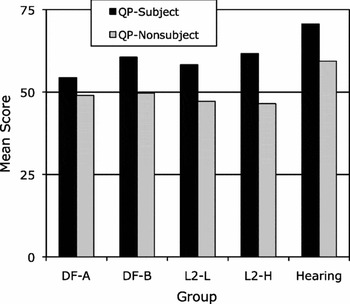
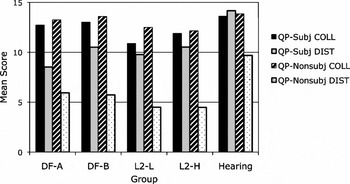
Question Q3 pertaining to QP position was explored through a Group (5) × Position (2) ANOVA with repeated measures on position (QP-subject, QP-nonsubject). The perfect score for each sentence position was 75 (15 items × 5 pictures), and the perfect score for each sentence position per individual quantifier was 25 (5 items × 5 pictures). The ANOVA yielded a significant interaction between group and position, F (4, 213) = 8.65, p < .0001, ηp2 = 34.61. This Group × Position interaction effect is graphically shown in Figure 1. Although performance overall was superior on QP-subject items, Figure 1 reveals that the deaf and L2 groups' performances were similar with respect to their higher performance on QP-subject compared to QP-nonsubject items. The primary source of the Group × Position interaction, therefore, is the scores of the hearing group, whose relative performance on QP-subject and QP-nonsubject items was higher than the other groups' relative performance by position.
Participant groups' overall performance by QP position.

With respect to QP order and participants' acceptance of all three available interpretations in task items, an examination of the performance of individual participants within groups is revealing. The percentages of participants per group who accepted all three interpretations in 50% or more of the QP-subject task items were calculated as follows: 21.9% for DF-A, 46.2% for DF-B, 30.8% for L2-L, 48.1% for L2-H, and 91.9% for hearing. For QP-nonsubject items the percentages of participants were as follows: 6.3% for DF-A, 7.7% for DF-B, 0.0% for L2-L, 0.0% for L2-H, and 45.2% for hearing. These percentages reveal that the full range of ambiguity was recognized by individual participants primarily in QP-subject items.
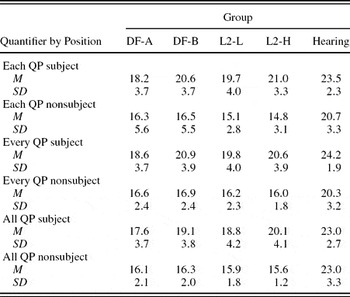
With respect to performance by QP position on the three quantifiers each, every, and all, the results of these three statistical analyses were similar to the overall analyses described above and in Figure 1. There was a consistent pattern of significant interaction effects between group and position for each, F (4, 213) = 9.27, p < .0001, ηp2 = 37.08; every, F (4, 213) = 5.29, p = .0004, ηp2 = 21.19; and all, F (4, 213) = 9.29, p < .0001, ηp2 = 37.15. The values in Table 3 across groups show some fluctuation in view of slightly higher performance by the DF-B and L2-H groups relative to the performance by their cohort DF-A and L2-L peers, respectively. At the same time, the relative performance on QP-nonsubject position for each quantifier shows virtually no difference between the DF-A and DF-B groups or between the L2-L and L2-H groups. Furthermore, the hearing group displayed higher means in their relative performance between QP-subject and QP-nonsubject position (except on the all sentences). Although acquisition of the subtle semantic properties of the three universal quantifiers by the participant groups is an important topic for future research, the analyses associated with Questions Q2 and Q3 revealed only trivial differences in performance across quantifiers by the learner groups. Thus, the results of the present study were not skewed by differential performance on the basis of the specific quantifier targeted.
Group means and standard deviations for scores on each universal quantifier type according to QP position

Note: QP, quantifier phrase; DF-A, lower English proficiency deaf group enrolled in associate's degree programs; DF-B, higher English proficiency deaf group enrolled in baccalaureate programs; L2-L, second language lower English proficiency; L2-H, second language higher English proficiency.
Grammatical knowledge
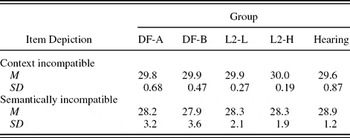
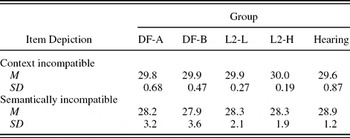
Clearly, any acceptable interpretation of a universal quantifier sentence such as those targeted in this study must depict both the agent and the object of the sentence. Question Q4 (To what extent did groups exhibit quantifier knowledge by rejecting context-incompatible depictions of universal quantifier sentences?) was addressed in a one-way ANOVA for Group (5) × Total Score for the three quantifiers combined, where the correct rejection of context-incompatible depictions was based on a maximum score of 30 (3 quantifiers × 10 items). There was no significant main effect for Group, F (4, 213) = 1.74, p = .1423, ηp2 = 6.96. The group means for the successful rejection of context-incompatible depictions are shown in the first half of Table 4. In addition to demonstrating full knowledge of the unacceptability of context-incompatible depictions, importantly, the groups' rejection of these depictions confirms that the participants were paying attention to task items and not responding randomly.
Group means and standard deviations for correct rejection of context-incompatible and semantically incompatible depictions on all universal quantifier items combined
Note: DF-A, lower English proficiency deaf group enrolled in associate's degree programs; DF-B, higher English proficiency deaf group enrolled in baccalaureate programs; L2-L, second language lower English proficiency; L2-H, second language higher English proficiency.
As noted above, the most basic feature of the meaning of a universal quantifier is that all members of the set of quantified entities are understood to participate in the action described by the sentence. Therefore, rejection of semantically anomalous depictions would confirm that a participant understood the basic meaning of a universal quantifier. Question Q5 regarding the extent to which participant groups rejected these depictions was answered in a one-way ANOVA for Group (5) × Total Score, where the correct rejection of semantically incompatible depictions was also based on a maximum score of 30 (3 quantifiers × 10 items). The ANOVA verified no significant differences between groups in their rejection of semantically incompatible depictions, F (4, 213) = 1.05, p = .3832, ηp2 = 4.19. The group means for this analysis are also provided in Table 4 and reveal near-ceiling rejection of semantically incompatible depictions by all groups. This result directly supports Hypothesis H2.
Collective and distributive interpretations
Question Q6 asked whether participant groups exhibited different performance patterns in their acceptance of collective versus distributive interpretations of universal quantifier sentences and whether QP position influenced acceptance of these interpretations. Q6 was addressed in a Group (5) × Interpretation (collective vs. distributive) × Position (2) ANOVA with repeated measures on the dependent variable. The analysis yielded significant main effects for group, interpretation, and position along with two significant interactions. There was a significant Group × Interpretation interaction, F (4, 852) = 11.04, p < .0001, ηp2 = 44.17, and a significant Position × Interpretation interaction, F (1, 852) = 104.05, p < .0001, ηp2 = 10.87. Figure 2 graphically illustrates the details of these interactions.
Participants groups' acceptance of collective and distributive interpretations of universal quantifier sentences.

The hearing group accepted QP-subject collective and distributive interpretations and QP-nonsubject collective interpretations with high and equivalent frequency relative to their considerably lower acceptance of QP-nonsubject distributive interpretations. As shown in Figure 2, the deaf and L2 groups accepted QP-nonsubject distributive interpretations with much lower frequency than the other interpretations and with a much greater proportionate difference relative to the hearing group. The deaf and L2 groups only accepted about one-third of the available QP-nonsubject distributive depictions. The deaf and L2 groups also exhibited a difference between their highest acceptance rates on the collective interpretations relative to their acceptance rates for the QP-subject distributive interpretation, with the greatest difference occurring in the DF-A group. It should be noted that the position variable in this analysis is based only on performance on two available depictions per item: the collective depiction and the symmetrical distributive depiction. The position variable in the overall task performance analysis by QP position described above relates to the influence of position on performance on all five depictions per item.
The results of the Q6 analysis directly support the predicted learnability order in Prediction 7 based on derivational economy as articulated in Hypothesis H4. The groups' performance patterns illustrated in Figure 2 reveal high and fairly equivalent performance in the acceptance of the two collective derivations (see Example 5), in both of which an indefinite DP is interpreted in situ as a singleton indefinite and QR does not apply. Although the QP-subject distributive interpretation does not involve QR, it was hypothesized to be a relatively less accessible interpretation because the domain of the indefinite DP is restricted to a multimember set within the scope of the universal quantifier (see Example 6a). With the exception of the hearing group, all groups exhibited a lower acceptance rate on these interpretations. As native speakers of English, the hearing group did not reveal any minimalist pressures in accepting the collective and QP-subject distributive interpretations. However, with respect to the most costly QP-nonsubject distributive interpretation, which requires QR (see Example 6b), the hearing group accepted many fewer of the relevant depictions, and the four learner groups accepted very few of these depictions relative to the others.
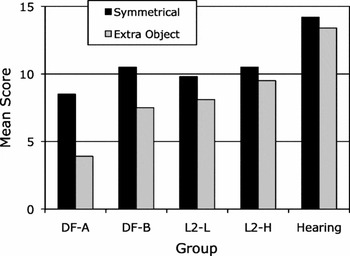
In association with Hypothesis H5, Question Q7 asked whether participant groups would exhibit different performance patterns in their acceptance of symmetrical versus extra-object distributive interpretations of QP-subject universal quantifier sentences. As noted in the Method section, the symmetrical distributive depiction shows an exhaustive one to one correspondence between members of the agent set and members of the object set (e.g., Appendix A, Item 1 Picture A). In contrast, the extra-object depiction includes an extraneous member of the object set (Picture C). Despite this difference, both distributive depictions satisfy the truth value of the sentence and permit a YES response. This question was addressed in a Group (5) × Symmetry (symmetrical vs. extra object) × Dependent Measure (summed across the three quantifiers) factorial ANOVA. The maximum score was 15 for the symmetrical and for the extra-object responses. In addition to significant main effects for group and symmetry, the ANOVA results showed a significant interaction between the two main effects, F (4, 426) = 3.15, p = .0142, ηp2 = 12.61.
The Group × Symmetry interaction is illustrated in Figure 3. The figure reveals that, despite the fact that both depictions are acceptable interpretations of the target sentences, the two deaf groups, especially Group DF-A, accepted symmetrical depictions with considerably greater frequency than extra-object depictions. The hearing group exhibited high and nearly equivalent acceptance levels for both distributive depictions, with the L2 groups' performance in between the deaf groups and the hearing group. Thus, despite the absence of global support for Hypothesis H3, some differences emerged in the more specific analyses that appear to set Group DF-A apart from the other groups in certain respects.
Participants group's acceptance of symmetrical and extra-object distributive depictions of QP-subject sentences.

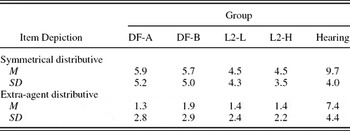
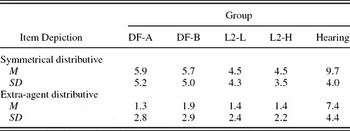
Question Q8 asked whether groups would exhibit different performance patterns in their acceptance of symmetrical (e.g., Item 5, Picture D) versus extra-agent (Picture E) distributive interpretations of QP-Nonsubject universal quantifier sentences. For these sentences, the extra-agent depiction includes an extraneous member of the agent set not performing the action portrayed in the sentence. Q8 was explored through a Group (5) × Symmetry (symmetrical vs. extra agent) × Dependent Measure (summed across the three quantifiers) factorial ANOVA. For symmetrical and extra-agent depictions, the maximum score was 15 for each response type. Both main effects were significant: group main effect, F (4, 426) = 37.63, p < .0001, ηp2 = 26.11; symmetry main effect, F (1, 426) = 69.88, p < .0001, ηp2 = 69.88. However, there was no significant Group × Symmetry interaction, F (4, 426) = 1.51, p = .1976, ηp2 = 6.05. Table 5 provides the groups' mean responses and standard deviations for the symmetrical and extra-agent distributive depictions.
Group means and standard deviations for participants' responses to quantifier phrase nonsubject symmetrical and extra-agent distributive depictions of universal quantifier sentences
Note: DF-A, lower English proficiency deaf group enrolled in associate's degree programs; DF-B, higher English proficiency deaf group enrolled in baccalaureate programs; L2-L, second language lower English proficiency; L2-H, second language higher English proficiency.
Pairwise post hoc comparisons, using the Scheffé test, for the symmetrical versus extra-agent distributive depictions revealed that the hearing group differed statistically from both deaf groups and both L2 groups. The mean differences between the hearing group and the other groups, all significant at p < .0001, were as follows: DF-A, M difference = 4.93; DF-B, M difference = 4.73; L2-L, M difference = 5.57; and L2-H, M difference = 5.59. Thus, although the symmetry main effect establishes that more symmetrical than extra-agent distributive depictions of QP-nonsubject sentences were accepted overall, the pairwise post hoc comparisons establish that there is no statistical difference in the extent of the greater acceptance of symmetrical than extra-agent depictions across the deaf and L2 groups. Table 5 reveals, however, that the hearing group accepted a much higher percentage of both depictions, with a greater number of symmetrical than extra-agent depictions.
Together the results associated with Questions Q7 and Q8 provide partial support for Hypothesis H5. As predicted, all groups exhibited the symmetry effect for both the symmetrical/extra-object and the symmetrical/extra-agent conditions. However, with respect to the symmetrical/extra-object condition (Figure 3), mean differences within the hearing group and the L2 groups were not large. Group DF-A exhibited the greatest mean difference in performance between symmetrical and extra-object depictions. As for the symmetrical/extra-agent analysis, the deaf groups and the L2 groups performed similarly and were equivalent in the extent to which their higher means on the symmetrical depictions differed from their lower means on the asymmetrical depictions. Accordingly, Hypothesis H5 was not supported relative to the expected decrease in the symmetry effect as proficiency level increased.
DISCUSSION
Demonstrated knowledge of universal quantifier sentences
Recognition of ambiguity. The above results establish that all participant groups in this study demonstrated firm knowledge of the most fundamental meaning feature of the English universal quantifiers each, every, and all. Specifically, they all demonstrated an understanding that, in sentences containing a QP and an indefinite noun phrase, all members of the set of entities designated by the universal quantifier participate exhaustively in the action described by the sentence (Hypothesis H2). On the picture task, participants overwhelmingly accepted sentence depictions that satisfied this requirement and, conversely, they rejected depictions in which this requirement was violated. Along with this fundamental knowledge, all groups exhibited high levels of recognition of the inherent ambiguity of universal quantifier sentences. The hearing group of native speakers of English was 87% successful in judging correctly the full complement of five pictures for each universal quantifier item on the picture task.
Although the hearing group's score was significantly higher than the scores of the other groups (Hypothesis H1), the other groups nevertheless exhibited impressively high overall scores reflecting knowledge of both the universal constraints on quantifier sentence interpretation and the availability of multiple interpretations of the target sentences. The deaf groups' overall percentage perfect scores were 69% (DF-A) and 74% (DF-B), and the L2 groups' scores were 70% (L2-L) and 72% (L2-H). These scores are remarkably similar and did not differ significantly from one another (contra Hypothesis H3). Perfect scores lower than 100% are to be expected, motivated either by minimalist pressures or by other factors driving preferences. In the case of overall higher performance on QP-subject items than on QP-nonsubject items (Figure 1), it is no doubt a consequence of low access to the costly QP-nonsubject distributive interpretations, as further discussed below.
Derivational economy and acquisition
Relative knowledge and preferences. The net effect of adopting Schwarzschild's (Reference Schwarzschild2002) singleton indefinites analysis is that the only derivation under consideration that requires the application of QR as a last resort or “rescue strategy” is the QP-nonsubject distributive interpretation. As shown in Example 9, this derivation requires the movement of every flower to a position from which it takes scope over a woman, yielding inverse scope.
9. [every flowerj [a woman is smelling tj]]
QR is forced in this case because a woman is not restricted to a singleton set; its interpretation can only be obtained within the scope of every flower, where it receives its plural set denotation. In contrast, QR is not involved in the QP-subject distributive derivation of Each dog is lying on a rug (Example 6a) because, via surface scope, each dog already takes scope over a rug if a rug is not restricted to a singleton set; accordingly, it receives its plural set denotation within the scope of each dog.
In view of the above analysis based on economy of derivation, the results of this study receive a principled explanation in the context of the minimalist program. The two learner groups for whom access to English language input is constrained exhibited knowledge of universal quantifier sentences consistent with the learnability order specified in Prediction 7. As illustrated in Figure 2, they exhibited greatest knowledge of the QP-subject and QP-nonsubject collective interpretations, which are derived without QR and in which the indefinite DP is interpreted as a singleton indefinite (i.e., morphologically and semantically singular). They exhibited relatively less knowledge of the QP-subject distributive interpretation, which, as noted, requires a plural set designation of its indefinite DP within the scope of the QP. Performance was markedly low on the lone derivation requiring QR. Despite their near-ceiling performance on the other three interpretations, even the hearing group performed lower on the QP-nonsubject distributive interpretations. Given Reinhart's (Reference Reinhart2006, p. 109) arguments that such an interpretation is more difficult to obtain and comes with “a computational cost,” the hearing group's avoidance of this interpretation is a predictable outcome.
Proficiency level. The deaf learner groups and the L2 learner groups exhibited striking parallels in their performance on the English Sentence Picture Task—Quantifiers. These parallels are reflected in their mean scores provided in Tables 2–5 and in their performance patterns illustrated in Figures 1–3. Such parallel performance is expected to the extent that economy factors constrain acquisition as specified in the learnability predictions of Hypothesis H4. The observed parallels supplement previous observations of parallel performance patterns by deaf and hearing L2 learners on a variety of English language phenomena (Berent, Reference Berent1983, Reference Berent, Ritchie and Bhatia1996a, in press). For example, Berent (Reference Berent1983, in press) demonstrated parallel performance between the two types of learner in interpreting the logical subjects of infinitive complements and explained the parallel performance on the basis of theory-driven learnability predictions. Furthermore, as overall English proficiency increased, so did the accuracy of the deaf and L2 learners' infinitive complement interpretations.
In the present study it was also hypothesized (H3, H5) that the groups with higher overall English proficiency would exhibit relatively greater knowledge of English quantifier sentences than the groups with lower overall English proficiency. However, differential performance by proficiency level was not observed (with subtle exceptions discussed below). This implies that, collectively, the two deaf groups and the two L2 learner groups had all internalized sufficient English language input associated with universal quantifier sentences to derive principled interpretations of the target sentences and to select, with predicted variation (H4), among the available English interpretations of these sentences. Beyond that, the groups exhibiting higher overall English proficiency had presumably not collectively exceeded whatever threshold is required to move beyond the minimalist pressures associated with the target derivations and to more closely approximate the competence of the hearing native speakers. Ultimate attainment of knowledge of English universal quantifier sentences by deaf and L2 learners is an open question.
Untangling the symmetry effect
Salience and singleton indefinites. The symmetry effect that was observed in this study in association with Hypothesis H5 and research Questions Q7 and Q8 requires a careful examination. As noted in the Introduction, existing explanations of the symmetry effect observed in child language research have not provided a convincingly adequate explanation of the phenomenon, and some invoke poorly operationalized notions such as “sloppy processing” (e.g., Brooks & Sekerina, Reference Brooks and Sekerina2006). Rakhlin (Reference Rakhlin2007a, Reference Rakhlin2007b), however, proposed a novel explanation: that the symmetry effect in children can be explained in the context of Schwarzschild's (Reference Schwarzschild2002) analysis of singleton indefinites. Schwarzschild's analysis is situated within his broader theory of quantifier domain restriction, where discourse and pragmatic factors can guide speakers' and hearers' perceptions of the interpretation of an indefinite DP. In view of possibly differing perceptions, in any given discourse the speaker and the hearer may assign distinct interpretations to the same utterance.
For example, as illustrated by Schwarzschild (Reference Schwarzschild2002), the unusual flexibility with which an indefinite DP can be restricted to a singleton indefinite can result in situations in which a DP presumed to denote a plural set might unexpectedly denote a singleton set. In a sentence like Every professor gave every student in their class an A, although it is probable that each professor has more than one student in his or her class, each receiving an A, in a case in which a professor has only one student in a class, the DP, an A, and even the universal QP every student would represent singleton sets in that subcontext. Schwarzschild argued that the domain of a quantifier is restricted by explicit syntactic and lexical material (e.g., as provided by the relative clause in Every professor who had five or more students per class gave every student in that class an A), or else it is restricted implicitly. Because individuals' intuitions about contexts may differ, Schwarzschild concluded that there is a fundamental “speaker–listener asymmetry” in quantifier domain restriction: implicit domain restrictions based on differing intuitions may result in different interpretations of the same sentence, despite the speaker's intentions.
Within that context, Rakhlin (Reference Rakhlin2007a, Reference Rakhlin2007b) argued that the symmetry effect would occur when a child focused on the extra object or the extra agent in an asymmetrical depiction and rejected the available distributive interpretation by virtue of perceiving the extra entity as a singleton indefinite. For example, if a child were shown the extra-object depiction (Picture C) of Appendix A Item 1 and was asked, “Is each dog lying on a rug?”, the child would answer “no” if he or she focused attention on the salient extra rug. In doing so, the child is implicitly restricting the domain of a rug to a singleton indefinite. In such a case, the answer is “no,” because not all dogs are lying on the one specific rug of interest. Rakhlin derived empirical support for her proposals from the fact that, although children rejected asymmetrical extra-object or extra-agent depictions with high frequency when a picture contained a single extra object or agent, they rarely rejected the depiction when the picture contained multiple extra objects or agents. Two or more entities cannot be perceived as a singleton set.
Pragmatic knowledge. Rakhlin attributed her results to young children's lack of “pragmatic flexibility” for managing contextual information and ruling out less plausible interpretations, pragmatic knowledge that she assumed adults have. However, as noted in the Introduction and in the results of the present study, older learners (deaf learners, L2 learners) and even adult speakers of L1 English exhibit the symmetry effect to varying extents on picture tasks. Because pragmatic knowledge is an integral component of linguistic knowledge that is essential for successful language comprehension and use, there is no reason not to assume that the same pragmatic deficit that presumably causes the symmetry effect in children also causes the effect in older learners. With more highly developed cognitive skills and higher levels of target language attainment, older learners would obviously exhibit the effect with lower frequency than young children. In seeking a unified explanation of the symmetry effect across ages and among diverse learners, the question is what specific domain of pragmatic knowledge is implicated?
Although research on the development of pragmatic knowledge is prevalent in the literature on child language development, there is very little research on deaf learners' development of pragmatic knowledge for English.Footnote 2 Nevertheless, there is evidence that deaf learners experience deficits in pragmatic abilities associated with conversational discourse. Jeanes, Nienhuys, and Rickards (Reference Jeanes, Nienhuys and Rickards2000) found that the pragmatic abilities of deaf learners aged 8–17 relating to conversational management, such as requests for clarification and conversational repair, lagged behind the abilities of their hearing, age-equivalent peers. With respect to L2 learners of English, there is more research on pragmatic knowledge (see the overview in Kasper & Roever, Reference Kasper, Roever and Hinkel2005), but this research has focused extensively on L2 speech acts related to negotiation of meaning, politeness, requests, routines, and other aspects of conversational discourse. In those areas, research has shown that L2 learners' pragmatic knowledge for L2 discourse management differs considerably from the pragmatic knowledge of native speakers (Bardovi-Harlig, Reference Bardovi-Harlig, Rose and Kasper2001). Findings differ, however, regarding the extent to which learners' L1 pragmatic knowledge transfers to the L2 and whether the transfer has a positive or negative effect on L2 use (Kasper & Roever, Reference Kasper, Roever and Hinkel2005).
In the L1 English child language literature, the issue of pragmatic knowledge relative to the interpretation of sentences containing a QP and a DP along with negation was directly addressed by Musolino and Lidz (Reference Musolino and Lidz2006). They explored 5-year-old children's and adults' interpretations of sentences like Examples 10a and 11. Sentence 10a (their 11, p. 825) is ambiguous between interpretations 10b and 10c. Musolino and Lidz contrasted judgments on sentences like 10a with judgments on sentences like 11 (their 12, p. 825), in which the original sentence was preceded by an affirmative statement.
- 10.
a. Every horse didn't jump over the fence.
b. None of the horses jumped over the fence.
c. Not all of the horses jumped over the fence.
11. Every horse jumped over the log but every horse didn't jump over the fence.
In the Example 10b interpretation of 10a, the QP every horse takes scope over negation. In the 10c interpretation, negation takes scope over the QP, for which QR is required for obtaining inverse scope.
In the scenario for assessing children's and adults' interpretations of Example 10a, two of three horses jumped over the fence but the third horse decided not to. This event corresponds to the inverse-scope 10c interpretation of 10a. The children almost never accepted Example 10a, spoken by a puppet, as a description of the event, whereas the adults almost always did. However, in a second scenario, all three horses first jumped over a log but then only two of them jumped over the fence. This time most children accepted Example 11 as a description of the events, as almost all the adults did. These results verified that children as young as 5 accept the required and, in this case, more costly QR derivation of Example 10a so long as the appropriate pragmatic context is provided.
In their second experiment, Musolino and Lidz (Reference Musolino and Lidz2006) assessed children's and adults interpretations of sentences like The strong guy didn't/won't put every elephant on the table (p. 836). This time the scenario described a strong guy being able to lift three dogs onto a table but not able to lift any of the (heavier) three elephants onto the table. The presence of not . . . every in the puppet's spoken sentence permits either an interpretation (a) in which the strong guy did not put any of the three elephants on the table, which is true in this scenario, or (b) in which the strong guy put one or two but not all three of the elephants on the table, which is not true in this scenario. In terms of quantifier “strength,” not . . . any is preferred over not . . . every for meaning (a). In the “prediction mode” of the experiment, the puppet noted that the elephants looked too heavy to lift and used won't put rather than didn't put in his sentence before the events unfolded. Both the children and the adults overwhelmingly accepted the sentence as true as a prediction. However, in the “description mode,” in which the puppet used didn't put rather than won't put to describe the completed events, the adults overwhelmingly rejected the sentence. Even though not . . . every is semantically acceptable in this case, the adults' pragmatic knowledge (related to scalar implicatures; see Levinson, Reference Levinson1983) forced them to override their semantic knowledge of the universal quantifier every, because not . . . any is the anticipated and preferred lexical choice for the descriptive scenario. Both they and the children had fully demonstrated their semantic knowledge of every in the predictive condition. From the children's acceptance of the target sentences in both the prediction and description modes, Musolino and Lidz concluded that the children's responses directly reflect their semantic knowledge of the universal quantifier but that the children lack the kind of pragmatic knowledge that guides adult interpretations.
As Musolino and Lidz (Reference Musolino and Lidz2006) and others (e.g., Noveck, Reference Noveck2001; Papafragou & Musolino, Reference Papafragou and Musolino2003) have demonstrated, if young children lack the relevant discourse pragmatic knowledge for “adultlike” interpretations of quantifier sentences, it is reasonable to assume that a deficiency in the same kind of discourse pragmatic knowledge yields unexpected or “nontarget” judgments in adult learners. Specifically, a unified explanation for the symmetry effect across ages and populations should seek to identify one specific domain of discourse pragmatic knowledge that, if un- or underdeveloped, could produce the symmetry effect or other interpretive anomalies. The lower incidence of the symmetry effect in older learners as compared with very young children would simply be a matter of the degree of development of pragmatic knowledge, which, along with linguistic development, involves other aspects of maturation including attention and memory. It is likely that such cognitive components account for the fact that even adult native speakers of English falter on occasion and exhibit the symmetry effect.
Discourse and the singleton effect. The English Sentence Picture Task—Quantifiers elicits interpretations of sentences that do not contain supplementary syntactic or lexical material for explicit domain restriction. Rather, in isolation these sentences invite implicit domain restriction (à la Schwarzschild, Reference Schwarzschild2002). For example, the target sentence in Appendix A Item 1 is Each dog is lying on a rug and not Each dog is lying on a different rug or Each dog is lying on a rug with the exception of one dog. Despite the ambiguity of the target sentences, four of the five pictures in an item set actually provide a straightforward pictorial context for an unequivocal, principled decision. The context-incompatible and semantically incompatible depictions elicit a clear-cut decision for verifying knowledge of the meaning of a universal quantifier. The collective and the symmetrical distributive depictions permit definitive decisions reflecting the acceptance of, or preference for, collective and distributive interpretations, respectively. In sharp contrast, the asymmetrical (extra-object and extra-agent) depictions provide contexts that are themselves “ambiguous.” For example, in Item 1 Picture C, all four members of the set of dogs distribute to individual rugs, justifying the restriction of a rug within the scope of each dog to a multimember set. However, suppression of attention to the dog–rug pairs and a focus on the lone unaffected rug permits, legitimately, a restriction of the domain of a rug to a singleton set.Footnote 3 The answer for that perceived subcontext is therefore NO.
However, mature pragmatic knowledge of English should suppress the singleton restriction in favor of the multimember set restriction. A clue to untangling the symmetry effect is the fact that universal QPs are referential; they presuppose a prior discourse referent. Accordingly, none of the target sentences on the picture task could initiate a natural discourse without prior mention of a referent for the QP (Look at those dogs. Each dog is lying on a rug.) or the simultaneous establishment of the referent with explicit lexical material (Each dog in that picture is lying on a rug.). If the test taker fails to envision a discourse containing a referent for the QP, the extra object or agent can reasonably become the focus of visual, and therefore discourse, attention. Note that, with respect to Item 1 Picture C, “foregrounding” the unoccupied rug actually yields an anomalous discourse like the following: Look at the rug in the middle of the picture. #Each dog is lying on a rug. The singular, specific DP the rug cannot serve as the discourse antecedent of the plural set of dogs (each dog) in the target sentence. The anomaly forces a NO answer.
Assuming that this type of discourse knowledge, the requirement to infer a discourse referent for a referential QP, accounts (in part or in whole) for the symmetry effect in children and adults, the phenomenon can no longer be considered a symmetry effect. It does not emerge out of a cognitive or perceptual need for the one to one matching of members of two sets with no “leftovers.” Instead, it occurs in the presence of a confounding, superfluous entity in a pictorial discourse, resulting in the learner's inability to employ the pragmatic knowledge (even if sufficiently developed) to infer a proper discourse referent for the QP in the sentence. With this discourse “breakdown,” the superfluous entity becomes “foregrounded” rather than “backgrounded,” and leads to the singleton restriction and the NO answer. The phenomenon is thus not a symmetry effect but rather a singleton effect.
Older learners. In the present study, the mean scores of the participant groups' acceptance of QP-subject symmetrical and extra-object distributive depictions were displayed above in Figure 3, and the mean scores of the acceptance of QP-nonsubject symmetrical and extra-agent depictions were provided in Table 5. In percentages, the mean differences between acceptance of the symmetrical and the asymmetrical depictions help to clarify performance relative to the singleton effect. For QP-subject sentences, the percentage differences between the greater acceptance of the symmetrical and lesser acceptance of the extra-object depictions were as follows per group: 30.7% for DF-A, 20.0% for DF-B, 11.3% for L2-L, 6.7% for L2-H, and 5.3% for hearing. The percentage differences between the QP-nonsubject symmetrical and extra-agent depictions were as follows: 4.6% for DF-A, 3.8% for DF-B, 3.1% for L2-L, 3.1% for L2-H, and 2.3% for hearing. In terms of difference scores, the percentages are more conspicuous for the QP-subject items, on which the deaf groups, especially the DF-A group, exhibited the greatest differential in accepting symmetrical versus extra-object depictions (30.7%).
Because QP-nonsubject distributive interpretations involve the most costly quantifier sentence derivation (requiring QR), explaining participants' acceptance or rejection of the extra-agent depictions is more complex than explaining their acceptance or rejection of the extra-object depictions of QP-subject sentences, for which distributive interpretations have the more economical derivation (see Figure 2). The very low acceptance rates of extra-agent depictions by the four learner groups (Table 5) could have been motivated by either of two factors: the general difficulty of obtaining the QP-nonsubject distributive interpretation on the basis of economy considerations, or the propensity to interpret the superfluous entity as a singleton indefinite, as discussed above. Succumbing to either pressure yields a NO answer. In the present study, there is no definitive way to tease these two influences apart. However, an examination of individual participant data offers some insight.
Participant data were examined to see if any participants exhibited a blanket rejection of asymmetrical depictions, both the QP-subject extra-object depictions and the QP-nonsubject extra-agent depictions. The percentages (and numbers) of participants per group who rejected all asymmetrical depictions were as follows, where “total rejection” was calculated as either zero or one acceptance of the 30 asymmetrical depictions: 54.7% (35) for DF-A, 28.2% (11) for DF-B, 23.1% (6) for L2-L, 11.1% (3) for L2-H, and 3.2% (2) for hearing. Given these values, the blanket rejection by DF-A participants stands out: 35 of 64 participants in that group rejected all asymmetrical depictions. Such balanced judgments across QP-subject and QP-nonsubject sentence types suggest the possibility that it was their underdeveloped pragmatic knowledge, rather than economy pressures, that led these learners' to reject asymmetrical depictions. Of the remaining participants within the groups, just two individuals rejected only extra-object depictions without also rejecting some number of extra-agent depictions. However, the percentages of participants per group who rejected only extra-agent depictions but no extra-object depictions were considerable: 23.4% (15) for DF-A, 33.3% (13) for DF-B, 46.2% (12) for L2-L, 70.4% (19) for L2-H, amd 11.3% (7) for hearing. What these rejection rates indicate is that there were proportionately more individual L2 learners than deaf learners, especially in the L2-H group (70.4%), who were able to accept QP-subject extra-object depictions but not able to accept QP-nonsubject extra-agent depictions. This skewed performance pattern suggests the possibility that, for these 31 L2 learners, it was the derivational cost of the QP-nonsubject distributive derivations, rather than underdeveloped L2 pragmatic knowledge, that led to their rejection of the extra-agent depictions. Thus, fully developed pragmatic knowledge in the L1 may very well have transferred to the L2 judgments of these learners. Directly testing these hypotheses remains for future research.
Knowledge versus preference
Predicted variation. The performance of the hearing group in this study demonstrated that hearing native speakers of English, despite their native competence (including pragmatic competence), exhibit preferences for some interpretations of ambiguous English universal quantifier sentences over others. This is the nature of ambiguity resolution (Kurtzman & MacDonald, Reference Kurtzman and MacDonald1993). No one would attribute variable performance across sentence types by native speakers to any lack of linguistic knowledge. Instead, the variation was attributed to minimalist pressures related to derivational economy as specified in the learnability order stated in Prediction 7. For the hearing group, these pressures were most apparent in their lower acceptance of QP-nonsubject distributive interpretations (Figure 2).
Even though the deaf and L2 learner groups exhibited lower overall scores than the hearing group, they still exhibited impressively high overall knowledge of English quantifier sentence interpretation (between 69% and 74% perfect scores in the Q1 analysis). It was their variable performance patterns on the QP-subject and QP-nonsubject collective and distributive interpretations (Figure 2) that clearly reflected the predicted learnability sequence specified in Prediction 7. Whether these patterns reflect relative degrees of L2 knowledge or, like native speakers, interpretive preferences constrained by minimalist pressures is not a critical distinction to make. Because the four learner groups were able to obtain the four relevant interpretations, it would seem that learner performance also reflected preferences where, in the case of ambiguity resolution in semantically complex sentences containing universal quantifiers, preferences are more definitively constrained according to minimalist-induced computational complexity.
Distinct learner grammars. However, the results of analyses based on group means, although statistically significant and demonstrative of learner patterns of acquisition and preference, do not rule out the possibility that individual learners might possess mental grammars that diverge from the grammars inferred from group performance. For example, it is possible that some learners accepted only collective interpretations and therefore had grammars or exclusive preferences in which indefinite DPs could be interpreted only as singleton indefinites. To explore this possibility, individual participant data were examined for response patterns in which only collective interpretations were accepted but no distributive interpretations. An exclusive collective performance pattern was calculated liberally to allow for error as ≥90% acceptance of the 30 collective depictions along with ≤10% acceptance of the 30 distributive depictions. The possibility of an exclusive distributive grammar/preference was similarly calculated but with the opposite proportions of acceptance. There were no participants who exhibited an exclusive distributive performance pattern. However, there were a few participants who did exhibit an exclusive collective pattern, as the following percentages (and numbers) of individuals per group indicate: 17.2% (11) for DF-A, 5.1% (2) for DF-B, 3.8% (1) for L2-L, and 3.7% (1) for L2-H. No participant in the hearing group exhibited an exclusive collective preference. Although very few participants exhibited this exclusive collective pattern, it is the DF-A group that stands out again, this time having the most participants in this regard: 11 out of 64.
An exclusive collective grammar would mean that, by interpreting singular indefinite DPs as singleton indefinites, the grammar would not be able to restrict the domain of an indefinite DP to a multimember set (as in distributive derivations). Although logically possible, a grammar without flexible domain restriction is extremely unlikely. First, it is a linguistic universal that all languages possess universal quantifiers and that some of these quantifiers, for example, every (and its cross-linguistic equivalents) are semantically biased toward distributive interpretations (Ioup, Reference Ioup and Kimball1975). Second, very young children learning English were shown to be able to obtain inverse scope and thus the plural set restriction on a singular indefinite DP (Musolino & Lidz, Reference Musolino and Lidz2006). Third, the study of learners' interlanguage grammars has established that interlanguages are principled natural-language grammars along their developmental paths toward the L2 (White, Reference White2003). In this regard, research has shown that this is also the case with respect to deaf learners' interlanguage development (Berent & Samar, Reference Berent and Samar1990; Lillo-Martin, Reference Lillo-Martin, Marschark and Clark1993, Reference Lillo-Martin, Flynn, Martohardjono and O'Neil1998). Fourth, the deaf participants in this study, including the DF-A group, have proceeded through formal education since early childhood and into college. Despite their relatively low overall English proficiency for a college-aged population, these students will have been exposed to a wealth of input in their years of study of English, math, science, and so forth, containing distributive meanings for indefinite DPs (e.g., . . . if every boy ate one apple, how many apples were left?). Fifth and finally, the inability to interpret a singular DP as a plural set would extend to numerous other English structures in the learner's grammar. For example, in response to the question What did you wear?, limitation to a singleton restriction would permit an answer such as a shirt but not a shirt, a tie, and a suit in interpreting the variable within the scope of what.
Although the likelihood of a collective grammar is remote, it is still possible that individual participants might have employed a “least-effort” strategy or exhibited an overwhelmingly strong preference to accept collective depictions and to reject distributive depictions. Such a strategy or preference is still consistent with the learnability order specified in Prediction 7 because, as demonstrated, the two collective derivations are the most economical among the four sentence types assessed (Figure 2).
CONCLUSION
This research explored college-level native speakers' and learners' knowledge and preferred interpretations of English sentences containing a universal quantifier and a singular indefinite DP. The performance of hearing native speakers was compared to the performance of two types of learner: deaf learners of English and hearing L2 learners of English. English acquisition by deaf learners is generally constrained by restricted access to auditory linguistic input and the consequences of delayed or later language acquisition. English acquisition by hearing L2 learners is also constrained by the cognitive–linguistic factors and associated input restrictions typical of later language learning. Participants' knowledge of universal quantifier sentences was assessed using a novel picture-task methodology, the English Sentence Picture Task—Quantifiers. The novelty of this instrument is its use of five depictions per task item, for each of which a participant must assess whether or not it represents a possible interpretation of a target sentence.
Picture-task results were assessed in the context of minimalist proposals for the semantics of English universal quantifier sentences and the learnability predictions of these proposals based on economy of derivation. The theoretical proposals incorporated Schwarzschild's (Reference Schwarzschild2002) theory of singleton indefinites. Results demonstrated that, despite the expected higher performance of the hearing native speakers, both their and the deaf and L2 learner groups' performance conformed to the proposed learnability predictions based on minimalism. Predicted differences between a higher and lower English proficiency group of deaf learners and between a higher and lower English proficiency group of L2 learners were largely not confirmed. However, the lower English deaf group exhibited greater challenges than the other groups on some aspects of quantifier sentence interpretation.
This study also explored the symmetry effect that commonly occurs in picture tasks used to elicit young children's knowledge of universal quantifier sentences. The symmetry effect has also been observed among older learners and even adult native speakers, as it was in the present study. Rakhlin's (Reference Rakhlin2007a, Reference Rakhlin2007b) explanation of the symmetry effect in children on the basis of singleton indefinite interpretations was adopted and expanded in explaining the symmetry effect in the present study. It was argued that the effect occurs when learners' underdeveloped pragmatic knowledge of English prevents them from inferring a discourse referent for a referential QP and they defer to the singleton indefinite interpretation of a depicted superfluous entity. Some evidence was provided suggesting that L2 learners might have an advantage over deaf learners in transferring L1 pragmatic knowledge to the L2 in interpreting quantifier sentences.
The implications of this research are broad. Most fundamentally, the results provide empirical evidence in support of minimalist proposals in linguistic theory and associated minimalist predictions for language acquisition and sentence comprehension. Further, the results contribute to the understanding of language acquisition under conditions of restricted access to target language input. It is under such a restriction that the linguistic–theoretic predictions for learnability have surfaced most clearly. Considering the L2 and deaf participants separately, the results of this study contribute directly to the knowledge base of two fields: the field of L2 acquisition research and the field of deaf studies. As noted, the phenomenon studied, universal quantifier sentences, has received relatively little attention in L2 research; in the field of deaf studies, it has previously received almost no attention. Thus, the results constitute separate contributions to these two fields at the same time that they collectively inform linguistic theory and language acquisition. In addition, the inclusion of both deaf and hearing L2 learners in this research yielded results that further demonstrate acquisitional parallels between the two types of learners on a specific target phenomenon. The value of such comparative results is that, as argued in Berent (in pressReference Berent, Ritchie and Bhatia), where deaf and L2 learner grammars converge, the convergence more likely reflects the instantiation of universal principles of grammar; where deaf and L2 learner grammars diverge, L1 transfer is more likely to be involved. In the present study, despite largely parallel performance, subtle divergence was noted relative to the symmetry effect, suggesting the possible transfer by some of the L2 learners of their L1 pragmatic knowledge to the L2. This issue requires further exploration.
Finally, the results of this study have educational implications. As noted in the Introduction, the discourse of STEM education pervasively employs quantificational structures for explaining quantificational concepts and phenomena. Accordingly, educational success depends on the comprehension of sentences in discourse that contain many different quantifiers and quantificational structures. As seen, quantifier sentences are generally open to more than one interpretation. Therefore, understanding the kinds of interpretations that learners (and native speakers) assign to quantifier sentences, including which interpretations are more or less difficult to obtain, contributes insights that may be exploited by educators in STEM education and in other fields in which accurate reading comprehension and written expression are vital to success.
APPENDIX A: ENGLISH SENTENCE PICTURE TASK—QUANTIFIERS: TOKENS OF UNIVERSAL QUANTIFIER ITEMS
QP-SUBJECT ITEMS
1. Each dog is lying on a rug.
2. Every boy is climbing a tree.
3. All the cooks are stirring a pot.


QP-NONSUBJECT ITEMS
4. A dad is carrying each baby.
5. A woman is smelling every flower.
6. A child is picking up all the balls.


APPENDIX B: UNIVERSAL QUANTIFIER SENTENCES TARGETED ON THE PICTURE TASK
QP-SUBJECT SENTENCES
1. Each dog is lying on a rug.
2. Each man is digging a hole.
3. Each firefighter is holding a hose.
4. Each baby is crawling into a box.
5. Each teenager is sitting on a couch.
6. Every boy is climbing a tree.
7. Every mouse is hiding in a hole.
8. Every bird is sitting on a branch.
9. Every child is swinging on a swing.
10. Every student is going in a door.
11. All the kids are flying a kite.
12. All the girls are feeding a squirrel.
13. All the cooks are stirring a pot.
14. All the boys are building a birdhouse.
15. All the workers are climbing a ladder.
QP-NONSUBJECT SENTENCES
1. A girl is holding each kitten.
2. A cat is watching each bird.
3. A dad is carrying each baby.
4. A kid is breaking each stick.
5. A worker is pulling each rope.
6. A clown is wearing every hat.
7. A cook is slicing every potato.
8. A woman is smelling every flower.
9. A man is spilling every glass.
10. A dog is chasing every cat.
11. A waiter is holding all the spoons.
12. A woman is filling all the glasses.
13. A teenager is eating all the hamburgers.
14. A child is picking up all the balls.
15. A cat is following all the ducks.
ACKNOWLEDGMENTS
This research was supported both by the NTID and by a grant (SBE-0350277) from the National Science Foundation to NTID, RIT, Rochester, NY, with collaborative subcontracts to Gallaudet University, Washington, DC, and Bowling Green State University, Bowling Green, OH. We are grateful to all the students at RIT who chose to participate in this study and to Jeffrey E. Porter, Chairperson of the NTID Learning Consortium, and Rhona Genzel, Director of the RIT English Language Center, for their facilitation of data gathering. We extend a special thanks to Sara Beauvais of Fairy Circle Illustration at TheFairy Circle.com for her art contributions to the development of the English Sentence Picture Task—Quantifiers.