Introduction
Intensifying international migration flows across the globe present many societies with a more multicultural and multi-ethnic demographic landscape (Abubakar et al., Reference Abubakar, Aldridge, Devakumar, Orcutt, Burns, Barreto, Dhavan, Fouad, Groce, Guo and Hargreaves2018; Juárez et al., Reference Juárez, Honkaniemi, Dunlavy, Aldridge, Barreto, Katikireddi and Rostila2019). With rapid populations ageing (Beard et al., Reference Beard, Officer, De Carvalho, Sadana, Pot, Michel, Lloyd-Sherlock, Epping-Jordan, Peeters, Mahanani and Thiyagarajan2016), access to health-care services is a key strategy for maintaining individuals’ functional ability that enables wellbeing in later life. Canada's older population (10.9 million) surpassed the number of children for the first time in 2016 (Statistics Canada, 2017) and one in every three older Canadians is foreign-born (Wang et al., Reference Wang, Guruge and Montana2019). This rapid growth of immigrants also makes up 65 per cent of populations identified as non-Caucasian in race (hereafter racialised groups), resulting from a larger inflow of humanitarian immigrants such as family reunification arrivals and refugees to Canada over the past half century (Statistics Canada, 2013). Meanwhile, the ongoing COVID-19 pandemic underscores the necessity of an equitable health-care system – a task that should be prioritised for older populations from racialised and immigrant communities who had disproportionately higher rates of infection and death from COVID-19 (Bailey and Moon, Reference Bailey and Moon2020; Seaton et al., Reference Seaton, Noah, Yoo and Vargas2020).
Immigrants tend to be healthier than their native-born peers (De Maio and Kemp, Reference De Maio and Kemp2010; Davison et al., Reference Davison, Lin, Tong, Kobayashi, Mora-Almanza and Fuller-Thomson2020), owing to the strict selection process of the merit-based points system and the mandatory health screening that favours individuals with established human capital and optimal health (Fuller-Thomson et al., Reference Fuller-Thomson, Saab, Davison, Lin, Taler, Kobayashi and Tong2020). This ‘healthy immigrant effect’ (HIE), however, appears to deteriorate with increased length of residence (Fuller-Thomson et al., Reference Fuller-Thomson, Noack and George2011), and is contingent on race, age and place of origin (Malmusi et al., Reference Malmusi, Borrell and Benach2010; Brown, Reference Brown2018). A recent systematic review on HIE in Canada has revealed that this health advantage is apparent among immigrant populations in middle adulthood but less evident in old age (Vang et al., Reference Vang, Sigouin, Flenon and Gagnon2017). Longer-term aged immigrants may even experience worse health as the HIE is reduced over time (Gee et al., Reference Gee, Kobayashi and Prus2004; Newbold, Reference Newbold2006; Lin et al., Reference Lin, Kobayashi, Tong, Davison, Arora and Fuller-Thomson2020). Researchers have been exploring what factors may be contributing to this observed diminishing trend of HIE and some argue that this is in part attributable to post-migration stressors, including barriers in accessing needed health care (Laberge and Leclerc, Reference Laberge and Leclerc2019).
Access to health care according to needs, not ability to pay, was the founding principle of the Canadian universal health system according to Canada Health Act of 1984. If such a system is equitably allocating health-care resources based on need, no significant disparities in access to care should be apparent across diverse social groups (Martin et al., Reference Martin, Miller, Quesnel-Vallée, Caron, Vissandjée and Marchildon2018); however, this is not always the case for immigrants who are ageing in a foreign land. For example, Canadian studies have found that racialised immigrants reported higher likelihoods of lacking a regular doctor (Siddiqi et al., Reference Siddiqi, Wang, Quinn, Nguyen and Christy2016), greater difficulties in accessing immediate care for a minor health problem (Sanmartin and Ross, Reference Sanmartin and Ross2006), fewer visits to specialised care services such as outpatient specialty visits, non-emergency surgery and selected diagnostic tests (Statistics Canada, 2016), lower use of hospital services (Ng et al., Reference Ng, Sanmartin, Tu and Manuel2014) and fewerpreventive care services (Lebrun and Dubay, Reference Lebrun and Dubay2010), compared to non-immigrants. The evidence of nativity and racial disparities renders racialised immigrants vulnerable to health care seeking and undermines Canada's mandate of universal health coverage. Therefore, this review article seeks to map existing conceptualisations of health-care use in relation to racialised immigrants in older age and to consider how an integration of these theoretical explanations could be applied in a narrative review of the Canadian literature.
Study objectives and rationale
Witnessing the demographic transition to a racially diverse society and shifting immigration patterns, it is imperative for health-care professionals to understand access barriers specific to such fast-growing racialised immigrant populations. A plethora of studies have documented racial or immigration-based inequalities in access to the market-oriented health system of the United States of America (USA) (Lebrun and Dubay, Reference Lebrun and Dubay2010) and the universal health care of the United Kingdom (UK) and Canada (Dixon-Woods et al., Reference Dixon-Woods, Cavers, Agarwal, Annandale, Arthur, Harvey, Hsu, Katbamna, Olsen, Smith and Riley2006; Koehn, Reference Koehn2009; Prus et al., Reference Prus, Tfaily and Lin2010). While the impacts of im/migration on health-care utilisation patterns have been addressed to some extent in existing literature (Thomson et al., Reference Thomson, Chaze, George and Guruge2015; Wang et al., Reference Wang, Guruge and Montana2019), the conventional approach tends to homogenise the experience of racialised and White immigrants. The intersectiobetween racialisation, immigration and old age has been overlooked (Ferrer et al., Reference Ferrer, Grenier, Brotman and Koehn2017; Brown, Reference Brown2018; Gkiouleka et al., Reference Gkiouleka, Huijts, Beckfield and Bambra2018). This is a serious shortcoming because race/ethnicity, language barriers and cultural differences may cumulatively impact immigrants’ ability to access health care (Koehn et al., Reference Koehn, Neysmith, Kobayashi and Khamisa2013). Therefore, a comprehensive review of the theorisation and investigations regarding how these intersecting power axes combine to shape health-care experience in late life is warranted.
This review article prefers ‘racialised’ over other terminologies such as ‘ethnocultural minority’, ‘ethnic minority’ and ‘visible minority’ to acknowledge the socially constructed nature of racialisation as a stratification process of unequal power relations between ethnic groups (Veenstra, Reference Veenstra2009; Bauer et al., Reference Bauer, Mahendran, Braimoh, Alam and Churchill2020). The study aims to synthesise both theoretical and empirical literature to develop and validate a theory-informed evidence-based framework that could explicate what (the substance) and how (the process and mechanism) socio-structural determinants lead to inequitable access to care experienced by racialised older immigrants in Canada. To validate this framework with existing empirical studies, it is then applied to guide a narrative review. This timely synthesis has important implications to inform targeted interventions and health policies to eliminate access barriers and health service gaps for underserved ageing populations in Canada and other migrant-receiving countries in the world.
Methods
A two-phase approach, both theoretical and empirical,was conducted to gain a comprehensive understanding of the existing knowledge base of socio-structural barriers that collectively put racialised older immigrants in a disadvantaged position to obtain timely and appropriate health-care services. First, three health-related theoretical frameworks were critically assessed, including Bronfenbrenner's ecological theory from developmental psychology (Bronfenbrenner, Reference Bronfenbrenner1977, Reference Bronfenbrenner, Husen and Postlethwaite1994), the social determinants of health (SDOH) paradigm from social epidemiology (Marmot, Reference Marmot2005; Solar and Irwin, Reference Solar and Irwin2010) and Andersen's Behavioral Model of Health Services Use (BMHSU) from medical sociology (Andersen, Reference Andersen1968, Reference Andersen1995), in relation to their specific applications to racialised immigrant populations. These explanatory conceptions are selected over other health theories such as the Health Belief Model (Janz and Becker, Reference Janz and Becker1984) or the Information–Motivation–Behavioral Skills Model (Fisher and Fisher, Reference Fisher, Fisher, DiClemente, Crosby and Kegler2002) that may over-individualise responsibility for health services uptake, whereas these three paradigms identify macro-systemic contexts of health-care access with a special focus on power and/or resources that lay a cross-referencing conceptual foundation. This paper seeks to perform a theoretical triangulation that could overcome the intrinsic biases of a single theory and reveal their unique scientific utility in the context of health-care research across diverse disciplines. The key premises, including concepts of developing persons, multilevel systems, social stratifications, power differentials and (in)equitable access, from these three theories were reviewed and synthesised to formulate an integrated analytical framework to understand how intersecting social forces jointly create health-care inequities.
Second, this theory-informed framework was then applied to guide a narrative review centring on a review question:
• What do we know about access-to-care barriers regarding social characteristics of racialised older immigrants, structural features of health-care institutions and systemic factors of Canada's society?
Instead of systematic review methodology that may be limited in critically interpreting different forms of evidence (Dixon-Woods et al., Reference Dixon-Woods, Cavers, Agarwal, Annandale, Arthur, Harvey, Hsu, Katbamna, Olsen, Smith and Riley2006), a narrative review technique, an approach that could enable a reflexive, inclusive and explorative analysis of both quantitative and qualitative studies (Greenhalgh et al., Reference Greenhalgh, Thorne and Malterud2018), was conducted to summarise Canadian literature with interpretations and critique. The review was initiated with the EndNote search interface of the PubMed, Embase and Web of Science databases for peer-reviewed studies written in English. Search strings were constructed in collaboration with a medical librarian, using key terms such as racial, minorities, immigra*, foreign-born, access, health care, Canad*. Hand searching for grey literature was conducted to discover references that database searches might have missed. All research evidence was considered equal regardless of the study design or quality. Studies were included if they met these four criteria: (a) participants in the study include racialised immigrant or refugee populations including both recently arrived old-aged immigrants (late-life immigrants) and long-term immigrants who aged in a foreign land; (b) participants in the study included persons aged 50 years and above since many racialised immigrants come from low-income and middle-income countries with diverse ethnocultural perceptions of old age; (c) studies were relevant to the Canadian context; (d) studies identified access barriers to health care and social services focused on meeting health needs (i.e. adopted a holistic view of health needs).
Theoretical synthesis
Contextualising Bronfenbrenner's ecological theory in health encounters
Grounded in developmental psychologist Bronfenbrenner's ecological systems theory (Bronfenbrenner, Reference Bronfenbrenner1977, Reference Bronfenbrenner1979, Reference Bronfenbrenner, Husen and Postlethwaite1994), the social-ecological model has been used extensively to investigate health behaviours and outcomes in social behavioural and health sciences (Wahl and Oswald, Reference Wahl, Oswald, Dannefer and Phillipson2010; Alwin, Reference Alwin2012; Sallis et al., Reference Sallis, Owen and Fisher2015). This approach attributes the human behaviours to multilevel factors of individuals’ interactions with physical and socio-structural environments that shape the human ageing process (Bronfenbrenner, Reference Bronfenbrenner, Friedman and Wachs1999), and provides a theoretical foundation for ‘environmental gerontology’ (Wahl and Oswald, Reference Wahl, Oswald, Dannefer and Phillipson2010) as well as lifecourse perspectives (Alwin, Reference Alwin2012). In Bronfenbrenner's (Reference Bronfenbrenner1979) seminal book, The Ecology of Human Development, the original ecological system model was proposed to describe how ‘person–context interconnectedness’ is represented by a series of nested structures. Bronfenbrenner categorised the person–environment interactions into four concentric circles of ecological systems: micro- (a particular direct setting), meso- (interrelations between different direct settings), exo- (broader indirect settings) and macro- (a meta-system of settings).
The developing person and multilevel systems
Bronfenbrenner (Reference Bronfenbrenner1979: 7) contends that changes in a person's role in different social positions depend on ‘role demands, stresses and supports emanating from other settings’. According to this proposition about the ‘developing person’, whether racialised immigrant patients can perform effectively in their roles as health system navigators and potential health service users is based on patients’ evaluations of their capacity to explore the system and their perception of their illness (Levesque et al., Reference Levesque, Harris and Russell2013). These evaluations are attributable to external factors/settings such as the flexibility of theircare-givers’ work schedule, the presence of supportive settings including the adequacy of friends and neighbours in case of emergencies, the availability of health care and social services, and the existence of inclusive societal values. The impact of these additional settings is, in turn, a function of broader policies, legislation and regulations exerting structural influences on individuals (Sallis et al., Reference Sallis, Owen and Fisher2015).
The micro-system is an immediate setting where the person directly engages in a particular activity in a specific role (e.g. family, hospital, health clinics). Bronfenbrenner (Reference Bronfenbrenner1979: 5) argued that the two-person system was a basic unit of analysis at ‘the innermost level of the ecological schema’, e.g. patient–care-giver/clinician relationships. When a particular micro-system interacts with one or more micro-systems, a meso-system emerges and is composed of their transactional relations (e.g. interactions between family and health clinics). Bronfenbrenner (Reference Bronfenbrenner1986: 726) articulated that the relationship between health-care facilities and the home/family as a meso-system constitutes ‘a moderating influence’ on a person's health and recuperation. The exo-system refers to a broader external setting that has an indirect influence on the individual who does not engage actively in this environment (e.g. the eligibility of family medical leave or care-giver leave). The macro-system consists of overarching institutional patterns of social structures, culture and ideology, such as economic, educational and legal systems, in which micro-, meso- and exo-systems are embedded (Bronfenbrenner and Morris, Reference Bronfenbrenner, Morris, Damon and Lerner2006). The macro-system not only refers to the explicit manifestations of laws and policies that are directly relevant to health-care services available to immigrant older adults (e.g. The Canada Health Act) but also includes implicit manifestations of cultural values and community norms, e.g. the stigmatisations surrounding illness (Cook et al., Reference Cook, Purdie-Vaughns, Meyer and Busch2014) and elder abuse (Schiamberg and Gans, Reference Schiamberg and Gans1999) are intangible impediments that hinder individuals’ motivation to seek care (Jimenez et al., Reference Jimenez, Bartels, Cardenas and Alegría2013).
There are two concepts particularly applicable to immigrants’ health-seeking process. First, Bronfenbrenner contends that ‘ecological transition’ is the alteration of a person's position resulting from a shift in role/setting (Bronfenbrenner, Reference Bronfenbrenner1979: 26–27). This notion recognises that immigration often requires the reconfiguration of familial roles as well as the navigation to a new health and social care system (Spitzer et al., Reference Spitzer, Neufeld, Harrison, Hughes and Stewart2003). Second, the phenomenon of social inequity was viewed as ‘consistent patterns of differentiation’ (Bronfenbrenner, Reference Bronfenbrenner1979: 26), representing ecological differences among various socio-economic, ethnic and religious groups. Bronfenbrenner argued that:
Between different social groups, the constituent systems may vary markedly. Hence, by analyzing and comparing the micro-, meso- and exo-systems characterizing different social classes, ethnic and religious groups, or entire societies, it becomes possible to describe systematically and to distinguish the ecological properties of these larger social contexts as environments for human development. (Bronfenbrenner, Reference Bronfenbrenner1979: 8)
Through Bronfenbrenner's (Reference Bronfenbrenner1979: 8) ecological lens, social inequities were defined as ‘intrasocietal contracts’, which involve cross-border comparisons of resources in macro-systems and its lower-level systems.
Revisiting WHO's paradigm on SDOH
Over the past three decades, health science theorists have started to argue that understanding health problems entails an upstream approach, moving from a primary focus on individual risk factors to increased attention on social structures that shape people's health-enhancing capabilities (Viner et al., Reference Viner, Ozer, Denny, Marmot, Resnick, Fatusi and Currie2012). In response to dominant ‘blame-the-victim’ lifestyle theories that overemphasise individuals’ responsibilities for disease, the SDOH approach originated in the Constitution of the World Health Organization (WHO, 1948), which acknowledged the profound influences of social conditions on population health. Distinct from the biomedical orientation of health and illness, the SDOH paradigm focuses on root causes or the ‘causes of the causes’ in explaining how social inequalities ‘get under the skin’ (Diderichsen et al., Reference Diderichsen, Evans, Whitehead, Evans, Whitehead, Bhuiya, Diderichsen and Wirth2001; Hertzman and Boyce, Reference Hertzman and Boyce2010). The WHO's Commission on Social Determinants of Health (CSDH) launched the ‘conceptual framework for action’ (hereafter, the CSDH framework) in 2005 (Marmot, Reference Marmot2005), revised in a 2008 report (Marmot et al., Reference Marmot, Friel, Bell, Houweling and Taylor2008), finalised in a 2010 discussion paper (Solar and Irwin, Reference Solar and Irwin2010) and reinforced in the ‘Health in All Policies’ approach (WHO, 2014). It aims to address the global challenge of remediable and unjust health differences among social groups, within and between countries.
Social stratification and power differentials
Taking a holistic view of health as the opportunity to lead a flourishing life (Marmot et al., Reference Marmot, Friel, Bell, Houweling and Taylor2008; Marmot, Reference Marmot2017), this action-oriented framework delineates evidence-based pathways by which upstream socio-economic-political context and structural determinants could translate through intermediary determinants (e.g. the health-care system) into health consequences. The CSDH framework posits that marked power differences in health-promoting opportunities, material resources and risk exposure are evident in every society (Malmusi et al., Reference Malmusi, Borrell and Benach2010); thus, it is necessary to point out those structural determinants that produce social stratification and define socio-economic positions in shaping the social process of resource distribution (Marmot, Reference Marmot2017). These structural stratifiers, including income, education, occupation, social class, gender and race/ethnicity, all serve as proxies for power hierarchies (Solar and Irwin, Reference Solar and Irwin2010).
In the WHO's SDOH dialogue, social stratification is defined as ‘the systematically unequal distribution of power, prestige and resources among groups in society’ (Solar and Irwin, Reference Solar and Irwin2010: 20). During the process of stratification, individuals attain different social positions based on structural stratifiers and bear varying degrees of disadvantage and privilege that are linked to ‘varying experiences of oppression and domination’ (Gkiouleka et al., Reference Gkiouleka, Huijts, Beckfield and Bambra2018: 93). Discrepancies in the production of social privilege and disadvantage then lead to differential behavioural, physiological and psycho-social circumstances that eventually create health inequities across the social spectrum. Consistent with the fundamental social cause theory (Link and Phelan, Reference Link and Phelan1995; Phelan and Link, Reference Phelan and Link2005, Reference Phelan and Link2015), the CSDH framework implies that disadvantaged individuals are more likely to command fewer resources for living, to face unfavourable material circumstances (Phelan et al., Reference Phelan, Link and Tehranifar2010), to experience stressful life situations and to engage in health-impairing behaviours (Adler and Stewart, Reference Adler and Stewart2010), compared to more advantaged groups. All these elevated risks that marginalised groups are exposed to (the weathering effect), in turn, operate through a myriad of physiological mechanisms (e.g. allostatic load) resulting in a wide range of health and illness outcomes (Geronimus et al., Reference Geronimus, Hicken, Keene and Bound2006; Seeman et al., Reference Seeman, Epel, Gruenewald, Karlamangla and McEwen2010).
There are two critical propositions of the CSDH framework that interrogate how structural constraints could disempower racialised older persons (Minkler, Reference Minkler1996). First, the CSDH framework draws heavily upon the power theory (e.g. notions of domination and oppression) to guide action on social determinants (Malmusi et al., Reference Malmusi, Borrell and Benach2010) and explicitly stresses the role of power in producing social stratification (Solar and Irwin, Reference Solar and Irwin2010: 22): it argues that power differentials are the major driver of health inequities, and thus ‘any serious effort to reduce health inequities will involve changing the distribution of power within society to the benefit of disadvantaged groups’. Furthermore, the framework articulated that coercive power and oppression ‘can take covert forms’, such as the ability of advantaged groups to shape the agenda of decision-making and to ‘mould’ oppressed individuals' thoughts and desires, in such ways that rationalise unequal resource (re)distribution (Solar and Irwin, Reference Solar and Irwin2010: 21). Second, race is viewed as a structural stratifier in shaping power differentials (Krieger, Reference Krieger2000). The CSDH framework assumes that race is not a biological expression, but a socially constructed category forged by the domination of certain benefiting groups through arbitrary definitions based on physical characteristics (Krieger, Reference Krieger2001, as cited in Solar and Irwin, Reference Solar and Irwin2010). Mounting evidence supports the claim that members from oppressed ethnicities are still suffering from racial discrimination and micro-aggressions in everyday life that jeopardise their physical, mental and social wellbeing (Ramraj et al., Reference Ramraj, Shahidi, Darity, Kawachi, Zuberi and Siddiqi2016; Siddiqi et al., Reference Siddiqi, Shahidi, Ramraj and Williams2017).
Appraising the WHO's SDOH paradigm in immigrant health research
Despite these promising points, several challenges faced by the CSDH framework deserve attention. First, since ‘immigration status’ is not explicitly discussed in the CSDH framework, critical health theoristsargue that it was legitimate to position immigrant/refugee status as a social determinant of health (Acevedo-Garcia et al., Reference Acevedo-Garcia, Sanchez-Vaznaugh, Viruell-Fuentes and Almeida2012; Borde and Hernández, Reference Borde and Hernández2019). Because the migration process is socially determined by diverse policies and programmes, whether on a voluntary or forced basis, it demands an ‘almost complete realignment of daily life’ (Castañeda et al., Reference Castañeda, Holmes, Madrigal, Young, Beyeler and Quesada2015: 377), which poses significant challenges to the health status and access to health care among immigrant populations.
Second, the CSDH framework is designed with a mandate to uproot causes of ‘inequity in health’ rather than ‘inequity in health care’, although these two concepts are closely intertwined and share causal mechanisms in terms of power and resource distribution for disadvantaged communities. In the context of health-care access, the primary unit of observation may be the visit, the admission, or the health and social services received for an episode of care instead of health outcomes per se. For this reason, the CSDH framework may be of limited value in assessing differential patterns of health coping strategy taken by patients and their surrounding ecological systems, both of which substantially determine the utilisation of health-care resources (White et al., Reference White, Williams and Greenberg1961).
Reconfiguring Andersen's BMHSU
The BMHSU is the most widely applied conceptual model, by far, in social gerontology to assist the understanding of ‘why’ and ‘how’ older adults access health and social care (Alley et al., Reference Alley, Putney, Rice and Bengtson2010). In Andersen's (Reference Andersen1968) initial framework, access to health care was conceptualised as a function of individual predisposing characteristics, enabling resources and the need for health care. Individuals are predisposed to health needs and service utilisation due to different demographics (e.g. age, gender), social structure and health beliefs (Andersen, Reference Andersen1995). Enabling factors represent the mobilisation of both personal/family and community resources, such as income, health insurance and regular access to care that could facilitate health-care utilisation (Lin, Reference Lin2020).
Andersen's theorisation of predisposing social positions, social structure and enabling community resources all linked to broader social stratification systems in distributing health-care resources (Andersen et al., Reference Andersen, Davidson, Baumeister, Andersen, Rice and Kominsky2014). In an equitable health system, individual health needs account for the major variance in health-care utilisation, whereas inequitable access to care refers to the phenomenon that either predisposing structural indicators or enabling resources becomes the major driver of health-care inequalities. This notion of ‘(in)equitable access’ indicates that the BMHSU embodies a social justice lens consistent with the SDOH paradigm (Andersen et al., Reference Andersen, Davidson, Baumeister, Andersen, Rice and Kominsky2014:12).
The fit between BMHSU, ecological theory and the SDOH paradigm
Andersen's BMHSU is theoretically coherent with ecological perspectives and the SDOH paradigm in three aspects. First, the way that the BMHSU conceptualised the social structure component directly speaks to ‘structural determinants’ in the SDOH paradigm. Andersen (Reference Andersen1995: 2) acknowledged that social structure includes a broad range of determinants that influence individuals’ ‘ability to cope with presenting problems and commanding resources to deal with these problems’, an ability which could be traditionally manifested as education, occupation and race/ethnicity that stratify people into different hierarchies in the social ladder. Resonating with the upstream/downstream logic of the SDOH paradigm, the BMHSU suggests that there are sequential ‘causal ordering’ and ‘explanatory process’ that predispose social structure and social hierarchy to the patients’ resources, health needs and their subsequent health-care use (Andersen, Reference Andersen1995: 1–2).
Second, the BMHSU classified health-related need factors into perceived need that represents how individuals view their health status when experiencing symptoms of illness, and evaluated need that accounts for ‘biological imperative’ assessed by health professionals. Resonating with the SDOH paradigm, Andersen stressed that perceived health need is a ‘social phenomenon’, which ‘should itself be largely explained by social structure and health beliefs’ (Andersen, Reference Andersen1995: 3). Andersen also realised the ‘dynamic and recursive nature’ between health service use and health status by specifying the feedback effect from health status as both the ultimate outcome and predictor of health-care utilisation (Andersen, Reference Andersen1995: 7). Such reciprocity between health and health care access provides a conceptual connection to integrate the BMHSU with the SDOH paradigm.
Third, the subsequent version of BMHSU explicitly emphasised the role of the health-care system and the contextual determinants in which health-care use takes place (Andersen and Newman, Reference Andersen and Newman1973). In particular, the BMHSU identified measures of the external environment in recognition of macro-structural influences such as economic climate, politics, prevailing norms of the society as well as provider-related factors (Phillips et al., Reference Phillips, Morrison, Andersen and Aday1998; Andersen et al., Reference Andersen, Davidson, Baumeister, Andersen, Rice and Kominsky2014), all of which align with the ecological perspective on the macro-system and the SDOH paradigm's idea of ‘socio-political context’. This additional inclusion of contextual variables and health-care environmental factors in the BMHSU signals an inherent orientation towards Bronfenbrenner's ecological formulation through a ‘system perspective’.
Theoretical triangulation: towards a multilevel eco-social framework
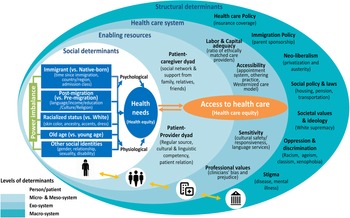
Given the aforementioned dimensions are mutually inclusive, an integrated eco-social framework is proposed to reconcile the three selected theories set forth above (see Figure 1), one grounded in a social justice lens to investigate how upstream social and structural factors shape access to care. This framework underscores that the relationship between racialised older immigrants and health-care access is a complex social process that involves individual and contextual factors which lie in between patients’ health needs and health services, including predisposing social characteristics (micro-system); enabling resources of service users and care providers (meso- and exo-systems); as well as broader systemic determinants, such as health policy (macro-system).
A multilevel eco-social framework to understand racialised older immigrants’ access to health care.
Notes: SES: socio-economic status. vs.: versus.

As shown in Figure 1, the application of Bronfenbrenner's ecological theory suggests that racialised immigrants’ health-seeking process is an ecological transition and person–environment interaction across multi-layered intersecting systems (four shaded circles) where patients’ health needs and health services are embedded. The SDOH paradigm proposes social causation pathways for how racialised immigrants’ social standings (i.e. power imbalance), resulting from the social stratification in the post-migration process, could lead to systematic differences in exposure to multiple health hazards, risks and harms (e.g. psycho-social stressors, hazardous environments). Such differential risk exposure then translates into discrepancies in physiological and psycho-social responses that affect immigrants’ health needs (white ellipse) embodied in the person circle. When the perceptions of illness and health needs emerge, Andersen's BMHSU explains how racialised immigrants’ predisposing social positions and enabling resources from patient–care-giver/provider interactions influence the patient capacity of health services uptake, processes which eventually lead to differential ‘access to health care’ (white ellipse) across meso- and exo-system circles.
This framework connects Andersen's BMHSU and the SDOH paradigm based on their common ground in theorising an ‘overlapping’ causal direction from predisposing characteristics (social origins of health and illness) to health need factors (health inequalities between social groups). These two theories differ in the way they conceptualise ‘health-care access’ as a ‘determinant’ of health (in the SDOH paradigm) versus as an ‘outcome’ itself (in Andersen's model). Integrating these two theoriesrecognises the reciprocal, iterative and dynamic process between ‘maintaining health and wellness’ and ‘accessing health care’ (Dixon-Woods et al., Reference Woods, Kirk, Agarwal, Annandale, Arthur, Harvey, Hsu, Katbamna, Olsen, Smith and Riley2005). As such, this integrated framework acknowledges the interconnectedness of ‘inequity in health’ and ‘inequity in health care’ as the joint function of unequal power and resource distribution for disadvantaged communities. Taken together, this multilevel model illuminates the mechanisms of structural determinants in shaping racialised immigrants’ health-care experience, as demonstrated in the narrative review of the next section.
Empirical synthesis
The database search yielded 1,653 records. After the removal of 408 duplicates, 1,245 records were included during the title and abstract screening, of which 1,162 were irrelevant to the research question. Of the remaining 83 potentially relevant full-text articles, 48 were excluded based on the inclusion criteria. A final 35 articles were included in the narrative synthesis and the review is organised by three ecological system levels.
Person- and micro-system: predisposing social determinants
Socio-economic challenges in the post-migration context
The narrative review indicates that racialised immigrants are more prone to economic insecurity in later life (Preston et al., Reference Preston, Weiser, King, Mandell, Kim, Luxton and Kilbride2014), because transnational migration and disrupted employment history could impose constraints on their education, occupation, salary and pension benefits in the host country (Danso, Reference Danso2007; Hoe, Reference Hoe2017). Such heightened risk of socio-economic deprivation among racialised immigrants determines not only their vulnerabilities to health-compromising conditions (Wang and Kwak, Reference Wang and Kwak2015) but also their care-seeking capacities in response to health deterioration (Lai and Chau, Reference Lai and Chau2007; Donnelly et al., Reference Donnelly, McKellin, Hislop and Long2009). This marginalisation, in essence, stems from the asymmetrical power relations between foreign-born racialised communities and Canadian-born White populations in the ‘white-settler society’ (Danso, Reference Danso2007; Lee and Bhuyan, Reference Lee and Bhuyan2013).
Multiple and intersecting forms of oppression may place immigrants in disadvantaged social locations that impede their access to needed health care (Denise, Reference Denise and McGibbon2012). Both quantitative and qualitative research has demonstrated that immigrants face unique socio-economic challenges, such as resettlement stress (Sakamoto, Reference Sakamoto2007a), devaluation of foreign credentials (Preston et al., Reference Preston, Weiser, King, Mandell, Kim, Luxton and Kilbride2014), discriminatory hiring practice (George et al., Reference George, Chaze, Fuller-Thomson and Brennenstuhl2012) and living in deprived neighbourhoods (Durbin et al., Reference Durbin, Moineddin, Lin, Steele and Glazier2015), that shape access to care. At the population level, increasing earning gaps between immigrants and non-immigrants (Picot and Sweetman, Reference Picot and Sweetman2004; Preston et al., Reference Preston, Weiser, King, Mandell, Kim, Luxton and Kilbride2014), a disproportionately higher unemployment rate than native-born Canadians (Statistics Canada, 2018) and overrepresentation in low-wage precarious occupations (Danso, Reference Danso2007; Hoe, Reference Hoe2017) are affecting racialised immigrants across all age and education groups and from most source countries compared to their White and Canadian-born counterparts (Picot and Sweetman, Reference Picot and Sweetman2004), despite that a small proportion of immigrants may have the financial privilege.
Foreign-born patients’ capacity of health services uptake is subject to migration history, resettlement conditions, scheduling flexibility, residential location and perceived health needs (McKeary and Newbold, Reference McKeary and Newbold2010). Qualitative studies show that immigrants and refugees reported difficulties balancing work, family and health-care demands (McKeary and Newbold, Reference McKeary and Newbold2010; Dastjerdi et al., Reference Dastjerdi, Olson and Ogilvie2012). For example, foreign-born older Vietnamese women who worked informally (e.g. babysitters, home-based piecework) expressed their powerlessness to access breast and cervical cancer screening, because ‘taking time off from work meant losing money’ (Donnelly et al., Reference Donnelly, McKellin, Hislop and Long2009: 467). Qualitative inquiries also reveal that racialised older immigrants with familism values hesitated to seek help from their adult children for health appointments as they were concerned about increased dependency (Koehn, Reference Koehn2009). Postcolonial feminist scholars assert that this pattern was ubiquitous among immigrant women caring for their families (O'Mahony and Donnelly, Reference O'Mahony and Donnelly2010).
Socio-cultural differences in translational health practices
Many racialised immigrants experienced contrasting clinical encounters in the host society, such as linguistic and cross-cultural differences in health practices, compared to their pre-migration experiences (Wang and Kwak, Reference Wang and Kwak2015). Limited proficiency in the Canadian official languages has been a pronounced barrier for immigrants to navigate the local health-care system, as translation and interpretation services are not always deemed to be providers’ responsibility (Asanin and Wilson, Reference Asanin and Wilson2008; Kalich et al., Reference Kalich, Heinemann and Ghahari2016). A significant body of studies reported that immigrants’ health beliefs are interwoven with cultural values in their countries of origin (Wang et al., Reference Wang, Guruge and Montana2019), e.g. racialised immigrants (e.g. South Asian and Muslim women) may feel too stigmatised to seek care for sensitive health issues such as mental disorders, domestic violence, elder abuse and sexually transmitted diseases, because they fear that these incidents would bring ‘shame’ to their families and communities (Ahmed et al., Reference Ahmed, Shommu, Rumana, Barron, Wicklum and Turin2016: 1531).
Furthermore, studies also reveal that some older Chinese immigrants may prefer traditional Chinese medicine over westernised ‘normative’ health care for minor health issues (Lai and Chau, Reference Lai and Chau2007). Likewise, cultural factors, such as traditional health beliefs and ethnic identity, were found to be comparable to health need characteristics in explaining the utilisation pattern of Western health services among older South Asian Canadians (Surood and Lai, Reference Surood and Lai2010). In the micro-system of patient–clinician dyads, both language difficulties and cultural barriers may create communication problems that lead to misinterpretation of symptoms and decreased access (Wang et al., Reference Wang, Rosenberg and Lo2008). A mixed-method study illustrated South Korean immigrants’ stories of cross-border health-care activities, such as travelling back to the home country for health examinations and importing medications, when they experienced difficulties in accessing care in Canada (Wang and Kwak, Reference Wang and Kwak2015).
Meso- and exo-system: enabling systemic determinants
Labour and capital adequacy
In line with the eco-social model, previous research findings indicated that upstream social determinants could impact health-care access through multiple channels at the meso- and exo-system levels of the health-care delivery system, where patients lack direct decision-making power. The retrenchment in the government-funded Interim Federal Health Program has significantly reduced insurance coverage for refugee populations since 2012 (Chase et al., Reference Chase, Cleveland, Beatson and Rousseau2017; Antonipillai et al., Reference Antonipillai, Baumann, Hunter, Wahoush and O'Shea2018). A health records review indicated that such Canadian Refugee Health Policy Reforms had decreased access to regular family doctors and created barriers to emergency care (e.g. higher rate of rejected claims) for refugee patients (Bakewell et al., Reference Bakewell, Addleman, Dickinson and Thiruganasambandamoorthy2018). This financial cutback may further intensify clinicians’ bias and prejudice towards refugees as ‘demanding’ patients (Spitzer, Reference Spitzer2004; McKeary and Newbold, Reference McKeary and Newbold2010), due to refugees’ increasingly stringent insurance and burdensome paperwork (Edge and Newbold, Reference Edge and Newbold2013).
Furthermore, the shortage of multilingual and culturally diverse health practitioners may compromise the accessibility and quality of health services for racialised immigrants who are looking for ethnically matched care providers (Wang et al., Reference Wang, Rosenberg and Lo2008). This is further compounded by immigrants’ unfamiliarity with a primary care-centric Canadian system, where family physicians act as gatekeepers for medical referrals to specialists and laboratory tests (Wang et al., Reference Wang, Rosenberg and Lo2008; Ahmed et al., Reference Ahmed, Shommu, Rumana, Barron, Wicklum and Turin2016), especially for those from low- and middle-income countries with a hospital-centred delivery model. Prolonged waits for linguistically matched family physicians reveal that there isinadequate funding to language and interpreter services for culturally responsive health care (Asanin and Wilson, Reference Asanin and Wilson2008). In many cases, professional translator services are rarely covered by provincial health policy in Canada, except for newly arrived government-assisted refugees (Ahmed et al., Reference Ahmed, Shommu, Rumana, Barron, Wicklum and Turin2016).
Organisational accessibility and sensitivity
The process of obtaining ‘entry’ to the health-care system is problematic for many racialised older immigrants. Qualitative studies have found that getting health-care appointments is another challenge for African immigrant and refugee patients (Woodgate et al., Reference Woodgate, Busolo, Crockett, Dean, Amaladas and Plourde2017). The rigid appointment schedule requires the patient's capacity to present in particular places at designated times, a system which is implicitly favourable to patients who possess greater socio-economic resources and better knowledge of health care. Consequently, instead of family physicians, walk-in clinics or hospital emergency rooms become the last resort where many racialised newcomers and refugees in crisis seek most of their health care (Asanin and Wilson, Reference Asanin and Wilson2008; Woodgate et al., Reference Woodgate, Busolo, Crockett, Dean, Amaladas and Plourde2017).
Following ‘entry’ into the health-care system, the manner in which health-care providers co-ordinate to interact with patients may marginalise racialised older immigrants through unequal power relations (Vissandjée et al., Reference Vissandjée, Weinfeld, Dupéré and Abdool2001); that is the level of cultural sensitivity and safety would shape the comfort level of patients from racial minority communities. In an ethnographic study, South Asian women shared how they experienced ‘othering’ practices and discriminatory treatments (i.e. essentialism, culturalism and racialisation) performed by care providers that reinforce domination and subordination (Johnson et al., Reference Johnson, Bottorff, Browne, Grewal, Hilton and Clarke2004). Johnson et al. (Reference Johnson, Bottorff, Browne, Grewal, Hilton and Clarke2004: 267) argued that health-care providers were those in power in these clinical interactions and that ‘middle-class values and professional socialisation can preclude practitioners from critically considering how race, gender, and class play out in the provision of health care’.
A scoping review of Canadian qualitative studies suggests that discriminatory encounters in Canadian health-care settings affect health status and service access among immigrants and refugees in a ‘subtle, elusive or systemic’ manner (Edge and Newbold, Reference Edge and Newbold2013: 143). The incident of discrimination in the Canadian health sector also includes racist views of particular ethnocultural groups based on physical appearances, such as perceptions of peculiar body odours and dressing (Spitzer, Reference Spitzer2004; Edge and Newbold, Reference Edge and Newbold2013). Population-based studies have documented that perceived everyday discrimination was related to self-reported health decline (Fuller-Thomson et al., Reference Fuller-Thomson, Noack and George2011), chronic disease and health-compromising behaviours among racialised Canadians and immigrants (Siddiqi et al., Reference Siddiqi, Shahidi, Ramraj and Williams2017).
Macro-system: broader structural determinants
Larger structural contexts create social conditions in which the inherent micro-, meso- and exo-level barriers to access care are embedded. Policy contexts are fundamental in framing racialised immigrants’ eligibility for accessing health-care resources (Oxman-Martinez et al., Reference Oxman-Martinez, Hanley, Lach, Khanlou, Weerasinghe and Agnew2005). At the macro-system level, these broader institutional influences on health-care access include both health policy and non-health-targeted policies across all sectors, such as immigration policy, social policy, societal values and ideology.
Health, immigration and social policies
Although Canada's universal health system (also known as Medicare) is a strong equalising force, the provision of health insurance alone cannot guarantee equitable access to all health services (Martin et al., Reference Martin, Miller, Quesnel-Vallée, Caron, Vissandjée and Marchildon2018) and by all racialised groups of immigrants (Siddiqi et al., Reference Siddiqi, Wang, Quinn, Nguyen and Christy2016). The uninsured costs of services outside the basket of the publicly funded system, including prescription drugs, vision care, dental care, physiotherapists, chiropractor and home care, may be unaffordable for those with limited financial resources or those who lack extended health benefits regardless of immigration status (Asanin and Wilson, Reference Asanin and Wilson2008; Woodgate et al., Reference Woodgate, Busolo, Crockett, Dean, Amaladas and Plourde2017). For newcomers, the health insurance gap during the first three-month waiting period to acquire provincial health coverage has systemically deprived them of their right to health care (Pollock et al., Reference Pollock, Newbold, Lafrenière and Edge2011).
Immigration policies and law in Canada stratify various immigration classes (Laroche, Reference Laroche2000; Durbin et al., Reference Durbin, Lin, Moineddin, Steele and Glazier2014), including the economic class (e.g. federal skilled worker class, provincial nominee class, entrepreneurs for start-ups, the Canadian experience class), family reunification class, convention refugees and asylum-seekers/refugee claimants (government-assisted or privately sponsored refugees). These diverse populations are associated with contrasting pre- and post-migration experiences and they are eligible for different health insurance programmes and government-funded assistance services (Durbin et al., Reference Durbin, Lin, Moineddin, Steele and Glazier2014). For instance, government-assisted refugees could benefit from free health-care orientation and translation services, for which their privately sponsored counterparts are not covered (Woodgate et al., Reference Woodgate, Busolo, Crockett, Dean, Amaladas and Plourde2017). Thus, the responsiveness of the health sector varies substantially across these socio-economically stratified categories of immigrant populations (Durbin et al., Reference Durbin, Lin, Moineddin, Steele and Glazier2014; Kalich et al., Reference Kalich, Heinemann and Ghahari2016), with refugees and racialised newcomers as the most marginalised groups (Gagnon, Reference Gagnon2002).
Other macro-economic and social redistributive policies are key to influencing health and health-care access. The quantitative evidence on immigration-based unequal uptake of universal public pensions (i.e. Canada's Old Age Security Program) suggests that older immigrants in Canada are less likely to receive pension benefits and are more vulnerable to old-age poverty, compared to non-immigrants (Curtis et al., Reference Curtis, Dong, Lightman and Parbst2017). This situation is more severe for recent aged immigrants who were sponsored by their families as they are ineligible for government assistance during the 20-year sponsorship period (Koehn, Reference Koehn2009). Studies have found that less than half of late-life family class immigrants via the Parent and Grandparent Sponsorship Program receive employment income (Ferrer, Reference Ferrer2015) and low average earnings (Government of Canada, 2014), which institutionalise financial barriers to care.
Societal values and ideology
The stigmatisation of racialised immigrants, intersecting with racism, may emerge from differences in appearance, speaking with foreign accents, skin tone and religious practices (Edge and Newbold, Reference Edge and Newbold2013). These everyday-life encounters occur where anti-immigration sentiment and radical right-wing populism (e.g. xenophobes, white supremacy) co-exist in the wider Canadian political climate (Perry and Scrivens, Reference Perry and Scrivens2016). Such anti-immigration rhetoric interacts with negative media narratives and frequently articulated concerns that immigrant arrival could exacerbate job-market saturation, terrorism, crime and welfare dependency (Bragg and Wong, Reference Bragg and Wong2016), albeit there is a more tolerant attitude in Canada than other Western countries (Esses et al., Reference Esses, Medianu and Lawson2013). The current COVID-19 pandemic has further fuelled xenophobia, nativism, racism and stigmatisation that may further exacerbate discrimination against Asian immigrants and threaten their wellbeing (Wu et al., Reference Wu, Wilkes, Qian and Kennedy2020).
The remaining service gaps, resulting from the narrow scope of the Medicare system, together with other social policy retrenchments cannot be addressed unless the institutional ideology of neoliberalism that compromises health-care equity is tackled (Edge and Newbold, Reference Edge and Newbold2013). As a globally pervasive social force, although neoliberalism influences the distribution of societal resources less severely in Canada than it does in the USA in terms of a greater de-marketisation of public goods (Siddiqi et al., Reference Siddiqi, Kawachi, Keating and Hertzman2013), the Canadian Medicare system has been subject to underfunding in the era of neoliberal reform.
Discussion
The body of empirical Canadian literature on health-care access for racialised older immigrants reflects racial/ethnic socio-economic disparities in every aspect of human living conditions and immigration experiences. The theory-informed empirical synthesis indicates that racialised older immigrants’ vulnerability in accessing health services is intrinsically linked to and constructed by socio-structural determinants in a complex interplay between immigrant/refugee status with numerous markers of power differences. These intersecting parameters include socio-economic class, gender, religious affiliation, racialised status, norms of health-care institutions, competency of health professionals and government funding across multilevel eco-social systems.
This eco-social framework is applicable and sensitive enough to guide health research and practice on matters of problem identification that reinforces the ‘status quo through subtle exclusionary measures that structure access to opportunities and social goods’ (Denise, Reference Denise and McGibbon2012: 120), as it crystallises ‘multiple jeopardies’ simultaneously experienced by racialised older immigrants. While health-care experiences are determined by both demand-side characteristics of patients and supply-side factors of health systems and organisations (Levesque et al., Reference Levesque, Harris and Russell2013), the entry point for conceptualising ‘access to care’ as a feature of social structure as well as of individuals will vary based upon health-care professionals’ positionality. Hence, the eco-social framework challenges a worrisome tendency of the ‘microfication in social science approaches’ driven by the overemphasis of human agency and ‘medicalisation’ of old age (Hagestad and Dannefer, Reference Hagestad, Dannefer, Binstock and George2001: 4). From the standpoint of ontology, the paper calls for a paradigm shift away from the functionalist school of thought that may individualise access barriers (e.g. ‘cultural competence’ or ‘personal choices’) and, instead, towards an upstream constructivist view in dismantling macro-structure forces that impinge on our taken-for-granted conception of realities, including human agency.
Access to care beyond ‘cultural competence’: the power imbalance
The eco-social model suggests that researchers should be cautious about the dominant discourse in Canadian scientific literature vis-à-vis health-care inequities, a discourse which individualizes access barriers in terms of cultural differences and advocates for ‘culturally competent care’. Admittedly, culture, language and ethnicity are closely intertwined, and the concept of ‘cultural sensitivity’ continues to be necessary but not sufficient to provide optimal care. Qualitative evidence has shown that even ethnically and linguistically matched care providers still held patronising and stereotypical opinions about patients from the same ethnic community, due to the ignorance about ‘power differences and societal inequalities’ (Johnson et al., Reference Johnson, Bottorff, Browne, Grewal, Hilton and Clarke2004). These practitioners’ roles may also be constrained by broader government-funded programmes with ‘assimilationist views’ (Sakamoto, Reference Sakamoto2007a). Culturalist explanations for inequitable care access, in part, reflect ‘stereotypical and overgeneralised views’, which may perpetuate the labelling effect of irresponsible health-related behaviours (e.g. lack of motivation; non-compliant patients) as cultural norms for racialised groups (Johnson et al., Reference Johnson, Bottorff, Browne, Grewal, Hilton and Clarke2004). Thus, current approaches to cultural competence have been criticised for ‘essentialising culture’ that may disempower patients (Kirmayer, Reference Kirmayer2012: 160).
The eco-social model suggests that overemphasising ‘culture’ as the major contributor to inequitable access may not only ‘reinforce racial stereotyping’ (Edge and Newbold, Reference Edge and Newbold2013: 145), but also obscure broader socio-structural determinants that mainly contribute to differential resource availability across social and ethnocultural groups. This notion has been acknowledged by critical health scholars in the USA (Acevedo-Garcia et al., Reference Acevedo-Garcia, Sanchez-Vaznaugh, Viruell-Fuentes and Almeida2012; Viruell-Fuentes et al., Reference Viruell-Fuentes, Miranda and Abdulrahim2012), the UK (Culley, Reference Culley1996, Reference Culley2006) and Canada (Johnson et al., Reference Johnson, Bottorff, Browne, Grewal, Hilton and Clarke2004; Edge and Newbold, Reference Edge and Newbold2013). Accordingly, health-care providers and scholars need to situate ‘culture’ within a dynamic context of wider social, economic and political forces to understand the social construction of inequitable access among racialised immigrants. An equitable health system should move beyond simplistically increasing the representation of ethnically matched health professionals at the superficial level (Kirmayer, Reference Kirmayer2012), but more fundamentally address the institutionalised power imbalance and inequitable social relationships in cross-cultural clinical encounters to assure cultural safety and accountability (Browne et al., Reference Browne, Varcoe, Smye, Reimer-Kirkham, Lynam and Wong2009; Kirmayer, Reference Kirmayer2012).
Access to care beyond ‘personal choices’: the socio-structural underpinnings
Second, the discursive representation in health services literature regarding access among racialised immigrants mainly describes those downstream barriers that happen in the health-care interactions, thus essentialising the problem within a narrow conventional scope of problems between the health system and personal choices or barriers. For example, a commonly cited barrier to health care among racialised immigrants is poor health literacy about the local health-care system (Koehn et al., Reference Koehn, Habib and Bukhari2016; Wang et al., Reference Wang, Guruge and Montana2019); therefore, studies recommend more resources allocated to community health promotion programmes for newcomers and refugees. While this strategy to assist immigrants’ health-care navigation continues to be important, to act on this health information, according to Giddens's (Reference Giddens1979) structure–agency thesis, requires individuals’ capacity and socio-economic resources, of which many racialised immigrants (especially from family reunification programmes) and refugees were deprived (Durbin et al., Reference Durbin, Lin, Taylor and Callaghan2011; Thomson et al., Reference Thomson, Chaze, George and Guruge2015).
Another example lies in the orientation considering ‘perceived competing demands’ (e.g. too busy for work, do not have time, did not get around to making an appointment) as ‘personal or attitudinal barriers’ in much health services research (Ferdous et al., Reference Ferdous, Goopy, Yang, Rumana, Abedin and Turin2020). This ‘blame-the-victim’ discourse may obscure and dilute the fact that the competing social demands patients perceived in the treatment-seeking process are inextricably linked to broader structural constraints; thus, their health-care ‘choices’ are delimited by supra-individual forces, such as social class (Schoenberg et al., Reference Schoenberg, Peters and Drew2003). Therefore, the eco-social framework makes clear that without intervening in those a priori structural drivers of vulnerability in the upstream casual chain that constrain racialised older immigrants from accessing resources, health-care professionals may find behavioural health promotion programmes ‘inadequate for addressing social inequities in health’ (Nutbeam, Reference Nutbeam2000; Baum and Fisher, Reference Baum and Fisher2014: 213). In other words, routine behavioural health interventions alone are inadequate to close the gap between the native-born White and racialised immigrants if their social locations are still marginalised.
Advancing anti-oppressive practice in health care
To sum up, despite the commitment to multiculturalism and a publicly financed health-care system in Canada, those upstream bureaucratic barriers and structural oppressions are still detrimental to ethnocultural older immigrants who may experience various exclusionary tactics in accessing health care (Denise, Reference Denise and McGibbon2012). Based on the empirical literature review, how structural arrangements and institutional apparatuses determine health-care equity is still an underresearched topic, which renders this new theoretical formulation valuable in making visible the significance of ‘distal’ or ‘macro’ social forces. Therefore, an upstream approach that unpacks institutional inequities, rather than an exclusive focus on individual behaviours, holds considerable promise in bridging gaps in the literature on the health-care access of older immigrants in Canada.
The eco-social framework coincides with the goal of anti-oppressive, anti-racist and anti-discriminatory practice for health service professions and institutions in response to the struggles of marginalised populations by challenging structural power dynamics and thus achieving social justice (Sakamoto and Pitner, Reference Sakamoto and Pitner2005). Acting on the macro- and meso-level, an anti-oppressive approach is a remedy for traditionally micro-focused clinical intervention in human services through institutional and societal changes to tackle social inequality and power differentials (Hulko et al., Reference Hulko, Brotman, Ferrer and Baines2017). Anti-oppressive perspectives critique ‘multiculturalism’ as being overwhelmingly de-political as it ‘acknowledges only superficial cultural differences’ between minority and majority ethnic groups (Sakamoto and Pitner, Reference Sakamoto and Pitner2005: 440; Sakamoto, Reference Sakamoto2007a, Reference Sakamoto2007b). Immigrant health research is suggested to undertake ‘critical interrogation of the impact of long-held assumptions of culture and acculturation’ (Sakamoto, Reference Sakamoto2007a: 515).
Situating health-care inequity in a multilevel social fabric rather than acculturation issues, this reconceived framework emphasises multiple socio-structural factors to inform more progressive and radical practice in dealing with immigrant clients from racialised communities to address macro-social inequality. This evidence-based framework also calls for health-care professionals to be ethically and socially responsible enough to prescribe ‘upstream’ solutions to assist immigrant clients in accessing needed health services (Potocky-Tripodi and Potocky, Reference Potocky-Tripodi and Potocky2002). The anti-oppressive solutions could take various forms such as fairness in the delivery services and increasing public awareness of xenophobia and systemic racism that fuels exclusion of diverse racialised immigrant groups. It offers a ‘practical instrument of resistance’ for public health response and policy efforts to implement structural change that would eventually emancipate and empower racialised immigrants in older age.
Acknowledgements
The author, Shen (Lamson) Lin, is grateful to the University of Toronto Fellowship in sponsoring his doctoral study and research. This study forms part of the author’s doctoral thesis for the doctoral degree in social work at the Factor-Inwentash Faculty of Social Work, University of Toronto, Canada. The author thanks Ms. Roz Spafford for the constructive comments on the early version of this paper.
Financial support
This work was supported by the University of Toronto.
Conflict of interest
The author declares no potential conflict with respect to the research, authorship and/or publication of this article.
Ethical standards
This is a review article so ethical approval is not required.