Introduction
A new generation of cash transfer programmes in middle-income countries such as Latin America and South Africa are used as policy levers to reduce child poverty, promote child and family well-being and empower women. Although these particular programmes vary in their focus, goals, objectives and design features, they all provide cash transfers to poor individuals, and their families, who qualify, and reach mainly the chronically poor (UNDP and ILO, 2011). Beneficiaries are either exclusively mothers, as is the case in Bolsa Familia in Brazil, or carers of children (predominantly women: mothers, grandmothers, aunts), as in South Africa. Evaluation studies of the programmes record different types of outcomes and varying degrees within each type. The outcomes include: declines in poverty levels, improvements in the nutrition of children, improved school enrolments, lower school dropout rates and a lowered incidence of child labour (Molyneux, Reference Molyneux2007; Molyneux and Thomson, Reference Molyneux and Thomson2011; DSD, SASSA and UNICEF, 2012). However, the gender-specific impacts of cash transfer programmes are only beginning to receive attention in evaluation studies (Adato et al, Reference Adato, de la Brière, Mindek and Quisumbing2000; Molyneux Reference Molyneux2007, Reference Molyneux2008; Molyneux and Thomson, Reference Molyneux and Thomson2011; Patel et al., Reference Patel, Hochfeld, Moodley and Mutwali2012; Sabates-Wheeler and Roelen, Reference Sabates-Wheeler and Roelen2011) and much more research is needed to assess the gender-specific causes and effects of the programmes. There is consensus that the evidence on whether transfers contribute to children's well-being, via women's decision-making power, is uneven and not sufficiently robust to enable generalisations to be made across different types of programmes (Sabates-Wheeler and Roelen, Reference Sabates-Wheeler and Roelen2011). Also, the design features of the programmes are different, as are the country contexts, histories, institutional arrangements and socio-demographic factors. Other evaluation issues are related to the different ways of conceptualising empowerment and how it is measured (Kabeer, Reference Kabeer1999), which, in turn, has a bearing on the inferences that are drawn.
Prompted by the above insights and by research on social pensions in South Africa, which suggests that money directed to women has a positive multiplier effect on women's status and, via that, on the well-being of the children in their care (Lund, Reference Lund and Padayachee2006), we were interested in understanding what the impact of the Child Support Grant (CSG) might be on women's empowerment and whether such empowerment had a bearing on the well-being of children. Although the CSG was not designed to promote gender equality and women's empowerment, it nevertheless is likely to have unintended impacts from a gender perspective. This is pertinent in the South African context in view of the country's legacy of apartheid and migrant labour – which resulted in the disruption and fragmentation of family life, high rates of absent fathers and large numbers of children living apart from their parents – as well as the effects of the HIV and AIDS pandemic (Budlender and Lund, Reference Budlender and Lund2011). In 2008, two-thirds of children were living below the poverty line of R515 (43.2 Euro) a month (Hall and Wright, Reference Hall and Wright2010). Based on comparative data between 1997 and 2006, Posel and Rogan (Reference Posel and Rogan2012:111) conclude that poverty remains gendered, with the extent and depth of poverty being considerably higher for women and households headed by women. In fact, while the reduction in poverty favoured males and male-headed households between 2004 and 2006, there were increases in poverty rates for women during this period (Posel and Rogan, Reference Posel and Rogan2012). However, research by Posel and Rogan (Reference Posel and Rogan2012) also suggests that CSG has reduced the depth of poverty for female care-givers and female-headed households.
This paper builds on a research project that aimed to assess the gender dynamics and impact of the CSG in a very poor urban community in Johannesburg, South Africa (Patel et al., Reference Patel, Hochfeld, Moodley and Mutwali2012). Here we further explore the relationship between the CSG, women's empowerment and child well-being by assessing the complex relationships between socio-demographic and contextual factors, including mechanisms that might be associated with improved capabilities and human-development outcomes for women and children. The specific research questions were designed to determine, first, whether the CSG influences a woman's autonomy in relation to the power to manage her own life and have control over spending and use of the resources she receives; second, whether this decision-making power has an effect on child well-being; and, third, whether grant receipt crowds out other forms of familial and social support. The paper is structured as follows: the first section provides a brief overview of the CSG and the theoretical background of the study and focuses particularly on the conceptualisation of the empowerment of women and findings of evaluation studies on the impact of cash transfers on women and children. In the next section, the research method and measures used are set out, followed in the third section by the results. The discussion and policy implications are contained in the concluding section.
The Child Support Grant
South Africa has a fairly developed social assistance system for older persons, people with disabilities and children. It reaches over 16 million beneficiaries and makes up 15 per cent of government spending and 3.4 per cent of GDP. Social assistance, together with compulsory schooling and health care, are free for poor children, although many problems remain with the quality of education as well as care services and access to health services. These programmes are publicly funded, non-contributory and are the post-apartheid government's largest poverty reduction initiative. Currently, 2.7 million people, approximately 68 per cent of the population above the age of sixty, receive an old-age pension, while disability grants reach 1.2 million beneficiaries or 2.5 per cent of the population.
The value of the pensions and disability grants is larger than the Child Support Grant (CSG) but the reach of the CSG is more extensive (Patel, Reference Patel, Midgley and Piachaud2013). In contrast to many north-western industrialised countries, South Africa does not offer a universal child allowance. Instead, it offers the CSG, which was first introduced in 1998. The main aim of the CSG is to provide supplementary income support, in order to improve food security for poor children, subject to a qualifying means test which is set fairly generously. Initially, the CSG was targeted at poor children, less than five years old, and was intended to reach three million children. Due to the success of the implementation of the programme, it was scaled up to include poor children up to eighteen years of age. The CSG is now one of the largest social assistance programmes in post-apartheid South Africa reaching 11.2 million children in 2012–13 (National Treasury, 2014), i.e., approximately 59 per cent of children. The 41 per cent of children not receiving CSG are either not poor or not poor enough and therefore do not meet the eligibility criteria. It could also be due to some of these children not having the necessary identity documents or supportive adults or social workers who could assist them with making the applications. Maternal orphans are particularly vulnerable in this regard.
The CSG is wholly publicly funded through taxation, and accounts for 3.4 per cent of GDP (Patel, Reference Patel2011). A flat rate, amounting to R300 per month per child in 2014 (17.24 Euro), is paid to the care-giver of the child. Although the grant is gender neutral in its targeting, the condition that it has to be taken up by the main care-giver (the biological parent, relative or non-relative responsible for the care of the child) prioritises women as beneficiaries, with only between 4 per cent and 8 per cent of those taking up the grant being men (Patel et al., Reference Patel, Hochfeld, Moodley and Mutwali2012; Voster and de Waal, Reference Vorster and de Waal2008). This approach attempts to break with the male breadwinner idea that was biased in favour of the nuclear family model. The nuclear family model is not applicable in the South African context where only a third of households conform to this norm and where 40 per cent of children live with their mothers only (Budlender and Lund, Reference Budlender and Lund2011).
Unlike the Latin American programmes, the CSG initially had no conditionalities attached to grant receipt. The requirement that children should attend school was included as a condition in 2010 (RSA, 2009). Since then, primary care-givers are obliged to demonstrate to the government twice yearly that their child is regularly attending school. Although this is less punitive than the proposed regulations of the Social Assistance Act (Republic of South Africa, 2009; Lund, Reference Lund2011), it nevertheless could impose a considerable burden on the care-givers. However, this system has been slow in its implementation and, at the time the research was conducted, it did not have an impact on the beneficiaries.
Evaluation studies found that the CSG had positive impacts on health, nutrition and education of children (Aguero et al., Reference Aguero, Carter and Woolard2006; Case et al., Reference Case, Hosegood and Lund2005). Other local studies also found evidence of how grant receipt aids job searches, is positively associated with higher success rates in finding employment and improves the productivity of workers in households in receipt of a grant as well as supporting household livelihood activities (Delany et al., Reference Delany, Ismail, Graham and Ramkisson2008; Neves et al., Reference Neves, Samson, van Niekerk, Hlatshwayo and du Toit2009; Samson et al., Reference Samson, Heinrich, Williams, Kaniki, Muzondo, Mac Quene and van Niekerk2008). However, limited research is available on the mechanisms by which the grants contribute to this success. One of these mechanisms, we assume, is the gendered impact of the grants (Lund, Reference Lund and Padayachee2006). Therefore, we focus here on whether and how grant receipt might be associated with women's empowerment and, via that, with child well-being (Patel et al., Reference Patel, Hochfeld, Moodley and Mutwali2012).
Social protection, women's empowerment and child well-being
There is a resurgence of interest in social protection policies, in developing countries, designed to promote human development and as an instrument to achieve gender equality (UNDP and ILO, 2011).
Turning to a conceptualisation of empowerment, we follow Kabeer's (Reference Kabeer1999) notion of empowerment which is tied to the ‘condition of disempowerment’ and ‘refers to a process by which those who have been denied the ability to make choices acquire such an ability’ (Kabeer, Reference Kabeer1999: 437). Essentially, this notion of empowerment involves an ability to make choices in relation to three key dimensions. The first dimension refers to resources which could be of a material or economic nature, as well as human and social resources which may be acquired through state, family, market and community. The second dimension is about agency and the power to set one's goals and act upon them. This dimension refers to the decision-making power to allocate resources, which involves choice and agency both of an individual, and collectively. Taken together, resources and agency are the capabilities that a person needs to acquire in order to achieve substantive freedoms (Sen, Reference Sen1985). Capability is the freedom to achieve alternative functioning combinations that are dependent on the person's individual ability and the wider social, economic and political environment in which they find themselves (Sen, Reference Sen1999). Thus the achievements flowing from this process are what Kabeer (Reference Kabeer1999) refers to as outcomes or capability achievements in Sen's use of the term. This is the third dimension of empowerment.
In our study on the gendered impact of the CSG, we were particularly interested in how women used resources (cash, support from outside the household and partnership) and agency (empowerment, financial decision making and other decision-making powers) to achieve particular outcomes that they considered to be valuable to their present and future functioning. The evidence, from a literature review on whether cash transfers contribute to gender equality and women's decision-making power, seems to be uneven. Some studies, based on women's concrete experiences, found that cash transfers contribute to meeting women's needs, for example in Kenya (Kukrety and Mohanty, Reference Kukrety and Mohanty2011). Similar findings were also observed in Bangladesh, Ethiopia and Peru where improvements in income were noted, including the regularity of income, the stabilisation of consumption patterns and increased household expenditure on food, health, education and immediate needs such as protection against seasonal vulnerabilities (Holmes et al., Reference Holmes, Jones, Mannan, Vargas, Tafere and Woldehanna2011). Several studies found evidence of increased social capital where women were more likely to receive credit from neighbours and family when in receipt of a transfer, and their social networks appeared to have strengthened as women began to engage outside of the home (Holmes et al., Reference Holmes, Jones, Mannan, Vargas, Tafere and Woldehanna2011). In line with other studies on the effects of social protection, we make the assumption here that state subsidies do not undermine but rather strengthen individual, familial or communal support (Künemund and Rein, Reference Künemund and Rein1999). Further, Adato et al.'s (Reference Adato, de la Brière, Mindek and Quisumbing2000) evaluation of PROGRESA, a poverty reduction intervention in Mexico, noted that women were personally and materially empowered, although modest positive impacts were noted on intra-household relationships. The behavioural conditions attached to receipt of cash transfers requiring women to participate in community work programmes and in health education programmes appeared to increase their knowledge.
However, others studies were critical of the extent to which needs that arise from the subordination of women to men were addressed (Sabates-Wheeler and Roelen, Reference Sabates-Wheeler and Roelen2011). In this regard, Holmes et al. (Reference Holmes, Jones, Mannan, Vargas, Tafere and Woldehanna2011) indicate that there is little evidence that women's decision-making power increased or that changes occurred in gender roles and responsibilities across the three countries where their research was conducted, namely Bangladesh, Ethiopia and Peru. Sabates-Wheeler and Roelen (Reference Sabates-Wheeler and Roelen2011) argue that evidence is ‘patchy’ and uneven on the question of whether money given to women is more likely to be directed to the feeding of children. A difficulty with evaluation studies is that they do not take intra-household relations and power inequalities into account in relation to women's control over the use of resources. Based on these findings, and drawing on evidence from Conditional Cash Transfers (CCTs) in Latin America, Molyneux (Reference Molyneux2008: 1) argues that there is insufficient evidence that CCTs empower women. Some of the programmes’ cited limitations include, first, that in a maternalistic model of care, children's needs supersede women's needs. Second, conditionalities attached to the receipt of a cash transfer serve to regulate the behaviour of mothers, for example having to take their children for health checks, ensuring school attendance, participating in health education programmes and engaging in community work. These conditions place additional time and care-giving demands on women. Third, CCTs serve to reinforce gender divisions in care, bind women to households as carers and do not change patterns of intra-household responsibilities for care or gender relations (Molyneux, Reference Molyneux2008). These studies have drawn attention to women's care activities in the home and in the care of children which remain invisible and unacknowledged in social protection policies. Eighty five per cent of CSG beneficiaries spent the bulk of their time on care activities which is a major factor in gender inequality and is a barrier to the realisation of their human capabilities (Patel et al., Reference Patel, Hochfeld, Moodley and Mutwali2012).
South Africa's cash transfers differ from social protection strategies in other countries in two ways. First, the CSG is gender neutral in its targeting. This means that both men and women primary caregivers can apply for the CSG. However, in practice, men seldom apply for the grant. Second, until 2010, the CSG had no conditions attached to grant receipt. The new conditions require that children receiving the grant should attend school. These conditions did not apply to the beneficiaries in the study and had no effect on the outcomes being measured, namely women's empowerment and child well-being.
Concerning women's empowerment, we have adopted the capability perspective in that we assume that the powers to manage one's own life, achieve financial autonomy and make financial decisions are crucial to improving women's lives. Children's well-being can be expressed in improved food security, health status, school performance and, finally, in the engagement of the main care-giver in the children's daily life (playing with them and reading to them among others activities).
The study: a household survey in Soweto
In order to understand the effects of the CSG on women and children, a household survey was conducted in Doornkop, Soweto, which is one of the poorest municipal areas in the City of Johannesburg. The population of Doornkop was 24,225 (Stats, SA 2004) and we estimated, based on previous research in the area, that there were 5,500 households (de Wet et al., Reference de Wet, Patel, Korth and Forrester2008) of which 3,500 included children. Doornkop has a large young population with 42 per cent being under nineteen years of age. The area was chosen as it is known to have a high up-take of CSG (de Wet et al., Reference de Wet, Patel, Korth and Forrester2008).
Systematic sampling, based on the area's official ward map of municipal stands (a stand is a plot of land on which a house it built), and using rigorous stand-selection rules, was used to select these households. Recent municipal maps were used to identify the stands. Thereafter, a stand number was assigned to the housing plots on aerial Google Earth maps. A random stand was systematically selected in each area using an interval of eleven. In this way forty-four stands were selected in each area in Ward 50 in Doornkop (Patel et al, Reference Patel, Hochfeld, Moodley and Mutwali2012). Once a stand was sampled, only one female care-giver with a child under fifteen years was randomly selected on site, based on pre-determined selection criteria, which did not include the criterion of being a CSG beneficiary. In households where there were no CSG beneficiaries, the care-giver responsible for a child, or children, under fifteen years was interviewed. The questionnaire consisted of closed questions covering the following areas: background household information, livelihood activities and income, food security, use of and views of the grant, partner relationships, household decision-making and care responsibilities and dimensions of women's empowerment.
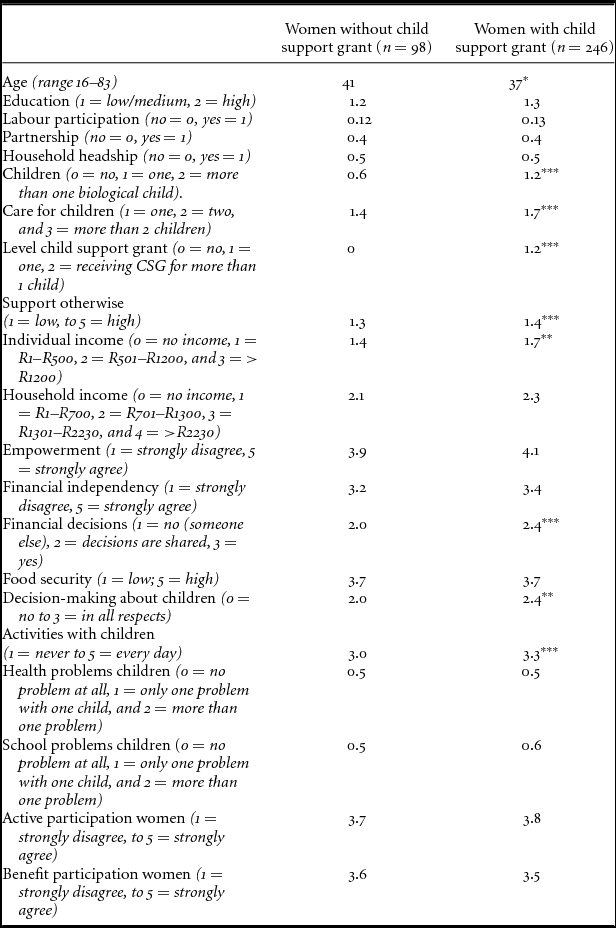
The field work was conducted in July 2010 by trained field workers who administered the questionnaires. The respondents involved in our research were all women, who were the primary care-givers of children aged fifteen years old and younger. A total of 344 women were surveyed. There was a 78 per cent response rate to the questionnaire. The sample included 72 per cent beneficiary and 28 per cent non-beneficiary households and covered 10 per cent of the population of children in this area. As this was a random sample, the split between beneficiary and non-beneficiaries was the result of the sampling procedure used. All in all, the sample offers an adequate divide for a statistical comparison of the effects of the CSG. There were no significant differences between the CSG and non-CSG households in terms of age, female headship of the household and levels of employment. However, CSG households took care of more children than non-CSG households which may explain the higher income levels of individual CSG beneficiaries in relation to the comparison group. In view of the similarities between the two groups, in terms of the above-mentioned variables, it was considered appropriate to compare CSG beneficiaries (treatment groups) with a comparison group (non-CSG beneficiaries).
Half of the women interviewed were younger than thirty-seven years; the oldest woman was aged eighty-three while the youngest was sixteen years old. The average age was thirty-seven years for CSG beneficiaries and forty-one years for the comparison group. Eighty-seven per cent of the women in both groups had no paid work and, on average, 54 per cent were the heads of households in both groups. However, on average, 28.5 per cent of CSG households cared for more children who were not their biological children compared to non-CSG households. Across both groups, 55 per cent of the female care-givers took care of one child only and 18 per cent cared for more than two children. The individual income of 17 per cent of the women care-givers was zero, 31 per cent had an income of less than R500 (28 Euro), 25 per cent had an income of between R500 and R1,200 (69 Euro), while 25 per cent had an income of more than R1200 (including the CSG for those who received it). The total household income was a bit higher; 11 per cent of the households had no income at all, 21 per cent had an income below R700 (40 Euro), 23 per cent had income between R700 and R1,300 (75 Euro), 25 per cent had between R1,300 and R2,230 (128 Euro), and another 20 per cent of the households had an income above R2,230 (including the CSG for those who received it). The means test for a single person with a child is R2200 per month and R5000 for a married person. Only 2.2 per cent of CSG households and 1.5 per cent of non-CSG households earned above R5,000 per month. The descriptions of beneficiary and non-beneficiary households are presented in Table 1, below. It is evident from the income data that both types of households were eligible to receive the CSG based on an assessment of their income and the fact that they were the primary care-giver of a child or children. Twenty-eight per cent of the households that were interviewed in the study did not receive the CSG for various reasons. The main barrier is due to a lack of identity documentation (34 per cent) and other factors, such as not getting around to doing it, a lack of interest and lack of knowledge (South African Human Rights Commission & UNICEF 2011). Some are not eligible, due to their income being too high. The similarity in the poverty levels of the two types of households further serves to justify the use of the comparison group in the data analysis.
Comparison of women without a CSG with women with a child support grant

Notes: T-tests (* p < 0.05; ** p <0.01; *** p <0.001).
The limitations of the methodology used are that: the results cannot be generalised to all CSG households nationally; conducting the field work on week-days excluded those with regular employment away from home, which probably resulted in interviewing less employed respondents than actually live in the ward. In addition, the study does not allow us to establish definitively a causal link between receipt of the CSG and women's empowerment and children's well-being. Such a causal link would either require a longitudinal study or experimental data. Longitudinal data are not (yet) available and an experimental design that allowed for the random selection of participants into treatment and control groups could not be conducted in view of the ethical implications of withholding cash transfers to beneficiaries who have a legal and constitutional right to the CSG. Instead, we have developed a structural equation modelling (SEM) based analysis on relationships identified in the theoretical literature, and we used a rich range of variables to control for differences between beneficiaries and non-beneficiaries. For this reason, we are reasonably confident that the detected differences in outcome are due to the CSG itself, but we cannot rule out the possibility that the two groups differ in some unobserved way which might explain (some) of the differences in outcomes. Structural equation modelling (SEM) is a statistical technique to explore how the variables are related to each other in terms of cause and effect. SEM enables the testing of a set of regression equations simultaneously (Hoyle, Reference Hoyle1995) and the construction of a path model of how the variables are ordered through networks of statistical dependence. We compared women who received the CSG with those who did not as the two groups are similar in terms of age, employment, household headship and poverty levels. A path model of the CSG was developed and tested which lays out the different sets of variables arranged in clusters and their effects on child well-being outcomes.
Research model
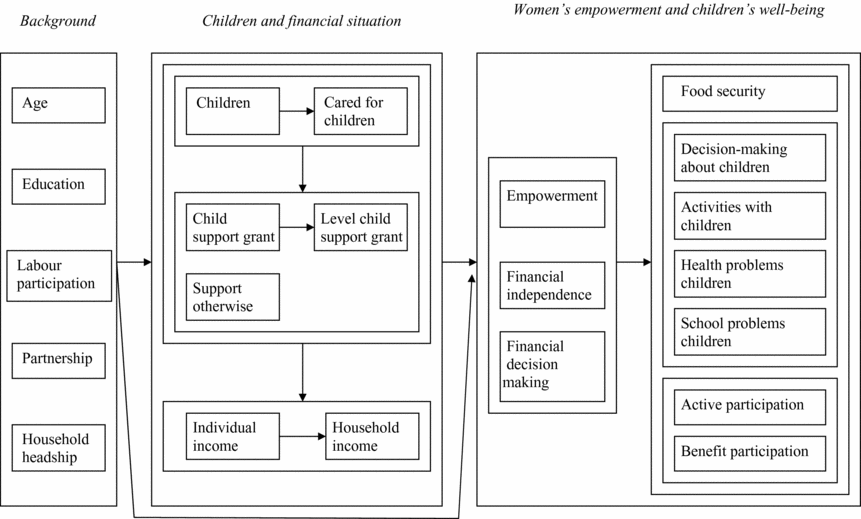
The research question was ‘what factors explain the relationship between the CSG (cash transfers), women's empowerment and child well-being?’ Drawing on the theoretical concepts and ideas outlined above, we developed a conceptual model to gain insight into the influences of the CSG, and three clusters of variables are identified that might explain the nature of the relationships between the variables (see Figure 1).
Influences of Child Support Grant

We assume that variables in Cluster 1 – Background, e.g., age, education, labour participation, partnership status and household headship – might affect those in Cluster 2 and Cluster 3. As indicated in Figure 1, some of the relationships between the three clusters are expected to be causal while others are not. These relationships will be determined through statistical analyses. The contextual factors in Cluster 2 – Children and financial situation – assume that various factors influence individual and household income respectively such as the number of biological children and children cared for, level of CSG received and the support received from external sources outside the household. We are also interested in understanding which factors carry the greatest weight in Clusters 1 and 2; is it the number of CSGs that make a difference in terms of household income or a combination of factors that make the difference to individual income. In Cluster 3 – Women's empowerment and children's well-being – we consider what mechanisms are most critical in influencing the outcome of the CSG for women, and (via them) for children. The effects on women are based on a set of proxy questions, namely women's perceptions of their level of empowerment, financial independence and financial decision making. Cluster 3 also indicates whether the outcomes for children are directly related to the effects of the CSG on the household's income or whether these are mediated by the female care-giver's decision-making power. The impact of the CSG on children is then assessed in terms of five outcome indicators (food security, decision making about children, activities with children, health problems and school problems) which are pertinent to children. We expect that a combination of variables will result in improved outcomes for both women and children. Finally, Cluster 3 indicates whether the CSG contributes to women's participation in the community.
Measures
Cluster 1. Background characteristics
This cluster refers to variations in the means and resources of the care-givers (labour participation, partnership status and household headship), and background characteristics represented by age, and level of education. The labour participation of the respondents was a binary measure, as was partnership status and head of the household.
Cluster 2. Household: Children and financial situation
This cluster refers to household composition and resources that are (partly) made up by the CSG. How many biological children does the care-giver have and how many children does she care for? This distinction was made to capture the fact that the care-giver is not the biological mother of the children and cares for children for whom she receives a CSG. Other questions in this cluster are: for how many children does the care-giver receive a CSG and what is the total amount of grants received; does she also receive other kinds of support (money, food, clothes); and what is the level of her individual income and the household income. This cluster includes three groups of variables. The first group captures the number of biological children of the care-giver and the number of children in her care. The second group of variables encompasses indicators for external support for the household. It contains variables on the received amount of the CSG as well as external (non-governmental) support. The monthly amount received from the grant is assessed by 0 = R0 (no CSG), 1 = R250, 2 = R251–R500 and 3 = > R500. External support has been assessed by a score on a scale of items (Cronbach α = 0.73): ‘I receive money from outside’, ‘I receive food from outside’ and ‘I receive clothes for adults/children from outside’.
The third group of variables represents the monthly individual and household income. Household income contains a range of resources obtained by all the members of the household, such as salary/earnings, remittances from family members, the CSG, other grants from the government, maintenance paid by the father of the children and/or money from other sources (pensions, rental or lodgers).
Cluster 3. Women's empowerment and children's well-being
This cluster encompasses the women's empowerment and child well-being outcomes and contains three groups of variables: women's decision-making power, children's well-being and women's participation.
The first group of variables – women's decision-making power – is made up of three measures: ‘empowerment’, ‘financial independence’, and ‘financial decision making’. Empowerment is measured by the score on the item ‘I have the power to manage my life’. Financial independence is measured by the score on the item ‘I am able to survive financially and stand on my own feet’. Financial decision making is measured by the item ‘I make the decisions about how the money is spent’.
The second group of variables concerns children's well-being and contains five indicators: food security, women's decision making about children, (care-givers’) activities with children, health of children and any school problems with children. The first indicator is access to food. A Household Food Security Access scale was used to assess the food security status of the households in the study (Coates et al., Reference Coates, Swindale and Bilinsky2006). A seven-item scale (Cronbach α = 0.73) was used to measure food security access in the month prior to the study and asked, for example, ‘did you or any other household member eat fewer meals in a day because there was not enough food?’ and ‘did you or any household member go to sleep at night hungry? The second indicator, women's decision making about children, is made up of three items on discipline, education and health (Cronbach α = 0.84). The health status of children was assessed based on the beneficiary's views of the health of the children, and measured for a maximum of five children per household by a sum score of three items: ‘has your child had the right injections or vaccinations for their age?’, ‘is the child in good health?’, and ‘has the child ever been admitted to hospital?’. School problems with children were also measured by a sum score for a maximum of five children on four items, for example ‘does the child go to school regularly?’ and ‘does the child have a proper uniform for school?’
The indicator for engagement of the beneficiary, with activities of the children inside and outside the home, has so far not been used in studies on the effects of the CSG. For this indicator, an eight-item scale (Cronbach α = 0.61) was used containing such items as ‘I play or read to my children’, ‘I help my child with school work’ and ‘my children help me with house chores’.
The third group of variables refers to women's participation which has two indicators. Active participation is measured by the item ‘I go to community meetings (e.g., meetings at school or for the street committee) to be a part of improving our lives’. Benefit participation is measured by the item ‘I benefit from participating as a member of a church, social, stokvel or burial society group.’
Results
Regarding the outcomes of the entire population of women interviewed, a majority felt that they had the power to manage their lives (empowerment), half of them said that they are financially independent, while almost two-thirds of the women reported that they could make decisions in the interest of the children. Also, two-thirds of the women interviewed reported that the children had no health problems and no problems at school. These rather positive results are contrasted with low results on food security; about half of the interviewed women reported low levels of access to food security or were of the view that they could not manage in this domain.
In comparing the care-givers who receive a CSG with those without a CSG, it appears that the female care-givers without a CSG are significantly older, have less children, care for fewer children, and receive less external support. Interestingly, compared to care-givers with CSG, they do not participate more in the labour market, are to the same degree with or without a partner and are to the same extent heads of households. Hence, the fact that they have lower individual income levels might be the single result of not receiving a CSG. The female care-givers that receive a CSG appear to have more decision-making power on financial issues as well as on issues related to the children's well-being. They also undertake more activities with their children than female care-givers without a CSG.
In order to investigate the empowerment of care-givers as well as the well-being of the children, we developed the aforementioned conceptual model (Figure 1), which includes twenty-two variables as described in the Research model section. The relationships between these variables were examined using the structural equation modelling (SEM) technique. SEM is an extension of the general linear model that enables the testing of a set of regression equations simultaneously. The input to the analysis is usually a covariance matrix of measured quantitative variables. SEM explicitly aims to test complex data models related to theories and hypotheses in the domain of interest. The supposed relationships between the variables can be depicted using a path diagram. The aim of the path analysis is to estimate the magnitude and significance of the hypothesised causal connections between variables. What the LISREL analysis does is to test the measured data against the theoretical model.
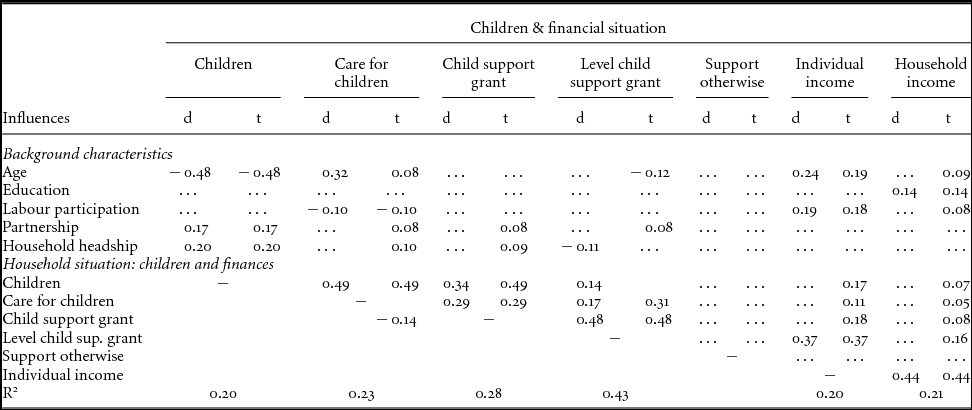
The model in Figure 1 was analysed using LISREL 8 (Jöreskog and Sörbom, Reference Jöreskog and Sörbom1993). We have developed an appropriate model for the connections within and between the three differentiated clusters of variables according to several usual measures of fit (χ2 = 161.83, df = 170, p = 0.66; Standardised Root Mean Square Residual = 0.043; Adjusted Goodness of Fit Index = 0.94; critical N = 458.41; analysis based on the covariance matrix of the 22 variables for 344 respondents). We first look at Clusters 1 and 2 and their relation to one another, and then at Cluster 3 and the paths from Cluster 1 and 2 to Cluster 3. We do not describe all the causal paths and correlations from Table 2 but instead concentrate on relatively strong, direct connections (β ≥ 0.10). Firstly, we will focus on three aspects of the relationships between Cluster 1 and Cluster 2; the background variables that relate to the level of the CSG, the contribution of the CSG to the individual and household income and the ‘crowding out’ hypothesis: do higher levels of governmental support crowd out familial and social support? After that, we focus on the relationships between Clusters 1 and 2 and the outcomes in terms of women's autonomy and children's well-being (Cluster 3).
Path analysis influences of Child Support Grant

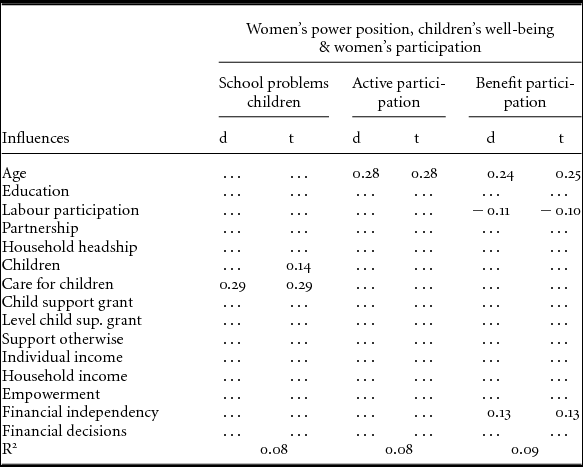
N = 344. Standardized β coefficients; d = direct effect, t = total effect (indirect effects: t-d). Significant effect is t-value > 1.96, p < 0.05, resp. β ≥ 0.05. Point ‘.’: not significant.
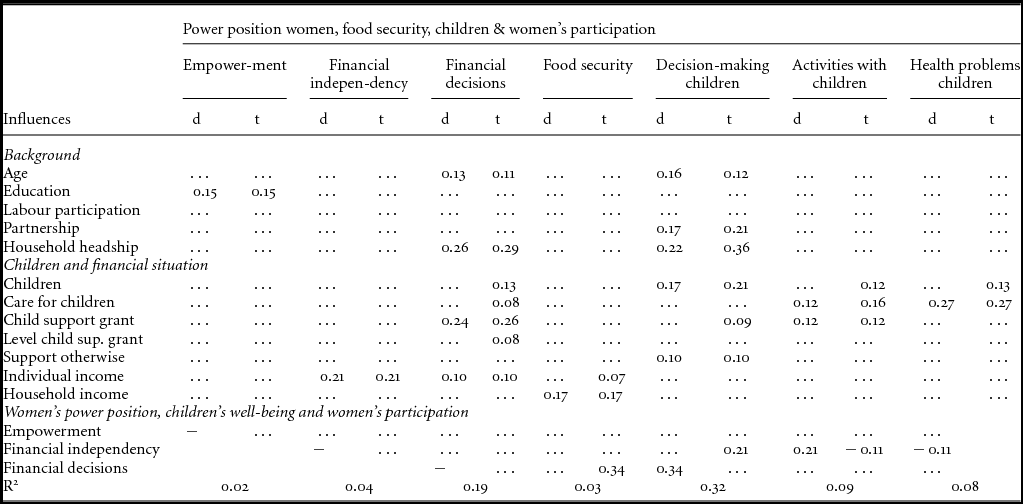
Path analysis influences of child support grant (continuation 1)

Path analysis influences of child support grant (continuation 2)

As Table 2 shows, the level of received CSG is negatively related to the age of the care-giver; the older she is, the less support she receives. The more children a care-giver has (biological and/or children in her care), the more CSGs she receives. The contribution of the CSG to the individual and household income is positive, but appears to be not the only (or main) contribution to the income of the care-giver and her family; also the care-giver's income from labour participation is a personal resource for her. It boosts her personal income more than that of her household. Finally, the ‘crowding in’ hypothesis seems plausible: there is evidence for the assumption that governmental support by way of the CSG does not minimise familial or communal support.
The next step in our analysis is the relationship between background variables; children and the financial situation of the household; and the outcome variables related to ‘women's decision-making power’. Education appears to be positively related to women's empowerment. Table 2 shows, secondly, that of all the variables concerning children and the financial situation of the household, only the individual care-giver's income contributes to financial independence. Thirdly, and in accordance with our expectations, it is the CSG in combination with household headship that contributes most to her decision-making power. Also her age and her individual income positively relate to that aspect of her autonomy. Interestingly, it is not her feeling of being empowered but her material resources that explain her decision-making power.
The well-being of children is one of the central outcomes in our model, indicated by ‘women's decision making on children’, ‘food security’, ‘health problems’, ‘school problems’ and ‘care-giver's activities with children’. Women's decision making on children appears to be not so much directly related to her receiving the CSG, instead it is mainly her household headship and her (overall) financial decision-making power that are decisive here (though the latter is strongly related to the CSG). The number of children (in her care), as well as the financial situation of the household, relates to children's well-being in diverse ways. The more children a care-giver has in her care, the more activities she undertakes, but also the more health and school problems these children have. Interestingly though, and in accordance with our assumptions, the active involvement of care-givers with the children's daily activities not only relates to the number of children in their care but also to the CSG. The latter finding, that the CSG relates positively to the carer's involvement with the children, is an important and positive finding of this study. Food security, in contrast, is only related to the total household income: neither a care-giver's individual income nor the CSG make a difference here.
Finally, one of the aims of this paper was to ascertain whether women's empowerment contributes to their autonomous activities and subsequently to the well-being of the children. In Table 2 we see that our analysis shows positive results: the more financially independent a female care-giver is, the less health problems the children have. In addition, there is a positive result showing that the financial independence of care-givers contributes greatly to their active involvement in children's activities: they play more with the children, read to them, walk them to school and take them to church meetings. In addition, as we pointed out before, the financial decision making of care-givers also relates closely to their decision making about the children's lives.
With regard to the female care-givers’ active participation in society we have to conclude that the CSG does not make a difference here. The level of active participation of women in the study was associated with a woman's age and her financial independence rather than with receipt of a CSG.
The older the female care-giver is, the more she participates in community, school and street activities. Also, the more financially independent she is, the more she benefits from participating as a member of the church, a stokvel or other social activities. Benefit participation in contrast diminishes if women are active in the labour market; probably due to time constraints.
All in all, the model offers a reasonable explanation for some differences in women's empowerment and children's well-being. It offers less explanation for women's participation (R2 for financial decision making amounts to 0.19, for decision making on children 0.32, and for women's activities only 0.08). The explanatory power for some other outcomes is minimal in spite of direct correlations between CSG and, for instance, activities with children.
Conclusions
Increased individual income for women and the lowering of the gender poverty gap is not simply a resource for women and their children. In the South African context where inequalities between men and women have their roots in colonialism, apartheid and socio-cultural systems that have contributed to the lowered position and status of women, improved individual income flowing from the grant is considered to contribute to women's functionings, and hence to their capabilities and free choice. Sen's (Reference Sen1985) formulation of capabilities as the freedom to make choices and to act – in short, what the person is able to do and be, is useful for this purpose. In addition, social protection policies of this kind are one way of contributing to setting a threshold below which women and children should not fall – important in a society such as South Africa where this social right is constitutionally guaranteed. This study provides evidence that the Child Support Grant in South Africa contributes to the care-giver's financial decision-making, and also, although to a lesser extent, to her decision-making about the children in her care. Equally important, however, is that it positively relates to the care-giver's active involvement in the daily lives of the children she cares for, which is known to have positive social, emotional and cognitive benefits in the development of children. Also, the study suggests that indirectly, via the CGS, women's financial independence contributes to fewer health problems in the children. Concerning school problems only, the number of children appears to be the only relevant factor. Given the complex context in which the CSG operates, further studies are recommended. A comparative study between South Africa's Child Support Programme and other similar programmes in middle-income countries might provide insight into what types of social grants contribute most to the capabilities of care-givers and under which conditions these grants are likely to offer the best results. This study has been conducted in one of the poorest urban wards of Johannesburg. We do not know if different results would be obtained if the study were to be conducted in rural areas or in better-off urban areas. More research is therefore needed in these areas.
The study indicates that making financial support conditional on behaviour change in care-givers is not necessary to stimulate female care-givers to be more engaged in developmental activities with their children; they do so if the stresses of their financial conditions are reduced by receiving such a grant.
Moreover, for those who caution against the promotion of ‘maternalism’ via the CSG, a positive finding is that the way these grants are provided in South Africa (at the time of our research) contributes to women's individual incomes and their financial decision-making power. So far, the design of the CSG appears to combine ‘the best of two worlds’; further research will have to investigate the effects of the newly introduced conditionality of the grant.
Finally, the study has some limitations due first to the cross-sectional, and not longitudinal, data that were collected. Second, the variables are theoretically based which does not exclude the possibility that other variables, currently omitted from the model, might be relevant too. Finally, selection bias is still a concern. However, we have good reasons to be fairly confident that the detected differences in outcome are due to the CSG itself. We hope that the findings may inspire further research on the issue.
Acknowledgment
We are grateful to the South African Netherlands Partnership for Alternatives to Development (SANPAD) for funding this research.