Introduction
Studies have shown that most referrals to Primary Mental Health Care (PMHC) are for depression (National Institute for Health and Care Excellence (NICE), 2010). A total of 50% of depressed patients have recurrent episodes with poorer outcome (Akiskal, Reference Akiskal1986; Kupfer, Reference Kupfer1991). Depression is the fourth most common cause of loss of disability-adjusted life years (DALY) in the world (DALY – a standardized measure of the burden of diseases, injuries and risk factors). Two-thirds of suicides occur in people with depression (World Bank, 1993; Murray & Lopez, Reference Murray and Lopez1997). The rates of antidepressant prescribing have increased and a recent Office for National Statistics study showed that rates of depression are higher in Northern Ireland compared with England (Office for National Statistics, 2011). The NICE guidelines on depression describe the stepped care model for treating depression, recommending that the choice of antidepressant treatment be guided by patient characteristics, previous illness and response to treatment (NICE, 2010). At a time of high economic burden, which requires cost savings in the health system, the importance of prompt and cost-effective treatment of depression cannot be overemphasized. Given the health budget cycle indicating an annual expenditure of £4.65 billion (and potential for rising cost) in Northern Ireland, the Compton Review (DHSSPSNI, 2011) emphasizes the need to make the best use of available resources. In order to improve the outcome for severe depression by predicting likely response to antidepressants and tailoring treatment accordingly, psychiatrists need adequate information when patients are referred (Wiles et al. Reference Wiles, Mulligan, Peters, Cowen, Mason, Nutt, Sharp, Tallon, Thomas, O'Donovan and Lewis2012). General practitioners (GPs) refer patients that need specialized care, but inappropriate or inadequate referral can delay the assessment of patients, leading to discontent amongst clinicians and tensions across the primary–secondary care interface (Chew-Graham et al. Reference Chew-Graham, Slade, Montâna, Stewart and Gask2008). In effect, the quality of referrals to PMHC has implications for patients, the health care system and health care costs (Akbari et al. Reference Akbari, Mayhew, Al-Alawi, Grimshaw, Winkens, Glidewel, Pritchard, Thomas and Fraser2008).
Working in a PMHC outpatient clinic in Northern Ireland, we encounter both new and re-referred patients. The PMHC service is the branch of community mental health services dealing with non-enduring mental illness of moderate severity, as opposed to the Support and Recovery service. Most referrals for assessment are from GPs, who are expected to provide clinically informative referrals that detail reasons for referral/re-referral. The letter should also provide information on current and previous medication history, more so when doctors cannot rely solely on patients’ memory and depression may further impact negatively on recollection. Working in this environment highlighted that the quality of referral letters lacked important details on medication history and, in particular, information on antidepressant use. We often had to spend time obtaining clarifications by contacting the referring GP for more information both before and after our weekly multidisciplinary meetings where we discuss referrals, allocate patients to the appropriate clinician and give appointments for assessment. We found that going back to obtain relevant data that should have been provided in the first instance (see NICE guidelines) often prolonged the time between initial referral and assessment. We decided to audit GP referral letters to identify areas that needed improvement.
Method
We designed an audit in March 2011 to investigate GP referrals to the Newry and Mourne Area PMHC Team between 23rd March 2011 and 20th April 2011. A letter was sent to all GPs working in the Newry and Mourne area in early March 2011 to inform them that their referral letters were being audited and of the criteria for the audit. All GP referrals for depression to consultant, psychology and mental health practitioners in the Newry and Mourne PMHC via the Mental Health Booking Centre [the single point of entry for all referrals in the Southern Health and Social Care (HSC) Trust] were obtained. All referrals were written as there were no electronic or email referrals. Most of the patients had recurrent depression. We excluded patients referred primarily for anxiety disorders, post-traumatic stress disorder, schizophrenia or other Axis I disorders.
Using standards identified in the NICE guidelines (see Table 1), the criteria that had to be met included:
∙ Patients referred should be aged between 18 and 64 years of age;
∙ referral must include the patient’s current antidepressant treatment and dose;
∙ referral must include duration of current treatment;
∙ information on past antidepressants history (with maximum dose reached and duration), or if patient never tried any other antidepressant, must be provided;
∙ reason(s) why antidepressants were discontinued or changed must also be provided.
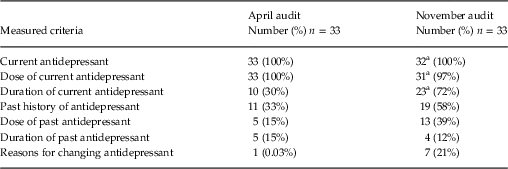
Audit (April) and re-audit (November) 2011 showing measured criteria
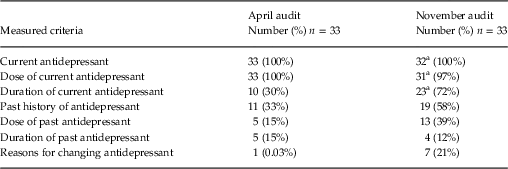
The performance of measured criteria as documented in referrals, comparing the April and November 2011 audits. Results showed some improvements in GP referrals giving the details of previous antidepressant.
a One patient referred for cognitive behavioural therapy was not taking any antidepressant, so n=32.
A standard was set for 100% of referrals to meet each of the above criteria. We collected data using questionnaires.
Results
The first audit (April 2011) of GP referrals (n=33, the total number of referrals received over a period of 1 month) showed poor documentation of antidepressant history (see Table 1). There was 100% documentation of current antidepressant and dose, but there was poor performance in documenting current antidepressant duration (30%) as well as the previous antidepressant use (33%), dose or duration (15%). Documentation of the reason for changing or stopping antidepressants was quite low (0.03%).
Results of this audit were distributed to all the 58 GPs in the area, who were asked whether they felt a referral pro forma should be implemented that would provide an effective way of relaying information to mental health practitioners. A small number [3(5%)] of GPs responded stating that they believed a pro forma to be unnecessary and that they would discuss the audit findings at their weekly practice meetings, aiming to highlight and improve information in referral letters.
All the 58 GPs were informed that the audit would be repeated later in the year to monitor improvement, with the aim of meeting the standards set in the NICE guidelines as stated above. To implement change after further discussions at multidisciplinary and educational meetings, telephone conversations and visits to some GP practices, we subsequently designed and distributed a referral pro forma indicating the required information.
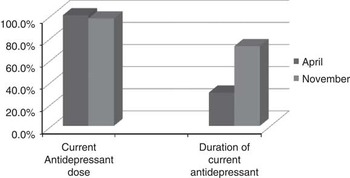
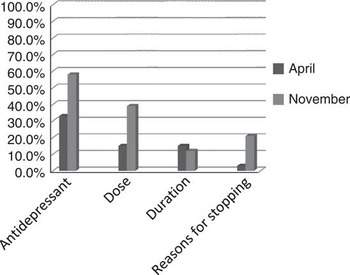
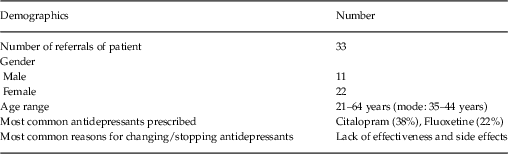
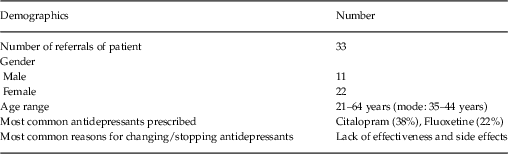
The re-audit in November 2011 again identified 33 GP referrals of patients with recurrent depression over a period of 1 calendar month (November 2011). The same criteria used in the April audit were used to measure performance (see Table 1). To evaluate how effective our intervention was, we have compared performance between the two audits (see (Figs 1 and 2)). Most of the referrals detailed the current antidepressants (100%), dose (97%) and duration (72%). The re-audit shows 42% rise in referral letters documenting the duration of current antidepressants and 25% and 24% rise in referral letters containing the names of previous antidepressant and maximum dose reached, respectively. There is a slight decline in giving the duration of previous antidepressant (3%) and a 20% rise in documenting the reason for stopping or changing antidepressants, but the performance is still quite low at 21%. As shown in Table 2, the most common reasons given in the September audit for changing or stopping antidepressants were lack of effectiveness and side effects.
Graph of current antidepressants: comparing performance between audit and re-audit. The re-audit shows 42% improvement in referral letters documenting the duration of current antidepressants.

Graph of previous antidepressants: comparing performance between audit and re-audit (April/November 2011). The re-audit shows 25% and 24% rise in referral letters containing the names of previous antidepressant and maximum dose reached, respectively. There is a slight decline in giving the duration but a 20% rise in documenting the reason for stopping or changing antidepressants.

Demography (November re-audit)
Discussion
The audit and re-audit showed low rates of documentation of necessary data on history of antidepressant use in GP referrals. Our interventions (feedback and distribution of referral pro forma to GPs) led to some modest improvement in meeting the measured standards. There was a 42% rise in referral letters documenting the duration of current antidepressants and a 25% and 24% rise in referral letters containing the names of previous antidepressant and maximum dose reached, respectively. The re-audit also showed an 20% rise in documenting the reason for stopping or changing antidepressants. For unknown reasons, there was a slight decline in giving the current antidepressant dose (3%) and duration of previous antidepressant (3%). The current level of performance is unacceptable.
As the audit was an assessment of the documentation given in referral letters, if a patient had not used any other antidepressants in the past and the referral did not state this, it was recorded that the history of previous antidepressant use was not included in the referral. This could have contributed in part to the low rates observed in the result. However, one would have expected higher rates, given that all patients in the two audits, except for one in the April audit, had recurrent depression. Only one of the referrals (patient in September audit) documented previous psychological or alternative treatment for depression. Nonetheless, our intervention showed only a modest rise in documenting previous antidepressant history.
This audit was not designed to identify the reasons for the poor performance, but studies have shown that relying mainly on feedback as a method of implementing change is ineffective (NICE, 2002). In a large study showing a low rate (25%) of completion of a structured referral pro forma by GPs, Slade et al. (Reference Slade2008) identified professional and organizational factors as barriers that need to be addressed (Slade et al. Reference Slade2008). Engaging a systematic approach and multifaceted interventions, which include identifying local barriers to change, providing a supportive environment and developing practical implementation plans appear to be more effective in making positive change in clinical practice. Making a contextual case for change and clearly delineating the potential benefits, including the significance to patients, increased organizational efficiency and productivity, are more likely to make change successful and sustainable (NICE, 2002).
When psychiatrists and mental health practitioners do not have adequate information on their patients, it is difficult to make safe, informed decisions regarding management. A thorough medication history is important for the safe and effective treatment of patients. A referral letter can be a useful and invaluable source of information. If it contains relevant clinical details, a better insight into the patient’s condition can be gained and decisions can be made accordingly. This informs psychiatrists and mental health practitioners. In an unpublished survey conducted by the authors of this paper, GPs indicated that they were unhappy when consultations are interrupted by several telephone calls to enquire about patients’ details (Towobola & Cotter, Reference Towobola and Cotter2014).
The intervention process in this audit also depicts the poor response and negative attitude to implementing change by introducing the structured referral form (pro forma). Of note is that very few GPs [3(5%)] responded to the feedback. Although most of those that replied were unconvinced that introducing a structured pro forma will be beneficial in improving the details provided in referrals, it would be presumptuous to assume what views the majority who did not respond hold. Following the re-audit, we conducted a survey asking GPs about their views on the PMHC referral system and improving the service, but the response rate was still low at 28% (17 GPs) (Towobola & Cotter, Reference Towobola and Cotter2014). Research has shown that a structured referral form can improve the quality of referrals and indeed communication between GPs and mental health professionals. Following their review of 23 audits assessing quality of referrals and nine audits assessing strategies to improve quality, which showed limited evidence overall, Durbin et al. (Reference Durbin, Barnsley, Finlayson, Jaakkimainen, Lin, Berta and McMurray2012) identified positive results using structured forms, advising that for optimal outcomes these should include a ‘minimum set of items, definition of items and structure to hold these information’. The study by Craven & Bland (Reference Craven and Bland2006) showed in a systematic review that enhanced collaboration paired with treatment guidelines or protocols offers important benefits over either intervention alone in major depression. It is important to build consensus amongst mental health practitioners and GPs, as collaborative care ‘offer better treatment outcomes than the issuing of guidelines to GPs’(Aguis & Vyas, Reference Aguis and Vyas2011; Hopwood & Aguis, Reference Hopwood and Aguis2013). Richards et al. (Reference Richards, Lovell, Gilbody, Gask, Torgerson, Barkham, Bland, Bower, Lankshear, Simpson, Fletcher, Escott, Hennessy and Richardson2008) in their study of depression in primary care defined ‘collaborative care’ as consisting of ‘case manager-coordinated medication, support coordinated by a case manager, brief psychological treatment, and enhanced specialist and GP communication’.
This audit highlights the need for the Southern HSC Trust to encourage active participation of GPs and psychiatrists in the Forum for Mental Health in Primary Care, where specific barriers to good practice in mental health can be jointly addressed. This will enhance joint clinical problem solving, as well as drafting and implementation of local joint care guidelines (Russell & Kelly, Reference Russell and Kelly2010; Fuller et al. Reference Fuller, Perkins, Parker, Holdsworth, Kelly, Roberts, Martinez and Fragar2011). As part of the systematic approach, evidence supports using visits to GP surgeries by ‘link-workers’ (mental health practitioners) – recently launched by the Newry and Mourne PMHC – to promote further collaboration between GPs and PMHC. Involvement of consultants in local educational activities in addition to link-worker (mental health practitioner) visits to local surgeries would be desirable as these have been shown to be effective in improving the appropriateness of outpatient referral (Akbari et al. Reference Akbari, Mayhew, Al-Alawi, Grimshaw, Winkens, Glidewel, Pritchard, Thomas and Fraser2008). This provides the opportunity for the psychiatrist to play a key role in developing the interface with primary care (Gask & Khanna, Reference Gask and Khanna2011). Postgraduate training of GPs in mental health has also been identified as a factor required for improving mental health care in primary care and referrals to psychiatric services (Copty & Whitford, Reference Copty and Whitford2005). As a practical step, we suggest involving GPs in designing an online version of the referral pro forma. This should be made easily accessible and should include tables and prompts for the required information (Durbin et al. Reference Durbin, Barnsley, Finlayson, Jaakkimainen, Lin, Berta and McMurray2012). A re-audit within 1 year would be important in order to monitor and sustain improvement. Durbin et al. (Reference Durbin, Barnsley, Finlayson, Jaakkimainen, Lin, Berta and McMurray2012) suggest using methodologies for measuring data quality, including electronically generated performance metrics to improve quality of referral letters.
This audit cycle has a small sample size as it captures snap-shots of GP referrals over a period of 1 calendar month, thus limiting generalizability. However, the authors are of the opinion that the audit is perhaps a general reflection of referrals within the GP–mental health interface in Northern Ireland as most Mental Health units in Northern Ireland and indeed the United Kingdom have similar design and structure owing to the shared care models of mental health service delivery within primary care and specialist mental health clinical services (Kelly et al. Reference Kelly2011). Larger multicentre longitudinal studies are needed to establish what is effective in improving quality of referrals in this model of health care system.
Conclusion and clinical importance
This audit highlights that there is a need to improve the information provided in referral letters. Providing feedback and distributing structured pro forma or guidelines cannot provide or sustain significant improvement. The audit cycle makes a contextual case for change and suggests an important barrier – negative attitude to change – that needs to be overcome in implementing change. Time spent in communication between GPs and mental health professionals in clarifying details can be more effectively used. Treating depression promptly and adequately would help to reduce the cost of depression in terms of the impact on patients and health care systems.
Acknowledgement
Authors would like to acknowledged members of the PMHC multidisciplinary team, Southern HSCT and GPs who have contributed to the audit in one way or the other. Special thanks also go to the peer reviewers for their constructive criticisms that the authors found useful.
Conflicts of Interest
None.