I. INTRODUCTION
Silicon tetrachloride (SiCl4) has been used as a gas precursor for the vapor–liquid–solid (VLS) growth of silicon wires or whiskers using Au as the catalyst since the initial work of Wagner and Ellis.Reference Wagner and Ellis1 These early studies focused on identifying conditions for stable whisker growthReference Wagner and Doherty2, Reference James and Lewis3 and investigating the origin of the diameter-dependent growth rate as reported by Givargizov.Reference Givargizov4 There has been renewed interest in the fabrication of vertical arrays of silicon nanowires (SiNWs) for photovoltaic applicationsReference Goodey, Eichfeld, Lew, Redwing and Mallouk5–Reference Garnett and Yang8 and nanowire (NW)-based electronics.Reference Goldberger, Hochbaum, Fan and Yang9 Although the majority of recent studies have utilized silane (SiH4) as the source gas for VLS growth of SiNWs , SiCl4 remains of interest because it is less hazardous than hydride sources such as SiH4. Furthermore, a high yield of epitaxially oriented SiNWs can readily be achieved with Au on (111) Si substrates using SiCl4 because of the combination of the high growth temperatures (>800 °C) that are typically usedReference Hochbaum, Fan, He and Yang10 and the presence of HCl, which has previously been shown to improve the yield of aligned SiNWs in VLS growth with SiH4.Reference Sharma, Kamins and Williams11 As a result of these factors, SiCl4 is an attractive source for the fabrication of large area radial p–n junction SiNW and microwire arrays for solar cell applications.Reference Kayes, Filler, Putnam, Kelzenberg, Lewis and Atwater12, Reference Kendrick, Yoon, Yuwen, Barber, Shen, Mallouk, Dickey, Mayer and Redwing13 These structures typically require the growth of long (>20 μm) Si wires to maximize absorption of solar radiation. Consequently, there is interest in understanding the effect of process conditions on the growth rate and structural properties of SiNWs grown with SiCl4 to achieve high growth rates without the introduction of undesired structural defects.
Several studies have examined the effect of growth parameters on the growth rate of Si wires grown with SiCl4 to elucidate information on the mechanism of VLS growth and the rate-limiting step in the process. Early work by GivargizovReference Givargizov4 demonstrated a temperature dependent growth rate over the temperature range from 900 to 1100 °C and an increase in the wire growth rate with increasing SiCl4 molar concentrations (0.3 to 6%) for Au, Pd, Ni, and Pt catalysts. Similar results were reported recently by Jeong et al.Reference Jeong, Park, Seong, Kim, Kim and Choi14 for SiNW growth with SiCl4 using a Pt catalyst. Conversely, WeyherReference Weyher15 reported a decrease in the Si wire growth rate with increasing SiCl4 mole fraction for growth in the 1000–1100 °C temperature range using Pt as the catalyst, and several studiesReference Mao, Ng, Nguyen, McNeil and Meyyappan16, Reference Zhang, Zhang, Wang, Yan, Zhou and Zhu17 have reported a complete cessation of NW growth at high SiCl4 concentrations. Schmidt et al.Reference Schmidt, Senz and Gosele18 proposed that the conflicting pressure dependencies were correlated to the rate-limiting step of the process (incorporation versus crystallization), but this has not been examined experimentally in detail.
In the case of Si thin film deposition from SiCl4, the deposition rate exhibits a strong dependence on the inlet mole fractions of SiCl4 and H2 and can lead to either Si deposition or etching depending on the process conditions.Reference Theuerer19, Reference Bloem, Oei, Demoor, Hanssen and Giling20 This behavior has been examined theoretically using equilibrium models of the Si–H–Cl systemReference Hunt and Sirtl21 and has been correlated to changes in the gas phase chemistry and Si vapor phase supersaturation.Reference Sirtl, Hunt and Sawyer22 In this study, the effects of growth temperature and SiCl4 partial pressure (PSiCl4) on the growth rate and structural properties of SiNWs were investigated. A thermodynamic model was utilized to predict the variation in Si vapor phase supersaturation with PSiCl4, which was found to agree qualitatively with the observed variations in SiNW growth rate. The implications of the results on the mechanism and rate-limiting step of VLS growth of SiNWs with SiCl4 are discussed.
II. EXPERIMENTAL
SiNWs were fabricated using 3-nm Au thin films sputter deposited on (111) Si substrates. Before the growth, the substrates were cleaned using a 10:1 buffered oxide etch for 2 min. Samples were loaded onto a quartz boat and placed in a 1" diameter quartz tube isothermal, atmospheric-pressure chemical vapor deposition (APCVD) reactor. Upon heating, samples were held at growth temperature for 5 min to allow the Au droplets to reach a uniform size. SiNWs were then grown by VLS using SiCl4 as the source gas and H2 as the carrier gas. Liquid SiCl4 was contained inside a stainless steel bubbler that was maintained at −11.8 °C and a pressure of 1300 Torr, and the SiCl4 vapor was transported into the reactor using H2 as the carrier gas. SiNWs were grown at 800–1050 °C for times between 30 s and 10 min. The total gas flow through the reactor was held constant at 100 sccm. The flow rate of the H2 carrier gas through the SiCl4 bubbler was varied from 5 to 100 sccm to control the PSiCl4 from 1 to 16 Torr.
Structural characterization of the samples was carried out using a Phillips XL-20 Scanning Electron Microscope (SEM; FEI, Hillsboro, OR), LEO 1530 Field Emission Scanning Electron Microscope (FESEM; Zeiss, Peabody, MA), and Philips FEI 420 Transmission Electron Microscope (TEM; FEI, Hillsboro, OR). NW lengths were measured via cross-sectional FESEM images of the samples using image processing software. TEM samples were prepared by sonicating the sample in isopropyl alcohol for 5 min to mechanically release the wires from the substrate. The solution was then dispersed onto a lacey carbon grid.
III. RESULTS
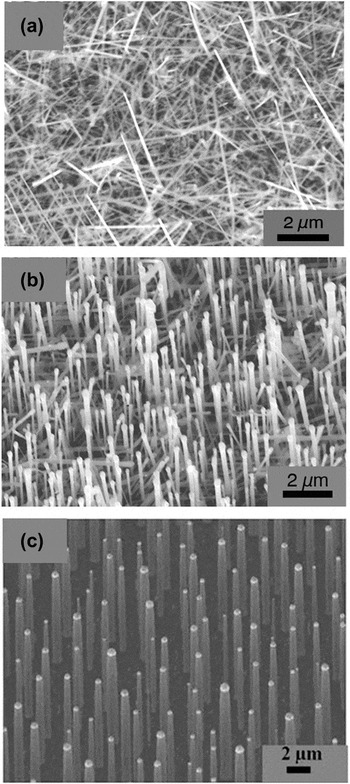
The effect of growth temperature on the structural properties and growth rate of the SiNWs was initially investigated. SiNWs were grown at temperatures ranging from 850–1050 °C using a constant PSiCl4 of 9 Torr. The vertical orientation of the SiNWs was found to be strongly dependent on the growth temperature as shown in Fig. 1. At 850 °C [Fig. 1(a)], ∼28% of the SiNWs grew in the <111> direction perpendicular to the substrate surface, compared to nearly 100% for NWs grown at 1050 °C [Fig. 1(c)]. The improved epitaxial registration between the nucleating SiNWs and the substrate is likely due to more complete removal of residual native oxide on the substrate surface at higher temperatures and the presence of increased HCl in the gas phase, which has previously been shown to improve epitaxial growth of SiNWs grown with SiH4.Reference Sharma, Kamins and Williams11 The average diameter of the SiNWs was found to increase with increasing growth temperature from 130 ± 50 nm at 850 °C to 162 ± 78 nm at 950 °C to 223 ± 90 nm at 1050 °C. The increase in the average SiNW diameter is believed to arise from Ostwald ripening of the Au particles before growth due to the increased temperatures and preheating times.
Field Emission Scanning Electron Microscope (FESEM) images at a 15° tilt showing the silicon nanowire (SiNW) orientation with respect to the Si (111) substrate at (a) 850 °C (b) 950 °C, and (c) 1050 °C.

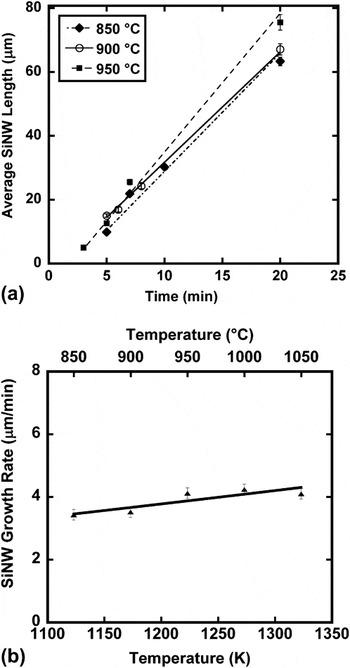
The lengths of the SiNWs were found to increase linearly with time over the investigated temperature range of 850–950 °C, as shown in Fig. 2(a). It can be seen from the graph that the x-intercept is nonzero suggesting that there may be a short incubation time before the beginning of NW growth. Growth rates on the order of 3–4 μm/min were obtained and exhibit only a small variation with temperature. To further investigate the temperature dependence, additional SiNW growths were carried out over the temperature range from 850 to 1050 °C under a constant PSiCl4 of 9 Torr, and the growth rate was found to increase slightly with temperature as shown in Fig. 2(b). The weak temperature dependence indicates the growth may be in a mass transport limited regime, similar to growth of Si thin films using SiCl4 at high temperatures (>1050 °C).Reference Bylander23
(a) Average SiNW length versus time for different temperatures from 850 to 950 °C at a SiCl4 partial pressure (PSiCl4) of 9 Torr, (b) SiNW growth rate versus temperature between 850 and 1050 °C. The solid line is a power law fit to Tn where n = 1.3.

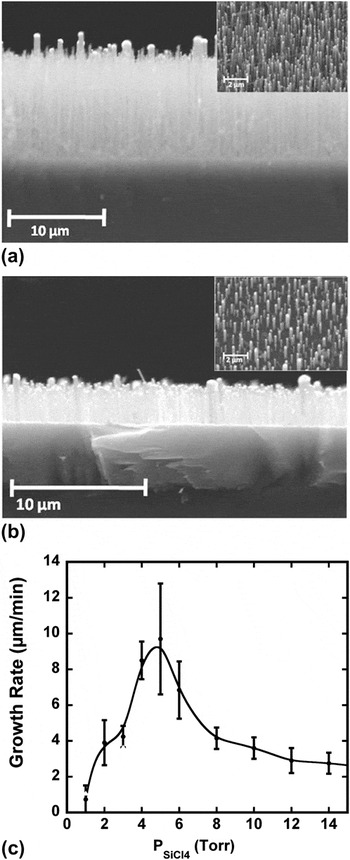
The flow rate of SiCl4 into the reactor was varied to determine the effect of PSiCl4 on the NW growth rate. Cross-sectional and plan view (inset) SEM images of SiNW arrays grown at a temperature of 950 °C for 75 s using PSiCl4 of 4.5 Torr and 14 Torr are shown in Figs. 3(a) and 3(b), respectively. At PSiCl4 of 4.5 Torr, the growth rate was 10 μm/min and decreased to 2.5 μm/min for PSiCl4 = 14 Torr. The NW diameter was found to increase from 82 ± 31 nm at PSiCl4 = 4.5 Torr to 110 ± 35 nm at PSiCl4 = 14 Torr, and the NW density was observed to be slightly lower at the higher PSiCl4. To further investigate the growth rate dependence on PSiCl4, additional samples were grown at 950 °C using PSiCl4 ranging from 1 to 14 Torr. As shown in Fig. 3(c), the SiNW growth rate increased with increasing PSiCl4 at lower partial pressures and reached a maximum of ∼10 μm/min at PSiCl4 of 4.5 Torr. Beyond this point, the growth rate decreased with increasing PSiCl4 and approached a value of ∼2.5 μm/min in the high partial pressure range. A similar maximum in the growth rate was also observed at 850 and 1050 °C. The partial pressure dependence was similar to that observed for Si thin film deposition using SiCl4.Reference Bloem, Oei, Demoor, Hanssen and Giling20, Reference Bylander23, Reference Bloem, Oei, Demoor, Hanssen and Giling24
Cross-sectional FESEM images of SiNW grown at 950 °C at (a) PSiCl4 = 4.5 Torr and (b) PSiCl4 = 14 Torr. Insets are plan view scanning electron microscope images tilted at 15°. (c) SiNW growth rate versus PSiCl4 at 950 °C. The solid line in the figure is a guide for the eye.

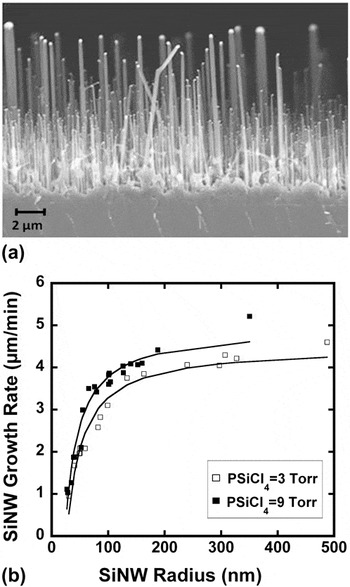
Several studies have reported a diameter-dependent growth rate for Si wires grown with SiCl4. GivargizovReference Givargizov4 observed an increase in the growth rate with increasing wire diameter for diameters ranging from ∼100 to 5 μm. Weyher,Reference Weyher15 however, reported a decrease in Si wire growth rate with increasing diameter for large diameter wires (5–120 mμm). The conflicting dependences correlated with differences in the dependence of wire growth rate on SiCl4 molar concentration; in Givargizov’s study, the growth rate increased with increasing SiCl4 molar concentration, whereas the opposite was observed in Weyher’s study. To investigate these opposing trends, the variation in SiNW growth rate with diameter was measured at two values of PSiCl4 (3 and 9 Torr) that lie on opposite sides of the maximum growth point shown in Fig. 3(c). The SiNWs were grown from a Au thin film that was heated rapidly before the growth such that sufficient time was not allowed for the Au droplet size to reach a uniform size, and consequently there was a large variation in NW diameter as shown in Fig. 4(a). The growth rate of the SiNWs was found to exhibit a similar dependence on diameter as shown in Fig. 4(b) for both values of PSiCl4 that were investigated. The observed trend is similar to the results reported by Givargizov et al.Reference Givargizov4 for SiNWs and by DayehReference Dayeh and Picraux25 for Ge NWs, which were explained as arising from changes in chemical potential in the droplet due to the Gibbs–Thomson effect.
(a) Cross-sectional FESEM image of SiNWs grown at 950 °C and PSiCl4 = 3 Torr and (b) a comparison of growth rate versus diameter for two different partial pressures at 950 °C.

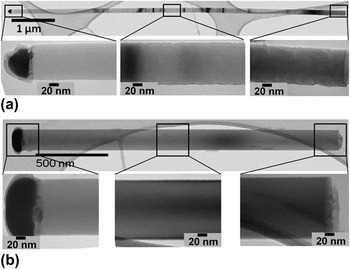
The effect of PSiCl4 on the structural properties of the SiNWs was also investigated. TEM images of SiNWs grown at 950 °C at lower (PSiCl4 = 3 Torr) and higher (PSiCl4 = 9 Torr) partial pressures are shown in Fig. 5. The SiNWs are single crystalline and exhibit a uniform diameter along their length. The sidewalls of the NWs exhibit similar roughness at the corresponding position on the NW. There is, however, a pronounced difference in the shape of the Au tips. The sample grown with PSiCl4 = 3 Torr exhibits a Au tip with a hemispherical shape compared with the flatter, oblong shape obtained at PSiCl4 = 9 Torr. The differences are believed to arise from a change in the contact angle of the catalyst, which could indicate a variation in catalyst composition with growth conditions or a change in surface energy due to Cl coverage, although further studies are required to investigate this behavior. It should be noted that a variation in the contact angle of the catalyst with PSiCl4 could also impact the measured diameter dependence of the growth rate reported in Fig. 4(b) because the SiNW radius may not be an accurate measurement of the droplet radius. In both cases, the Au catalyst is encapsulated in an amorphous shell, which is believed to be SiO2 that formed postgrowth during sample cooling.
Transmission electron microscope images of SiNWs grown at 950 °C with (a) PSiCl4 = 3.0 Torr and (b) PSiCl4 = 9 Torr.

IV. DISCUSSION
The mechanism of SiNW growth with SiCl4 has previously been considered within the context of the overall VLS growth process. In its simplest form, VLS growth is generally considered to consist of four main steps: (i) mass transport of the precursor gas atoms in the vapor phase to the surface; (ii) adsorption and/or decomposition of the precursor on the catalyst surface and incorporation into the liquid; (iii) diffusion of atoms through the liquid phase from the catalyst surface to the liquid/solid interface; and (iv) incorporation of atoms in the crystal at the liquid–solid interface.Reference Givargizov4 Several modelsReference Froberg, Seifert and Johansson26–Reference Dubrovskii, Sibirev, Cirlin, Soshnikov, Chen, Larde, Cadel, Pareige, Xu, Grandidier, Nys, Stievenard, Moewe, Chuang and Chang-Hasnain28 have also considered the diffusion of adsorbed species along the sidewalls of the wire to the catalyst as an additional flux that contributes to wire growth. The diffusion of atoms in the liquid phase is typically fast and is not considered to be rate limiting for typical catalyst particle sizes.Reference Lew and Redwing29 Under steady state conditions, the rate of incorporation of atoms into the liquid phase from the vapor (step 2) must be equal to the rate of crystallization of atoms from the liquid phase into the solid (step 3). Consequently, the growth of Si wires by VLS can generally be considered to be limited by either the incorporation or crystallization rates depending on process conditions as described by Schmidt et al.Reference Schmidt, Senz and Gosele18
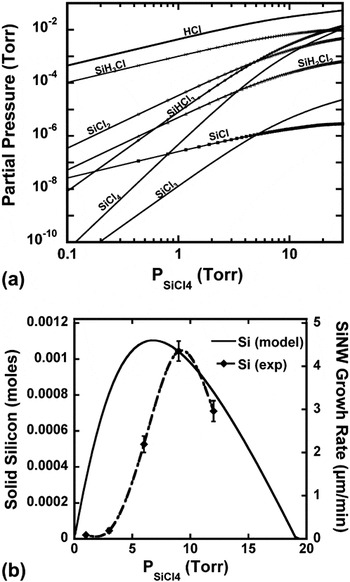
When SiH4 is used as the precursor under low temperature, reduced-pressure conditions, the Si incorporation rate is believed to be kinetically limited by the rate of adsorption/surface decomposition of SiH4, which is expected to be higher on the liquid Au–Si surface compared with a hydrogen-terminated Si surface.Reference Schmidt, Senz and Gosele18, Reference Lew and Redwing29 In contrast, SiNW growth with SiCl4 is typically carried out at higher temperatures (950–1050 °C) and atmospheric pressure in an H2-containing ambient. When a hot wall reactor is used such as in this study, the high gas phase temperatures and pressures will result in rapid homogeneous reaction of SiCl4 and H2 producing a variety of SiHxCl4-y intermediate species in the gas phase.Reference Hunt and Sirtl21 Earlier studies of vapor–solid deposition of Si thin filmsReference Theuerer19, Reference Bloem, Oei, Demoor, Hanssen and Giling20, Reference Sirtl, Hunt and Sawyer22–Reference Bloem, Oei, Demoor, Hanssen and Giling24, Reference Bloem, Claassen and Valkenburg30 have assumed that the gas phase is in near equilibrium with solid silicon under these conditions, and thermodynamics can therefore be used to predict the gas phase partial pressures and the mass of solid silicon formed, which can then be translated into a thin film deposition rate. To investigate the applicability of this approach to SiNW growth, thermodynamic calculations were carried out using a gas phase equilibrium model similar to that developed by Van der Putte et al.Reference Van der Putte, Giling and Bloem31 to predict the equilibrium partial pressures of gas phase species present in the Si–Cl–H system as a function of temperature and inlet SiCl4 and H2 mole fractions. The software package HSC Chemistry 5.1 and its data library were used to minimize Gibbs free energy assuming the gas phase species present included Si, SiCl, SiCl2, SiCl3, SiCl4, SiH, SiH4, SiHCl3, SiH2Cl2, SiH3Cl, Cl, Cl2, H, H2, and HCl in equilibrium with solid silicon. The predicted gas phase partial pressures of the major species present are shown in Fig. 6(a) as a function of the inlet PSiCl4 for a temperature of 1050 °C and H2 as the carrier gas assuming a fixed pressure of 760 Torr. At low inlet PSiCl4, the major Si-containing gas phase species are SiH3Cl and SiCl2 similar to that previously reportedReference Van der Putte, Giling and Bloem31 and the amount of SiCl4 present at equilibrium is negligible. As the inlet PSiCl4 is increased above ∼5 Torr, the equilibrium partial pressures of SiCl4 and SiHCl3 within the system increase substantially compared to the other Si-containing species indicating a shift in the gas phase equilibrium.
(a) Predicted gas phase species at 1050 °C as a function of inlet PSiCl4 and (b) predicted Si supersaturation and experimentally measured SiNW growth rate versus PSiCl4.

In the case of vapor–solid deposition of silicon, the growth rate will be proportional to the supersaturation of silicon in the vapor phase (Δp), which is the driving force for the reactions leading to growth.Reference Lew and Redwing29 The silicon supersaturation can be described by Δp = p i − p s, where pi is the inlet partial pressure of silicon-containing reactants and p s is the partial pressure of all silicon-containing species in the vapor phase at equilibrium. This assumes that each silicon-containing molecule contains only a single Si atom, which is valid for the model considered here. In the Si–Cl–H system, Δp can be positive or negative corresponding to silicon deposition or etching, respectively.Reference Bloem, Oei, Demoor, Hanssen and Giling24 In our case, p i is equal to the inlet PSiCl4, and p s can be calculated from the equilibrium data shown in Fig. 6(a) by summing the values for all Si-containing gas phase species that includes SiH3Cl, SiCl2, SiHCl3, SiH2Cl2, SiCl4, SiCl, SiCl3, SiH4, SiH, and SiCl. The predicted values for the silicon supersaturation, plotted as moles of silicon solid, are shown in Fig. 6(b) as a function of inlet PSiCl4 along with the experimentally measured SiNW growth rate at 1050 °C. The overall variation in the SiNW growth rate as a function of PSiCl4 compares favorably with the predicted change in the moles of silicon, although the maximum value of the growth rate occurs at a higher PSiCl4 than predicted from the equilibrium model. It is anticipated that better agreement between the experimental and predicted growth/etch curves can be obtained by considering the effects of mass transport and thermal diffusion, as demonstrated by Van der Putte et al.,Reference Van der Putte, Giling and Bloem31 but this is beyond the scope of this study. Nevertheless, the results demonstrate that an equilibrium approach can be used to qualitatively describe the SiNW growth process with SiCl4. Under APCVD conditions, SiNW growth from SiCl4 is dependent on gas phase thermodynamics and the balance of the Si formation and etching reactions similar to that observed for Si thin film deposition. The reduction in SiNW growth rate at higher silicon tetrachloride partial pressures results from a shift in the gas phase equilibrium, which leads to an increase in the chlorine-containing gas phase species (SiCl4, SiHCl3) as the growth transitions into an etching dominated regime.
The growth rate of SiNWs in the VLS process is assumed to be limited by the rate of incorporation of Si into the liquid droplet. Depending on the growth conditions, the Si incorporation rate can be controlled by surface reactions such as the rate of precursor decomposition/adsorption (reaction controlled) or by the flux of Si to the liquid surface (diffusion controlled). At the high temperatures used for Si vapor–solid deposition with SiCl4, the surface reactions are considered to be fast, and the deposition rate is assumed to be limited by the mass transport of Si precursor species to the surface.Reference Bloem, Claassen and Valkenburg30 A similar qualitative model can be used to describe SiNW growth with SiCl4, but in this case the surface is assumed to be that of the Au–Si liquid droplet rather than the Si substrate. Assuming a simple one-dimensional (1D) boundary layer model, the flux (J) of Si precursor to the surface can be described by:

where D is the gas phase diffusivity, δ is the boundary layer thickness, p g is the partial pressure of the Si precursor in the gas ambient outside of the boundary layer, and p s,l is the equilibrium partial pressure of the Si precursor at the Au–Si liquid surface. For simplicity, we assume that the diffusion coefficients of all the SiHxCly species are equal and, therefore, p g in Eq. (1) can be assumed to represent the inlet PSiCl4, and p s,l represents the sum of the partial pressures of all Si-containing species at equilibrium with the Au–Si liquid surface. Furthermore, at steady state, it is assumed the catalytic decomposition of Si-containing species on droplet surfaces is not the rate-limiting step. Consequently, the chemical potential of Si-containing species in equilibrium with the liquid surface, represented by p s,l, is assumed to be equal to the chemical potential of Si atoms incorporated into the liquid droplet. For an ideal gas at atmospheric pressure, D can be assumed to vary with temperature as D = D o(T/T o) Reference Wagner and Doherty2 where Do is the diffusivity at a reference temperature T o.Reference Ohring32 It is further assumed that a Gibbs–Thomson effect arising from surface curvature will modify the equilibrium Si precursor partial pressures at the Au–Si liquid surface according to the relationship:

where V m is the molar volume of the Au–Si liquid phase, σ is the surface energy of the liquid, r is the NW radius, and p s,l(∞) is the equilibrium precursor partial pressure for a flat surface. Assuming ex ≅ 1 + x and then substituting for D and p s,l into Eq. (1) and rearranging yields:

The NW growth rate dL/dt can be assumed to be proportional to the flux as dL/dt = V mJ. Consequently, the first term in Eq. (3) represents the growth rate for large diameter NWs where r → ∞. The second term represents a modification of the growth rate due to the Gibbs–Thomson effect and is functionally identical to the equation derived by Schmidt et al. for the case where incorporation into the liquid phase is the rate-limiting step.Reference Schmidt, Senz and Gosele18 The fit of Eq. (3) to the experimental data is shown in Fig. 4(b) for two different values of the inlet PSiCl4. The fit yields a maximum value of the growth rate of 4.5 and 4.9 μm/min for PSiCl4 of 3 and 9 Torr, respectively, which compare favorably to the results shown in Fig. 3(b). In addition, Eq. (3) indicates that in the mass transport controlled regime, the NW growth rate should vary linearly with growth temperature (T) for constant values of p s,l(∞) and δ. From Fig. 2(b), the SiNW growth rate at a constant inlet PSiCl4 is proportional to T 1.3 over the range from 850 to 1050 °C, which is close to that expected from the model. The modified form of the simple boundary layer model, therefore, provides a satisfactory qualitative description of SiNW growth from SiCl4 under the conditions used in this study.
As shown by Eq. (3), the SiNW growth rate is dependent on the equilibrium partial pressures of the Si-containing precursors [p s,l(∞)] that are determined by the inlet SiCl4/H2 ratio. The SiNW growth rate can therefore increase or decrease with an increase in PSiCl4 depending on the gas phase equilibrium. The primary influence of growth temperature arises from an increase in gas phase diffusivity, which results in the weak temperature dependence of the SiNW growth rate as shown in Fig. 2(b). The SiNW growth rate decreases rapidly with decreasing SiNW diameter below ∼200 nm in both the growth and etching regimes (low and high PSiCl4, respectively), indicating that the precursor partial pressure dependence and diameter dependence are not necessarily correlated as previously suggested.Reference Schmidt, Senz and Gosele18 Within the context of the mass transport model, curvature-related effects due to the small NW diameter can be considered to modify the equilibrium partial pressures giving rise to the characteristic 1/r dependence of the growth rate.
V. CONCLUSIONS
The results of this study demonstrate that SiNW growth from SiCl4 under APCVD conditions is dependent on gas phase thermodynamics and the balance of the Si formation and etching reactions similar to that observed for Si thin film deposition. The SiNW growth rate was found to be weakly dependent on growth temperature but strongly dependent on PSiCl4, exhibiting a maximum at a particular value of PSiCl4 as the gas phase equilibrium shifts from a growth to an etching dominated regime. The variation in SiNW growth rate with PSiCl4 was qualitatively similar to the variation in the moles of solid silicon predicted to form from a gas phase equilibrium model of the Si–Cl–H system. The SiNW growth rate was found to be diameter-dependent in both the growth and etching regimes. The results were explained within the context of a 1D mass transport model where the SiNW growth rate is assumed to be dependent on the flux of Si precursors to the growth surface. The SiNW growth rate is predicted to be dependent on the equilibrium partial pressures of the Si-containing gas phase species, modified by curvature-related effects at small NW diameters, which is consistent with the experimental results.
ACKNOWLEDGMENTS
This work was supported by the Department of Energy under contracts DE-FG02-05ER15749 and DE-FG36-08GO18010 and by the National Science Foundation under grant ECS-0609282. The TEM work was performed in the electron microscopy facility of the Materials Characterization Laboratory at Penn State.