





Introduction
Health inequalities are unfair, avoidable, and systematic differences in morbidity and mortality between population groups. Reducing inequalities is a core aim of health policy. To target interventions effectively, decision-makers require timely, comparable measures of inequalities and evidence on the relative contribution of modifiable factors. This is challenging without detailed data, and improving evidence on ethnic group and deprivation inequalities remains a key priority for health protection in England [1].
Influenza and COVID-19 contribute substantially to morbidity and mortality in England, with unequally distributed burdens across ethnic groups and deprivation levels. This includes inequalities for infection itself, and for severe outcomes following infection – hospitalization, intensive care admissions, and mortality [2–Reference Irizar6]. Deprivation itself is also a well-established risk factor for influenza and COVID-19 [7]. Both infections have established vaccination programmes, with wide coverage but notable inequalities in uptake [8,9]. However, vaccination inequalities are often monitored separately from inequalities in hospitalization and comorbidities, limiting understanding of how these factors interact to produce unequal outcomes.
Recent UK Health Security Agency analyses [7] found significant inequalities in hospitalization for influenza and COVID-19 by deprivation and ethnic group in England (September 2022 to February 2023). Influenza admission rates for the most deprived areas were 2.6 times higher than the least deprived areas and 2.1 times higher for COVID-19. For influenza (but not COVID-19), there were persistent differences in hospitalization rates between ethnic groups, for instance, the Pakistani group had influenza hospitalization rates 2.7 times higher than the White group. Post-pandemic, ethnic group inequalities for COVID-19 have been comparably lower than during the pandemic [10].
Vaccination reduces infection risk and disease severity, but uptake remains consistently lowest in the most deprived areas, and among some ethnic groups. In reporting closest to the time period of this study (2023–2024), 79% of those aged ≥65 from the least deprived areas were vaccinated for COVID-19 in the 6 months prior, compared to 59% in the most deprived areas [8]. Influenza vaccine uptake was also lower in the most deprived areas compared to the least deprived areas, across all vaccination cohorts [8]. There were considerable ethnic group inequalities in vaccine uptake; for COVID-19, vaccine uptake was lowest for the Pakistani (18%) and Bangladeshi groups (24%) and highest for the White British (76%) and White Irish groups (64%) [8]. For influenza, vaccine uptake was lowest for the Black or Black British Caribbean (46%) and the Black or Black British African groups (48%) and highest for the White British (82%) and White Irish groups (76%) [8].
Comorbidities which predispose individuals to a higher risk from COVID-19 and influenza are detailed in the clinical risk groups in the Green Book, which provides information for public health professionals on immunization [11]. Risks for many of these conditions are higher among certain ethnic groups, including cardiovascular disease, diabetes, and multi-morbidity [12–14]. Indian, Pakistani, Bangladeshi, Black African, Black Caribbean people and people from the ‘Any other Black ethnic group’, ‘Any other Asian ethnic group’, or with a mixed ethnic background may also have a higher risk of developing multiple long-term conditions [Reference Hayanga, Stafford and Bécares15]. Comorbidities are also highest for those living in deprived areas, with large differences by deprivation for mortality involving lung cancer and asthma, two risk factors for COVID-19 and influenza [12–14]. These conditions form part of the eligibility criteria for vaccination programmes, reflecting existing policy efforts to mitigate severe outcomes among higher-risk groups.
Previous studies have shown that comorbidities, vaccination coverage, and socioeconomic, demographic, and geographic factors together accounted for differences in COVID-19 mortality across ethnic groups during the pandemic [16]. However, evidence on the relative importance of specific mediators remains limited, especially for influenza and for COVID-19, post-pandemic. In this article, we use causal mediation analysis with linked administrative data on hospitalizations, vaccination, and laboratory testing to estimate the extent to which deprivation, vaccination uptake, and comorbidities explain ethnic group and deprivation inequalities in influenza and COVID-19 hospitalizations between 1 September 2023 and 31 March 2024 for the vaccine-eligible cohort.
Methods
Study population
The study population was defined using age and clinical risk data within the Immunization Information System (IIS), based on the Joint Committee on Vaccination and Immunization criteria for vaccine-eligible cohorts. For influenza and COVID-19 between 1 September 2023 and 31 March 2024, eligibility included individuals aged ≥65 years, those in clinical risk groups (Supplementary Materials), care home residents, household contacts of immunosuppressed individuals, and frontline health and social care workers. For influenza only, children aged 2–16 years were also eligible.
Analyses were restricted to vaccine-eligible individuals to assess the contribution of vaccination uptake to hospitalization risk, ensuring observed differences were not due to eligibility criteria. All analyses were repeated for the whole population as sensitivity analyses (Supplementary Tables S9–S13). Results presented in the main article relate to the vaccine-eligible cohort.
Data sources
Hospitalizations between 1 September 2023 and 31 March 2024 were identified from the Hospital Episode Statistics Admitted Patient Care dataset [Reference Herbert17], restricted to one observation per individual. Vaccination data were obtained from IIS, which captures all vaccination events for individuals registered with a general practitioner in England and includes vaccinations delivered in pharmacies, schools, and other settings. The number of individuals without an NHS number has been assessed to be small, but is likely to disproportionately include more vulnerable populations, such as migrants, asylum seekers, and undocumented individuals [Reference Tessier18]. As a result, whilst it is unlikely that vaccination events are missed from the data, vaccination inequalities may be underestimated if unvaccinated individuals from these groups are excluded from the denominator. Overall, IIS vaccination records and denominators are the most complete records available in England and have been assessed as highly accurate, as compared to enhanced surveillance from the COVID-19 pandemic [Reference Tessier18]. All vaccination events between 1 September 2023 and 31 March 2024 were included; the earliest cohort commencement was 1 September 2023 for children’s influenza vaccinations.
Laboratory-confirmed COVID-19 and influenza tests were sourced from the Second Generation Surveillance System and linked to hospitalizations. Data were linked using unique NHS numbers and accessed in accordance with NHS Digital Data Sharing Agreements on a secure platform. Analyses were conducted on aggregated subgroup-level data, ensuring no individual was identifiable.
Outcomes, exclusions, and covariates
Hospitalization with influenza or COVID-19 was the primary outcome. Variable definitions are provided in Supplementary Table S5. Admissions without diagnostic or laboratory confirmation or with missing covariates were excluded (5% of influenza total eligible cohort, 3% of COVID-19 eligible cohort; Supplementary Table S4).
Statistical analyses and causal framework
Directed acyclic graphs (Figure 1) were used to define causal structures and adjustment sets [Reference Tennant19]. Ethnic group and deprivation were analysed separately as exposures. When ethnic group was the exposure, age, sex, and region were treated as competing exposures and deprivation, comorbidities, and vaccination uptake were treated as mediators, with deprivation and comorbidities as intermediate confounders. Total causal effects were estimated using models that included competing exposures, as their inclusion improved model fit (Supplementary Table S6). When deprivation was the exposure, ethnic group, age, sex, and region were pre-exposure confounders and comorbidities and vaccination uptake were mediators, with comorbidities as an intermediate confounder.
Directed acyclic graph (DAG) for the effect of ethnic group and deprivation on the outcome of hospitalization with influenza or COVID-19.

Figure 1. Long description
The diagram shows the hypothesized causal relationship between the exposure variables of ethnic group and deprivation and the outcome variable of influenza or COVID-19 hospitalization. Eight measured variables and three unmeasured variables in total are included, organized left to right in assumed temporal order. Age, sex, and region are included as pre-exposure or competing confounders. Deprivation, pre-existing comorbidities, and vaccination uptake are included as potential mediators on the pathway between exposure and outcome. The diagram also includes unmeasured variables: exposure to infection, healthcare access, and experience of healthcare. Arrows show the assumed direction of influence between variables.
Unmeasured mediators (exposure to infection, experience of healthcare, and access to healthcare) were assumed to crystallize at the same time point in the context of this analysis and are considered a limitation of results.
The DAG was constructed following recommended practice for causal inference, with variables arranged in temporal order from left to right and arcs drawn using forward saturation [Reference Tennant19]. Assumed relationships were informed by Office for National Statistics Census (ONS) 2021 population statistics and sociodemographic cross‑tabulations [20], together with existing literature on comorbidities, vaccination uptake, access to healthcare, experience of healthcare, and infection risk [Reference Zhao3–Reference Tessier18].
Models and mediation analysis
Hospitalizations were modelled using weighted binomial regression to estimate total causal effects (equations in Supplementary Table S16). Mediation analyses were conducted using regression-based methods when no intermediate confounding was present [Reference Valeri and VanderWeele21] and g-formula methods when intermediate confounders were included [Reference Shi22,Reference Robins23]. Estimation of mediated effects was limited to focal relationships with, at most, one intermediate confounder, as the R package used here cannot accommodate multiple sequential mediators. Therefore, for ethnic group as exposure, we estimated mediation by deprivation, and mediation by comorbidities, conditioning on deprivation, but we were unable to estimate mediation by vaccination uptake. For deprivation as exposure, we estimated mediation by comorbidities, and then separately estimated mediation by vaccination uptake, while conditioning on comorbidities. Comorbidities and vaccination uptake mediator or intermediate confounder models were estimated using weighted binomial models and deprivation models were estimated using weighted multinomial models. All models were fitted using the cmest function in CMAverse (R version 4.3.2) [Reference Robins23].
Interpretation
Effects were reported as odds ratios (ORs). ORs (and associated 95% confidence intervals (CI)) exceeding 1.25 or below 0.80 were interpreted as disproportionate, following Race Equality Unit guidance [24]. ORs were interpreted as statistically significant when associated 95% CIs did not overlap with 1.0 (parity). Mediation results were presented only for ethnic groups or deprivation levels where total effects indicated disproportionality. Given the rarity of hospitalization (0.07% of influenza total eligible cohort and 0.14% COVID-19 eligible cohort), ORs were considered meaningful approximations to risk ratios. Proportion mediated was estimated using differences in predicted risks on the risk scale and therefore does not correspond precisely to the ratio of odds ratios.
Results
Descriptive analysis
The eligible vaccination cohort included 28.4 million individuals for influenza and 19.1 million for COVID-19, with 19,077 influenza hospitalizations and 27,361 COVID-19 hospitalizations between 1 September 2023 and 31 March 2024. For influenza, substantial differences between ethnic groups (compared to the White British group) and deprivation levels (compared to the least deprived group) were observed in hospitalization, vaccination uptake, and comorbidities. For COVID-19, substantial differences were present for vaccination uptake and comorbidities, but hospitalization differences by ethnic group were smaller (Tables 1 and 2).
Descriptive characteristics of the influenza vaccine–eligible cohort

Table 1. Long description
Table shows counts and percentages of people in different ethnic groups and living in different deprivation quintiles broken down by hospital admission, vaccination uptake, comorbidities, and deprivation, with the total number of people from the influenza vaccine–eligible cohort given for each group.
Descriptive characteristics of the COVID-19 vaccine-eligible cohort

Table 2. Long description
Table shows counts and percentages of people in different ethnic groups and living in different deprivation quintiles broken down by hospital admission, vaccination uptake, comorbidities, and deprivation, with the total number of people from the COVID-19–vaccine-eligible cohort given for each group.
Influenza
Total causal effects
In the adjusted total causal effect model for ethnic group, including age, sex, and region as competing exposures (model 1, Table 3), the Pakistani and Bangladeshi groups had disproportionately high odds of influenza hospitalization compared with White British individuals (OR 2.0, 95% CI: 1.83, 2.10 and OR 1.6, 95% CI: 1.39, 1.80, respectively). No ethnic group had disproportionately low odds of influenza hospitalization.
Adjusted odds ratios (95% confidence interval) for influenza and COVID-19 hospitalization by ethnic group, Model 1

Table 3. Long description
Odds ratios for ethnic groups of being admitted to hospital for influenza or COVID-19 from logistic regression models, including ethnic group, age group, sex, and region (Model 1). The reference groups are White British, 17–44 years old, female, London. Key findings are given in the text.
The reference groups were taken as ethnic group: White British, age group: 17–44 years, sex: Female, region: London.
In the adjusted total causal effect model for deprivation (model 2, Table 4), adjusting for ethnic group, age, sex, and region, as pre-exposure confounders, individuals in the more deprived areas (IMD1 and IMD2) had disproportionately high odds of influenza hospitalization, compared to the least deprived areas. The most deprived area (IMD1) had odds 1.7 (95% CI: 1.63, 1.79) times higher than the least deprived area.
Adjusted odds ratios (95% confidence interval) for influenza and COVID-19 hospitalization by deprivation (IMD quintiles), Model 2

Table 4. Long description
Odds ratios for deprivation quintiles of being admitted to hospital for influenza or COVID-19 from logistic regression models including ethnic group, age group, sex, region, and deprivation (Model 2). The reference groups are White British, 17–44 years old, female, London, least deprived quintile. Key findings are given in the text.
The reference groups were taken as ethnic group: White British, age group: 17–44 years, sex: Female, region: London, deprivation quintile: IMD 5 (least deprived).
Mediation analysis
Ethnic group as exposure
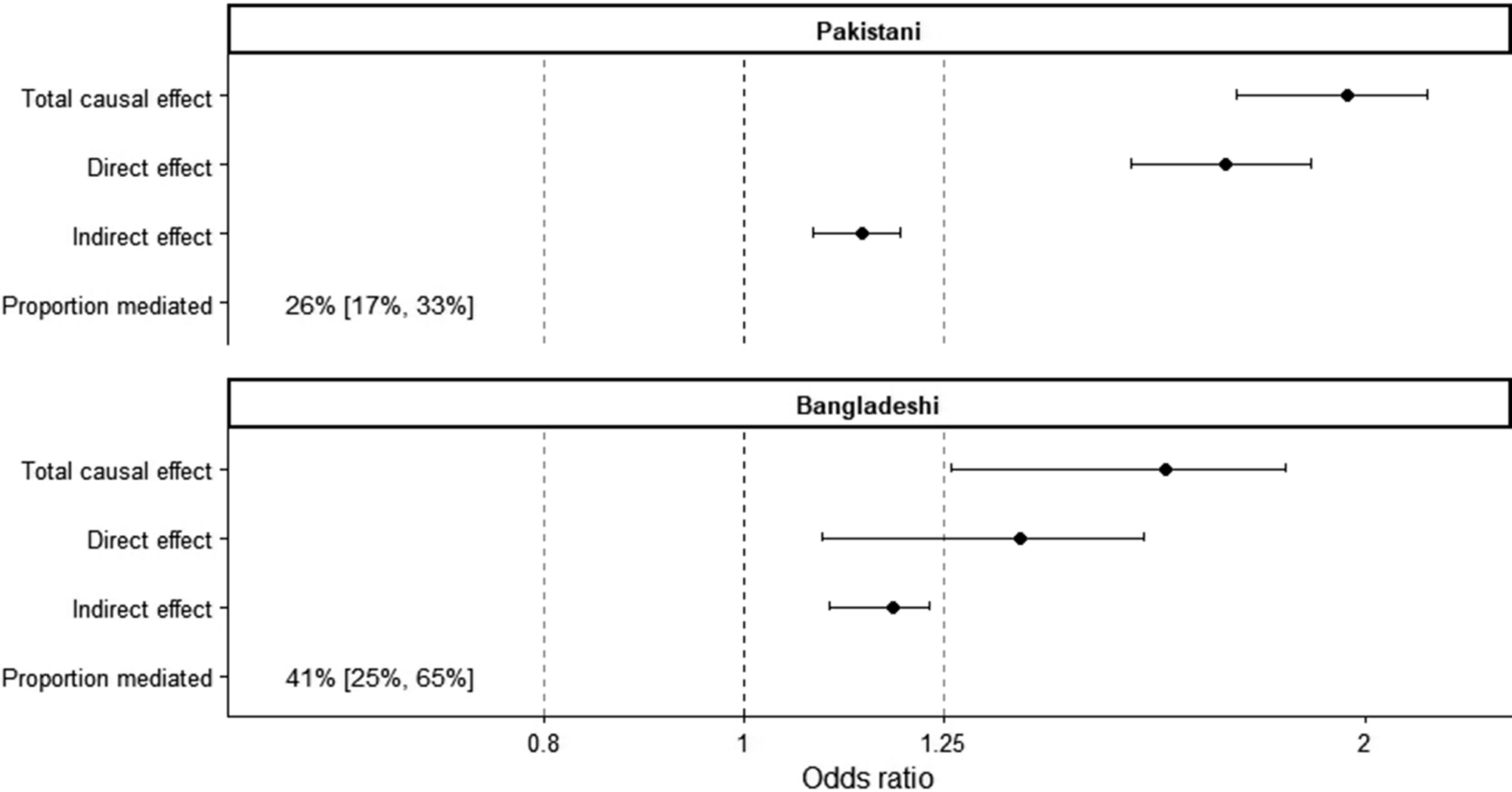
Mediation analyses were conducted for Pakistani and Bangladeshi groups only, as the only ethnic groups with disproportionately high odds of hospitalization (Table 3). For both groups, indirect effects through deprivation were statistically significant. The indirect effect OR was 1.1 (95% CI: 1.08, 1.19) for the Pakistani group and 1.2 (95% CI: 1.10, 1.23) for the Bangladeshi group (Figure 2, Table 5), corresponding to 26% and 41% of the total causal effect, respectively. Indirect effects through comorbidities, conditioning on deprivation, were not significant for either ethnic group (Table 5).
Effect of ethnic group on influenza hospitalization with mediation by deprivation in the vaccine-eligible cohort in England, 1 September 2023 to 31 March 2024.

Figure 2. Long description
Outputs from causal mediation analysis of the effect of ethnic group on influenza hospitalization. The plot shows the total causal effect for two ethnic groups: the Pakistani group and Bangladeshi group and how this is decomposed into a direct effect and an indirect effect which is mediated by deprivation. Odds ratios from the model are presented with 95% confidence intervals. The proportion of the effect mediated by deprivation is also reported. Values are reported in the text and in Table 5.
Effect of ethnic group on influenza hospitalization, proportion mediated by deprivation and comorbidities

Table 5. Long description
Results of causal mediation analysis. Total causal effect of ethnic group on influenza hospitalization, decomposed into the direct effect of ethnic group and the indirect effects mediated by deprivation and by comorbidities, conditioning on deprivation. 95% confidence intervals and proportions mediated are also shown. Key findings are given in the text.
a The reference group was taken as ethnic group: White British. Exposure: ethnic group; Competing exposures: age group, sex, region; Mediator: deprivation.
b The reference group was taken as ethnic group: White British. Exposure: ethnic group; Competing exposures: age group, sex, region; Mediator: comorbidities; Intermediate confounder: deprivation.
The direct effect remained statistically significant for both ethnic groups after accounting for deprivation, and remained disproportionate for the Pakistani group, therefore pathways beyond deprivation likely contributed to the excess risk. Part of both the indirect effect and direct effect could occur through vaccination uptake, as we did not decompose this factor in this analysis, or through other unmeasured factors.
Deprivation as exposure
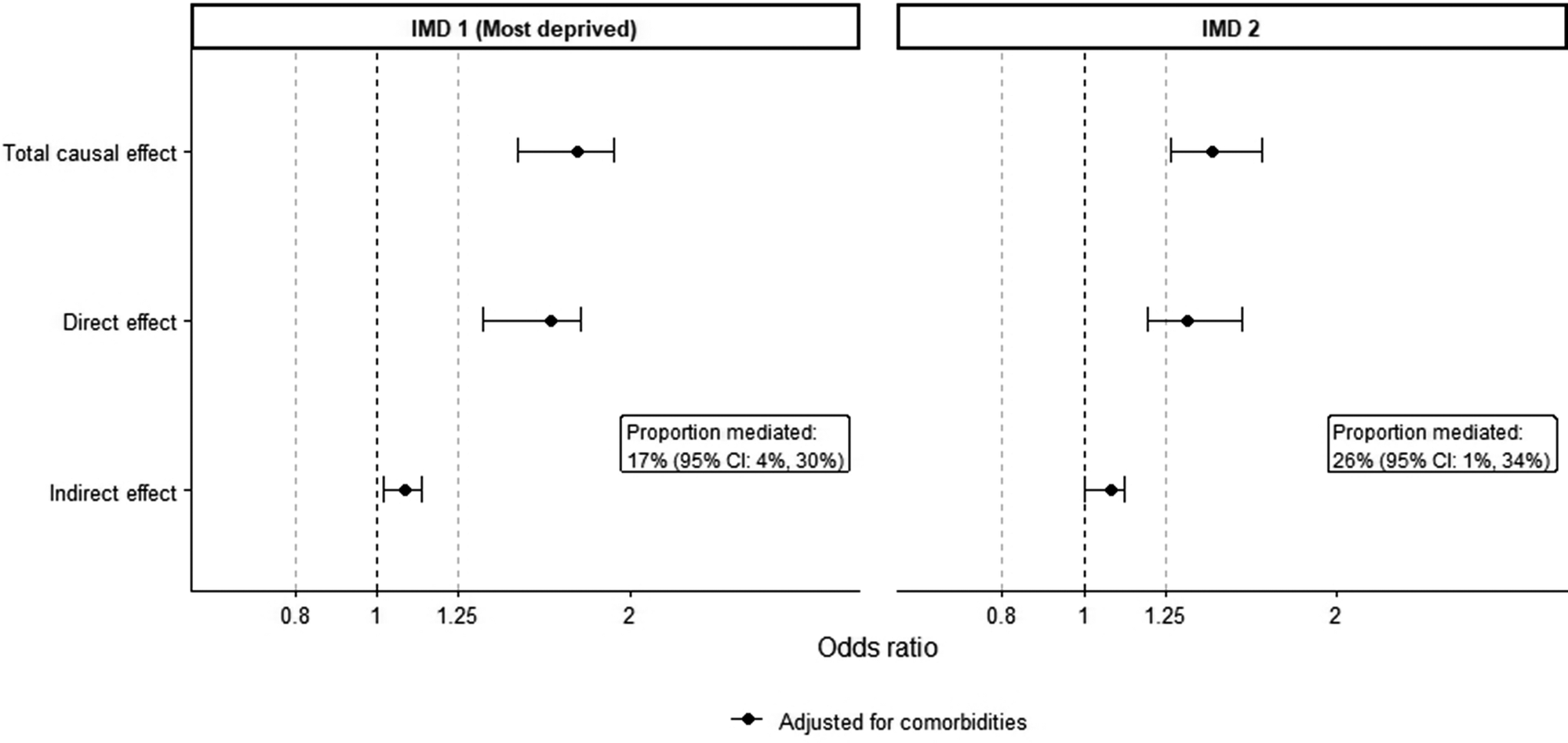
Mediation analyses were performed for IMD1 and IMD2 only. For individuals in IMD1, the indirect effect mediated by vaccination uptake, conditioning on comorbidities, was significant (Figure 3, Table 6) (OR 1.1; 95% CI: 1.02, 1.13), accounting for 17% of the total causal effect. A similar pattern was observed for IMD2, (indirect OR 1.1; 95% CI: 1.00, 1.12; proportion mediated 26%). Indirect effects through comorbidities alone were not significant (Table 6). Direct effects of deprivation were statistically significant for both IMD1 and IMD2, and remained disproportionate for IMD1, after accounting for vaccination uptake, indicating incomplete mediation.
Effect of deprivation on influenza hospitalization with mediation by vaccination status in vaccine-eligible population in England, 1 September 2023 to 31 March 2024.

Figure 3. Long description
Outputs from causal mediation analysis of the effect of deprivation on influenza hospitalization. The plot shows the total causal effect for the two most deprived quintiles of the England population (IMD 1 and IMD 2) and how these are decomposed into a direct effect and an indirect effect which is mediated by vaccination uptake. Odds ratios from the model are presented with 95% confidence intervals. The proportion of the effect mediated by vaccination uptake is also reported. Values are reported in the text and in Table 6.
Effect of deprivation on influenza and COVID-19 hospitalization, proportion mediated by comorbidities and vaccination uptake

Table 6. Long description
Results of causal mediation analysis. Total causal effect of deprivation on influenza and COVID-19 hospitalization, decomposed into the direct effect of deprivation and the indirect effects mediated by vaccination uptake, conditioning on comorbidities and by comorbidities. 95% confidence intervals and proportions mediated are also shown. Key findings are given in the text.
a The reference group was taken as deprivation quintile: IMD 5 (least deprived). Only IMD quintile pairwise comparisons with disproportionate total causal effects were included in the mediation analysis (IMD1, IMD2). Exposure: deprivation; Pre-exposure confounders: age group, sex, region, ethnic group; Mediator: vaccination status; Post-exposure confounder: comorbidities.
b The reference group was taken as deprivation quintile: IMD 5 (least deprived). Only IMD quintile pairwise comparisons with disproportionate total causal effects were included in the mediation analysis (IMD1). Exposure: deprivation; Pre-exposure confounders: age group, sex, region, ethnic group; Mediator: vaccination status; Post-exposure confounder: comorbidities.
c The reference group was taken as deprivation quintile: IMD 5 (least deprived). Only IMD quintile pairwise comparisons with disproportionate total causal effects were included in the mediation analysis (IMD1, IMD2). Exposure: deprivation; Pre-exposure confounders: age group, sex, region, ethnic group; Mediator: comorbidities.
d The reference group was taken as deprivation quintile: IMD 5 (least deprived). Only IMD quintile pairwise comparisons with disproportionate total causal effects were included in the mediation analysis (IMD1). Exposure: deprivation; Pre-exposure confounders: age group, sex, region, ethnic group; Mediator: comorbidities.
COVID-19
Total causal effects
No ethnic group had disproportionately high odds of COVID-19 hospitalization (model 1, Table 3). Of the 15 ethnic groups, 4 had disproportionately low odds of COVID-19 hospitalization; the Black African group (OR 0.5, 95% CI: 0.44, 0.58), the any other Black background group (OR 0.6, 95% CI: 0.45, 0.70), the Indian group (OR 0.6, 95% CI: 0.53, 0.65), and the Chinese group (OR 0.4, 95% CI: 0.32, 0.55). Only IMD1 had disproportionately high odds compared with the least deprived, with odds of 1.5 (95% CI: 1.43, 1.55) (model 2, Table 4), a smaller difference than observed for influenza.
Mediation analysis
Ethnic group mediation was not conducted due to the absence of disproportionate total effects. For IMD1, the indirect effect mediated by vaccination uptake, conditioning on comorbidities, was significant (Figure 3, Table 6) (OR 1.2, 95% CI: 1.01, 1.20). The estimated proportion mediated was high (97%) but unstable, with wide confidence intervals, limiting interpretability. No significant indirect effects were observed for comorbidities alone (Table 6). Overall, after accounting for vaccination uptake and comorbidities, no meaningful residual deprivation inequality in COVID-19 hospitalization remained.
Model checks
For total causal effect models with ethnic group as the exposure, inclusion of age, sex, and region as competing exposures reduced both the Akaike Information Criterion (AIC) and Bayesian Information Criterion (BIC) relative to unadjusted models for influenza and COVID-19 (Supplementary Table S6). This indicated improved model fit, and these adjusted models were therefore retained as the primary total causal effect specifications.
We assessed whether including mediator–exposure interaction terms in the outcome models improved goodness of fit. For influenza, when ethnic group was the exposure and deprivation the mediator, inclusion of an interaction term increased both AIC and BIC (Supplementary Table S7, Table 1), indicating poorer model fit. Mediation by ethnic group was not conducted for COVID-19; therefore, interaction testing was not applicable for this specification.
When deprivation was the exposure and vaccination uptake the mediator, inclusion of a mediator–exposure interaction had mixed support. For influenza, the interaction decreased BIC but increased AIC (Supplementary Table S7, Table 2), suggesting that while the interaction captured some systematic structure in the data, it did not materially improve predictive performance [Reference Shmueli25]. In contrast, for COVID-19, both AIC and BIC decreased, indicating improved model fit. Mediation results including interaction terms for vaccination uptake were compared with primary analyses and showed consistent effect estimates and conclusions for both infections (Supplementary Table S8, Tables 1 and 2).
Variance inflation factors (VIFs) for all covariates in the models (excluding interactions terms) were below five, indicating no evidence of problematic multicollinearity under standard thresholds [Reference Baskaran, Lim and McKeever26,27]. Interaction terms were excluded from VIF assessment, as elevated VIFs are expected in the presence of interactions.
Sensitivity analyses: Comorbidities
Because comorbidities form part of the eligibility criteria for vaccination, analyses restricted to the eligible cohort are subject to selection bias. Among individuals aged 17–64, eligibility is based solely on comorbidity status, whereas children aged 2–16 (influenza) and adults aged ≥65 (influenza and COVID‑19) include individuals both with and without comorbidities due to age-based eligibility. As a result, in some age strata, comorbidity status is deterministically related to eligibly, leading to limited variation and structural dependence between age and comorbidity indicators. Consequently, estimates from the eligible cohort primarily describe how inequalities operate within this selected population, rather than the contribution of comorbidities in the general population.
To assess the impact of this selection, we repeated mediation analyses stratified by age group. For influenza, results for ages 2–16 and ≥65 were compared with the full eligible cohort analysis. For COVID‑19, results for those aged ≥65 were compared with the full eligible cohort analysis. Mediation by ethnic group was not examined for COVID-19 due to the absence of disproportionate total effects.
For influenza, when ethnicity was the exposure, comorbidities were not a significant mediator among children aged 2–16 (Supplementary Table S14, Table S14.1b), consistent with results from the full eligible cohort analysis (Table 5). Among adults aged ≥65, however, comorbidities significantly mediated ethnic group differences, conditioning on deprivation, with indirect effects of 1.2 for both Pakistani and Bangladeshi groups, corresponding to proportions mediated of 33% and 29%, respectively. Deprivation remained an important mediator of ethnic group effects in both age strata (Supplementary Table S14, Table S14.1a).
When deprivation was the exposure, comorbidities were not a significant mediator of the deprivation–hospitalization association for either infection in age-stratified analyses, consistent with the full eligible cohort analysis (Supplementary Table S15, Tables 3 and 4). However, for influenza, age stratification decreased evidence for mediation by vaccination uptake when conditioning on comorbidities, as indirect effects were no longer significant in these models (Supplementary Table S15, Table 1). In contrast, for COVID‑19, among those aged ≥65, almost all the deprivation effect was mediated through vaccination uptake, conditioning on comorbidities (Supplementary Table S15, Table 2), whereas no residual deprivation effect was observed in the full eligible cohort analysis (Table 6).
We also repeated all mediation analyses for the whole population, where comorbidities were not subject to selection. Patterns of total ethnic and deprivation inequalities were similar to those observed in the eligible cohort, although effect sizes were marginally larger in some cases (Supplementary Tables S9 and S10). In the whole-population mediation analyses with ethnicity as the exposure (influenza only, Supplementary Table S11), deprivation remained as the important mediator. Unlike in the eligible cohort, comorbidities mediated part of the ethnic group effect for the Bangladeshi group (indirect effect OR = 1.1, 95% CI: 1.02, 1.18, proportion mediated 16%). For deprivation as the exposure, vaccination uptake mediated influenza inequalities for the most deprived group (IMD1), while for COVID-19, adjustment for vaccination uptake and comorbidities eliminated residual deprivation inequalities (Supplementary Table S13), consistent with eligible-cohort findings. Unlike eligible-cohort analyses, comorbidities alone were an important mediator of COVID-19 deprivation inequalities in the whole population (indirect effect OR = 1.2, 95% CI: 1.05, 1.37, proportion mediated 51%), in contrast to results from the eligible cohort.
Overall, within analyses restricted to the full eligible cohort, comorbidities did not appear to mediate ethnic or deprivation inequalities, partly because eligibility itself is determined by comorbidity status. Vaccination policy targets those most at risk, partly based on comorbidity status, which aims to mitigate inequalities between ethnic group and deprivation inequalities in the whole population. Within the eligible cohort, in age groups with variation in comorbidities, and in analyses of the whole population, comorbidities played a more substantial mediating role for selected groups and outcomes. Because whole-population analyses include additional causal pathways not related to vaccination eligibility, findings from the eligible cohort should not be extrapolated beyond this selected population.
Discussion
In the vaccine-eligible cohort, inequalities in hospitalization were substantially greater for influenza than for COVID-19. For influenza, people from the Pakistani and Bangladeshi groups had disproportionately higher odds of hospitalization than the White British group. No ethnic groups had disproportionately higher odds of COVID-19 hospitalization, with several groups, including the Chinese and Black African groups, having lower odds than the White British group, which may reflect differences in infection exposure, social and occupational contact patterns, healthcare-seeking behaviours, and uptake of protective health behaviours. Deprivation-based inequalities were evident for both types of infection but were larger for influenza.
The comparatively lower risk of COVID-19 hospitalization for ethnic minority groups found in this study is in stark contrast to early stages of the pandemic (2020–2021) when most ethnic groups had significantly worse outcomes compared to the White British group. Given widespread evidence of current ethnic group inequalities in respiratory disease [28], our finding is perhaps surprising. However, it is congruent with other research: the ONS found no evidence of ethnic minority groups having higher COVID-19 mortality compared to the White British group during the Omicron period (January–December 2022) [29]. Historically, increased risk of infection was the main driver of disproportionate clinical outcomes for COVID-19 in ethnic minority groups, with smaller differences observed for subsequent outcomes, including hospitalization [Reference Irizar6]. Ethnic minority groups may have acquired higher levels of immunity to SARS-CoV-2 because of their greater likelihood of previous infection, which, in turn, may have contributed to the attenuation of ethnic group inequalities in COVID-19 hospitalization in more recent periods [Reference Pan30].
Deprivation was an important mediator of ethnic group inequalities for influenza. For the Pakistani and Bangladeshi groups, approximately 26%–41% of the excess odds of hospitalization were mediated through differences in deprivation. These estimates will include the unmeasured variables in our DAG (Figure 1), and differences in vaccination uptake – our approach was unable to decompose these for ethnic group. Other unmeasured variables linked to deprivation that may contribute to the effect include persistent differences in occupational exposure to infection [31–Reference Rhodes33], housing and neighbourhood conditions, including exposure to air pollution [Reference Balogun, Rankl and Wilson34,35], and psychosocial and sociocultural determinants for health-related behaviours [Reference Flowers36]. Lifestyle factors, such as smoking [Reference Baskaran, Lim and McKeever26], are closely linked to deprivation and further increase vulnerability to severe respiratory infection. Many of these determinants are shaped by wider social and economic policies and deserve further research and evaluation. Tackling deprivation would offer widespread health benefits but is inherently more challenging than improving vaccination coverage.
Vaccination uptake was an important mediator in deprivation inequalities for influenza and COVID-19 hospitalization, after accounting for differences between deprivation levels in age, sex, region, ethnic group, and comorbidities. For influenza, differences in vaccination uptake accounted for around 17% to 26% of the excess hospitalization risk among people living in the most deprived areas (IMD1 and IMD2). For COVID-19, there was no residual difference between deprivation levels after including vaccination uptake and comorbidities. As a modifiable factor, vaccination uptake represents a clear and actionable target for public health interventions to reduce inequalities for both respiratory infections. For example, if vaccination uptake was increased across ethnic groups and deprivation levels with low coverage, hospitalization rates would reduce and be more similar to the White British group and the least deprived areas.
Within the eligible cohort, comorbidities did not play a significant mediating role in deprivation inequalities, nor in ethnic group inequalities, after conditioning on deprivation. However, as vaccine eligibility in some age groups was based on comorbidity status, the lack of effect may be explained by selection bias. Comorbidities remain an important determinant of hospitalization overall, and in mediating inequalities for certain groups, as shown in whole-population analyses and age-stratified analyses of the eligible cohort (Supplementary Tables S9–S15). Whilst the prevalence of comorbidities could be reduced, this would require long-term changes across the health system, so they are less amenable to policy action than vaccination uptake – apart from their existing application in prioritising vaccination.
Several limitations should be acknowledged. The results depend on the assumptions encoded in the DAG and mediation models. For ethnic group, we only considered the proportion of the effect mediated by deprivation and comorbidities; the remaining direct effect could be decomposed further into the effect due to vaccination uptake or other unmeasured factors. For deprivation, we only considered the role of comorbidities, and then vaccination uptake, conditioned on comorbidities. Future work should explore more complex mediation structures involving multiple intermediate confounders. We also made simplifying assumptions about the variables included in the DAG, and the temporal order of variables, for instance, that region precedes an individual’s deprivation status. There are likely to be more complex interactions over time and additional unmeasured factors not included here. This analysis did not examine inequalities in infection risk, healthcare access, or care experiences, for instance, due to racism or discrimination [27], nor outcomes following hospitalization. Findings reflect hospitalization risk among infected individuals within the vaccine eligible cohort during a 2023–2024 in England and may not generalize to other contexts or time periods.
Improving vaccination uptake in groups with low coverage would likely reduce hospitalization inequalities. Lessons from the COVID-19 pandemic highlight the importance of accessible and inclusive communications, which address vaccine concerns, and the use of trusted community and healthcare networks to provide accurate information [Reference Kamal, Hodgson and Pearce37]. Tailored, locally co-designed solutions, alongside strengthened core national vaccination offers in General Practice and to school-age children, must remain a policy priority [38]. However, reducing ethnic and socio-economic inequalities in respiratory infections requires wider action on the underlying social determinants of health, particularly poverty, alongside efforts to improve vaccination uptake.
Supplementary material
The supplementary material for this article can be found at http://doi.org/10.1017/S0950268826102180.
Data availability statement
The UK Health Security Agency (UKHSA) operates a robust governance process for applying to access protected data that considers:
-
• the benefits and risks of how the data will be used
-
• compliance with policy, regulatory, and ethical obligations
-
• data minimization
-
• how the confidentiality, integrity, and availability will be maintained
-
• retention, archival, and disposal requirements
-
• best practice for protecting data, including the application of ‘privacy by design and by default’, emerging privacy conserving technologies, and contractual controls
Access to protected data is always strictly controlled using legally binding data sharing contracts. UKHSA welcomes data applications from organizations looking to use protected data for public health purposes. To request an application pack or discuss a request for UKHSA data you would like to submit, contact DataAccess@ukhsa.gov.uk.
Acknowledgements
We thank NHS England for providing the data used in this analysis. We are grateful for the contributions and review from UKHSA colleagues, including Steve Parratt and the following teams: Public Health Analysis, Health Equity and Inclusion Health, Statistics, Infectious Disease Modelling, and Immunizations and Vaccine Preventable Diseases. We would also like to thank the anonymous reviewers for their helpful suggestions which greatly improved the paper.
Author contribution
Conceptualization: M.S., L.B., L.G.; Data curation: T.R.; Formal analysis: M.S., L.B., T.R., J.D.B.; Investigation: M.S., L.B., J.D.B.; Methodology: M.S., L.B., J.D.B., Z.R., L.G.; Project administration: M.S.; Validation: T.R., Z.R.; Visualization: T.R.; Writing - original draft: M.S., L.B.; Writing - review & editing: M.S., L.B., L.G.
Funding statement
The authors were employed by the UKHSA but received no specific funding for this study.
Competing interests
The authors declare none.





 Open access

