Introduction
Multidrug-resistant organisms (MDROs) represent one of the most pressing challenges to contemporary healthcare. Infections caused by carbapenem-resistant Enterobacterales, multidrug-resistant (MDR) Pseudomonas aeruginosa and Acinetobacter spp., and vancomycin-resistant enterococci (VRE) are associated with excess mortality, prolonged hospitalization, and substantial healthcare costs. Large burden-of-disease analyses indicate that antimicrobial resistance is responsible for hundreds of thousands of deaths annually in Europe, with Southern and Eastern European countries disproportionately affected. Reference Cassini, Högberg and Plachouras1,2 Greece remains among the countries with the highest prevalence of carbapenem-resistant Klebsiella pneumoniae and Acinetobacter spp., underscoring the need for effective hospital-based containment strategies. Reference Galani, Karaiskos and Giamarellou3 In particular, Greece has experienced a sustained and alarming increase in MDR Klebsiella pneumoniae, with complex resistance phenotypes becoming endemic in hospital settings. Reference Maraki, Mavromanolaki and Kasimati4
Colonization with MDROs precedes most healthcare-associated infections and constitutes the principal reservoir for onward transmission. Carriers have a markedly increased risk of subsequent invasive infection, including bloodstream infection and surgical site infection, with significant associated morbidity and mortality. Reference Heath, Fan and Leu5–Reference Li, Zhang and Chen7 Consequently, international guidelines from the World Health Organization and the U.S. Centers for Disease Control and Prevention emphasize active surveillance of high-risk patients as a cornerstone of infection prevention and control (IPC) programs. 8,Reference Siegel, Rhinehart and Jackson9 Early identification of carriers enables timely implementation of contact precautions, cohort isolation, and targeted interventions that limit transmission and outbreak propagation. Reference Magill, O’Leary and Janelle10,Reference Tsakris, Poulou and Pournaras11
Despite the widespread use of screening programs, there is no consensus on the optimal anatomical sites for sampling, and many hospitals apply uniform multisite strategies irrespective of the target organism. This approach may be inefficient because MDROs occupy distinct ecological niches. Gram-negative MDROs and enterococci predominantly colonize the gastrointestinal tract, where antimicrobial selective pressure facilitates persistence and horizontal gene transfer. Reference Heath, Fan and Leu5,Reference Dimartino, Venditti and Messina12 Rectal carriage of carbapenem-resistant Enterobacterales and VRE is strongly associated with subsequent infection and underpins most current surveillance protocols. Reference Vock, Ragozzino and Urwyler13 In contrast, the emerging fungal pathogen Candida auris preferentially colonizes skin and intertriginous areas rather than the gastrointestinal tract. Surveillance and outbreak investigations consistently demonstrate superior yield from groin and axillary swabs, reflecting the organism’s skin tropism and environmental persistence. Reference Chowdhary, Sharma and Meis14–Reference Ruiz-Gaitán, Moret and Tasias-Pitarch16
These biological differences imply that a “one-size-fits-all” screening strategy risks both unnecessary laboratory workload and clinically important false-negative surveillance. However, comparative real-world data quantifying site-specific detection across multiple MDROs remain limited, particularly in high-burden hospital settings. Reference Vock, Ragozzino and Urwyler13,Reference Jiang, Pu and Huang17
We recently described the prevalence, microbiological spectrum, and ward-level distribution of MDRO colonization in a large prospective surveillance cohort from a tertiary academic hospital in Northern Greece, a setting characterized by endemic carbapenem-resistant Enterobacterales and the emergence of Candida auris Reference Myrou, Savvakis and Kiouli18 . Building on that data set, the present analysis addresses a clinically actionable IPC question: which anatomical site provides the highest diagnostic yield for each MDRO? By quantifying pathogen-specific detection across rectal and groin swabs, we aim to inform more efficient, targeted, and resource-conscious surveillance strategies in hospitals facing a high burden of antimicrobial resistance.
Methods
Study design and setting
This study is a pathogen-specific secondary analysis of a prospective MDRO surveillance program conducted at AHEPA University Hospital, a 700-bed tertiary academic center in Thessaloniki, Northern Greece. The hospital serves as a regional referral center for medical, neurological, and surgical specialties and operates in a setting with a high burden of antimicrobial resistance. Surveillance was performed from October 1, 2024, to January 31, 2025. The overall surveillance framework, ethical approvals, and microbiological procedures have been described previously. Reference Myrou, Savvakis and Kiouli18
Patient population and eligibility
Hospitalized adult patients were eligible for MDRO screening if they met at least one predefined infection-control criterion: hospitalization longer than 7 days, transfer from another healthcare facility or long-term care facility, admission to a high-risk ward (e.g., intensive care unit or hematology), contact tracing after exposure to a confirmed MDRO-positive patient, or a documented history of MDRO colonization or infection. These criteria are aligned with international recommendations for targeted MDRO surveillance in high-risk hospital populations. 8,Reference Siegel, Rhinehart and Jackson9
Sampling strategy and anatomical sites
Screening swabs were obtained by trained nursing staff using standardized sterile technique. Two anatomical sites were targeted: the rectum and the groin (inguinal region). Rectal swabs were used to detect gastrointestinal carriage of Gram-negative MDROs and VRE, whereas groin swabs were used to detect skin-associated pathogens including Candida auris. Multisite sampling was performed in patients with central venous or urinary catheters, prolonged or broad-spectrum antimicrobial exposure, chronic wounds or pressure ulcers, ICU or hematology admission, or prior MDRO history, reflecting evidence that these factors increase the probability of multisite colonization. Reference Heath, Fan and Leu5,Reference Para, Georgopoulou and Metallidis6
Microbiological methods
All specimens were transported promptly to the microbiology laboratory and processed according to standardized protocols. Selective chromogenic media were used for pathogen isolation: CHROMagar™ ESBL for extended-spectrum β-lactamase–producing Enterobacterales, CHROMagar™ VRE for vancomycin-resistant enterococci, and CHROMagar™ Candida Plus for Candida auris. Screening for MDR Klebsiella pneumoniae included both extended-spectrum β-lactamase (ESBL)–producing and carbapenem-resistant strains. Carbapenem resistance was identified through antimicrobial susceptibility testing using the VITEK® 2 system according to EUCAST 2024 breakpoints. MDROs were defined as organisms exhibiting phenotypic resistance to at least one antimicrobial agent in three or more antimicrobial classes, in accordance with international consensus definitions. Reference Magiorakos, Srinivasan and Carey19,Reference Tacconelli, Carrara and Savoldi20 For Candida auris, identification was based on species-level detection due to its intrinsic multidrug resistance and outbreak potential.
Data collection
For each screened patient, demographic variables (age and sex), ward of hospitalization, indication for screening (contact tracing, prolonged hospitalization, inter-facility transfer, high-risk ward admission, or prior MDRO history), anatomical site of sampling, and microbiological results were recorded in a dedicated surveillance database. For patients who underwent multisite sampling, each specimen was analyzed separately to enable site-specific detection analyses.
Outcomes
The primary outcome was pathogen-specific detection by anatomical site. For each MDRO, the proportion of total isolates detected by rectal and groin swabs was calculated. Secondary outcomes included the relative contribution of each anatomical site to overall MDRO detection and the proportion of isolates that would have been missed if surveillance had relied on a single anatomical site.
Statistical analysis
Categorical variables are presented as counts and percentages, and continuous variables as medians with interquartile ranges. Pathogen-specific detection yields were calculated descriptively. Analyses were performed using IBM SPSS Statistics version 28.0 and R version 4.3.1, consistent with the primary cohort study. Given the descriptive, surveillance-focused nature of the analysis, no adjustment for multiple comparisons was applied.
Ethical considerations
This study was conducted as part of the hospital’s routine infection prevention and control surveillance program. Patient data were fully anonymized prior to analysis, and no study-specific interventions were performed. The study protocol was reviewed and approved by the Scientific Committee of AHEPA University General Hospital. Informed consent was obtained from all participants or their legal guardians prior to screening, in accordance with the approved hospital infection control protocol.
Results
Study population and sampling profile
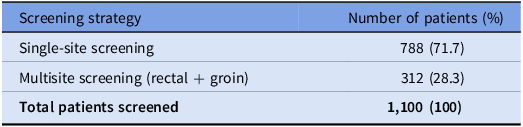
During the four-month surveillance period (October 2024–January 2025), 1,206 screening swabs were obtained from approximately 1,100 unique hospitalized patients. Of these patients, 312 (28.3%) underwent multisite sampling involving both rectal and groin swabs, whereas 788 (71.7%) were screened using a single anatomical site (Table 1). Rectal (n = 614) and groin (n = 584) swabs accounted for nearly all specimens collected during the surveillance period.
Screening strategy among hospitalized patients undergoing MDRO surveillance

Overall MDRO detection
Of the 1,206 swabs, 308 (25.5%) were positive for at least one MDRO. At the patient level, approximately 28% of screened individuals were colonized. Co-colonization with two or more MDRO species was observed in 47 patients (15.3% of MDRO-positive cases), indicating a substantial burden of multidrug resistance in this hospital population.
The most frequently detected organisms were MDR Klebsiella pneumoniae (n = 96), Pseudomonas aeruginosa (n = 69), vancomycin-resistant enterococci (VRE; n = 59), Acinetobacter spp. (n = 33), and Candida auris (n = 27), with marked heterogeneity in their anatomical distribution.
Pathogen-specific detection by anatomical site
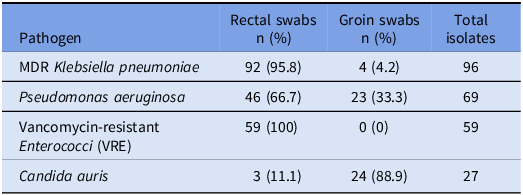
Clear pathogen-specific differences in detection by anatomical site were observed (Table 2). Rectal swabs identified nearly all MDROs colonizing the gastrointestinal tract, including 92 of 96 MDR Klebsiella pneumoniae isolates (95.8%), all 59 VRE isolates (100%), and 46 of 69 Pseudomonas aeruginosa isolates (66.7%). In contrast, groin swabs were the dominant site for Candida auris, detecting 24 of 27 isolates (88.9%), whereas only three cases were identified from rectal swabs. Acinetobacter spp. were detected in the surveillance cohort; however, incomplete site-level data precluded inclusion in the site-specific detection analysis.
Pathogen-specific detection by anatomical site

Table 2. Long description
The table presents data on pathogen-specific detection rates by anatomical site, focusing on rectal and groin swabs. It includes four pathogens: multi-drug-resistant Klebsiella pneumoniae, Pseudomonas aeruginosa, vancomycin-resistant Enterococci, and Candida auris. The table has four rows for each pathogen and three columns for rectal swabs, groin swabs, and total isolates. Rectal swabs detected ninety-two of ninety-six multi-drug-resistant Klebsiella pneumoniae isolates, representing ninety-five point eight percent, and all fifty-nine vancomycin-resistant Enterococci isolates, representing one hundred percent. Groin swabs detected four of ninety-six multi-drug-resistant Klebsiella pneumoniae isolates, representing four point two percent, and twenty-four of twenty-seven Candida auris isolates, representing eighty-eight point nine percent. Rectal swabs detected forty-six of sixty-nine Pseudomonas aeruginosa isolates, representing sixty-six point seven percent, and groin swabs detected twenty-three of sixty-nine Pseudomonas aeruginosa isolates, representing thirty-three point three percent.
Percentages represent the proportion of isolates detected from each anatomical site for each pathogen. Data are derived from the prospective MDRO surveillance cohort at AHEPA University Hospital (October 2024–January 2025).
Among patients who underwent multisite sampling, pathogen detection frequently differed between anatomical sites, with rectal swabs identifying most MDROs colonizing the gastrointestinal tract and groin swabs detecting most of Candida auris carriers.
Missed detection under single-site screening strategies
Anatomical site selection had a major impact on surveillance sensitivity. If rectal swabs alone had been used, 24 of 27 Candida auris carriers (88.9%) would have remained undetected. Conversely, if groin swabs alone had been used, 95.8% of Klebsiella pneumoniae carriers and all VRE carriers would have been missed. These findings demonstrate a high frequency of false-negative surveillance outcomes when sampling is not aligned with pathogen ecology.
MDRO detection by indication for screening
Contact tracing was strongly associated with MDRO positivity: 51.3% of MDRO-positive patients were screened because of contact with a known carrier, compared with 27.6% among MDRO-negative patients. In contrast, prolonged hospitalization alone did not meaningfully differentiate MDRO-positive from MDRO-negative individuals, suggesting that exposure to colonized patients was a more important determinant of acquisition than length of stay.
Ward-level distribution
Internal medicine wards accounted for the largest share of MDRO detections (30.8% of swabs positive), followed by neurology (10.7%), neurosurgery (8.2%), and surgical wards (3.5%). Candida auris was detected predominantly in non-surgical units, reinforcing the importance of groin screening in high-risk medical wards.
Discussion
This pathogen-specific analysis of a large hospital-wide MDRO surveillance cohort demonstrates that anatomical site selection is a central determinant of screening sensitivity. Rectal swabbing provided near-complete detection of MDROs colonizing the gastrointestinal tract, including MDR Klebsiella pneumoniae (encompassing ESBL-producing and carbapenem-resistant strains) and VRE, whereas groin sampling was indispensable for identifying Candida auris. Together, these findings suggest that a uniform, multisite screening strategy may be inefficient and risks substantial under-detection of clinically important pathogens.
The gastrointestinal tract is the primary ecological reservoir for Gram-negative MDROs and enterococci. Intestinal colonization with carbapenem-resistant Enterobacterales and VRE is strongly associated with subsequent invasive infection, including bloodstream infection, and with increased mortality. Reference Heath, Fan and Leu5–Reference Li, Zhang and Chen7 Accordingly, rectal screening has become the cornerstone of MDRO surveillance programs. Our observation that 95.8% of Klebsiella pneumoniae and 100% of VRE isolates were detected by rectal swabs confirms the dominant role of gastrointestinal carriage in the epidemiology of these organisms and supports the continued prioritization of rectal sampling for their detection.
In contrast, Candida auris displays a distinct epidemiological profile. Unlike most invasive yeasts, it preferentially colonizes the skin and intertriginous areas and persists on environmental surfaces, facilitating prolonged transmission within healthcare facilities. Reference Chowdhary, Sharma and Meis14 Surveillance and outbreak investigations consistently demonstrate that groin and axillary swabs provide the highest detection yield. Reference Ruiz-Gaitán, Moret and Tasias-Pitarch16 In our cohort, nearly 90% of Candida auris carriers would have been missed if surveillance had relied solely on rectal screening, highlighting the substantial risk of silent transmission when pathogen-specific ecology is not considered.
These findings are particularly relevant for hospitals in Southern and Eastern Europe, where MDRO prevalence remains among the highest in the European Union and where Candida auris is increasingly reported. Greece continues to face endemic carbapenem-resistant Klebsiella pneumoniae and Acinetobacter spp., together with a rising burden of non-albicans Candida species in hospital outbreaks. Reference Galani, Karaiskos and Giamarellou3,Reference Maraki, Mavromanolaki and Kasimati4 In such high-burden settings, surveillance strategies that fail to account for pathogen-specific colonization patterns may both waste resources and delay outbreak recognition.
From a hospital epidemiology and health-economics perspective, pathogen-targeted, site-directed screening offers a more efficient alternative to universal multisite sampling. Routine collection of multiple swabs from all high-risk patients is labor-intensive and costly, particularly in large tertiary centers with constrained microbiology capacity. Modeling and observational studies suggest that tailoring sampling strategies to pathogen ecology can achieve equivalent or superior detection rates while reducing unnecessary testing. Reference Vock, Ragozzino and Urwyler13 Our data provide empirical support for this approach, showing that rectal and groin swabs deliver complementary but non-redundant information: rectal sampling identifies the intestinal reservoir of Gram-negative MDROs and VRE, whereas groin sampling captures skin-associated Candida auris carriers who would otherwise remain undetected.
This study has limitations. Sampling was guided by clinical risk criteria rather than systematic multisite screening of all patients, which may have introduced selection bias. In addition, incomplete site-specific data for Acinetobacter spp. precluded precise determination of its optimal sampling site. Molecular typing was not available to assess transmission networks. Nevertheless, the large prospective cohort, standardized microbiological methods, and real-world hospital setting strengthen the relevance of these findings for other high-prevalence tertiary-care hospitals.
In summary, our results support a shift from uniform multisite MDRO screening to pathogen-targeted, site-specific surveillance. Prioritizing rectal sampling for Gram-negative MDROs and VRE and groin sampling for Candida auris can enhance early detection, improve allocation of infection-control resources, and reduce the risk of undetected transmission in hospitals facing a high burden of antimicrobial resistance.
Financial support
This study received no external funding. The surveillance program was conducted as part of routine infection prevention and control activities at AHEPA University Hospital.
Competing interests
The authors declare that they have no conflicts of interest relevant to this study.