There has been a growing interest in diffusion research in the study of American politics in recent years (e.g., Shipan and Volden Reference Shipan and Volden2006; Shipan and Volden Reference Shipan and Volden2008; Nicholson-Crotty Reference Nicholson-Crotty2009). The core question at the heart of this research is whether the decisions of political actors are influenced by the decisions of other political actors. In the congressional literature, in particular, there has long been a consensus that members of Congress are attentive to their colleagues’ behavior. However, few studies have been in a position to offer insights into the processes that produce these social dynamics. This is not an indictment of existing scholarship, but rather a consequence of the inherent difficulties associated with identifying empirical measures of diffusion. More often than not, legislative behavior, such as roll-call voting, is not accompanied by information regarding how individual members arrived at their decisions. Even when researchers engage in extensive “soaking and poking,” such dynamics are difficult to uncover.
As such, we can identify correlations in behavior (e.g., by comparing voting behavior across members), but we typically cannot say whether the correlation is due, for example, to peer pressure or learning, which would, at a minimum, require information about the timing of individual decisions. At the same time, it is very clear that a better understanding of the mechanisms that underlie the diffusion of legislative behavior would offer valuable insights into broader questions of political representation and accountability. Particularly in the US Congress, where the demands on members are too great for their decisions to be independent and informed on all matters, it is important to understand how social dynamics develop (i.e., behavior diffuses).
We know that behaviors can diffuse through organizations in a variety of ways that vary dramatically in terms of the extent to which individuals process the information they receive about those behaviors. At one extreme, a behavior can be transmitted by its mere existence. That is, individuals within the organization adopt a behavior on the basis of simply observing it, which requires no critical evaluation whatsoever. At the other extreme, individuals engage with information about behavioral adoptions in more cognitively demanding ways, by evaluating the observed returns to the behavior against their (potentially well developed) prior beliefs about its costs and benefits. Given the wide array of possible diffusion mechanisms, understanding how information diffuses within Congress offers valuable insights about important aspects of the organization. For example, we can learn how legislators engage with the information they receive about the behaviors adopted by their colleagues, which is central to our understanding of how members approach representation and what outcomes emerge from collective legislative decision-making.
This project demonstrates how recent theoretical innovations can be used to distinguish between different forms of diffusion (Young Reference Young2009). A basic requirement of this method is the availability of data that document the timing of behavioral adoptions. Due to recent reforms of the congressional discharge procedure, which is used to force a measure out of committee for floor consideration, we now have data on the timing of one important form of legislative behavior—discharge petition signing. The availability of these new data has spurred a substantial increase in scholarship on the discharge petition (e.g., Krehbiel Reference Krehbiel1995; Binder, Lawrence and Maltzman Reference Binder, Lawrence and Maltzman1999; Crombez, Groseclose and Krehbiel Reference Crombez, Groseclose and Krehbiel2006; Lindstädt and Martin Reference Lindstädt and Martin2007; Patty Reference Patty2007; Pearson and Schickler Reference Pearson and Schickler2009). We note that, while discharge petition data are unique in that they provide us with reasonably precise information on the timing of behavioral adoptions (i.e., signing)—a requirement to empirically discriminate between diffusion models—discharge petition signing shares a number of characteristics with more commonly studied forms of legislative behavior such as roll-call voting, floor speeches, and bill (co)sponsorship (e.g., Krehbiel Reference Krehbiel1995; Schickler, Pearson and Feinstein Reference Schickler, Pearson and Feinstein2010). Most importantly, as is the case for these other forms of legislative behavior, signing a discharge petition is not done without cost (Burden Reference Burden2005). Therefore, while a motivating purpose of this study is the application of an identification strategy intended to discern between diffusion processes, we believe that the empirical findings generated by this method are generalizable beyond discharge petitions to other forms of legislative behavior that involve calculated decision-making.
We find that discharge petition signatures are most likely to follow a social learning process. According to the social learning model, members of Congress combine their privately held information on the viability of signing a discharge petition with the information provided by other members’ signing decisions. This suggests that members of Congress are more inclined to make decisions about discharge petition signatures on the basis of the rational evaluation of information than peer pressure or frequency of interaction—alternative processes of diffusion that have received considerable support in social scientific research (e.g., Kuran Reference Kuran1991; Masket Reference Masket2008).
The paper proceeds as follows. We begin by briefly reviewing the growing literature on diffusion that motivates this research. We then outline the identification strategy developed in previous research that allows us to empirically distinguish between the main candidate diffusion processes, and then detail our empirical test of these theoretical predictions. Finally, we offer some concluding remarks and provide suggestions for further research.
Diffusion in Congress
While there is no shortage of studies that point to associations in behavior among members of Congress (e.g., Fowler Reference Fowler2006a; Fowler 2006Reference Fowlerb; Zhang et al. Reference Zhang, Friend, Traud, Porter, Fowler and Mucha2008; Cho and Fowler Reference Cho and Fowler2010), and therefore provide evidence for the existence of social dynamics in Congress, we are unaware of any research studying the specific mechanisms of behavior dissemination (i.e., diffusion) within the bodies.Footnote 1 Diffusion, in the absence of coercion, requires decision-makers to be autonomous—whereby adoption of behavior is voluntary—yet mindful of the choices made by others (Elkins and Simmons Reference Elkins and Simmons2005; Jacobs Reference Jacobs2012). By this account, many decisions made by members of Congress are particularly well suited for studying diffusion. After all, members of each chamber effectively operate within their own markets as a result of being elected by mutually exclusive constituencies. Consequently, members are not subject to coercion, but rather are independent of one another in determining their own course of action. Moreover, efforts to bind legislative behavior are tenuous at best given that members’ central goal of reelection is furthered more by individual positions than legislative outcomes (Mayhew Reference Mayhew1974).
Studies of legislative behavior have found ample evidence that members learn from one another (e.g., Matthews and Stimson Reference Matthews and Stimson1975). Kingdon (Reference Kingdon1981), for instance, finds that members most frequently cite fellow members when responding to the question “How did you go about making up your mind?” In particular, members rely on the behavior of trusted colleagues. Relatedly, there is evidence that a member’s decision regarding whether or not to cosponsor a bill is, in part, a function of the previous cosponsors (Fowler Reference Fowler2006a; Fowler 2006Reference Fowlerb; Harward and Moffet Reference Harward and Moffet2010). In a study of the California Assembly, Masket (Reference Masket2008) finds that legislators who share desks in the chamber are inclined to vote similarly even when controlling for partisanship. These are merely some examples of studies that demonstrate that a legislator’s behavior reflects awareness of the behavior of other legislators. What remains less clear is the mechanism by which behavior is diffused within Congress in particular, and legislatures more generally. That is, there are several diffusion processes that could produce these findings. After all, members may adopt behaviors for a variety of reasons, all grounded in diffusion and ranging from simple mimicry to rational evaluation of available information. While the indeterminacy of the underlying mechanism of diffusion certainly does not minimize the importance of previous findings, there are various reasons why we would want to probe the underlying dynamics further. These dynamics, for example, have implications for collective outcomes relating to political representation and accountability, which we discuss in more detail below.
In this study, we concentrate on three general classes of diffusion models—contagion, social influence, and social learning. Each of these categories encompasses numerous variations, and there is considerable discrepancy in the terminology used across disparate literatures. We select these categories because they provide realistic possibilities within Congress and are the predominate processes discussed in the literature. Moreover, we are able to empirically discern between them.
The simplest of these models—contagion—describes a diffusion process according to which individuals adopt a behavior by contact with others who have adopted it earlier. We stress that the contagion model, in its most fundamental form, requires no evaluation of the observed practice by the potential adopter. That is, exposure, in and of itself, is sufficient cause for adoption. In the context of Congress, this model suggests that a member determines that a behavior is viable, and thus worthy of adoption, upon observing that another member has adopted this behavior. Studies concluding that the spatial proximity of legislators to one another affects patterns of behavior underscore that the contagion model is a relevant construct in legislative research (e.g., Caldeira and Patterson Reference Caldeira and Patterson1987; Arnold, Deen and Patterson Reference Arnold, Deen and Patterson2000; Masket Reference Masket2008; Bratton and Rouse Reference Bratton and Rouse2011).Footnote 2 Contact in the congressional context can occur in a variety of ways, ranging from a member’s personal exposure to a colleague’s behavior to observing second-hand accounts of behavior. Our empirical analysis allows for a broad definition of contact.
Since the social influence and learning models have some similar characteristics, we refer to them collectively as social diffusion models. There are important theoretical and empirical differences between the contagion and social diffusion models. Notably, the social diffusion models require observation and processing of others’ behavior, as opposed to mere contact. While some sort of contact in the broadest sense is necessary in the social diffusion models, contact is not a sufficient catalyst.
In the social influence model, potential adopters assess the value of certain practices according to the number of previous adopters (e.g., Kuran Reference Kuran1991). Each individual possesses a minimum threshold that drives the individual’s adoption decision. Once the number of adopters preceding her reaches that threshold, the individual will follow suit and adopt the behavior. In short, a potential adopter is influenced by the popularity of a behavior, and there may be variation across individuals in terms of their responsiveness to popularity.
According to the social learning model, individuals combine private information and publicly available information in the form of outcomes or actions by others to determine the viability of a particular behavior (e.g., Bikhchandani, Hirshleifer and Welch Reference Bikhchandani, Hirshleifer and Welch1992). The key difference between the social learning model and the social influence model above is the presence of uncertainty in the former. Whether an individual adopts a particular behavior in the social learning model depends on the relative evaluation of public and private information. For example, assume a distribution of payoffs associated with a behavior, reflecting the possibility that the given practice has variable utility across potential adopters. Moreover, potential adopters incur different costs, known privately, for adopting the behavior. In determining whether to adopt the behavior, each potential adopter considers her prior expectations for the payoff of adoption, her personal costs, and the observed payoffs to previous adopters. If she expects the payoff (i.e., the mean of the payoff distribution) to exceed her costs, she will adopt the practice. As potential adopters observe favorable payoffs reaped by previous adopters, they update their beliefs accordingly and are increasingly likely to follow suit.Footnote 3
Social learning seems to capture well what we know about congressional dynamics. Individual members possess private information about the viability of an action (e.g., cosponsoring a bill, voting against a particular judicial nominee, etc.), but there is some level of uncertainty as to whether adoption is an optimal strategy (e.g., uncertainty over electoral consequences). As a result, members rely not only on their own private information about the situation but also observe the consequences of others’ behavior, thereby rationally considering all of the information that is available to them.Footnote 4
The key to the social diffusion processes (i.e., influence and learning), assuming that they have sufficient force, is that personal considerations beyond the goal of political survival (which is largely invariant across members of Congress) can, at times, be overwhelmed by social dynamics. Stated differently, if personal preferences, to name just one example, always trumped any other consideration, then we should never observe members changing their positions in response to the behavior of others.Footnote 5 Of course, individual preferences are going to condition a member’s susceptibility to social dynamics, such as peer pressure. Importantly, such heterogeneity in predispositions to adopting certain behaviors is accounted for in the following analysis. The processes by which behavior diffuses within social organizations, such as Congress, is of considerable import since they have the potential to profoundly effect the collective decisions produced.
Having briefly outlined why diffusion is important, how it works, and why it deserves consideration in the study of Congress, we proceed to detail the identification strategy for discriminating between the diffusion processes. The interested reader can consult Section A of the Supplemental Appendix for a discussion of the discharge procedure, and why it is a particularly fitting case for studying diffusion in Congress. We reiterate that the focus of this project is the application of the identification strategy. While we believe the results of the analysis below are generalizable to other forms of legislative behavior, discharge petition signing is merely one behavior that lends itself to this analysis given that we can observe temporal patterns of behavior adoption.
Analyzing the Macrobehavior of Discharge Diffusion
Below, we outline the empirical propositions derived by Young (Reference Young2009) for each of the diffusion models discussed above. We then detail the data we use in this study and the methods employed to empirically explore these propositions. We conclude this section with a discussion of the results.
Empirical Predictions
Young (Reference Young2009) provides us with useful propositions for identifying the operative process of (innovation) diffusion in the context of heterogeneous populations of potential adopters. Specifically, the assumptions inherent to each of the diffusion models have specific implications for the dynamic structure of behavioral adoptions. Young’s work identifies the differences across the models in terms of the patterns of adoption acceleration (i.e., rate of change in velocity), and does so for general distributions of heterogenous characteristics. For our purposes, the conditions described by Young permit us to make relatively precise distinctions between the contagion model and the social diffusion models (i.e., social influence and social learning models), and then to discern difference among the social diffusion models. Our application seeks to identify the process that best characterizes the dissemination of behavior surrounding discharge petitions.
The assumption of heterogeneity among potential adopters permits individuals within the population to have different characteristics. Potential adopters, for example, may have different prior information regarding the value of a certain practice or different proclivities (i.e., preferences) toward adoption. The heterogeneity assumption, taken to its logical limit, even permits some members of the population to be entirely resistant to adoption (i.e., immune). Particularly in the case of political actors, we believe that this assumption is far more reasonable (and flexible) than assuming a homogenous population. As a result, it is not necessary to assume that micromotives are constant across legislators in order to apply Young’s approach to the discharge procedure. The identification of macrobehavioral patterns is, therefore, not contingent on explicitly modeling the micromotives.Footnote 6
Young’s approach lends itself well to analyzing the diffusion process that underlies discharge petition signatures. For one, Young’s study focuses on processes that are principally driven by information conveyed via internal feedback (i.e., among group members). Such would seem to be the case with discharge petitions, as petition-related information appears largely to follow pathways of member communication. Also, Young assumes that this feedback is the product of essentially random interaction. While members surely rely on guidance from certain colleagues, there are no fixed networks through which members exclusively receive information. In other words, a member’s observation of adoption behavior is not, in principle, restricted to select colleagues or networks.Footnote 7
In addition, the version of the social learning model explored in Young’s analysis assumes that the outcomes of adoption decisions are directly observable. It seems quite reasonable to assume that potential petition signatories witness the outcomes resulting from previous signatures, such as the responses of party leaders, organized interests, and/or voters. Moreover, it is unlikely that empirical evidence for social diffusion would be a function of uneven exposure to adoptions in the case of discharge petitions, since the filing and signing of petitions are public information (published in the Congressional Record). Therefore, all members can plausibly be assumed to have equal access to information regarding adoptions, suggesting evenness in exposure.
Finally, Young’s approach demands a relatively refined measure of the timing of adoptions as well as data that span the cycle of the adoption process. Both of these empirical requirements are satisfied by the discharge petition signature data, which record the unique days on which signatures were made over the course of the permissible time period (a Congress).
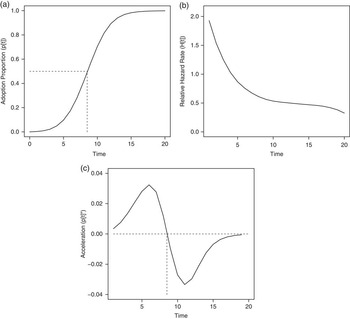
Young finds that a central property of the contagion model is that the hazard rate must be non-increasing relative to the current number of adopters (Young Reference Young2009, 1904).Footnote 8 To be clear, the hazard rate relative to current adopters, referred to as the relative hazard rate, is measured as ∆ t /p t (1−p t ), where p t is the proportion of adopters (i.e., discharge petition signatories) at time t and ∆ t =p t+1 −p t is the rate of change at t. A non-increasing relative hazard rate requires that the adoption curve (i.e., adoptions as a function of time), denoted p(t), decelerate beyond p=0.5. In other words, the contagion process, associated with an S-shaped adoption curve, demands that acceleration (i.e., change in the velocity) of the function must slow once half of the population has adopted the behavior. Figure 1 presents a simulated adoption curve (Figure 1a) that generates a monotonically decreasing relative hazard rate (Figure 1b), and thus meets the criterion for classification as diffusion by contagion. For adoptions above p=0.5, which occurs in our example at approximately time t=8.5, there is no point at which p(t) accelerates, as shown in Figure 1c. Any adoption curve that accelerates beyond the 50 percent adoption level yields a relative hazard rate that is not non-increasing in t.
Simulation of diffusion by contagion
Note: Part (a) is a simulated adoption curve that produces a monotonically decreasing relative hazard rate, shown in Part (b). Part (c) presents the acceleration of the adoption curve.

Intuitively, this conclusion suggests that the rate of adoptions slows as adoptions approach saturation. This property of a non-increasing relative hazard rate, however, does not hold for the social diffusion models. That is, the social diffusion models permit the relative hazard rate to be a non-monotonic function that is increasing over subsets of time. Therefore, a finding that the relative hazard rate of discharge petition signatures is non-monotonic offers evidence against the contagion model and in favor of the social diffusion models.Footnote 9
When the relative hazard rate exhibits evidence of non-monotonic behavior, it is of interest to discern which of the social diffusion models best characterizes the diffusion process. A key empirical difference between the social diffusion models is that the rate of adoption at a given time is dependent upon previous levels of adoption in the social learning model but not in the social influence model (Young Reference Young2009, 1915).Footnote 10 This distinction stems from the fact that adoption in the social influence model is driven solely by potential adopters’ thresholds for conformity, whereas the social learning model stipulates that individuals differ in a variety of factors that dictate their susceptibility to adoption, including, but not limited to, their prior beliefs and payoffs to adoption. Therefore, the rate of change in adoptions is more stable across time in the social influence model than it is for the social learning model, which motivates this empirical implication.
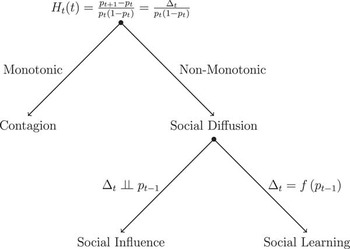
Figure 2 offers a graphical presentation of the identification strategy used in this analysis, where H t (t) represents the relative hazard rate as a function of time. In sum, when there is evidence that H t is a monotonic (non-increasing) function of time, then we conclude that the adoption behavior has followed a contagion process. If, instead, we find that H t (t) is non-monotonic, providing evidence of a social diffusion process, we proceed to further analysis. Among non-monotonic cases, a finding that the rate of adoption, or ∆ t =p t+1 − p t , is independent of first-order lagged adoptions (p t−1) points to a social influence process, whereas a finding that ∆ t is functionally related to lagged adoptions suggests a social learning process. Next, we introduce the data and methods we use to test for diffusion in discharge petition signature behavior at the aggregate level.
Identification strategy

Data and Methods
We test Young’s (Reference Young2009) propositions in three steps. We first calculate the (empirical) relative hazard rates for each petition filed during the period from the 104th to the 113th Congress (1995–2014), provided that the petition exhibits sufficient variation in unique signature dates to qualify for the identification strategy (see requirement below).Footnote 11 Next, we estimate polynomial regressions of the relative hazard rate on time (weekdays from filing through last signature day).Footnote 12 We assess the fit of the polynomial regression and examine the signs of the coefficient estimates for the various polynomial terms of time. The combination of these two steps will allow us to determine whether discharge petition signatures followed a process of social diffusion (i.e., social influence or social learning), or a process of contagion. If we observe statistically significant coefficients on the polynomial terms of time, and if the signs of the coefficients exhibit some evidence of an alternating pattern (e.g., the first degree polynomial coefficient is negative and the second degree is positive), then this offers support for the occurrence of a social diffusion process. The requirement of statistical significance on the polynomial coefficients seeks to eliminate instances of alternating signs occurring by chance. To confirm that petitions in which we find statistically significant, and alternating, polynomial degree coefficients exhibit meaningful non-monotonic behavior, we developed a program to calculate the numerical first derivative of the relative hazard rate function to verify that the function is non-monotonic over the duration in which signatures were made.
For the final step, we regress the rate of adoption on the adoption level corresponding to the first-order lag of time for each petition included in our final data set. This step allows us to distinguish between the two forms of social diffusion—social learning and social influence. If we observe statistically significant effects on the lagged time variable, then we can conclude that the process followed a pattern of social learning.
Having provided a conceptual overview of the empirical strategy above, we now provide a more detailed account of the models used at these identification stages. Once the (empirical) relative hazard rate has been calculated for the petitions with a sufficient number of signature days (see requirement below), we use a linear regression model to regress the relative hazard rate on the polynomial of time to determine whether signatures followed a social diffusion or contagion process. The model takes the form shown in Equation 1, where K is the highest degree for the petition-specific equation. Since the purpose of the linear polynomial regression model is to approximate the relative hazard rate, we allow K to take the value that corresponds to the best fit. It would, for example, be unreasonable to impose a low-order polynomial on a petition if there is considerable undulation in its relative hazard rate. We, therefore, select the degree of polynomial that minimizes the Bayesian Information Criterion (BIC).
 $$H_{t} \, {\equals}\, \alpha {\plus}\mathop{\sum}\limits_{k\, {\equals}\, 1}^K {\beta _{k} t^{k} } {\plus}\in_{t}\!.$$
For the final part of our analysis, we estimate a simple linear regression model of the rate of adoptions at time t on the adoption level (as a proportion) corresponding to the first-order lag of time. In order to do so, we require a sufficient number of signature days, namely three, since otherwise we would not have any variation in the independent variable, rendering the regression model unestimable.Footnote 13 Of the 129 petitions filed during the period from the 104th to the 113th Congress, we eliminate 22 petitions due to insufficient data.
After dropping these petitions, we still analyze approximately 83 percent of all the petitions filed during this period.Footnote 14 The model takes the form shown in Equation 2. Since the explanatory variable is the first-order lag of time, this model makes use of even fewer observations than the previous stage of the analysis.
 $$\Delta _{t} \, {\equals}\, \alpha {\plus}\beta p_{{t{\minus}1}} {\plus}{\epsilon}_{t} .$$
In the next section, we discuss the results of the empirical analysis detailed above. We find evidence that a substantial number of discharge petitions follow a social diffusion process, rather than a contagion process. In particular, we find that the social learning model explains the signing behavior on more petitions than the alternative diffusion models.
Results
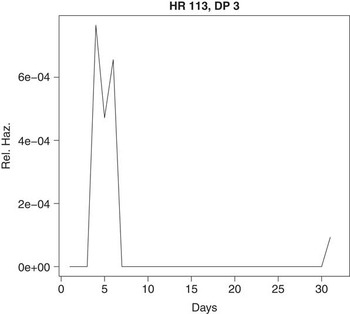
For illustrative purposes, Figure 3 graphically displays the relative hazard rate for Discharge Petition 3 in the 113th Congress.Footnote 15 For the case of this petition, it is quite apparent that the relative hazard rate exhibits non-monotonic behavior. To more closely examine the behavior of the relative hazard rates for all of the petitions in the data set, we turn our attention to the polynomial fits.
Relative hazard rate, 113th Congress, petition 3

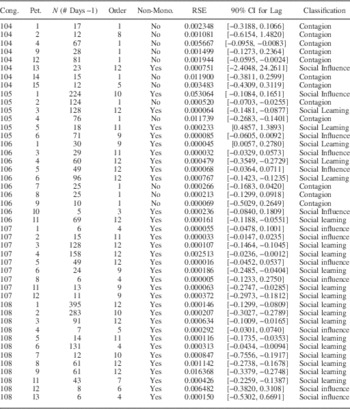
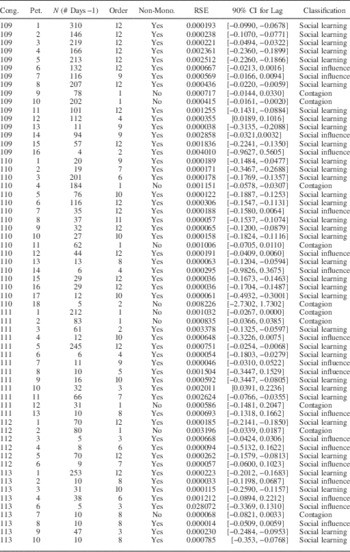
Relevant information regarding the polynomial fit for each of the petitions in our study can be found in Tables 1 and 2. In particular, the tables report information on the Congress in which a petition was filed (Cong.), the number of the petition in that Congress (Pet.), the number of observations for each petition (i.e., the number of weekdays between the filing of the petition and the last signature day less one to account for the relative hazard rate calculation) [N (# Days−1)], the order of the best-fit polynomial regression for the petition (Order), whether there are consecutive statistically significant degrees (at the p≤0.05 level) with alternating signs in the polynomial regression for a given petition (Non-Mono.), and the residual standard error of the regression. The reader can refer to Section A of the Supplemental Appendix for information on the number of signatures per petition.
Discharge Petitions in the 104th–108th Congress

Note: N refers to the number of observations for the polynomial regressions. Order is the degree of the polynomial for time used in the regression. Non-Mono indicates whether the polynomial regression yields statistically significant non-monotonicity. RSE is the residual standard error of the regression model. 90 percent CI for Lag gives the 90 percent confidence interval for the first-order time lag for the proportion of signatories when regressing the rate of adoption on that first-order time lag.
Discharge Petitions in the 109th to 113th Congress

Note: N refers to the number of observations for the polynomial regressions. Order is the degree of the polynomial for time used in the regression. Non-Mono indicates whether the polynomial regression yields statistically significant non-monotonicity. RSE is the residual standard error of the regression model. 90 percent CI for Lag gives the 90 percent confidence interval for the first-order time lag for the proportion of signatories when regressing the rate of adoption on that first-order time lag.
Consider, for example, Discharge Petition 13 in the 110th Congress. The petition was filed by Representative Thelma D. Drake (R-VA, 2nd) to discharge the Committee on Energy and Commerce from consideration of the Boutique Fuel Reduction Act of 2007 (H.R. 2493).Footnote 16 The petition received 138 signatures during the 14 weekdays between the introduction of the discharge petition on July 15, 2008 and the last signature day on August 1, 2008. In this case, we fit a polynomial of degree eight to the data. This order of polynomial optimized the fit of the relative hazard rate as a function of time, with an exceedingly small residual standard error of 0.000063. The results from the regression model indicate that there are significant non-monotonicities (in fact, all eight polynomial terms are statistically significant, and the signs are alternating between negative and positive, with the first degree having a negative sign, the second degree a positive sign, and so forth).
In total, we find that for 85 out of the 107 petitions in our data set, there is statistically discernible evidence of a social diffusion process. This implies that 79 percent of the petitions analyzed followed a social diffusion process. This provides strong evidence against behavior adoption on the basis of mere contagion. Upon examining the numerical first derivative of the relative hazard rate function, we find that all of the cases that result in statistically significant, and alternating, polynomial degree coefficients do, indeed, exhibit non-monotonic behavior over the number of weekdays in which signatures occurred.
The column labeled 90% CI for Lag in Tables 1 and 2 displays the 90 percent confidence interval (CI) for the first-order time lag for the proportion of signatories for the model shown in Equation 2. Of the petitions classified as following a social diffusion process, we can classify 54 petitions as having been subject to a social learning process by way of the identifiable first-order lag effect (i.e., the CI does not contain 0).Footnote 17 Accordingly, social learning was the operative diffusion process in ~64 percent of the petitions consistent with the social diffusion models. We conclude from these results that an overwhelming number of discharge petitions exhibit clear social dynamics, with many following a pattern that points to social learning as the driving force behind discharge petition signatures. Given the strict requirements for classification as a social learning process (two stages of statistically discernible conditions), along with the relatively small sample size for many of the discharge petitions in the analysis (i.e., number of weekdays between filing of the petition and last signature day), the number of petitions that achieve classification according to the social learning model is quite impressive and likely understated.
To further explore these results, we offer a brief supplemental analysis to examine the determinants of the diffusion processes surrounding discharge petitions (see Section C of the Supplemental Appendix). We would expect variation in the decision-making context of discharge petitions to affect the process by which information diffuses within the chamber. In other words, we might anticipate that petitions that seek to discharge legislation that is broadly consequential to members’ legislative and/or electoral fortunes will be more likely to follow a social diffusion process, and the social learning process in particular, given that these processes involve active observation and critical evaluation by members of previous adoption behavior. We find evidence consistent with this supposition. Specifically, we find that party polarization and legislative significance are positively related to social diffusion processes, and have an especially pronounced effect on the occurrence of social learning. That is, discharge petitions that occur during periods of intense party polarization or that target important legislation have a higher probability of generating social diffusion processes, and particularly social learning, than other discharge petitions. After all, with rising levels of polarization, the policy differences between legislative wins and loses and the electoral consequences of legislative outcomes grow, and therefore we would generally expect members to engage in more effortful evaluation of legislative behavior. Likewise, the importance (i.e., visibility) of legislation should also increase the costs of decision-making to members, making social diffusion processes more likely. The results of this supplemental analysis, which point to systematic and predictable determinants of variation in diffusion processes, offer some additional confirmation of the diffusion model classifications generated by the identification strategy outlined above. In the section to follow, we comment on the implications of these results for our understanding of political accountability and representation in Congress.
Discussion and Conclusion
Due to the demands on legislators’ resources (e.g., time), it is often unrealistic for them to formulate independent, informed decisions. To this point, Speaker Martin (R-MA) commented that “[i]n the complexity and volume of today’s legislation, however, most members have to trust somebody else’s word or the recommendation of a committee” (Campbell Reference Campbell2002, 56). For this reason, it is quite important that we understand how members arrive at socially influenced legislative decisions.
While a number of important studies have demonstrated behavioral similarities across subsets of members in various legislative settings, there has been no systematic study of the diffusion mechanism by which behaviors and practices disseminate within legislatures, including the US Congress.Footnote 18 We move toward identifying the mechanism for the diffusion of behavior in the US House of Representatives. Recent theoretical work provides us with distinct propositions for patterns of behavior adoption across competing models of diffusion (Young Reference Young2009). This project offers a detailed account of this identification strategy, which can be used to examine the diffusion of myriad behaviors given sufficient information regarding the timing of adoptions. We apply this method to examining the patterns of discharge petition signatures, and find that they are primarily driven by social diffusion processes. In particular, we find evidence that members rationally consider the behavior of other members, evaluating others’ actions in relation to their privately held beliefs. Additional individual level analyses substantiate this conclusion (see Section B of the Supplemental Appendix).
In general, we contend that diffusion and social dynamics have important implications for broader questions of political representation and accountability—a line of reasoning that straddles both positive and normative political theory. That is, the social dynamics present in decision-making have the potential to translate into policy outcomes that are unrepresentative of the populace: the greater the social dynamics are within a political (or any other) organization, the weaker the link between the organization and its constituents tends to be. But not all social dynamics are equal in this respect. Rather, when social dynamics are present, it is reasonable to conclude that democratic accountability is stronger in legislatures where members are more engaged in actively evaluating information generated from previous adopters. To this end, some might find the central results of this study comforting, especially with a view toward political representation, as they suggest that peer pressure or an even more arcane form of socialization based on contagion are less likely to drive legislative behavior than a process by which members engage in the rational evaluation of information. Nevertheless, diffusion via the social learning process remains a social dynamic susceptible to producing suboptimal outcomes.
With respect to the social learning process, two important caveats are required. First, we need to be mindful of the meaning of information in this context. As mentioned above, members consider the payoffs to previous adopters, suggesting that the decision to adopt a behavior (e.g., sign a discharge petition) may be more a function of opportunistic behavior than of careful evaluation of the facts underlying the legislative measure under consideration. Second, as previous research has highlighted, social learning can also fall prey to serious inefficiencies with respect to the use of information (Bikhchandani, Hirshleifer and Welch Reference Bikhchandani, Hirshleifer and Welch1992). In short, legislators may throw away important private information by paying too much attention to what others do. These caveats aside, the social learning process nonetheless involves more safeguards (via members’ priors) against the uncontrolled dissemination of harmful or unrepresentative behaviors than other social diffusion mechanisms. Therefore, we might conclude that it is a qualitatively more desirable social dynamic than other diffusion processes. And we find from a preliminary analysis that social diffusion processes are more likely to occur when members are presented with consequential decisions, which also bodes well for democratic accountability within a social body.
We believe that this identification strategy can open up discussions on a wide range of important topics relating to legislative politics, and organizations more generally. For instance, the social dynamics of legislatures have important implications for institutional design. Assuming for a moment that social dynamics have undesirable effects—for example, because they tend to reduce diversity of viewpoints—one would want to opt for institutional arrangements that promote independence in the decision-making process. What such institutions would look like is beyond the scope of this study, but this and other questions highlight why studying the mechanisms underlying diffusion is not just important for understanding public policy, but also for legislative organization more broadly. We believe that our research offers important insights into the processes that scholars, to date, have been unable to measure, and, as a result, we hope this study facilitates future research on the causes and implications of intra-governmental social dynamics.
Acknowledgments
The authors thank the editors and anonymous reviewers at PSRM for their thoughtful comments and careful reading of their manuscript. In addition, the authors thank the participants of the 2015 National Capital Area Political Science Association (NCAPSA) American Politics Workshop for their excellent feedback.