Zika virus disease (ZVD) and its detrimental complications have been a significant global health threat. More importantly, a causal link has been established between Zika virus infection during pregnancy and the risk of development of congenital anomalies. 1 While Zika predominantly impacts developing babies, it is also associated with Guillain-Barré syndrome in adults. 1 Since 2007, a total of 75 countries and territories worldwide have reported evidence of mosquito-transmitted Zika infection. 2 The first large outbreak of ZVD occurred in 2007 in Island of Yap (Federated States of Micronesia). 3 Subsequently, the resurgence of the outbreak occurred in Northeast Brazil in 2015. 2 During this reemergence, there was an unexpected epidemic of newborns with microcephaly and other neurological impairments. 2 This led to the Public Health Emergency of International Concern declaration by the World Health Organization (WHO) on February 1, 2016.
The Zika pandemic also raised particular concern in Malaysia as the country is hyperendemic with dengue and has favorable ecological conditions for transmission of the Zika virus such as warm temperature, humid condition, and high rainfall. Although Malaysia has never had a ZVD outbreak, the history of Zika virus infection in Malaysia dates back to 1969 when the first Zika virus was isolated in Aedes aegypti. Reference Marchette, Garcia and Rudnick4 There was evidence of Zika virus transmission in the country before the outbreak of Zika in 2016. Zika infection was diagnosed in a traveler from Malaysia in 2014. Reference Tappe5 During the global pandemic of Zika virus in 2016, Malaysia’s first case of Zika infection was reported on September 1 from a woman who returned to Malaysia after a visit to a neighboring country. In 2016, a total of 8 cases of Zika were confirmed in Malaysia, with at least 3 people classified as travel-related cases. 6 Subsequently, in 2017 and 2018, there were no confirmed Zika cases reported. The epidemic has since subsided in Malaysia; however, in October 2019, a case of Zika virus infection was detected in a local man. 7 The ZVD is still a health concern in Malaysia as new cases continue in several Southeast Asia countries, particularly in neighboring countries of Malaysia such as Vietnam Reference Moi, Nguyen and Nguyen8 and most recently in Lao People’s Democratic Republic in 2020. Reference Calvez, Vetsaphong and Somlor9
Addressing Zika-related knowledge, attitudes and prevention practice gaps are important in combating ZVD. Reference Luetke, Omodior and Nelson10,Reference Chaw, Tuah and Idris11 There have been several small-scale studies on knowledge, attitudes, and practices in regard to dengue and Zika prevention in Malaysia, all of which suggest that the locals exhibit gaps in awareness and appropriate prevention practices. Reference Arief, Hassali and Saleem12 To date, no previous studies have examined the ZVD-related knowledge, attitudes, and practices of a larger general population in Malaysia. Such study is important to accurately inform the government authorities to develop appropriate precautionary measures to tackle the resurgence of Zika virus infection. To do so, this study aimed to investigate a wide range of knowledge and attitudes toward Zika infection as well as mosquito prevention practices in Malaysia at a nationwide level.
Materials and Method
Participant Recruitment
Telephone interviews were carried out during the period from June 2019 through February 2020. The telephone interviews were performed by 5 trained interviewers who received training to carry out the interviews. The telephone numbers were randomly generated from the electronic residential telephone directory (2018/2019) of all 13 states and 3 federal territories in Malaysia. Inclusion criteria were Malaysian citizen above 18 years old, awareness of Zika, and residing in the contacted household. In each contacted household, only 1 person per household was interviewed. If more than 1 person in the contacted household met the inclusion criteria, 1 person was randomly selected to answer the survey using a random number table. Interviews were conducted between 5:30 pm and 10 pm on weekdays and from 12 pm to 7 pm on weekends or public holidays to avoid overrepresentation of unemployed participants. Unanswered calls were attempted at least 2 more times on separate days before being regarded as non-responses.
Instruments
The survey questionnaire (Supplementary File 1) consisted of 3 sections assessing (1) sociodemographic characteristics and environmental factors, (2) knowledge regarding Zika, (3) attitudes toward Zika, and (4) mosquito prevention practices.
Questions on Zika-related knowledge consisted of 3 sections (14 items): i. Symptoms of Zika (7 items); ii. Risk of microcephaly (1 item); iii. Transmission of Zika virus (6 items). For each statement, the optional answers were “yes,” “no,” or “don’t know.” The correct response was given a score of 1, and an incorrect or “don’t know” was scored as 0. The knowledge scores were calculated by adding up the score on the 14 items. The possible score ranged between 0 and 14, with a higher score indicating a higher level of knowledge about Zika.
Assessment of attitudes consisted of 3 questions measuring risk perception and worries concerning Zika. The statements were: “What is your perceived risk of being infected with Zika?”; “If you are infected with Zika, do you think you will have serious health consequences?”; and “It has been over 3 years since the Zika virus pandemic in year 2016, how worried are you about Zika at present?” Response options were “extremely,” “moderately,” “a little,” and “not at all.” The item statements were not scored.
Practices of mosquito prevention consisted of 9 questions. For each question, the response options were “never,” “seldom,” “sometimes,” and “often,” scored as 0, 1, 2, and 3, respectively. The possible mosquito prevention practice scores ranged from 0 to 27, where higher scores implied a greater level of mosquito prevention practices.
All the questions were developed and validated by a panel of experts that consisted of academicians and physicians. Malaysia is a multi-ethnic nation that consists of 3 main ethnicities, namely the Malays, Chinese, and Indians. Therefore, the questionnaire, which was developed in English, was translated into Bahasa Malaysia (the national language of Malaysia), Mandarin (Chinese), and Tamil. The translation was verified using the methods of back-translation. All the translated questionnaires were pilot-tested to identify and quantify errors of literal translation, omission, and mistranslation. Pilot tests were carried out on random samples of the different ethnic populations from the telephone directory. A team of trained interviewers from 3 ethnic groups performed the interviews, and each interviewer was assigned to interview respondents of a similar ethnic group. The objective of the study and the voluntary nature of the study were carefully explained to participants, and oral informed consent was obtained before the commencement of each telephone interview.
Statistical Analysis
The reliability of the knowledge and practices items was evaluated by assessing the internal consistency of the items representing the scores. The 14 items for knowledge and 9 items of the practice questions had reliability (Cronbach’s α) of 0.932 and 0.604, respectively. Multivariable logistic regression analysis was used to determine the demographic factors influencing the level of Zika-related knowledge. Multivariable logistic regression for the outcome variable mosquito prevention practices included demographic characteristics and level of knowledge. Odds ratios (OR), 95% CI, and P-values were calculated for each independent variable. A P-value of less than 0.05 was considered statistically significant. The model fit was assessed using the Hosmer–Lemeshow goodness-of-fit test. Reference Hosmer, Lemeshow and Sturdivant13 All statistical analyses were performed with the Statistical Package for the Social Sciences Version 20.0 (SPSS; Chicago, IL, USA).
Results
Participant Characteristics
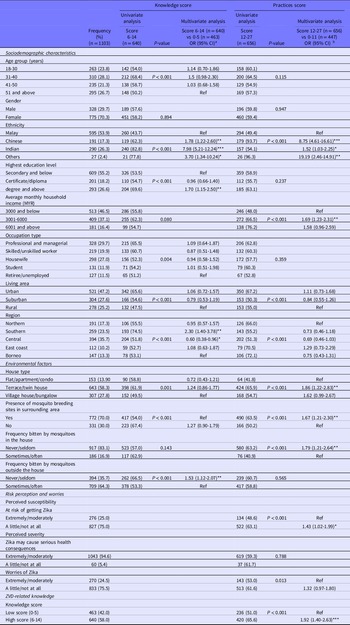
A total of 18 021 randomized numbers were contacted and 1901 people responded. Of these, only 1103 (58.0%) had heard of or were aware of Zika and proceeded with the survey. The demographic characteristics of the 1103 participants are shown in Table 1. The mean age was 41.9 years (SD 14.4; range 18–82). The study had a higher representation of female (70.3%) and Malay (53.9%) participants. Slightly over half were participants with secondary and below education attainment (55.2%), and with an average monthly household income of MYR3000 and below (46.5%). There were no significant ethnic disparities in terms of educational attainment.
Factors associated with ZVD-related knowledge and practices against mosquitoes (n = 1103)

*P < 0.05, ** P < 0.01, *** P <0.001.
a Hosmer–Lemeshow test, chi-square: 8.717, P-value: 0.367; Nagelkerke R2: 0.262.
b Hosmer–Lemeshow test, chi-square: 16.610, p-value: 0.034; Nagelkerke R2: 0.281.
Northern region (Perlis, Kedah, Perak, Penang); Central (KL, Selangor, Negeri Sembilan, Putrajaya); East coast (Terengganu, Kelantan, Pahang); Southern (Melaka, Johor); and Borneo (Sabah, Sarawak, Labuan).
Knowledge Regarding Zika
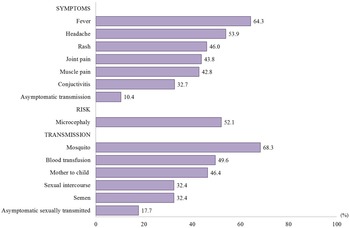
Figure 1 shows the correct responses of knowledge items. Findings on knowledge regarding symptoms of Zika show that nearly two thirds (64.3%) correctly identified fever as one of the symptoms of Zika infection. Only 10.4% were aware that Zika infection could be asymptomatic. Slightly over half (52.1%) were aware that Zika virus infection is associated with microcephaly. Slightly over two thirds (68.3%) knew Zika virus infection is transmitted by mosquitoes. Less than half (46.4%) were aware of vertical transmission from a pregnant mother to the child. A relatively lower proportion correctly responded to questions about transmission of Zika virus infection via sexual intercourse (32.4%), semen of infected individuals (32.4%), and from a person who has Zika to his or her sexual partners (17.7%).
Proportion of correct responses for Zika-related knowledge (n = 1103).

The mean for the Zika knowledge score was 5.9 (SD ± 4.4; range 0 to 14) out of a possible score of 14. The median score was 6.0 (interquartile range [IQR], 1.0 to 9.0). The knowledge scores were categorized as a score of 6–14 or 0–5, based on the median split; as such, a total of 640 (58.0%; 95% CI: 55.0 to 61.0) were categorized as having a score of 6–14, and 463 (42.0%; 95% CI: 39.0 to 45.0) were categorized as having a score of 0–5. Table 1 shows the multivariable logistic regression analysis of demographics factors influencing the level of knowledge regarding Zika. There were ethnic disparities in the level of Zika knowledge where the participants of Indian ethnicity recorded the highest level of knowledge than Chinese and Malay. Participants of educational attainment university degree and above reported higher knowledge than those of secondary and below (OR = 1.70, 95% CI: 1.15–2.50). Participants from the southern region reported a higher level of knowledge.
Risk Perception and Worries
As shown in the first and second columns of Table 1, the majority perceived little or no risk of getting Zika (75.0%). A high proportion (94.6%) reported “extremely” or “moderately” for perceived severity of health consequence of Zika infection. A total of 75.5% responded with “a little” or “not at all” worry about Zika.
Mosquito Prevention Practices
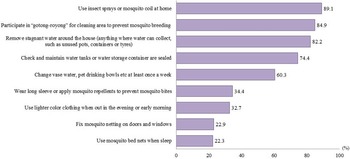
Figure 2 shows that a high proportion (89.1%) reported the use of insect sprays or mosquito coils to prevent mosquito bites, participated in gotong royong (mutual cooperation among people in the neighborhood) to clean up mosquito breeding places (84.9%), and removed stagnant water in the house (82.2%). The lowest proportion reported fixing mosquito netting on doors and windows (22.9%) and use of mosquito bed nets (22.3%).
Proportion of “Seldom”/“Sometimes”/“Often” responses for practices against mosquitoes (n = 1103).

The mean for the mosquito prevention practices score was 11.9 (SD ± 4.7; range 0 to 27) out of a possible score of 27. The median score was 12.0 (IQR, 9.0 to 15.0). The mosquito prevention practices scores were categorized as a score of 12–27 or 0–11, based on the median split; as such, a total of 656 (59.5%; 95% CI: 56.5 to 62.4) were categorized as having a score of 12 to 27, and 447 (40.5%; 95% CI: 37.6 to 43.5) were categorized as having a score of 0–11. Table 1 shows that the odds of a higher mosquito prevention practice score in other ethnic minorities (OR = 19.19, 95% CI: 2.46–14.91) and Chinese (OR = 8.75, 95% CI: 4.61–16.61) were higher than the Malays. Participants with an average household income of RM3001–6000 reported a higher mosquito prevention practices score than those with an income of RM3000 and below (OR = 1.69, 95% CI: 1.23–2.31). Participants living in a terrace or twin house reported higher prevention practices than those living in a flat, apartment, or condominium (OR = 1.86, 95% CI: 1.22–2.83). Those who reported having mosquito breeding sites in their surrounding areas were likely to report higher mosquito prevention practice scores (OR = 1.67, 95% CI: 1.21–2.30). Participants who reported never or seldom being bitten by mosquitos reported higher preventive practice scores (OR = 1.79, 95% CI: 1.21–2.64). Participants who perceived a little or not at all risk of getting Zika reported higher mosquito prevention practices (OR = 1.43, 95% CI: 1.02–1.99). A higher knowledge score was associated with higher mosquito prevention practices (OR = 1.92, 95% CI: 1.40–2.63).
Discussion
Sporadic cases of Zika infections have been reported worldwide as well as in Malaysia, despite a number of years since the WHO declared the Zika virus pandemic a public health emergency in February 2016. The present study is meaningful in that it examined Zika virus-related knowledge, attitudes, and mosquito prevention practices among the general public in Malaysia to identify gaps or specific areas that provide important information for the development of health education interventions toward the prevention of a ZVD resurgence.
The finding of a low mean of Zika-related knowledge score near 6 out of a possible maximum score of 14 indicates that overall, the study participants have a poor level of knowledge about ZVD. Zika virus is a mosquito-borne virus, and it is predominantly transmitted by Aedes mosquitoes. Despite being well-known, it is worrisome that approximately two thirds of the study participants were aware ZVD is caused by a virus transmitted by mosquitoes. The proportion aware of mosquito transmission of Zika infection in this study was relatively lower than that of a study conducted in 2017 among the general public in the state of Selangor, Malaysia, Reference Arief, Hassali and Saleem12 and a study among community pharmacists, Reference Lim and Tham14 where in both studies the majority of participants were university graduates. Higher educated people reported higher health literacy and showed greater health information-seeking behavior. Reference Lee, Jin and Henning-Smith15,Reference Manganello, Gerstner and Pergolino16 Of note, in this study, over half of the study participants were of secondary education level and below, and this perhaps explains the relatively low level of knowledge compared with previous studies. It is also important to note that past studies reported level of education as the key determinant of knowledge of Zika Reference Maharajan, Rajiah, Belotindos and Basa17 and knowledge about dengue and its transmission. Reference Diaz-Quijano, Martínez-Vega and Rodriguez-Morales18 In the present study, the ethnic disparities in Zika-related knowledge warrant further investigation as there were no significant ethnic disparities in terms of educational attainment among the study participants.
The present study also reveals that a considerable high proportion was unaware that Zika virus can spread by vertical transmission and of the risk of microcephaly. Health education during antenatal care should educate pregnant women to avoid exposing their fetuses to infections that may cause birth defects, such as Zika infection prevention during pregnancy. Moreover, despite the fact that the presence of Zika virus in semen and the role of sexual transmission on the spread ZVD are well-known, Reference Harrower, Kiedrzynski and Baker19,Reference Hastings and Fikrig20 our study showed that an overwhelming majority of the participants presented little knowledge on the sexual transmission of Zika. Such a knowledge gap is of serious concern as this may imply that many may not be protecting themselves from sexual transmission of Zika. It is equally important that this knowledge gap is addressed during antenatal care. Emerging evidence shows sexual transmission risks of Zika are largely underestimated. Reference Allard, Althouse, Hébert-Dufresne and Scarpino21 This indicates that sexual transmission risks of Zika should also be highlighted in public information dissemination efforts. The multivariable regression analysis revealed that a higher education level is a significant predictor of a higher level of overall Zika-related knowledge. Henceforth, it is best that educational intervention targets the lower-educated segment of the population in Malaysia.
Another concern to be highlighted in this study is that, although the majority perceived high severity of Zika infection, the perception of risk and level of worry about the infection were low. Poor risk perception has also been similarly reported in a previous smaller-scale study conducted among the Malaysian public in 2017. Reference Arief, Hassali and Saleem12 This is perhaps due to the study taking place approximately 3 years after the 2016 outbreak of Zika and relatively few Zika cases have been reported in Malaysia since 2016. Likewise, other studies among the public in the United States, Reference Reynolds, Gui, Chen and Zheng22 Germany, Reference Obenauer, Rübsamen and Castell23 and Western Europe Reference Le Tyrant, Bley and Leport24 also similarly reported a low risk perception of contracting Zika among the public. Having a higher risk perception is associated with higher preventive-seeking behaviors. Reference Oh, Lee and Han25 Therefore, considering the low risk perception and worry about Zika virus infection found in this study, it is necessary to increase the public’s perception of the health threat of Zika.
On a positive note, a high proportion of participants in this study reports the use of insect sprays or mosquito coils to prevent mosquito bites, participates in gotong royong, and removes stagnant water from the house. Carrying out gotong royong among people in the community to clean up mosquito breeding places is a common practice in Malaysia. Gotong royong is sometimes carried out on a regular basis in areas that are prone to mosquito breeding sites or areas where dengue cases were reported. The occurrence of mosquito larvae in stagnant water in residential areas in Malaysia was reported to be high. Reference Low, Chen and Lee26 Hence, it is important to encourage the public to continuously carry out these prevention practices. In this study, a relatively lower proportion of people reported fixing mosquito netting on doors and windows, and use mosquito bed nets. The inconveniences of using mosquito nets, such as mosquito bed nets retaining heat and difficulties in hanging the net, were commonly reported. Reference Pulford, Hetzel and Bryant27
In the present study, participants with a higher household income reported higher preventive measures. Poor-income households may not be able to afford mosquito prevention materials, such as insect sprays, mosquito coils, or bed nets. Reference Chandren and Wong28 Our results suggest that the provision of a subsidy for mosquito prevention materials from the government for people in the lower income group would be beneficial to enhance their preventive measures. Importantly, the finding of lower prevention practices among people living in apartments or condominiums is worrisome. Although terraced houses and semi-detached houses with a garden or yard are likely to have mosquito breeding places, Aedes mosquitoes are also prevalent in high-rise residential apartments and buildings, Reference Lau, Chen and Lee29,Reference Ab Hamid, Mohd Noor and Isa30 therefore, residents of high-rise apartments should be informed about the risk of mosquito-borne diseases, such as Zika, and advised not to neglect mosquito prevention. A lower rate of mosquito prevention for people in high-rise apartments could be due to lower mosquito density in apartments compared with landed houses. Mosquito habitants were found more likely to be higher in landed households compared to apartments. Reference Aik, Neo and Rajarethinam31
Of note, participants who perceived little to no risk of getting Zika reported higher mosquito prevention practices. This could be due to the participants carrying out proper mosquito prevention practices, thereby preventing mosquito bites and Zika transmission and perceived little risk of getting Zika. The results from our study also demonstrate that people with greater knowledge regarding Zika are more likely to engage in more mosquito prevention practices, likewise similarly reported in other studies. Reference Luetke, Omodior and Nelson10,Reference Chaw, Tuah and Idris11 This suggests that to achieve better mosquito prevention practices, health authorities should widely disseminate information about Zika to the general public. It should also be noted that increased knowledge may not always translate into behavior change, hence, motivation to translate knowledge on preventive measure to practice is essential. Reference Herbuela, Karita, Francisco and Watanabe32
This study has some limitations. The first limitation is the utility of telephone interviews, whereby all information obtained from the interview was self-reported and may possibly be subjected to social desirability response and self-report bias. Another limitation relates to the CATI method, which only included households with fixed-line telephones; consequently, households without a telephone line were underrepresented. Of note, increasing numbers of households no longer use landline phone service and instead rely on mobile phones to stay connected. The second important limitation of this study is the cross-sectional design used. Careful consideration is needed in the interpretation of the direction of associations from a cross-sectional survey. Despite these limitations, the study was the first nationwide survey in Malaysia that was carried out on a wide spectrum of sociodemographics to evaluate the knowledge and attitudes toward ZVD and mosquito prevention practices.
Conclusion
This study has documented important gaps in knowledge and attitudes on Zika among the Malaysian public. Areas of focus that need to be addressed when developing health educational interventions to increase their knowledge and change practices were identified. Sociodemographic disparities in Zika-related knowledge and mosquito prevention practices exist, and addressing the identified inequalities should be the priority in future interventions. These findings will help health policy-makers in Malaysia implement target-specific education interventions to enhance Zika-related health literacy, promote household mosquito control, and encourage community responsibility in eradicating mosquito breeding sites.
Author contributions
WLP, LHY, and SAB designed and conceptualized the study. WLP and HA collected and analyzed the data. WLP wrote the first draft. LHY and SAB edited and revised the manuscript. All authors have read and approved this manuscript version.
Funding statement
This study was financially supported by the Ministry of Higher Education Malaysia under Long Term Research Grant Scheme (LRGS MYRUN Phase 1: LRGS MYRUN/F1/01/2018). We acknowledge the funding from the Ministry of Higher Education, Malaysia for niche area research under the Higher Institution Centre of Excellence (HICoE) program (Project MO002-2019).
Conflict(s) of interest
The authors declare that they have no conflict of interest.
Ethical standards
The study was approved by the University of Malaya Research Ethics Committee (UM.TNC2/UMREC - 531).