


Introduction
Weed seed retention at plant maturity has been identified as a weed control opportunity for the problematic annual weed species of Australian crop production systems. The major weeds, rigid ryegrass (Lolium rigidum Gaudin), wild radish (Raphanus raphanistrum L.), brome grass (Bromus spp.), and wild oats (Avena sp.) retain significant proportions of total seed production, at a height that allows collection during harvest (Walsh and Powles Reference Walsh and Powles2014). Once collected, these weed seeds are processed and then exit the harvester, primarily in the chaff fraction (Broster et al. Reference Broster, Walsh and Chambers2016). The residue management systems on harvesters redistribute the straw and weed seed–bearing chaff material evenly across the field, effectively reseeding the collected weed seeds. Intercepting this process has now become a focus, with grain harvest recognized as a weed control opportunity. Subsequently, harvest weed seed control (HWSC) systems have been developed specifically to target weed seeds during commercial wheat (Triticum aestivum L.) crop harvest to prevent inputs to the seedbank (Walsh et al. Reference Walsh, Newman and Powles2013).
HWSC systems use a range of approaches to target the weed seed–bearing chaff fraction: chaff collection followed by burning/removal (chaff cart), concentration in narrow rows (chaff lining/tramlining) or in a narrow windrow with straw residues for subsequent burning (narrow windrow burning), collection in bales along with straw residues (bale direct system), and mechanical destruction during harvest (Harrington Seed Destructor [HSD], integrated HSD [iHSD], and Seed Terminator). When implemented effectively, these systems have been shown to be similarly effective in delivering high levels of weed seed destruction (>85%) and equivalent reductions in subsequent weed emergence (Walsh et al. Reference Walsh, Aves and Powles2017). Thus, growers can choose the HWSC option that best fits their production system.
Crop competition, as well as suppressing weed seed production, is also likely to increase the efficacy of HWSC by increasing the height of weed seed retention at crop maturity. The role of crop competition in reducing weed seed production has been established for the major weeds of Australian cropping: L. rigidum (Lemerle et al. Reference Lemerle, Cousens, Gill, Peltzer, Moerkerk, Murphy, Collins and Cullis2004), R. raphanistrum (Walsh and Minkey Reference Walsh and Minkey2006), Avena sp. (Radford et al. Reference Radford, Wilson, Cartledge and Watkins1980), and Bromus spp. (Gill et al. Reference Gill, Poole and Holmes1987). Additionally, weeds of annual cropping systems are not normally shade tolerant (Gommers et al. Reference Gommers, Visser, Onge, Voesenek and Pierik2013), and their growth and development is restricted under low light conditions (Zerner et al. Reference Zerner, Gill and Vandeleur2008). A typical response to crop canopy shading by shade-intolerant species is a more erect growth habit (Morgan et al. Reference Morgan, Finlayson, Childs, Mullet and Rooney2002; Vandenbussche et al. Reference Vandenbussche, Pierik, Millenaar, Voesenek and Van Der Straeten2005). The likely result of this response is that weed seed heads and pods will be produced higher in the crop canopy and, therefore, will be more prone to collection during grain harvest. As the efficacy of HWSC is directly related to weed seed collection, crop competition may increase the weed seeds available for control by increasing the collectable proportion.
There is little doubt that the dominant weed populations of cropping systems, if given the opportunity, will evolve resistance to all forms of weed control. In Australian cropping systems, as well as the countless cases of herbicide resistance evolution (Boutsalis et al. Reference Boutsalis, Gill and Preston2012; Broster et al. Reference Broster, Koetz and Wu2013; Owen et al. Reference Owen, Martinez and Powles2014), there are many instances of adaptation in dormancy patterns to avoid cultivation (Fleet and Gill Reference Fleet and Gill2012; Kleemann and Gill Reference Kleemann and Gill2006; Owen et al. Reference Owen, Michael, Renton, Steadman and Powles2011). Globally, there are examples of resistance evolution to grazing, mowing, and even hand weeding (Barrett Reference Barrett1983; Gould Reference Gould1991; McKinney and Fowler Reference McKinney and Fowler1991). Resistance or adaptation to specific weed control strategies, regardless of mechanism or type, seems almost inevitable, particularly when large genetically diverse populations are persistently exposed to selection (Diggle and Neve Reference Diggle and Neve2001; Neve and Powles Reference Neve and Powles2005). Resistance evolution in L. rigidum populations has been particularly dramatic, and there seems little doubt that this highly adaptable species has the potential to evolve resistance to all forms of weed control. With the increasingly frequent and widespread use of HWSC systems in Australian cropping, there is concern that L. rigidum will evolve resistance to this new form of weed control. The aims then of this study were to: (1) examine the distribution of retained L. rigidum seed through the canopies of mature wheat crops across Australian cropping regions, (2) determine the influence of wheat crop competition on the distribution of L. rigidum seed retention in wheat crop canopies, and (3) investigate the effects of HWSC use on seed retention of L. rigidum in wheat crops.
Materials and Methods
Plant Sample Collection and Processing
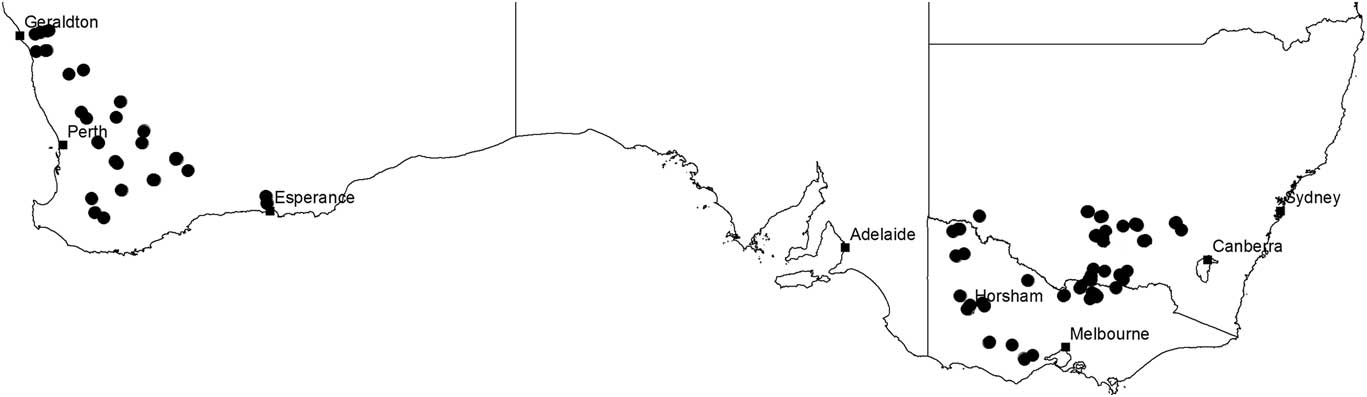
To establish the distribution of retained L. rigidum seed through wheat crop canopies at maturity, samples were collected from wheat crops at 71 locations across the western and southern wheat belt regions of Australia (Figure 1). Sampled wheat crops were randomly selected, apart from the fields specifically selected for comparison of long-term effects of HWSC on L. rigidum seed retention. To evaluate the effect of mid- to long-term HWSC use, L. rigidum seed retention was compared in specifically targeted fields with recorded + and − HWSC use. At nine locations, two fields were selected—one where HWSC had been used at least five times and the other with no HWSC use. Within each field, areas with low to moderate (1 to 20 plants m−2) L. rigidum plant density were typically targeted for sampling. In some instances, higher-density areas were sampled (Table 1). Sampling of L. rigidum and wheat plants was conducted over the initial 2 to 3 wk of the 2013 harvest (November to December, depending on the region). At each location, L. rigidum and wheat plants were counted and plant material samples were collected from within four 1.0-m2 quadrats. In each quadrat, L. rigidum and wheat plants were sampled at five heights commencing at 40 cm above the soil surface and then at 10-cm intervals to the soil surface. The soil surface within the quadrat was swept with a brush to collect any seed, seed heads, and plant material that had fallen from wheat and L. rigidum plants. Collected plant samples were oven-dried at 70 C for 48 h and then weighed to determine wheat and L. rigidum biomass production values for each sampling height. Wheat and ryegrass seed heads were threshed and weighed to determine seed yields at each sampling height.
Locations of sampling sites across the western and southern grain production regions of Australia.
Site average wheat biomass and grain yield and corresponding rigid ryegrass plant density and seed production values at each of the 71 sites sampled to examine rigid ryegrass seed retention through wheat crop canopies.

HWSC systems have been used more frequently in Western Australia than elsewhere; therefore, wheat fields from this region were specifically sampled to examine the effects of HWSC use on L. rigidum seed retention height. At nine locations, L. rigidum plants were sampled from wheat fields where HWSC had been used (5 to 10 treatments) and from nearby wheat fields where HWSC had never been used.
Statistical Analyses and Data Presentation
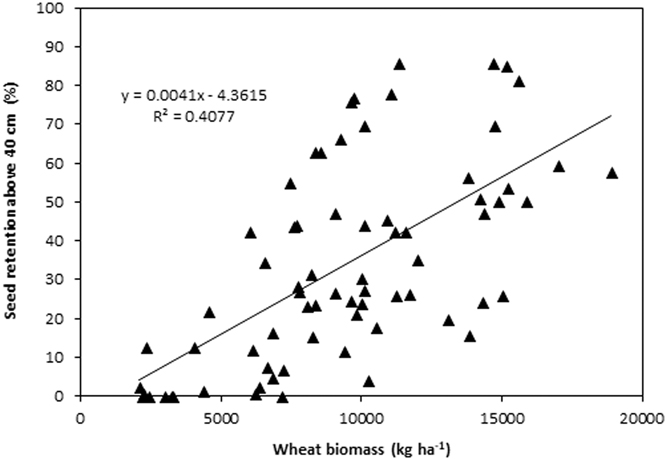
To examine the influence of crop competition on L. rigidum seed production, seed number at each sampling height was converted to percent cumulative seed production and contrasted against wheat biomass production. There was a linear relationship between crop biomass and seed retention above a 40-cm canopy height. Microsoft Excel was used to plot the linear relationship of seed retention above 40 cm against wheat crop biomass. No relationship between seed retention and wheat crop biomass was observed at any other canopy height (unpublished data). To further examine the influence of crop biomass on L. rigidum seed retention, we compared the influence of high (≥12,000kg ha−1) and low (≤7,000kg ha−1) biomass–yielding wheat crops for their effects on the distribution of retained L. rigidum seed through the crop canopy.
ANOVAs, using a linear mixed model (GenStat 2015), compared the cumulative L. rigidum seed retention values in the canopy above 10-cm height for each of the nine + and nine – HWSC site comparisons. One-way ANOVA using a general linear model compared total annual L. rigidum seed production for each site comparison. Where differences occurred, means were separated using Fisher’s protected LSD at α=0.05.
Results and Discussion
Lolium rigidum plants retained greater proportions of total seed production in the upper canopy when grown in competition with higher biomass–yielding wheat crops. A survey of 71 wheat fields across several agroecological zones (Figure 1) resulted in the collection of seed retention data from wheat fields with a wide range of biomass production values (2,085 to 18,885kg ha−1) (Table 1). Sampling at 10-cm increments down through the crop canopy at each of the sampling sites identified a large variation in proportion of total seed production (16% to 100%) retained above 10 cm (Table 1). Despite this variation, there was a trend for higher L. rigidum seed retention in high biomass–yielding crops. Segregating sites into high (≥12,000kg ha−1) and low (≤7,000kg ha−1) biomass–yielding groups provided a clearer indication of the biomass effects on seed retention. For instance, average seed retention above 10-cm canopy height was 67% in low-biomass crops and increased to 79% in high-biomass crops (Table 2).
Average wheat biomass and yield, L. rigidum seed production and seed retention for high wheat biomass, low wheat biomass and all sites of southern and western wheat belt regions in 2013.

a Numbers in parentheses are the standard errors of the mean of respective numbers of sampling sites.
The influence of crop biomass on L. rigidum seed retention appears to be stronger in the upper canopy. There is a relatively weak linear relationship between wheat biomass and L. rigidum seed retention above the 40-cm canopy height (Figure 2). The indication is that L. rigidum responded to increased wheat crop competition by increasing the proportion of seed retained in the upper canopy. The influence of crop competition on L. rigidum seed retention is more evident when average seed retention values for the high (≥12,000kg ha−1) and low (≤7,000kg ha−1) wheat biomass sites are plotted along with the average values of all sites (Figure 3). These groupings clearly identified the increased proportion of seed retained higher in the crop canopy in response to competition from high biomass–producing wheat crops.
Relationship between cumulative proportion of Lolium rigidum seed retention above 40 cm and wheat biomass.
Cumulative rigid ryegrass seed retention for high (≥12,000kg ha−1) and low (≤ 7,000kg ha−1) wheat biomass sites and average of all sites. Bars represent the standard errors of the mean values from high, low and all sampling sites.

With increasing biomass production, it is expected that there will be increased crop competition with L. rigidum plants for light as well as for nutrients and soil moisture (Zimdahl Reference Zimdahl2007). The increase in average seed retention height is likely due to shade avoidance by annual L. rigidum plants growing within wheat crops. Lolium spp., like many annual weeds, are shade intolerant (Ehret et al. Reference Ehret, Graß and Wachendorf2015; Morgan and Smith Reference Morgan and Smith1979), and a common morphological response to shading is stem elongation (Holt Reference Holt1995; Smith Reference Smith1982). As a shade-avoidance strategy, stem elongation in grasses leads to an increase in plant height as plants attempt to intercept more light. Thus, the increased proportion of seed retained higher in the canopies of higher biomass–yielding wheat crops occurs because of the shade-avoidance strategy of L. rigidum plants. This biological attribute of shade-intolerant weed species creates the opportunity to use shading through crop competition to increase weed seed retention height and, therefore, the efficacy of HWSC.
As expected, the seed production of L. rigidum plants was reduced when they grew in competition with higher biomass–yielding wheat crops. Lolium rigidum plants maturing in high-biomass wheat crops produced less seed (P<0.05) than plants maturing in low-biomass crops (Table 2). However, despite wheat biomass increases (P<0.05) of more than 70%, L. rigidum seed production (P<0.05) was reduced by just 33%. This result indicates that increases in crop biomass alone are not sufficient to substantially reduce reproductive capacity of competing L. rigidum plants.
There was no clear evidence that a history of selection with HWSC has affected the height or amount of L. rigidum seed retention at crop maturity. It is speculated that HWSC, like all other forms of weed control, will impose a selection pressure that, if strong enough, will lead to resistance evolution. In the case of L. rigidum, the repeated use of HWSC is expected to result in plants that have a more prostrate growth habit and/or early seed shedding, both of which would result in a reduced proportion of seed retained above the low harvest height of 10 cm at crop maturity. Australian growers are now well aware of the potential for adaptation in L. rigidum populations and are reporting concerns of adaptation to HWSC. Across the nine +/− HWSC comparison locations, L. rigidum seed retention was not consistently reduced (P>0.05) in fields where HWSC had been used between 5 to 10 times compared with nearby fields with no history of HWSC use (Table 3; Figure 4). Although seed retention was lower for six of the nine +/− HWSC comparison sites, there were only two instances (Site 64 vs. Site 68 and Site 59 vs. Site 58) where these differences were significant (P<0.05) (Table 3). In all other comparisons there were no differences (P>0.05) in seed retention above the 10-cm canopy height.
Cumulative rigid ryegrass seed retention as influenced by plus (9 sites) and minus (9 sites) HWSC use over 5–10 years. Bars represent the standard errors of the mean values for plus and minus HWSC sampling sites.

Lolium rigidum cumulative seed retention (%) above 10-cm canopy height for sites with and without medium to long-term use of HWSC.

a Seed retention and seed production means with the same letter within the same row are not significantly different (P>0.05)
b Numbers in parentheses are the numbers of HWSC operations in each field.
Lolium rigidum seed production was on average lower in fields with a history of HWSC use; however, this reduction was not consistent across all +/− HWSC comparisons. In fields with a 5- to 10-yr history of HWSC use, average L. rigidum seed production (1,383 seeds m−2) was lower (P<0.05) than in fields where there was no history of HWSC use (2,014 seeds m−2). This lower average seed production for + HWSC fields was mostly due to large reductions (>2,000 seeds m−2) in L. rigidum seed production for three of the comparisons (Table 3). For the majority of the +/− HWSC comparisons, there were no differences (P>0.05) in seed production; however, lower (P<0.05) seed numbers were recorded in the − HWSC field in one comparison (Site 71 vs. Site 55). As sampling sites were specifically located in areas where L. rigidum was present, there were no differences (P>0.05) in plant densities between + and − HWSC sites (unpublished data), which was what had been expected.
Lolium rigidum seed was retained uniformly through wheat crop canopies; therefore, the lowest practical harvest height would result in the highest seed collection and HWSC efficacy. On average across the 71 sampling locations, 34% of total L. rigidum seed production was retained at and above 40-cm canopy height (Figure 5). Cumulative seed retention values at decreasing canopy heights of 30, 20, and 10 cm were 50%, 62%, and 74%, respectively. Thus, reducing harvest height by 30 cm (from 40 to 10 cm) would potentially double HWSC efficiency, from 34% to 70%. Within the crop canopy (10 to 40 cm), there was, on average, a 13% increase in L. rigidum seed retention with each 10-cm decrease in height. This uniform distribution of L. rigidum seed throughout the crop canopy means that even if a low 10-cm harvest height cannot be achieved, any height reduction will lead to a proportional increase in seed collection during harvest.
The cumulative proportions of Lolium rigidum seed retention, wheat biomass, and wheat yield at decreasing wheat crop heights. Bars represent the standard errors of the mean of 71 sampling sites.
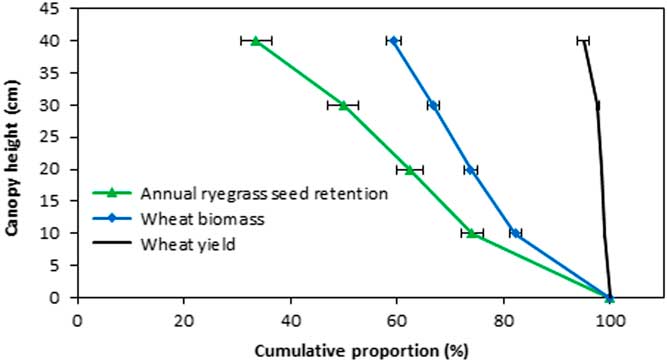
Reducing wheat crop harvest height to increase the efficacy of HWSC does not markedly increase the amount of crop biomass collected. To maximize weed seed collection, growers using HWSC systems typically use the lowest practical wheat crop harvest height (10 to 15 cm). The long-held belief is that HWSC systems considerably slow harvest operation, because lowering the harvest height to collect weed seeds markedly increases the amount of crop biomass that the harvester needs to process. Based on average grain heights of the sampled wheat crops, a harvest height of 30 cm would have ensured the collection of at least 98% of grain (Figure 5). At this height, 50% of total L. rigidum seed production would have been collected along with 67% of total crop biomass. In contrast, the minimum practical harvest height of 10 cm would have increased L. rigidum seed collection to 74% with 82% crop biomass collected. Therefore, reducing harvest height from 30 to 10 cm to increase L. rigidum seed collection by 24% would have resulted in the collection of just an additional 15% of wheat biomass. This survey of 71 wheat crops demonstrated that the major proportion of wheat crop biomass is located at or above the harvest height required for grain collection. Lowering the harvest height for more effective HWSC does not substantially increase the amount of crop biomass collected.
The overall efficacy of HWSC systems on weed populations is directly related to the proportion of total seed production that can be collected during the harvest operation. This survey of Australian wheat fields determined that L. rigidum seed retention at crop maturity is highly variable and, therefore, will result in variable results for HWSC. The impact of crop competition/shading on seed retention indicates the potential for using agronomic approaches to increase the proportion of seed retained at a height that can be collected during harvest. Using agronomy to increase crop competition will have the dual effect of increasing HWSC efficacy and reducing weed seed production. Although there is no evidence of field-evolved resistance to HWSC, increasing the proportion of total seed production collected will increase selection pressure. Countering this is the reduced genetic diversity that occurs when weed populations are dramatically reduced through HWSC use as part of a weed management program.
Acknowledgments
This work was funded by a Grains Research and Development Grant. No conflicts of interest have been declared. The authors would like to acknowledge the assistance of casual staff and students from University of Western Australia and Charles Sturt University who assisted in the collection and processing of the samples.



