Introduction
Reconfiguring citizens from ‘passive’ benefit recipient into ‘active’ labour market participant is core to the institutional character of many contemporary welfare states. This is symbolised by the re-designation of recipients as ‘jobseekers’ (Marston, Reference Marston2006: 86) and the widening of requirements for those in receipt of benefits to participate in welfare-to-work programmes and other forms of work-related conditionality. In countries like Australia that have marketised their public employment services, this ‘commodifying’ role (Holden, Reference Holden2003: 307) of the state is increasingly devolved to agencies competing in quasi-markets ‘for clients, fees and outcome payments’ (OECD, 2012). These providers bear responsibility for creating implementation policy on the ground, including not only delivering job placement support but also monitoring clients’ activity requirements. But a key question in the literature on quasi-markets in social services concerns how ‘market accountability instruments’ (Jantz et al., Reference Jantz, Klenk, Larsen and Wiggan2018: 321) such as payment-by-results and performance management shape the way jobseekers are ‘targeted and governed at the street level’ (Brady, Reference Brady2018: 831). Of particular interest is the claim that New Public Management (NPM) accountability instruments may alter what Brodkin (Reference Brodkin2015: 15) describes as ‘the terms of inclusion and commodification on the ground’ by stimulating agencies to internally sort clients for employability and to prioritise those with whom ‘targets are easier to realise’ (van Berkel and Knies, Reference van Berkel and Knies2016: 64). Other researchers argue that performance management regimes may intensify the commodifying elements of welfare by motivating client-facing staff to turn to sanctions to achieve targets rather than taking the time to solve clients’ problems (Bredgaard and Larsen, Reference Bredgaard and Larsen2007; Soss et al., Reference Soss, Fording and Schram2011; Caswell and Høybye-Mortensen, Reference Caswell and Høybye-Mortensen2015).
Existing studies of frontline categorisation practices largely focus on agencies’ internal selection strategies in the context of concerns about the ‘parking’ of more disadvantaged jobseekers (for example van Berkel, Reference van Berkel2014; Carter and Whitworth, Reference Carter and Whitworth2015; Considine et al., Reference Considine, O’Sullivan and Nguyen2018; Greer et al., Reference Greer, Schulte and Symon2018). Here, however, we examine how NPM accountability instruments can also incentivise more formal re-categorisation strategies by motivating agencies to resist and alter how clients are officially assessed for activation by the benefit administration agency. This issue is of particular interest within the context of the Australian welfare-to-work system in which the assessment of welfare recipients’ distance from employment is administratively separated from the delivery of employment services. That categorisation plays a critical role in determining the value of the outcome payments that agencies can receive and the level of clients’ participation requirements that caseworkers must manage. This creates a dynamic in which these assessment decisions carry a substantial financial and reputational value, paving the way for re-categorisation strategies at an inter-organisational level, and in ways that go beyond existing documented practices of creaming and parking. In particular, agencies’ classification strategies are no longer simply administrative coping strategies for identifying how performance targets can most quickly be achieved. They can become a mechanism for changing the very nature of targets and therefore the dollar value of their success.
We develop this argument, drawing on case study research with four Australian providers examining their practices in supporting ‘harder-to-help’ jobseekers. This research provided a window into the production of activation politics at the street-level to reveal how the management of the way jobseekers are officially categorised has now become a core part of ‘activation work’ in Australia’s marketised system. We proceed by introducing the Australian quasi-market and its performance framework, before reviewing the literature on the interaction between performance management and frontline categorisation practices. This is followed by the presentation of the study and findings.
Quasi-markets, performance measurement, and selection practices
Australia was among the first OECD countries to marketise its public employment services (Considine, Reference Considine2001). Third-party providers were first licensed to deliver case management services alongside the Commonwealth Employment Service (CES) under the Working Nation reforms of the mid-1990s (Ramia and Carney, Reference Ramia and Carney2010). This ‘layering’ (Struyven, Reference Struyven2014: 156) of the public system with market principles was soon followed by a full-scale tendering model, Job Network (JN), in 1998, and subsequent full-privatisation when the CES was dissolved in July 2003. Australia’s commissioning model has since moved from a ‘radical experiment’ to an ‘established institution’ (Finn, Reference Finn2010: 294); one in which the market share awarded to providers is heavily determined by the Star Ratings systems used to benchmark agencies’ performance and to periodically re-allocate business from ‘low’ to ‘high’ performing providers (Considine et al., Reference Considine, Lewis, O’Sullivan and Sol2015). Using a regression analysis, each agency office is awarded a rating from one to five depending on the degree to which they are exceeding or falling below predicted levels of performance. The principal indicator is the proportion of clients who sustain twenty-six-weeks or more of employment. With ‘success’ in terms of ‘past results’ being the key criteria for awarding contracts, there has been a diminishing number of new entrants to the market (McDonald and Marston, Reference McDonald and Marston2008: 106) and a ‘dramatic consolidation’ in the total number of providers from 306 in 1998 to just forty-four in 2015 (Brady, Reference Brady2018: 833).
Although two further commissioning models, Job Services Australia (JSA) (2009-15) and Jobactive (2015-2020), have since replaced JN, ‘management by results via the star ratings’ (Struyven, Reference Struyven2014: 159) and payment-by-results have remained core governance instruments (Finn, Reference Finn2010; Ramia and Carney, Reference Ramia and Carney2010). Indeed, under the current Jobactive contract, more than half of all provider funding now depends on outcome payments (ANAO, 2017). These payments are differentially structured: agencies receive higher payments for outcomes with ‘harder-to-place’ clients. The premise behind this approach, also a feature of the UK Work Programme, is that a sophisticated pricing model ‘is the best means to promote equity in service provision and achieve employment outcomes’ (Jantz et al., Reference Jantz, Klenk, Larsen and Wiggan2018: 337). But whereas the value of differential payments under the Work Programme was determined solely by clients’ benefit category (Carter and Whitworth, Reference Carter and Whitworth2015), under the Australian approach that categorisation is determined by a combination of their duration of unemployment and the service stream (A, B, or C) they are referred into following an initial assessment of their level of barriers to employment.
Despite this differential pricing structure, the Australian system has historically failed to deliver results for jobseekers with complex needs. The average duration in employment services among the most disadvantaged client cohort, currently those in Stream C, is approximately five years (DJSB, 2018b). This low performance with ‘harder-to-help’ jobseekers is by no means unique to the Australian quasi-market. It is indicative of the wider problems of ‘creaming’ and ‘parking’ – where agencies prioritise those ‘most likely to trigger an outcome payment’ (Rees et al., Reference Rees, Whitworth, Carter, Considine and O’Sullivan2015: 113) while excluding ‘harder-to-place’ clients from intensive assistance – that have proven ‘a perennial problem’ (Carter and Whitworth, Reference Carter and Whitworth2015: 292) for quasi-markets internationally, including the UK, US, Denmark, Australia and the Netherlands (van Berkel, Reference van Berkel2014; Greer et al., Reference Greer, Schulte and Symon2018; Jantz et al., Reference Jantz, Klenk, Larsen and Wiggan2018). Although the risk of ‘harder-to-help’ clients being ‘parked’ is considered larger when caseloads are high, and programmes are targeted at a generalist clientele rather than specific claimant groups (Greer et al., Reference Greer, Schulte and Symon2018); characteristics of the present Australian system.
In Australia, the purchaser has tried to mitigate against this risk by turning to what van Berkel describes as ‘hard contracting’ (Reference van Berkel2014: 192). The early JN operated largely as a ‘black box’ in which agencies were afforded wide discretion over how to deliver services. However, since 2003, minimum servicing standards have increasingly been specified and providers continuously audited ‘for contract compliance, the validity of expense claims, service quality… and other factors’ (OECD, 2012: 13). Detailed guidelines have been developed about multiple aspects of frontline work, including forty-five pages on monitoring clients’ mutual obligation requirements (DJSB, 2018a). This illustrates how re-regulation has been driven partly by the government’s desire to ensure conditionality is enforced (Considine et al., Reference Considine, Lewis, O’Sullivan and Sol2015). Under the Jobactive contract, 20 per cent of agencies’ Star Ratings depends on the proportion of clients they commence (and how quickly) in Work-for-the-Dole (WfD): an annual six-month ‘activity phase’ when participants are required to undertake up to twenty-five hours per week of unpaid community work (ANAO, 2017). This intensive monitoring is emblematic of how contractualism leads not to less ‘but a different kind of regulation’ (Bredgaard and Larsen, Reference Bredgaard and Larsen2007: 291) and of the reliance of NPM accountability instruments on a form of ‘double activation’ in which the same activation techniques used to motivate jobseekers are ‘applied to client-facing staff themselves by the purchaser’ (Considine et al., Reference Considine, Lewis, O’Sullivan and Sol2015: 30). This ‘interplay’ between systems for regulating clients and systems for disciplining providers, argue Soss et al., constitutes ‘one of the most distinctive and critical features of contemporary poverty governance’ (2011: i205).
The introduction of performance management in social services delivery, critics argue, constitutes a political and not just technical reform. This is because of how it disciplines what Brodkin (Reference Brodkin2011: i260) describes as ‘the calculus of street level choice’; directing attention to what is measured and to those metrics that attract rewards. Performance indicators do more than just measure what people do. They encourage workers ‘to do different things’ (van Berkel and Knies, Reference van Berkel and Knies2016: 64), sometimes at the expense of policy objectives. Dias and Maynard-Moody (2006: 189) describe this as the ‘performance paradox’. One manifestation is the impact on frontline categorisation practices. This is demonstrated in Greer et al.’s (Reference Greer, Schulte and Symon2018: 1437) case studies of Work Programme providers, in which agencies adapted to targets by institutionalising a traffic-light system to internally sort clients ‘for employability’, prioritising those closest to employment. Van Berkel and colleagues have extensively researched client selection practices within Dutch local welfare offices and contracted agencies (van Berkel, Reference van Berkel2014, Reference van Berkel, van Berkel, Caswell, Kupka and Larsen2017; van Berkel and Knies, Reference van Berkel and Knies2016). In the Netherlands, decisions about contracting-out and the activation of social assistance recipients have been devolved to municipalities since the mid-2000s. Municipalities receive an annual social assistance budget from the national government, which provides an incentive to reduce their welfare caseloads as any budget savings can be retained. Van Berkel and Knie’s (Reference van Berkel and Knies2016) research suggests that municipalities have responded by prioritising ‘job ready’ recipients for activation in caseload allocation decisions, while welfare officers have responded to individual performance targets by focusing on the proportion of their clients they consider nearer employment. In a parallel study on the contracting of activation services by local welfare offices, agency workers similarly responded to specified placement targets by focusing resources on clients they considered ‘most easily activated’ (van Berkel, Reference van Berkel2014: 196).
Other studies have examined how performance management can intensify the policy shift towards behavioural conditionality by increasing the pressures on workers to apply sanctions for non-compliance (Soss et al., Reference Soss, Fording and Schram2011; Brodkin, Reference Brodkin2015; Caswell and Høybye-Mortensen, Reference Caswell and Høybye-Mortensen2015). In Denmark, administrative responsibility for delivering activation has been transferred to municipalities since the late 2000s (Caswell and Larsen, Reference Caswell, Larsen, van Berkel, Caswell, Kupka and Larsen2017). However, the central government continues to prescribe outcome targets. It also benchmarks municipalities by their sanctioning and job outcome rates as a way of signalling ‘work first’ and ‘sanctioning as a desired practice’ (Caswell and Høybye-Mortensen, Reference Caswell and Høybye-Mortensen2015: 41). Studying two of the highest sanctioning municipalities, Caswell and Høybye-Mortensen (Reference Caswell and Høybye-Mortensen2015) found that this benchmarking motivated municipalities to adopt stricter interpretations of legislation and to substantially reduce caseworkers’ discretion to avoid applying sanctions in cases of non-compliance.
The Australian quasi-market context differs from these European examples not only in being fully-privatised but also in relation to how jobseekers are categorised for activation. Dutch benefit recipients are distinguished into three categories (‘job ready’, ‘remote’ or ‘very remote’ from employment) although it is up to local welfare agencies – who also deliver employment support – to decide the basis of categorisation and standardised profiling tools are infrequently used (van Berkel, Reference van Berkel, van Berkel, Caswell, Kupka and Larsen2017). Profiling tools are more commonly used in Denmark to group recipients into ‘match categories’ but, again, this assessment is undertaken within Jobcentres (Caswell and Larsen, Reference Caswell, Larsen, van Berkel, Caswell, Kupka and Larsen2017). In Australia, by contrast, this categorisation process is managed by the public benefits administration agency rather than employment service providers, using a statistical profiling tool: the Job Seeker Classification Instrument (JSCI). Depending on the JSCI score, jobseekers are either referred directly into Stream A or a further Employment Services Assessment (ESAt) is undertaken to determine their eligibility for higher service streams. This assessment is pivotal in determining not only the conditionality requirements that agencies must monitor but also the outcome payments that they can receive. In the case of someone unemployed for less than twenty-four months, these range from A$1550 [£830] (Stream A) to A$5500 [£2950] (Stream C), providing a strong incentive for providers ‘to move jobseekers into a higher stream if possible’ (OECD, 2012: 112). Negotiating client assessment thus becomes a highly tactical aspect of the system that takes on a very real commodity value because of how it informs how jobseekers must be managed and the financial rewards associated with a successful outcome. Whereas previous studies of frontline selection strategies have largely focused on informal sorting practices that unfold internally within agencies, our study addresses the link between performance management and the formal categorisation of clients at an official, administrative level.
Method
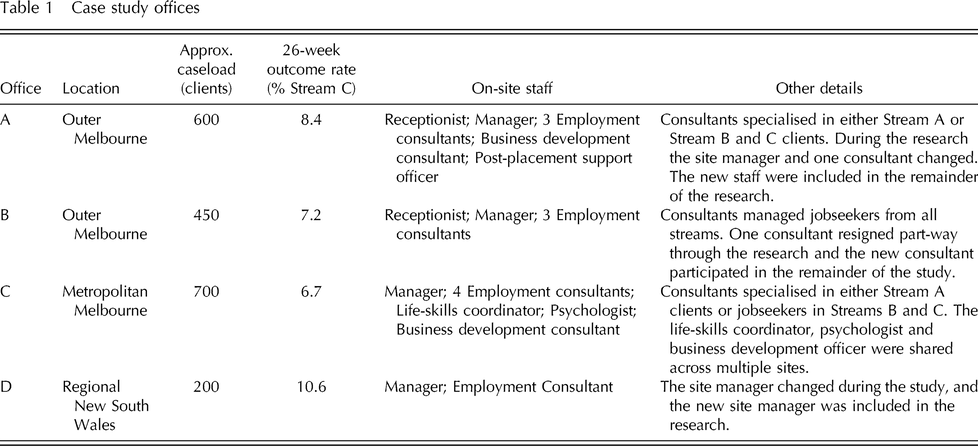
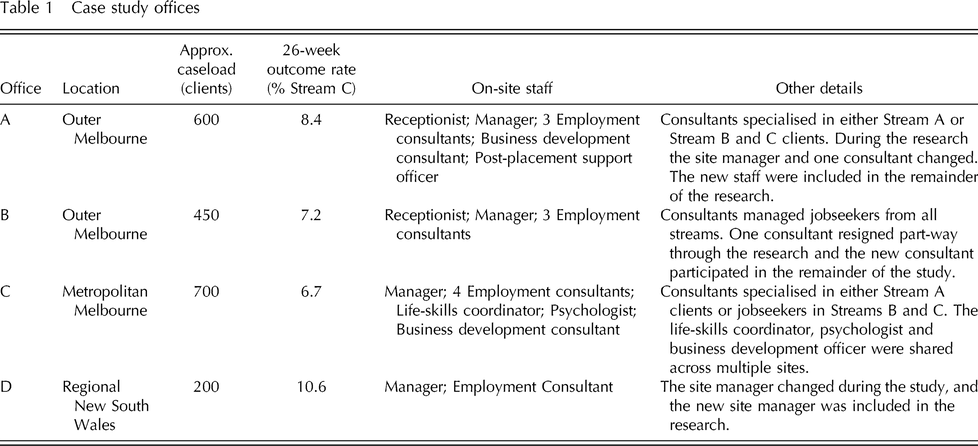
The study draws from larger case study research with four ‘high performing’ Jobactive offices, conducted over eighteen months, to understand ‘what works’ in assisting more disadvantaged jobseekers into employment. To select eligible sites, the government purchaser provided a list of twenty-nine of the highest performing offices in Victoria and New South Wales according to the proportion of each office’s Stream C caseload that had been placed into twenty-six weeks or more of employment during the first year of the Jobactive contract. This is the principal indicator under the Star Ratings system but also the measure upon which the system has thus far struggled to achieve results. Only 29,310 Stream C clients in total were placed into twenty-six weeks or more of employment between July 2015 and May 2018 (DJSB, 2018b). This list only included offices where agency management had agreed in principle to participate in the research. Four offices were purposively chosen to provide variation along ‘theoretically relevant conditions’ (Greer et al., Reference Greer, Schulte and Symon2018: 1433) related to performance such as geography and ownership structure. This was to facilitate exploration of elements of success that could be embedded in different organisational contexts and locations. Accordingly, the sample was designed so that no two offices were operated by the same provider or located in the same region. This reduced the number of eligible sites, as the twenty-nine offices were operated by only ten providers in nine regions. Furthermore, the sites were chosen to incorporate a mix of for-profit and non-profit agencies, as well as sites in a regional location and in areas with high unemployment (Table 1). The offices, staff and jobseekers are all presented anonymously. The research was approved by the University of Melbourne Human Ethics Committee.
Case study offices
Following in the tradition of ‘the ethnographic turn in political science’ (Brodkin, Reference Brodkin2017), the method included observational research and interviews with managers and all client-facing staff: six managers (including two replaced managers), ten employment consultants (including two replaced consultants), two business development consultants responsible for employer-engagement and ‘marketing’ clients to recruiters, and three specialist staff. The interviews were semi-structured and addressed providers’ caseloads, assumptions about clients, how they worked with ‘harder-to-help’ jobseekers, and explanations of site performance. Two researchers also spent an initial two to three days at each office observing appointments, staff meetings, and interactions between co-workers and other stakeholders such as employers. Each visit generated around thirty pages of fieldnotes from each researcher, providing a strong level of confidence in our observations and that we captured the totality of operations, from multiple perspectives.
Combining observational and interview research in this way is commonly used to study street-level organisations and the gap between formal policy as written and as (re)produced at the ‘micro-level of social policy’ (Rice, Reference Rice2012: 1043). Observational research, in particular, enables researchers to study the organisational as well as individual processes ‘by which institutional norms are reproduced’ (Weeden, Reference Weeden2010: 262) through ‘giving visibility’ to sources of ambiguity in policy implementation that are less likely to be revealed by other methods (Brodkin, Reference Brodkin2017: 132). The research design also incorporated a longitudinal dimension to the data collection with employment consultants. Consultants were each re-interviewed every eight to ten weeks about how they were working with a proportion of their Stream C clients and the progress these clients were making towards employment. Although qualitative longitudinal interviews have been widely used to study jobseekers’ experiences of activation (e.g. Danneris, Reference Danneris2018), the experiences of frontline workers in activating clients have rarely been examined through such an approach. Observational and interview research with frontline workers has largely followed a cross-sectional design, gathering data about street-level practices at specific moments rather than tracking the evolution of caseworkers’ approaches over a sustained period of working with clients. However, re-interviewing workers over a prolonged period can facilitate deeper revelations as significant further nuance is added about workplace practices and their responses to clients’ situations (Jordan, Reference Jordan2018). Accordingly, to operationalise this approach, ten jobseekers per full-time consultant were chosen to repeatedly discuss in follow-up interviews. This included a diverse range of jobseekers by age, gender, and duration on benefits. Seventy-four jobseekers were initially selected, and a further thirty-two were added midway through to replace clients who had dropped off sites’ caseloads due to long-term suspensions or transfers.
All observational and interview data were imported into NVivo and systematically coded for key themes in the literature on the frontline delivery of welfare-to-work, including: performance management, categorisation practices, job search monitoring, referrals to training and external support services, and sanctioning. The material presented is only a subset of this wider data but has been selected because of its significance for debates about frontline selection practices.
Findings
A failure to adequately assist Stream C jobseekers is one of the most consistent criticisms of the Australian quasi-market. Exploring this puzzle, via our case study design, quickly revealed that the categorisation and initial streaming of clients by the benefit administration agency is highly disputed by frontline staff. When interviewees were asked about the key differences between Stream C clients and jobseekers in other streams, a typical response was to question the accuracy of what was perceived as a ‘very robotic’ (INT 19, Manager, Site D) assessment process:
We can never work out how does Centrelink justify why the jobseeker is in B and not in C… of course, Stream C, outcome-wise we get more funding from the government (INT14, consultant, Site C).
Agency staff did not simply accept that a jobseeker was a Stream B, for example, if that person was referred as a Stream B. Rather, a trend we observed at each site was that consultants made their own judgements about how jobseekers should be classified and then set about trying to have clients’ re-categorised in line with that assessment. No doubt this was undertaken in part because staff sincerely believed that a mis-categorisation had occurred, and in part because of the importance of jobseeker categorisation to other key issues such as: the level of activity requirement, available assistance funds, and outcome payments. It is not our conjecture that reclassification is the only or even the most important practice responsible for high achievement in relation to Stream C jobseekers. However, it is a practice we observed routinely. Below we consider the various forms this took, its rationale, and what it means theoretically from the perspective of how we understand the role of street-level bureaucrats.
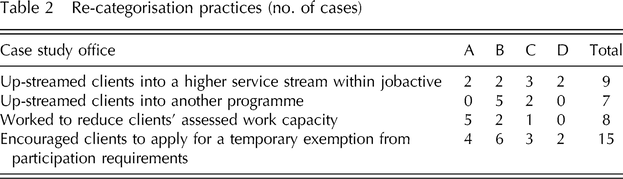
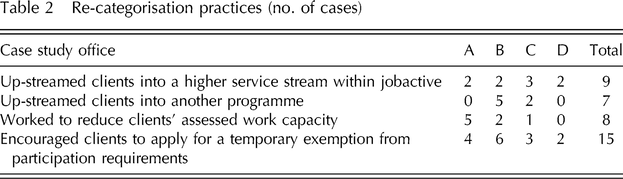
Agencies actively sought to re-categorise clients in several ways, including: working to temporarily suspend their participation requirements, reduce clients’ work-capacity requirements, and ‘upstream’ (INT16, Psychologist, Site C) jobseekers into higher service streams. As shown in Table 2, sixteen jobseekers were successfully up-streamed by agencies, either through recategorisation into a higher service stream within Jobactive (9 cases) or into another program such as Disability Employment Services (DES) (7 cases). A further eight remained in Stream C but were re-categorised with reduced requirements. No cases were identified in which agencies sought to recategorise clients into lower service streams. Altogether almost a quarter of the jobseekers were re-categorised in some way during their period with the agency.
Re-categorisation practices (no. of cases)
Since providers couldn’t directly arrange re-assessment appointments for clients in lower service streams, the onus was on jobseekers to broker this re-assessment via the benefit administration agency. This typically involved consultants working on getting clients ‘to go into their GP or their specialist’ (INT1, Consultant, Site A) to get the required evidence for a re-assessment, and then priming jobseekers about ‘the right things that you need to tell Centrelink so that you’re in the right stream’ (INT21, Consultant, Site D):
We quite often get a lot of Stream A jobseekers that the girls will see and go ‘That’s not an A’… They’ll be talking to them quite quickly about medical issues… and saying ‘Come back with some evidence and show me.’ (INT 5, Manager, Site A).
This was a common practice across all sites, and psychologists engaged by the agencies often played a key mediating role. Site C directly employed a psychologist and life-skills coordinator to advocate ‘with Centrelink so [clients] get reassessed, and whether or not jobactive is the most suitable service’ (INT17, Life-skills coordinator, Site C). Site A contracted-in an external psychologist to meet with clients ‘and then basically… we use that as evidence for a re-assessment by Centrelink’ (INT6, consultant, Site A). This consultant used this approach to reduce the work-capacity requirements of a homeless jobseeker with whom the site subsequently achieved a full-outcome, after her colleague persuaded him to convert voluntary work into eight hours per week of self-employment:
We were hoping for a reduced work capacity… Then he’s come back on, reduced work capacity, and [colleague] has got him to put his self-employment down (INT6, Consultant, Site 1).
Nine of the jobseekers we followed were up-streamed after originally being referred in either Streams A (4 cases) or B (5 cases). Aside from the higher outcome payments that agencies could receive, re-categorisation was also perceived as a way of lessening ‘the burden of [jobseekers’] requirements’ (INT6, consultant, Site A) particularly if it resulted in these being reduced to part-time. A consultant described a Stream B client serving a community corrections order that she ‘needs to be in Stream C because I’ve had to bend over backwards and manipulate the system to not refer her to a WfD activity’ (INT1):
Her [corrections] caseworker said, ‘Please don’t make her do that because that will set her up to fail’… I’ve obviously spoken at length on the phone and via email to her caseworker to just basically have all the evidence there as to why I am doing, and not doing what I’m not doing (INT1, Consultant, Site A).
An alternative way that consultants could avoid enforcing conditionality requirements, at least temporarily, was if clients could obtain a medical exemption to ‘buy [them] time’ (INT13, consultant, Site C) and prevent them from being sanctioned. Although this approach required jobseekers to be temporarily reclassified as incapable of working thereby limiting access to support. Agencies are not required to service suspended jobseekers (Department of Employment, 2017) and are ineligible for outcome payments for placing suspended jobseekers. Consequently, there was no incentive for agencies to work with suspended clients ‘because technically we can’t offer them a job’ (INT14, Consultant, Site C).
Over the study, twenty-nine different jobseekers (27 per cent) from across all sites received at least one medical or personal crisis exemption. In twenty-one cases, these were either long-term (over a month) or the jobseeker received multiple exemptions. Suspensions were not always at the recommendation of consultants. Site C, for example, had an exceptionally high suspension rate (forty-five out of ninety-nine Stream C jobseekers were suspended at one point), which a consultant partly attributed to its ‘aggressive model… pushing them into survival jobs, it’s not surprising that a lot of jobseekers would switch to passive model on suspension’ (INT14, Consultant, Site C). Nonetheless, fifteen different jobseekers were directly encouraged to apply for a suspension in order to be exempted from conditionality requirements and the risk of a participation failure. A consultant at Site B described learning from a colleague about a form that jobseekers could take to their doctor to support their case for a suspension:
So now I am just telling them ‘Go to your doctors, get them to fill it out. It prevents you from your mutual obligations’…But if they’re not suspended they’ve still got to comply…and that’s been our worst nightmare…I’ve had people that are supposed to be on WfD on medicals (INT9, Consultant, Site B).
Although agencies had some discretion to excuse Stream C clients from WfD activities, this depended upon clients undertaking the equivalent number of hours training or a health maintenance program (DJSB, 2018a). This created tensions in cases where clients weren’t considered capable of undertaking WfD but not engaged in alternatives. For example, a consultant described how she had temporarily avoided referring a jobseeker to WfD because the jobseeker had severe anxiety and had just lost a job:
I need to do a referral for her now that she’s not commenced in anything… She’s not participating in anything non-vocational so it’s very tricky. Because she is fairly fragile it wouldn’t have been a good idea for me to refer her… It may have tipped her over the edge which it’s really not even my choice to use that discretion (INT1, Consultant, Site A).
In other examples of re-categorisation practices, agencies worked to get jobseekers more permanently exempted by seeking to reclassify them out of the system entirely. This could be achieved if clients were reclassified as eligible for DES. We tracked seven examples where sites were successful in this approach although it was a strategy unsuccessfully pursued in fourteen other cases. The practice was particularly prevalent at Sites B and C, the two offices most likely to resort to ‘work first’ strategies of intensive job-search monitoring and frequent (fortnightly) appointments. Describing her site’s philosophy of ‘riding’ jobseekers, a consultant at Site C explained how clients’ progress would be regularly reviewed at team meetings:
…to see what we are doing with each person predominantly and getting advice off others ‘What should I do with him?’ You know what, ‘Do you think you are going to get an outcome?’ ‘No.’ And as hard as that is to say, push `em along whether it be DES… That’s still some kind of a result (INT13, Consultant, Site C).
In an example concerning an early school leaver, a consultant at Site B arranged for the jobseeker to be re-assessed twice in six months. That the jobseeker was an early school leaver was particularly significant because agencies had little discretion over how such jobseekers could be managed. Under measures introduced in the 2015-16 budget, jobseekers under twenty-five with no high school qualification were required to undertake twenty-five hours per week of Employability Skills Training (EST) unless already engaged in accredited training. The consultant initially referred the jobseeker to hospitality training, which she only attended for two days. So a re-assessment was arranged which ‘dropped’ her client’s activity-test requirements, although it didn’t remove the obligation to participate in EST. Consequently, the consultant had little choice but to refer her to EST, which resulted in a sanction for non-attendance. This prompted a second attempt to get the jobseeker re-classified as eligible for DES: ‘So that worked… getting her reassessed, because she was not serviceable whatsoever’ (INT11, Consultant, Site B).
Discussion: performance monitoring and categorisation
It is through assessment and classification that individuals ‘are “made up” as targets for activation’ (Brady, Reference Brady2018: 842). While categorisation practices have long been regarded as a coping strategy among workers in social service organisations (Rosenthal and Peccei, Reference Rosenthal and Peccei2006), studies of selection practices in quasi-market contexts suggest that performance management intensifies the pressures to sort clients for employability. However, the re-categorisation practices observed in this study differ from these informal categorisation practices in that they entail contestations over the formal classification of jobseekers at an administrative level and involve screening clients not primarily for employability but for how they can be identified ‘as bearers of socially-defined risks’ (Brady, Reference Brady2018: 830). This is underscored by the multiple observed examples of agencies working to deconstruct how clients were initially ‘profiled’ by Centrelink, including in a series of ways that paradoxically reduced the commodifying tendencies of welfare – such as when agencies worked to reduce clients’ assessed work capacity requirements, or to up-stream clients from Jobactive into DES, or when jobseekers were encouraged to apply for temporary exemptions. Our data suggest that providers spend a considerable amount of time on re-categorising clients in these ways – strategies at odds with the policy goal of activating recipients from welfare-to-work and which generate considerable transaction costs for agencies, jobseekers, and the purchaser from clients ‘having to go back and forward’ (INT9, Consultant, Site B) between Centrelink, Jobactive agencies, and health professionals. According to a previous OECD analysis, these jobseeker classification assessments constitute ‘a large element of overall system costs’ and suggest a provider focus on issues of jobseeker categorisation ‘as much as CVs, training, [and] job vacancies’ (2012: 132). While street-level theorists often highlight the ways in which performance management fosters practices ‘that emphasise welfare reform’s commodifying features’ (Brodkin, Reference Brodkin2015: 14), deterministic accounts should be avoided due to the diversity of accountability systems (van Berkel, Reference van Berkel, van Berkel, Caswell, Kupka and Larsen2017).
Of course, the re-categorisation practices we observed need not necessarily be viewed as responses to performance regimes. Other interpretations are possible. It may be that caseworkers are simply responding to what they perceive as ‘system failures’, out of empathy for clients as persons. In Maynard-Moody and Musheno’s terms, they are acting as ‘citizen agents who improvise in response to these encounters’ (Maynard-Moody and Musheno, Reference Maynard-Moody and Musheno2000: 356). The fact that so many of the attempts (though not all) were successful does indeed point to underlying system problems with official classification processes, while there was certainly evidence of caseworkers being driven by empathy to up-stream clients. For example, a consultant recounted learning that one of his clients was homeless:
He was a Stream A and then he said he’s been living in a swag [small canvass tent for sleeping]… But we need a proper assessment. So we got him to go to Centrelink… They’re the ones that you’ve got your bit of heart out to (INT 8, consultant, Site B).
Motivations for re-categorising clients are diverse. Nevertheless, aspects of the accountability systems that consultants worked under also sensitized them to the possibilities of re-categorisation, should previously undisclosed client ‘risks’ emerge. Our argument here is not that accountability instruments provided the sole explanation for re-categorisation practices but that they made the option of working to address mis-categorisation issues more worthwhile. Indeed, the frequency of these re-categorisation practices suggests that these were far from ad hoc examples of caseworkers going out of their way to help clients but constituting embedded ‘organisational practices’ (van Berkel and Knies, Reference van Berkel and Knies2016: 63).
All consultants had targets of eight to fifteen job placements per month depending on their caseload, with progress routinely monitored via white boards visible at each site. Managers also monitored consultants’ WfD referral and attendance rates: ‘Are [clients] commenced…are they tracking towards their hours?’ (INT5, Manager, Site A), illustrating what van Berkel (Reference van Berkel, Brodkin and Marston2013) describes as ‘triple activation’: how the use of behavioural incentives reaches beyond the activation of benefit recipients and the organisations delivering contracts to the frontline staff within those agencies.
Category manoeuvres facilitated the achievement of performance targets in several ways. For example, agencies can achieve a full twenty-six week outcome with full-time activity tested clients in one of two ways: either by placing them into sufficient hours of employment that clients no longer remain on benefits, or by reducing their work-capacity requirements so that those with sufficient part-time employment can continue receiving benefits and agencies can achieve a full-outcome. With consultants perceiving that clients’ employability was often limited to casual shift-work in hospitality or process-work, this latter approach was viewed as a rational way of getting a full outcome:
I get them to get an ESAt done, make them go part-time instead of full-time. They get that part-time job that coincides with looking after their children or physical barriers they may have… It’s easier to get a fifteen hour job apparently or so around here because there is a lot of retail (INT13, Consultant, Site C).
The same consultant attempted this strategy with a full-activity tested client, an ex-offender already in part-time employment, explaining that ‘to get an outcome…we were trying to reduce his capacity’ (INT13, Site C).
Even removing clients from caseloads entirely through recategorising them as eligible for DES was perceived as a result despite not producing a payable outcome. The benefit, explained a consultant at Site B, was that ‘every time you get someone off your caseload that you can’t work with, you open another spot up’ (INT11). From this perspective, it could be viewed as a more efficient form of ‘parking’ in that rather than retaining perceived dead-weight on their caseloads, getting ‘harder-to-help’ jobseekers transferred to another programme increased the proportion of clients that they potentially could realise an outcome with. Performance targets reinforced these incentives. As a consultant at Site C explained when asked whether there was any benefit of clients transferring to DES: ‘Our KPI [Key Performance Indicator] is based on the number of jobseekers in our caseload… And we understand that jobactive is not for every single job seeker.’ She continued:
…[It benefits] both parties. Benefit to us because if you don’t have many jobseekers, then our KPI will be lower. On the other hand, for job seeker, they can get a better and more appropriate service (INT14, Consultant, Site C).
So re-categorising clients had the immediate short-term benefit of reducing KPIs. Encouraging clients to obtain exemptions could similarly temporarily reduce consultants’ active caseload, although the key benefit arose from how ‘Suspensions stop the clock’ (INT5, Manager, Site A). This was particularly important during jobseekers’ annual activity phase, when exemptions could be used to avoid the risk of adverse performance ratings as well as clients’ incurring payment penalties. Managers were acutely aware that 20 per cent of their Star Rating depended on WfD referrals: ‘You’ve got to get them into an activity within five days and then obviously have them meet their AARs and that’s worth ten per cent each’ (INT10, Manager, Site B). By enabling agencies to stop the clock on clients’ annual activity phase, medical exemptions provided a way to defer referring clients to WfD ‘when you know someone’s not going to meet their requirements’ (INT21, Consultant, Site D). Otherwise non-referral might ‘flag’ in the system and perhaps trigger an audit, which in turn may jeopardise their Star Rating. This was highlighted by the unusual case of a client who had yet to be transferred onto a Parenting Payment after giving birth, and was ‘one week in’ to the annual activity phase:
She’s due for an annual activity requirement… So she’s going against my stats as well. She’s supposed to be in ‘work for the dole’. I’ve told her to get onto it [attaining an exemption] urgently (INT 1, consultant, Site A).
Suspensions served as an adaptive strategy to accountability systems that penalised non-compliance with regulatory activation measures by enabling the possibility of compliant non-compliance. These examples suggest that regulatory conditionality requirements can paradoxically lead to organisational behaviour that results in jobseekers being disengaged or occasionally withdrawn from activation programmes, highlighting the disjuncture between formal policy as written and as produced ‘in everyday organizational life’ (Brodkin, Reference Brodkin2011: i273).
Our evidence suggests that policymakers are presented with a dilemma in relation to mutual obligation policy. On the one hand, policymakers operating from the perspective of a work-first political ideology, are likely to see merit in a policy regime that requires jobseekers to be activated in a range of ways considered suitable for their relative distance from employment. At the same time, from the perspective of contracted agencies and street-level bureaucrats, there is an almost irresistible incentive to manage their workload in ways that optimise their outcomes. In this case that seems to mean investing considerable effort not just in ensuring jobseekers meet their requirements, but also in changing the nature of those requirements so they are more easily met. In the context of a performance framework that pays-by-results and penalises agencies for non-enforcement of conditionality, identifying and operationalising harder-to-help clients’ barriers (to re-categorise them into higher streams, reduce their assessed work requirements, or facilitate temporary exemptions from the reach of conditionality) can become a tactical organisational response.
Acknowledgements
The authors thank the Australian Research Council and our industry partners (Jobs Australia, the National Employment Services Association, and Westgate Community Initiatives Group), who funded the research upon which this article is based (LP150100277). The authors also thank the four employment agencies who participated in this research, and especially the frontline staff who repeatedly took time out of their busy days to be interviewed. Finally, the authors thank the referees for their thoughtful and constructive feedback on earlier versions of the article.