Has the COVID-19 crisis affected the outcome of the 2020 U.S. presidential election? Or did partisanship play a particularly strong role in a context of high polarization? Was Donald Trump exonerated from the management of the economic and political crisis by a populist electoral base, or did democratic accountability play a role explaining his ultimate defeat?
These questions are important for both American and comparative politics scholars. First, the reasons behind the electoral fortunes and defeat of an atypical president in recent American history are a matter of interest in political science (Inglehart and Norris Reference Inglehart and Norris2017; Sides, Tesler, and Vavreck Reference Sides, Tesler and Vavreck2017; Federico and Zavala Reference Federico and de Zavala2018; Goetz et al. Reference Goetz, Davlasheridze, Han and Fleming-Muñoz2018; Hooghe and Dassonneville Reference Hooghe and Dassonneville2018; Morgan and Lee Reference Morgan and Lee2018; Mutz Reference Mutz2018; Schaffner, Macwilliams, and Nteta Reference Schaffner, Macwilliams and Nteta2018; Setzler and Yanus Reference Setzler and Yanus2018; Redlawsk et al. Reference Redlawsk, Roseman, Mattes and Katz2018; Reny, Collingwood, and Valenzuela Reference Reny, Collingwood and Valenzuela2019; Knuckey and Hassan Reference Knuckey and Hassan2020). The significance of the Trump administration for the nature of American values and resilience of liberal democracy is highly debated and controversial. Moreover, Trump’s double status as both a populist outsider and a presidential incumbent make this case particularly interesting. While populist entrepreneurs are expected to benefit from some forms of economic anxiety and disaffection with the political system (Hobolt and Tilley Reference Hobolt and Tilley2016; de Vries and Hobolt Reference de Vries and Hobolt2020), incumbent candidates are expected to be electorally punished in bad economic times (van der Brug, van der Eijk, and Franklin Reference van der Brug, van der Eijk and Franklin2007; Duch and Stevenson Reference Duch and Stevenson2008). Disentangling which of these dynamics was at play has important implications for the role of democratic accountability and the prospects of populist illiberal narratives in the United States.
Second, this research question is also relevant for comparative scholars and beyond the specific interest on Trump’s electoral fortunes. The impact of economic and political crises on political behavior outcomes like radical-right voting (Arzheimer Reference Arzheimer2009, Reference Arzheimer and Rydgren2018; Golder Reference Golder2016; Hobolt and Tilley Reference Hobolt and Tilley2016; Gidron and Mijs Reference Gidron and Jonathan2019) or policy preferences (Margalit Reference Margalit2013) remains surprisingly controversial. The COVID-19 epidemic is a major and exogenous shock providing a unique opportunity to analyze how different aspects of a sudden crisis affect political attitudes and behavior (Acharya, Gerring, and Reeves Reference Acharya, Gerring and Reeves2020; Amat et al. Reference Amat, Arenas, Falcó-Gimeno and Muñoz2020; Arceneaux et al. Reference Arceneaux, Bakker, Hobolt and de Vries2020; Bol et al. Reference Bol, Giani, Blais and Loewen2020).
To test the impact of the COVID-19 crisis on the 2020 U.S. presidential election, we present the results of a survey experiment fielded during the campaign manipulating the salience of different aspects of the crisis: the major economic downturn, a controversial political management of the pandemic (with the United States having the highest death toll worldwide at the time of the election), and immigration-related anxieties around the Chinese origin of the virus spreading globally via open borders. We compare vote intentions and thermometer feelings between respondents exposed to each of those treatment conditions and a control group. Our research design has two main advantages. First, it allows us to assess the causal impact of specific aspects of the crisis, net of partisanship and other well-known perceptual screens filtering attribution of responsibility. Second, given the high levels of affective and ideological polarization in a bitterly divisive campaign (Gidron, Adams, and Horne Reference Gidron, Adams and Horne2020), our design is a potentially conservative test of the ability of economic and political retrospective evaluations to affect voting behavior.
Our analyses provide two main findings. First, the economic downturn is the only aspect of the crisis with an average, negative, and significant effect on Trump’s re-election prospects. More interestingly, we find this effect to be pervasive across the population, and not conditional on partisanship. The group exposed to factual information on the economic crisis reduced vote intentions for Trump by 7–9 percentage points. Household income levels below $50,000 were responsive to the economic downturn in a more statistically significant way, suggesting that egocentric calculations also played a role in Trump’s electoral prospects.
Second, information on the political management of the crisis had strong negative effects on Trump’s prospects among voters between 55 and 70 years of age. In comparison to respondents of the same age in the control group, being exposed to information on the management of the health crisis depressed Trump support up to 25 percentage points, which is a remarkable magnitude for a demographic typically aligned with the Republican Party.
Our findings have several implications for the literature on crises and political behavior, and for the prospects of populism in the United States. The main implication of our findings is that, despite the toxic and polarizing character of the campaign, the 2020 election was to a large extent a normal contest. It was fiercely fought along traditional partisan and demographic lines, and the incumbent was held to account by a turbulent economic and political context. Despite the overwhelming effect of partisanship, race, and religion in our data, Trump was still evaluated as a standard presidential incumbent. He was punished by the economic crisis, and by older voters most at risk by the mismanagement of the pandemic.
Our findings imply a considerable degree of rationality in the 2020 outcome and are in line with canonical theories of economic voting (Lewis-Beck and Stegmaier Reference Lewis-Beck and Stegmaier2000; Tilley, Neundorf, and Hobolt Reference Tilley, Neundorf and Hobolt2018) and the politics of competence (Green and Jennings Reference Green and Jennings2017, Reference Green and Jennings2019). Our results also confirm that anti-immigrant attitudes are one of the strongest predictors of Trump support (Hooghe and Dassonneville Reference Hooghe and Dassonneville2018), as well as anti-tax policy preferences. Overall, our experiment suggests that populist candidates are not immune to democratic accountability once in power (Spanje Reference Spanje2011), and that becoming insiders is one of their biggest electoral dangers.
Hypotheses
The global COVID-19 outbreak constitutes an unprecedented crisis affecting various politically relevant areas. Firstly, it can be considered a health crisis with unseen consequences in fatalities and pressures on national health systems, putting enormous expectation and strain on national governments. Second, the economic consequences of the pandemic far surpass the impact of the financial crisis in 2008, with national debt mounting, GDP plummeting, and unemployment rising. Third, the crisis has led to an unparalleled impact on the openness of international borders, with governments shutting down specific travelling routes and many pointing at international flows of people as spreaders of the pandemic.
We develop several theoretical expectations concerning the impact of different aspects of the COVID-19 crisis on voting behaviour. More specifically, the next sub-sections consider the effects of the major economic debacle caused by the pandemic, the political management of the crisis, the global spread of the virus, and the role of partisanship filtering political events.
The Role of the Economic Debacle
Socio-tropic theories of economic voting have profusely documented strong effects of macro-economic conditions on the electoral fortunes of incumbents (Lewis-Beck and Stegmaier Reference Lewis-Beck and Stegmaier2000; Duch and Stevenson Reference Duch and Stevenson2008; Vavreck Reference Vavreck2009). The COVID-19 crisis has generated an unprecedented economic debacle. According to official U.S. government data and by the time of the 2020 presidential campaign, GDP had decreased by 32.9% following the start of the coronavirus outbreak. This output drop is four times larger than after the financial crisis in 2008. The unemployment rate had tripled in comparison to the previous year.Footnote 1
From a socio-tropic perspective, and assuming that Trump was perceived as a standard incumbent with responsibility over recent economic performance, the magnitude of the 2020 economic crisis should have significant, direct, and negative effects on Trump’s prospects of re-election. This leads to our first hypothesis:
Hypothesis 1 (H1): Respondents exposed to information on the economic crisis triggered by the pandemic will evaluate Trump (Biden) more negatively (positively) than respondents in the control group.
While socio-tropic considerations have proved to be highly consequential in previous research, egocentric or pocketbook considerations can also be relevant when attribution of responsibility is clear (Tilley, Neundorf, and Hobolt Reference Tilley, Neundorf and Hobolt2018). This means that the economic downturn should especially affect vote intentions of those personally affected by it. Economic self-interest can be conceptualized from an income-maximizing (Kenworthy and Pontusson Reference Kenworthy and Pontusson2005) or an economic risk perspective (Rehm Reference Rehm2009). The former focuses on present income as the best indicator of hardship, and the latter considers prospective unemployment risk as a key determinant of preferences and political behavior. Our second hypothesis expects economic conditions to interact with the individual probability to feel the downturn. More specifically, we expect information on the economic conditions to harm Trump’s prospects more among those at higher risk of becoming unemployed or with lower incomes:
Hypothesis 2 (H2): The negative effect of the economic crisis treatment versus the control group on the evaluation of Trump will be larger among respondents at high risk of unemployment (H2a) and with low income (H2b) (conditional effects).
The study of an exogenous economic shock triggered by a global pandemic provides a unique opportunity to analyze the role of populist attitudes on Trump’s electoral prospects. While Trump had been considered an atypical candidate capitalizing on populist and political disaffection (Rudolph Reference Rudolph2019), he was also the presidential incumbent and leader of the Republican Party. The tension between his permanent outsiderness and his role as a canonical anti-tax Republican leader leads to two competing expectations.
On the one hand, macro-economic turbulence has been suggested as a trigger of populist radical right electoral success (Hobolt and Tilley Reference Hobolt and Tilley2016; de Vries and Hobolt Reference de Vries and Hobolt2020). The arguably exogenous shock of COVID-19 could exonerate Trump from any responsibility in the economic downturn, and even re-activate populist and anti-systemic attitudes ultimately benefiting him. On the other hand, the economic crisis could activate classical left-right distributional issues and bring preferences over tax and spending to the forefront of the election, at least in the short term (Margalit Reference Margalit2013). The major economic shock and consequent public debt could exacerbate anti-tax preferences among high and median-income voters, who tend to be redistribution-averse in majoritarian systems (Iversen and Soskice Reference Iversen and Soskice2006). The populist versus mainstream dichotomy leads to the next pair of hypotheses:
Hypothesis 3 (H3): Respondents exposed to information on the economic crisis will increase their populist attitudes in comparison to the control group, and those attitudes will subsequently increase positive (negative) evaluations of Trump (Biden) (mediation effect).
Hypothesis 4 (H4): Respondents exposed to information on the economic crisis will increase their anti-tax and spending preferences in comparison to the control group, and those preferences will subsequently increase positive (negative) evaluations of Trump (Biden) (H4a); this effect will be larger among high-income respondents (H4b) (mediation effect).
The Political Management of the Pandemic
The COVID-19 crisis is of course not only an economic catastrophe, but a major public health issue. The role of governments at imposing social and mobility restrictions to halt the spread of the virus has become a salient and divisive issue in many democracies. The management of the crisis by the Trump administration, the use of masks, and the infection of the president himself became highly politicized events during the campaign.
Perceptions of governmental competence have become a crucial determinant of the fortunes of mainstream politicians in advanced liberal democracies (Green and Jennings Reference Green and Jennings2017, Reference Green and Jennings2019). Assuming that high public health standards are a valence and universally valued issue, the capacity of governments to control the epidemic is a reasonable determinant of their chances to remain in office. More specifically, we expect that priming on the highest death toll worldwide and the controversies over the governmental management of the pandemic should depress Trump’s electoral prospects on average. We also expect a conditional effect with age, since older respondents are a particularly vulnerable groupFootnote 2 more at risk of suffering serious health consequences from contracting COVID-19.
Hypothesis 5 (H5): Respondents exposed to information on the high death toll of the virus and the controversies over the government’s management of the pandemic will evaluate Trump (Biden) more negatively (positively) than respondents in the control group (H5a); and this effect will be larger among older respondents (H5b) (conditional effect).
Our expectations on older voters speak to a burgeoning literature on age and COVID-19 (Canning et al. Reference Canning, Karra, Dayalu, Guo and Bloom2020; Daoust Reference Daoust2020; Siemens Reference Siemens2021). Since age appeared to be the most important determinant of hospitalization and the chances to survive the virus, social scientists have turned their attention to the differences in attitudes and compliance with preventive measures between the young and old. One of the most interesting and emerging findings is that the relationship between age and COVID-19 measures is not linear (Daoust Reference Daoust2020), which we will consider in our analyses.
Out-Group Hostility
Earlier studies on Trump’s 2016 electoral victory point out that anti-immigrant attitudes clearly outperformed economic factors and other electoral determinants (Hooghe and Dassonneville Reference Hooghe and Dassonneville2018; Reny, Collingwood, and Valenzuela Reference Reny, Collingwood and Valenzuela2019). This finding speaks to the overwhelming evidence in favor of cultural and status-related concerns as the strongest drivers of radical right electorates (Mudde Reference Mudde2007; Mutz Reference Mutz2018; Norris and Inglehart Reference Norris and Inglehart2019). Trump kept his populist and anti-immigrant narrative alive throughout his term in office. Consequently, one would expect anti-immigrant attitudes to still benefit the clear owner of the issue in the 2020 election.
The COVID-19 crisis might have exacerbated the salience of anti-immigration and anti-globalization attitudes driving electoral choices. This would resonate with attempts by the Republican campaign to frame the crisis as the “Chinese virus,”Footnote 3 and by beliefs that open borders contributed to the global spread of the disease (Yucesahin and Sirkeci Reference Yucesahin and Sirkeci2020). There is evidence that anti-Asian attitudes were associated with COVID-19 attitudes and behaviors in the early stages of the pandemic, when conservative elites racialized the outbreak (Reny and Barreto Reference Reny and Barreto2020).
Out-group hostility may thus be a relevant theoretical channel explaining the electoral impact of the COVID-19 crisis. Priming respondents on the Chinese origin of the virus and the role of international travelling and migration routes could interact with prior levels of out-group hostility, and ultimately boost vote intentions for Trump. Even if the coronavirus crisis is unable to change anti-immigrant attitudes entrenched in stable cultural values and beliefs (Kustov, Laaker, and Reller Reference Kustov, Laaker and Reller2019), immigration concerns associated with the pandemic (i.e., priming respondents on the risk of open borders and the Chinese origin of the virus) could still increase Trump’s electoral prospects among electorates with anti-immigrant policy preferences. This leads to our next hypothesis:
Hypothesis 6 (H6): Respondents exposed to immigration concerns associated with the pandemic will evaluate Trump (Biden) more positively (negatively) than respondents in the control group (H6a); and this effect will be larger among respondents with anti-immigrant policy preferences (H6b) (conditional effect).
Partisanship
Finally, it is well known that partisanship is a strong driver of American voting behavior and political attitudes, and that affective and ideological polarizations are a crucial wedge between Democrats and Republicans (Gidron, Adams, and Horne Reference Gidron, Adams and Horne2020). Partisanship has also become a surprisingly strong driver of attitudes towards the pandemic, including the use of masks and the compliance with social distancing measures (Grossman et al. Reference Grossman, Kim, Rexer and Thirumurthy2020). Partisanship is traditionally regarded as a stable perceptual screen filtering elements that may be associated with the COVID-19 crisis, like economic downturns and governmental competence (Evans and Andersen Reference Evans and Andersen2006). We would thus expect the mechanisms summarized in our previous hypotheses to be more visible among weak partisans or independents than among strong partisans:
Hypothesis 7 (H7): The expected effect of economic conditions (H1), the political management of the pandemic (H5a), and immigration anxieties (H6a) will be stronger for weak partisans and independents than for strong partisans of either party (conditional effects).
Research Design
To test our hypotheses, we use a survey experiment priming respondents on different aspects of the COVID-19 crisis. Survey experiments prime latent attitudinal and behavioral traits and are a powerful tool for causal inference (Krupnikov and Findley Reference Krupnikov, Findley, Atkeson and Alvarez2018). This approach is particularly valuable when studying attitudes that are likely to be confounded by underlying partisan and ideological considerations.
The scope of our findings is inevitably limited by the conditions created by the experiment and the context in which they were received. We aim, however, at a reasonable level of external validity by embedding our experiment in a representative sample of the U.S. population, during the campaign leading to the election that we are studying, and at a time in which the economy and COVID-19 were highly salient issues in the public.Footnote 4
We registered the data collection and data analysis of this study at the OSF on October 15, 2020, before any data collection commenced.Footnote 5
Data collection
Participants were recruited from an online access panel administered by the company Deltapoll and their partners. No direct financial incentives were given. However, respondents got some virtual tokens, which they can ultimately exchange for some money or vouchers. The survey includes 1,200 individuals, representative of the U.S. population.Footnote 6
Our analysis is well powered according to standard calculations. As it is conventional to do, we assume 95% level of statistical significance and 80% statistical power. We then calculate the standardized difference that we expect to find between our control and each of our treatment groups: difference between the means/standard deviation of our outcome in the population (Jones, Carley, and Harrison Reference Jones, Carley and Harrison2003). We assume a 0.1 (10%) difference in the means of our outcomes between our treatment and control group and take the standard deviation of thermometer feelings towards Trump from the 2016 pre-electoral survey of the American National Election Study (0.33). We look at one-tailed hypotheses given the strong theoretical background suggesting specific signs of competence and economic perceptions on incumbents. Given these assumptions, we need 176 individuals per treatment group for a well-powered analysis, which adds up to 704 as the total necessary sample size for average treatment effects.
We also estimated the necessary power to calculate heterogenous treatment effects across partisan groups (Democrats, Independents, and Republicans). Based on the 2016 American National Election Study, the difference in thermometer feelings for Trump between Republicans and Independents is 0.25, which is a conservative assumption since the difference between Republicans and Democrats is much larger. The standard deviation of feelings towards Trump for both Democrats and Republicans is 0.25. Given these values and the well-known strong effects of partisanship on voting behavior, a well-powered conditional analysis across four treatments and three partisan groups would require a total sample size of 204.
Online appendix 1 tabulates key demographic characteristics of our sample and shows a remarkably high correspondence with a high-quality sample from the American National Election Study.Footnote 7 Data collection took place between October 21–29, 2020, about one week before the election, which was held on November 3, 2020.
Experimental Design
After consenting to participating in our study, respondents were first asked a few pre-treatment variables: gender, age, education, partisanship, and state of residence. They were then randomly assigned to the control group or one of our three treatment groups. Outcome variables were directly asked after the exposure to the treatments, followed by some mediating and moderating variables needed to test some of our hypotheses. The survey finished with some additional demographic questions on income, domicile, ethnicity, and religiosity.Footnote 8
Randomization
We randomly assigned three treatment conditions and one control group to our sample, relying on simple block-randomization, whereby respondents were first allocated to one of three groups: Democrats, Independents, and Republicans.Footnote 9 The random assignment of our treatment conditions took place within each group. Each experimental condition makes up 25% of the sample.
As we show in online appendix 2, the randomization of our treatment was largely successful, based on key demographics: gender, age, education, partisanship, income, urban/rural residence, ethnicity, and religiosity. Estimating a multi-nominal logistic regression of treatment allocation (reference category: control group), we find only slight significant differences in terms of religion (especially for the governmental management treatment) and ethnicity (for China virus treatment). In order to deal with these small imbalances between the treatment groups and the control group, observed demographic characteristics are included in the regression models, presented as control variables.
Variables
Experimental treatments
Our main independent variable is the random assignment to the control group or one of our three treatment groups. This variable has four values: 1) “control group”; 2) “economic treatment”; 3) “government management treatment”; and 4) “China virus treatment.” The control group was not exposed to any vignette or mentioning of COVID-19. All treatment conditions report factual statistics from official sources or academic studies, and the sources were provided in the vignettes. The wording of the vignettes for each treatment is the following:
ECONOMIC TREATMENT—T1: “According to official data from the US government, the economy has declined dramatically over the last few months. GDP decreased by 32.9% following the start of the coronavirus outbreak, which is four times higher than after the financial crisis in 2008.Footnote 10 The unemployment rate has tripled in comparison to last year.Footnote 11”
GOVERNMENT MANAGEMENT TREATMENT—T2: “According to data from Johns Hopkins University, the death toll in the US due to the coronavirus outbreak is the highest in the world, well surpassing 200,000 deaths.Footnote 12 The federal government has been under intense scrutiny recently, accused of being slow to coordinate a national response and sending unclear messages.Footnote 13”
CHINESE VIRUS TREATMENT—T3: “Recent academic studies have linked the spread of coronavirus to migration and specific travelling routes originating in Central China and spreading across the world.Footnote 14 Based on Census Bureau data, immigration to the United States has tripled since 1970, reaching unprecedented levels. According to recent estimates, the U.S. foreign-born population has reached a record 44.8 million.Footnote 15”
Immediately after each treatment, respondents assigned to that particular vignette were asked about a related opinion on subjective unemployment risk, political performance, or immigration policy respectively. Those questions were part of the treatment. Everyone else was still asked the same questions, but after the outcome variables.
Outcome variables
To test the impact of our treatments on the electoral fortunes of the main presidential candidates—incumbent president Donald J. Trump and Democratic challenger Joseph R. Biden, Jr.—we use two questions. First, we investigate vote intention for Trump over Biden, setting to missing those who would not vote (5.4%), vote for another candidate (2.4%), or did not know who to vote for (5.4%).Footnote 16 Based on our sample, 47.6% stated that they would vote for Trump, which is within 1% to the official election results, confirming the high quality of our sample.Footnote 17 In online appendix 3 (M5) we further replicate our main models using Trump vote versus all other options, including not voting and don’t know answers.
The second set of outcomes focuses on thermometer feelings towards the two candidates, ranging from 0 to 100. Figure 1 plots the distribution of the two variables and illustrates the extreme polarization of the American public in the lead up to the 2020 election. Thirty-five percent of respondents give Trump a zero on the feeling thermometer, while 21% give him 100. Biden exhibits a similar extreme, bi-modal distribution, with 24% giving him a zero and 20% giving him a 100. As one would expect, the two variables are highly, negatively correlated (R = -0.75) and strongly reflect partisanship.Footnote 18 We see this context as a difficult case study to prove contextual economic and political effects on vote intentions.
Descriptive distribution of feeling thermometer for Trump (A) and Biden (B)

Mediating and moderating variables
Based on our pre-registered hypotheses and analytical strategy, we expect varying moderating and mediating variables to impact the effect of COVID-19 on the electoral success of the two presidential candidates. Following H2 we expect subjective unemployment risk and income to condition the impact of the pandemic. To measure the former, we use a four-categorical scale that asked respondents “how likely do you think it is, if at all, that during the next twelve months you will be unemployed and looking for work for at least four consecutive weeks?”, ranging from 1 “very likely” to 4 “not at all likely”. Respondents who do not seek work are coded as missing.
To measure income, respondents were asked to state their combined, pre-tax annual household income, ranging from less than $15,000 (1) to $250,000 and above (24). We use income as a linear variable, and in online appendix 5.2 replicate the results using a binary variable—below sample median (below $50,000) = 0; above sample median ($50,000+) = 1. While income is an important measure of personal economic circumstances, it inevitably misses other important aspects like property of assets (Nadeau, Foucault, and Lewis-Beck Reference Nadeau, Foucault and Lewis-beck2010; Stubager, Lewis-Beck, and Nadeau Reference Stubager, Lewis-Beck and Nadeau2013; Nadeau, Arel-Bundock, and Daoust Reference Nadeau, Arel-Bundock and Daoust2019) and class or occupation (Evans and Tilley Reference Evans and Tilley2017).
H3 and H4 look at potential mediators of the economic treatment. First, we measure populist attitudes (H3) asking respondents whether they disagree (1) or agree (5) with the following statement: “The people, and not politicians, should make our most important policy decisions.” This is a verified item often used to measure populist sentiments. Second, we measure anti-tax and spending preferences using the following question: “Imagine that the federal government had to choose between increasing taxes and spending more on unemployment benefits (1), or decreasing taxes and spending less on unemployment benefits (5), which should they do?”.
H5b further expects that the impact of the government management treatment to be strongest among older voters. To test this hypothesis, we model age as a linear as well as non-linear effect. Online appendix 5.4 further replicates the analysis using a binary age variable (below 55 years old = 0; 55 years or older = 1).
Next, we look at the conditioning effect of immigration preferences (H6b), asking respondents “How restrictive, if at all, do you think immigration policy in the United States should be?” Responses range from not at all restrictive (1) to extremely restrictive (5). Last, to test H7 we condition the effects of our three treatments by partisanship, using the same three categories also used for block randomization. For this we collapsed the standard 7-point partisanship into Democrats (1 and 2), Independents (3–5, don’t know), and Republican (6 and 7).
It is important to note that two of our moderators (i.e., subjective economic risk and immigration policy preferences) are post-treatment, as we also wanted to check whether they mediated rather than moderated our treatments of interest. Online appendix 8 shows clearly insignificant effects of our treatments on all our endogenous mediators and moderators. This already indicates that our different COVID-19 primes are not mediated by unemployment risk, spending preferences, populism, and immigration policy preferences. This also means that none of our moderators were affected by the treatments.
Additional Control Variables
As outlined in our pre-registration plan, our models control for key demographic variables. This will help to account for small but significant imbalances in our treatment groups (refer to online appendix 2) and to compare the effect size of our treatments with well established (pre-treatment) drivers of vote choice. We include the following control variables:
-
• Gender: Female (51.3%) versus male (48.7%)
-
• Education: Degree (35.6%), high school (58.0%), less than high school (6.4%)Footnote 19
-
• Domicile: Urban (25.1%), Suburban (41.2%), City or sizable town (10.3%), Rural (23.4%)
-
• Ethnicity: White (73.4%), Black (12.4%), Hispanic (9.2%), Other (5.0%)Footnote 20
-
• Religion: Identify with religion + frequent attend (31.9%), Identify with religion + not frequent attend (35.8%), do not identify with religion (32.3%)
-
• Age: To compare the effect size across all variables, age was recoded to range from 0 to 1Footnote 21
Results
To test our hypotheses, we use OLS regression analysis with the following dependent variables: vote intention in the 2020 presidential election as well as thermometer feelings concerning Trump and Biden.Footnote 22 Our main independent variables are our experimental conditions, which are specified as a set of dummy variables with the control group as the reference category. In this section, we first test the average impact of our treatments on our outcome variables, before exploring further the conditional and mediating effects outlined in our hypotheses.
Main Effects
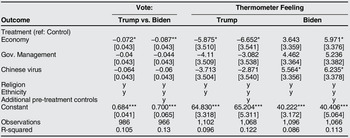
Table 1 reports the regression coefficients and standard errors predicting our three outcomes. Those coefficients test the effects of our three COVID-19 priming treatments compared to the control group. In these models we control for key demographics, which are exogenous to the treatment, and which have been shown to be important for U.S. voting behavior. Models M1.1, M2.1, and M3.1 only include ethnicity and religiosity, which remain imbalanced between our treatment and control groups.
Regression coefficients: Main treatment effects

Significance levels: *** p
 $ \hskip0.5em \le \hskip0.5em 0.01 $
, ** p
 $ \hskip0.5em \le \hskip0.5em 0.05 $
, * p
 $ \hskip0.5em \le \hskip0.5em 0.1 $
.
Source: Deltapoll online survey.
Note: The table reports coefficients and standard errors. The results are based on linear regressions predicting the three outcome variables: A) Vote intention for Trump (1) over Biden (0); B) Thermostatic feelings towards Trump (0–100); C) Thermostatic feelings towards Biden (0–100). The coefficients capture the impact of the three treatments in comparison to the control group. Ethnicity and religiosity are included in all models as controls due to small imbalances between the treatment groups. In models M1.2, M2.2, and M3.2 we additionally control for gender, age, education, and domicile. The full list of coefficients is reported in online appendix 3.
The results confirm Hypothesis 1, which stated that the economic crisis triggered by the pandemic will harm Trump’s electoral prospects and help his opponent. Table 1 confirms that the expected vote intention is about 7 to 9 percentage points lower for the treated group compared to the control group. This effect is significant at the 5% level when including the full list of control variables (M1.2) and significant at the 10% level when using a reduced number of controls (M1.1).Footnote 23 The results are also robust to the use of clustered standard errors by state (refer to online appendix 3, Model 6). In terms of thermostatic feelings, being primed on the economic impact of COVID-19 reduces positive feelings towards Trump by between 6 and 7 percentage points. This effect is however only significant at the 10% level. Figures 7.1 and 7.2 in the online appendix express the magnitudes of the main findings in this section in terms of predicted vote shares for treated and control groups.
Turning to the other two primes of the COVID-19 crisis, we find no significant effects for the governmental management of the crisis nor the possible connection of the pandemic to immigration. If anything, both treatments seem to harm Trump, despite our expectation that framing the crisis as a “Chinese virus” might help him (H6). The insignificant average effect of our political management treatment is consistent with Acharya, Gerring, and Reeves’s (Reference Acharya, Gerring and Reeves2020) conclusion that global public health issues have limited domestic electoral effects. This also confirms that COVID-related performance is very much filtered by partisan lenses (Grossman et al. Reference Grossman, Kim, Rexer and Thirumurthy2020).
Online appendix 3 also reports the results of our control variables, which are all coded 0 to 1 to make comparisons possible. The results confirm usual patterns. For example, Trump receives support from white, lower educated, rural respondents who are religious. These findings are hardly surprising. However, it is worth noting that in terms of effect size, the impact of the economy is similar to comparing rural and urban voters, while the difference between black and white voters is about four times larger than the economic impact of COVID-19.
In online appendix 4 we further present models that add partisanship, immigration, and tax-spending preferences as additional controls to the models presented in table 1. Our findings are robust to the inclusion of these endogenous variables. It is interesting to note that neither voting for/against Trump nor his thermostatic appeal are driven by the indicator we used to measure populist sentiments.
COVID-19 and the Economy
In a next step, we further investigate whether the economic effect is conditional on respondents’ own hardship, which we measure using subjective unemployment risk as well as income levels. Figure 2 plots the marginal effects of the economic treatment by these two conditional factors.Footnote 24 Based on H2 we expect the economic implications of COVID-19 to hit harder those most at economic risk. This is partially confirmed when looking at income. As figure 2.B confirms, the negative impact of the economic treatment on voting for Trump over Biden is only significant for low-income respondents (below $50,000 annual, pre-tax household income). However, the confidence intervals of the estimation overlap across all values of the moderating variable. This does not allow us to confirm that the strength of our economic treatment differs across income groups.
Marginal effects of economic treatment by unemployment risk and income levels on vote for Trump
Note: The results are based on linear regressions predicting vote intention for Trump (1) over Biden (0), interacting the economic treatment with subjective unemployment risk and income. The model controls for age, gender, education, domicile, ethnicity, and religiosity. Online appendix 5.1 further plots these interaction effects for the thermometer feelings towards Trump and Biden.

Turning to the impact of subjective unemployment risk, the results presented in figure 2.A are somewhat surprising. Based on our findings, the impact of the economic crisis is particularly strong among those not at risk of losing their jobs. When focusing on respondents at the lowest level of unemployment risk who were primed on the economic crisis, their likelihood to vote for Trump is 28 percentage points lower than the control group. This is a strong effect, comparable to the partisanship effect (Independents versus Republicans, refer to online appendix 4). Based on H2 we expected the opposite. The finding might be explained by a potential ceiling effect. Those most at risk of losing their job in the current crisis do not need to be reminded of the economic impact of COVID-19, as they are experiencing it directly. On the other hand, among those not at risk themselves, the priming of the economic crisis has the expected impact due to the increased salience of the topic.
H3 and H4 are tested with mediation analysis (Imai et al. Reference Imai, Keele, Tingley and Yamamoto2011). The economic treatment is supposed to increase populist attitudes (H3) and anti-spending and tax preferences (H4), and each of those mediators is in turn supposed to increase (decrease) vote intention and warm feelings for Trump (Biden). Tables 2 and 3 report the Average Causal Mediation Effect (ACME) of our economic treatment (versus the control group) via populism and tax-spending preferences respectively and compares it to the Average Direct Effect (ADE) and the Total Effect (direct and mediated) of the economic treatment. Tables A6.1–A6.3 in the online appendix report the effect of our treatment on the relevant mediators, and the effect of the mediators on our outcome.Footnote 25
Economic effects mediated by populism

Significance levels: *** p
 $ \hskip0.5em \le \hskip0.5em 0.01 $
, ** p
 $ \hskip0.5em \le \hskip0.5em 0.05 $
, * p
 $ \hskip0.5em \le \hskip0.5em 0.1 $
.
Source: Deltapoll online survey.
Note: The table reports causal mediation effects using the ‘mediation’ package in R (Imai et al. Reference Imai, Keele, Tingley and Yamamoto2011). Significance tests obtained via nonparametric bootstrapping after 1,000 simulations.
Table 2 shows insignificant ACME’s of the economic treatment via populist attitudes, and therefore rejects H3. By contrast, the ADE of the economy significantly reduces vote intention and thermometer feelings for Trump and increases thermometer feelings for Biden. The significant total effects of the economy are only equivalent to its direct effects, suggesting that populism had no role at mediating the effects of the COVID-19 pandemic. Moreover, tables A6.1 and A6.2 in the online appendix show that being exposed to the economic treatment did not significantly increase populist attitudes in our experimental setup, and that populist attitudes were not significantly related to voting for Trump. However, in order to measure populism, we only relied on a single item capturing agreement with the idea that the people, and not politicians, should make the most important policy decisions. While this particular item has proved to have the strongest loading in underlying populist attitudinal scales in public opinion (Akkerman, Mudde, and Zaslove Reference Akkerman, Mudde and Zaslove2014, 1333), more efforts should be made to better measure and test the multifaceted concept of populism on the fate of Trump as an incumbent candidate.
Table 3 rejects H4a, as the indirect effects of our economic treatment via tax and spending preferences are far from reaching statistical significance when predicting our three outcomes. Table A6.4 in the online appendix also rejects H4b, which looks at the same effects among high-income respondents only. This result does not mean that economic preferences did not matter, however. Table A6.3 in the online appendix shows very strong effects of economic policy preferences on vote intentions in the expected direction: anti-tax and spending positions are positively (negatively) correlated with supporting Trump (Biden). However, as shown in table A6.1 in the online appendix, the economic crisis had no significant impact on those preferences. In sum, our mediation analyses confirm the important role of economic preferences in the 2020 U.S. presidential election, even if their effect was independent from the COVID-19 crisis.
Economic effects mediated by tax and spending preferences

Significance levels: *** p
 $ \hskip0.5em \le \hskip0.5em 0.01 $
, ** p
 $ \hskip0.5em \le \hskip0.5em 0.05 $
, * p
 $ \hskip0.5em \le \hskip0.5em 0.1 $
.
Source: Deltapoll online survey.
Note: The table reports causal mediation effects using the ‘mediation’ package in R (Imai et al. Reference Imai, Keele, Tingley and Yamamoto2011). Significance tests obtained via nonparametric bootstrapping after 1,000 simulations.
Crisis Management and the Elderly
In a next step, we further investigate the impact of the governmental management prime. As shown in table 1, we do not find a significant effect of this treatment across all respondents (H5a). However, based on H5b we further expect the handling of the crisis to mainly impact older voters, who are most at risk of experiencing severe health consequences from COVID-19. The results of an interaction between our government management treatment and age are presented in figure 3, illustrating the marginal effects of the treatment on Trump versus Biden vote intention. We model age in two different ways. Figure 3.A models age as a linear effect, while figure 3.B allows for a more flexible non-linear function, including quadratic and cubic specifications of age.
Marginal effects of government management treatment by age on vote for Trump
Note: The results are based on linear regressions predicting vote intention for Trump (1) over Biden (0). The model controls for: gender, education, domicile, ethnicity and religiosity. Online appendix 4.2 further plots these interaction effects for the thermometer feelings towards Trump and Biden.

The results presented in figure 3 strongly confirm our hypothesis that older voters are particularly receptive to the management of the crisis. No matter how we model the age effects, respondents over 55 exposed to the performance treatment exhibit significantly less support for Trump compared to the control group. The same pattern is also visible when looking at feeling thermometers or using a binary age specification distinguishing under and over 55. The additional results are presented in online appendix 5.3 and 5.4. Our results also indicate a significant curvilinear pattern, in line with recent research analyzing the relationship between age and compliance with COVID-19 preventive measures (Daoust Reference Daoust2020). In our experiment, the group between 55–70 years old was the most significantly responsive to the political performance treatment, especially in comparison to the group between 25–35 years old.
This subsection is revealing a substantial impact of the pandemic on an important group of voters that helped Trump win the election in 2016. The exit polls conducted every presidential election by Edison Research for the National Election Pool suggest that the micro-mechanisms found here might have shaped to some extent the actual outcome of the election. In 2016 Trump won by 8%–9% over Clinton among voters over 45 years old.Footnote 26 In 2020, the electoral advantage of Trump in that age group shrank to 1% among those 45–64 and 5% among voters over 64. Based on our findings, we conclude that this key age group in part abandoned Trump as a response to how his government managed the pandemic.
Is This an Immigration Crisis?
In the lead-up to the election, President Trump often referred to COVID-19 as the “China virus”, stoking anti-immigrant sentiments, which were an important driver of his electoral success in 2016. As we saw earlier in table 1, we did not find a direct effect of priming respondents on the potential connection between the pandemic and immigration (H6a). However, we theorized that the impact of this prime could be conditional on a respondent’s anti-immigrant policy preferences (H6b).
In figure 4 we plot the marginal effects of the “China virus” prime by immigration preferences. The figure overall confirms that the treatment had no significant effect on support for Trump, no matter the level of anti-immigration policy preferences. We therefore conclude that attempts to link COVID-19 to anti-immigration anxieties were not effective. One possible limitation of this conclusion is that the primes on immigration and the Chinese origin of the virus contained in the same vignette might be sending mixed messages. However, there is no clear theoretical argument or empirical strategy to discern whether this was indeed the case. It is nevertheless important to note that according to the findings presented in online appendix 4, anti-immigration preferences are one of the strongest drivers of support for Trump, independently of COVID-19.
Marginal effects of immigration treatment by immigration preferences on vote for Trump
Note: The results are based on linear regressions predicting vote intention for Trump (1) over Biden (0). The model controls for: gender, education, domicile, ethnicity and religiosity. Appendix 5.5 further plots these interaction effects for the thermometer feelings towards Trump and Biden.

Seeing the Coronavirus Outbreak through Partisan Lenses
Last, we investigate whether the impact of the pandemic is conditional on partisanship. Based on H7, we expect the priming effect of the different aspects of COVID-19 to be stronger for weak partisans and Independents. To test this hypothesis, we condition the impact of our three treatments on partisanship, distinguishing between 1) Democrats, 2) Republicans, and 3) weak partisans and Independents. The results are presented in figure 5, which plots the marginal effect of each treatment by partisan group on vote intention for Trump over Biden.
Marginal effects of COVID treatments by partisanship on vote for Trump
Note: The results are based on linear regressions predicting vote intention for Trump (1) over Biden (0). The model controls for: gender, education, domicile, ethnicity and religiosity. Online appendix 5.6 further plots these interaction effects for the thermometer feelings towards Trump and Biden.

Based on the test of H7, we find no differential impact of our treatments by partisanship. The impact of the crisis - whether economic, governmental management, or immigration—is not conditionally affecting vote intention for Trump for different partisans. We only find two significant conditional effects for feelings towards Biden (refer to online appendix 5.6). As expected in H7, the government management treatment has a positive impact only among Independents, increasing positive feelings towards Biden. Interestingly, the priming of the crisis as a “China virus” impacted Republicans positively towards Biden. This is a surprising finding indicating that, if anything, attempts of the sitting President to divert responsibility for the COVID-19 crisis helped the electoral prospects of the Democratic challenger.
In sum, this section has revealed three main findings. First, COVID-19 affected the electoral support for Trump negatively, mainly due to the economic downturn. Second, this effect is conditioned by personal economic situations. The economic effect is significant at low levels of income, and particularly pronounced among those least at risk of losing their jobs. We interpreted the latter finding as a ceiling effect, whereby respondents feeling likely to become unemployed already had the economic downturn in mind. Thirdly, the mismanagement of the crisis has a strong negative impact among older voters.
Conclusion
The victory of Donald Trump in the 2016 presidential election and the significant support that he received in 2020 raise questions on the role of democratic accountability, authoritarianism, and illiberal populism in contemporary U.S. politics. When looking at endogenous predictors, our results show that partisanship and anti-immigration policy preferences were among the strongest drivers for Trump’s support. This is consistent with the thesis that out-group hostility and authoritarianism (understood as some form of social conservatism) were core components of Trump’s social base. At the same time, however, Trump also fitted the portrait of a canonical Republican candidate in 2020. His electoral support strongly benefited from anti-tax policy preferences (with identical magnitudes to the effect of immigration preferences), race divides, and religiosity.
The strong effects of the COVID-19 pandemic also point towards the conclusion that Trump was assessed as a standard incumbent and not as a perennial political outsider with no responsibility over the economic and political turmoil experienced by the United States at the time of the election. Our survey experiment revealed exogenous effects of the economic downturn beyond partisanship and other confounders, reducing vote intentions by 7–9 percentage points among those exposed to economic information. The political management of the health dimension of the crisis did not have significant average effects, suggesting that COVID-related performance is filtered by partisanship and individual circumstances. However, public health performance massively decreased vote intentions among voters over 55 years old, and marginally increased warm feelings towards Biden among Independents. Attempts to frame the crisis as a “Chinese virus” had no electoral effects, and if anything, attempts to elude responsibility in this way marginally backfired precisely among Republican identifiers.
Despite the unusually toxic and polarized campaign environment, our results point toward a high degree of rationality and even normality behind the 2020 outcome. The effects of the crisis are perfectly consistent with predictions based on standard economic voting and valence models of voting behavior, and cross-cut partisan divides. Not only democratic accountability seemed to play a strong role by punishing an incumbent in bad times, but the effect of populist attitudes on Trump’s support proved to be negligible in the context of our experiment. This result is in line with recent research questioning the importance of populist attitudes when explaining the electoral success of nativist candidates. However, future research should devote more efforts to better measure and test the role of populism in Trump’s 2020 electoral base than our experiment allowed.
In terms of the external validity of our results, a survey experiment is inevitably circumscribed by the choice of specific primes, and by the context in which they were received. It is also true that our experiment is embedded in a high-quality sample representative of the U.S. population and fielded during the electoral campaign. While our analyses do not attempt to forecast the vote percentages that candidates got from different subgroups in real life, they do show exogenous causal effects of different aspects of the COVID-19 crisis on vote intentions. Those effects were observed at a time when the pandemic and elections were salient issues in the public debate, and when many voters were potentially making up their minds. It is therefore reasonable to conclude that the COVID-19 pandemic played a significant role in Trump’s electoral demise.
The 2020 U.S. presidential election will probably be perceived by many as a singular event. However, our findings could potentially inform future research on the fate of populist incumbents at a time of crisis beyond the United States, like in Brazil or Eastern Europe. Our study implies that political outsiders can face a particularly high governing cost once in power. While the electoral prospects of anti-immigrant candidates in the United States and other countries is very strong, it is unclear that populist illiberal leaders will be able to systematically elude democratic accountability in the future.
Supplementary Materials
-
1 Comparing sample characteristics with American National Election Study (ANES) data
-
2 Balance Test: Multi-nominal logistic regression of treatment allocation (reference category: control group)
-
3 Coefficients of main models and robustness estimation strategy
-
4 Additional results: Controlling for political preferences (immigration and spending for unemployment) and populism
-
5 Additional results: Marginal effects on feelings towards Trump and Biden
-
5.1 The conditional effects of the economy treatment on thermometer feelings by subjective unempl. risk and income
5.1.1 The conditional effects of the economy treatment by income (binary–median split)
-
5.2 The conditional effects of the government management treatment on thermometer feelings by age
-
5.2.1 The conditional effects of the economy treatment by age (binary–below/above 55)
-
-
5.3 The conditional effects of the immigration treatment on thermometer feelings
-
5.4 The conditional effects of partisanship across all treatments on thermometer feelings
-
-
6 Additional results—Mediation analysis
-
6.1 Effects of economic treatment on populism and tax-spending preferences
-
6.2 Effects of populism on voting behavior outcomes
-
6.3 Effects of tax-spending preferences on voting behavior outcomes
-
6.4 Economic effects mediated by tax and spending preferences (high income respondents only)
-
6.5 Direct effects of populism and tax-spending preferences on outcomes
-
-
7 Predicted vote share
-
7.1 Predicted vote share for Trump (over Biden) by treatment group
-
7.2 Predicted vote share for Trump (over Biden) by unemployment risk (A) and age (B) and treatment group
-
-
8 Impact of treatments on potentially endogenous moderating and mediating variables To view supplementary material for this article, please visit http://doi.org/10.1017/S1537592721001961.
Acknowledgements
This research was generously funded by the British Academy. The authors thank Chris Carman, Steven Finkel, Zac Green, Kelly Kollman, Aykut Ozturk, Tom Scotto, and Karen Wright for feedback and support. Special thanks to Debra Leiter for her generous support in pre-testing some of our questions. A previous version of this paper was presented at the “Governments, Parties and Elections Online Seminar” at Liverpool University and the virtual Workshop “Public Policy, Opinions, Behavior, and Health Outcomes during the COVID Pandemic” (May 2021).