Liver dysfunction is common in patients with CHD.Reference Denis, De Kerguennec, Bernuau, Beauvais and Cohen Solal1–Reference Alonso-Gonzalez3 In fact, all adult Fontan patients are believed to suffer from liver dysfunction.Reference Rychik, Veldtman and Rand4 In the acute post-operative setting, potential mechanisms for hepatic injury include ischaemia from low cardiac output or hypoxia,Reference Asrani, Asrani and Freese2,Reference Kavoliuniene, Vaitiekiene and Cesnaite5–Reference Fuhrmann, Jäger, Zubkova and Drolz7 venous congestion from heart failure,Reference Asrani, Asrani and Freese2,Reference Rychik, Veldtman and Rand4–Reference Fouad and Yehia6,Reference Waseem and Chen8,Reference van Deursen, Damman, Hillege, van Beek, van Veldhuisen and Voors9 the use of extracorporeal membranous oxygenation,Reference Asano, Matsumae, Suzuki, Nakai, Nakayama and Nomura10 hepatotoxic medications such as inotropes,Reference Gottesman, Del Vecchio and Aronoff11 or total parenteral nutrition.Reference Kwan and George12 Parenteral nutrition in particular is known to cause cholestasis, liver disease, and increased rates of morbidity and mortality,Reference Willis, Carter, Rogers, Hawthorne, Hicks and Abrams13 affecting more than half of patients on parenteral nutrition.Reference Kwan and George12 Cardiac patients with liver dysfunction have worse post-operative outcomesReference Shteyer, Yatsiv, Sharkia, Milgarter and Granot14 and poor long-term prognosis.Reference Alonso-Gonzalez3,Reference Rychik, Veldtman and Rand4,Reference Ambrosy, Vaduganathan and Huffman15 Therefore, a sensitive marker of liver dysfunction in post-operative patients could pose a useful metric for the timely identification of patients at high risk of poor outcome.
Many compounds, including bilirubin, are useful for identifying liver dysfunction.Reference Shteyer, Yatsiv, Sharkia, Milgarter and Granot14 Elevation in unconjugated bilirubin is common in neonates and is typically benign,Reference Gottesman, Del Vecchio and Aronoff11,Reference Feldman and Sokol16,Reference Jacquemin, Lykavieris, Chaoui, Hadchouel and Bernard17 though elevation in conjugated bilirubin is always pathologic.Reference Gottesman, Del Vecchio and Aronoff11,Reference Feldman and Sokol16,Reference Chiou, Ong, Phua, Chedid and Kader18 In patients without CHD, conjugated hyperbilirubinaemia is associated with biliary atresia, Alagille syndrome, haemolysis, and metabolic conditions.Reference Gottesman, Del Vecchio and Aronoff11,Reference Feldman and Sokol16,Reference Jacquemin, Lykavieris, Chaoui, Hadchouel and Bernard17 Hyperbilirubinaemia is known to occur in heart failureReference Asrani, Asrani and Freese2,Reference Kargl, Gitter and Pumberger19 and is associated with poor outcomes in adults.Reference Ambrosy, Vaduganathan and Huffman15 While alanine and aspartate transaminases have been well-studied in CHD,Reference Asrani, Asrani and Freese2,Reference Shteyer, Yatsiv, Sharkia, Milgarter and Granot14 bilirubin can be elevated even in the absence of a transaminitis, especially in the setting of venous congestion.Reference Asrani, Asrani and Freese2,Reference Kavoliuniene, Vaitiekiene and Cesnaite5,Reference Jacquemin, Lykavieris, Chaoui, Hadchouel and Bernard17 Bilirubin has been the subject of few studies on outcomes in neonates and infants with CHD.Reference Fujishiro, Sugiyama and Ishimaru20 Much is also unknown regarding the pathophysiology of parenteral nutrition-associated liver disease,Reference Kwan and George12 and few studies exist investigating parenteral nutrition use in patients with CHD. In this study, we intend to report the demographic and surgical profile of neonates and infants who develop conjugated hyperbilirubinaemia following cardiac surgery, in addition to the factors associated with higher levels of peak bilirubin. Secondly, we intend to report the association between the use of therapeutic infusions (including inotropes and parenteral nutrition) and conjugated hyperbilirubinaemia in our population. Finally, we intend to report the association between conjugated hyperbilirubinaemia and higher mortality or prolonged length of stay.
Materials and methods
Study population
Following approval from our institutional review board, we conducted a retrospective chart review on all neonates and infants undergoing cardiac surgery for CHD between January 2013 and December 2017 at Nicklaus Children’s Hospital, identifying post-operative admissions during which patients developed conjugated hyperbilirubinaemia. Surgeries were included regardless of the intraoperative use of cardiopulmonary bypass. All surgeries were performed by the cardiothoracic surgeons at our institution. When patients underwent multiple cardiac surgeries in the same admission, only the first surgery was used in this analysis.
Patient demographic characteristics, intraoperative surgical variables, use of therapeutic infusions, and post-operative ICU variables were extracted from existing databases, as were post-operative outcomes. All post-operative admissions for patients within the age group who had at least one conjugated bilirubin level measured after cardiac surgery were eligible for inclusion. Admissions where patients had conjugated hyperbilirubinaemia (as defined below) prior to cardiac surgery were excluded from the study.
Definitions
For the purpose of this study, conjugated hyperbilirubinaemia was defined as either direct bilirubin level greater than 1 mg/dl when the total bilirubin was less than 5 mg/dl or more than 20% of the total bilirubin if the total bilirubin was greater than 5 mg/dl. In evaluating for hyperbilirubinaemia, we used the highest measured direct bilirubin level if more than one level was measured. Although conjugated bilirubin is the subject of our study, direct bilirubin was the measured substance. As such, we use the term conjugated bilirubin to refer to the concept and direct bilirubin to refer to directly measured values. For other measures of liver function, we used the values obtained closest to the highest measured direct bilirubin level and excluded these measures if the closest measurement was greater than 24 hours from this level. Patients were categorised as a neonate if their age was 30 days or less upon admission, or an infant if their age was greater than 30 days and less than 1 year upon admission. Prolonged length of stay was defined as length of stay greater than the 75th percentile at our institution.Reference Sasaki, Dykes and Sosa21
Data analysis
We first described demographic, surgical, post-operative intervention, and outcome data for each encounter after cardiac surgery. These data were presented as median (25–75% interquartile range) for continuous variables and as n (%) for categorical variables. To evaluate the equality of the groups with and without identified conjugated hyperbilirubinaemia, we performed a chi-squared analysis comparing counts for categorical or interval variables, or a Wilcoxon rank sum test comparing averages for continuous variables. Since it would be expected that ursodiol would lower levels of conjugated bilirubin,Reference Kondrackiene, Beuers and Kupcinskas22 a Wilcoxon rank sum test was also used to compare differences in direct bilirubin in patients who used ursodiol as compared to those who did not. A Pearson correlation coefficient with a 95% CI was calculated to detect correlation between direct bilirubin and continuous variables.
To assess risk factors for conjugated hyperbilirubinaemia and for outcomes, logistic regression using a binomial distribution was used to calculate an OR with a 95% CI. A multivariate logistic regression was attempted if multiple univariate logistic regressions were significant at the p < 0.05 level. When testing for association between hyperbilirubinaemia and outcomes, we first assessed for an association between those risk factors for hyperbilirubinaemia found to be significant and the outcomes, performing a multivariate logistic regression as appropriate. This tested if associations with hyperbilirubinaemia were inherent, and not that hyperbilirubinaemia was simply a variable representing the risk factors. Lastly, we performed a Cox proportional hazards regression to determine the hazard ratio of length of stay based on the identification of conjugated hyperbilirubinaemia, censoring for mortality.
All statistical tests were two tailed, and a p value less than 0.05 was considered significant. Analyses were performed with RStudio (Boston, MA, USA).
Results
Population description
Bilirubin was measured in 253 post-operative admissions for infants and neonates who underwent cardiac surgery during the study period, of which 11 patients excluded due to the identification of elevated total bilirubin in the pre-operative period. Of the remaining 242 admissions, direct bilirubin was measured in 187 of these admissions, and conjugated hyperbilirubinaemia was identified in 45 admissions (24%).
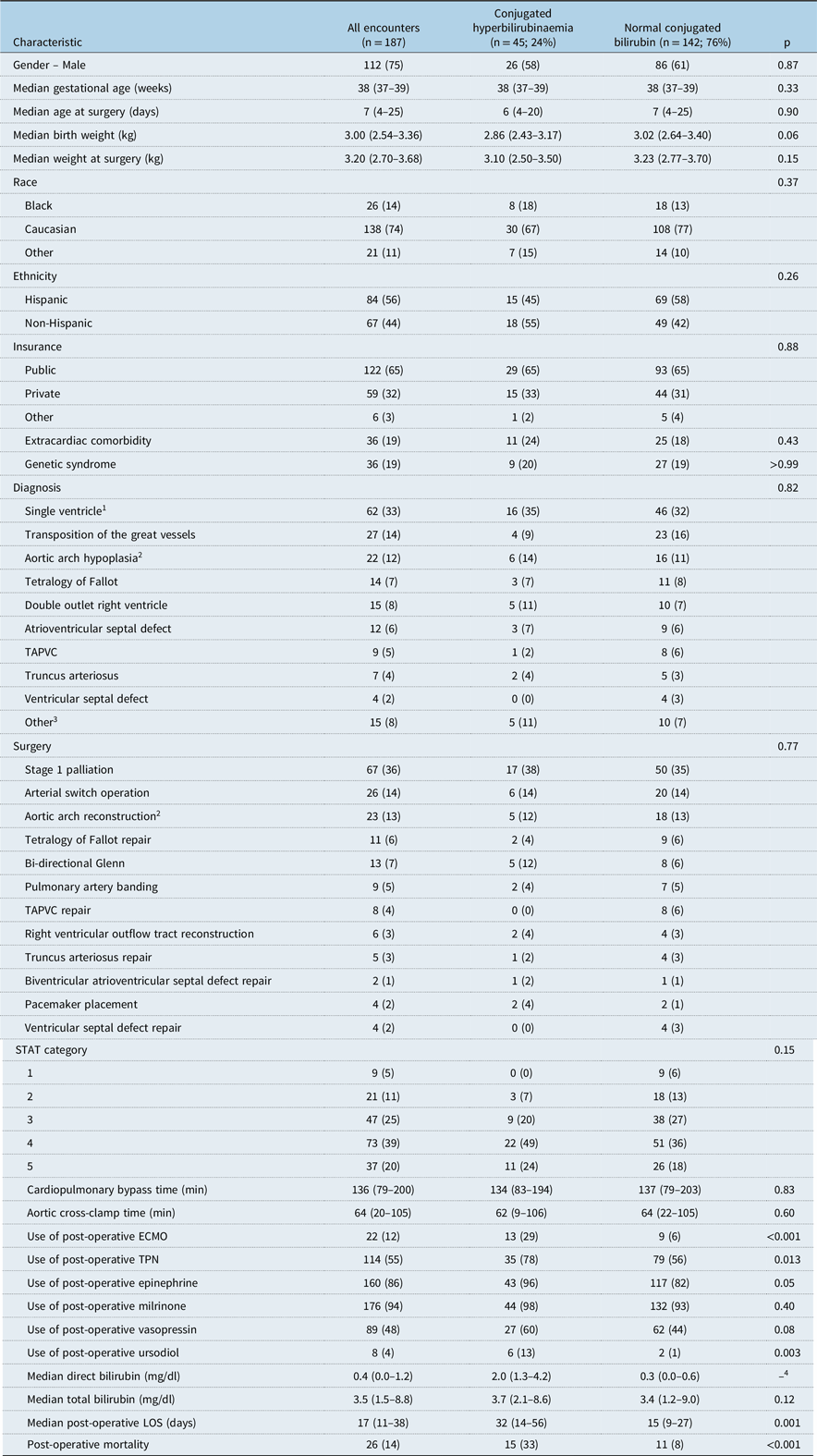
Characteristics for patients identified as having conjugated hyperbilirubinaemia is presented in Table 1, including demographic information, intraoperative variables, use of post-operative interventions, and outcome data. In the entire cohort, 37 (20%) patients were preterm. An extracardiac congenital anomaly was identified in 36 patients (19%), though none of these patients had a biliary tract abnormality by abdominal imaging. A genetic abnormality was identified in 36 patients (19%). These abnormalities included a JAG1 mutation (one patient), 22q11 deletion syndrome (seven patients), a CHD7 mutation (four patients), trisomy 18 (two patients), and trisomy 21 (two patients), with the remainder having variants of unknown significance. Lesions with single ventricle physiology accounted for 62 patients (33%). Most patients survived until discharge (161, 86%). The median length of stay for our cohort was 17 days (25–75% IQR: 11–38).
Differences in patient characteristic counts or medians between patients with conjugated hyperbilirubinaemia and control peers

Data are presented as counts with percent or as medians with the first and third inter-quartile range, as appropriate. p-values calculated using a chi-square test for counts or using a Wilcoxon rank-sum test for medians.
LOS = length of stay; STAT = the Society of Thoracic Surgeons-European Association for Cardio-Thoracic Surgery Score; TAPVC = total anomalous pulmonary venous connection; TPN = Total parenteral nutrition.
1 Single ventricle includes all patients who entered into the staged single-ventricle palliation pathway, including hypoplastic left heart syndrome, tricuspid atresia, and pulmonary atresia with intact ventricular septum.
2 Aortic arch hypoplasia includes coarctation and interrupted aortic arch. Similarly, aortic arch reconstruction includes coarctation repair.
3 Other diagnoses include all diagnoses with <5 patients, including anomalous coronary artery, cardiac tumour, cardiomyopathy, congenital arrhythmia, Ebstein’s anomaly, major aortopulmonary collateral arteries, patent ductus arteriosus, valvular disease, and vascular ring.
4 As level of direct bilirubin was used to define patients with conjugated hyperbilirubinaemia, the statistical difference in bilirubin levels between patient cohorts was not tested.
Patients with conjugated hyperbilirubinaemia trended towards a lower birth weight (2.86 kg versus 3.00 kg, p = 0.06) and lower weight at surgery (3.10 kg versus 3.20 kg, p = 0.15) as compared to control peers. The demographic composition of the patients with conjugated hyperbilirubinaemia was otherwise similar to those without conjugated hyperbilirubinaemia, specifically in regard to age, gender, race, ethnicity, insurance type, diagnosis, and surgery.
A higher proportion of patients with conjugated hyperbilirubinaemia required post-operative extracorporeal membrane oxygenation [13 (29%) versus 9 (6%), p < 0.001), total parenteral nutrition [35 (78%) versus 79 (56%), p = 0.013), epinephrine infusion [43 (96%) versus 117 (82%), p = 0.05], and ursodiol administration [6 (13%) versus 2 (1%), p = 0.003) as compared to control peers. These patients required more days of inotropic therapies than peers [6.0 (25–75% IQR:3.0–12.0) versus 3.0 (25–75% IQR:2.0–4.5), p < 0.001], although the maximum inotropic score did not differ between the groups [3.54 (25–75% IQR:2.08–7.67) versus 2.74 (25–75% IQR:1.76–4.49), p < 0.0079]. The median peak lactic acid level for patients with conjugated hyperbilirubinaemia was higher than these levels for their peers [8.71 (25–75% IQR:5.80–14.7) versus 5.67 (25–75% IQR:4.07–8.59), p = 0.001]. A higher proportion of these patients also experienced post-operative mortality [15 (33%) versus 11 (8%), p < 0.001] as compared to peers. Patients with conjugated hyperbilirubinaemia had a longer median length of stay compared to peers (32 versus 15 days, p = 0.001).
The median peak direct bilirubin level was 0.4 mg/dl (25–75% IQR: 0.0–1.2), with a median total bilirubin level at peak of 3.5 mg/dl (25–75% IQR: 1.5–8.8). Patients receiving ursodiol had higher levels of conjugated bilirubin than those patients not receiving the medication (3.5 mg/dl versus 0.4 mg/dl, p = 0.001). This pattern was also seen when only patients with hyperbilirubinaemia were included (6.2 mg/dl versus 1.7 mg/dl, p = 0.01).
Correlation of bilirubin and other markers of liver function
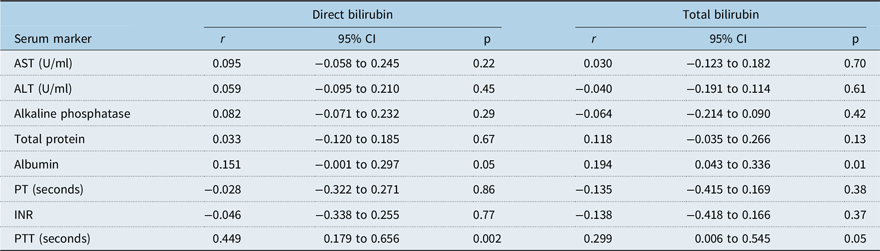
Peak direct bilirubin was not significantly correlated with any liver enzyme at the time of peak direct bilirubin measurement (Table 2). Specifically, there was no correlation with neither aspartate nor alanine transaminases. Direct bilirubin had a weak correlation with albumin level (r = 0.151, p = 0.05). Of the markers of coagulation, direct bilirubin had a moderate correlation with partial thromboplastin time at the time of peak direct bilirubin measurement (r = 0.449, p = 0.002). Notably, there was no association between heparin use (p = 0.66) or the duration of heparin use and partial thromboplastin time at the time of peak direct bilirubin measurement (r = 0.12, p = 0.42), suggesting that heparin use did not confound this correlation. A similar pattern was seen with total bilirubin at peak, having a mild correlation with both albumin (r = 0.194, p = 0.01) and partial thromboplastin time (r = 0.299, p = 0.05).
Correlation between bilirubin and other markers of liver function at time of peak direct bilirubin measurement

Data are presented as Pearson correlation (r) with a 95% confidence interval (CI) and calculated p-value.
ALT = alanine aminotransferase; AST = aspartate aminotransferase; CI = confidence interval; INR = international normalised ratio; PT = prothrombin time; PTT = partial thromboplastin time.
Risk factors for conjugated hyperbilirubinaemia
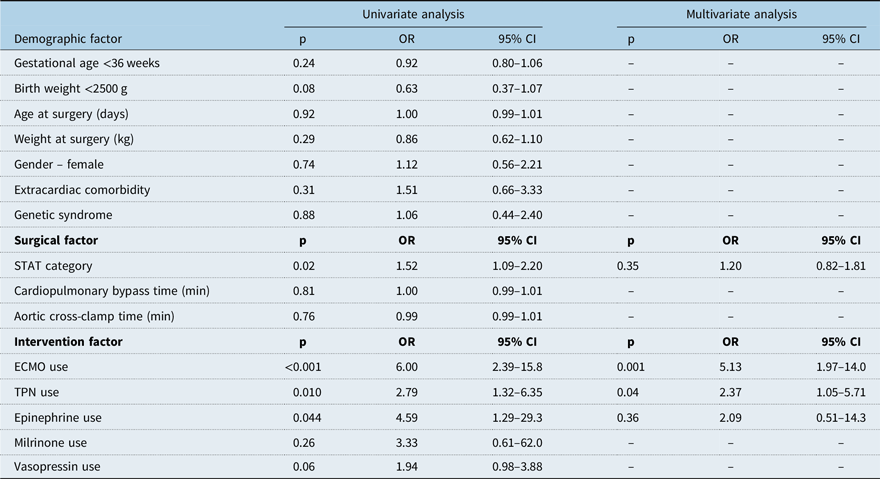
No pre-operative risk factor that we analysed was found to be associated with the development of conjugated hyperbilirubinaemia by univariate logistic regression (Table 3). Of the surgical risk factors, only the Society of Thoracic Surgeons-European Association for Cardio-Thoracic Surgery score of the surgery was found to be associated with hyperbilirubinaemia (OR 1.52, p = 0.02). The use of all post-operative interventions studied except for milrinone and vasopressin infusions was associated with the development of hyperbilirubinaemia by univariate logistic regression, although only the use of extracorporeal membrane oxygenation (OR 5.13, p = 0.001) and total parenteral nutrition (OR 2.37, p = 0.04) was associated with conjugated hyperbilirubinaemia by multivariate logistic regression. Notably, the duration of total parenteral nutrition administration did not correlate with the maximum direct bilirubin level (r = 0.05, p = 0.45).
Risk factors for conjugated hyperbilirubinaemia

Data are presented as an odds ratio (OR) with 95% confidence interval (CI) and calculated p-value.
CI = confidence interval; ECMO = extracorporeal membrane oxygenation; OR = odds ratio; STAT = the Society of Thoracic Surgeons-European Association for Cardio-Thoracic Surgery Score; TPN = Total parenteral nutrition.
Outcomes of patients with conjugated hyperbilirubinaemia
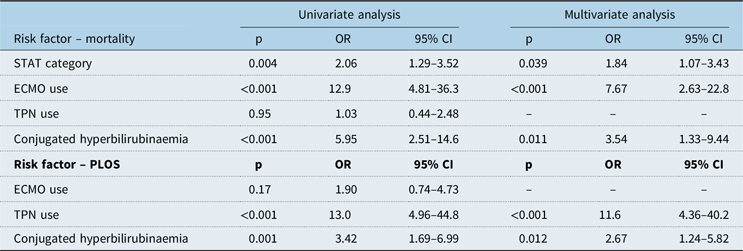
Patients with conjugated hyperbilirubinaemia had a significantly higher odds of mortality (OR 5.95, 95% CI 2.51–14.6), as seen in Table 4. They also had a significantly higher odds of prolonged length of stay (OR 4.00, 95% CI 2.02–7.97). After adjusting for other risk factors with multivariate logistic regression, hyperbilirubinaemia remained associated with higher odds of mortality (OR 3.74, 95% CI 1.47–9.35) and prolonged length of stay (OR 2.87, 95% CI 1.38–6.03).
Risk factors for mortality and prolonged length of stay (LOS)

Data are presented as an odds ratio (OR) with 95% confidence interval (CI) and calculated p-value.
CI = confidence interval; ECMO = extracorporeal membrane oxygenation; OR = odds ratio; STAT = the Society of Thoracic Surgeons-European Association for Cardio-Thoracic Surgery Score; TPN = total parenteral nutrition.
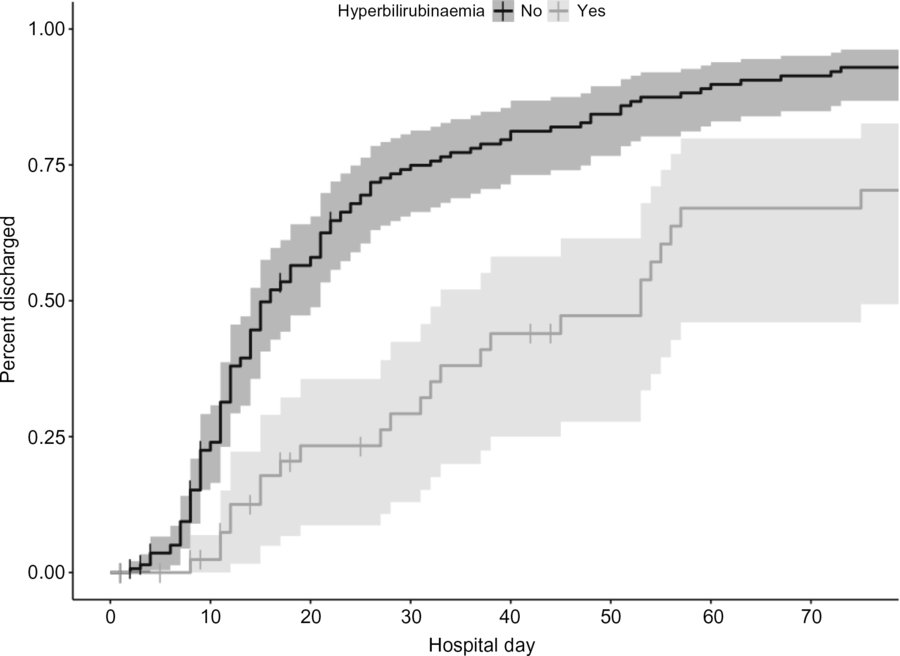
When censored for mortality, patients without conjugated hyperbilirubinaemia were discharged sooner than the control peers without hyperbilirubinaemia (HR 2.50. 95% CI 1.65–3.77), as seen in Figure 1.
Kaplan–Meir plot demonstrating likelihood of discharge over time by conjugated hyperbilirubinaemia status, with shaded 95% confidence interval. Hashmarks indicate censored data of patients who died at the given hospital post-operative day.

Discussion
In our single-centre series retrospective review over 5 years, we found conjugated hyperbilirubinaemia to be associated with 5-fold higher odds of post-operative mortality from cardiac surgery in neonates and infants, and 4-fold higher odds of prolonged post-operative length of stay. This association was independent of risk factors, which included the post-operative use of extracorporeal membrane oxygenation or parenteral nutrition. Considering the average direct bilirubin level in patients with conjugated hyperbilirubinaemia was only 3.0 mg/dl, it is surprising that a seemingly low level of direct bilirubin was associated with such profound outcomes.
Of the pre-operative and surgical risk factors for conjugated hyperbilirubinaemia analysed in this study, only Society of Thoracic Surgeons-European Association for Cardio-Thoracic Surgery score was found to have a significant association, though not upheld in multivariate analysis. Patients with higher Society of Thoracic Surgeons-European Association for Cardio-Thoracic Surgery scores represent patients with a higher risk of post-operative mortality, but also patients undergoing more complicated surgeries, experiencing less favourable haemodynamic states before, during, and after surgery.Reference O’Brien, Clarke and Jacobs23 As such, it follows that these patients would have a higher risk of liver injury and the development of increased conjugated bilirubin levels. The use of both epinephrine and vasopressin also had significant associations with the development of conjugated hyperbilirubinaemia, though not upheld in multivariate analysis. This is likely explained by the overlap between the population requiring extracorporeal membrane oxygenation and the population requiring inotropic support. Notably, patients with conjugated hyperbilirubinaemia had lower birth weights and weights at surgery; however, these factors were not associated with hyperbilirubinaemia by logistic regression analysis.
Similar to Shteyer et al, we find that there is no association between bilirubin and cardiopulmonary bypass time.Reference Shteyer, Yatsiv, Sharkia, Milgarter and Granot14 This suggests that post-operative haemodynamics, as opposed to demographic or intraoperative factors, have a more profound effect on post-operative liver injury. Furthering this theory, the presence of an extracardiac comorbidity, genetic syndrome, or younger gestational age was not associated with hyperbilirubinaemia.
Notably, direct bilirubin levels were actually higher in patients using ursodiol than those who did not. This is likely because ursodiol was only used in those patients with significantly elevated bilirubin. Since it appeared that, in our cohort, ursodiol did not lower the level of conjugated bilirubin to a significant degree, we did not have to exclude patients receiving this intervention.
Like prior studies,Reference van Deursen, Damman, Hillege, van Beek, van Veldhuisen and Voors9,Reference Philip, Samraj, Lopez-Colon, Gonzalez-Peralta, Chandran and Bleiwies24 we identified a relationship between bilirubin and other liver enzymes, although this relationship was limited to partial thromboplastin time and albumin. The lack of relationship between transaminases and bilirubin levels may have been due to the high proportion of patients with normal transaminase levels, suggesting that our study was underpowered to identify an association between these markers. Regardless, it is noteworthy that our study identified significant liver dysfunction in a manner independent of transaminase levels.
Conjugated hyperbilirubinaemia was identified in approximately 10% of admissions after cardiac surgery in neonates and infants in our study, which is lower than other reports of a 20–60% prevalence.Reference van Deursen, Damman, Hillege, van Beek, van Veldhuisen and Voors9,Reference Shteyer, Yatsiv, Sharkia, Milgarter and Granot14,Reference Fujishiro, Sugiyama and Ishimaru20 This discrepancy is likely related to selection bias, as we only were able to examine those patients who had bilirubin levels measured, and it is possible that some patients had unmeasured conjugated hyperbilirubinaemia. In addition, by attempting to decrease confounders by excluding patients with pre-operative hyperbilirubinaemia, we also eliminated patients with likely post-operative hyperbilirubinaemia from our study cohort. Despite this, our observed prevalence represents a significant portion of our patient.
Our study is limited by its retrospective nature, with the decision to check bilirubin levels left to the managing physician. Thus, we are unable to identify a patient with conjugated hyperbilirubinaemia if no bilirubin level was obtained. We also assume that peak bilirubin levels occurred at or near the time of measurement, although it is possible that the true peak occurred between measurements, causing our measurements to not be reflective of the true peak. Future studies may address this by measuring bilirubin in all post-operative patients at set, standardised time points. In addition, while we assume the underlying mechanism of liver injury to be related to poor haemodynamics, we base this assumption on previous literature and did not include direct measures of cardiac output or haemodynamics such as central venous pressure.
We present a retrospective review of conjugated hyperbilirubinaemia after cardiac surgery in neonates and infants at our institution. The use of parenteral nutrition and extracorporeal membrane oxygenation post-operatively was identified as risk factors for hyperbilirubinaemia. These patients were more likely to experience morbidity and mortality than other post-operative patients at our institution. As such, bilirubin is a marker for those at risk of poor post-operative outcomes and should be more frequently measured in those at risk of low cardiac output or liver disease.
Acknowledgments
We thank the medical and nursing staffs of the Heart Program at Nicklaus Children’s Hospital for their expert care of these patients.
Financial support
This research received no specific grant from any funding agency, commercial or not-for-profit sectors.
Conflict of interest
None.
Ethical standards
The authors assert that all activities contributing to this work comply with the ethical standards of the US Good Clinical Practice Guidelines and the 2008 revised version of the Helsinki Declaration of 1975, and have been approved by the institutional review boards of Nicklaus Children’s Hospital.