Introduction
Sociolinguistic contexts are being rapidly transformed by globalization processes (Blommaert Reference Blommaert2010). While the spread of English is by no means the only language phenomenon implicated in such transformations (Duchêne & Heller Reference Duchêne and Heller2012), it is perhaps the most visible and arguably one of the most contentious. English mediates transnational flows of both economic and cultural capitals and knowledge, and states frequently see improving English competence among their citizens as necessary for integration into (and gaining a competitive advantage within) increasingly globalized political and economic networks, markets, and institutions (Block, Gray, & Holborow Reference Block, Gray and Holborow2012). For these reasons, English is commonly described, often in positive terms, as the ‘global language’. However, as Park & Wee (Reference Park and Wee2012:1) point out, ‘the spread of English is not only an apt demonstration of how our world has become increasingly interconnected; it is also a key example of the problems and dilemmas that globalization engenders or exacerbates’. These problems include growing disparities in wealth, income, and equity of opportunity between both states and individual citizens. These are, arguably, largely due to the global, national, and local neoliberalization of the socioeconomic and political order, and the subsequent uptake of neoliberalism's dubious virtues of choice, competition, and the ‘free’ market. The imposition of a foreign language, such as English, into compulsory—and competitive—education systems potentially has particularly damaging effects on educational equality and thus socioeconomic mobility. These effects are most acutely felt when access to language education is stratified, either through unequal resource allocation in public schools or where the public sector competes with a shadow private education sector.
A small but emerging body of literature has examined these issues from a variety of perspectives in a diverse range of national settings, including Indonesia (Pasassung Reference Pasassung2004; Lamb & Coleman Reference Lamb and Coleman2008), Japan (Kubota Reference Kubota2011; c.f. Seargeant Reference Seargeant2009), South Korea (Park Reference Park2009; Park & Lo Reference Park and Lo2012; Piller & Cho Reference Piller and Cho2013), Pakistan (Shamim Reference Shamim and Coleman2011), and Rwanda (Williams Reference Williams and Coleman2011). This article contributes to the literature by using English-language education (ELE) policies in Taiwan as a case study. It focuses on policies first promulgated under the tenure of the Democratic Progressive Party (DPP) between 2000 and 2008, a period marked by democratic transition, a heightened nationalism, and programs to reduce socioeconomic, educational, and ethnic inequalities. In parallel, somewhat paradoxically, there was an emphasis on competitive neoliberal political and economic globalization, for which improving English competence was held to be central. Specifically, this study addresses three interrelated research questions: If national-level policies towards a global language are framed within neoliberal discourses, then to what extent are these discourses taken up in regional and local contexts where policy is implemented? How do these discourses put regions, schools, and individuals into deleterious competition with each other? How are these issues complicated when access to ELE is stratified along rural/urban and socioeconomic lines?
The article begins by elaborating a theoretical framework to understand the spread of English in the context of the neoliberal political economy of contemporary globalization. The Taiwanese research context is addressed in the following section, describing how the DPP's emphasis on English for both ‘internationalization’ and ‘national development’ was constructed in neoliberal policies and discourses, before outlining the ethnographic data and methodology used. The main body of the article analyses and discusses the data according to the research questions posed above. First, I examine the ideological and discursive construction of English-as-capital in both public and private education sectors. Then I examine the co-opting by neoliberal discourses of language ideologies related to optimum second-language (L2) acquisition, specifically the younger-the-better argument and the idealization of the native-speaking teacher. I conclude with modest suggestions for how an understanding of the Taiwanese context may be applicable to studies of neoliberalism, globalization, and the spread of English elsewhere.
Neoliberalism, globalization, and the spread of English
Critiques of the spread of English are not particularly new. English has the potential to disturb local language ecologies, even if this does not lead inexorably to language death (Mufwene Reference Mufwene2002). English in postcolonial and other peripheral contexts has been charged with reproducing older forms of imperial political, economic, and cultural dominance (Phillipson Reference Phillipson1992). Other scholars have, albeit romantically, problematized the privileging of native-speaker models over the quite legitimate nonnative, hybridized, and appropriated linguistic expressions that have often emerged as a form of resistance to the reproduction of imperialist power relations (Kachru Reference Kachru1986; Pennycook Reference Pennycook2003). Recent work has suggested, however, that an effective critique of the spread of English in the context of contemporary globalization—particularly its role in exacerbating or even creating socioeconomic and educational inequalities in local contexts—needs to examine the specific and novel characteristics of the political economy of globalization itself (Block et al. Reference Block, Gray and Holborow2012; Duchêne & Heller Reference Duchêne and Heller2012; Park & Wee Reference Park and Wee2012). Piller & Cho (Reference Piller and Cho2013:24) see understanding the spread of English as necessitating ‘look[ing] outside language and link[ing] language explicitly to the socio-economic order’. That order is neoliberalism, the currently dominant political and economic logic of globalization (Chomsky Reference Chomsky1999; Harvey Reference Harvey2005), and it has profoundly influenced both states in the global context and their social, economic, and political dynamics at national and local levels.
Neoliberal doctrine venerates unfettered capitalism and, at least for certain functions such as welfare provision or environmental regulation, a diminished role for the state. In theory, this allows for the operation of supposedly more efficient market forces. It perceives market forces and ‘competition’, rather than the state, as offering the benefits of ‘choice’ for rational, autonomous individuals within free markets of both private and public goods and services, including language and education. In practice, however, neoliberalism is paradoxical, and rather more nefarious. A reasonably strong state is necessary for the operation of ostensibly free markets and to deal with the consequences of ‘market failure’, as well as repress dissent or protest against neoliberal policies. Furthermore, state policies at the national level—including language and education policies—remain important conduits for ‘multiscalar’ globalization processes (Sassen Reference Sassen2008). The supposed virtues of competition are dubious when they encourage deleterious rivalry between states, regions, schools, and individuals (Harvey Reference Harvey2005:65). For Block and colleagues (Reference Block, Gray and Holborow2012:6) the neoliberalization of education has entailed a ‘shift from pedagogical to market values [and] the abandonment of the social and cooperative ethic in favour of individualist and competitive business models’. Not only is competition premised on pre-existing inequalities, but it results in the exacerbation of these inequalities and, arguably, the creation of new ones. Furthermore, choices are disproportionately available to those who possess sufficient economic, cultural, and social capitals (Bourdieu Reference Bourdieu and Richardson1986:46–53). Those lacking such capitals are blamed for failing to avail themselves of market forces. Their status is thus entrenched, and they suffer ‘the stigma and material consequences whether in education, personal development [or] work’ (Nash Reference Nash2010:28). As David Harvey puts it, somewhat bluntly:
Neoliberalism wears a benevolent mask of wonderful-sounding words like freedom, liberty, choice and rights that hides the grim realities of the … reconstitution of naked class power, locally as well as transnationally. (Harvey Reference Harvey2005:119)
The neoliberal mantra of choice and competition is evident in the spread of English in a number of ways (see Phillipson Reference Phillipson2008). There is no explicit coercion forcing states to emphasize English. Given the interlinked and competitive nature of the global political and economic system, however, it is questionable whether, as the proponents of neoliberalism would have it, adopting English is exactly a choice. States perceive English as having a utilitarian necessity and construct it as such in economic and political discourses as a means to connect with the world politically, or gain (or maintain) a competitive economic edge. Both private corporations, such as English First, and supra-national institutions, such as the International Monetary Fund (IMF) or World Bank, view English competence as an important indicator of whether a given country is an attractive place to do transnational business. Policies that emphasize English in compulsory education systems lead to the ‘commodification of language’ (Heller Reference Heller2010) as a valued cultural capital, either through the ‘embodied’ cultural capital of linguistic competence or through the ‘institutionalized’ capital of test scores scores or exam certificates (Bourdieu Reference Bourdieu and Richardson1986). For Park & Wee (Reference Park and Wee2012), the ‘value’ of English transcends the traditional conception of a unified and nationally bounded ‘linguistic market’; ‘markets of English’ are plural and overlapping, consisting of linguistics, educational and employment markets, and they are also transnational. For Duchêne & Heller (Reference Duchêne and Heller2012), the value of language in ‘late capitalism’ is less tied to symbolic ‘pride’ as a marker of national identity than it is to economic ‘profit’.Footnote 1 Individual citizens have little choice, by definition, of studying English in a compulsory system. As Piller & Cho (Reference Piller and Cho2013:29) note in the South Korean context, ‘assessment mechanisms [in compulsory education] constrain the “choice” of English so heavily that it can hardly be described as a choice at all’. In addition, since the cultural capital of English competence acts as a gatekeeper to higher education and employment markets, students have little choice but to learn English well. An emphasis on English thus introduces another layer of competition into already competitive compulsory examinations and higher education and employment prospects. Furthermore, while there is substantial empirical work on the broader neoliberalization of education, introducing a foreign language presents particular challenges. Language acquisition is qualitatively different from, say, uncritically learning historical ‘facts’ (even if language exams and thus language teaching have an element of rote memorisation of arcane and prescriptive grammatical rules).
This is complicated further by the fact that the broader neoliberalization of society in general, and education specifically, causes local regions and even individual schools to compete with each other, either for government funding to provide the education that policies require, or to achieve higher test scores on national exams. Perhaps most perniciously, the divestment to the market of traditional state functions—including education—means that the public sector is often in competition with the private sector, and supplementary education in the private sector is available only to those who can afford it. ‘English for all’ is therefore problematic as a discourse within neoliberal ideology in two ways. First, due to policies and discourses that make ELE a highly valued cultural capital in (and gatekeeper to) education and employment markets, ‘English for all’ is an imperative, not an opportunity. Second, ‘English for all’ is potentially ‘English for the few’ when access to ELE is stratified along, for example, socioeconomic and regional lines.
Resistance to neoliberalism is not impossible, but its central paradoxes make resistance inherently difficult (a detailed theorization of resistance is beyond the scope of this article, though see Ferguson Reference Ferguson2010). Neoliberalism's success lies in its ideological potential to naturalize the dominant political-economic logic into unassailable common sense. Failure to avail oneself of market forces is punished—symbolically or materially—regardless of whether one consciously opposes neoliberalism (a ‘choice’ that neoliberalism does not permit) or whether one simply lacks the material means or opportunities to participate in its markets. The values of neoliberalism, to some extent, must be internalized in order to survive within a neoliberal system. For those working in the public education sector, these values become delicately balanced against more humanistic goals, such as commitment to effective pedagogy and values of inclusivity and equity in opportunity.
Research context
The politics of English in Taiwan (2000–2008)
The Democratic Progressive Party (DPP) was elected in 2000, the first change of government since the Kuomintang (KMT) lost the civil war to Chairman Mao's Communist forces and took control of the island in 1949. The KMT imposed Martial Law on Taiwan between 1949 and 1987, before transitioning to democracy in the late 1990s. Despite functioning as a de facto independent state, Taiwan remains isolated from the international community, which officially agrees with the People's Republic of China (PRC) that Taiwan is a renegade Chinese province to be reunited with the mainland, by force if necessary. The DPP's central election platform was to eventually achieve de jure independence and international recognition as a sovereign state for the island's twenty-three million people, while maintaining the economic growth achieved under the ‘Taiwan miracle’. Taiwan's ambivalent geopolitical status exemplifies Putnam's (Reference Putnam1988:430) notion of a ‘domestic-international entanglement’: a ‘two-level game’ that must be played both at home and abroad, and one which the DPP played partly through language politics.
Domestically, the DPP's project required inculcating a pan-Taiwanese identity among the island's four main ethnolinguistic groups as part of a nationalist project of bentuhua or ‘Taiwanization’ (Hsiau Reference Hsiau2000; Makeham & Hsiau Reference Makeham and Hsiau2005). Broadly, this was a pragmatic approach to reducing historical ethnic and socioeconomic inequalities, which remain patterned along rural/urban lines and between the KMT elite-dominated north of the island, Taipei in particular, and the central and southern areas. Hoklo, Hakka, and the fourteen or so indigenous Austronesian languages and identities (Huang Reference Huang1993), previously repressed by the KMT in favour of Mandarin Chinese, were revitalized and promoted in education and public life (Scott & Tiun Reference Scott and Tiun2007). At the same time, the nationalist project also required engagement with the international community and thus with increasingly neoliberalized globalization processes. Enhancing English-language competence among the population was seen as key to enhancing Taiwan's political and economic visibility on the world stage. Chen (Reference Chen2006) perceptively argues that the emphasis on promoting both English and local languages created a tension between ‘indigenization and internationalization’, but my approach here is instead to understand the promotion of English within a framework of neoliberal globalization.
In 2002—the same year that Taiwan was accepted as a member of the World Trade Organization (WTO)—then-President Chen Shui-Bian suggested that Taiwan should adopt English as a second (or quasi) official language in order to maintain the island's ‘competitive edge’ and ‘to connect Taiwan with the world’ (Ko & Yeh Reference Ko and Yeh2002), a proposal that was enshrined in the Challenge 2008 six-year national economic development plan (CEPD 2002). This particular idea did not come to fruition, but the plan emphasized various mechanisms to ‘improve English proficiency among the whole population’ (CEPD 2002:18). The ‘whole population’—or ‘English for all’—aspect was apparently intended literally; Challenge 2008 went as far as specifying the need to enhance proficiencies among marginalized populations such as ‘senior citizens, farmers and fishermen, aborigines and people with learning disabilities’ (CEPD 2002:18). Improved English competence was explicitly rationalized within a neoliberal and globalized framework as central to ‘national adaptation to globalization and internationalization’ (2002:18) and ‘improving [Taiwan's] international competitiveness’ (2002:19). An English-language summary of Challenge 2008 (MOE, n.d.) further drew on this framework, emphasizing the need to ‘cultivate competitive citizens with international foresight’ and ‘move forward into the new century’ in a ‘world where national boundaries are disappearing’, as well as ‘enhanc[ing] the international competitive advantage of higher education institutions’.
Challenge 2008 included somewhat esoteric and ambitious proposals, including adopting bilingual street signage and Anglicizing restaurant menus. It focused, however, on the role of English in the compulsory education system, and spawned a raft of new policies. Elementary school ELE had been mandated to start from grade five (i.e. age 10–11) in 2001, and from grade one beginning in 2003. The General Scholastic Aptitude Test (GSAT) for university entrance replaced the older Joint Central College Examinations (JCCE) in 2002; while the JCCE had an English component, the broader push towards English meant it had an ever-more important gatekeeping function to higher education under the GSAT. This was complicated by the Ministry of Education's (MOE) development of the parallel General English Proficiency Test (GEPT) which, from 2002, offered a means to demonstrate English proficiency from elementary to advanced levels outside of the GSAT. Many universities eagerly accepted GEPT scores for matriculation purposes; some even required high scores on the GEPT or other metrics of English proficiency in order for students to graduate. While it recognised that disparities in education provision between rural and urban areas were potential barriers to its ‘English for all’ ethos, Challenge 2008 offered little in terms of concrete policy proposals to reduce them. Crucially, it did not seem to anticipate the private sector seeking to profit by providing ELE in competition with the public sector, contributing further to stratification along socioeconomic lines.
Data and methodology
This article draws on demographic, survey, media, and interview data. It focuses on policies and discourses that emerged under the DPP's tenure between 2000 and 2008, largely understood from a broader ethnographic study of Taiwan's language and politics conducted by the author. In part, this is a study using an ‘extended case method’ (Burawoy Reference Burawoy, Burawoy, Blum, George, Gille, Gowan, Haney, Klawiter, Lopez, Riain and Thayer2000) that aims to link local discursive practices and social processes with the national and the global. Survey and media data contextualizes data from semistructured interviews with school principals and county education directors in 2007. The voices of public-sector educators are emphasized due to their roles as a meso-level population who mediate macro-level government policymaking in micro-level classroom contexts. They are an under-represented population in the literature who balance differentiated educational resources and local socioeconomic conditions with both pedagogical concerns and policy goals. Interviews were concerned with their experiences implementing ELE policy alongside local language-revitalization policies, and the pressures on public education caused by the existence of a shadow private education sector. At the time, interviews were concerned with implementing policies towards revitalizing local languages and promoting English, and were not framed specifically as discussions about neoliberalism or globalization. However, recent theoretical innovations in the sociolinguistics of globalization (e.g. Blommaert Reference Blommaert2010; Park & Wee Reference Park and Wee2012; Block et al. Reference Block, Gray and Holborow2012) have prompted new research questions, with regard to the manifestation of neoliberal and globalized discourses in local settings, which are used to frame reanalysis and recoding of the data.
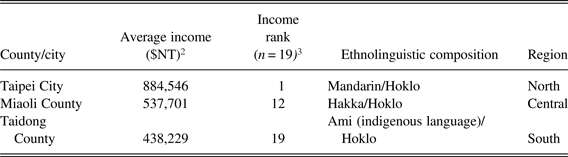
Education bureaux in all eight municipalities and fourteen counties (apart from the offshore island counties of Penghu, Kinmen, and Lienchiang) were approached with an interview request. Directors from two counties—Miaoli and Taidong—and the capital, Taipei City, agreed to take part. These happen to be broadly representative of the Taiwan's socioeconomic and ethnolinguistic distributions, as well as the cultural and political distinctions between the northern and central and southern regions (Table 1). Once interviews with the relevant directors were secured, elementary schools in each area were approached. I conducted interviews in Mandarin, which were semistructured and between sixty and ninety minutes long. Broad transcription and translation was undertaken by a bilingual research assistant; I checked the quotes in English used here for accuracy against the original Mandarin. Names of education directors are anonymized, though their counties are not. Names of school principals, their schools, and their school districts are all anonymized.
Summary of socioeconomic, ethnolinguistic, and geographical contexts of research sites.

Data analysis
In this section, I present data that demonstrates how broader neoliberal discourses—competition, choice, and the free market—that framed national policies towards ‘global’ English percolated down into local contexts where policy was implemented. DPP policies and discourses increased the value of English as a cultural capital that could be used to access educational and employment markets, and thus be transformed into economic capital. Unsurprisingly, Taiwanese citizens sought to accrue as much of this as possible, meaning access to ELE was structured by the neoliberal notion of competition, but on a playing field that was anything but level. These issues manifested themselves in two key ways. The first is arguably sociological: the structural and ideological function of English as a valued cultural capital in Taiwanese society, particularly within the compulsory education system. The second is related, though arguably linguistic: ideologies of the younger-the-better and the idealized native-speaking teacher for optimum L2 acquisition and thus the most effective acquisition of a valued cultural capital. Both these sets of social and linguistic ideologies undergird competition between individuals, schools, and regions, as well as between the public and private education sectors.
English-as-capital
English was framed as a valued capital in various policies, most obviously testing mechanisms in compulsory education, and discourses that both underpinned and emanated from such policies. Access to English, however, was stratified along rural/urban and socioeconomic lines: by uneven resource allocation in public schools that disfavoured poorer, rural areas and the fact that buxiban ‘private schools’ operated in wealthier, urban areas where it was economically viable to do so. Poorer, rural areas were thus disenfranchised by both the public and private sectors. As Director Chen of the Miaoli County Education Bureau put it:
Starting times for kids to learn languages and the shortage of good English teachers are the most controversial issues in many areas. In 2001, we wanted to start ELE in the 3rd grade, since research shows this is a good time to start. But there were not enough English teachers in Taiwan, so we delayed implementation until the 5th grade. The MOE tried to recruit 3,000 local Taiwanese English teachers. But most teachers were attracted to urban areas. (Director Chen, Miaoli County Education Bureau)
Assuming that Miaoli County's ELE policy was grounded in sound pedagogy, it was constrained by structural sociological factors. The MOE and the DPP were cognizant of iniquitous access to ELE along geographic and socioeconomic lines. In 2002, Challenge 2008 noted disparities between rural and urban areas due to differences in ‘economic capacity, teachers and resources’ and the need to ‘improve English in rural areas’. In 2007, however, five years later and towards the end of the program, it seemed little had changed: most of my interviewees mentioned continuing rural/urban gaps, and the issue surfaced regularly in media and political discourses. Director Chen made explicit reference to the difficulties of attracting teachers to already socioeconomically disadvantaged rural areas. Even if salaries were comparable in rural areas, there are complex sociological reasons why teachers may prefer urban settings: rural areas have fewer amenities and ‘outsiders’ often face challenges in integrating into local communities; paradoxically, teachers with children may be put off by the under-resourced local school systems that need teachers most.
Unequal resource distribution is by no means confined to Taiwan or to ELE, but the Taiwanese context had a political specificity in terms of competition between local areas. The DPP's nation-building bentuhua project had to contend with a historically delicate balance between the affluent north and poorer counties in central and southern Taiwan. This is not merely a rural/urban or even socioeconomic divide, but one that is political and cultural. Chinese immigrants who arrived between 1945 and 1949 became political elites and settled in Taipei and surrounding areas in the north. The rest of the country, commonly referred to as ‘the South’, continues to be inhabited by the historically marginalized Hoklo majority and minority Hakka and aboriginal ethnolinguistic groups. An editorial in the Taipei Times, concerning the DPP's new ELE policy proposals, warned:
[As] the issue of language can influence the growth and decline of ethnic groups—not to mention that speaking English has usually been taken as a symbol of elitism in southern Taiwan—the issue may easily become a fight over ideologies that divides our ethnic groups. (Wang Reference Wang2002)
English was unlikely to literally ignite ethnic conflict in Taiwan, but its potential to precipitate even a ‘fight over ideologies’ is important. The symbolic indexing of ‘elitism’—made concrete by the value of English as a cultural capital—positioned English as another site for the contestation of cultural politics. These were at least partly constituted by ethnolinguistic- and class-based structural inequalities that patterned along north/south lines. Bentuhua attempted to redress the injustices of the authoritarian KMT era and the disenfranchisement of autochthonous ‘southern’ ethnolinguistic groups. English was not a language of any particular group, nor a lingua franca of anyone other than ‘an elite minority’ (Mufwene Reference Mufwene2002:167). But while it might not itself hasten the demise of Hoklo, Hakka, or aboriginal languages and identities, English devalues them as capitals within linguistic and educational markets. Principal Long of Lan Hua Elementary School in Taipei, further described the differences between Taipei and the rest of the island by invoking the notion of academic ‘pressure’ and the expectations of parents who were positioned as consumers within neoliberalized discourses and policies:
We are in Zhong Da district. There are many professors' kids studying at our school, so parents demand a lot from the school and the teachers. Let's put it this way [draws map of Taiwan on table with finger]. Taipei City is here. Going south, the pressure becomes smaller. Taidong [an impoverished county in the South East] is here, the pressure is pretty small here. It is great in Taipei city. It is greater in Zhong Da district. And the pressure is greatest in Lan Hua School in Zhong Da district! (Principal Long, Lan Hua Elementary School, Taipei)
Principal Long links ELE with academic ‘pressure’ and its importance in the compulsory education system. The reference to ‘professors’ is to some degree literal, given that Lan Hua School is near two prestigious universities. But ‘professors’ might also be a heuristic for a broader middle-class dynamic. As Skeggs (Reference Skeggs1997:9) argues, ‘social categories’ such as class are not capitals themselves; instead ‘they provide the relations in which capitals come to be organized and valued’. Education attainment—including attainment in English—is a highly important form of cultural capital valued by both ‘professors’ and the imputed middle class. Principal Long further configured pressure as a normative function of the national education system and presented it as concentric, radiating out from a single school in a single district in Taipei. Stratification within Taipei was indicated by the principal's distinction between Lan Hua School and others in the district, and between Zhong Da and other districts. She constructed the broader division, however, at the national level: between Taipei and ‘the South’ and, implicitly, between rural/urban and poorer/wealthier areas. The concept of ‘pressure’—which might be shorthand for ‘competition’—illustrates an important aspect of language-in-education policies (and education policies more broadly). In a compulsory education system, pressure would be theoretically equal; assuming access to educational resources was equal. However, a clearly iniquitous distribution of resources would mean that poorer, rural counties with less access to resources should be under more pressure to achieve; in short, they would have to do more with less in order to compete effectively in the educational market. So why did Principal Long see children in Taipei—and in her school specifically—as being under greater pressure? One explanation is that rather than, as Principal Long suggested, “going south, the pressure becomes smaller”, it may be more accurate to say that going south, the opportunities become scarcer. Children in the south or rural areas lacked access to educational resources, and thus were ruled out of competing effectively in the education market. They were under less pressure to achieve, since their opportunities were already limited.
Linguistic or educational markets, however, are no longer solely bound by the nation-state (Park & Wee Reference Park and Wee2012); in contemporary globalization, these also have multiscalar dimensions in which regional dynamics have an additional global aspect. As Director Zhang of the Taipei City Bureau of Education put it:
English is an important international language, and Taipei is an international metropolis. Taipei's children in future will have to compete globally, [and] participate in international exchanges. They will need to know English, and so we must teach them. (Director Zhang, Taipei City Bureau of Education)
Mr. Zhang seems to concur with Principal Long that Taipei is the epicentre of the island's academic pressure, but also positions it as the capital city of a nation with aspirations towards sovereignty and one enmeshed in a constellation of other ‘global cities’ (Sassen Reference Sassen2002). These cities form a network in which the centres of finance and capital in the global north, such as London, New York, and Hong Kong are increasingly linked with the global south through intermediaries such as Bangkok, Sao Paulo, and Mexico City. Sassen calls these linkages ‘the new geographies of centrality at the inter-urban level’, that constitute ‘a transnational space for the formation of new claims by global capital but also by other types of actors’ (2002:17). ‘Claims by global capital’ may correspond with the director's prediction that “Taipei's children [would] have to compete globally”: here we see neoliberalism's catechism—competition and globalization—invoked. What the director phrased as “participat[ion] in international exchanges” perhaps reflects less the naked power of capitalism than the soft(er) power of what Sassen calls ‘claims … by other types of actors’, such as supranational political or cultural organizations. Taken together, English is a highly valued capital as the conduit through which these global economic, political, and cultural interactions were presumed to take place. These discourses reproduced the DPP's own rationale for ‘improving English competence among the whole population’ in order to enhance ‘globalization and internationalization’ (CEPD 2002:18).
The paradigm of neoliberal competition that implicated counties and cities, schools and individuals, was put into even sharper relief by the parallel education system in the private sector. Neoliberalism approves of transferring to the private sector traditional state functions, but the existence of a private market for supplementary ELE in Taiwan provides a case study in how even private markets are not ‘free’ but constructed by state discourses and policies (and largely supports Piller & Cho's (Reference Piller and Cho2013) analysis of the South Korean context). The imperative to learn English under the DPP created opportunities for private schools, or buxiban, to profit from the perception that access to the valued cultural capital of English was lacking in parts of the public sector. There are two central paradoxes here. First, the demand met by the supposedly ‘free’ market in the private education sector was created by state policies that emphasized ELE in the first place, despite neoliberalism being ‘philosophically opposed to any form of regulation, including language policy’ (Piller & Cho Reference Piller and Cho2013:24). Second, parents were hardly exercising their ‘choice’ within a free linguistic or educational market; rather, they were impelled to compete in it. Private buxiban offered an advantage within a compulsory system, but access to buxiban was dependent on socioeconomic factors such as individual income level and whether aggregated wealth or income in a given community constituted a market that justified buxiban operating. Stratification occurred, therefore, along both class and geographic lines, which paralleled—and arguably exacerbated—that which occurred in the public education system. Neoliberal theory, however, does not take into account these structural barriers to the ‘free’ market. For Director Wang, of rural Taidong County's education bureau, parents did not merely turn to the private education system because the public sector was perceived to be lacking; rather, the private education sector actively had a detrimental effect on the public sector. V. Chang (Reference Chang2007:68) notes dryly that English learning in Taiwan is a ‘national sport’, and Director Wang made a similar analogy:
If the buxiban are run well, they help people get good grades in exams. It's a chicken-and-egg situation. If the buxiban did not help, then people wouldn't attend them. They are not positive for the education system. They are like the drugs people use in the Olympics. (Director Wang, Taidong County Bureau of Education)
Private supplementary education is not unique to Taiwan: Turkey has the deshane system; the US has ‘test preparation centres’. Nor is it an entirely novel response to neoliberalism: Taiwanese buxiban share with South Korean hagwon (and contemporary Japanese juku) a common ancestor in the supplementary education systems developed by Japanese colonization of both countries in the early twentieth century (Zeng Reference Zeng1999:66). Arguably, the Japanese, Korean, and Taiwanese systems have even earlier antecedents in the private schools for the formidable Chinese civil service examinations, or keju, in operation from the seventh century to 1905 (Suen & Yu Reference Suen and Yu2006:48). Despite this long history, however, ‘foreign language’ buxiban in Taiwan mushroomed between the 1990s and 2008, paralleling the growth of neoliberalism globally and nationally, and the increasing commodification of English as essential to educational success and socioeconomic advancement. Licensed foreign language buxiban doubled from 2,506 in 2003 (the earliest figures available) to 5,119 in 2008, apparently driven in part by the Challenge 2008 six-year development program (TPBOE 2013). In 2011, foreign language buxiban comprised one third of the market; the remainder offer instruction mainly in Chinese, math, and science, subjects also tested on the GSAT, and thus highly valued within compulsory education (Chou & Yuan Reference Chou and Yuan2011). In this regard should be noted the ‘symbolic added value’ (Duchêne & Heller Reference Duchêne and Heller2012:10) of buxiban themselves. Private buxiban performed a surrogate child-care function in addition to their central raison d'etre of increasing access to ELE, thus indexing a symbolic value linked to prestige and wealth. Mom-and-pop operations at one end of the scale to Montessori-type schools at the other competed for the business of parents, and parents thus competed with each other on the socioeconomic scale as to the perceived best or most prestigious buxiban to which to send their children. Though she did not keep records, Principal Long estimated that, of children in her elementary school in an affluent area of Taipei:
[Probably] more than 80% go to the buxiban. They don't all necessarily take English classes, [but] most of them—maybe 85%—do. English is taught from the first grade. And then there are English tests in high school and the GEPT. So there ought to be many students. They need to take the tests, so they care about this. (Principal Long, Taipei)
There ought to have been many students studying at English buxiban because English is a gatekeeper in the form of tests in the public education sector from elementary school onward. Ironically, the principal acknowledges that the private buxiban offer the kinds of competitive advantages in ELE that are valuable capital in the public sector to which the principal belongs. State discourses and policies thus have a normative function in constructing a ‘free’ market in the private sector. In a neoliberal system, both private and public functions overlap and compete, but in a competition in which the private sector inevitably prevails; in effect, the public sector is competing against itself, since it is always destined to lose either way. At root here, again, is the role of the state in setting the relative value of the capital of ‘educational attainment’, a capital organized by social categories such as class. Students (or, more accurately, their parents) should be availing themselves of supplementary education, assuming that parents have the socioeconomic means to do so. In Principal Long's affluent area of the capital city, this is less of an issue than for parents in more socioeconomically disadvantaged areas, either elsewhere in Taipei or in the rest of the island. In contrast, Principal Tang, from Yang Shan elementary school in a remote and socioeconomically underprivileged area in the mountains of Taidong County, said:
People in Taidong are poor. They do not have money. It is expensive to go to the cram schools. Most people in Taidong are farmers and they can only make money to sustain their daily living. They can't afford to pay tuition fees for learning dancing, singing, and English. (Principal Tang, Taidong County)
Of course, not all people in Taidong are poor, since wealth inequalities exist in micro-level contexts. But people in Taidong are poor relative to other areas; they are impoverished compared to some other counties, and particularly compared to urban areas, and especially compared to the capital, Taipei. The corollary of this is that private buxiban operate according to the iron logic of the market. Buxiban were not attracted to poorer areas where it is difficult, or impossible, to turn a profit. Aggregating official data on population (MOI 2010), licensed buxiban (TPBOE 2013), average income, and agricultural income (both DGBAS 2010), broad correlations emerge. Below average income correlates with fewer buxiban on average compared to population and vice-versa (one buxiban per 6,740 people compared to 4,512); higher average agricultural income—indicating more rural areas—correlates with fewer buxiban and lower average income.Footnote 4 Rural and poorer areas (including, presumably, poorer areas within cities) thus tend to have less access to private ELE, compounding the structural problems of access to ELE in the public education sector. Furthermore, this disparity broadly falls along a north-to-south axis. Again, Principal Long's notion that “going south, the pressure becomes smaller” may be more accurately put as going south, the opportunities become scarcer. ‘Pressure’ decreases as access to the cultural capital of English decreases: the stakes become lower and disparities in public education between the north and south, between poorer and wealthier areas, and between rural and urban areas, are further entrenched by the private sector. I asked Principal Tang what he thought was the best way to increase access to ELE in his rural area. I expected him to suggest more resources or teachers for Yang Shan elementary school. Instead, he linked local socioeconomic development with the creation of particular markets:
If there were some tunnels to connect the west with the east, it may only take an hour to get here. And Taidong will have many chances to develop. Why? People will come to establish factories, businesses, or tourism. Once the population increases, the English buxiban and fast food restaurants [maidanglao 麥當勞] will come here. (Principal Tang, Taidong County)
The principal's comments echo, I suspect unintentionally, Spolsky's ‘only half-facetious’ (Reference Spolsky2004:15) dictum that the best way to increase ELE on the Navajo Reservation in the US was by ‘building more roads’ (Spolsky Reference Spolsky and Pialorsi1974). For Principal Tang, broader socioeconomic development of the local area—via the government investing in infrastructure—would grant greater access to buxiban and hence to a global language. Once again, we see the neoliberal paradox: state policy is fundamentally implicated in local socioeconomic development and the creation of a supposedly ‘free’ private buxiban market, which is held to be the only (or at least most efficient) way that children can compete in the public education system. Equating the arrival of buxiban with fast-food restaurants—the principal used maidanglao, the phonologically assimilated name of the global and emblematically neoliberal McDonald's burger chain—rather aptly demonstrated the influence of neoliberal globalization in local contexts. English is not merely a tool for communication but, equated with globalization, indexes neoliberal values of competition, commodification, and the infallibility of the ‘free’ market. Principal Tang finished our interview with this observation:
English is a world language. People in Europe, America, and Asia all speak English. I think learning English is more helpful in future than learning local languages. (Principal Tang, Taidong County)
There is a rather poignant irony in this quote. Due to physical and geographical constraints, local children had trouble getting over the mountains and outside their local areas without the national government building more roads and tunnels. In spite of these limitations, English was seen as the language to connect them to the rest of the world in the global context.
The earlier-the-better argument and the idealization of the native speaker
The emphasis on ELE, and its gate-keeping effect within the public education system, contributed to an anxiety among parents as to the most effective age to begin learning English and thus acquire a valued cultural capital. A persistent language ideology exists that foreign L2 acquisition is more effective the earlier it starts. Arguably, this is based on the ‘nativist’ model of (L1 or actually bilingual) language acquisition whereby it is understood that babies learn language from birth and the disseminations in popular discourse that, as Lenneberg (Reference Lenneberg1967) first proposed, there is a ‘critical period’ between birth and puberty when language must be acquired. Lenneberg's hypothesis is in itself controversial and based on isolated cases of linguistic and social deprivation, and it was not originally intended to apply to L2 acquisition. Scholarly opinion differs on the optimum age for beginning L2 acquisition outside of a genuinely bilingual environment; this can be anywhere from around seven years old to adulthood, depending on how ‘optimum’ is defined in various models of competence. The younger-the-better argument, which first gained credence in the late 1960s, pre-dates the emergence of neoliberalism in the late 1970s. But it is well suited to neoliberal discourses of competition for a language that is a valued capital. In January 2009, I received an email from an adult former student living in Taipei:
I would like to buy some books and CDs from the UK for my little baby who is five months old. Could you give me some recommendations? I mean audio books. I want my baby to hear English at home. (emphasis added)
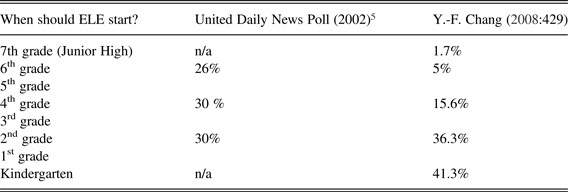
Beginning ELE at five months old might seem extreme, but a whole industry is dedicated to early childhood (and even in utero) education, including language learning. It indexes the prevalence of the younger-the-better belief in Taiwan, which can be demonstrated beyond mere anecdote. Table 2 shows data from two separate surveys in 2002 (United Daily News poll data, cited in J. Chang Reference Chang2004:110) and Reference Chang2008 (Y.-F. Chang Reference Chang2008) as to the age Taiwanese parents believed ELE should start in public schools. Between the promulgation of the Challenge 2008 national development plan in 2002 and its conclusion in 2008, the data shows a downward trend in the perceived optimum age for beginning ELE. Official policy arguably shaped public perception and vice versa (Oladejo Reference Oladejo2006); MOE policies that lowered the age that ELE must have begun in schools—to grade five in 2001, and to grade three in 2003—may have contributed to the perception that ELE should start earlier, and vice versa. Desiring early access to ELE had as much to do with optimizing access to an institutionalized cultural capital (Bourdieu Reference Bourdieu and Richardson1986) as it did with acquiring linguistic competence. Parents were forced into a competitive situation, whereby children with a head start on ELE were perceived to gain an important competitive advantage later.
Parental opinions on when ELE should start in public schools.
Teachers, school principals, and local education managers were similarly implicated in a competitive system. The younger-the-better issue in Taiwan was exacerbated by a quirk of DPP language policy: not all counties and cities started ELE in public schools at the same time. MOE policy specified the age at which English must have started—in grade five from 2001, in grade three from 2003—but gave latitude to local education departments as to when it could start. V. Chang (Reference Chang2007:68) estimates that, as a result, 61% of children started ELE in grade three, 7% in grade two, and 32% in grade one. According to this data, almost a third of children started two years earlier before the rest of the country.
Y.-F. Chang's survey data (2008:429) also found that 83.6% of parents viewed inconsistent starting of ELE as ‘disrupt[ing] the curriculum continuity’, and that 95.7% thought the MOE should ensure that all schools began ELE at the same grade level. For Principal Long, principal of an elementary school in Taipei, this aspect was a pedagogical issue and one framed by neoliberal discourses of competition:
We offer English lessons from the first grade at our school. This is a rule made by the Taipei city education department. There are two sessions of English courses each week. The schools [in the rest of the island] are different. English courses start from the third grade. English education starts earlier and progresses faster in Taipei. (emphasis added; Principal Long, Lan Hua Elementary School, Taipei)
Principal Long's comments indicate the normative function of neoliberal competition. For her, an early—and thus competitive—start on ELE in Taipei compared to the rest of Taiwan was positive. She prefaced this, however, by stressing that her school's policy was dictated by a “rule made by the city education department”. The city decided who began ELE when, not Principal Long. She was absolved of responsibility, as an educator, for directly contributing to stratified access to ELE. Her participation in an unequal system was justified, since she had little choice in a competitive system that entailed ‘a shift from pedagogical to market values’ (Block et al. Reference Block, Gray and Holborow2012:6). V. Chang (Reference Chang2007:68) found that at least two rural areas (Nantou and Taichung counties) started ELE at grade one even while they lacked teachers and resources, presumably as a result of the pressure to compete. Challenge 2008 recognized that ‘different starting points’ for ELE constituted a disparity between urban and rural areas. Yet it refrained from adjusting policy to harmonize the age at which ELE began, ostensibly offering the neoliberal value of ‘choice’ but (perhaps unintentionally) encouraging competition, illusory notions in the context of unequal distribution of resources. Furthermore, for various sociological reasons, parents are severely constrained in their ability to avail themselves of ‘choice’ in a competition between different regions; it is very difficult to justify moving cities or counties simply to optimize early access to ELE.
The imperative to learn English under the DPP thus created opportunities for buxiban to profit from the perceptions that earlier ELE was more effective. Bilingual kindergartens proliferated in the decade up to 2008, as did after-school buxiban for elementary and middle school children. Kindergartens were formally forbidden from teaching English to children under six years old in 2004 (Ng Reference Ng2004). Wu Tsai-Shun, director of the MOE's Department of Elementary Education, said at the time:
The kindergarten curriculum should focus on health, games, music, general knowledge, [mother tongue] language, and identity. A second language is just not a priority in the education of kindergarten children.
The ban was presumably an attempt to stave off competition with the public sector from the buxiban, although it was also framed by bentuhua nationalist discourses about exposing Taiwanese children to ‘Western’ culture too early. But it was something of a paper tiger: lax enforcement of the ban, and the meagre threat of paltry fines—between NT$50,000 and NT$250,000—could be construed as only symbolic state interference with the ‘free’ market, and it meant kindergartens continued to operate with impunity. Contrary to the minister's assertion, this suggests that second language education was very much an educational priority in the eyes of parents. Buxiban advertising eagerly reproduced the younger-the-better ideal:
Learning English should be a very fun, enjoyable thing to do. The moment a baby opens his mouth and calls “Mom!” is the moment he starts his way through language. (Buxiban website)
At least in part, buxiban proliferated due to a perception that the public education system was lacking. Y.-F. Chang (Reference Chang2008:429) found that 56.7% of parents agreed or strongly agreed that if policy mandated ELE from the first grade in public schools island-wide, then the numbers attending buxiban would decline dramatically. Again, the notion of ‘choice’ in the ‘free’ market is chimerical. While parents were free to choose whether to send their children to bilingual kindergartens and buxiban, and free to choose which buxiban to send them to, the exercise of ‘choice’ is constrained by the notion of ‘competition’ in the context of the younger-the-better belief in acquiring a valued cultural capital.
Closely related to the belief in the younger-the-better argument for L2 acquisition is the belief in the native-speaker as the ideal and most effective L2 teacher. As Director Chen, of Miaoli County's education bureau, described above, plans to introduce ELE in grade three were thwarted by the lack of local teachers. The MOE's attempts to recruit some 3,000 teachers to rural areas hit a wall when local teachers were not attracted to those areas for the kinds of sociological reasons alluded to earlier. It is not quite the case, then, that foreign native speakers are necessarily the first choice for L2 teachers over their local counterparts in terms of national policy. But popular discourses play on the nativist argument, and policy follows. In 2004 the MOE proposed to address these local problems with a decidedly transnational solution, by recruiting qualified foreign native-speaking teachers to rural areas. Parents and educators were generally enthusiastic about the idea. As Mr. Tang, the principal of an elementary school in Taidong County, put it:
It's very good if native speakers teach our kids English. They are definitely able to teach English better than Taiwanese teachers because English is their mother tongue. We do require the native speakers to have some Chinese ability. Or we have to pay for an interpreter. (Mr. Tang, Taidong County)
Mr. Tang thought that native-speaking teachers were helpful in some areas of language acquisition, but not others. Sound pedagogy would suggest that at least some knowledge of the L1 background of L2 learners would be helpful. Unlike babies acquiring their L1, L2 acquisition does not proceed merely via linguistic osmosis. Nevertheless, he thought that native speakers were better than Taiwanese teachers, and that, presumably, this was a way to ameliorate some of the rural/urban divides in access to ELE. The MOE, however, recruited just five foreign teachers in 2004, vastly short of the original goal of 1,000 per year. The MOE seemed bemused by the lacklustre response. An MOE representative quoted by the Taipei Times in 2004 said, “Not many people are attracted to the project. We don't know why. Maybe it is in a remote area or we are not paying enough”. While usually supportive of the DPP, the Taipei Times called the MOE's policy a ‘band-aid solution’ (Freundl Reference Freundl2004). As with attracting local teachers, it appears that rural areas were simply unable to compete with urban areas for native-speaking teachers for sociological reasons such as pay or amenities. The subsequent five years were similarly dismal: recruitment peaked at 104 teachers in 2006, and had a very low contract renewal rate (MOE 2010).
Arguably, MOE policy toward recruiting native-speaking teachers mirrored ideologies in the private buxiban sector. Two main types of buxiban characterize the industry. Larger operations feature ‘superstar’ Taiwanese language teachers, who are sometimes accorded celebrity-like status. Often clustered around the buxiban mecca of Zhongxiao West Road and Nanyang Street, across from Taipei Railway Station, these schools exist to ‘sell English’ (J. Chang Reference Chang2013). Smaller operations, often franchises of larger national chains, are staffed partially or mainly by foreign English teachers; these can be found tucked away in alleys on every other block in Taipei and larger towns and cities, usually located near public schools. They are rarer in smaller towns and practically nonexistent in rural areas. Native speakers are idealized as language teachers. As buxiban increased under the DPP's tenure, so did foreign residents holding teaching visas: 3,812 as the DPP took office in 2000, to 5,967 in 2002; this number peaked at 6,831 in 2004 and remained steady at an average of 6,120 through 2008 (NIA 2011). Foreign teachers are required to possess specific institutionalized cultural capital to be granted a teaching visa: a bachelor's degree (though not necessarily in English, linguistics, or education) and a passport from the MOE's designation of an ‘English-speaking country’. In practice, this is a passport from Kachru's (Reference Kachru1992) ‘inner-circle’: the US, Canada, the UK, Australia, New Zealand, or South Africa. Native speakers from the Philippines or India need not apply, no matter how qualified. Native speaking teachers also possess embodied cultural capital, most obviously having English as a first language.
This transnationalized cultural capital, however, was unevenly distributed among native-speaking teachers. Accents were (and remain) ranked in a preferred hierarchy, broadly from American to South African. This hierarchy was reflected in job advertisements requesting certain accents or nationalities (more than one advert seemingly confused concepts and stipulated ‘native American’ teachers), or specifying that, for example, British accents were ‘acceptable’. Differentiated salaries and tuition fees for different accents and nationalities are not unheard of. A further category of embodied cultural capital is racialized: white teachers were often preferred (J. Chang Reference Chang2004; Lan Reference Lan2011) and Asian-American teachers were often denied teaching jobs or offered lower salaries.Footnote 6 The higher the symbolic value of ‘superstar’ local teachers or idealized (white, American-accented) native speakers, the more that buxiban could charge in tuition fees, and the higher the symbolic capital associated with sending children to buxiban. Again, as mentioned above, the buxiban themselves thus indexed different notions of class as much as English was a valued capital in the compulsory education system. It is moot whether a one- or two-year difference in starting times, or being taught by a native-speaking teacher, would have a significant impact on senior high school exam results where the institutionalized cultural capital really counts. But the perception of unequal access is problematic for a program, such as the DPP's bentuhua nationalist movement, that is premised on notions of socioeconomic and linguistic equality.
Conclusion
This article has used Taiwan as a case study to examine the nexus of neoliberalization, globalization, and the spread of English. It has attempted to demonstrate how neoliberal notions of competition, choice, and the free market shape national policies and discourses towards a global language, and how these percolate down into local contexts where policy is implemented. While ‘English for all’ policies and discourses are framed as opportunities, there is little actual choice to acquire the cultural capital of English when it so fundamentally functions as a gatekeeper in and to education and employment markets. Regions, schools, and individuals are forced to compete with each other on anything but a level playing field given uneven resource allocation in the public education sector between rural and urban areas. The ‘free’ market in the private sector is not really ‘free’ when it exists to meet demand created by state discourses and policies, when it profits by ameliorating perceived or actual gaps in public education, or when it contributes to further stratification of access to ELE along socioeconomic lines. The construction of English-as-capital further manifests itself in linguistic ideologies—the belief in the younger-the-better argument for L2 acquisition, and the idealization of the native-speaking teacher—which serve to further cement these neoliberal notions.
This study is limited to data from fieldwork done in 2007, and therefore does not address the extent to which ELE policies have changed under the (substantially reformed) KMT government elected in 2008. However, the world since then has arguably become more, not less, globalized and—either in spite or because of the global financial crisis of 2007–2009—neoliberalism has strengthened its ideological and structural grip. Furthermore, it is only comparatively recently that language study has begun to adequately theorize a sociolinguistics of globalization (Blommaert Reference Blommaert2010; Park & Wee Reference Park and Wee2012) or the effects of neoliberalism on language and language policy (Block et al. Reference Block, Gray and Holborow2012), even if work on the commodification of language has a somewhat older provenance (see Heller Reference Heller2010). The data presented here is thus analysed in light of these theoretical innovations, particularly by heeding Piller & Cho's call to ‘look outside language and link language explicitly to the socio-economic order’ (2013:24). We might well ask: what is the real price of ‘English for all’?