Policies for the allocation of scarce healthcare resources and the potential prioritization of healthcare and other essential workers during the coronavirus disease (COVID-19) pandemic have not routinely incorporated direct patient and community input. Published recommendations from ethics cohorts highlight the importance of transparency with the public about developed policiesFootnote 1 , Footnote 2 but do not emphasize the value of involving the public as stakeholders in the policy development process itself. The inclusion of patient and community perspectives on pandemic triage is rarely reported in the literature with some exceptionsFootnote 3 , Footnote 4 , Footnote 5 , Footnote 6 , Footnote 7 , Footnote 8 , Footnote 9 and has failed to be comprehensively considered in relation to the COVID-19 pandemic. Similarly, although some healthcare professionals have published recommendations regarding the COVID-19 crisis, the literature is void of a robust exploration of the perspectives of healthcare professionals, collectively or by discipline.Footnote 10 , Footnote 11 , Footnote 12 , Footnote 13 , Footnote 14 , Footnote 15 , Footnote 16
In developing recommendations regarding healthcare and essential worker prioritization as part of a resource allocation policy during COVID-19, the Cleveland Clinic’s ethics department, with support from executive leadership, chose to integrate the perspectives of stakeholders, including healthcare professionals with direct care obligations and patients (and their families). Involving stakeholders in ethical decision-making has been coined a “deliberative” approach, defined as “[an] iterative two-way dialogue…[that] engage[s] citizens in a formal process of information exchange and knowledge-making.”Footnote 17 How a policy decision is made significantly impacts trust in an organization and perceptions of organizational fairness;Footnote 18 using the deliberative approach identifies collective priorities while also building trust among stakeholders.Footnote 19
There were several reasons our bioethics department chose to pursue this deliberative approach. First, through our internal deliberative process, there were core disagreements among ethicists within the bioethics department regarding whether essential workers should receive allocation priority, particularly with respect to critical care resources. Obtaining stakeholder perspectives was a natural step as part of the next phase of deliberations, which also included continued conversations with other ethicists in the region and an internal survey of our own ethicists. The ethics consultation service at our institution has a history of commitment to actively engaging patients and healthcare professionals in ethical decision-making surrounding care.Footnote 20 , Footnote 21 , Footnote 22 Seeking stakeholder input on COVID-19 resource allocation would be an extension of the department’s disposition toward cultivating a broader moral community in terms of ethical decision-making at the organizational level.Footnote 23
Moreover, recognizing our institution as a moral agent responsible for its actions,Footnote 24 our hospital leadership encourages stakeholder participation in the policy-making process in alignment with our organizational commitment to relationship- and patient-centered care. This viewpoint is reflected in the institution’s mission to treat all patients and healthcare professionals as a collaborative team with crucial perspectives.Footnote 25 , Footnote 26 , Footnote 27 , Footnote 28 It also aligns with the organizational ethics concept known as “stakeholder theory,” which posits that members of an organization constitute a moral community who each have obligations toward one another.Footnote 29 , Footnote 30 , Footnote 31
By exploring the perspectives of caregivers, including physicians, nurses, social workers, and law enforcement personnel, as well as patients, this paper fills a gap in knowledge about how an organization may incorporate stakeholder perspectives in formulating responses to organizational ethics issues, even in the middle of a crisis. Several questions are addressed: How should healthcare institutions best involve stakeholders in the midst of an emergency? What are the benefits, limitations, and tradeoffs to engaging a wider community in ethical deliberations in the midst of a crisis? What are the lessons learned and how should processes be modified going forward? And finally, what future efforts are needed to improve organizational ethics practices and engage a range of stakeholders in discussions about responses to organizational ethics issues? To create inclusive pandemic planning, value-laden policy decisions should be informed not only by the perspectives of administrators, senior clinicians, and ethicists, but also by those who will be responsible for this work and live with the decisions made.
The Process
Several organizational constraints sparked our modified deliberative approach to involving stakeholders. Our deliberative process was engaged when the pandemic first began to escalate in the United States. The traditional public health strategy of involving the public in town hall meetings to gather community feedback, teach about public health crises, and share policies was not feasible.Footnote 32 , Footnote 33 The unprecedented nature of the pandemic made large-scale meetings impossible due to required social distancing, and, at the beginning of the pandemic, video conferencing capacities were still limited. There was an urgent need to act quickly to develop new practices and policies, but healthcare institutions were also directing efforts to transform their hospitals and workforces. In response to these constraints and with a goal to involve stakeholders, the deliberative approach was modified.
A series of short conversations were held between 21 stakeholders and members of the bioethics department and the research team. While the ethicists were directly involved in the conversations with stakeholders, survey and interview methodologists on the research team provided practical support to develop conversation guides and to quickly identify themes in these conversations.Footnote 34 The conversations sought to identify ethical perspectives, to quickly provide guidance on whether and how to prioritize healthcare and other essential workers in a broader resource allocation policy, and to strengthen our community. A one-to-one approach was utilized due to the potential emotional burden of these discussions and time constraints of coordinating larger groups. Some stakeholders described feeling safer sharing their views individually with one ethicist rather than within a larger group. Clinical ethicists led the conversations and, as needed, a designated note-taker took notes.
Stakeholders were identified by drawing on preexisting, trusted networks of caregivers and patient volunteers. The Cleveland Clinic uses the term caregivers to indicate both clinical and nonclinical employees, all of whom contribute to the common goal of patient care. The patient-volunteer program includes patients and family members who share their uniquely valuable firsthand perspective on the care process. They serve as an advisory group to ensure patient voices are heard and that patient safety and well-being remain our highest priorities.
Fourteen caregivers and seven patients participated in the conversations. Caregivers represented a range of organizational locations including five nurses from different units and enterprise hospitals, six physicians from various specialties, one social worker, one clinical speech pathologist, and one hospital system police officer. With respect to demographics, patients spanned a broad age-range (17–69 years old). Three patients identified as female and four as male, with five who considered themselves Caucasian and two African American. One patient was still in high school, two had completed 1–3 years of college (some college, technical school, or associate degree), one had a college degree, and three had completed graduate education.
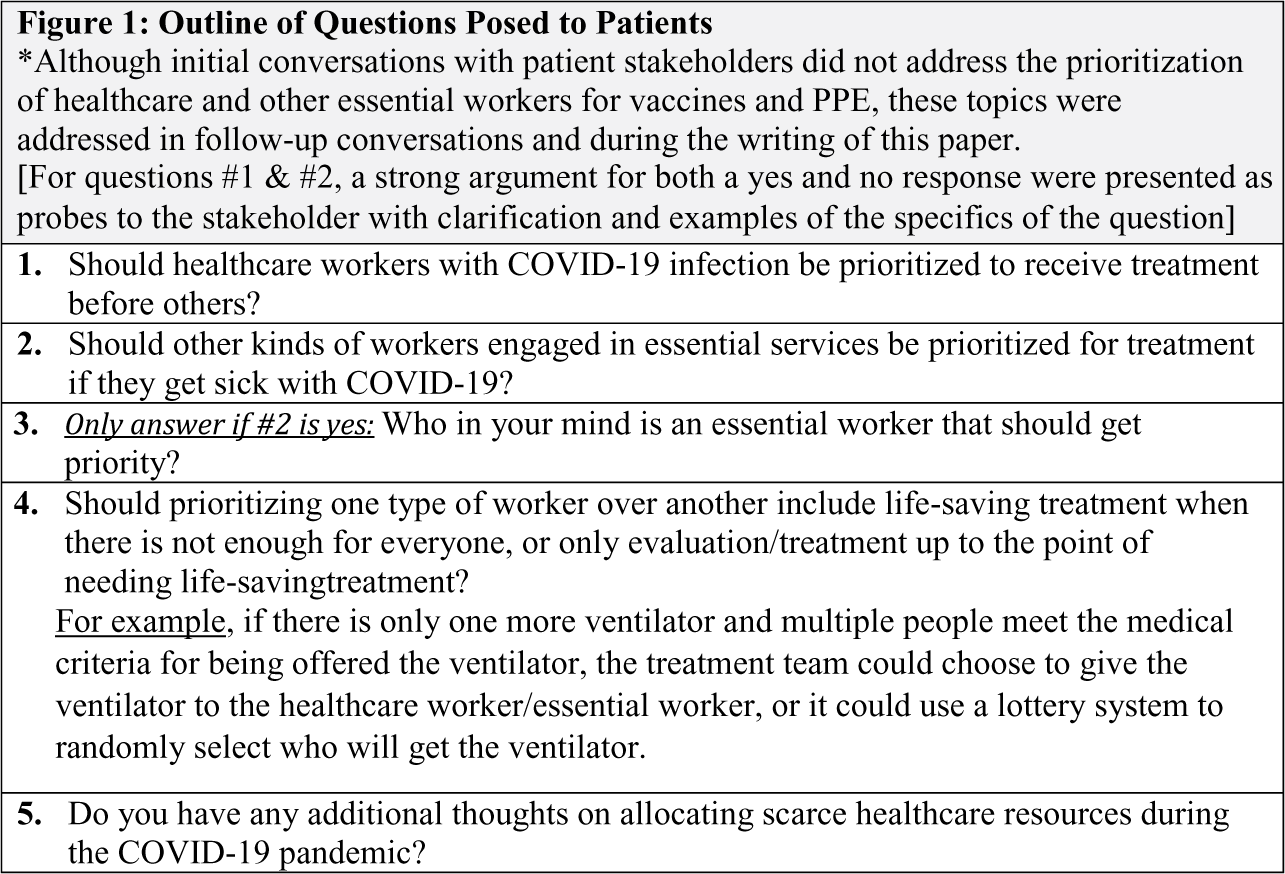
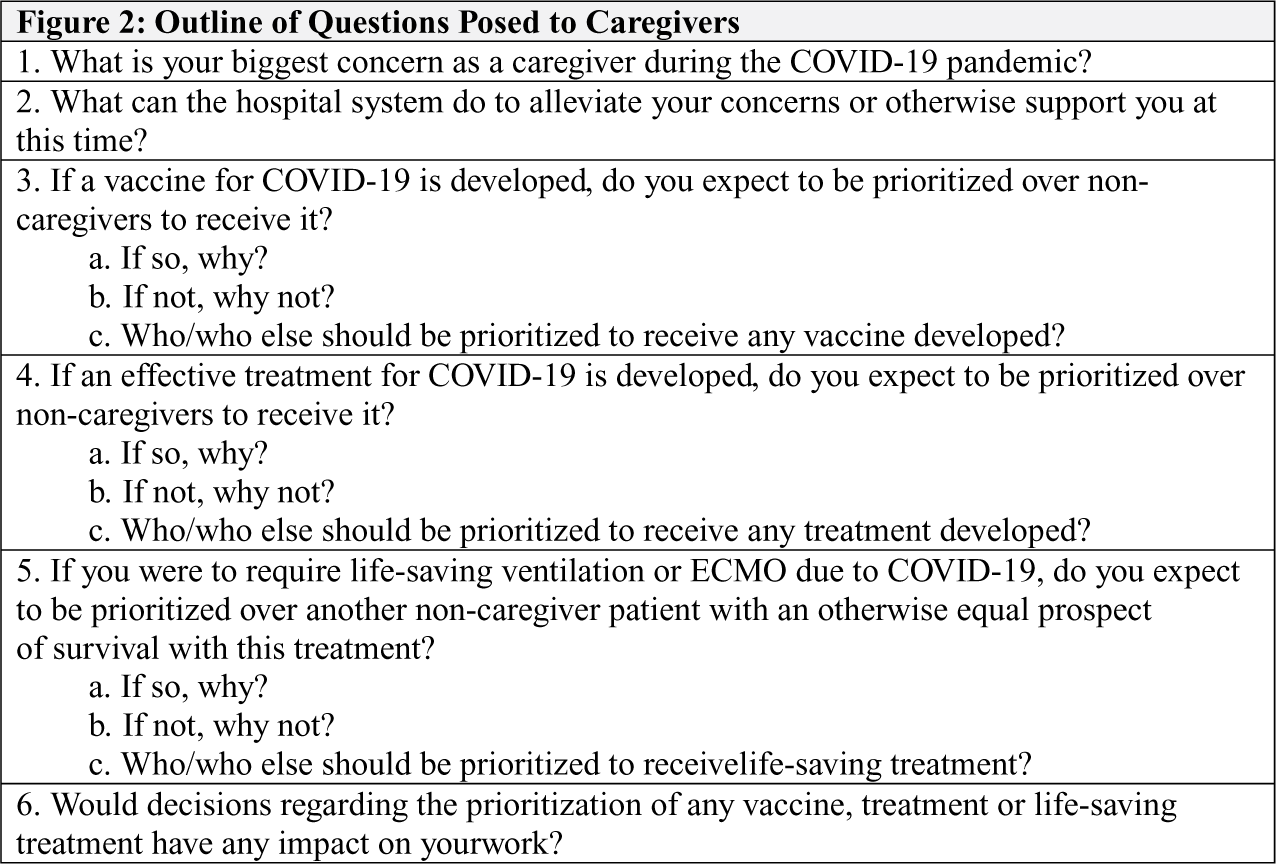
In each conversation, the ethicists conversed with stakeholders about whether healthcare workers and other essential personnel, such as first responders (emergency medical services, police, and firefighters), grocery store and parcel delivery workers, and other human services operation personnel directly interfacing with the public, who acquire COVID-19 should be prioritized over others to receive COVID-19 treatment. Each conversation began with more general terms and moved into more specific types of scarce resource allocation questions, such as how to allocate vaccines and ventilators. See Figures 1 and 2 for additional details about questions posed to caregivers and patients.
Outline of questions posed to patients.

Outline of questions posed to caregivers.

Findings
Generally, there is broad consensus among experts, healthcare workers, leaders, and communities that a primary goal in a public health crisis is to maximize the number of lives saved, with consideration also given to minimizing suffering.Footnote 35 , Footnote 36 , Footnote 37 This guides decisions made about allocating available resources. What is less clear is whether priority should be given to healthcare workers and/or other types of essential personnel. We sought to explore to what extent a wider group of caregivers, patients, and ethicists agreed about these priorities in the midst of the unfolding COVID-19 crisis.
Ethical prioritization schemes generally fall into four frameworks: (1) treating people equally, (2) favoring the worst off (prioritarianism), (3) maximizing total benefits and reducing harms (utilitarianism), and (4) promoting and rewarding social usefulness.Footnote 38 , Footnote 39 , Footnote 40 Instrumental value and reciprocity are ethical arguments that use a largely utilitarianism perspective and the ethos of promoting and rewarding social usefulness. Instrumental value specifies that certain people who are central to the crisis response are given priority for preventive measures and therapeutic treatments in order to maintain an adequate workforce.Footnote 41 For example, frontline healthcare workers save the lives of others and reduce harm to those who become ill; to accomplish this necessary societal role, they must remain healthy, protected from infection by personal protective equipment (PPE) and vaccines, once available. While instrumental value may support treatment for those who do become ill if such treatment means they may return to the workforce quickly, reciprocity accounts retrospectively to reward employees who have already taken life-threatening risks, even if they may not be able to reenter the workforce.Footnote 42 Reciprocity arguments recognize that essential workers are risking their lives to do their jobs and argues these workers therefore should have priority for treatment and vaccines as they become available.
We found that caregivers and patients rely on both instrumental value and reciprocity arguments to support prioritization of healthcare providers and first responders in allocation policies. Patients and caregivers felt that those who have direct patient contact, whether in the hospital or as first-responders, should be prioritized for healthcare resources. Interestingly, all seven patients believed that healthcare workers should be prioritized for treatment. Rooted in instrumental value, one patient’s perspective was representative: “If you really want to curb the spread and impact of the virus, you need to prioritize those who can help others and save more lives.” In addition, one patient commented: “As one who has lost a first responder family member, I would gladly volunteer to forego scarce treatment, knowing it would be used to aid a vital service provider’s recovery.” Likewise, 10 of the 14Footnote 43 caregivers drew on instrumental value to argue for the prioritization of healthcare workers. A nurse explained:
“The healthcare worker could potentially, when recovered from illness, go back into the workforce to help treat other COVID-19 patients. If they can return to the workforce, then they should be prioritized for the reason of helping others. Although it is difficult to make these decisions, the technical nature of [and intensive training required for] these professions make that reason a consideration for prioritization.”
The nurse elaborated on the view that healthcare workers provide necessary help to others that typical community members cannot. Patients and caregivers contributed to a consensus that the priority should be to preserve a healthy, safe healthcare workforce to serve patients in order to reduce the most amount of harm from the pandemic.
Similarly, caregivers and patients agreed that healthcare workers should be prioritized to receive PPE and a vaccine. This perspective was largely rooted in instrumental value, that is, healthcare workers must remain healthy in order to care for others. A physician’s response noted this instrumental value argument: “Healthcare providers should be vaccinated first and then first-responders. We’re at higher risk so we need protection first so that we can take care of everyone else.” Emphasizing the need to save the most lives, the physician recognized that healthcare workers need to remain safe and healthy. A nurse supported this sentiment, adding, “While these are very uncomfortable things to consider, the fact remains that there are not endless resources.” Likewise, a patient advocated, “[We] need to dedicate proper PPE and vaccinations to caregivers from the start, so all hands are available to treat the community.” Raising both agreement and some issues for debate, another patient elaborated why all caregivers in the hospital who have patient contact should be included:
“Keep in mind that a clean hospital is a safe hospital. Environmental Service workers keep hospitals clean and safe for everyone. They should be a high priority for PPE, screenings, and vaccines.”
Put succinctly, one police officer provided this summary:
“I think it’s essential that when push comes to shove that certain people get the vaccine, especially clinical staff who take care of patients. If [those] staff go down, everything implodes.”
The police officer’s views recognized that in a severe resource shortage, healthcare workers have particular training necessary for addressing crisis and therefore should have priority. Drawing on each of their organizational positions as well as on their identities as members of a team of specialized caregivers or patients, these statements generally recognized that healthcare workers are uniquely trained to care for patients; thus, it is instrumental to keep them healthy so that they can do their jobs and keep the pandemic under control. Most of the groups’ rationale around PPE and vaccines followed such instrumental logic and supported the utilitarian framework.
While there was agreement among caregivers and patients that healthcare workers should be prioritized for some levels of COVID-19 treatment, several areas of divergence emerged. For example, prioritization of other essential workers beyond healthcare providers and first responders was one such source of debate. Another area of divergence was that, for those workers deemed to warrant priority, caregivers and patients voiced a variety of perspectives on whether to allocate life-saving ventilators and intensive care to them. Most caregivers commented that this decision is more complex than the others, with some even expressing repugnance at the mention of such a possibility. Caregivers spoke of the need to follow important considerations per usual medical need, age, comorbidities, and likelihood of survival, while patients either did not distinguish between effective and life-saving treatment or valued the essential role healthcare workers play in society. For example, a physician explained:
“Nurses, doctors, front desk hospital workers, anyone who puts themselves at risk fighting this disease should be prioritized for life-saving treatment. Like the army and Veterans Affairs—they risked their lives and now we give them care.”
Drawing on reciprocity arguments, this physician voiced the framework for promoting and rewarding social usefulness. This was in contrast to another physician who suggested that utilitarianism (that does not include giving healthcare workers priority) should remain the guiding framework and offers a perspective for saving the most lives and life-years:
“I think we should continue to use co-morbidities and age considerations; and likelihood to survive. We should not prioritize healthcare providers over others in terms of treatment and intensive care.”
Like the caregivers, patients also debated how to allocate life-saving ventilators and intensive care. Four of the seven patient participants reported that prioritization of treatment should include life-saving treatments. One patient summed up their views using an “all or nothing” framework: “You have to go the whole nine yards, including vent. That is necessary treatment.” Another patient framed their perspective using instrumental value,
“If it gets to the point of life-saving treatment, our number one goal shouldn’t be a question of whose lives matter more; it should be an objective question of how best to curb the spread of the disease.”
Three patients voiced other sides of the debate, stating that healthcare providers should only receive priority up to the point of life-saving treatment. In the words of one patient,
“No one group or person should be making a decision about who lives and who does not get life-saving treatment. At some point on the continuum, I don’t think we should say this person gets it and this person does not.”
In the same vein, another commented, “That’s where I see the lottery come in. We should treat everyone equally at that point.”
It was apparent that both caregivers and patients found the questions harder to consider as they progressed by degree of intervention.Footnote 44 Some responded with uncomfortable laughter; others with exclamations like “wow,” “that’s a tough question,” and “I know it’s horrid, but…” before they shared their perspectives. Nevertheless, caregivers and patients acknowledged the importance of preparing such policies to guide clinical decision-making and to prevent moral distress. In the words of one patient,
“I [am glad] a definite protocol [is being] developed to make these decisions should it become necessary. Otherwise the psychological damage caused to frontline caregivers forced to make these decisions could be catastrophic.”
Likewise, a physician was grateful that the preemptive ethical decision-making would “[shoulder] the weight of traumatizing, life-altering decisions that will need to be made,… lighten[ing] the load felt by [myself and other caregivers].”
Furthermore, caregivers and patients were eager to be involved as stakeholders in the ethical decision-making. For example, a physician confided to the team of authors, “I wanted to extend my gratitude, first for including me in this discussion of utmost importance, and secondly for bringing my voice to this publication.” Patients also echoed this, as one expressed, “including us... fill[s] a gap which is not often recognized... but is vital to patient care.” It “allowed our voice[s] to be heard, [which is] especially important during a crisis like this.” This feedback suggested that not only did this contributor not find the process of providing input too burdensome, but also did they appreciate the opportunity to engage in this collaborative process. From the voices of caregivers and patients themselves, these quotes emphasize the value of stakeholder involvement for the stakeholders. Furthermore, we view this feedback as a collective recognition of shared learning and empathy for the gravity of the pandemic. Through this series of exchanges and synthesis of stakeholder views, we learned of each other’s perspectives, which contributed to the development of policy and this article.
The Policy
Conversations with stakeholders, a literature review, a survey of the ethicists in our hospital system, and dialogue with other ethicists in our region grounded our process of rapidly developing an institutional policy regarding prioritization of essential workers for COVID-19 treatment. This process was informed by several concurrent steps and led by a group of individuals from the bioethics department and the research team. First, the group engaged caregivers and patients in the stakeholder input process. Second, we conducted a literature review regarding severity of the COVID-19 crisis and its potential impact on healthcare and other essential workers. Third, the group surveyed ethicists within the hospital system regarding their individual perspectives. The survey intended to elucidate areas of disagreement and agreement as well as help each ethicist further clarify his/her own thought process. Survey questions centered on defining who counts as an essential workerFootnote 45 and which, if any, of these essential workers should receive priority for testing, outpatient management, admission to the regular nursing floor, access to critical care in the intensive care unit (ICU), and life-sustaining treatment such as ventilatory support or extracorporeal membrane oxygenation (ECMO).
Importantly, the ethicists—after rigorous debate—agreed upon a definition of essential worker that included all healthcare workers and emergency medical service personnel who regularly interface with patients in the same physical environment in which the patient is receiving (or did receive) care. The definition included all workers regardless of setting (acute care hospital, ICU, nursing home, long-term acute care hospitals, regular nursing floors, and outpatient services). For example, nurses, physicians, respiratory therapists, speech therapists, physical therapists, occupational therapists, social workers, chaplains, environmental service workers, and law enforcement personnel would all be included as essential workers. Healthcare workers only interfacing with patients virtually or who provide supportive services in other settings in which patients are not being cared for were excluded from the definition of essential workers. Other first responders (e.g., police, firefighters, etc.) would also qualify as essential workers if they interfaced directly with the public and were necessary to maintaining safety, law, and order. Informed by a relationship-centered approach, the policy included considerations for a diverse group of caregivers across our hospital system.
Notably, there was no clear consensus among ethicists within our hospital system on prioritizing essential workers for critical care and life-saving therapies. Including stakeholder views became a crucial aspect of resolving this area of disagreement. For example, one ethicist, who previously supported the proprioritization of healthcare workers for critical care and life-sustaining therapies based on reciprocity and instrumental value, found these arguments less persuasive after some of the caregivers themselves expressed that they did not expect or find such prioritization ethical. Such a change underscores the importance of obtaining stakeholder input in ethical decision-making including the variegated opinions of caregivers and patients. Arguments in favor drew on the instrumental and reciprocal logic reflected in literature and stakeholder comments. Arguments against focused on justice concerns. The commonalities that did exist centered on the ethical supportability of prioritizing essential workers who are necessarily exposed to higher risk of infection by the nature of their work for testing and evaluation, PPE, and other prevention efforts such as vaccines when they are available. Due to conversations with stakeholders, we could feel more secure in knowing that our institutional policy fairly reflected a wider range of caregivers’ and patient’s perspectives in our community.
Representative ethicists in our hospital system had contributed to a working group of ethicists from several other hospital systems in the region. The working group focused on building alignment between local healthcare institutions in order to provide consistent standards for the community at large. After several online discussions, the working group’s majority opinion recommended prioritizing essential workers for life-saving therapies if all other clinical factors were equal.
The bioethics department and the research team met virtually to prepare a framing document with recommendations for the prioritization of essential workers in healthcare allocation decisions at our institution. The agreed upon definition of essential worker was included, as well as the recommendation to prioritize essential workers for testing and evaluation, PPE, and other prevention efforts such as vaccines when they are available. On the question of life-saving care, the bioethics department ultimately reached agreement that it would align with the regional working group’s majority opinion to prioritize essential workers for life-saving therapies if all other clinical factors were equal, given that this position had support among a number of patient and caregiver stakeholders and was not absolutely ethically contraindicated. The bioethics department reasoned on balance that maintaining consistency across the hospitals in the region was an ethical priority grounded in justice considerations. The framing document was incorporated into the institution’s formal triage protocol for allocating critical care resources. The formal triage protocol, fortunately still unused, remains available to guide allocation of scarce healthcare resources in the case of an extreme escalation of COVID-19 patients within our hospital system.
Lessons for the Future
Our deliberative approach to developing recommendations regarding healthcare and essential worker prioritization as part of our system’s COVID-19 triage policy resulted in several important lessons for the future. First, including stakeholder input in policy-making processes produces more robust and ethically sound guidance. Good decision-making processes necessitate stakeholder input and relying on aligning an organizations’ choices with its institutional mission.Footnote 46 , Footnote 47 , Footnote 48 For healthcare institutions with an organizational mission focused on relationship- and patient-centered care, utilizing a deliberative approach honors these commitments, and regardless of whether the outcomes of the deliberations change, the process is fairer. Our process demonstrates that organizational ethics dilemmas that involve significant time pressures and other resource constraints can be addressed using this approach, though we note that we benefited from our preexisting network of trusted caregivers and patient volunteers. With collaborative stakeholders, conversations do not substantially delay the development of organizational ethics policies and, in fact, potentially improve them. Future work in this area and other organizational ethics issues should continue to dialogue with patients, caregivers, and the general public to incorporate their perspectives.
Second, one of the limitations of our process was that we engaged a narrow group of patients and caregivers who were easily accessible, given the need to respond to the ongoing crisis quickly. Although we purposely sampled patients and caregivers from a range of organizational positions and aimed for heterogeneity in terms of background, age, gender, race, and profession, our results as described here are not generalizable to the United States population. In future work, larger sample sizes, more diverse stakeholders, and even incorporating rigorous research methods should be included whenever possible. Moreover, with more time, we might have improved our process by developing a formal prospective research study that included a randomly selected sample of stakeholders. Although we continued conversations with patients and caregivers until we elicited no new views, logics, or other information, future efforts would ideally involve a greater number of people to establish thematic saturation. In addition, consensus might be built more traditionally and in a shared space, such as in the form of dialogue among a larger number of community members in town hall meetings. We hope to do this in future iterations.
Third, it would be valuable to engage in further efforts to understand stakeholder viewpoints on the issues that generated the most disagreement during our process and, as knowledge surrounding the pandemic continues to evolve, to confirm stakeholder viewpoints on areas of agreement. Life-saving therapies were an area of debate among the ethicists in our hospital system. Similarly, there was no clear agreement among caregivers and patients on these issues. Given the significant disagreement this issue generated, and especially as clinical data, expert recommendations, and public views continue to evolve rapidly, it is worth continuing to explore this debate. Of note, a potential limitation of our process was the fact that stakeholder conversations were held early in the pandemic. Stakeholders responded based on hypotheticals for an event that they arguably could not feel the full weight of experiencing. With new information about the disease, knowledge about the effectiveness of interventions like ventilator support, and data about the disparate way the disease impacts communities of color, some of us find that our own views have shifted and suspect the views of other stakeholders may shift as well.
Lastly, more efforts should be made by public health authorities, the bioethics community, and hospital systems to educate the public about scarce resource allocation and ethical decision-making in healthcare. If resource allocation considerations were better understood prior to the pandemic, our deliberative process and consensus building toward a new policy may have been quite different. Engaging in dialogue about these questions regularly will produce greater public health knowledge and trust. With public, patient, and caregiver commitment, healthcare professionals may be able to engage in more focused work with some sense of certainty and baseline consensus even amid a crisis situation wrought with unknowns.
Conclusion
The process described here applies best practices in clinical ethical decision-making to an organizational ethics issue—namely, involving stakeholders in policy-making and aligning institutional practices to organizational mission—to support decision-making during the COVID-19 pandemic. Even in times of crisis, inclusion of multiple stakeholders is a vital component of an ethical clinical decision-making process. Including stakeholders can lead to compassionate conversations, the exchange of knowledge, and the discovery of commonalities and collaborations. Incorporating stakeholder viewpoints benefited our institutional policy. As stay-at-home orders end and societies resume public life, the COVID-19 crisis continues to present unprecedented challenges. Yet the urgency of the COVID-19 pandemic should not dismantle clinical ethics or organizational ethics approaches to care and policy decision-making. Rather, crisis necessitates an even higher level of ethical commitment by the community engaged in the crisis and should be guided by ethical decision-making processes informed by multiple stakeholders. The opportunity to initiate enhanced collaborations between patients, caregivers, and communities must be recognized. Furthermore, in building consensus, it is necessary to strengthen the collective response required to abate the widespread impact of COVID-19.