


Voice is nothing but a basic portion and function of any political system, known sometimes also as ‘interest articulation’ [Albert Hirschman, 1970].
Introduction
In recent years, Universal Basic Income (UBI) – an unconditional, regular cash payment to all citizens – has attracted growing academic and public attention. In Catalonia, however, persistent and comparatively high levels of support have not produced a robust socio-political coalition. This apparent paradox raises a central yet understudied question: under what conditions do policy preferences translate into political mobilisation for UBI in particular?
We argue that structural constraints provide a compelling explanation. Catalonia’s dualised labour market and contributory welfare system generate two intersecting cleavages – insiders–outsiders and winners–losers – that politically marginalise those most supportive of UBI. Their limited influence within parties, trade unions, and other policy-shaping organisations constrains coalition formation.
The article proceeds in two parts. Sections The UBI in Catalonia: from a political ideal to a policy proposal to Methodology contextualise the Catalan case, review the literature on UBI preferences, and establish the micro-foundations of our hypotheses, showing that economic vulnerability is a stronger predictor of support than ideology or party sympathy. Section From economic to political precariousness connects these findings to macro-level coalition dynamics, explaining how economic precarity translates into political precariousness. By linking individual-level evidence with structural analysis, the article clarifies how strong attitudinal support can coexist with weak collective mobilisation under conditions of inequality.
The UBI in Catalonia: from a political ideal to a policy proposal
Scholarly attention to UBI in Catalonia remains limited, despite its longstanding presence in regional political debate. At the societal level, the Spanish Basic Income Network, founded in 2001, has maintained a strong base in Catalonia (Medina and Raventós, Reference Medina, Raventós, Medina and Raventós2026). Within party politics,Footnote 1 ERC and ICV-EUiA introduced two initiatives on UBI at the Catalan and Spanish Parliaments in 2002 and 2005 (Parlament de Catalunya, 2002; BOCG, 2005).
The 2003 progressive coalition agreement between PSC, ERC, and ICV-EUiA committed to ‘redefining the Minimum Income Scheme aiming to transform it into a basic citizenship income’ (Tinell Agreement, 2003). Currently, Catalunya En Comú formally endorses UBI without incorporating it into its programme, while PSC supports reforms of existing minimum income programmes. ERC takes a similar stance, despite internal factions advocating comprehensive UBI. CUP remains the only party to include UBI in its electoral platform (Raventós, Reference Raventós2021b).Footnote 2 Right-wing parties have consistently opposed UBI, whereas left-wing groups have displayed greater internal and programmatic ambiguity (Santa Cruz, Reference Santa Cruz Díez2019; ECAS, 2023; Martínez, Reference Martínez2023).
Beyond party politics, the Indignados movement of May 2011 contributed to popularising UBI (Casassas and Manjarin, Reference Casassas and Manjarin2013). Subsequently, PODEMOS incorporated it into its European Parliament election manifesto (Noguera, Reference Noguera2019). The 2017–2019 B-MINCOME pilot in Barcelona further contributed to the debate, although it remained largely confined to the local level (Merrill et al., Reference Merrill, Neves and Laín2021; Rincón, Reference Rincón2022). The announcement of the Catalan pilot in 2021 – ultimately cancelled by PSC-PSOE and Junts (Catalan News, 2023; Standing, Reference Standing2023) – substantially increased UBI’s public salience. This sparked parliamentary debates between 2022 and 2024, attracted broad public and political attention, and prompted engagement among scholars and policymakers with the feasibility and policy design of UBI (Laín, Reference Laín, Liu and Caputo2027; Godàs et al., Reference Godàs, Raventós and Raventós2025).
Consequently, UBI has acquired a more technical and programmatic profile. The coexistence of an organised pro-UBI advocacy community and recent institutional efforts to implement a pilot makes Catalonia a particularly relevant case for analysing support for UBI. The policy now occupies a consolidated, albeit modest, position within political, academic, and policy arenas, which may help contextualise its relatively high levels of public support. Its growing institutional and political presence in Catalonia makes the analysis of the determinants of support for UBI particularly pertinent.
Explanatory factors for support of universal basic income
Research on UBI preferences is relatively recent but has already produced a substantial body of empirical evidence. Support for UBI is widespread across Europe (Dermont and Stadelmann-Steffen, Reference Dermont and Stadelmann-Steffen2019), with between 68 and 75 per cent of Europeans expressing willingness to implement it in their countries (Dalia, 2017; Delsen and Schilpzand, Reference Delsen, Schilpzand and Delsen2019). In Central and Eastern European countries, such as Lithuania, Romania, and Hungary, acceptance rates reach 80 per cent, whereas in Central and Nordic countries such as Norway, support drops to 33.9 per cent (Baranowski and Jabkowski, Reference Baranowski and Jabkowski2021; ESS, 2023). Recent studies report support levels of 50–65 per cent in Germany, Spain, and Italy, and around 40 per cent in Sweden, France, Denmark, and the UK (Ipsos, 2017; FEPS, 2020; YouGov, 2024). Explanations for UBI preferences generally focus on the following three factors.
Individual attributes
With few exceptions (Baute and Meuleman, Reference Baute and Meuleman2020; Baranowski and Jabkowski, Reference Baranowski and Jabkowski2021), no systematic association has been found between support for UBI and gender or educational attainment. Age, by contrast, consistently predicts attitudes, with younger cohorts displaying more favourable positions (Lee, Reference Lee2018; Dermont and Weisstanner, Reference Dermont and Weisstanner2020; Bollain et al., Reference Bollain, Guerendiain-Gabás, Arnoso-Martínez and Elías Ortega2024).
Among socio-political variables, left-wing self-placement and higher institutional trust positively correlate with support (Dermont and Stadelmann-Steffen, Reference Dermont and Stadelmann-Steffen2019; Jordan et al., Reference Jordan, Ferguson and Haglin2021), whereas conservatism and anti-immigration attitudes correlate negatively (Bay and Pedersen, Reference Bay and Pedersen2006; Kevins, Reference Kevins and Crepaz2022; Yeung, Reference Yeung2022). Identifying with the right is associated with a probability of support of 41 per cent, compared with 61 per cent among those identifying with the left (Vlandas, Reference Vlandas2021).
Socioeconomic factors are also salient (Laenen et al., Reference Laenen, Mulayi, Francisco and Van Lancker2023). Unemployment and part-time employment (Andersson and Kangas, Reference Andersson, Kangas and Standing2004; Bay and Pedersen, Reference Bay and Pedersen2006), precariousness (Shin et al., Reference Shin, Kemppainen and Kuitto2021; Patulny and Spies-Butcher, Reference Patulny and Spies-Butcher2023), and receipt of social benefits (Martinelli, Reference Martinelli2020) are associated with higher support. Individuals in the lowest or highest income decile show probabilities of support of 56 and 46 per cent, respectively (Vlandas, Reference Vlandas2021), while middle-income groups tend to be more reluctant, often perceiving themselves as net contributors (Roosma and Van Oorschot, Reference Roosma and Van Oorschot2020; Zimmermann et al., Reference Zimmermann, Boljka, Rakar and Hrast2020).
Policy characteristics
Support for UBI also depends on attitudes towards its three defining attributes: individuality, universality, and unconditionality (Gielens et al., Reference Gielens, Roosma and Achterberg2024). While individuality tends to receive broader approval, universality and unconditionality remain more contested because of their normative and institutional tension with existing welfare regimes (Haagh, Reference Haagh2019).
Evidence on universality remains inconclusive (Choi, Reference Choi2021; Patulny and Spies-Butcher, Reference Patulny and Spies-Butcher2023), as no clear causal link has been established between support for universal social policies and for UBI (Lee, Reference Lee2018). Financing is therefore central (Rincón, Reference Rincón2023): support increases when UBI is framed as funded through progressive taxation that limits net losers and avoids perceptions that the just are treated as sinners. Conversely, support declines when UBI is expected to raise overall tax burdens or crowd out existing benefits (Lee, Reference Lee2018; Vlandas, Reference Vlandas2021). These concerns contribute to shaping preference formation in social policy (Rehm, Reference Rehm2009; Barnes, Reference Barnes2015) and plausibly extend to UBI.
Unconditionality is controversial because it challenges meritocratic and reciprocity-based principles embedded in many welfare systems (Lister, Reference Lister2020; White, Reference White2003; cfr. Van Parijs, Reference Van Parijs1997; Neves, Reference Neves2024). Accordingly, support is lower among those concerned with ‘false positives’ – beneficiaries who do not meet the requirements – whereas it increases among those worried about ‘false negatives’ – those meeting eligibility criteria yet remaining excluded (van Oorschot and Roosma, Reference Van Oorschot, Roosma, van Oorschot, Roosma, Meuleman and Reeskens2017). Sensitivity to perceived undeservingness plays a decisive role (Piff et al., Reference Piff, Wiwad, Robinson, Aknin, Mercier and Shariff2020), since opposition to activation policies’ sanctions correlates with stronger support (Lee, Reference Lee2018; Vlandas, Reference Vlandas2021). The deserving–undeserving cleavage constrains support for redistributive policies in general (van Oorschot, Reference Van Oorschot2000; Sachweh et al., Reference Sachweh, Ullrich, Christoph, Mau and Veghte2007; van Oorschot and Roosma, Reference Van Oorschot, Roosma, van Oorschot, Roosma, Meuleman and Reeskens2017) and for UBI in particular (Gómez-Frías et al., Reference Gómez-Frías, Sánchez-Chaparro, Maeso-Álvarez and Salgado-Criado2021; Lindner et al., Reference Lindner, Mijs, de Koster and van der Waal2023).
Economic and political-institutional factors
A third level of analysis concerns political-institutional configurations, inequality, and welfare state generosity. Lower GDP, high unemployment (Parolin and Siöland, Reference Parolin and Siöland2020; Laenen et al., Reference Laenen, Mulayi, Francisco and Van Lancker2023), and limited social benefits (Vlandas, Reference Vlandas2021) are associated with stronger support. In contexts of persistently high and largely involuntary unemployment, activation policies become contentious, increasing UBI’s appeal (Groot, Reference Groot2004:69–77). High economic polarisation similarly predicts stronger backing for UBI (Roosma and van Oorschot, Reference Roosma and Van Oorschot2020; Choi, Reference Choi2021; Patulny and Spies-Butcher, Reference Patulny and Spies-Butcher2023) and redistributive policies more broadly (Korpi and Palme, Reference Korpi and Palme1998; Blekesaune and Quadagno, Reference Blekesaune and Quadagno2003; Jeene et al., Reference Jeene, Van Oorschot and Uunk2014; Fernández-Albertos and Manzano, Reference Fernández-Albertos and Manzano2016).
The effects of ideology and immigration attitudes are often conditioned by macroeconomic conditions such as social expenditure (Parolin and Siöland, Reference Parolin and Siöland2020), though this varies depending on the universality of the welfare regime (Bay and Pedersen, Reference Bay and Pedersen2006) or, conversely, its restrictive or chauvinistic orientation (Andersen and Bjørklund, Reference Andersen and Bjørklund1990; Choi, Reference Choi2021; Careja and Harris, Reference Careja and Harris2022). In low-spending contexts, ideology tends to matter less, whereas in high-spending systems political-ideological variables become more salient (Parolin and Siöland, Reference Parolin and Siöland2020). Political-institutional and macroeconomic variables must be assessed alongside socio-cultural factors, since a dominant work ethic linking employment to dignity and self-realisation often constrains support for unconditionality (Herke and Vicsek, Reference Herke and Vicsek2022; Henderson, Reference Henderson2023; Gielens et al., Reference Gielens, Roosma and Achterberg2024).
Understanding UBI preferences therefore requires examining not only inequality but also the specific configuration of economic distribution, labour market structure, benefits design, and the breadth and selectivity of coverage. Who is included – or excluded – from existing schemes shapes both policy preferences and their potential translation into political mobilisation. Empirical evidence on these mechanisms remains limited, particularly in cases such as Catalonia, where systematic research is still incipient. This article addresses that gap.
Hypotheses
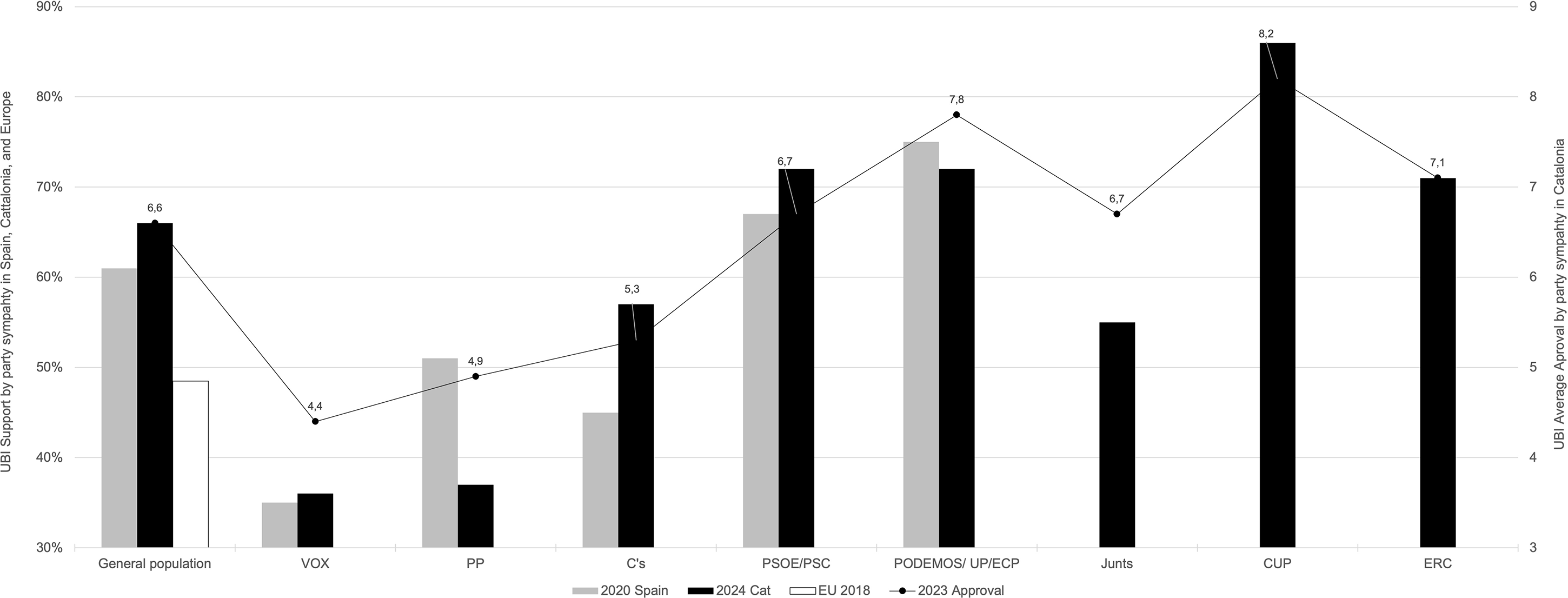
The sustained presence of UBI across the socio-political arenas described in Section 2 (“The UBI in Catalonia: from a political ideal to a policy proposal”) helps explain consistently high levels of support in Catalonia. As Figure 1 shows, levels range between 62 and 85 per cent – systematically higher than in Spain (COTEC, 2020; RRB, 2020) and Europe (ESS, 2023). Support also cuts across party lines, ranging from 36 per cent among right-wing sympathisers to 86 per cent among CUP supporters, with an overall average of 64 per cent – rising to 75 per cent when Junts, PP, and VOX are excluded (Generalitat de Catalunya, 2023).
UBI support rate by party sympathy in Spain (2020), Catalonia (2024), and Europe (2018), and UBI average approval by party sympathy in Catalonia (2023).
Source: Authors’ elaboration. Party sympathy for Spain (RRB, 2020), Catalonia (CEO, 2024), and Europe (ESS, 2023). Average approval in Catalonia (Generalitat de Catalunya, 2023).

Yet this broad attitudinal support contrasts with the limited parliamentary debate and absence of sustained coalition-building. If ideology were decisive, why do left-wing organisations not mobilise more decisively? Similarly, if inequality and low social spending predict higher support, why, in Catalonia, characterised by high-income inequality and low social spending, is the debate less advanced than in more egalitarian and higher-spending countries such as Finland, the Netherlands, or Switzerland?
Recent research has examined how income distribution shapes both the formation of policy preferences (Svallfors, Reference Svallfors2005; Fernández-Albertos and Manzano, Reference Fernández-Albertos and Manzano2016) and socio-political coalitions (Rueda, Reference Rueda2007; Gingrich and Häusermann, Reference Gingrich and Häusermann2015; Rovny and Rovny, Reference Rovny and Rovny2017; Schwander, Reference Schwander2019; Kuziemko et al., Reference Kuziemko, Longuet-Marx and Naidu2023). In this sense, Spain presents a surprising lack of partisan conflict over the welfare state: the most precarious show lower levels of support for welfare expansion regardless of ideology or party identification (Fernández-Albertos and Manzano, Reference Fernández-Albertos and Manzano2012).
This pattern has been attributed to pronounced labour market dualisation, which produces a cleavage between insiders – permanent workers with high union density and extensive bargaining coverage – and outsiders – temporary, part-time, unemployed, unstable, or inactive individuals (Dolado and Bentolila, Reference Dolado and Bentolila1993; Ferrera, Reference Ferrera1996; Lindbeck and Snower, Reference Lindbeck and Snower2001; Rueda, Reference Rueda2005, Reference Rueda2014). This dualisation reinforces a predominantly contributory welfare regime that disproportionately benefits insiders, generating a second cleavage between winners and losers (Larsen, Reference Larsen2006; Häusermann and Schwander, Reference Häusermann, Schwander, Emmenegger, Häusermann, Palier and Seelieb-Kaiser2012; Silva and Vázquez-Grenno, Reference Silva and Vázquez-Grenno2013; Bandrés et al., Reference Bandrés, Rodríguez and Carabaña2023).Footnote 3 The interaction of the two cleavages may foster among labour-market outsiders and welfare-state losers a perception of structural exclusion, reducing their willingness to endorse any welfare reform (Fernández-Albertos, Reference Fernández-Albertos2018; Stantcheva, Reference Stantcheva, Blanchard and Rodrik2021).
Existing evidence suggests that this Spanish singularity may partially apply to UBI preferences in Catalonia, thereby leading to two working hypotheses:
H1. Socioeconomic status influences UBI preferences more strongly than political-ideological variables.
H2. Contrary to this Spanish pattern, precarious groups – outsiders and losers – are more favourable to UBI.
Despite having higher levels of support for UBI (H2), the precarious groups remain politically marginal. Their limited influence within trade unions, political parties, and other social actors constrains the translation of their preferences into collective mobilisation. This occurs in two ways. First, weak internal cohesion hinders the articulation of shared demands, rendering them a ‘diffuse agency […] with little or no apparent coordination or collective intention’ (De Wispelaere and Noguera, Reference De Wispelaere, Noguera and Caputo2012:19). Second, their marginal position restricts their capacity to define social problems and advance viable policy alternatives (Sabatier, Reference Sabatier1988). In short, the same economic dynamics that intensify their demand for social protection simultaneously diminish their political leverage (Fernández-Albertos, Reference Fernández-Albertos2018).
The disjuncture between high survey-reported support and weak mobilisation or coalition-building around UBI is not unique to Catalonia. Finland (Halmetoja et al., Reference Halmetoja, De Wispelaere and Perkiö2019; Perkiö, Reference Perkiö2020) and the Netherlands (Rossetti et al., Reference Rossetti, Roosma, Laenen and Abts2020; Rombouts and Betkó, Reference Rombouts and Betkó2024) exhibit similar patterns despite extensive debate, whereas Brazil (Waltenberg and Katz, Reference Waltenberg, Katz, Waltenberg and Katz2023) and India (Davala, Reference Davala and Torry2023) have seen the emergence of more clearly articulated socio-political coalitions around UBI-like initiatives and pilots.Footnote 4 What, then, constrains coalition-building in Catalonia?
While political-strategic (De Wispelaere, Reference De Wispelaere2016a), belief-based (Sabatier, Reference Sabatier1988), and communicative factors (Falcón and Pujol, Reference Falcón, Pujol, Medina and Raventós2026) may also matter, in the concluding section we outline several additional structural and contextual mechanisms that complicate any straightforward causal inference between individual preferences and observable patterns of political mobilisation.Footnote 5 Nevertheless, we argue that two structural features are particularly decisive in Catalonia: a markedly dualised labour market and a predominantly contributory welfare regime. Having outlined the hypotheses and their theoretical foundations, we now proceed to test them empirically.
Methodology
Sample
This study draws on Omnibus Survey No. 1097 conducted by the Centre for Opinion Studies (CEO, 2024). Fieldwork took place in spring 2024 through a self-administered survey targeting Catalan residents aged 16 and over. The initial random sample was constructed by mailing letters to 6,000 individuals selected from the official population register and complemented with 3,402 panellists. A total of 1,246 valid responses were obtained. At a 95 per cent confidence level and assuming maximum variance (p = q = 0.5), the margin of error is ±1.90. To ensure representativeness, the CEO applied proportional iterative weighting (raking) by gender, age, and educational attainment.
The survey includes a single question measuring support for UBI on a 0–10 scale and does not provide information on respondents’ income, attitudes towards universality or unconditionality, or broader welfare state preferences. Despite these limitations, it allows us to construct the profile of outsiders and losers using available indicators.
Outsiders are identified through employment status and sociodemographic characteristics strongly associated with labour market precarity and exclusion, including younger respondents, lower educational attainment, large households, and a higher number of children (Generalitat de Catalunya, 2025). The profile of losers is constructed using housing tenure and cost, as well as unpaid bills. Housing insecurity and financial hardship represent central dimensions of social exclusion insufficiently addressed by Catalan social policy (ECAS, 2024). Accordingly, losers comprise individuals facing housing insecurity due to limited access to housing assistance programmes, as well as those experiencing financial strain resulting from inadequate coverage by the Renda Garantida de Ciutadania or RGC [the Catalan Guaranteed Citizenry Income] and the Ingreso Mínimo Vital or IMV [the Spanish Minimum Vital Income], the two main minimum income schemes available to residents of Catalonia.
Variables and method of analysis
To test the hypotheses, we estimate a three-tier hierarchical linear regression (Table 2), assessing both the specific and cumulative effects of the explanatory variables (Table 1).
Descriptive statistics of independent and dependent variables

Table 1. Long description
A table with descriptive statistics of independent and dependent variables. The table has 10 rows and 10 columns. Column headers include Age, Maximum level of studies, Number of children, Household members, Ideology, Party Sympathy, Working, Dwelling regime, Housing costs, Overdue bills, and UBI support. Row labels include age groups, education levels, number of children, household members, ideology levels, party sympathies, working status, dwelling regimes, housing costs, overdue bills, and UBI support levels. Each row provides the percentage and mean values for each variable. Notable trends include the highest percentage of the age group 45-59 at 28.0 percent, the highest education level being secondary at 38.1 percent, and the highest party sympathy being none at 22.9 percent.
Source: Authors’ elaboration based on CEO (2024).
Hierarchical linear regressions of UBI support

Table 2. Long description
The table presents hierarchical linear regressions of UBI support, structured into three models (M1, M2, M3) with coefficients and standard errors for various variables. Sociodemographic variables include age, level of studies, number of children, and household members. Socio-political variables cover ideology, party sympathy, and working status. Socioeconomic variables include dwelling regime and housing costs as a percentage of total income. Each row lists coefficients and standard errors for different age groups, education levels, and other factors. Notable trends include significant coefficients for household members and ideology in models M2 and M3. The table also includes statistical measures like observations, R2, adjusted R2, residual standard error, and F statistic.
Source: Authors’ elaboration based on CEO (2024).
Note: Coeff. = Standardised β coefficient. SE = Standard Error.
* P < 0.05, **P < 0.01, ***P < 0.001.
Model 1 (M1) includes standard sociodemographic controls: Age (four categories), Level of studies (dummy-coded, reference ‘No studies’), and Number of Children and Household Size (continuous).
Model 2 (M2) tests H1 by adding political variables: Ideology (0 = extreme left to 10 = extreme right) and Party Sympathy (dummy-coded for the eight parliamentary parties in 2024: CUP, ERC, ECP, PSC, Junts, C’s, PP, and VOX – merged with AC (Aliança Catalana) due to ideological similitudes and non-significance – plus a category for no party affiliation). ‘Don’t know,’ ‘Prefer not to answer,’ and ‘Other’ are excluded for statistical irrelevance.
Model 3 (M3) evaluates H2 by incorporating economic indicators: Employment Status (employed = 1), Dwelling Regime (three dummies: ‘Paid,’ ‘Paying’ for mortgage, and ‘Renting’), and Housing Costs (percentage of household income, into three dummies with 0–25 per cent as reference), and Overdue Bills. The latter, a key component of the CEO’s Wellbeing Index comparable to the Severe Material Deprivation component of the AROPE Indicator, captures acute financial strain and social exclusion.
Results
The models reveal both the individual contribution of each variable and their cumulative explanatory power. In Model 1 (M1), number of children emerges as a robust predictor of UBI support, consistent with previous research (Hernanz et al., Reference Hernanz, Malherbet and Pellizzari2004; Laín and Julià, Reference Laín and Julià2024). Those aged 16–29 display a modest but significant effect that weakens across models, suggesting that age partly captures labour vulnerability. Secondary education shows a small but persistent negative association, in line with findings on the inverse relationship between education and UBI support (Herke and Vicsek, Reference Herke and Vicsek2022). Household size exerts the strongest effect, which is also persistent across all models, reinforcing the number of children result: larger households bearing greater responsibilities tend to express higher levels of support.
Model 2 (M2) introduces ideology, which becomes the third most influential and stable predictor. Left-leaning individuals display higher support, challenging findings that ideology plays only a marginal role (Roosma and van Oorschot, Reference Roosma and Van Oorschot2020), in poorer or more unequal European contexts (Lee, Reference Lee2018) or confined to higher-income Spaniards (Guerendiain-Gabás et al., Reference Guerendiain-Gabás, Gil d Montes, Bobowik and Arnoso-Martínez2023). By contrast, Party sympathy is statistically insignificant across models. This likely reflects the Catalan political landscape illustrated in Figure 1, where support is relatively widespread among most parties. While number of children remains significant, household size loses strength once ideology is included, partially challenging H1, yet socioeconomic variables remain the most powerful predictors overall.
Model 3 (M3) highlights the negative effect of being employed, supporting H2: employment is associated with lower support, consistent with arguments that it reduces perceived need for income support (Vlandas, Reference Vlandas2021; Weisstanner, Reference Weisstanner2022), despite a working-poverty rate of 7.7 in Catalonia. To refine the profile of losers, three variables are introduced. Dwelling regime (‘Renting’ or ‘Mortgage’) and housing costs exert stronger effects than either household size or ideology, underscoring housing precarity as a key determinant of UBI support (Johnson et al., Reference Johnson, Johnson and Nettle2023). Overdue bills also significantly predict support, with an effect size exceeding that of being employed, indicating that financial strain – closely tied to housing burdens – is a central driver of precarity and thereby of UBI support.
Although overall predictive power remains moderate – partially due to survey limitations and the nature of the dependent variableFootnote 6 – the increase in R2 across models (0.123, 0.209, 0.238) shows that political variables (M2), and particularly economic and housing variables (M3), account for substantially more variance while enhancing the model’s explanatory capacity.
This leads to three conclusions: sociodemographic factors exert limited influence; ideology is relevant, but not determinant; and economic precarity – particularly housing vulnerability and financial hardship – faced by outsiders and losers constitutes the strongest determinant. Two contrasting profiles emerge. Supporters are more likely to live in larger households, have children, identify with the left, be unemployed, face high housing costs (rent or mortgage), and experience overdue bills. Opponents tend to live alone or in smaller households, be homeowners, identify with the right, be employed, and enjoy financial security. These findings align with European and non-European evidence (Yang et al., Reference Yang, Choe and Nam2024) while supporting H1 and H2: beyond ideology, economic vulnerability is the most consistent predictor of UBI support.Footnote 7
However, strong individual-level support does not automatically translate into collective mobilisation or policy change. Much of the welfare politics literature has examined the formation of policy preferences and institutional constraints but rarely connects individual-level preferences with organisational capacity for sustained collective action (cfr. Hays, Reference Hays2001; Bonoli, Reference Bonoli2005). Building on this micro-level evidence, the next section examines the structural mechanisms through which economic vulnerability translates into political precarity.
From economic to political precariousness
Some authors have addressed this by arguing that ‘broader coalitions of UBI supporters can be found in countries with low social spending […] it is the countries that tend to do less to address concerns of poverty and inequality where demand for UBI is greatest’ (Parolin and Siöland, Reference Parolin and Siöland2020:12). However, evidence from the UK (Martinelli and Pearce (Reference Martinelli and Pearce2019), Mexico (Zapata Celestino, Reference Zapata Celestino2025), and Catalonia challenges this hypothesis, as no stable pro-UBI coalitions have materialised despite significant levels of public support. Although ‘[t]he coalition dynamics of basic income support are complicated’ (De Wispelaere et al., Reference De Wispelaere, Halmetoja and Pulkka2018:17), it remains analytically pertinent to identify the structural constraints that inhibit coalition-building in the Catalan case.Footnote 8
We argue that economic precariousness translates into political precariousness because their preferences are underrepresented – or entirely excluded – from the agendas of influential political and social actors. This disjunction is particularly striking in Spain, where ‘outsiders outnumber insiders in terms of electoral relevance’ (Bürgisser and Kurer, Reference Bürgisser and Kurer2021:14). Numerical weight, however, does not automatically confer political influence. Structural economic constraints fragment collective interests, reduce organisational capacity, and inhibit sustained mobilisation. This helps explain why high levels of individual support for UBI can coexist with weak coalition-building.
Rather than establish causal inferences, our aim is to provide an empirically grounded account of the conditions under which attitudinal support for UBI may – or may not – translate into collective political demand. Specifically, and beyond other potential explanatory factors, we empirically examine how labour market structure and the design of the social protection system jointly hinder the translation of UBI preferences into organised political mobilisation.
To do so, Section “A single country, two speeds: the economically precarious” analyses the two structural mechanisms that define economic precariousness in Catalonia. First, high inequality is primarily driven by lower-market incomes, producing a labour-market cleavage between insiders and outsiders. This cleavage is illustrated through employment elasticity and in-work poverty indicators. Second, the contributory bias of the social protection system generates a further cleavage between winners and losers. This is reflected in the uneven redistributive capacity of cash transfers and the limited coverage of housing assistance and minimum income programmes.
Section “The (dis)articulation of collective interests: the politically precarious” then examines how these structural cleavages undermine the capacity of precarious groups to articulate shared interests and policy preferences, thereby rendering them politically precarious. As a result, they are underrepresented or excluded from key socio-political actors – particularly political parties and trade unions – and display lower levels of political engagement – representation, participation, political interest and understanding, and institutional trust.
The empirical evidence shows that the most economically precarious groups – those more supportive of UBI – consistently display the lowest levels across these indicators. This structural disconnection helps to explain the central paradox identified in this article: their robust individual preferences do not translate into durable coalitions capable of advancing UBI implementation.
A single country, two speeds: the economically precarious
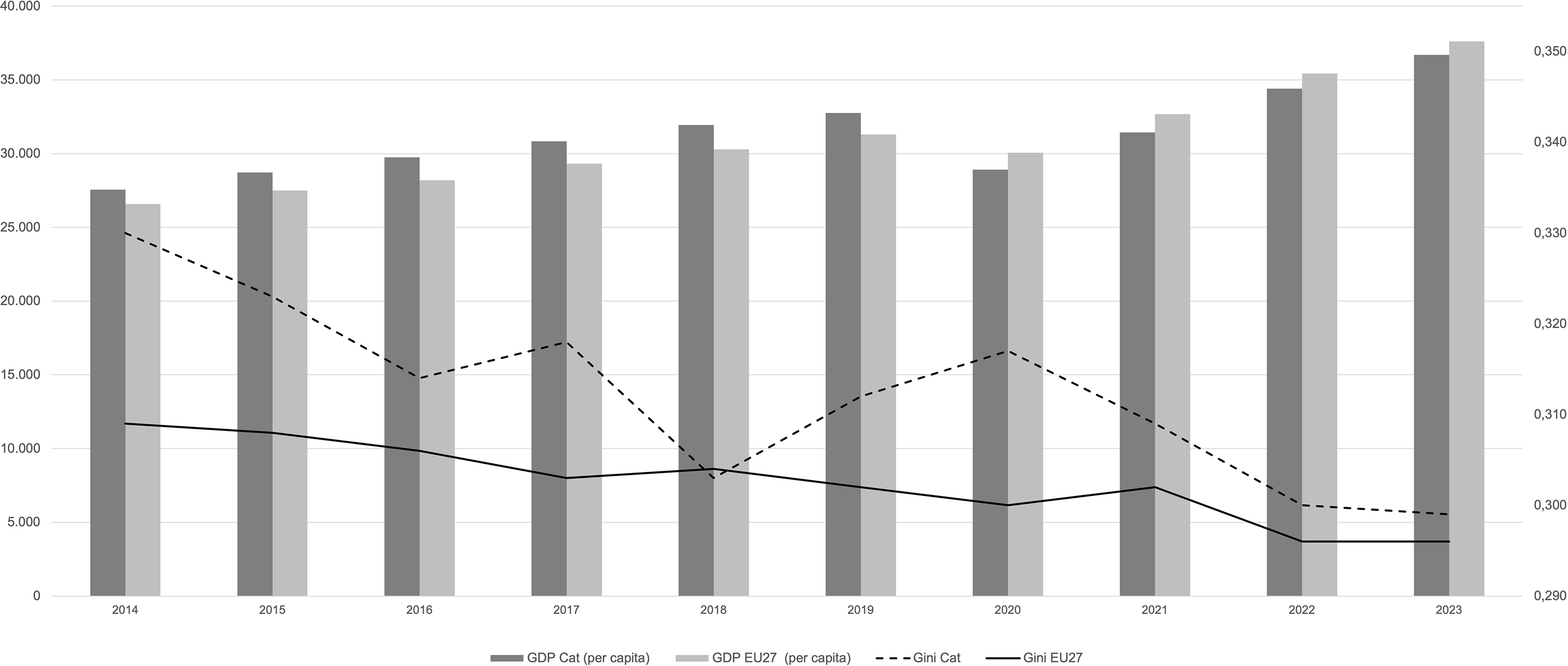
As shown in Figure 2, Catalonia’s GDP trajectory closely follows that of the EU-27, with per capita GDP surpassing the European average by nearly €1,800 after the austerity period. Yet inequality, measured by disposable income, remains strikingly high: Catalonia ranks twelfth in the EU-27. A similar pattern emerges in the AROPE rate, where Catalonia stands only marginally ahead of Romania, Latvia, Bulgaria, and Greece.
GDP per capita and Gini (disposable income). Catalonia and EU-27 (2014-2023).
Source: Authors’ elaboration based on Eurostat (ilc-di12) and Idescat.

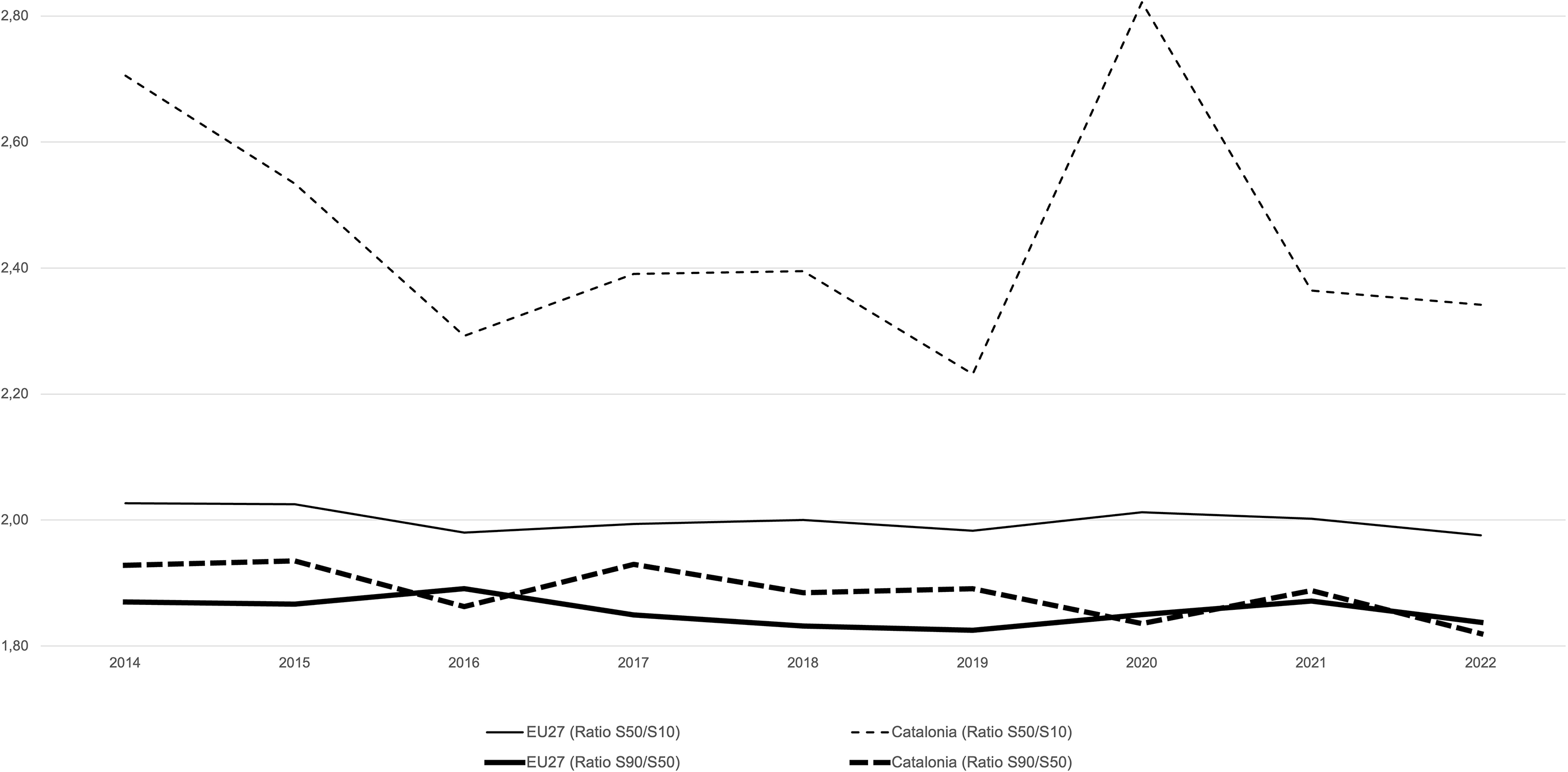
A common explanation attributes this inequality to erosion of middle-class incomes. However, Figure 3 suggests otherwise. While the 90/50 ratio (top 10 vs. bottom 50 per cent) is broadly comparable to the EU-27 average, the 50/10 ratio (bottom 50 vs. bottom 10 per cent) is, on average, 2.55 times higher in Catalonia. Inequality thus stems less from middle-class decline than from the pronounced income gap between the lower decile and the rest of the distribution.
90/50 Ratio and 50/10 Ratio, EU27 and Catalonia (2014–2022).
Source: Authors’ elaboration based on EU-SILC and ECHP surveys, Idescat, and OECD Inequality Database.

This distributional pattern can be traced to two structural mechanisms: (i) polarisation in market incomes generated by a dualised labour market (insiders-outsiders cleavage), and (ii) a contributory social protection system (winners-losers cleavage).
The first cleavage is evident in employment elasticity and in-work poverty. First, for each one-point decline in GDP, permanent contracts fall by 0.2 points, whereas temporary and part-time contracts decline by nearly 1 point. A similar asymmetry appears across age groups: employment decreases by 0.3 points among adults but 0.9 among younger workers. Second, 12.4 per cent of full-time workers are affected by in-work poverty, rising to 26.8 per cent among part-time workers. Labour market adjustments to economic cycles are thus disproportionately absorbed by insiders.
The second cleavage derives from the contributory bias of the social protection system, which privileges pensions and contributory unemployment benefits over assistance-based schemes (Fuenmayor et al., Reference Fuenmayor, Granell and Savall2020; Bandrés et al., Reference Bandrés, Rodríguez and Carabaña2023). This is illustrated by poverty risk according to households’ income source: 16.3 per cent among wage earners and 18.9 per cent among contributory benefit recipients, compared to 98.6 per cent among those relying exclusively on assistance benefits and 82.0 per cent among those with no income (FOESSA, 2022). Thus, redistributive capacity sharply reflects this asymmetry. Contributory pensions reduce inequality by 6.2-8.7 Gini points and unemployment benefits by 0.8 points (accounting for 64.4 and 6.3 per cent of total cash-transfer redistribution, respectively), whereas non-contributory benefits exert a negligible effect (Ayllón and Ramos, Reference Ayllón and Ramos2022).
Housing assistance and minimum income schemes – central to the operationalisation of the losers’ profile in Section “Sample” – belong to these cash-transfer mechanisms. First, housing costs constitute a major axis of exclusion: 19.3 per cent of Catalan households face excessive burdens (ECAS, 2024). Poverty risk stands at 12 per cent among homeowners but rises to 33 per cent among tenants – 13 points above the EU average (Khametshin et al., Reference Khametshin, López and Pérez2024). Among the already excluded, 82.2 per cent experience severe housing-access problems (FOESSA, 2022). Limited housing benefits amplify this vulnerability (Caritas, 2023). Second, minimum income schemes display similar shortcomings: 67 per cent of those in severe poverty are unaware of the RGC, only 24.5 per cent have applied, and just 13.1 per cent have received it (ADGSS, 2023). The resulting non-take-up rate – around 60 per cent – translates into a minimal redistributive impact: 0.61 Gini points and 1.66 points in the 90/10 ratio (Ivàlua, 2023).
The contributory bias of the welfare regime is reinforced by the insiders-outsiders cleavage. Replacement rates – the proportion of benefits relative to the beneficiary’s salary – are comparatively high for average- and low-income pensioners and unemployment recipients, but lower for insiders. This asymmetry increases insiders’ cost of job loss, strengthening their incentives for union participation (Häusermann and Schwander, Reference Häusermann, Schwander, Emmenegger, Häusermann, Palier and Seelieb-Kaiser2012; Frank and Malcomson, Reference Frank and Malcomson1994). As Rueda (Reference Rueda2014:384) observes, ‘high levels of insider protection are correlated with weaker demands for protection and therefore with less generous social policy’. Collective bargaining processes thus tend to reflect insiders’ preferences, marginalising outsiders and consolidating dualisation. The combined effect of labour market segmentation and contributory bias weakens precarious workers’ bargaining power and reduces their influence within trade unions and major socio-political actors.
The result is a dual disadvantage for outsiders and losers. They face not only comparatively inferior socioeconomic conditions, but also structural barriers to political agency rooted in labour market exclusion and limited social protection. The following section examines how this structural subordination translates into diminished political engagement, ultimately hampering the ability of economically precarious groups to build or join broad socio-political coalitions that can effectively influence policymaking.
The (dis)articulation of collective interests: the politically precarious
As shown in Section “Hypotheses”, 64 per cent of all political parties’ sympathisers express high or very high support for UBI. Similarly, three out of four Spanish union members regard UBI as a form of social protection measure, and none consider that it would weaken collective bargaining (Cigna, Reference Cigna2021).Footnote 9 Yet high support does not automatically translate into sustained organisational advocacy. The structural underrepresentation of outsiders and losers weakens the transmission belt between grassroots preferences and organisational agendas, reducing the likelihood that diffuse support for UBI crystallises into a durable socio-political coalition backed by political parties and trade unions.Footnote 10
This disarticulation can be operationalised across five dimensions: union representativeness, political and civic exclusion, political interest, political understanding, and institutional trust.
First, union representativeness reveals a structural imbalance. Comissions Obreres (CC.OO.), the largest union, has 160,000 members, 22,930 representatives, and has collective-bargaining coverage of 40.34 per cent of the workforce. Although 60 per cent of its members report ‘always or almost always struggling to make ends meet’, and 64 per cent earn no more than €2,000 per month (CC.OO., 2022), membership remains concentrated among insiders in industry, banking, healthcare, and the public sector (Sanfey, Reference Sanfey1995). This representation gap limits unions’ penetration into the most precarious segments (Polavieja, Reference Polavieja, van Gyes, de Witte and Pasture2001; Fernández Macías, Reference Fernández Macías2003). While 40 per cent of workers have union representation, fewer than one in four precarious workers are covered by union representation (Martín, Reference Martín2015). Organisational leverage remains skewed toward relatively protected constituencies.
Second, labour market dualisation and the contributory welfare bias generate not only material inequalities between insiders and outsiders but also differentiated capacities for political and civic participation. In Catalonia, 53.3 per cent of the population experiences high or very high levels of political and civic exclusion – lacking the right vote or stand for election. The share of households in which at least one member lacks candidate rights and the right for election increased from 12.9 per cent in 2018 to 16 per cent in 2022. Likewise, households effectively excluded from collective decision-making – through abstention driven by disinterest and non-membership in civil organisations – rose from 4.1 to 7.5 per cent in the same period (FOESSA, 2022). Socioeconomic marginality translates into institutional detachment.
Third, aggregate levels of political interest conceal marked stratification. Although Catalonia ranks ninth among twenty-four European countries in political interest (Tormos, Reference Tormos2021), participation is socially uneven. Political interest is reported by 47.4 per cent of those aged 16-34, compared with 53.4 per cent among those aged 50-64; by 38 per cent of individuals with primary education versus 63.4 per cent of university graduates; and by 45.7 per cent of the working class compared with 55 per cent of the middle-upper class. Political engagement declines along lines of socioeconomic vulnerability.
Fourth, political informational resources follow the same gradient. Among those aged 16-34, 54 per cent feel that they understand political matters as well as others and 42.9 per cent feel informed about governmental activity, compared with 70 and 62.1 per cent, respectively, among those aged 50-64. Education differences are similarly pronounced: 55 and 50.2 per cent among those with primary education report feeling that they understand political matters and are informed about governmental activity, compared with 76.9 and 64.5 per cent among university graduates. Class disparities reinforce this pattern: 60.8 and 52 per cent of the working class feel equally understanding and informed, compared with 68.9 and 60.7 per cent of the middle–upper class.
Fifth, institutional trust mirrors these inequalities. Only 10.8 per cent of the working class expresses trust in political parties (versus 16.7 per cent among the middle-upper class), and 27.4 per cent in trade unions (versus 26.7 per cent) (Tormos, Reference Tormos2021). These disparities are reflected in electoral participation, where the turnout gap between the lowest and highest income deciles exceeds 22 percentage points. Political participation varies systematically by socioeconomic position.
The issue extends beyond political disinterest. Economic precarity becomes political precarity through exclusion from both labour and representative institutions. Structural segmentation erodes organisational embeddedness, civic skills, informational resources, and trust in mediating institutions.
Moreover, an increasingly competitive party system oriented toward short-term electoral returns discourages unions and parties from endorsing policies benefiting precarious groups in the long run. Instead, they prioritise incremental gains for those better positioned to assert their interests over long-term structural reforms benefiting outsiders (Carruth and Oswald, Reference Carruth and Oswald1987).
This dynamic provides a structural explanation for the limited organisational endorsement of UBI in Catalonia: a policy widely supported by members yet perceived as strategically costly or institutionally disruptive by party and trade-union leaderships.Footnote 11 The politically precarious remain economically and organisationally disadvantaged, limiting their capacity to convert policy preferences into effective collective mobilisation.
Conclusions
The limited cohesion and organisational capacity among the economically precarious, coupled with the weak cross-class basis of their preferences, reduce the likelihood of a pro-UBI coalition emerging in Catalonia. A widening cleavage within lower-income strata reinforces this dynamic: as vulnerable groups detach from the middle classes, they perceive diminishing returns from policies promoted by parties, unions, and the government (Fernández-Albertos, Reference Fernández-Albertos2018), while middle-class actors prioritise their own interests. Labour market dualisation and the contributory bias of the welfare regime exacerbate economic polarisation, further weakening the political influence of outsiders and losers.
Using previously unexamined statistical evidence, this article shows that socioeconomic vulnerability is a stronger predictor of support for UBI than political-ideological factors. While this finding is consistent with evidence from other contexts, the link between individual preferences and collective political articulation remains limited. Beyond explanations centred on misinformation, coordination failures, internal divisions, or cheap rhetoric support, we highlight structural obstacles. Those most supportive occupy marginal positions within the labour market and welfare system, reducing their influence in parties, unions, and other key actors. Economic precarity thus translates into political precariousness, constraining the formation of coalitions capable of advancing a UBI policy.
This study acknowledges four limitations. First, causal claims could benefit from analysing parties’ and unions’ internal strategies regarding specific policies. Second, disaggregating party and union types may clarify receptivity to precarious constituencies. Third, other socio-political actors relevant to coalition-building merit investigation. Fourth, high formal support among precarious groups does not imply effective mobilisation, which also depends on policy design, welfare architecture, media dynamics, and discursive framing.
Despite these limits, this article makes both empirical and theoretical contributions. It documents the socioeconomic foundations of UBI support in Catalonia and emphasises how structural constraints shape the political translation of individual preferences. By framing these dynamics as the political economy of UBI, the study shows that understanding preferences alone is not sufficient to explain political mobilisation. Addressing socio-economic obstacles is crucial for coalition-building. While near-term UBI reform remains uncertain, recognising these structural factors points to potential strategic avenues for transforming individual support into effective collective action.
Financial support
This work is supported by the research project “Political Philosophy, Economics and Ethics of Fiduciary Relationships: Freedom, Property, and Public Policy” funded by MCIN/AEI/10.13039/501100011033/FEDER, EU.
Competing interests
The authors declare none.
Note on the statistical source
Full information on the statistical source (Òmnibus 1/2024, 1097), including technical features, variables recodification, the proportional iterative weighting algorithm (raking), and ethical standards, can be accessed at: https://ceo.gencat.cat/ca/estudis/registre-estudis-dopinio/estudis-dopinio-ceo/omnibus/detall/index.html?id=9308.



 Open access

