INTRODUCTION
Collaborative resource management (CRM) is a common strategy used to engage local people living in and around protected areas (PAs) in conservation efforts. CRM emerged from perceived failures of ‘fortress conservation’ (Songorwa Reference Songorwa1999; Wilshusen et al. Reference Wilshusen, Brechin, Fortwangler and West2002). Originally the dominant conservation paradigm, fortress conservation advocates strict protection of natural resources, but, in the past 20 years, techniques that present local people as part of the solution rather than the problem have been increasingly promoted in PA management (Adams & Hulme Reference Adams, Hulme, Hulme and Murphree2001; Brechin et al. Reference Brechin, Wilshusen, Fortwangler and West2002; Wilshusen et al. Reference Wilshusen, Brechin, Fortwangler and West2002).
The term CRM has been used to describe different programmes (such as community-based conservation, collaborative conservation and integrated environmental management; Conley & Moote Reference Conley and Moote2003), but generally refers to resource management shared by at least two different stakeholders (one often being a government agency), in which resources are managed to accrue some benefit (Borrini-Feyerabend Reference Borrini-Feyerabend1996; Selin & Chavez Reference Selin and Chavez1995). The underlying assumption is that benefits allow local people to be compensated in lieu of something foregone, often lost access to resources (Alpert Reference Alpert1996; Scott Reference Scott1998).
Local peoples’ support and participation are necessary for sustainability of conservation programmes (Jacobson et al. Reference Jacobson, McDuff and Monroe2006). Attitudes (such as an individual's evaluation of a person, concept, entity or action (Fishbein & Azjen Reference Fishbein and Ajzen1975), can help predict support for environmental policies, influence pro-environmental behaviour (Browne-Nuñez & Junker Reference Browne-Nuñez and Jonker2008; Jacobson Reference Jacobson2009) and may be correlated with PA success (Struhsaker et al. Reference Struhsaker, Struhsaker and Siex2005).
‘Behaviour’ refers to a particular action (Monroe Reference Monroe2003), such as setting of wire snares. Changing the behaviour of local people is the central focus of conservation and development programmes that hope to reduce pressure on natural resources by providing livelihood alternatives (Adams & Hulme Reference Adams, Hulme, Hulme and Murphree2001). In general, studies have shown that benefits generated from conservation and development projects do not persuade participants to adopt more pro-conservation behaviours (Gartlan Reference Gartlan, McShane and Wells2004; Emerton Reference Emerton, Hulme and Murphree2001; Lewis & Phiri Reference Lewis and Phiri1998; Wells et al. Reference Wells, McShane, Dublin, O'Connor, Redford, McShane and Wells2004). However, some exceptions have been found (see for example Lewis et al. Reference Lewis, Kaweche and Mwenya1990; McShane & Newby Reference McShane, Newby, McShane and Wells2004; Morgan-Brown et al. Reference Morgan-Brown, Jacobson, Wald and Childs2010). The type of benefit received may influence pro-environmental behaviour, as benefits accruing directly to individuals are more likely to encourage pro-environmental behaviour than community-level benefits (Ferraro Reference Ferraro2001; Kiss Reference Kiss, McShane and Wells2004). Costs associated with carrying out a behaviour (for example risks of penalty for illegal resource use) also directly impact behaviour (Marcus Reference Marcus2006; Milner-Gulland & Leader-Williams Reference Milner-Gulland and Leader-Williams1992).
By providing benefits, CRM programmes aim to increase support for conservation, promote pro-environmental behaviours (those leading to resource conservation) or contribute to poverty alleviation, but the literature offers few empirical studies that evaluate CRM outcomes (Ferraro & Pattanayak Reference Ferraro and Pattanayak2006; Sunderlin et al. Reference Sunderlin, Angelsen, Belcher, Burgers, Nasi, Santoso and Wunder2005). Here we examine the impact of participation in a fishing CRM programme in Kibale National Park (KNP), Uganda, on conservation-related attitudes, behaviours and income. Uganda's colonial history has shaped its conservation policies and practices, which embrace a protectionist stance that aims to exclude resource users from areas of conservation significance and prohibit hunting of most fauna (Hulme Reference Hulme1998). However, these protectionist measures have not halted exploitation, but have created strong negative emotions towards PAs and the government among people living near national parks (Naughton-Treves Reference Naughton-Treves1996; Hulme Reference Hulme1998; Mugisha & Jacobson Reference Mugisha and Jacobson2004).
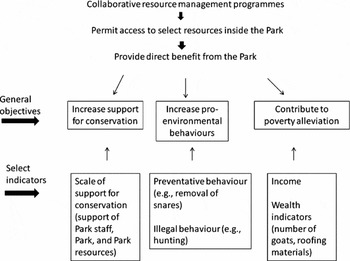
Through CRM, Uganda Wildlife Authority (UWA) embraces a ‘rights for responsibilities’ strategy that grants local people access to use certain natural resources inside PAs, participation in policy development and management, and responsibilities to monitor and regulate harvests (Chhetri et al. Reference Chhetri, Mugisha and White2003). UWA hopes this strategy will help alleviate poverty, increase support for conservation and reduce illegal uncontrolled use of Park resources (UWA 2000; Ogwal Reference Ogwal2003; Fig. 1).
Conceptual framework for this assessment of Uganda Wildlife Authority's collaborative resource management programme at Kibale National Park.

We focused on KNP because of its commitment to CRM. Information regarding CRM was provided to communities in sensitization programmes in 1997, and UWA implemented CRM in KNP in 1999. By 2003, KNP had established specific issue agreements covering various resource issues such as rattan cane, fishing, beekeeping and firewood, among others. We examined a CRM programme that permitted fishing in a lake inside KNP. PA managers and local community members established an agreement detailing shared responsibilities and benefits, monitoring and control mechanisms, as well as conditions for revocation or renewal of the fishing agreement (UWA 2000). UWA believed that CRM would be most successful in areas where resource use had been ongoing for long periods (UWA 2000); ideally such use would be critical to local livelihoods (Adams & Hulme Reference Adams, Hulme, Hulme and Murphree2001). CRM may be successful in communities where ongoing conflict exists between the community and PA staff regarding resource use restrictions, but UWA (2000) noted that CRM was not appropriate where severe conflicts existed (for example due to agricultural encroachment into the Park or boundary disputes), existing law enforcement approaches were successful and where species required high levels of protection.
Using survey research, we compared fishers participating in a CRM programme at Lake Kabaleka in KNP to another closely matched group of people (Margoluis et al. Reference Margoluis, Stem, Salafsky, Brown, Birnbaum and Mickwitz2009). Our primary objective was to test whether CRM fishers exhibited fewer signs of poverty, expressed more support for conservation, reported more pro-environmental behaviours and engaged in fewer illicit behaviours than the comparison group (see Fig. 1).
METHODS
Study site
KNP, a 795 km2 forest remnant in western Uganda, is listed as one of the highest conservation priority sites on the African continent, surrounded by some of the densest human populations in all of Africa (Cordeiro et al. Reference Cordeiro, Burgess, Dovie, Kaplin, Plumptre and Marrs2007; Naughton-Treves et al. Reference Naughton-Treves, Kammen and Chapman2007). Kibale harbours an exceptional primate diversity (Struhsaker Reference Struhsaker1981). People surrounding the Park practise subsistence agriculture and use forest products to augment their livelihoods (Chege et al. Reference Chege, Onyango, Drazu and Mwandha2002). In the 1970s and 1980s, when the PA was a forest reserve and game corridor, a large number of people (estimates range from 8800 to 170 000 (Chapman & Lambert Reference Chapman and Lambert2000) resided within its boundaries. In 1992, these people were evicted from the area and the national park was gazetted in 1993 (Chege et al. Reference Chege, Onyango, Drazu and Mwandha2002), thereby making it illegal for anyone to reside inside the Park. Illegal resource use is a major threat to the biodiversity (Mugisha & Jacobson Reference Mugisha and Jacobson2004; Solomon et al. Reference Solomon, Jacobson, Wald and Gavin2007). Crop-raiding and resource use restrictions have produced negative attitudes towards the Park among local residents (Naughton-Treves Reference Naughton-Treves1996; Mugisha Reference Mugisha2002; Hartter Reference Hartter2009).
Located in southern KNP, Lake Kabaleka is a shallow lake (usually < 2–3 m deep) measuring approximately 100 ha (Melnychuk & Chapman Reference Melnychuk and Chapman2002). Home to indigenous and introduced tilapiine cichlids, it is located within the Lake George swamp system, a wetland designated as a Ramsar site of international importance (Melnychuk & Chapman Reference Melnychuk and Chapman2002; Ramsar Convention Secretariat 2008).
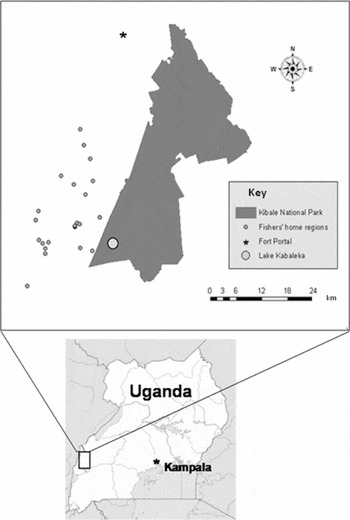
In 2000, the fishing specific issue agreement for the Kayanja landing site located on Lake Kabaleka (Fig. 2) was instituted; this covers all fishers, including boat owners and fishmongers who also participate in fishing. Prior to this agreement, fishing was considered illegal inside the Park. The agreement was instigated by UWA to curb illegal fishing, which was rampant on Lake Kabaleka (O. Biira, Community Conservation Warden, KNP, personal communication 2003). Throughout the study (June 2003–May 2004), the local chairman of the Kayanja landing site region served as the liaison between UWA and the fishers. UWA staff provided the local chairman and another fisher with forms to collect data on fish harvested and gear used. These forms were collected throughout the year by UWA staff. Staff supplied suggestions for net sizes to fishers, but there were no catch restrictions. Although there was still no written contract at the time of the study, fishers were issued identification cards by UWA following the programme's inception, indicating their involvement in CRM.
Residential communities of fishers participating in collaborative resource management, Kibale National Park.

The fishery was primarily composed of four species; mudfish (Clarias gariepinus), lungfish (Protopterus aethiopicus) and tilapia (Oreochromis niloticus and O. leucostictus). Fishers used nets or hooks. Fishers noted that while the lungfish and mudfish were primarily caught with hooks, tilapia was usually caught with nets. Kayanja Landing site was the only location where fishing was legal under the CRM programme. All other fishing within the Park remained illegal.
Data collection and sources
During June 2003–May 2004, we conducted standardized surveys with CRM participants and non-participants, open-ended interviews with five KNP staff members and a review of programme-related documents. We aimed to provide a comprehensive understanding of the CRM fishing programme.
Survey design and analysis
An 81-item structured survey, including a combination of open-ended and fixed response questions, was conducted with a census of fishers who fished solely on Lake Kabaleka. We acquired a list of all fishers involved in CRM (n = 95) from a local council leader for the area who was responsible for filling out fishing resource data sheets for UWA.
Because no baseline data were available, we selected a comparison group (n = 101; see Ferraro & Pattanayak Reference Ferraro and Pattanayak2006; Margoluis et al. Reference Margoluis, Stem, Salafsky, Brown, Birnbaum and Mickwitz2009), matching each fisher to an individual (all fishers were male) with the same region of residence, same age class and wealth ranking. We first identified every community of residence for each fisher, then we divided the study area into seven regions. Within each region the individuals from the comparison group were chosen from the community where the majority of the fishers resided. The local chairman of each selected community provided a list of all household heads in the community and their respective ages. Next, we asked the local chairman of each selected community to identify three to four community leaders. These community leaders assisted in modifying four wealth categories that had been previously used in development research in Uganda (International Institute for Sustainable Development 2003). These categories, in order from the poorest category to the wealthiest are: ‘cannot manage’, ‘earns slowly’, ‘have something’ and ‘can manage’ (International Institute for Sustainable Development 2003). Community leaders were then asked to sort local residents into the four categories according to the leaders’ perceptions of how the individuals ranked in terms of their wealth (Shields & Slocum Reference Shields, Slocum, Slocum, Wichhart, Rocheleau and Thomas-Slayter1995; Adams et al. Reference Adams, Evans, Mohammed and Farnsworth1997; Bernard Reference Bernard2002). Based on the wealth ranking results and the data on ages and community of residence, we created a list of potential matching individuals for each fisher. From this list we randomly selected an individual to be included in the comparison group. In this way we developed a comparison group for the fishers.
The survey was designed and pilot-tested in two communities surrounding KNP. The survey covered: support of conservation, benefits received from the Park, a household profile that included sociodemographic variables to be used as poverty indicators, behaviours, knowledge of environmentally-related law and involvement in the collaborative resource management programme. In order to increase the reliability of the survey, we used ‘translation/back-translation’ (Behling & Law Reference Behling and Law2000). First, the English version was translated into the local language. Second, the draft local language version was translated back into English by a second bilingual person who was unfamiliar with the original source language document. The back-translated version was then compared with the original. If considerable differences existed between the two versions, then adjustments were made to correct them and the entire process began anew.
A five-point Likert scale with anchor points of 1 = strongly agree and 5 = strongly disagree was used to measure support for conservation. The lower end of the scale indicated weak support of conservation and higher figures indicated a pro-conservation response. The wording of some questions related to support for conservation was reversed during the design phase of the survey to prevent response bias. All negatively-worded items were reverse scored for analysis purposes. Thirteen items were designed to measure support for conservation. Five of the scaled items were removed from the final conservation-related measure due to poor inter-item reliability. We used eight items in the scale to measure support for conservation (Table 2).
The survey was conducted in one of three languages: English (the national language of Uganda), Rutoro or Rukiga. Two men and one woman fluent in the vernacular languages of the area were trained to administer the survey. Respondents were asked what language they preferred and the survey was delivered in that language. Responses to the survey were written in English, but all interviews, except one, were conducted in one of the local languages.
Survey data were statistically analysed in SPSS 10.0. Most responses were not normally distributed, including the Likert and dichotomous response items. We considered p values ≤ 0.05 to be statistically significant. We described and compared the sociodemographic characteristics of the fishers and the comparison group using Pearson's χ2. We compared income data, support for conservation and behaviour items between fishers who were identified as part of the CRM programme and residents who were not part of the programme (comparison group). To control for potential confounding variables, we analysed all sociodemographic variables that differed significantly between the fishers and comparison group for associations. We then included all sociodemographic variables that differed significantly between the two groups and were found to have statistically significant associations with the response variables in models when examining if differences existed between the fishers and comparison group.
We analysed five-point Likert response items for differences between fishers and the comparison group using a proportional odds model (Agresti Reference Agresti2002). In cases where the assumption of parallel lines was not met (p < 0.05), we used multinominal logistic regression. We analysed dichotomous response variables that had covariates for differences between fishers and the comparison group using binary logistic regression. Differences between nominal data were analysed using Pearson's χ2 tests; results that had expected frequencies of < 5 were analysed using the Fisher's exact test.
RESULTS
Sociodemographic variables
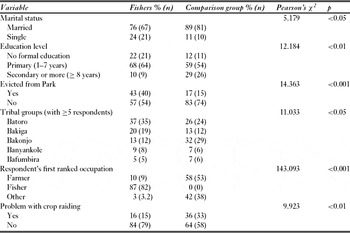
Six of 20 sociodemographic variables differed between fishers and the comparison group (Table 1; Appendix 1, see supplementary material at Journals.cambridge.org/enc). All respondents were male, with the average age of fishers being 31 years (SD = 12.5) and the comparison group being 34 years (SD = 11.2).
Sociodemographic variables that differed between fishers and comparison group.

Livelihood-related data
The median annual self-reported gross income for fishers was US$ 376.02 (SD = 403.48; UgSh 1835 = US$ 1, 2 June 2003 Bank of Uganda exchange rate) while the comparison group's median was US$ 196.19 (SD = 538.21). Fishers (m place = 10608) earned significantly more than the comparison group (m place = 78.32; U = 2953.50, p < 0.001). The only covariate for income was the Bakonjo tribe. Using a general linear model when income is stratified for Bakonjo, fishers that were Bakonjo (n = 12) earned on average US$ 399.38 more than Bakonjo people in the comparison group (n = 29) (Wald = 6.52 (1), p < 0.05). A significant negative association existed between Bakonjo and income (r pb = –0.204, p < 0.01, n = 184).
Fishers earned 70% (US$ 261.58, SD = 291.20) of their annual median income from fishing activities alone. Eighty-three per cent of fishers reported that they were financially better off compared to the time before they started their fishing activities. On average, fishers had been collecting the resource for 7.3 years. Of the 94 fishers included in the study, approximately half of them (43) engaged in fishing activities prior to the year 2000 when the CRM fishing programme was instituted. Of those 49 fishers who started fishing following or at the CRM programme's inception, 84% reported being financially better off than before they started fishing activities and 81% of those who were engaged in fishing activities prior to implementation of the CRM programme reported being financially better off than they were before they started fishing in KNP. Fishers reportedly experienced less crop raiding by wildlife (χ 2 = 9.92, p < 0.01). Comparison group members that reportedly experienced crop raiding did not differ significantly in income when compared with comparison group members that reportedly did not experience crop raiding (U = 811.5, not significant).
On average, fishers reported carrying out fishing activities at Lake Kabaleka for 4.7 days per week and three weeks per month. Time spent on a collecting trip (which includes travel time to and from the collection area) averaged approximately 6.7 hours. On average, fishers reported collecting nine fish per day (range 2– 35).
Other indicators of wealth
Local community leaders placed eight (9%) fishers in the lowest ‘cannot manage’ wealth category during the wealth ranking exercise. Forty-nine (58%) fishers were categorized as ‘earns slowly’. Twenty-five (29%) fishers were placed in the ‘have something’ category and three (4%) were in the highest ‘can manage’ wealth category.
Fishers had land holdings of 0–3.44 ha, while the comparison group's holdings were 0.12–3.28 ha. Although we found no difference between the two groups in terms of area holdings, 20% of the fishers did not know the areas they held. The fishers did not differ from the comparison group in other wealth-related assets such as wall materials, roof materials, painted houses, personal transportation, eligible children attending school, number of wives or number of goats.
Support for conservation scale
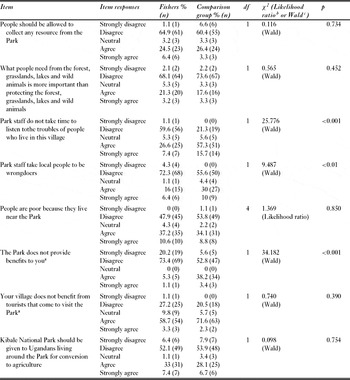
On a scale of 1–5, overall mean support for conservation was 3.16 (SD = 0.6322). Fishers’ scores (m place = 97.91) were significantly higher than those reported by the comparison group (m place = 770.02; U = 2906.5, p < 0.01). Fishers’ unadjusted mean support was 3.28 (SD = 0.6101) and that for the comparison group was 3.02 (SD = 0.6317). Our reliability analysis of the eight items revealed a Cronbach's alpha of 0.74 with an inter-item mean of 0.26. Analysis of covariance (ANCOVA) with the covariates income (r s = 0.153, p < 0.05, n = 173) and distance of region from Park border (r s = 0.167, p < 0.05, n = 168) revealed a violation of the assumption of homogeneity of regression slopes, in particular a significant interaction with income. The Johnson-Neyman technique showed in regression slopes a significant difference between the two groups when annual income was less than US$ 602, but not when income exceeded US$ 602. Thirty-four per cent of fishers and 25% of the comparison group reported incomes greater than US$ 602. Three support for conservation items differed between the fishers and comparison group; fishers responded more positively towards Park staff and had greater belief that the Park provided benefits than the comparison group (Table 2).
Comparison of individual support for conservation items between fishers and comparison group. aQuestion has been reverse worded for analysis. bMultinominal regression analysis was used. cA proportional odds model was used.

Pro-environmental behaviours
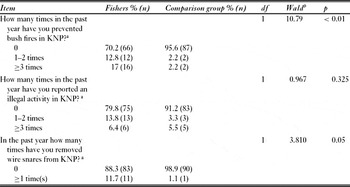
Three survey questions related to deterring illegal activity in the Park were noted by UWA as indicators of the successfulness of the CRM programme: preventing illegal activity, in particular extinguishing bush fires and removing wire snares that are used for hunting (Table 3). Fishers and the comparison group differed in their behaviours regarding extinguishing bush fires (Wald = 10.79 (1), p < 0.01) and removal of wire snares (Wald = 3.810 (1), p = 0.05); in both cases, fishers reported more pro-environmental actions than the comparison group (Table 3). The two groups did not differ in their responses concerning the number of times they reported illegal acts in KNP in the past year (Wald = 0.967 (1), p = 0.325).
Comparison of pro-environmental behaviours for fishers and comparison group. aScale was collapsed to allow for statistical analysis. bWald score indicates a proportional odds model was used (for dependent variables with multiple categories) or logistic regression (for dependent variables with dichotomous response) was carried out in order to control for significant covariates.

Illicit behaviours
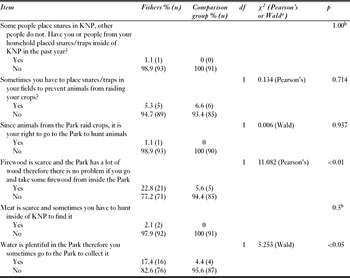
The fishers and comparison group did not differ in responses to the question, ‘Some people place snares in Kibale National Park, other people do not. Have you or people from your household placed snares/traps inside of Kibale National Park in the past year?’ Only one respondent, a fisher, answered in the affirmative in response to the question and 6% of all respondents admitted to placing snares/traps in crop fields. Five other statements referred to hunting in crop fields outside of the Park, collection of firewood, collection of water and hunting within the Park. Fishers did not differ from the comparison group in responses to any of the hunting-related questions and very few respondents responded affirmatively to these items (Table 4). Significantly more fishers responded ‘yes’ to the statement, ‘Firewood is scarce and the Park has a lot of wood, therefore there is no problem if you go and take some firewood from inside of the Park’ (χ 2(1) = 11.082, p < 0.01), with approximately 23% of fishers replying ‘yes’ in comparison to 6% of the comparison group (Table 4). After controlling for marriage, the responses of fishers were significantly different from the comparison group in response to the statement, ‘Water is plentiful in the Park, therefore you sometimes go to the Park to collect it’ (Wald = 5.253 (1), p < 0.05).
Comparison of illegal behaviours and opinions of behaviours for fishers and comparison group. aLogistic regression was used to control for significant covariates. bA Fisher's exact test was used.

Other
In 2003, 95 individuals were identified as CRM fishers by the community leader in charge of completing resource data sheets. All fishers interviewed were fishing from the KNP Kayanja landing site and believed they were part of the CRM programme. A UWA report issued in 2003 noted that only 30 fishers were provided with resource identification cards, and 15 boats were registered with the Fisheries Department (Ogwal Reference Ogwal2003).
DISCUSSION
The UWA's CRM programme at Lake Kabaleka in KNP had both negative and positive impacts. Fishers participating in the programme reported higher incomes and were more supportive of conservation than the comparison group. Although some fishers were actively protecting the Park from illegal activities, some might also extract resources without permission. Additionally, the implementation of CRM led to greater pressure on the fish stock, as half the fishers involved started fishing at Lake Kabaleka shortly after the commencement of the CRM programme.
Impact of CRM on poverty
Fishers had almost double the gross income relative to the comparison group, and the majority reported being better off as compared to before the commencement of the fishing CRM programme. In addition, the poorest of the poor (namely the members of the Bakonjo tribe) benefited significantly in terms of income earned from being involved in the fishing programme. In contrast, most integrated conservation and development programmes have shown little positive impact on local peoples’ incomes (Wells et al. Reference Wells, McShane, Dublin, O'Connor, Redford, McShane and Wells2004), and the beneficiaries are not necessarily those with the greatest need (Kellert et al. Reference Kellert, Mehta, Ebbin and Lichtenfeld2000).
Support for conservation
Many studies have concluded that providing benefits to local people results in support for conservation, and that individual benefits tend to have a greater impact on attitudes than community-level benefits (Lewis et al. Reference Lewis, Kaweche and Mwenya1990; Newmark et al. Reference Newmark, Leonard, Sariko and Gamassa1993; Hamilton et al. Reference Hamilton, Cunningham, Byarugaba and Kayanja2000; Mehta & Heinen Reference Mehta and Heinen2001; Bauer Reference Bauer2003; Arjunan et al. Reference Arjunan, Holmes, Puyravaud and Davidar2006; Lepp & Holland Reference Lepp and Holland2006). Our results confirm these trends, as the CRM fishing programme provided a personal benefit (income via fishing) to individuals involved, and the majority of fishers were more supportive of conservation than the majority of the comparison group. However, unlike previous studies that found links between crop-raiding and negative conservation attitudes (Infield & Namara Reference Infield and Namara2001; Treves et al. Reference Treves, Wallace, Naughton-Treves and Morales2006), in our study crop raiding was not a significant variable predicting support for conservation.
In general, studies have found ‘high public support for conservation in principle, but a pronounced lack of support for the external institutions responsible for the implementation of conservation strategies’ (Gillingham & Lee Reference Gillingham and Lee1999, p. 218). Local people often hold negative attitudes about PA staff, sometimes due to costs such as evictions from the PA and resource use constraints (Newmark et al. Reference Newmark, Leonard, Sariko and Gamassa1993). Poor relations with park staff can contribute to negative attitudes toward a PA (Fiallo & Jacobson Reference Fiallo and Jacobson1995). Therefore, it is not surprising that the fishers we surveyed reported better relationships with Park staff, given that these fishers are permitted inside the Park, have frequent interaction with Park staff and benefit from the resource.
The results of our survey of conservation attitudes also indicate that the relationship between attitudes and benefits may not be strictly linear. For example, a minority of fishers who earned > US$ 602 annually did not differ from the comparison group in terms of their support for conservation. These results indicate that there may be a critical threshold effect, and earning relatively larger incomes does not necessarily ensure increased support for conservation.
Impact of CRM on pro-environmental behaviours
Ugandan parks have limited staff available to manage illegal activities, and UWA documents indicated one of the CRM objectives was to reduce management costs by encouraging CRM participants to protect the Park. Some fishers engaged in pro-environmental behaviour and actively protected the Park by preventing at least one bushfire and/or removing snares in the year prior to the survey. Although a statistically significant difference existed between fishers and the comparison group when it came to extinguishing bushfires or removing snares inside the Park, this may be because many respondents in the comparison group were less likely to visit the Park on a regular basis, as they had little legal reason to be there. However, although fishers may have engaged in pro-environmental behaviours, fishers and the comparison group did not differ in reporting illegal activities. This result is unsurprising, as the cost of carrying out a behaviour influences the frequency of the behaviour (Milner-Gulland & Leader-Willams Reference Milner-Gulland and Leader-Williams1992; Marcus Reference Marcus2006). Reporting illegal acts may be more time consuming than preventing bushfires or removing snares, as fishers have to locate Park staff at various outposts around the Park to report illegal activities, and distances between villages and Park staff outposts can be substantial.
Impact of CRM on illicit behaviours
The number of responses for less sensitive questions regarding collection of firewood and water were significantly different between the fishers and comparison group, with more fishers replying ‘yes’ to those items. Some fishers may not believe such activities to be illegal, possibly because they have not been sanctioned for them or because of bribery involving UWA guards (Infield & Namara Reference Infield and Namara2001; Struhsaker et al. Reference Struhsaker, Struhsaker and Siex2005). Similarly, the literature provides evidence that not all projects which boost income promote conservation-friendly behaviours. Some studies have found that increased living standards encourage resource use (McShane & Newby Reference McShane, Newby, McShane and Wells2004 and references therein). A community conservation programme around Lake Mburo National Park (Uganda) generated community-level and individual benefits but did not alter illegal hunting (Infield & Namara Reference Infield and Namara2001).
Limitations of study
The absence of baseline data was a limitation of this study. This prevented analysis of individual improvement of support for conservation, pro-environmental behaviours or poverty levels of CRM participants. Ideally, an experimental design in which respondents would have been randomly assigned to treatment and control groups would be employed, but, as reviewed by Margoluis et al. (Reference Margoluis, Stem, Salafsky, Brown, Birnbaum and Mickwitz2009), the quasi-experimental design we used employing matched comparison groups should provide a robust evaluation design. However, participants in the CRM programme may already have differed markedly from their peers in variables other than those studied, as they chose to take part in the programme. The comparison group used was carefully selected to be the best available comparative group for the fishers. Ideally fishers would have been matched to other fishers not involved in CRM, but this was not possible as there were no other residents who primarily fished in these communities.
This study only included men and therefore little can be said about conservation attitudes and behaviours of women. Homogeneity cannot be assumed within a village, as gender and life circumstances play a role in support for conservation and resource-related behaviour (Hill Reference Hill1998; Coomes et al. Reference Coomes, Barham and Takasaki2004).
Implications of collaborative resource management findings for conservation
CRM is a viable tool to promote support for conservation and raise incomes, yet CRM can also increase pressure on protected resources. This result reinforces the need to examine unintended consequences of conservation-related programming both prior to implementation as well as throughout the project's lifespan. Viewing CRM programmes as experiments in progress rather than established programmes is a necessity (Robinson & Redford Reference Robinson, Redford, McShane and Wells2004), and for this reason an adaptive management approach (Walters & Holling Reference Walters and Holling1990) is critical.
Although previous studies noted that integrated conservation and development projects may encourage in-migration to the project location (McShane & Newby Reference McShane, Newby, McShane and Wells2004), little research has focused on changing livelihood strategies or the impact those changes have on individuals, communities and resources. In this study, > 50% of fishers were new to fishing and fishing had become their major source of income. For these people, the programme did not merely supplement income, but rather completely redefined their livelihoods. This impact has inherent problems, both for the people involved in the programme who may become dependent on a single income activity, as well as the resource base. Exogenous and stochastic events can influence the needs of people as well as resource availability, and income diversification is an essential component of both conservation and development programming.
Monitoring attitudes, behaviours and the health of the resource base are critical elements of resource sustainability. Accurate record keeping is necessary for successful management. Discrepancies in record keeping can prevent effective monitoring and oversight of CRM programmes. Improvements in institutional capacity for monitoring are needed. Although the CRM programme theoretically provides fishers a vested interest in conservation of their major source of income, biological monitoring of the resource base is essential for the long-term viability of the programme. Therefore, although CRM may potentially contribute to local conservation and development efforts, systematic programme assessments will be essential to ensure long-term conservation and livelihood success.
ACKNOWLEDGEMENTS
We are grateful to Colin Chapman for research advice, the National Security Education Program's Boren program and the Fulbright Program for Africa for research funding, Birungi Sixtus, Kakooza Micheal, Karungi Edith and Mukwenda John for field assistance, and communities around Kibale National Park for their hospitality. We thank Alisa Coffin for assistance with mapping GIS data. We thank Michael Gavin and three anonymous reviewers for insightful comments.