



1 Introduction
In [Reference Fuchs6], I began in the study of blurry ordinal definability, and the present article is the continuation of that study. The basic idea is, given a cardinal
 $\kappa \ge 2$
, to weaken the notion of ordinal definability of a set a, which can be formulated by saying that a is the unique set x satisfying
 $\varphi (x,\alpha )$
, for some formula
 $\varphi $
and ordinal
 $\alpha $
, to the notion of
 ${<}\kappa $
-blurry ordinal definability, which says that a is one of fewer than
 $\kappa $
many sets x which satisfy
 $\varphi (x,\alpha )$
. The seeming metamathematical complications in formalizing this notion can be overcome in much the same way as with traditional ordinal definability, as is spelled out in detail in Section 2. Precursors to this idea are Hamkins and Leahy [Reference Hamkins and Leahy12], where the case
 $\kappa =\omega $
is considered, and Tzouvaras [Reference Tzouvaras24], where it is argued that the case
 $\kappa =\omega _1$
is the one to be focused on, whereas I consider the full spectrum of possible values for
 $\kappa $
.
As was observed by Tzouvaras, for every cardinal
 $\kappa $
, the class
 ${<}\kappa \text {-}\mathsf {OD} $
of all
 ${<}\kappa $
-blurrily ordinal definable sets is uniformly definable (using
 $\kappa $
as parameter), and defining
 ${<}\kappa \text {-}\mathsf {HOD} $
to consist of all sets x such that
 $\mathop {\mathsf {TC}}(\{x\})\subseteq {<}\kappa \text {-}\mathsf {OD} $
gives rise to an inner model. Clearly, increasing
 $\kappa $
weakens the notion of
 ${<}\kappa $
-blurry ordinal definability, so we are dealing with a weakly increasing hierarchy of inner models, leading from
 $\mathsf {HOD} ={<}2\text {-}\mathsf {HOD} $
to
 $\mathrm {V} ={<}\infty \text {-}\mathsf {HOD} =\bigcup _{2\le \kappa \in \mathrm {Card}}{<}\kappa \text {-}\mathsf {HOD} $
, assuming the axiom of choice. The main objective of this project is to understand how this hierarchy grows. Since the concepts involved are highly non-absolute, there are two kinds of results to be expected:
 $\mathsf {ZFC} $
-provable, general results about the hierarchy on the one hand, and relative consistency results on the possible behavior of the hierarchy on the other.
The main results of the first kind are to be found in Section 3, and they concern the question how close
 ${<}\kappa \text {-}\mathsf {HOD} $
is to
 ${<}\lambda \text {-}\mathsf {HOD} $
, for different cardinals
 $\kappa $
and
 $\lambda $
. Generalizing results from [Reference Fuchs6], I show that if
 $\kappa <\lambda $
, then
 ${<}\kappa \text {-}\mathsf {HOD} $
satisfies the (external)
 $\lambda $
-approximation and -cover properties in
 ${<}\lambda \text {-}\mathsf {HOD} $
, Theorem 3.3. This has a very useful consequence, Corollary 3.7, which says that if
 ${<}\kappa \text {-}\mathsf {HOD} \subsetneq {<}\lambda \text {-}\mathsf {HOD} $
, then there are sets a and b such that
 $a\in {<}\lambda \text {-}\mathsf {HOD} \setminus {<}\kappa \text {-}\mathsf {HOD} $
,
 $a\subseteq b\in {<}\kappa \text {-}\mathsf {HOD} $
, and
 $\mathsf {card}(b)<\lambda $
. This fact proves useful both in understanding the growth of the blurry
 $\mathsf {HOD} $
hierarchy in forcing extensions and in obtaining the lower consistency strength bounds mentioned below.
Most results of the second kind concern the notion of a leap, a central concept in the analysis of the blurry
 $\mathsf {HOD} $
hierarchy introduced in [Reference Fuchs6]. A leap is a cardinal
 $\kappa>2$
such that
 ${<}\kappa \text {-}\mathsf {HOD} \neq {<}{\bar {\kappa }}\text {-}\mathsf {HOD} $
for every cardinal
 $2\le {\bar {\kappa }}<\kappa $
. The main result of the article is that the following three statements are equiconsistent (over
 $\mathsf {ZFC} $
):
-
(1) The least leap is the cardinal successor of a strong limit cardinal of countable cofinality.
-
(2)
 $\aleph _\omega $
is a strong limit cardinal and
$\aleph _{\omega +1}$
is the least leap.
-
(3) There is an inner model with a measurable cardinal.


This follows by taking together Theorems 5.1 and 9.16.
I will conclude this introduction by giving a section by section overview of the contents of this work.
In Section 2, I give the formal definition of the blurry
 $\mathsf {HOD} $
hierarchy, along with a definable prewellordering that has not explicitly been introduced in [Reference Fuchs6], so even readers familiar with that paper are encouraged to skim this part. I also sum up the basic facts on leaps.
Section 3 proves the results on the (external) approximation and cover properties mentioned above, and contains some connections to the question of existence of fresh sequences. There is also an excursion contrasting this with the effects of Bukovsky’s approximation property on fresh sets.
In Section 4, I give an overview over Příkrý forcing, Příkrý sequences and their interactions with inner models and covering. These results will be used in the subsequent sections.
Section 5 uses these results to establish the lower bound of an inner model with a measurable cardinal to (a weakening of) the least leap being the successor of a singular strong limit cardinal, and it explores what can be said when the cofinality of the cardinal in question is uncountable.
Section 6 summarizes the forcing tools that will be used in the subsequent sections.
Section 7 shows that the statement that the least leap is the successor of a singular cardinal has no consistency strength; methods for producing models in which the singular cardinal in question has countable or uncountable cofinality are developed here. Thus, the assumption that the singular cardinal is a strong limit is essential in the main equiconsistency result.
Section 8 produces a model where
 $\aleph _\omega $
is a strong limit cardinal which is also a limit of leaps, and where
 $\aleph _{\omega +1}$
is a leap. The basic idea is to add a Příkrý sequence over
 $L[U]$
and to collapse between the Příkrý points with even indices.
In Section 9, this idea is taken further, forcing over
 $L[U]$
to produce a model where
 $\aleph _\omega $
is a strong limit cardinal and
 $\aleph _{\omega +1}$
is the least leap. The key idea is to modify Magidor’s version of Příkrý forcing with integrated collapses so as to collapse between the Příkrý points with even index, und subsequently coding the collapsing functions in order to make them ordinal definable. This result provides the desired equiconsistency.
Section 10 sketches how to achieve the situation where the least leap is the successor cardinal of
 $\aleph _\lambda $
, for other values of
 $\lambda $
.
The article concludes with Section 11, containing some open questions, and in concluding the introduction, I would like to thank the referee for very useful feedback.
2 Basics
Definition 2.1. Let
 ${\langle \varphi _n\;|\;} {n<\omega \rangle }$
be a recursive enumeration of all internal first order formulas in the language of set theory with two free variables. Let
 $\mathsf {Sat}(x,y,z)$
be the satisfaction relation, so that for a set u, a natural number n, and a pair
 $ {\langle a,b \rangle } \in u^2$
,
 $\mathsf {Sat}(u,n, {\langle a,b \rangle } )$
holds iff
 $ {\langle u,{\in }\cap u^2 \rangle } \models \varphi _n(a,b)$
.
Let a be a set. A blurry ordinal definition of a is an
 $\mathsf {OD} $
set A with
 $a\in A$
. Given a cardinal
 $\lambda $
, a
 ${<}\lambda $
-blurry ordinal definition of a is a blurry ordinal definition of a of cardinality less than
 $\lambda $
. Let
 $\Sigma (a)$
be the least cardinal
 $\kappa $
such that a has
 ${<}\kappa ^+$
-blurry ordinal definition (if such a cardinal exists—assuming
 $\mathsf {AC} $
, it always does).
Let
 $D(a)$
be the least ordinal of the form
 ${\prec }\alpha ,n,\beta {\succ }$
such that the set
 $$\begin{align*}\{x\in\mathrm{V}:\alpha\;|\;\mathsf{Sat}(\mathrm{V}:\alpha,\varphi_n, {\langle x,\beta \rangle} )\}\end{align*}$$
is a
 ${<}\Sigma (a)^+$
-blurry ordinal definition of a (if such a triple exists).
For a cardinal
 $\lambda>1$
, define
 ${<}\lambda \text {-}\mathsf {OD} $
to be the class of sets that have a
 ${<}\lambda $
-blurry ordinal definition, and define that
 $a\in {<}\lambda \text {-}\mathsf {HOD} $
iff
 $\mathop {\mathsf {TC}}(\{a\})\subseteq {<}\lambda \text {-}\mathsf {OD} $
.
Observation 2.2. We have the following facts about
 $\Sigma $
and D.
-
(1) The functions
$\Sigma $
and D are definable without parameters. Assuming
$\mathsf {ZFC} $
, both are total. -
(2) Let a be a set for which
$\Sigma (a)$
is defined. Let
$D(a)=\rho $
. Then
$D^{-1}(\rho )=\{x\;|\; D(x)=\rho \}$
is a blurry ordinal definition of a, and
$\mathsf {card}(D^{-1}(\rho ))=\Sigma (a)$
.


Proof. (1) is obvious.
(2): Since
 $\Sigma (a)$
is defined, so is
 $\rho =D(a)$
. The ordinal
 $\rho $
is of the form
 ${\prec }\alpha ,n,\beta {\succ }$
, and the set
 $A=\{x\;|\;\mathrm {V} _\alpha \models \varphi _n(x,\beta )\}$
is a blurry ordinal definition of a of cardinality
 $\Sigma (a)$
. Now suppose that
 $b\in D^{-1}(\rho )$
as well. Then A is also a blurry ordinal definition of b. Thus,
 $D^{-1}(\rho )\subseteq A$
. Hence,
 $\mathsf {card}(D^{-1}(\rho ))\le \mathsf {card}(A)=\Sigma (a)$
. By minimality of
 $\Sigma (a)$
, we have that
 $\Sigma (a)\le \mathsf {card}(D^{-1}(\rho ))$
.
So we can let R be the prewellordering associated with the norm D, that is, R is the set-like, well-founded relation on
 $ \mathrm {dom} (D)\times \mathrm {dom} (D)$
defined by setting
 $xRy$
iff
 $D(x)<D(y)$
. For every cardinal
 $\lambda \ge 2$
, the restriction of R to
 ${<}\lambda \text {-}\mathsf {HOD} $
is then a prewellordering of
 ${<}\lambda \text {-}\mathsf {HOD} $
such that for every
 $x\in {<}\lambda \text {-}\mathsf {HOD} $
, the set of y that are incomparable to x is precisely
 $D^{-1}(D(x))\cap {<}\lambda \text {-}\mathsf {HOD} $
, a set of cardinality less than
 $\lambda $
(more precisely, of cardinality
 $\Sigma (x)$
).
The following “metatheorem” is sometimes useful. It shows that we may allow parameters from
 ${<}\kappa \text {-}\mathsf {OD} $
in
 ${<}\kappa $
-blurry ordinal definitions.
Theorem 2.3. Let
 $\kappa \ge \omega $
be a cardinal, and suppose that A is a set of cardinality less than
 $\kappa $
definable using ordinals and parameters which are
 ${<}\kappa \text {-}\mathsf {OD} $
. Then every
 $a\in A$
is
 ${<}\kappa \text {-}\mathsf {OD} $
.
Proof. Let
 $A=\{x\;|\;\varphi (x,{\vec {\alpha }},\vec {b})\}$
, where
 $\mathsf {card}(A)={\bar {\kappa }}<\kappa $
,
 $\vec {b}=b_0,\ldots ,b_{n-1}$
are
 ${<}\kappa \text {-}\mathsf {OD} $
and
 ${\vec {\alpha }}=\alpha _0,\ldots ,\alpha _{m-1}$
are ordinals. For
 $i<n$
, let
 $B_i$
be a
 ${<}\kappa $
-blurry ordinal definition of
 $b_i$
. Let
 $$\begin{align*}B=\{ {\langle c_0,\ldots,c_{n-1} \rangle} \in B_0\times\cdots\times B_{n-1}\;|\;\mathsf{card}(\{x\;|\;\varphi(x,{\vec{\alpha}},\vec{c})\})={\bar{\kappa}}\}.\end{align*}$$
Then
 $ {\langle b_0,\ldots ,b_{n-1} \rangle } \in B$
. Let
 $$\begin{align*}C=\bigcup_{\vec{c}\in B}\{x\;|\;\varphi(x,{\vec{\alpha}},\vec{c})\}.\end{align*}$$
Then C is
 $\mathsf {OD} $
,
 $A\subseteq C$
, and
 $\mathsf {card}(C)\le \omega \cdot {\bar {\kappa }}\cdot \mathsf {card}(B)<\kappa $
, so that C is a
 ${<}\kappa $
-blurry ordinal definition of any element of A.
I will need some basic fact on blurry
 $\mathsf {HOD} $
which were established in [Reference Fuchs6].
Definition 2.4 [Reference Fuchs6, Definitions 6 and 7].
A cardinal
 $\lambda>2$
is a leap if
 $$\begin{align*}{<}\delta\text{-}\mathsf{HOD}\subsetneqq{<}\lambda\text{-}\mathsf{HOD},\end{align*}$$
for every cardinal
 $\delta <\lambda $
. I write
 ${\langle \Lambda _\alpha \;|\;} {\alpha <\Theta \rangle }$
for the monotone enumeration of the leaps (it is the empty sequence, i.e.,
 $\Lambda _0$
is undefined, if there is no leap). A leap
 $\lambda $
is a successor leap if
 $\lambda =\Lambda _{\xi +1}$
, for some
 $\xi $
, and it is a limit leap if it is of the form
 $\lambda =\Lambda _\xi $
, where
 $\xi $
is a limit ordinal. A leap
 $\gamma $
is a big leap if
 $$\begin{align*}\left(\bigcup_{\delta<\gamma,\delta\in\mathrm{Card}}{<}\delta\text{-}\mathsf{HOD}\right)\subsetneqq{<}\gamma\text{-}\mathsf{HOD}.\end{align*}$$
The following facts were shown in [Reference Fuchs6, Lemma 2 and Theorems 9 and 10].
Fact 2.5. Leaps have the following properties.
-
(1) The class of leaps is closed in the ordinals.
-
(2)
$\Lambda _0$
, if defined, is an uncountable successor cardinal. -
(3) Successor leaps are successor cardinals.
-
(4) Every leap is big.
-
(5) If
$\lambda $
is a limit leap, then
${<}\lambda \text {-}\mathsf {HOD} $
does not satisfy the axiom of choice.


3 The closeness between
${<}\kappa \text {-}\mathsf {HOD} $
and
${<}\lambda \text {-}\mathsf {HOD} $


In the analysis of the consistency strength of certain leap constellations, it is crucial to understand how close
 ${<}\kappa \text {-}\mathsf {HOD} $
and
 ${<}\lambda \text {-}\mathsf {HOD} $
are to each other, for cardinals
 $\kappa <\lambda $
. In [Reference Fuchs6], the closeness between
 $\mathsf {HOD} $
and
 ${<}\lambda \text {-}\mathsf {HOD} $
was already investigated. Let me look at the more general picture now.
3.1 Approximation and cover properties
The following are properties expressing the closeness between two models, introduced by Hamkins [Reference Hamkins11], along with “external” versions thereof, designed to apply in the context where the inner models in question don’t necessarily satisfy the axiom of choice, but are situated within an ambient model of
 $\mathsf {ZFC} $
.
Definition 3.1. Let
 $M\subseteq N$
be transitive classes, and let
 $\kappa $
be a cardinal in N.
M satisfies the
 $\kappa $
-cover property in N if for every set
 $a\in N$
with
 $a\subseteq M$
and
 $\mathsf {card}(a)^N<\kappa $
, there is a set
 $c\in M$
such that
 $a\subseteq c$
and
 $\mathsf {card}(c)^M<\kappa $
. M satisfies the external
 $\kappa $
-cover property in N if for every
 $a\in N$
with
 $a\subseteq M$
and
 $\mathsf {card}(a)^{\mathrm {V}} <\kappa $
, there is a
 $c\in M$
with
 $a\subseteq c$
and
 $\mathsf {card}(c)^{\mathrm {V}} <\kappa $
.
Let
 $a\in N$
be a set with
 $a\subseteq M$
. A set of the form
 $a\cap c$
, where
 $c\in M$
and
 $\mathsf {card}(c)^M<\kappa $
, is called a
 $\kappa $
-approximation to a in M. If the set is of the form
 $a\cap $
c, where
 $c\in M$
and
 $\mathsf {card}(c)^{\mathrm {V}} <\kappa $
, then it is called an external
 $\kappa $
-approximation to a in M. The set a is said to be (externally)
 $\kappa $
-approximated in M if every (external)
 $\kappa $
-approximation to a in M belongs to M. M satisfies the (external)
 $\kappa $
-approximation property in N if whenever
 $a\in N$
with
 $a\subseteq M$
is (externally)
 $\kappa $
-approximated in M, then
 $a\in M$
.
The external versions of the approximation and cover properties generalize their original versions.
Observation 3.2. Assume that
 $M,N$
are transitive models of
 $\mathsf {ZFC} $
, and let
 $\kappa $
be a cardinal. Then M satisfies the
 $\kappa $
-approximation property in N iff M satisfies the external
 $\kappa $
-approximation property in N.
Similarly for the external
 $\kappa $
-cover property.
Proof. The point is that if
 $b\in M$
, then
 $\mathsf {card}(b)^M<\kappa $
iff
 $\mathsf {card}(b)^{\mathrm {V}} <\kappa $
, and similarly for N, since
 $\kappa $
is a cardinal. In detail, since M satisfies the axiom of choice,
 $\mathsf {card}(b)^M$
exists, and hence
 $\mathsf {card}(b)^{\mathrm {V}} $
exists. Clearly,
 $\mathsf {card}(b)^V\le \mathsf {card}(b)^M$
. Suppose we had that
 ${\bar {\kappa }}=\mathsf {card}(b)^V<\kappa $
while
 $\mathsf {card}(b)^M\ge \kappa $
. Let
 $f\in M$
be a surjection from b onto
 $\kappa $
, and let
 $g:b\longrightarrow {\bar {\kappa }}$
be a bijection. Then
 $f\circ g^{-1}:{\bar {\kappa }}\longrightarrow \kappa $
is a surjection, so
 $\kappa $
is not a cardinal, a contradiction.
In the context in which I want to apply these properties, the ambient universe satisfies
 $\mathsf {ZFC} $
, but the two models, being of the form
 ${<}\kappa \text {-}\mathsf {HOD} $
and
 ${<}\lambda \text {-}\mathsf {HOD} $
, are merely models of
 $\mathsf {ZF} $
.
Theorem 3.3 (
$\mathsf {ZFC} $
).

Let
 $2\le \kappa \le \lambda $
be infinite cardinals. Then
 ${<}\kappa \text {-}\mathsf {HOD} $
satisfies the external
 $\lambda $
-cover property and the external
 $\lambda $
-approximation property in
 ${<}\lambda \text {-}\mathsf {HOD} $
.
Proof. The case
 $\kappa =2$
was shown in [Reference Fuchs6, Theorem 3], and it was pointed out there that this case implies directly that
 ${<}\omega \text {-}\mathsf {HOD} =\mathsf {HOD} $
, which was first shown in [Reference Hamkins and Leahy12]. Because of this, we may assume that
 $\omega \le \kappa <\lambda $
.
To verify the external
 $\lambda $
-cover property, let
 $a\in {<}\lambda \text {-}\mathsf {HOD} $
be such that
 $a\subseteq {<}\kappa \text {-}\mathsf {HOD} $
and
 $\gamma =\mathsf {card}(a)^{\mathrm {V}} <\lambda $
. Let A be a
 ${<}\lambda $
-blurry ordinal definition of a. Since
 $a\subseteq {<}\kappa \text {-}\mathsf {HOD} $
and
 $\mathsf {card}(a)=\gamma $
, we may assume that for all
 $b\in A$
,
 $b\subseteq {<}\kappa \text {-}\mathsf {HOD} $
and
 $\mathsf {card}(b)=\gamma $
, since these requirements may be added to the definition of A if necessary. Set
 $c=\bigcup A$
. By the axiom of choice in
 $\mathrm {V} $
,
 $\mathsf {card}(c)^{\mathrm {V}} \le \gamma \cdot \mathsf {card}(A)<\lambda $
, c is
 $\mathsf {OD} $
, and
 $c\subseteq {<}\kappa \text {-}\mathsf {HOD} $
. Thus,
 $c\in {<}\kappa \text {-}\mathsf {HOD} $
, and clearly,
 $a\subseteq c$
.
Turning to the external
 $\lambda $
-approximation property, let
 $a\in {<}\lambda \text {-}\mathsf {HOD} $
,
 $a\subseteq {<}\kappa \text {-}\mathsf {HOD} $
be externally
 $\lambda $
-approximated in
 ${<}\kappa \text {-}\mathsf {HOD} $
. Let A be a
 ${<}\lambda $
-blurry ordinal definition of a. As before, we may assume that every
 $b\in A$
is a subset of
 ${<}\kappa \text {-}\mathsf {HOD} $
that’s externally
 $\lambda $
-approximated in
 ${<}\kappa \text {-}\mathsf {HOD} $
.
I will now use the functions D and
 $\Sigma $
of Definition 2.1, definable without parameters. Given distinct sets
 $b_0,b_1\in A$
, it follows that
 $b_0\triangle b_1\subseteq {<}\kappa \text {-}\mathsf {HOD} $
, so for every
 $x\in b_0\triangle b_1$
,
 $\Sigma (x)<\kappa $
. So, letting
 $$\begin{align*}\mu_{b_0,b_1}=\min D[b_0\triangle b_1],\end{align*}$$
it follows that
 $D^{-1}(\mu _{b_0,b_1})$
is a subset of
 ${<}\kappa \text {-}\mathsf {OD} $
of cardinality less than
 $\kappa $
; see Observation 2.2. Let
 $$\begin{align*}\Delta={<}\kappa\text{-}\mathsf{HOD}\cap\bigcup\{D^{-1}(\mu_{b_0,b_1})\;|\;\{b_0,b_1\}\in[A]^2\}.\end{align*}$$
Then
 $\Delta $
has cardinality less than
 $\lambda $
. Moreover,
 $\Delta $
is
 $\mathsf {OD} $
, as the function D is definable without parameters, A is
 $\mathsf {OD} $
, and so is the function mapping
 $b_0,b_1\in A$
to
 $\mu _{b_0,b_1}$
. Moreover,
 $\Delta \subseteq {<}\kappa \text {-}\mathsf {HOD} $
, so
 $\Delta \in {<}\kappa \text {-}\mathsf {HOD} $
.
Letting
 $a_0=a\cap \Delta $
, we have that
 $a_0\in {<}\kappa \text {-}\mathsf {HOD} $
, since a is
 $\lambda $
-approximated in
 ${<}\kappa \text {-}\mathsf {HOD} $
and
 $\Delta \in {<}\kappa \text {-}\mathsf {HOD} $
has size less than
 $\lambda $
. But note that if
 $b_0,b_1\in A$
are distinct, then
 $b_0\cap \Delta \neq b_1\cap \Delta $
. In other words, a is the unique
 $c\in A$
such that
 $c\cap \Delta =a_0$
. Thus, a is ordinal definable from the parameters c and
 $a_0$
, which are
 ${<}\kappa \text {-}\mathsf {OD} $
, so by Theorem 2.3, a is
 ${<}\kappa \text {-}\mathsf {OD} $
. Since a is contained in
 ${<}\kappa \text {-}\mathsf {HOD} $
, it follows that
 $a\in {<}\kappa \text {-}\mathsf {HOD} $
, as wished.
Definition 3.4 (Hamkins).
Let
 $M\subseteq N$
be inner models, and let
 $\theta $
be an ordinal. A sequence
 $a:\theta \longrightarrow M$
is a fresh sequence in N over M if
 $a\in N$
,
 $a\notin M$
, but for all
 $\xi <\theta $
,
 $a{\restriction }\xi \in M$
.
Lemma 3.5 (
$\mathsf {ZFC} $
).

Let
 $\lambda $
be an infinite cardinal, and suppose
 $M\subseteq N$
are inner models with
 $M\subsetneqq N$
.
-
(1) Suppose that M satisfies the external
$\lambda $
-approximation property in N. If N has a fresh sequence over M of length
$\theta $
, then
$ \mathrm {cf} (\theta )<\lambda $
. -
(2) Suppose that M satisfies the external
$\lambda $
-approximation and -cover properties in N. Then there are sets a, b such that
$a\in N\setminus M$
,
$a\subseteq b\in M$
, and
$\mathsf {card}(b)<\lambda $
.


Proof. For (1), suppose
 $f:\theta \longrightarrow M$
,
 $f\in N$
is such that for every
 $\alpha <\theta $
,
 $f{\restriction }\alpha \in M$
, and
 $ \mathrm {cf} (\theta )\ge \lambda $
. I will show that
 $f\in M$
. As a set, f is a subset of M, and the point is that f is externally
 $\lambda $
-approximated in M. To see this, let
 $a\in M$
,
 $\mathsf {card}(a)^{\mathrm {V}} <\lambda $
. Since
 $ \mathrm {cf} (\theta )\ge \lambda $
, it follows that
 $\{\xi <\theta \;|\; {\langle \xi ,f(\xi ) \rangle } \in a\}$
is bounded in
 $\theta $
, say by
 $\alpha $
. Then
 $f\cap a=(f{\restriction }\alpha )\cap a\in M$
, as
 $f{\restriction }\alpha \in M$
. So f is externally
 $\lambda $
-approximated in M, which implies that
 $f\in M$
, since M satisfies the external
 $\lambda $
-approximation property in N.
For (2), Let
 $\Delta $
be the class of
 $\in $
-minimal elements of
 $N\setminus M$
. Clearly,
 $a\in \Delta $
iff a has the following properties:
-
(a)
$a\in N$
. -
(b)
$a\subseteq M$
. -
(c)
$a\notin M$
.


Let
 $\mu =\min \{\mathsf {card}(b)\;|\; b\in \Delta \}$
, and let
 $a\in \Delta $
be of cardinality
 $\mu $
. It follows that a is externally
 $\mu $
-approximated in M, because if
 $b\in M$
has cardinality less than
 $\mu $
, then
 $\mathsf {card}(a\cap b)<\mu $
,
 $a\cap b\in N$
and
 $a\cap b\subseteq M$
. So it must be that
 $a\cap b\in M$
, because otherwise,
 $a\cap b$
would be in
 $\Delta $
, but of cardinality less than
 $\mu $
, which is impossible. It follows that
 $\mu <\lambda $
, because if
 $\mu \ge \lambda $
, then it would follow that a is
 $\lambda $
-approximated in M, but this in turn would imply that
 $a\in M$
, since M has the external
 $\lambda $
-approximation property in N, a contradiction.
Hence,
 $\mathsf {card}(a)=\mu <\lambda $
. Since
 $a\subseteq M$
and M has the external
 $\lambda $
-cover property in N, there is a
 $b\in M$
with
 $a\subseteq b$
and
 $\mathsf {card}(b)<\lambda $
, so a and b are as wished.
Corollary 3.6 (
$\mathsf {ZFC} $
).

Let
 $2\le \kappa <\lambda $
be an infinite cardinal. If
 $\theta $
is a limit ordinal with
 $ \mathrm {cf} (\theta )\ge \lambda $
, then
 ${<}\lambda \text {-}\mathsf {HOD} $
has no length
 $\theta $
sequence that’s fresh over
 ${<}\kappa \text {-}\mathsf {HOD} $
.
Corollary 3.7 (
$\mathsf {ZFC} $
).

Let
 $2\le \kappa <\lambda $
be cardinals such that
 ${<}\kappa \text {-}\mathsf {HOD} \subsetneqq {<}\lambda \text {-}\mathsf {HOD} $
. Then there are sets a and b such that
 $a\in {<}\lambda \text {-}\mathsf {HOD} \setminus {<}\kappa \text {-}\mathsf {HOD} $
,
 $a\subseteq b\in {<}\kappa \text {-}\mathsf {HOD} $
, and
 $\mathsf {card}(b)<\lambda $
.
This last corollary simplifies some arguments of [Reference Fuchs6], and will be used frequently in what follows.
3.2 Bukovsky’s approximation property
In this subsection, I would like to explore a second notion of closeness, originally introduced by Bukovsky. This material is not going to be used in the following sections and may be skipped without loss.
Definition 3.8 [Reference Bukovský1, (1.6)].
Let
 $M_1\subseteq M_2$
be transitive models, and let
 $\kappa $
be a cardinal in
 $M_2$
. Then
 $\mathsf {Apr}_{M_1,M_2}(\kappa )$
says that whenever
 $f\in M_2$
is a function from an ordinal
 $\alpha $
to an ordinal
 $\beta $
, then there is a function
 $g:\alpha \longrightarrow {\mathcal {P}}(\beta )$
in
 $M_1$
such that for every
 $\xi <\alpha $
,
 $f(\xi )\in g(\xi )$
and
 $\mathsf {card}(g(\xi ))^{M_1}<\kappa $
.
It was shown in [Reference Fuchs6] that for any cardinal
 $\lambda $
,
 $\mathsf {Apr}_{\mathsf {HOD} ,{<}\lambda \text {-}\mathsf {HOD} }(\lambda )$
holds. In the present context, I would like to extend this to
 ${<}\kappa \text {-}\mathsf {HOD} $
instead of
 $\mathsf {HOD} $
, where
 $\kappa <\lambda $
. Since
 ${<}\kappa \text {-}\mathsf {HOD} $
may not satisfy the axiom of choice, it is useful to devise a variation of Bukovsky’s property, similar to the “external” versions of Hamkins’ approximation and cover properties. In fact, a slight strengthening of the obvious external version of the condition holds, formulated below.
Definition 3.9. Let
 $M_1\subseteq M_2$
be inner models, and let
 $\kappa $
be a cardinal in
 $M_2$
. Then
 $\mathsf {Apr}^+_{M_1,M_2}(\kappa )$
says that whenever
 $f\in M_2$
is a function from an ordinal
 $\alpha $
to
 $M_1$
, then there is a function
 $g:\alpha \longrightarrow M_1$
in
 $M_1$
such that for every
 $\xi <\alpha $
,
 $f(\xi )\in g(\xi )$
and
 $\mathsf {card}(g(\xi ))^{\mathrm {V}} <\kappa $
.
In this definition, one could have allowed
 $\alpha $
to be any set
 $a\in M_1$
, and the following lemma would still hold, but I won’t need that version of the condition. Let us check that in the situation where Bukovsky’s original condition is usually applied, it follows from its “external” version.
Observation 3.10. Let
 $M_1\subseteq M_2$
be inner models,
 $\kappa $
a cardinal. Suppose that
 $M_1\models \mathsf {AC} $
. Then
 $\mathsf {Apr}^+_{M_1,M_2}(\kappa )$
implies
 $\mathsf {Apr}_{M_1,M_2}(\kappa )$
.
Proof. Let
 $f:\alpha \longrightarrow \beta $
,
 $f\in M_2$
. By
 $\mathsf {Apr}^+_{M_1,M_2}(\kappa )$
, let
 $g:\alpha \longrightarrow {\mathcal {P}}(\beta )$
,
 $g\in M_1$
be such that for all
 $\xi <\alpha $
,
 $f(\xi )\in g(\xi )$
and
 $\mathsf {card}(f(\xi ))<\kappa $
. Fixing
 $\xi <\alpha $
, since
 $M_1\models \mathsf {AC} $
, we may let
 $\kappa '=\mathsf {card}(f(\xi ))$
. It follows that
 $\kappa '<\kappa $
, or else, there would be in
 $\mathrm {V} $
a bijection between
 $\mathsf {card}(f(\xi ))<\kappa $
and
 $\kappa '\ge \kappa $
, so that
 $\kappa $
couldn’t have been a cardinal.
Observation 3.11. Let
 $\kappa <\lambda $
be cardinals. Then
 $\mathsf {Apr}^+_{{<}\kappa \text {-}\mathsf {HOD} ,{<}\lambda \text {-}\mathsf {HOD} }(\lambda )$
holds.
Proof. Let
 $f:\alpha \longrightarrow {<}\kappa \text {-}\mathsf {HOD} $
,
 $f\in {<}\lambda \text {-}\mathsf {HOD} $
. Let F be a
 ${<}\lambda $
-blurry ordinal definition of f. We may assume that for all
 $f'\in F$
,
 $f':\alpha \longrightarrow {<}\kappa \text {-}\mathsf {HOD} $
. Define
 $g:\alpha \longrightarrow {<}\kappa \text {-}\mathsf {HOD} $
by
 $g(\xi )=\{f'(\xi )\;|\; f'\in F\}$
. Then
 $g\in {<}\kappa \text {-}\mathsf {HOD} $
, since g is
 $\mathsf {OD} $
and
 $g\subseteq {<}\kappa \text {-}\mathsf {HOD} $
, and for all
 $\xi <\alpha $
,
 $f(\xi )\in g(\xi )$
and
 $\mathsf {card}(g(\xi ))<\lambda $
, as wished.
Let me now show that the external version of Bukovsky’s approximation property also limits the existence fresh sequences, but not as strongly as the external version of Hamkins’ approximation property. First, I need a version of Kurepa’s theorem on the existence of branches through trees. If T is a tree, I will write
 $T(\alpha )$
for the collection of its nodes on level
 $\alpha $
, and I will denote the tree ordering by
 $<_T$
. The height of T,
 $ \mathrm {ht} (T)$
, is the least
 $\alpha $
such that
 $T(\alpha )=\emptyset $
, and T is well-pruned if for every
 $\alpha <\beta < \mathrm {ht} (T)$
and every
 $x\in T(\alpha )$
there is a
 $y\in T(\beta )$
such that
 $x<_T y$
.
Theorem 3.12 (after Kurepa).
Let
 $\kappa <\lambda $
be cardinals,
 $\lambda $
regular. Let T be a well-pruned tree of height
 $\lambda $
all of whose levels have size less than
 $\kappa $
. Then there is an
 $\alpha <\lambda $
such that for all
 $x\in T(\alpha )$
and all
 $\beta \in (\alpha ,\lambda )$
, there is a unique
 $y=y(x,\beta )\in T(\beta )$
with
 $x<_T y$
.
Proof. For
 $x\in T$
, let
 $s(x)$
be the least
 $\beta <\lambda $
such that there are distinct
 $y_0,y_1\in T(\beta )$
such that
 $x<_T y_0$
and
 $x<_T y_1$
, if there is such a
 $\beta $
—otherwise, let
 $s(x)=0$
. Say that x is splitting if
 $s(x)>0$
. I have to show that there is an
 $\alpha $
such that no
 $x\in T(\alpha )$
is splitting.
Define, for
 $\alpha <\lambda $
,
 $$\begin{align*}f(\alpha)=\sup\{s(x)\;|\; x\in T(\alpha)\}.\end{align*}$$
Since
 $\mathsf {card}(T(\alpha ))<\kappa <\lambda = \mathrm {cf} (\lambda )$
,
 $f(\alpha )<\lambda $
. Since
 $\lambda $
is regular, the set
 $C=\{\gamma <\lambda \;|\; f[\gamma ]\subseteq \gamma \}$
is club in
 $\lambda $
. Let
 ${\langle \xi _i\;|\;} {i<\lambda \rangle }$
be the monotone enumeration of C, and let
 $\alpha =\xi _\kappa $
be the
 $\kappa $
-th element of C. I claim that
 $\alpha $
is as wished.
Namely, let
 $x\in T(\alpha )$
. Suppose towards a contradiction that x is splitting. Let
 $b=\{y\;|\; y<_Tx\}$
. Then every
 $y\in b$
is splitting. Let, for
 $i<\kappa $
,
 $y_i$
be the unique element of
 $b\cap T(\xi _i)$
. Then
 $s(y_i)<\xi _{i+1}<\alpha $
. So there is a
 $z_i>_T y_i$
in
 $T(\xi _{i+1})$
such that
 $z_i\notin b$
. And since T is well-pruned,
 $z_i$
has a successor
 $u_i$
in
 $T(\alpha )$
. For
 $i<j$
, it follows that
 $u_i\neq u_j$
, because otherwise, we’d have:
 $y_i<_T z_i<_T u_i$
and
 $x_j<_T u_i$
, so
 $z_i<_T x_j$
, that is,
 $z_i\in b$
, a contradiction. But then,
 $\{u_i\;|\; i<\kappa \}\subseteq T(\alpha )$
, so
 $\mathsf {card}(T(\alpha ))\ge \kappa $
, a contradiction.
Observation 3.13. Let
 $\lambda $
be a cardinal,
 $M\subseteq N$
inner models such that
 $\mathrm {Apr}^+_{M,N}(\lambda )$
holds, and let
 $\theta $
be a limit ordinal with
 $ \mathrm {cf} (\theta )>\lambda $
. Then N has no length
 $\theta $
sequence fresh over M.
Note:
-
(1) By Lemma 3.5, if M has the external
$\lambda $
-approximation property in N, then the same conclusion can be drawn just assuming that
$ \mathrm {cf} (\theta )\ge \lambda $
. -
(2) This observation cannot be improved in general. For example, if S is a Souslin tree and b is a generic branch for S, then
$\mathsf {Apr}^+_{\mathrm {V} ,\mathrm {V} [b]}(\aleph _1)$
holds, since S is ccc. But of course, b is a fresh
$\omega _1$
-sequence over
$\mathrm {V} $
.


Proof. Assume the contrary. Let
 $\theta $
be the least counterexample. It is easy to see that
 $\theta $
must be regular. So
 $\theta = \mathrm {cf} (\theta )>\lambda $
.
Let
 $f:\theta \longrightarrow M$
be fresh over M,
 $f\in N$
. By applying
 $\mathsf {Apr}_{M,N}(\lambda )$
to the function
 $\xi \mapsto f{\restriction }\xi $
, it follows that there is a function
 $g:\theta \longrightarrow M$
,
 $g\in M$
, so that for all
 $\xi <\theta $
,
 $f{\restriction }\xi \in g(\xi )$
and
 $\mathsf {card}(g(\xi ))<\lambda $
. We may assume that for all
 $\xi <\theta $
,
 $g(\xi )$
consists of functions with domain
 $\xi $
.
Working in M, define an ordinal
 $\rho $
and a sequence
 ${\langle g_\alpha \;|\;} {\alpha <\rho \rangle }$
of functions with domain
 $\theta $
recursively as follows:
-
(1)
$g_0=g$
. -
(2) If
$g_\alpha $
has already been defined, then define
$g^{\prime }\alpha :\theta \longrightarrow M$
by setting If
$$ \begin{align*} g^{\prime}{\alpha+1}(\xi)=\{h\in g_\alpha(\xi)\;|& \quad \forall\zeta\in(\xi,\theta)\exists h'\in g_\alpha(\zeta)\quad h'{\restriction}\xi=h\\ & \quad \text{and}\ \forall\zeta<\xi\quad h{\restriction}\zeta\in g_\alpha(\zeta)\}. \end{align*} $$
$g^{\prime }{\alpha +1}=g_\alpha $
, then let
$\rho =\alpha +1$
, ending the construction. Otherwise, define
$g_{\alpha +1}=g^{\prime }{\alpha +1}$
.
-
(3) If
$\alpha $
is a limit ordinal and
$g_\zeta $
has been defined for all
$\zeta <\alpha $
, then define
$g_\alpha :\theta \longrightarrow M$
by
$$\begin{align*}g_\alpha(\xi)=\bigcap_{\zeta<\alpha}g_\zeta(\xi).\end{align*}$$


Since
 $g_{\alpha +1}(\xi )\subseteq g_\alpha (\xi )$
when defined, the sequence has to stabilize, and it has a last element, say
 $g_{\bar {\rho }}$
, so that
 $\rho =\bar {\rho }+1$
. Note that inductively,
 $f{\restriction }\xi \in g_\alpha (\xi )$
, for every
 $\xi <\theta $
,
 $\alpha <\rho $
.
Now let
 $T= {\langle \bigcup \mathrm {ran} (g_{\bar {\rho }}),\subsetneqq \rangle } $
. By construction, it is a well-pruned tree of height
 $\theta $
each of whose levels has cardinality less than
 $\lambda $
in
 $\mathrm {V} $
. Since
 $\lambda <\theta $
and
 $\theta $
is regular, Theorem 3.12 applies. So let
 $\alpha <\theta $
be such that for every
 $\xi \in (\alpha ,\theta )$
, every node in
 $T(\alpha )$
has a unique successor in
 $T(\xi )$
. Then
 $$\begin{align*}f=\bigcup\left(\bigcup_{\xi\in(\alpha,\theta)}\{h\in T(\xi)\;|\; f{\restriction}\alpha\subseteq h\}\right)\in M\end{align*}$$
since
 $T\in M$
.
4 Canonical inner models and Příkrý sequences
Příkrý forcing and its interactions with canonical inner models will play a major role in the arguments to follow, so it seems appropriate to give an overview of the results I am going to use.
The starting point for Příkrý forcing is a measurable cardinal, and I will actually begin a little bit below this assumption. A crucial tool I will use is the Dodd–Jensen covering lemma for their core model
 $K^{DJ}$
, which was introduced in [Reference Dodd and Jensen2].
An inner model W is said to have the covering property if for every uncountable set of ordinals X, there is a set
 $Y\in W$
of the same cardinality as X, such that
 $X\subseteq Y$
.
Theorem 4.1 (Dodd–Jensen [Reference Dodd and Jensen3, Theorem 5.17]).
If there is no inner model with a measurable cardinal, then
 $K^{DJ}$
has the covering property.
I will also use some basic properties of the core model, such as the fact that it is forcing invariant (i.e.,
 $K^{\mathrm {V}} =K^{\mathrm {V} [G]}$
, when G is set generic over
 $\mathrm {V} $
) and that
 $K\subseteq \mathsf {HOD} $
. For more background, I refer the reader to [Reference Schimmerling22]. Let’s now move into the realm of measurable cardinals.
Definition 4.2 (Příkrý [Reference Příkrý21]).
Given a measurable cardinal
 $\kappa $
and a normal ultrafilter U on
 $\kappa $
, the Příkrý forcing for U, denoted
 ${\mathord {\mathbb P}}_U$
consists of all pairs of the form
 $ {\langle s,T \rangle } $
such that s is a finite subset of
 $\kappa $
,
 $T\in U$
and
 $s\subseteq \min (T)$
. The partial ordering of
 ${\mathord {\mathbb P}}_U$
is defined by
 $ {\langle s',T' \rangle } \le _{{\mathord {\mathbb P}}_U} {\langle s,T \rangle } $
iff
 $s\subseteq s'$
,
 $T'\subseteq T$
, and
 $s'\setminus s\subseteq T$
.
Definition 4.3. Let W be an inner model,
 ${\bar {\kappa }}$
a measurable cardinal in the sense of W, and
 $\bar {U}$
a normal ultrafilter on
 ${\bar {\kappa }}$
in W. Then a set
 $C\subseteq {\bar {\kappa }}$
of order type
 $\omega $
is a Příkrý sequence for
 ${\bar {U}}$
iff for every
 $A\in {\bar {U}}$
,
 $C\setminus A$
is finite. Such a C is a maximal Příkrý sequence for
 ${\bar {U}}$
if for every Příkrý sequence D for
 ${\bar {U}}$
,
 $D\setminus C$
is finite.
Fact 4.4. Let
 $\kappa $
be measurable, U be a normal ultrafilter on
 $\kappa $
, and G be
 ${\mathord {\mathbb P}}_U$
-generic over
 $\mathrm {V} $
.
-
• The set
$C=\bigcup \{a\;|\;\exists B\in U\quad {\langle a,B \rangle } \in G\}$
is a Příkrý sequence for U. -
•
$\mathrm {V} _\kappa =\mathrm {V} _\kappa ^{\mathrm {V} [G]}$
. -
•
$\mathrm {V} [G]=\mathrm {V} [C]$
, that is,
$G=G_C$
can be recovered from C, as
$G_C=\{ {\langle a,B \rangle } \in {\mathord {\mathbb P}}_U\;|\;a\ \text {is an initial segment of}\ C\ \text {and}\ C \setminus a\subseteq B\}$
. -
• Mathias [Reference Mathias18] characterizes when
$D\subseteq \kappa $
of order type
$\omega $
gives rise to a
${\mathord {\mathbb P}}_U$
-generic filter
$G_D$
: this is the case iff D is a Příkrý sequence for U. -
• In
$\mathrm {V} [C]$
, C is a maximal Příkrý sequence over
$\mathrm {V} $
. See [Reference Fuchs5] for a proof of (a generalization of) this, and [Reference Gitik, Kanovei and Koepke10] for much more information in this direction.


A lot more information on Příkrý forcing and its variations can be found in [Reference Gitik, Foreman and Magidor9].
I will use the minimal inner model for a measurable cardinal,
 $L[U]$
, which originated in work of Solovay, Silver, and Kunen (see [Reference Kunen16]). There is a crucial connection to Příkrý sequences, which is why I include it in the present section.
When I write
 $L[U]$
, I mean to say that
 $U\in L[U]$
is a normal ultrafilter on an ordinal
 $\kappa $
in the sense of
 $L[U]$
, where for no
 ${\bar {\kappa }}<\kappa $
is there a
 $\bar {U}$
such that
 $\bar {U}\in L[\bar {U}]$
and
 $\bar {U}$
is a normal ultrafilter on
 ${\bar {\kappa }}$
in
 $L[\bar {U}]$
—Kunen [Reference Kunen16] showed that this
 $L[U]$
is unique, and that
 $\kappa $
is the unique measurable cardinal in
 $L[U]$
; in his terminology, it is the minimal
 $\rho $
-model. For more on the history, Kanamori [Reference Kanamori14, Chapter 4, Section 20] is a good source. By the uniqueness of U, it is definable, and hence every element of
 $L[U]$
is ordinal definable, so
 $L[U]\subseteq \mathsf {HOD} $
.
Later, I will also need the Dodd–Jensen covering lemma for
 $L[U]$
, stated below. The statement “
 $0^\dagger $
does not exist,” which occurs in its formulation, may be taken to mean that there is no elementary embedding
 $j:L[U]\longrightarrow L[U]$
with critical point greater than
 $\kappa $
, the measurable cardinal of
 $L[U]$
. From a more modern perspective, if
 $0^\dagger $
does not exist and there is an inner model with a measurable cardinal, then
 $L[U]$
is the core model K; see [Reference Mitchell19] for a nice introduction to the general theory.
Theorem 4.5 (Dodd–Jensen [Reference Dodd and Jensen4]).
Suppose there is an inner model with a measurable cardinal, i.e.,
 $L[U]$
exists. Assume that
 $0^\dagger $
does not exist. Then either
 $L[U]$
has the covering property, or there is a maximal Příkrý sequence C for U such that
 $L[U][C]$
has the covering property.
The maximality of C is not explicitly stated in the formulation of the theorem in [Reference Dodd and Jensen4], but it is implicit in the proof. It is made more explicit in the excellent overview article [Reference Mitchell19, pp. 1547–1548].
5 Obtaining consistency strength lower bounds
Having generalized the salient facts about
 $\mathsf {HOD} $
and
 ${<}\lambda \text {-}\mathsf {HOD} $
(Section 3), and having the necessary inner model theoretic tools (Section 4) at our disposal, the next goal is to derive strength from the statement “there is a non-leap, singular strong limit cardinal whose successor cardinal is a leap.”
Theorem 5.1 (
$\mathsf {ZFC} $
).

Suppose
 $\lambda $
is a singular strong limit cardinal,
 $\lambda $
is not a leap, but
 $\lambda ^+$
is a leap. Then there is an inner model with a measurable cardinal.
Proof. Assume towards a contradiction that there is no inner model with a measurable cardinal.
Since
 $\lambda $
is a limit cardinal which is not a leap, the leaps below
 $\lambda $
must be bounded in
 $\lambda $
, since the class of leaps is closed, by Fact 2.5. Let
 ${\bar {\lambda }}<\lambda $
be a cardinal which is greater than all the leaps below
 $\lambda $
. It follows that
 ${<}\lambda \text {-}\mathsf {HOD} ={<}{\bar {\lambda }}\text {-}\mathsf {HOD} $
.
Let
 $\kappa $
be the least cardinal such that there is a set
 $a\in {<}\lambda ^+\text {-}\mathsf {HOD} \setminus {<}\lambda \text {-}\mathsf {HOD} $
with
 $a\subseteq {<}\lambda \text {-}\mathsf {HOD} $
of cardinality
 $\kappa $
, and let
 $a_0$
be such a set. By Corollary 3.7,
 $\kappa =\mathsf {card}(a_0)\le \lambda $
.
I will now use the functions D and
 $\Sigma $
introduced in Definition 2.1. Let
 $P=D[a_0]$
,
 $\pi = \mathrm {otp} (P)$
, and let
 $e:\pi \longrightarrow P$
be the monotone enumeration of P. Since
 $\mathsf {card}(a_0)\le \lambda $
, it follows that
 $\pi <\lambda ^+$
. For
 $\xi \le \pi $
, let
 $$\begin{align*}a_0{\restriction}\xi=\{x\in a_0\;|\; e^{-1}(D(x))<\xi\}=a_0\cap D^{-1}[e[\xi]].\end{align*}$$
So
 $a_0{\restriction }\pi =a_0$
. Let
 $\Omega \le \pi $
be least such that
 $a_0{\restriction }\Omega \notin {<}\lambda \text {-}\mathsf {HOD} $
. Note that
 $a_0{\restriction }\xi \in {<}\lambda ^+\text {-}\mathsf {HOD} $
, for all
 $\xi \le \pi $
—the question is when
 $a_0{\restriction }\xi $
stops being in
 ${<}\lambda \text {-}\mathsf {HOD} $
; this is clearly true for
 $\xi =0$
but false for
 $\xi =\pi $
.
-
(1)
$\Omega $
is a limit ordinal.

Proof of (1).
Otherwise, say
 $\Omega =\bar {\Omega }+1$
. Let
 $a^{\prime }0=a_0\cap D^{-1}(e(\bar {\Omega }))$
. Then
 $a_0{\restriction }\Omega =a{\restriction }\bar {\Omega }\cup a^{\prime }0$
. Let
 ${\bar {\kappa }}=\mathsf {card}(D^{-1}(e(\bar {\Omega })))$
. Then
 ${\bar {\kappa }}<\lambda $
. This is because
 $e(\bar {\Omega })=D(x)$
for some
 $x\in a_0\subseteq {<}\lambda \text {-}\mathsf {HOD} $
, so that
 $\Sigma (x)<\lambda $
—see Observation 2.2. So
 ${\mathcal {P}}(D^{-1}({e(\bar {\Omega }))})$
is
 $\mathsf {OD} $
(using
 $e(\bar {\Omega })$
as a parameter), has cardinality less than
 $\lambda $
, and contains
 $a^{\prime }0$
, making it a
 ${<}\lambda $
-blurry ordinal definition of
 $a^{\prime }0$
. Since
 $a^{\prime }0\subseteq {<}\lambda \text {-}\mathsf {HOD} $
, it follows that
 $a^{\prime }0\in {<}\lambda \text {-}\mathsf {HOD} $
. But also, by minimality of
 $\Omega $
,
 $a_0{\restriction }\bar {\Omega }\in {<}\lambda \text {-}\mathsf {HOD} $
. Hence,
 $$\begin{align*}a_0{\restriction}\Omega=(a_0{\restriction}\bar{\Omega})\cup a^{\prime}0\in{<}\lambda\text{-}\mathsf{HOD},\end{align*}$$
a contradiction.
-
(2)
$\kappa <\lambda $
.

Proof of (2).
Since
 $\Omega $
is a limit ordinal, it makes sense to consider its cofinality. As
 $\Omega \le \pi <\lambda ^+$
and
 $\lambda $
is singular, it follows that
 $ \mathrm {cf} (\Omega )<\lambda $
. And since
 $K\subseteq {<}\lambda ^+\text {-}\mathsf {HOD} $
and K has the covering property,
 $\bar {\Omega }= \mathrm {cf} ^{{<}\lambda ^+\text {-}\mathsf {HOD} }(\Omega )<\lambda $
.
So let
 $c:\bar {\Omega }\longrightarrow \Omega $
be monotone and cofinal,
 $c\in {<}\lambda ^+\text {-}\mathsf {HOD} $
. Let
 $a^{\prime }0=\{a_0{\restriction } c(\xi )\;|\;\xi <\bar {\Omega }\}$
. Then
 $a^{\prime }0\in {<}\lambda ^+\text {-}\mathsf {HOD} $
,
 $a^{\prime }0\subseteq {<}\lambda \text {-}\mathsf {HOD} $
and
 $a^{\prime }0\notin {<}\lambda \text {-}\mathsf {HOD} $
. So by minimality of
 $\kappa $
,
 $\kappa \le \mathsf {card}(a^{\prime }0)\le \bar {\Omega }<\lambda $
, as wished.
So we have
 $\kappa =\mathsf {card}(a_0)<\lambda $
, and hence
 $\mathsf {card}(D[a_0])<\lambda $
. By the Dodd–Jensen Covering Lemma, there is a set
 $c\in K$
such that
 $D[a_0]\subseteq c$
and
 $\mathsf {card}(c)\le \aleph _1+\mathsf {card}(D[a_0])<\lambda $
. Let
 $c'=\{\xi \in c\;|\;\mathsf {card}(D^{-1}(\xi ))<{\bar {\lambda }}\}$
. Then
 $c'$
is
 $\mathsf {OD} $
, and we still have that
 $D[a_0]\subseteq c'$
, since for every
 $x\in a_0$
,
 $x\in {<}{\bar {\lambda }}\text {-}\mathsf {HOD} $
, so
 $\Sigma (x)<{\bar {\lambda }}$
, so
 $\mathsf {card}(D^{-1}(D(x)))<{\bar {\lambda }}$
, again by Observation 2.2. It then follows that
 $\mathsf {card}(D^{-1}[c'])\le {\bar {\lambda }}\cdot \mathsf {card}(c')<\lambda $
, and that
 $a_0\subseteq D^{-1}[c']$
. But
 ${\mathcal {P}}(D^{-1}[c'])$
is an
 $\mathsf {OD} $
set of cardinality
 $2^{\mathsf {card}(D^{-1}[c'])}<\lambda $
, and it contains
 $a_0$
, so
 $a_0$
has a
 ${<}\lambda $
-blurry ordinal definition and
 $a_0\subseteq {<}\lambda \text {-}\mathsf {HOD} $
. This means that
 $a_0\in {<}\lambda \text {-}\mathsf {HOD} $
. This is a contradiction.
The assumptions of the previous lemma are satisfied in particular in the focal case that the least leap,
 $\Lambda _0$
, is the successor cardinal of the singular strong limit cardinal
 $\lambda $
. In the remainder of this section, I will show that assuming the cofinality of
 $\lambda $
to be uncountable increases the consistency strength of this constellation. The results presented here are merely a first step; a much higher consistency strength can be obtained, as I will show in a follow-up paper.
Observation 5.2. If
 $\lambda $
is a strong limit cardinal, then
 $H_\lambda \subseteq {<}\lambda \text {-}\mathsf {HOD} $
.
Proof. Since every member of
 $H_\lambda $
is coded by a bounded subset of
 $\lambda $
, it suffices to show that every bounded subset of
 $\lambda $
is in
 ${<}\lambda \text {-}\mathsf {HOD} $
. But if
 $\alpha <\lambda $
, then
 ${\mathcal {P}}(\alpha )$
is an
 $\mathsf {OD} $
set of cardinality less than
 $\lambda $
, so
 ${\mathcal {P}}(\alpha )\subseteq {<}\lambda \text {-}\mathsf {HOD} $
.
Lemma 5.3. Suppose
 $\lambda $
is a singular strong limit cardinal, and that the following conditions all hold true:
-
(1)
$\lambda ^+=\Lambda _0$
. -
(2)
$(\lambda ^+)^{\mathsf {HOD}} =\lambda ^+$
. -
(3)
$\lambda $
is singular in
$\mathsf {HOD} $
.


Then there is a set in
 ${<}\lambda ^+\text {-}\mathsf {HOD} \setminus \mathsf {HOD} $
which is a subset of
 $\lambda $
of cardinality less than
 $\lambda $
.
Proof. By Corollary 3.7, there are an
 $a\in {<}\lambda ^+\text {-}\mathsf {HOD} \setminus \mathsf {HOD} $
and a set b with
 $\mathsf {card}(b)\le \lambda $
such that
 $a\subseteq b\in \mathsf {HOD} $
. Since
 $\mathsf {HOD} $
satisfies the axiom of choice and
 $\lambda ^+=(\lambda ^+)^{\mathsf {HOD}} $
, it follows that
 $\theta =\mathsf {card}(b)^{\mathsf {HOD}} \le \lambda $
. So let
 $f\in \mathsf {HOD} $
,
 $f:\theta \longrightarrow b$
a bijection. Let
 ${\bar {a}}=f^{-1}[a]$
. Then
 ${\bar {a}}\subseteq \theta \le \lambda $
, and
 ${\bar {a}}\notin \mathsf {HOD} $
(or else
 $a=f[{\bar {a}}]\in \mathsf {HOD} $
), but
 ${\bar {a}}\in {<}\lambda ^+\text {-}\mathsf {HOD} $
. By Observation 5.2,
 ${\bar {a}}$
must be unbounded in
 $\lambda $
, since
 $\mathsf {HOD} ={<}\lambda \text {-}\mathsf {HOD} $
contains all bounded subsets of
 $\lambda $
. That is,
 $\theta =\lambda $
.
Let
 ${\bar {\lambda }}= \mathrm {cf} ^{\mathsf {HOD} }(\lambda )$
. By assumption,
 ${\bar {\lambda }}<\lambda $
. Let
 $g:{\bar {\lambda }}\longrightarrow \lambda $
be cofinal,
 $g\in \mathsf {HOD} $
. Then the set
 ${\bar {a}}'=\{{\bar {a}}\cap g(\xi )\;|\;\xi <{\bar {\lambda }}\}$
is in
 ${<}\lambda ^+\text {-}\mathsf {HOD} \setminus \mathsf {HOD} $
. Clearly,
 $\mathsf {card}({\bar {a}}')\le {\bar {\lambda }}<\lambda $
and
 ${\bar {a}}'\subseteq \mathsf {HOD} $
(the latter again since
 $\mathsf {HOD} ={<}\lambda \text {-}\mathsf {HOD} $
contains all bounded subsets of
 $\lambda $
, by Observation 5.2.)
By that same observation again,
 $H_\lambda =H_\lambda ^{\mathsf {HOD}} $
. Since
 $\lambda $
is a strong limit cardinal, we have that
 $H_\lambda $
has cardinality
 $\lambda $
. But since
 $(\lambda ^+)^{\mathsf {HOD}} =\lambda ^+$
,
 $H_\lambda $
also has cardinality
 $\lambda $
in
 $\mathsf {HOD} $
. So let
 $h:\lambda \longrightarrow H_\lambda $
,
 $h\in \mathsf {HOD} $
. Note that
 ${\bar {a}}'\subseteq H_\lambda $
. Let
 $\tilde {a}=h^{-1}[{\bar {a}}']$
. Then
 $\tilde {a}\subseteq \lambda $
and
 $\mathsf {card}(\tilde {a})<\lambda $
. Moreover,
 $\tilde {a}\in {<}\lambda ^+\text {-}\mathsf {HOD} \setminus \mathsf {HOD} $
. So
 $\tilde {a}$
is as wished.
Theorem 5.4. If
 $\Lambda _0$
is the successor of a singular strong limit cardinal
 $\lambda $
of uncountable cofinality, then
 $0^\dagger $
exists.
Proof. Assume
 $0^\dagger $
does not exist. By Theorem 5.1, there is an inner model with a measurable cardinal. By the Dodd–Jensen covering lemma for
 $L[U]$
, either
 $L[U]$
has the covering property, or there is a maximal Příkrý sequence C for U and
 $L[U][C]$
has the covering property. It cannot be that
 $L[U]$
has the covering property, because if so, we could run the argument of Theorem 5.1 with
 $L[U]$
in place of
 $K^{DJ}$
, getting a contradiction to the covering property of
 $L[U]$
. So let C be a maximal Příkrý sequence for U, so that
 $L[U][C]$
has the covering property. Let
 $\kappa $
be the measurable cardinal of
 $L[U]$
. The existence of C implies that
 $ \mathrm {cf} (\kappa )=\omega $
. Since
 $ \mathrm {cf} (\lambda )\ge \omega _1$
,
 $\kappa \neq \lambda $
.
Case 1:
 $\kappa <\lambda $
There are only
 $\kappa $
many maximal Příkrý sequences over U, and C is one of them. This is because if D is a maximal Příkrý sequence over U, then both
 $C\setminus D$
and
 $D\setminus C$
are finite, so D is obtained from C by removing some finite number of elements of C and adding some finite number of ordinals less than
 $\kappa $
, and there are only
 $\kappa $
ways of choosing these finite sets. Since U is
 $\mathsf {OD} $
, this shows that
 $C\in {<}\kappa ^+\text {-}\mathsf {HOD} \subseteq {<}\lambda \text {-}\mathsf {HOD} $
. So
 $L[U][C]\subseteq {<}\lambda \text {-}\mathsf {HOD} =\mathsf {HOD} $
. This allows us again to run the argument of the proof of Theorem 5.1 with
 $L[U][C]$
in place of
 $K^{DJ}$
, getting a contradiction to the covering property of
 $L[U][C]$
.
Case 2:
 $\lambda <\kappa $
.
The conditions of Lemma 5.3 are all satisfied:
 $\lambda ^+=\Lambda _0$
by assumption,
 $(\lambda ^+)^{\mathsf {HOD}} =\lambda ^+$
because
 $0^\dagger $
does not exist, so
 $(\lambda ^+)^K=\lambda ^+$
, and
 $K\subseteq \mathsf {HOD} $
, and
 $\lambda $
is singular in
 $\mathsf {HOD} $
, because there is a cofinal subset of
 $\lambda $
of order type less than
 $\lambda $
in
 $\mathrm {V} $
, which is covered by such a subset in
 $L[U][C]$
, but as
 $\lambda <\kappa $
,
 ${\mathcal {P}}(\lambda )^{L[U][C]}={\mathcal {P}}(\lambda )^{L[U]}\subseteq \mathsf {HOD} $
, so such a subset exists in
 $\mathsf {HOD} $
as well. So by Lemma 5.3, there is an
 $a\subseteq \lambda $
of cardinality less than
 $\lambda $
such that
 $a\in {<}\lambda ^+\text {-}\mathsf {HOD} \setminus \mathsf {HOD} $
.
But by the covering property of
 $L[U][C]$
, let
 $b\in L[U][C]$
be such that
 $a\subseteq b$
,
 $\mathsf {card}(b)\le \mathsf {card}(a)+\aleph _1$
,
 $b\subseteq \lambda $
. Then
 $\mathsf {card}(b)<\lambda $
, and since
 $b\in {\mathcal {P}}(\lambda )^{L[U][C]}={\mathcal {P}}(\lambda )^{L[U]}$
,
 $b\in L[U]\subseteq \mathsf {HOD} $
. But then
 $a\in {\mathcal {P}}(b)$
, and
 $\mathsf {card}({\mathcal {P}}(b))<\lambda $
, since
 $\lambda $
is a strong limit cardinal. So
 ${\mathcal {P}}(b)$
is a
 ${<}\lambda $
-blurry ordinal definition of a, and
 $a\in {<}\lambda \text {-}\mathsf {HOD} =\mathsf {HOD} $
. This is a contradiction.
6 Forcing basics
In this section, I will collect some facts on the interaction between forcing and blurry ordinal definability. Most of these were established in [Reference Fuchs6].
Observation 6.1 (
$\mathsf {ZFC} $
[Reference Fuchs6, Proposition 10]).

Suppose that
 ${\mathord {\mathbb P}}$
is a notion of forcing, G is generic for
 ${\mathord {\mathbb P}}$
over
 $\mathrm {V} $
,
 $\kappa $
is a cardinal in
 $\mathrm {V} [G]$
, and
 $\mathrm {V} $
is definable in
 $\mathrm {V} [G]$
from a parameter in
 ${<}\kappa \text {-}\mathsf {OD} ^{\mathrm {V} [G]}$
. Then
 $$\begin{align*}{<}\kappa\text{-}\mathsf{OD}^{\mathrm{V}}\subseteq{<}\kappa\text{-}\mathsf{OD}^{\mathrm{V}[G]}\end{align*}$$
and so,
 ${<}\kappa \text {-}\mathsf {HOD} ^{\mathrm {V}} \subseteq {<}\kappa \text {-}\mathsf {HOD} ^{\mathrm {V} [G]}$
as well.
The following observation will complement this fact. In order to formulate it, I’ll introduce some terminology.
Definition 6.2. Let
 ${\mathord {\mathbb P}}$
be a forcing notion. For
 $p\in {\mathord {\mathbb P}}$
, let the cone below p in
 ${\mathord {\mathbb P}}$
be the set
 $$\begin{align*}{\mathord{\mathbb P}}_{{\le}p}=\{q\in{\mathord{\mathbb P}}\;|\; q\le p\}\end{align*}$$
equipped with the restriction of the ordering of
 ${\mathord {\mathbb P}}$
.
 ${\mathord {\mathbb P}}$
is called cone homogeneous if for any two conditions
 $p,q\in {\mathord {\mathbb P}}$
, there are
 $p'\le p$
and
 $q'\le q$
such that
 ${\mathord {\mathbb P}}_{{\le }p'}$
and
 ${\mathord {\mathbb P}}_{{\le }q'}$
are isomorphic.
Observation 6.3 (
$\mathsf {ZFC} $
).

Suppose that
 ${\mathord {\mathbb P}}$
is an ordinal definable, cone homogeneous notion of forcing, G is generic for
 ${\mathord {\mathbb P}}$
over
 $\mathrm {V} $
, and
 $\kappa $
is a cardinal in
 $\mathrm {V} [G]$
.
If
 $a\in \mathrm {V} $
is not
 ${<}\kappa \text {-}\mathsf {OD} $
in
 $\mathrm {V} $
, then a is not
 ${<}\kappa \text {-}\mathsf {OD} $
in
 $\mathrm {V} [G]$
. (So if
 $a\in \mathrm {V} $
is not
 ${<}\kappa \text {-}\mathsf {HOD} $
in
 $\mathrm {V} $
, then it is not
 ${<}\kappa \text {-}\mathsf {HOD} $
in
 $\mathrm {V} [G]$
either.)
Proof. Suppose
 $A=\{x\;|\;\varphi (x,\alpha )\}^{\mathrm {V} [G]}$
were a
 ${<}\kappa $
-blurry ordinal definition of a. Let
 $\delta =\mathsf {card}(A)^{\mathrm {V} [G]}<\kappa $
.
Since
 ${\mathord {\mathbb P}}$
is cone homogeneous, every condition in
 ${\mathord {\mathbb P}}$
forces with respect to
 ${\mathord {\mathbb P}}$
that
 $\varphi (\check {a},\check {\alpha })$
holds and that the cardinality of
 $\{x\;|\;\varphi (x,\check {\alpha })\}$
is
 $\check {\delta }$
.
Working in
 $\mathrm {V} $
, let
 $$\begin{align*}B=\{x\;|\;\text{every}\ p\in{\mathord{\mathbb P}}\ \text{forces}\ \varphi(\check{x},\check{\alpha})\}.\end{align*}$$
Clearly,
 $a\in B\subseteq A$
. It follows that
 $\mathsf {card}(B)^{\mathrm {V}} <\kappa $
, because otherwise,
 $\kappa $
would be collapsed as a cardinal in
 $\mathrm {V} [G]$
(there would be an injection from
 $\kappa $
into B in
 $\mathrm {V} $
, and an injection from B into
 $\delta <\kappa $
in
 $\mathrm {V} [G]$
—the composition of these would inject
 $\kappa $
into
 $\delta $
, making
 $\kappa $
not a cardinal in
 $\mathrm {V} [G]$
).
It is easy to see that the argument goes through even if it is only assumed that
 ${\mathord {\mathbb P}}$
is
 ${<}\kappa \text {-}\mathsf {OD} $
.
Lemma 6.4 [Reference Fuchs6, Lemma 3].
Let
 $\kappa $
be a regular cardinal, let
 ${\mathord {\mathbb P}}$
be a cone homogeneous,
 ${<}\kappa $
-closed forcing notion, and let
 $G\subseteq {\mathord {\mathbb P}}$
be
 ${\mathord {\mathbb P}}$
-generic over
 $\mathrm {V} $
. Then
 $$\begin{align*}{<}\kappa\text{-}\mathsf{HOD}^{\mathrm{V}[G]}\subseteq\mathrm{V}.\end{align*}$$
7 Making the least leap the successor of a singular without large cardinals
It was shown in [Reference Fuchs6, Theorem 16] that if one adds a Příkrý sequence to the measurable cardinal
 $\kappa $
of
 $L[U]$
, then in the forcing extension,
 $\kappa ^+$
is the least leap, so it is the successor of a singular strong limit cardinal in that model. We have seen that the consistency strength of a measurable cardinal cannot be dropped in this result. Let me show that no large cardinals are needed to produce a model in which the least leap is the successor of a singular (not strong limit) cardinal. First, let’s achieve this just using Cohen forcing. I’ll begin by establishing some terminology and observations on products of forcing notions.
Definition 7.1. Let
 ${\mathord {\mathbb P}}$
be a forcing poset, and let
 $\kappa $
,
 $\lambda $
be cardinals. Then
 ${\mathord {\mathbb P}}^\lambda \ with\ {<}\kappa $
support is the poset consisting of functions
 $p:\lambda \longrightarrow {\mathord {\mathbb P}}$
such that for all but less than
 $\kappa $
many
 $i<\lambda $
,
 $p(i)=1_{\mathord {\mathbb P}}$
. The support of
 $p\in {\mathord {\mathbb P}}^\lambda $
, denoted
 $\mathrm {support}(p)$
, is the set of
 $i<\lambda $
such that
 $p(a)\neq 1_{\mathord {\mathbb P}}$
. Finite support means
 ${<}\omega $
support. The ordering on
 ${\mathord {\mathbb P}}^\lambda $
is the ordering of
 ${\mathord {\mathbb P}}$
in each coordinate, that is, for
 $p,q\in {\mathord {\mathbb P}}^\lambda $
,
 $p\le _{{\mathord {\mathbb P}}^\lambda }q$
iff for each
 $i<\lambda $
,
 $p(i)\le _{\mathord {\mathbb P}} q(i)$
.
In this situation, let
 $g:\lambda \longrightarrow \lambda $
be a bijection. Then g induces an automorphism
 $\pi _g$
of
 ${\mathord {\mathbb P}}^\lambda $
, defined by
 $$\begin{align*}\pi_g(p)=p\circ g^{-1}.\end{align*}$$
Note that the support of
 $\pi _g(p)$
is the pointwise image of the support of p under g.
For
 $i<\lambda $
, let
 $\Gamma _i$
be the canonical
 ${\mathord {\mathbb P}}^\lambda $
-name for the i-th slice of the
 ${\mathord {\mathbb P}}^\lambda $
-generic filter. Any automorphism of
 ${\mathord {\mathbb P}}^\lambda $
induces a transformation of
 ${\mathord {\mathbb P}}^\lambda $
-names, and I will make no notational difference between the automorphism and the induced transformation. Clearly,
 $\pi _g(\Gamma _i)=\Gamma _{g(i)}$
.
Now suppose
 $a,b\subseteq \lambda $
are disjoint sets of the same cardinality, and let
 $f:a\longrightarrow b$
be a bijection. Then f determines a bijection
 $f^+:\lambda \longrightarrow \lambda $
defined by letting
 $f^+{\restriction } a=f$
,
 $f^+{\restriction } b=f^{-1}$
, and
 $f^+{\restriction }(\lambda \setminus (a\cup b))$
is the identity. Note that
 $f^+=(f^+)^{-1}$
. The coordinate-swapping automorphism of
 ${\mathord {\mathbb P}}^\lambda $
induced by f is the automorphism
 $\pi _{f^+}$
. I will also denote it by
 $\pi _f$
. This automorphism swaps the coordinates in a with the coordinates in b, as prescribed by f.
Lemma 7.2. Let
 ${\mathord {\mathbb P}}$
be a forcing poset,
 $\kappa \le \lambda $
infinite cardinals, and let
 ${\mathord {\mathbb Q}}={\mathord {\mathbb P}}^\lambda $
with
 ${<}\kappa $
support. Let G be generic for
 ${\mathord {\mathbb Q}}$
. Let
 $p\in {\mathord {\mathbb Q}}$
be some fixed condition with support a, and let
 $I\subseteq \lambda $
be a subset of cardinality at least
 $\kappa $
in
 $\mathrm {V} $
. Then there is a coordinate swapping automorphism
 $\pi =\pi _f$
of
 ${\mathord {\mathbb Q}}$
, where
 $f:a\longrightarrow b$
is a bijection,
 $a\cap b=\emptyset $
,
 $\pi \in \mathrm {V} $
,
 $\pi (p)\in G$
,
 $b\subseteq I$
.
Proof. Let D be the set of conditions q in
 ${\mathord {\mathbb P}}^\lambda $
such that there are a
 $b\subseteq I$
, b disjoint from a, and a bijection
 $f:a\longrightarrow b$
such that
 $q\le \pi _f(p)$
. Then D is dense in
 ${\mathord {\mathbb P}}^\lambda $
, because given a condition r, say with support c, we can find
 $b\subseteq I$
with
 $b\cap (a\cup c)=\emptyset $
and
 $\mathsf {card}(b)=\mathsf {card}(a)$
, as
 $\mathsf {card}(a),\mathsf {card}(c)<\kappa \le \mathsf {card}(I)$
. Letting f be any bijection between a and b, it follows that the support of
 $\pi _f(p)$
is b, hence disjoint from c, the support of r. Hence,
 $\pi _f(p)$
and r are compatible. Any common extension q is in D and below r, as wished. By genericity, there is a
 $q\in G\cap D$
. Letting
 $f:a\longrightarrow b$
witness this,
 $\pi =\pi _f$
is as wished.
Theorem 7.3. Assume
 $\mathrm {V} =L$
, say, and let
 $\lambda $
be a singular limit cardinal of uncountable cofinality. Let G be generic for
 ${\mathord {\mathbb P}}=\mathord {\mathrm {Add}}(\omega ,\lambda )$
, the forcing to add
 $\lambda $
Cohen reals. Then
 $\mathrm {V} [G]$
has the same cardinals as
 $\mathrm {V} $
, and in
 $\mathrm {V} [G]$
,
 $\lambda $
is a singular limit cardinal and the least leap is
 $\lambda ^+$
.
Proof. Since
 ${\mathord {\mathbb P}}$
is ccc, it preserves cardinals and cofinalities, so
 $\lambda $
is a singular limit cardinal in
 $L[G]$
, and since
 ${\mathord {\mathbb P}}$
is weakly homogeneous and ordinal definable in L,
 $\mathsf {HOD} ^{L[G]}=L$
.
Let’s show that
 ${<}\lambda \text {-}\mathsf {HOD} ^{L[G]}=\mathsf {HOD} ^{L[G]}$
, that is, that there are no leaps less than or equal to
 $\lambda $
in
 $L[G]$
. Assume towards a contradiction that
 $\mathsf {HOD} ^{L[G]}\subsetneqq {<}\lambda \text {-}\mathsf {HOD} ^{L[G]}$
. By Lemma 3.7, let a, b be such that
 $a\in {<}\lambda \text {-}\mathsf {HOD} ^{L[G]}\setminus \mathsf {HOD} ^{L[G]}$
,
 $a\subseteq b\in \mathsf {HOD} ^{L[G]}$
, and
 $\beta =\mathsf {card}(b)<\lambda $
. We may assume that
 $\beta \ge \omega $
. By replacing a and b with their pointwise images under a bijection in
 $\mathsf {HOD} ^{L[G]}$
between b and
 $\beta =\mathsf {card}(b)$
, we may also assume that
 $a\subseteq \beta =b$
(using that
 $L=\mathsf {HOD} ^{L[G]}$
and
 $L[G]$
have the same cardinals).
Now let
 $\dot {a}\in \mathrm {V} $
be such that
 $\dot {a}^G=a$
and
 $\dot {a}$
is a nice name for a subset of
 $\beta $
. Say
 ${\langle A_\alpha \;|\;} {\alpha <\beta \rangle }$
is a sequence of antichains in
 ${\mathord {\mathbb P}}$
such that
 $\dot {a}=\bigcup _{\alpha <\beta }\{\check {\alpha }\}\times A_\alpha $
. Since
 ${\mathord {\mathbb P}}$
has the c.c.c., each
 $A_\alpha $
is countable. Let us view
 ${\mathord {\mathbb P}}$
as the finite support product of
 $\lambda $
copies of the Cohen forcing
 $\mathord {\mathrm {Add}}(\omega ,1)$
. For
 $\alpha <\beta $
, let
 $I_\alpha =\bigcup _{p\in A_\alpha }\mathrm {support}(p)$
, and let
 $I=\bigcup _{\alpha <\beta }I_\alpha $
. Each
 $I_\alpha $
is a countable union of finite sets, hence countable, so that I has cardinality at most
 $\beta $
.
Since
 $a\in {<}\lambda \text {-}\mathsf {HOD} ^{L[G]}$
, we may fix a
 ${<}\lambda $
-blurry ordinal definition A of a, say
 $A=\{x\;|\;\psi (x,\rho )\}^{L[G]}$
. We may also fix a condition
 $p\in G$
which forces that
 $\dot {a}\subseteq \check {\beta }$
is not in L, and that
 $\psi (\dot {a},\check {\rho })$
holds.
Working in L, let
 $\lambda =\bigcup _{\alpha <\lambda }T_\alpha $
be a partition, with
 $I\cup \mathrm {support}(p)\subseteq T_0$
, and each
 $T_\alpha $
of the same cardinality as
 $T_0$
, but at least
 $\omega $
.
Now, for every
 $\alpha <\lambda $
,
 $\alpha>0$
, there is a coordinate-swapping isomorphism
 $\pi _\alpha $
of
 ${\mathord {\mathbb P}}^\lambda $
that’s based on a bijection
 $f_\alpha :T_0\longrightarrow T_\alpha $
and such that
 $\pi _\alpha (p)\in G$
: since
 $T_\alpha $
is infinite, Lemma 7.2 applies, showing that there is such an isomorphism based on a bijection between
 $\mathrm {support}(p)$
and some subset of
 $T_\alpha $
of the same size as
 $\mathrm {support}(p)$
, but if one expands this bijection to a bijection between
 $T_0$
and
 $T_\alpha $
, then it will still have the desired property.
Writing
 ${\mathord {\mathbb P}}^{T_\alpha }$
for the restriction of
 ${\mathord {\mathbb P}}^\lambda $
to the coordinates in
 $T_\alpha $
, clearly these posets are isomorphic, and
 $G_{T_\alpha }$
, the restriction of G to those coordinates, is
 ${\mathord {\mathbb P}}^{T_\alpha }$
-generic.
Since
 $\pi _\alpha (p)\in G$
, it follows that
 $a_\alpha =\pi _\alpha (\dot {a})^G=\pi _\alpha (\dot {a})^{G_{T_\alpha }}$
is a subset of
 $\beta $
not in L and that
 $\psi (a_\alpha ,\rho )$
holds in
 $L[G]$
, because this was forced by p about
 $\dot {a}$
.
If
 $\alpha <\beta <\lambda $
, then
 $a_\alpha \neq a_\beta $
, because if we had that
 $c=a_\alpha =a_\beta $
, then we’d get that
 $c\in L[G_{T_\alpha }]\cap L[G_{T_\beta }]\subseteq L$
, as
 $G_{T_\alpha }$
and
 $G_{T_\beta }$
are mutually generic (see [Reference Solovay23, Lemma 2.5 + the following remark]), a contradiction.
But since
 $\{a_\alpha \;|\;\alpha <\lambda \}\subseteq A$
, this means that A has cardinality at least
 $\lambda $
in
 $L[G]$
. This is a contradiction.
To complete the proof, it remains to see that
 $\lambda ^+$
is a leap in
 $L[G]$
. But in
 $L[G]$
, the cardinality of
 ${\mathcal {P}}(\omega )$
is
 $\lambda $
(it is crucial here that
 $ \mathrm {cf} (\lambda )$
is uncountable). So in
 $L[G]$
, the
 $\mathsf {OD} $
set
 ${\mathcal {P}}(\omega )$
can serve as a
 ${<}\lambda ^+$
-blurry ordinal definition of every real. It follows that
 ${\mathcal {P}}(\omega )^{L[G]}\subseteq {<}\lambda ^+\text {-}\mathsf {HOD} ^{L[G]}$
. Since there clearly are reals in
 $L[G]$
that don’t belong to
 $L=\mathsf {HOD} ^{L[G]}$
, this shows that in
 $L[G]$
,
 $\Lambda _0=\lambda ^+$
.
This theorem raises the question whether it is possible to arrange that the least leap is the successor of a singular cardinal with countable cofinality. It turns out that this can be done by a very similar technique, but using as the base forcing a poset constructed in L by Jensen [Reference Jensen and Bar-Hillel13], and subsequently slightly modified by Kanovei and Lyubetsky [Reference Kanovei and Lyubetsky15]. Following [Reference Kanovei and Lyubetsky15, p. 346], let’s call this forcing
 ${\mathord {\mathbb P}}$
. The forcing
 ${\mathord {\mathbb P}}$
is ccc, but the crucial realization of Kanovei and Lyubetsky was that
 ${\mathord {\mathbb P}}^{{<}\omega }$
, the product of
 $\omega $
copies of
 ${\mathord {\mathbb P}}$
with finite support, is also ccc. Moreover, another property of
 ${\mathord {\mathbb P}}$
carries over to
 ${\mathord {\mathbb P}}^{{<}\omega }$
as well: Jensen had shown that his forcing adds a real number which is the unique generic real for the forcing in its extension. The same is true of
 ${\mathord {\mathbb P}}^{{<}\omega }$
in a sense made precise below. If
 $G\subseteq {\mathord {\mathbb P}}^{{<}\omega }$
is a generic filter, then
 $G_i$
denotes the set of i-th components of conditions in G. The forcing
 ${\mathord {\mathbb P}}$
consists of perfect subtrees of
 ${}^{{<}\omega }2$
, ordered by inclusion, and the filter
 $G_i$
, generic for
 ${\mathord {\mathbb P}}$
, corresponds to a real number
 $x^{G_i}$
, the binary sequence of length
 $\omega $
which is a branch through every perfect tree in
 $G_i$
, or
 $\bigcup (\bigcap G_i)$
. Such a real number is called a
 ${\mathord {\mathbb P}}$
-generic real.
Theorem 7.4 (Kanovei and Lyubetsky [Reference Kanovei and Lyubetsky15, Lemma 29]).
If
 $G\subseteq {\mathord {\mathbb P}}$
is
 ${\mathord {\mathbb P}}$
-generic over L, then in
 $L[G]$
, the set of
 ${\mathord {\mathbb P}}$
-generic reals over L is exactly
 $\{x^{G_i}\;|\; i<\omega \}$
.
This can be used to solve our problem.
Theorem 7.5. Assume
 $\mathrm {V} =L$
, and let
 $\lambda $
be any infinite cardinal. Let
 ${\mathord {\mathbb P}}^{{<}\lambda }$
be the finite support product of
 $\lambda $
copies of
 ${\mathord {\mathbb P}}$
. If
 $G\subseteq {\mathord {\mathbb P}}^{{<}\lambda }$
is generic over L, then
 $L[G]$
has the same cardinals and cofinalities as L, and in
 $L[G]$
,
 $\Lambda _0=\lambda ^+$
.
Proof. First, it is easy to see that
 ${\mathord {\mathbb P}}^{{<}\lambda }$
is ccc: suppose
 $A\subseteq {\mathord {\mathbb P}}^{{<}\lambda }$
is an antichain of size
 $\aleph _1$
. Find a subset
 $\bar {A}\subseteq A$
of size
 $\aleph _1$
such that the set of supports of conditions in
 $\bar {A}$
forms a
 $\Delta $
-system with some root
 $r\in [\lambda ]^n$
, for some
 $n<\omega $
. Then the set of restrictions of conditions in
 $\bar {A}$
to r gives rise to an uncountable antichain in the n-fold product of
 ${\mathord {\mathbb P}}$
, contradicting the fact shown by Kanovei and Lyubetsky that
 ${\mathord {\mathbb P}}^{{<}\omega }$
is ccc.
So
 ${\mathord {\mathbb P}}^{{<}\lambda }$
preserves cardinals and cofinalities.
Next, the argument of the proof of Theorem 7.3 shows that
 ${<}\lambda \text {-}\mathsf {HOD} ^{L[G]}=\mathsf {HOD} ^{L[G]}=L$
.
Now let’s show that
 $\lambda ^+$
is a leap (and hence the least leap) in
 $L[G]$
. This will be achieved by showing that
 $x^{G_i}$
is in
 ${<}\lambda ^+\text {-}\mathsf {HOD} ^{L[G]}$
, for each
 $i<\lambda $
.
The main point is that
 $\{x^{G_i}\;|\; i<\lambda \}$
is exactly the set of
 ${\mathord {\mathbb P}}$
-generic reals in
 $L[G]$
. To see this, let y be a
 ${\mathord {\mathbb P}}$
-generic real in
 $L[G]$
. Let
 $y=\dot {y}^G$
, where
 $\dot {y}$
is a nice name for a subset of
 $\omega $
. Since
 ${\mathord {\mathbb P}}^{{<}\lambda }$
is ccc, the set
 $I\subseteq \lambda $
of coordinates
 $\dot {y}$
refers to is countable. If I is finite, let’s add some coordinates to make it countably infinite. Letting
 $G_I$
be the restriction of G to coordinates in I, and letting
 ${\mathord {\mathbb P}}^I$
be the finite support product of
 ${\mathord {\mathbb P}}$
over I,
 $y=\dot {y}^G=\dot {y}^{G_I}\in L[G_I]$
. But since
 $G_I$
is generic for
 ${\mathord {\mathbb P}}^{I}$
, which is isomorphic to
 ${\mathord {\mathbb P}}^{{<}\omega }$
, Theorem 7.4 applies, showing that
 $y=x^{G_i}$
, for some
 $i\in I$
.
Since
 ${\mathord {\mathbb P}}\in L$
,
 ${\mathord {\mathbb P}}$
is ordinal definable in
 $L[G]$
, and thus
 $$\begin{align*}\{x\in{}^\omega 2\;|\; x\ \text{is } {\mathord{\mathbb P}}\text{-generic over}\ L\}\end{align*}$$
is a
 ${<}\lambda ^+$
-blurry ordinal definition of
 $x^G_i$
, for every
 $i<\lambda $
. Thus,
 $\{x^{G_i}\;|\; i<\lambda \}\subseteq {<}\lambda ^+\text {-}\mathsf {HOD} ^{L[G]}$
.
So
 $\lambda ^+$
is a leap in
 $L[G]$
, and it is the least one.
8 Making
$\aleph _\omega $
a strong limit leap whose successor is a leap

I turn now to the problem of making
 $\aleph _{\omega }$
a strong limit cardinal whose successor cardinal is a leap. As a warm-up, I’ll arrange that
 $\aleph _\omega $
is also a limit of leaps. The method will be refined in the next section to arrange that there are no leaps below
 $\aleph _\omega $
.
Definition 8.1. Let
 $\kappa $
be a regular cardinal, and let
 $\alpha $
be an ordinal. By
 $\mathrm {Col}(\kappa ,\alpha )$
, I denote the poset consisting of partial functions from
 $\kappa $
to
 $\alpha $
of cardinality less than
 $\kappa $
, ordered by inclusion. For a cardinal
 $\lambda $
,
 $\mathrm {Col}(\kappa ,{<}\lambda )$
is the product
 $\prod _{\alpha <\lambda }\mathrm {Col}(\kappa ,\alpha )$
, taken with
 ${<}\kappa $
support.
For concreteness,
 $\mathrm {Col}(\kappa ,{<}\lambda )$
consists of all functions f with
 $\mathsf {card}(f)<\kappa $
,
 $ \mathrm {dom} (f)\subseteq \{ {\langle \alpha ,\beta \rangle } \;|\;\beta {\kern-1pt}<{\kern-1pt}\kappa {\kern-1pt}\le{\kern-1pt} \alpha {\kern-1pt}<{\kern-1pt}\lambda \}$
, such that for all
 $ {\langle \alpha ,\beta \rangle } {\kern-1pt}\in{\kern-1pt} \mathrm {dom} (f)$
,
 $f(\alpha ,\beta )<\alpha $
. The ordering is reverse inclusion.
Thus,
 $\mathrm {Col}(\kappa ,{<}\lambda )$
adds surjections from
 $\kappa $
onto
 $\alpha $
, for each
 $\alpha <\lambda $
. If
 $\lambda $
is inaccessible, then after forcing with this poset,
 $\lambda $
will be the cardinal successor of
 $\kappa $
.
Theorem 8.2. Assume
 $\mathrm {V} =L[U]$
, U the normal ultrafilter on
 $\kappa $
. There is a forcing poset that forces that
 $\aleph _\omega $
is a strong limit cardinal, a limit of leaps, and
 $\aleph _{\omega +1}$
is a leap.
Proof. Let
 $C=\{c_n\;|\; n<\omega \}$
be
 ${\mathord {\mathbb P}}_U$
-generic, such that
 $c_0=\omega _1$
and for every
 $n>0$
,
 $c_n$
is inaccessible. In
 $\mathrm {V} [C]$
, consider the full support product
 $$\begin{align*}{\mathord{\mathbb Q}}=\prod_{n<\omega}\mathrm{Col}(c_{2n},{<}c_{2n+2}).\end{align*}$$
Let
 $\dot {{\mathord {\mathbb Q}}}$
be a canonical
 ${\mathord {\mathbb P}}_U$
-name for
 ${\mathord {\mathbb Q}}$
, so that the trivial condition of
 ${\mathord {\mathbb P}}_U$
forces that
 $\dot {{\mathord {\mathbb Q}}}$
satisfies the definition given, and
 ${\mathord {\mathbb Q}}=\dot {{\mathord {\mathbb Q}}}^C$
. Let G be
 ${\mathord {\mathbb Q}}$
-generic over
 $\mathrm {V} [C]$
.
Then
 $\mathrm {V} [C][G]$
is our model. In
 $\mathrm {V} [C][G]$
,
 $\aleph _\omega =\kappa $
, and
 $(\kappa ^+)^{\mathrm {V}} =(\kappa ^+)^{\mathrm {V} [C][G]}$
.
-
(1) In
$\mathrm {V} [C][G]$
,
$\kappa ^+=\aleph _{\omega +1}$
is a leap.


Proof of (1).
We know that C is, in
 $\mathrm {V} [C]$
, one of
 $\kappa $
many Příkrý sequences over
 $L[U]$
. Since G does not add new
 $\omega $
-sequences, this
 ${<}\kappa ^+$
-blurry ordinal definition of C still works in
 $\mathrm {V} [C][G]$
. So
 $C\in ({<}\kappa ^+\text {-}\mathsf {HOD} )^{\mathrm {V} [C][G]}$
. We have to show that
 $C\notin ({<}\kappa \text {-}\mathsf {HOD} )^{\mathrm {V} [C][G]}$
. Assume the contrary. In
 $\mathrm {V} [C][G]$
, let A and
 $\gamma <\kappa $
be such that
 $C\in A$
, where
 $A=\{x\;|\;\varphi (x,\xi )\}$
and
 $\mathsf {card}(A)=\gamma $
. Arguing in
 $\mathrm {V} [C]$
,
 ${\mathord {\mathbb Q}}$
is cone-homogeneous, so that the statement “
 $\varphi (\check {C},\check {\xi })$
” is forced by
 $1_{\mathord {\mathbb Q}}$
. Let
 $\dot {C}$
be the canonical name for the Příkrý sequence. So there is a condition
 $p_0= {\langle s_0,A_0 \rangle } \in G_C$
(the
 ${\mathord {\mathbb P}}_U$
-generic filter corresponding to C) such that
 $p_0$
forces over
 $\mathrm {V} $
that in every further forcing extension by
 $\dot {Q}$
,
 $\varphi (\dot {C},\check {\xi })$
holds. We may assume that
 $A_0$
consists of inaccessible cardinals.
Let
 $A^*_0=A_0\cap \{\alpha <\kappa \;|\;\alpha \ \text {is a limit point of}\ A_0\}$
. Then
 $A^*_0\in U$
. Let D be a Příkrý sequence over
 $\mathrm {V} $
with
 $p_0^*= {\langle s_0,A^*_0 \rangle } \in G_D$
. Everything said about C above is true of D now.
For
 $\nu <\kappa $
with
 $\nu \in A^*\setminus \{d_{2n}\;|\; n<\omega \}$
,
 $\nu>d_0$
, let
 $n(\nu )$
be such that
 $d_{2n(\nu )}<\nu <d_{2n(\nu )+2}$
, and define
 $d^\nu (m)=d(m)$
for
 $m<\omega $
unless
 $m=2n(\nu )+1$
, in which case we let
 $d^\nu (m)=\nu $
. Observe that
 $D^\nu =\{d^\nu _m\;|\; m<\omega \}$
is a Příkrý sequence over
 $\mathrm {V} $
and
 $\mathrm {V} [D]=\mathrm {V} [D^\nu ]$
. Moreover,
 $$\begin{align*}\dot{{\mathord{\mathbb Q}}}^{G_D}=\dot{{\mathord{\mathbb Q}}}^{G_{D^\nu}}.\end{align*}$$
Fix
 $G'$
generic over
 $\mathrm {V} [D]$
for this forcing. Since
 $p_0\in G_{D^\nu }$
we have that
 $$\begin{align*}\mathrm{V}[D][G']=\mathrm{V}[D^\nu][G']\models\varphi(D^\nu,\xi).\end{align*}$$
This is true for every
 $\nu $
as above, so for
 $\kappa $
many
 $\nu <\kappa $
. This is a contradiction, since the forcing
 ${\mathord {\mathbb P}}_U*\dot {{\mathord {\mathbb Q}}}$
preserves
 $\kappa $
as a cardinal.
-
(2) In
$\mathrm {V} [C][G]$
,
$\aleph _\omega $
is a limit of leaps.


Proof of (2).
For every
 $n\in \omega $
, the n-th coordinate of G, let’s call it
 $G_n$
, codes a sequence
 ${\langle F^n_\alpha \;|\;} {\alpha <c_{2n+2}\rangle }$
such that
 $F^n_\alpha :c_{2n}\longrightarrow \alpha $
is surjective. This sequence can clearly be coded by a subset of
 $c_{2n+2}$
, (which is
 $\aleph _{n+2}^{\mathrm {V} [C][G]}$
). Thus,
 $G_n$
is in
 $({<}c_{2n+2}^{++}\text {-}\mathsf {HOD} )^{\mathrm {V} [C][G]}$
(that is,
 $({<}\aleph _{n+4}\text {-}\mathsf {HOD} )^{\mathrm {V} [C][G]}$
). Now if in
 $\mathrm {V} [C][G]$
, the leaps were bounded below
 $\aleph _\omega =\kappa $
, say by
 $\gamma $
, then for every
 $n<\omega $
,
 $G_n$
would be in
 ${<}\gamma \text {-}\mathsf {HOD} ^{\mathrm {V} [C][G]}$
. Now pick n so that
 $c_{2n}>\gamma $
. Since
 ${\mathord {\mathbb Q}}{\restriction }[n,\omega ]$
is
 $c_{2n}$
-closed in
 $\mathrm {V} [C]$
and cone-homogeneous, it follows that
 ${<}\gamma \text {-}\mathsf {HOD} ^{\mathrm {V} [C][G{\restriction }[n,\omega )]}\subseteq \mathrm {V} [C]$
. So
 $G_n\notin {<}\gamma \text {-}\mathsf {HOD} ^{\mathrm {V} [C][G{\restriction }[n,\omega )]}$
. But then,
 $G_n$
cannot be in
 ${<}\gamma \text {-}\mathsf {HOD} ^{\mathrm {V} [C][G{\restriction }[n,\omega )][G{\restriction }[0,n)]}$
either, by applying Observation 6.3 in
 $\mathrm {V} [C][G{\restriction }[n,\omega )]$
to the forcing
 ${\mathord {\mathbb Q}}{\restriction } n$
. Note here that
 ${\mathord {\mathbb Q}}{\restriction } n$
is definable in
 $\mathrm {V} [C][G{\restriction }[n,\omega )]$
from a finite set of ordinals. It is important here that for
 $\gamma <\delta <c_{2n}$
,
 $\mathrm {Col}(\gamma ,{<}\delta )^{\mathrm {V} [C]}=\mathrm {Col}(\gamma ,{<}\delta )^{\mathrm {V} [C][G{\restriction }[n,\omega )]}$
, and that
 $\gamma $
is preserved as a cardinal by
 ${\mathord {\mathbb Q}}{\restriction } n$
.
9 Making
$\aleph _\omega $
a strong limit cardinal and
$\aleph _{\omega +1}$
the least leap


Fix a measurable cardinal
 $\kappa $
and a normal ultrafilter U on
 $\kappa $
. The strategy is going to be similar to that of the previous subsection: add a Příkrý sequence, then collapse between the even indexed Příkrý points. Unfortunately, this introduces leaps below
 $\kappa $
. So as a last step, I will encode the collapsing functions into the continuum function above
 $\kappa $
.
To have better control over the collapsing functions, I will use Magidor’s idea from [Reference Magidor17] of adding a Příkrý sequence while simultaneously collapsing between the Příkrý points. But the forcing needs to be adjusted so that it collapses between the even indexed Příkrý points only.
Another difference is that I merely work with a measurable cardinal, while Magidor’s construction was designed to work with cardinals with potentially higher degrees of supercompactness. Namely, the use of Magidor’s original forcing was to produce a model where
 $\aleph _\omega $
is a strong limit cardinal and
 $2^{\aleph _\omega }=\aleph _{\omega +k}$
, for a fixed
 $k<\omega $
with
 $k\ge 2$
, thus violating the singular cardinal hypothesis. The starting assumption in the original setting was a cardinal
 $\kappa $
that’s
 $\kappa ^{{+}(k-1)}$
-supercompact.
9.1 Příkrý forcing with interleaving alternating collapses á la Magidor
The development follows Magidor’s exposition [Reference Magidor17] very closely. See Definition 8.1 for the meaning of
 $\mathrm {Col}(\kappa ,{<}\lambda )$
.
Definition 9.1. For a set
 $A\subseteq \mathrm {On} $
, denote by
 $[A]^2$
the collection of two-element subsets of A. When I write
 $\{\alpha ,\beta \}\in [A]^2$
, it is understood that
 $\alpha <\beta $
.
 $\mathbb {M}$
is the forcing notion consisting of conditions of the form
 $$\begin{align*}\pi= {\langle {\langle\kappa_i\;|\;} {i<l\rangle},{\langle f_i\;|\;} {i<l,\ i\ \text{is even}\rangle},A,F \rangle} \end{align*}$$
with the following properties:
-
(1)
$2\le l\in \omega $
is an even number, the length of
$\pi $
, denoted
$ \mathrm {lh} (\pi )$
. -
(2) The sequence
${\langle \kappa _i\;|\;} {i<l\rangle }$
is strictly increasing,
$\kappa _0=\omega $
, and for
$0<i<l$
,
$\kappa _i$
is inaccessible. Note that
$l-1$
, the largest index for which
$\kappa _i$
is defined, is odd. -
(3) For even i with
$i+2<l$
,
$$\begin{align*}f_i\in\mathrm{Col}(\kappa_i^+,{<}\kappa_{i+2}).\end{align*}$$
-
(4)
$f_{l-2}\in \mathrm {Col}(\kappa _{l-2},{<}\min (A))$
. -
(5)
$A\in U$
, and for all
$\alpha \in A$
,
$\alpha $
is inaccessible. -
(6) For
$i<l$
,
$\kappa _i<\min (A)$
. -
(7) F is a function with domain
$[A]^2$
, and if
$\alpha <\beta <\gamma $
and
$\alpha ,\beta ,\gamma \in A$
, then
$F(\{\alpha ,\beta \})\in \mathrm {Col}(\alpha ^+,{<}\gamma )$
. I will often write
$F(\alpha ,\beta )$
instead of
$F(\{\alpha ,\beta \})$
.


I write
 $\vec {\kappa }^\pi ={\langle \kappa _i\;|\;} {i< \mathrm {lh} (\pi )\rangle }$
,
 ${\vec {f}}^\pi ={\langle f_i\;|\;} {i< \mathrm {lh} (\pi )\ \text {is even}\rangle }$
,
 $A^\pi =A$
,
 $F^\pi =F$
.
For future reference, if
 $j\le l$
is even, then I write
 $$\begin{align*}\pi{\restriction} j= {\langle {\langle\kappa_i\;|\;} {i<j\rangle},{\langle f_i\;|\;} {i<j, i\ \text{even}\rangle} \rangle} (= {\langle {\vec{\kappa}}^\pi{\restriction} j,{\vec{f}}^\pi{\restriction} j \rangle} ).\end{align*}$$
Note that
 $\pi {\restriction } j$
is not in
 $\mathbb {M}$
.
The ordering of
 $\mathbb {M}$
is defined as follows. Let
 $\pi $
be as above, and let
 $$\begin{align*}\pi'= {\langle {\langle\kappa^{\prime}_i\;|\;} {i<l'\rangle},{\langle f^{\prime}_i\;|\;} {i<l'\ \text{is even}\rangle},A',F' \rangle} \in\mathbb{M}.\end{align*}$$
Then
 $\pi '\le \pi $
if:
-
(1)
$l\le l'$
. -
(2) For
$i<l$
,
$\kappa _i=\kappa ^{\prime }_i$
. -
(3) For
$l\le i<l'$
,
$\kappa ^{\prime }_i\in A$
. -
(4) For all even
$i<l$
,
$f_i\subseteq f^{\prime }_i$
. -
(5) For all even
$i\in [l,l')$
,
$F(\kappa ^{\prime }_i,\kappa ^{\prime }_{i+1})\subseteq f^{\prime }_i$
. -
(6)
$A'\subseteq A$
. -
(7) For all
$\{\alpha ,\beta \}\in [A']^2$
,
$F(\alpha ,\beta )\subseteq F'(\alpha ,\beta )$
.


In this situation, if
 $j\le l$
, then
 $\pi '$
is a j-direct extension of
 $\pi $
(
 $\pi '\le ^j\pi $
) if
 $\pi '\le \pi $
and:
-
(1) For all even
$i\in [j,l)$
,
$f^{\prime }_i=f_i$
. -
(2) For all even
$i\in [l,l')$
,
$f^{\prime }_i=F(\kappa ^{\prime }_i,\kappa ^{\prime }_{i+1})$
. -
(3)
$A'=A\setminus (\kappa ^{\prime }_{l'-1}+1)$
and
$F'=F{\restriction }[A']^2$
.


And
 $\pi '$
is a j-length preserving extension of
 $\pi $
(
 $\pi '\le _j\pi $
) if
 $\pi '\le \pi $
and:
-
(1)
$j\le l=l'$
. -
(2) For all even
$i<j$
,
$f^{\prime }_i=f_i$
.


The poset
 $\mathbb {M}$
, as defined, has no weakest condition. One could of course add such a condition, but I chose not to, because it seemed to introduce notational complications.
Note that if
 $\pi '\le \pi $
, where the components of
 $\pi $
and
 $\pi '$
are named as in the previous definition, and if
 $j\le l$
, then there is a unique “interpolant”
 ${\tilde {\pi }}$
such that
 $$\begin{align*}\pi'\le_j{\tilde{\pi}}\le^j\pi.\end{align*}$$
Namely,
 $$\begin{align*}{\tilde{\pi}}= {\langle {\langle{\tilde{\kappa}}_i\;|\;} {i<\tilde{l}\rangle},{\langle\tilde{f}_i\;|\;} {i<\tilde{l}\ \text{is even}\rangle},\tilde{A},\tilde{F} \rangle}, \end{align*}$$
where:
-
(1)
$\tilde {l}=l'$
. -
(2)
${\tilde {\kappa }}_i=\kappa ^{\prime }_i$
for
$i<\tilde {l}$
. -
(3)
$\tilde {f}_i=f^{\prime }_i$
for even
$i<j$
.[this all to ensure that
$\pi '\le _j{\tilde {\pi }}$
] -
(4)
${\tilde {A}}=A\setminus ({\tilde {\kappa }}_{\tilde {l}-1}+1)$
and
${\tilde {F}}=f{\restriction }[{\tilde {A}}]^2$
. -
(5) For all even
$i\in [j,l)$
,
$\tilde {f}_i=f_i$
. -
(6) For all even
$i\in [l,\tilde {l})$
,
$\tilde {f}_i=F({\tilde {\kappa }}_i,{\tilde {\kappa }}_{i+1})$
.[these least three points to ensure that
${\tilde {\pi }}\le ^j\pi $
]


Let’s introduce some convenient notation.
Definition 9.2. Let
 $\pi ,{\tilde {\pi }}\in \mathbb {M}$
with
 ${\tilde {\pi }}\le \pi $
. Let
 ${\vec {\lambda }}$
be such that
 ${\vec {\kappa }}^{{\tilde {\pi }}}={\vec {\kappa }}^\pi {{}^\frown }{\vec {\lambda }}$
(that is, the sequence
 ${\vec {\kappa }}^{{\tilde {\pi }}}$
is the sequence
 ${\vec {\kappa }}^\pi $
extended by
 ${\vec {\lambda }}$
). Let
 $m=\mathrm {lh}({\vec {\lambda }})$
, noting that m is even. Then there is a weakest extension
 $\pi '$
of
 $\pi $
such that
 ${\vec {\kappa }}^{\pi '}={\vec {\kappa }}^\pi {{}^\frown }{\vec {\lambda }}$
. I write
 $\pi {{}^\frown }{\vec {\lambda }}$
for this condition. It is defined by:
-
•
$ \mathrm {lh} (\pi ')= \mathrm {lh} (\pi )+m$
. -
•
${\vec {\kappa }}^{{\vec {\pi }}'}={\vec {\kappa }}^\pi {{}^\frown }{\vec {\lambda }}$
. -
•
${\vec {f}}^{\pi '}{\restriction } \mathrm {lh} (\pi )={\vec {f}}^{\pi '}$
. -
• For
$i<m$
even,
$f^{\pi '}_{ \mathrm {lh} (\pi )+i}=F^\pi (\lambda _i,\lambda _{i+1})$
. -
•
$A^{\pi '}=A^\pi \setminus (\lambda _{m-1}+1)$
if
$m>0$
,
$A^{\pi '}=A^\pi $
otherwise. -
•
$F^{\pi '}=F^\pi {\restriction }[A^{\pi '}]^2$
.


Further, if
 ${\vec {g}}={\vec {f}}^{{\tilde {\pi }}}{\restriction } j$
, where
 $j\le \mathrm {lh} (\pi )$
is even, then I write
 $\pi [{\vec {g}}]$
for the condition
 $\sigma $
such that:
-
•
$ \mathrm {lh} (\sigma )= \mathrm {lh} (\pi )$
. -
•
${\vec {\kappa }}^\sigma ={\vec {\kappa }}^\pi $
. -
•
${\vec {f}}^\sigma {\restriction } j={\vec {g}}$
. -
•
${\vec {f}}^\sigma {\restriction }[j, \mathrm {lh} (\pi ))={\vec {f}}^\pi {\restriction }[j, \mathrm {lh} (\pi ))$
. -
•
$A^\sigma =A^\pi $
. -
•
$F^\sigma =F^\pi $
.


Observation 9.3. In the situation of the previous definition, if
 $\pi "\le \pi $
is such that
 ${\vec {\kappa }}^{\pi "}\supseteq {\vec {\kappa }}^\pi {{}^\frown }{\vec {\lambda }}$
and for each even
 $i<j$
,
 $f^{\pi "}_i\supseteq g_i$
, then
 $$\begin{align*}\pi"\le(\pi{{}^\frown}{\vec{\lambda}})[{\vec{g}}]\end{align*}$$
Observation 9.4. In the situation of the previous definition, the j-interpolant of
 $\pi $
and
 ${\tilde {\pi }}$
is
 $$\begin{align*}(\pi{{}^\frown}{\vec{\lambda}})[{\vec{f}}^{{\tilde{\pi}}}{\restriction} j],\end{align*}$$
which is the same as
 $(\pi [{\vec {f}}^{{\tilde {\pi }}}{\restriction } j]){{}^\frown }{\vec {\lambda }}$
.
Since the length of a condition is finite and can be increased by extending the condition,
 $\mathbb {M}$
is not countably closed. If a longer decreasing sequence of conditions
 ${\langle \pi _\xi \;|\;} {\xi <\lambda \rangle }$
(with limit
 $\lambda $
) is to have a lower bound, then the lengths of the conditions
 $\pi _\xi $
have to stabilize, i.e., be ultimately constant. So let us focus on this case.
Observation 9.5. Let
 ${\langle \pi _\xi \;|\;} {\xi <\lambda \rangle }$
be a
 $\le _j$
-decreasing sequence in
 $\mathbb {M}$
,
 $j\le l<\omega $
, where l is the common length of the conditions in the sequence and j is even. Let
 $\kappa _j=\kappa ^{\pi _0}_j$
.
If
 $j<l$
, then assume that
 $\lambda <\kappa _j^+$
, and if
 $j=l$
, then assume that
 $\lambda <\kappa $
.
Then there is a
 ${\tilde {\pi }}\in \mathbb {M}$
such that
 ${\tilde {\pi }}\le _j\pi _\xi $
, for all
 $\xi <\lambda $
.
Proof. For
 $\xi <\lambda $
, let
 $$\begin{align*}\pi_\xi= {\langle {\langle\kappa_i\;|\;} {i<l\rangle},{\langle f^\xi_i\;|\;} {i<l\ \text{even}\rangle},A_\xi,F_\xi \rangle}. \end{align*}$$
Define
 ${\tilde {\pi }}= {\langle {\langle \kappa _i\;|\;} {i\le l\rangle },{\langle \tilde {f}_i\;|\;} {i\le l\ \text {even}\rangle },\tilde {A},\tilde {F} \rangle } $
, by cases.
Case 1:
 $j<l$
.
In this case, set:
-
•
$\tilde {A}=\bigcap _{\xi <\lambda }A_\xi $
.Since
$\lambda <\kappa $
,
$\tilde {A}\in U$
. -
• For
$i<j$
, i even,
$\tilde {f}_i=f^0_i$
. -
• For
$j\le i< l$
, i even, Since each
$$\begin{align*}\tilde{f}_i=\bigcup\{f^\xi_i\;|\;\xi<\lambda\}.\end{align*}$$
$f^\xi _i\in \mathrm {Col}(\kappa _i^+,{<}\theta )$
, where
$\theta $
is either
$\kappa _{i+2}$
or the minimum of
$\tilde {A}$
, so is
$\tilde {f}_i$
, as
$\lambda <\kappa _j^+\le \kappa _i^+$
and
$\mathrm {Col}(\kappa _i^+,{<}\theta )$
is
${<}\kappa _i^+$
-closed.
-
•
$\tilde {F}:[\tilde {A}]^2\longrightarrow \mathrm {V} $
is defined by Note that
$$\begin{align*}\tilde{F}(\alpha,\beta)=\bigcup_{\xi<\lambda}F_\xi(\alpha,\beta).\end{align*}$$
$\lambda <\kappa _j^+\le \kappa _{l-1}^+<\alpha $
, since
$\kappa _{l-1}<\min (\tilde {A})$
. Since each
$F_\xi (\alpha ,\beta )$
is in
$\mathrm {Col}(\alpha ^+,{<}\gamma )$
, where
$\gamma =\min ({\tilde {A}}\setminus (\beta +1))$
, so is the union.


Case 2:
 $j=l$
.
In this case, set:
-
•
$\tilde {A}=(\bigcap _{\xi <\lambda }A_\xi )\setminus (\lambda +1)$
.Since
$\lambda <\kappa $
,
$\tilde {A}\in U$
. -
• For
$i<l$
, i even,
$\tilde {f}_i=f^0_i$
. -
•
$\tilde {F}:[\tilde {A}]^2\longrightarrow \mathrm {V} $
is defined by Note that if
$$\begin{align*}\tilde{F}(\alpha,\beta)=\bigcup_{\xi<\lambda}F_\xi(\alpha,\beta).\end{align*}$$
$\{\alpha ,\beta \}\in [A]^2$
, then
$\lambda <\alpha $
. Since each
$F_\xi (\alpha ,\beta )$
is in
$\mathrm {Col}(\alpha ^+,{<}\gamma )$
, where
$\gamma =\min ({\tilde {A}}\setminus (\beta +1))$
, so is the union.


Lemma 9.6. Let
 $k\in \omega $
be even. Let
 $\tau $
be an
 $\mathbb {M}$
-name for an ordinal. Let
 $\pi \in \mathbb {M}$
, with
 $\mathrm {lh}(\pi )=l$
. Let
 $j\le l$
be even. Let
 $\eta $
be the restriction to j of some extension of
 $\pi $
. Then there is a
 $\pi '\le _j\pi $
such that for every
 $\pi "\le \pi '$
of length
 $l+k$
, if
 $\pi "$
decides
 $\tau $
and
 $\pi "{\restriction } j=\eta $
, then already the j-interpolant of
 $\pi "$
and
 $\pi '$
decides
 $\tau $
.
In other words, in this situation, letting
 ${\vec {\lambda }}$
be such that
 ${\vec {\kappa }}^{\pi "}={\vec {\kappa }}^{\pi '}{{}^\frown }{\vec {\lambda }}$
, then
 $(\pi '{{}^\frown }{\vec {\lambda }})[{\vec {f}}^{\pi "}{\restriction } j]$
decides
 $\tau $
.
Proof. The proof is by induction on even k. The inductive statement is that the lemma holds for all
 $\pi $
, j,
 $\eta $
(but we may fix
 $\tau $
).
 $\fbox {k=0}$
Let
 $\pi = {\langle {\langle \kappa _i\;|\;} {i<l\rangle },{\langle f_i\;|\;} {i<l\ \text {even}\rangle },A,F \rangle } $
,
 $j\le l$
even.
Case 1: there is a
 $\pi "\le \pi $
of length
 $l=l+k$
such that
 $\pi "{\restriction } j=\eta $
and
 $\pi "$
decides
 $\tau $
.
In this case, letting
 $\pi "= {\langle {\langle \kappa _i\;|\;} {i<l\rangle },{\langle f^{\prime \prime }_i\;|\;} {i<l\ \text {even}\rangle },A",F" \rangle } $
, we can define
 $$\begin{align*}\pi'= {\langle {\langle\kappa_i\;|\;} {i<l\rangle},{\langle f^{\prime}_i\;|\;} {i<l\ \text{even}\rangle},A",F" \rangle} ,\end{align*}$$
where for
 $i<j$
even,
 $f^{\prime }_i=f_i$
(which is dictated by the requirement that
 $\pi '$
be a j-length preserving extension of
 $\pi $
), for
 $j\le i<l$
, i even,
 $f^{\prime }_i=f^{\prime \prime }_i$
,
 $A'=A"$
, and
 $F'=F"$
. Then
 $\pi '$
is as wished: Clearly,
 $\pi '$
is a j-length preserving extension of
 $\pi $
. Now suppose
 ${\tilde {\pi }}\le \pi '$
has length l, decides
 $\tau $
, and has
 ${\tilde {\pi }}{\restriction } j=\eta $
. So
 ${\tilde {\pi }}{\restriction } j=\pi "{\restriction } j$
, and for
 $j\le i<l$
, i even,
 $f^{{\tilde {\pi }}}_i\supseteq f^{\prime }_i=f^{\prime \prime }_i$
.
Suppose
 $j>0$
. Then the j-interpolant of
 $\pi '$
and
 ${\tilde {\pi }}$
is
 $$\begin{align*}{\langle {\langle\kappa_i\;|\;} {i<l\rangle},{\langle f^{\prime\prime}_i\;|\;} {i<j,\ i\ \text{even}\rangle},A",F" \rangle}, \end{align*}$$
which is the same as
 $\pi "$
, and hence it decides
 $\tau $
.
Case 2: Case 1 fails.
In this case, we can set
 $\pi '=\pi $
. Then
 $\pi '$
vacuously behaves as wished.
 $\fbox{\(k\longrightarrow k+2\)}$
Again, let
 $\pi = {\langle {\langle \kappa _i\;|\;} {i<l\rangle },{\langle f_i\;|\;} {i<l\ \text {even}\rangle },A,F \rangle } $
,
 $j\le l$
even.
I will use the well-ordering
 $\prec $
of
 $[A]^2$
defined by
 $\{\alpha ,\beta \}\prec \{\gamma ,\delta \}$
iff
 $\beta <\delta $
or (
 $\beta =\delta $
and
 $\alpha <\gamma $
). Since A consists of infinite cardinals, it is clear that the set of predecessors of
 $\{\gamma ,\delta \}$
has cardinality at most
 $\delta $
; in fact, it is contained in the set of
 $a\in [A]^2$
with
 $\max (a)\le \delta $
, which also has cardinality at most
 $\delta $
.
For
 $a=\{\alpha ,\beta \}\in [A]^2$
, I am going to define a condition
 $\pi _a$
, which I will also denote by
 $\pi _{\alpha ,\beta }$
, of length
 $l+2$
, such that the following conditions hold.
-
(1)
$\pi _{\alpha ,\beta }$
is of the form (i.e., for
$$\begin{align*}\kern-12pt\pi_{\alpha,\beta}= {\langle {\langle \kappa_0,\ldots,\kappa_{l-1},\alpha,\beta \rangle} , {\langle f_0,\ldots,f_{j-2},f^{\alpha,\beta}_j,f^{\alpha,\beta}_{j+2},\ldots,f^{\alpha,\beta}_{l-2},f^{\alpha,\beta} \rangle} ,B^{\alpha,\beta},H^{\alpha,\beta} \rangle} \end{align*}$$
$i<j$
even,
$f^{\pi _{\alpha ,\beta }}_i=f_i$
, for
$j\le i\le l-2$
, i even,
$f^{\pi _{\alpha ,\beta }}_i=f^{\alpha ,\beta }_i$
(to be defined), and
$f^{\pi _{\alpha ,\beta }}_{l}=f^{\alpha ,\beta }$
(also to be defined). And
$\kappa ^{\pi _{\alpha ,\beta }}_l=\alpha $
,
$\kappa ^{\pi _{\alpha ,\beta }}_{l+1}=\beta $
).
-
(2)
$\pi _{\alpha ,\beta }\le \pi $
. -
(3) If
$\{\alpha ,\beta \}\prec \{\gamma ,\delta \}$
, then-
(a)
$B^{\alpha ,\beta }\supseteq B^{\gamma ,\delta }$
. -
(b) If
$x\in [B^{\gamma ,\delta }]^2$
, then
$H^{\alpha ,\beta }(x)\subseteq H^{\gamma ,\delta }(x)$
.
-


(So
 $\pi _{\alpha ,\beta }{\restriction } j=\pi {\restriction } j$
.)
Note that since
 $\pi _{\alpha ,\beta }\le \pi $
, it must be that
 $F(\alpha ,\beta )\subseteq f^{\alpha ,\beta }$
, and if
 $x\in B^{\alpha ,\beta }$
, then
 $F(x)\subseteq H^{\alpha ,\beta }(x)$
.
I will define
 $\pi _{\alpha ,\beta }$
by
 $\prec $
-recursion on
 $\{\alpha ,\beta \}$
. So assume
 $\pi _b$
is already defined, for all
 $b\prec \{\alpha ,\beta \}$
.
In order to define
 $\pi _{\alpha ,\beta }$
I will apply the inductive assumption to a preliminary condition
 $\chi _{\alpha ,\beta }$
, also of length
 $l+2$
, which is defined as follows.
 $$\begin{align*}\chi_{\alpha,\beta}= {\langle {\langle \kappa_0,\ldots,\kappa_{l-1},\alpha,\beta \rangle} , {\langle f_0,f_2,\ldots,f_{l-2},g^{\alpha,\beta} \rangle} ,A^{\alpha,\beta},G^{\alpha,\beta} \rangle} \end{align*}$$
(so that
 $f^{\chi _{\alpha ,\beta }}_{l}=g^{\alpha ,\beta }$
), where
-
•
$g^{\alpha ,\beta }=\bigcup \{H^b(\alpha ,\beta )\;|\; b\prec \{\alpha ,\beta \}\ \text {and}\ \{\alpha ,\beta \}\in B^b\}\cup F(\alpha ,\beta )$
[Note: Let
$P=\{b\prec \{\alpha ,\beta \}\;|\;\{\alpha ,\beta \}\in B^b\}$
. P is downward closed wrt.
${\prec }$
. Moreover, if
$b\in P$
, then
$\max (b)<\alpha $
, because it must be that
$\max (b)<\min (B^b)$
, and
$\alpha \in B^b$
. So the cardinality of P is at most
$\alpha $
.If
$P\neq \emptyset $
, then let
$b\in P$
. By the note above,
$F(\alpha ,\beta )\subseteq H^b(\alpha ,\beta )$
. So in this case, we wouldn’t have to explicitly add in
$F(\alpha ,\beta )$
as we did in the definition of
$g^{\alpha ,\beta }$
. Moreover, in this case, we are looking at an increasing union of elements of
$\mathrm {Col}(\alpha ^+,{<}\kappa )$
of size at most
$\alpha $
, so we get a condition in this poset.On the other hand, if
$P=\emptyset $
, then the first part of the union defining
$g^{\alpha ,\beta }$
is empty, and we get
$g^{\alpha ,\beta }=F(\alpha ,\beta )$
, also a valid condition in
$\mathrm {Col}(\alpha ^+,{<}\kappa )$
.] -
•
$A^{\alpha ,\beta }=\left (A\cap \bigcap \limits _{b\prec \{\alpha ,\beta \}}B^b\right )\setminus (\beta +1)$
. -
• For
$x\in [A^{\alpha ,\beta }]^2$
,
$G^{\alpha ,\beta }(x)=\bigcup \limits _{b\prec \{\alpha ,\beta \}}H^b(x)$
.


Note that
 $\chi _{\alpha ,\beta }\le \pi $
.
Now apply the inductive assumption to the number k, the condition
 $\chi _{\alpha ,\beta }$
, which has length
 $l+2$
, and the same j,
 $\eta $
, and
 $\tau $
. The inductive assumption guarantees the existence of a condition
 $\pi '\le _j\chi _\alpha $
such that whenever
 $\pi "\le \pi '$
has
 $\pi "{\restriction } j=\eta $
and
 $\pi "$
decides
 $\tau $
, then already the j-interpolant of
 $\pi '$
and
 $\pi "$
decides
 $\tau $
.
Define
 $\pi _{\alpha ,\beta }$
to be this
 $\pi '$
. It is of the form described above, since
 $\pi "\le _j\chi _\alpha $
.
Having defined
 ${\langle \pi _{\alpha ,\beta }\;|\;} {\{\alpha ,\beta \}\in [A]^2\rangle }$
, we are going to amalgamate all of these into one condition, which is going to be the condition
 $\pi '$
we want.
By thinning out A, we can find
 $A_0\subseteq A$
with
 $A_0\in U$
, such that
 $a\mapsto f^a_i$
is constant for
 $a\in [A_0]^2$
,
 $j\le i<l-2$
, i even. This is because for each
 $a\in [A]^2$
,
 $f^a_i$
is a condition in
 $\mathrm {Col}(\kappa _i^+,{<}\kappa _{i+2})$
, a poset of size less than
 $\kappa $
. Note that this does not immediately work for
 $i=l-2$
, because
 $f^{\alpha ,\beta }_{l-2}\in \mathrm {Col}(\kappa _{l-2}^+,{<}\alpha )$
. However, for every
 $a\in [A_0]^2$
, there is an ordinal
 $\rho _a<\min (a)$
such that
 $f^a_{l-2}\in \mathrm {Col}(\kappa _{l-2}^+,{<}\rho _a)$
. Since the function
 $a\mapsto \rho _a$
is regressive on
 $[A_0]^2$
, there is an
 $A_1\in U$
,
 $A_1\subseteq A_0$
, such that it is constant on
 $A_1$
, say with value
 $\rho $
. Now, for all
 $a\in [A_1]^2$
,
 $f_{l-2}^a\in \mathrm {Col}(\kappa _{l-2}^+,{<}\rho )$
, and this poset has cardinality less than
 $\kappa $
, so we can find a
 $B\subseteq A_1$
with
 $B\in U$
, on which the function
 $a\mapsto f^a_{l-2}$
is also constant. Let
 $g_j,\ldots ,g_{l-2}$
be the constant values of
 $f^a_j,\ldots ,f^a_{l-2}$
, for
 $a\in [B]^2$
.
Define the condition
 $\pi '$
of length l by
 $$\begin{align*}\pi'= {\langle {\langle \kappa_0,\ldots,\kappa_{l-1} \rangle} , {\langle f_0,f_2,\ldots,f_{j-2},g_j,g_{j+2},\ldots,g_{l-2} \rangle} ,C,H \rangle}, \end{align*}$$
where
 $C=B\cap \triangle_{a\in [A]^2}B^a$
and
 $H:[C]^2\longrightarrow \mathrm {V} $
is defined by
 $H(a)=f^a$
.
We claim that
 $\pi '$
is as wished.
Note that for
 $a\in [C]^2$
,
 $$\begin{align*}\bigcup\{H^b(a)\;|\; (b\in[A]^2)\land(b\prec a)\land(a\in[B^b]^2)\}\cup F(a)=g^a\subseteq f^a\}.\end{align*}$$
Let’s check that
 $\pi '$
has all the desired properties.
It’s clear that
 $\pi '\le _j\pi $
.
Now suppose
 $\pi "\le \pi '$
,
 $\mathrm {lh}(\pi ")=l+k+2$
,
 $\pi "{\restriction } j=\eta $
and
 $\pi "$
decides
 $\tau $
.
We have to show that already
 $\chi $
, the j-interpolant of
 $\pi '$
and
 $\pi "$
, decides
 $\tau $
. That is, letting
 ${\vec {\kappa }}^{\pi "}= {\langle \kappa _0,\ldots ,\kappa _{l-1} \rangle } {{}^\frown }{\vec {\lambda }}$
, and
 $\vec {h}={\vec {f}}^{\pi "}{\restriction } j$
,
 $$\begin{align*}\chi=(\pi'{{}^\frown}{\vec{\lambda}})[\vec{h}].\end{align*}$$
Note that
 ${\vec {\lambda }}= {\langle \lambda _0,\ldots ,\lambda _{k+1} \rangle } $
is from C.
Note that since
 $\pi "{\restriction } j=\eta $
, we have that
 $\eta = {\langle {\langle \kappa _0,\ldots ,\kappa _{j-1} \rangle } ,\vec {h} \rangle } $
.
Let
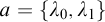 $a=\{\lambda _0,\lambda _1\}$
.
We have that
 $\chi \le \pi _a$
: since
 $\lambda _2,\ldots ,\beta _{k+1}\in C$
and
 $\lambda _1<\lambda _2$
, it follows that
 $\beta _2,\ldots ,\beta _k,\beta _{k+1}\in B^a$
. To see that
 $f^a\subseteq f^{\chi }_l$
, note that
 $f^\chi _l=H(\alpha ,\beta _1)=f^a$
. It remains to check that
 $H^a(x)\subseteq H^\chi (x)$
for all
 $x\in [C\setminus (\beta _1+1)]^2$
. But for such x,
 $H^\chi (x)=H(x)=f^x\supseteq g^x\supseteq H^a(x)$
since
 $\max (a)=\beta _1<\min (x)$
.
So since
 $\pi "\le \chi \le \pi _a$
, we have that
 $\pi "\le \pi _a$
. The length of
 $\pi "$
is k more than the length of
 $\pi _a$
, which is
 $l+2$
, and
 $\pi "{\restriction } j=\eta $
. Since
 $\pi "$
decides
 $\tau $
, by the properties of
 $\pi _a$
, already the j-interpolant of
 $\pi _a$
and
 $\pi "$
, call it
 $\chi '$
, decides
 $\tau $
.
We have:
-
•
$\chi $
is the j-interpolant of
$\pi '$
and
$\pi "$
. -
•
$\chi '$
is the j-interpolant of
$\pi _a$
and
$\pi "$
. -
•
$\chi \le \pi _a$
.


It follows that
 $\chi \le \chi '$
: note that
 $\chi '$
is the weakest condition extending
 $\pi _a$
whose
 ${\vec {\kappa }}$
-sequence is
 ${\vec {\kappa }}^{\pi _a}{{}^\frown } {\langle \lambda _2,\ldots ,\lambda _{k+1} \rangle } $
and whose
 ${\vec {f}}$
-sequence begins with
 $\vec {h}$
. But since
 $\chi \le \pi _a$
,
 $\chi $
is such a condition. As a result,
 $\chi \le \chi '$
. So since
 $\chi '$
decides
 $\tau $
, so does
 $\chi $
(in the same way).
Lemma 9.7. Let
 $\tau $
be an
 $\mathbb {M}$
-name for an ordinal. Let
 $\pi \in \mathbb {M}$
,
 $j\le \mathrm {lh} (\pi )$
even. Let
 $\eta $
be the restriction to j of some extension of
 $\pi $
. Then there is a
 $\pi '\le _j\pi $
such that for every
 $\pi "\le \pi '$
, if
 $\pi "$
decides
 $\tau $
and
 $\pi "{\restriction } j=\eta $
, then already the j-interpolant of
 $\pi "$
and
 $\pi '$
decides
 $\tau $
.
In other words, in this situation, letting
 ${\vec {\lambda }}$
be such that
 ${\vec {\kappa }}^{\pi "}={\vec {\kappa }}^{\pi '}{{}^\frown }{\vec {\lambda }}$
, then
 $(\pi '{{}^\frown }{\vec {\lambda }})[{\vec {f}}^{\pi "}{\restriction } j]$
decides
 $\tau $
.
Proof. Define a sequence
 ${\langle \pi _k\;|\;} {k<\omega \ \text {even}\rangle }$
by recursion on k such that:
-
•
$\pi _0=\pi $
. -
•
$\pi _{k+2}\le _j\pi _k$
. -
• Whenever
$\pi "\le \pi _{k+2}$
is such that
$\pi "{\restriction } j=\eta $
,
$ \mathrm {lh} (\pi ")= \mathrm {lh} (\pi _k)+k$
, and
$\pi "$
decides
$\tau $
, then the j-interpolant of
$\pi _{k+2}$
and
$\pi "$
decides
$\tau $
.


 $\pi _{k+2}$
is defined by applying Lemma 9.6 to
 $\pi _k$
, j, and k. Note that all conditions
 $\pi _k$
have the same length.
By Observation 9.5, let
 $\pi '$
be a lower
 $\le _j$
-bound of
 ${\vec {\pi }}$
in
 $\mathbb {M}$
. We claim that
 $\pi '$
is as wished. So suppose
 $\pi "\le \pi '$
is such that
 $\pi "{\restriction } j=\eta $
and
 $\pi "$
decides
 $\tau $
. Let
 $k= \mathrm {lh} (\pi ")- \mathrm {lh} (\pi )$
. Since
 $\pi "\le \pi _{k+2}$
, it follows that
 $\chi $
, the j-interpolant of
 $\pi _{k+2}$
and
 $\pi "$
, decides
 $\tau $
. But
 $\pi "\le \pi '\le \pi _{k+2}$
, so
 $\chi '$
, the j-interpolant of
 $\pi "$
and
 $\pi '$
, is at least as strong as
 $\chi $
, the j-interpolant of
 $\pi _{k+2}$
and
 $\pi "$
. So
 $\chi '$
decides
 $\tau $
, as wished.
Lemma 9.8. Let
 $\tau $
be an
 $\mathbb {M}$
-name for an ordinal. Let
 $\pi \in \mathbb {M}$
, and let j be an even number such that
 $j=0$
or
 $j< \mathrm {lh} (\pi )$
. Then there is a
 $\pi '\le _j\pi $
such that for every
 $\pi "\le \pi '$
, if
 $\pi "$
decides
 $\tau $
, then already the j-interpolant of
 $\pi "$
and
 $\pi '$
decides
 $\tau $
.
In other words, in this situation, letting
 ${\vec {\lambda }}$
be such that
 ${\vec {\kappa }}^{\pi "}={\vec {\kappa }}^{\pi '}{{}^\frown }{\vec {\lambda }}$
, then
 $(\pi '{{}^\frown }{\vec {\lambda }})[{\vec {f}}^{\pi "}{\restriction } j]$
decides
 $\tau $
.
Proof. Let
 $l= \mathrm {lh} (\pi )$
.
Note that the lemma follows immediately from Lemma 9.7 if
 $j=0$
, using
 $\eta =\emptyset $
. So let’s assume that
 $0<j<l$
. Consider the set
 $X=\{\pi "{\restriction } j\;|\;\pi "\le \pi \}$
. The cardinality of X is the same as the cardinality of
 $Y=\{{\vec {f}}^{\pi "}{\restriction } j\;|\;\pi "\le \pi \}$
, and
 $$\begin{align*}Y\subseteq\mathrm{Col}(\kappa_0^+,{<}\kappa_2)\times\cdots\times\mathrm{Col}(\kappa_{j-2}^+,{<}\kappa_j).\end{align*}$$
Since
 $\kappa _j$
is inaccessible, Y has cardinality at most
 $\kappa _j$
. Recall that by Observation 9.5, any
 $\le _j$
-decreasing sequence in
 $\mathbb {M}$
starting with
 $\pi $
, of length at most
 $\kappa _j$
, has a lower bound in
 $\mathbb {M}$
.
We construct such a sequence as follows. Let
 ${\langle \eta _\xi \;|\;} {\xi <\kappa _j\rangle }$
enumerate X. By recursion on
 $\xi $
, define
 $\pi _\xi $
such that:
-
•
$\pi _0=\pi $
. -
• If
$\xi <\zeta <\kappa _j$
, then
$\pi _\zeta \le _j\pi _\xi $
. -
• Whenever
$\pi "\le \pi _{\xi +1}$
is such that
$\pi "$
decides
$\tau $
and
$\pi "{\restriction } j=\eta _\xi $
, then already the j-interpolant of
$\pi _{\xi +1}$
and
$\pi "$
decides
$\tau $
.


In the successor step of the construction, the existence of
 $\pi _{\xi +1}$
is guaranteed by applying Lemma 9.7 to
 $\pi _\xi $
and
 $\eta _\xi $
, and in the limit step, one uses Observation 9.5.
Having constructed the sequence
 ${\vec {\pi }}$
, another application of Observation 9.5 yields the existence of a
 $\pi '$
such that
 $\pi '\le _j\pi _\xi $
for all
 $\xi <\kappa _j$
. This
 $\pi '$
is as wished: clearly,
 $\pi '\le _j\pi $
. And if
 $\pi "\le \pi '$
decides
 $\tau $
, then letting
 $\xi $
be such that
 $\eta _\xi =\pi "{\restriction } j$
, it follows that
 $\chi $
, the j-interpolant of
 $\pi _{\xi +1}$
and
 $\pi "$
, decides
 $\tau $
, since
 $\pi "\le \pi _{\xi +1}$
. But since
 $\pi '\le \pi _{\xi +1}$
, the j-interpolant of
 $\pi '$
and
 $\pi "$
is at least as strong as
 $\chi $
and hence also decides
 $\tau $
.
Corollary 9.9. Let
 $\pi \in \mathbb {M}$
with
 $ \mathrm {lh} (\pi )=n$
, and let j be an even number such that
 $j=0$
or
 $j<n$
. Let
 $\mu \le (\kappa ^\pi _j)^+$
and let
 $\dot {b}$
be an
 $\mathbb {M}$
-name such that
 $\pi $
forces wrt.
 $\mathbb {M}$
that
 $\dot {b}:\check {\mu }\longrightarrow \mathrm {On} $
. Then there is a
 $\pi '\le _j\pi $
such that whenever
 $\pi "\le \pi '$
and
 $\lambda <\mu $
are such that for some
 $\beta $
,
 $\pi "\Vdash _{\mathbb {M}}\dot {b}(\check {\lambda })=\check {\beta }$
, then this is already forced by the j-interpolant of
 $\pi '$
and
 $\pi "$
.
Proof. Construct a
 $\le _j$
-decreasing sequence
 ${\langle \pi _\lambda \;|\;} {\lambda <\mu \rangle }$
by setting
 $\pi _0=\pi $
, defining
 $\pi _\lambda $
to be a lower bound of
 ${\vec {\pi }}{\restriction }\lambda $
in the case that
 $\lambda $
is a limit (using Observation 9.5), and by applying Lemma 9.8 to
 $\pi _\lambda $
and the name “
 $\dot {b}(\check {\lambda })$
” to get
 $\pi _{\lambda +1}$
. Let
 $\pi '$
be a
 $\le _j$
-lower bound of
 ${\vec {\pi }}$
. This
 $\pi '$
is as wished.
Definition 9.10. Let
 $G\subseteq \mathbb {M}$
be
 $\mathrm {V} $
-generic. Let
 ${\vec {f}}^G={\langle f^G_i\;|\;} {i<\omega \ \text {even}\rangle }$
where for even
 $i<\omega $
,
 $f^G_i=\bigcup _{\pi \in G,\ i< \mathrm {lh} (\pi )}f^\pi _i$
, and let
 ${\vec {\kappa }}^G=\bigcup _{\pi \in G}{\vec {\kappa }}^\pi $
. Let
 $\dot {{\vec {f}}}$
and
 $\dot {{\vec {\kappa }}}$
be canonical names for
 ${\vec {f}}$
and
 ${\vec {\kappa }}$
, respectively.
Clearly, if
 $G\subseteq \mathbb {M}$
is
 $\mathrm {V} $
-generic, then
 $\mathrm {V} [G]=\mathrm {V} [{\vec {f}}^G,{\vec {\kappa }}^G]$
. The following is the version of [Reference Magidor17, Theorem 3.2] for the current forcing.
Theorem 9.11. Let
 $p\in \mathbb {M}$
be a condition of length n, let
 $0<j<n$
be even,
 $\mu <(\kappa ^\pi _j)^+$
, and
 $\dot {b}$
an
 $\mathbb {M}$
-name such that
 $\pi $
forces that
 $\dot {b}$
is subset of
 $\check {\mu }$
. Then
 $\pi $
forces that
 $\dot {b}\in \check {\mathrm {V} }[\dot {{\vec {f}}}{\restriction } j]$
.
Proof. This proof is basically identical to that of [Reference Magidor17, Theorem 3.2]. I include it for the reader’s convenience.
For
 $i<n$
, let
 $\kappa _i=\kappa ^\pi _i$
, and write
 $$\begin{align*}{\mathord{\mathbb P}}_j=\mathrm{Col}(\kappa_0^+,{<}\kappa_2)\times\cdots\times\mathrm{Col}(\kappa_{j-2}^+,{<}\kappa_j),\end{align*}$$
where for convenience I’ll index elements of
 ${\mathord {\mathbb P}}_j$
with even numbers between
 $0$
and
 $j-2$
, so members of
 ${\mathord {\mathbb P}}_j$
are of the form
 $ {\langle g_0,g_2,\ldots ,g_{j-2} \rangle } $
such that for
 $i<j$
even,
 $g_i\in \mathrm {Col}(\kappa _i^+,{<}\kappa _{i+2})$
.
Note that if G is
 $\mathbb {M}$
-generic over
 $\mathrm {V} $
and
 $\pi {\kern-1pt}\in{\kern-1pt} G$
, then
 $G_j{\kern-1pt}={\kern-1pt}\{{\vec {f}}^\pi {\restriction } j\;|\;\pi {\kern-1pt}\in{\kern-1pt} G,\, \mathrm {lh} (\pi ){\kern-1pt}>{\kern-1pt}j\}$
is
 ${\mathord {\mathbb P}}_j$
-generic over
 $\mathrm {V} $
. The filter
 $G_j$
is definable from
 ${\vec {f}}{\restriction } j$
and vice versa, so
 $\mathrm {V} [{\vec {f}}{\restriction } j]$
can be viewed as a
 ${\mathord {\mathbb P}}_j$
-generic extension of
 $\mathrm {V} $
.
Let’s show that the set of conditions that force that
 $\dot {b}$
is in
 $\mathrm {V} [\dot {{\vec {f}}}{\restriction } j]$
is dense below
 $\pi $
in
 $\mathbb {M}$
. So let
 $\pi '\le \pi $
. We’ll find a
 $\chi \le \pi '$
that does the job. Let
 $\chi '\le \pi '$
be as in Corollary 9.9 (identifying
 $\dot {b}$
with a name for the characteristic function of
 $\dot {b}$
). That is,
 $\chi '\le _j\pi $
has the property that whenever
 $\xi <\mu $
and
 $\chi "\le \chi '$
decides the statement “
 $\check {\xi }\in \dot {b}$
,” then already the j-interpolant of
 $\chi '$
and
 $\chi "$
decides it (the same way
 $\chi "$
does).
Define a partition
 $F:[A^{\chi '}]^{{<}\omega }\longrightarrow X$
, where
 $X={\mathcal {P}}({\mathord {\mathbb P}}_j\times \mu \times 3)$
. Note that
 $X\in \mathrm {V} _\kappa $
, hence X has cardinality less than
 $\kappa $
. F is defined by letting
 $F(\{\lambda _0,\ldots ,\lambda _{i-1}\})$
(where it is understood that
 ${\vec {\lambda }}= {\langle \lambda _0,\ldots ,\lambda _{i-1} \rangle } $
is increasing) consists of all triples
 $ {\langle {\vec {g}},\xi ,i \rangle } $
such that
 ${\vec {g}}\le _{{\mathord {\mathbb P}}_j}{\vec {f}}^{\chi '}{\restriction } j$
,
 $\xi <\mu $
and
 $i<3$
is such that:
-
• If
$(\chi '{{}^\frown }{\vec {\lambda }})[{\vec {g}}]\Vdash \check {\xi }\notin \dot {b}$
, then
$i=0$
. -
• If
$(\chi '{{}^\frown }{\vec {\lambda }})[{\vec {g}}]\Vdash \check {\xi }\in \dot {b}$
, then
$i=0$
. -
• If
$(\chi '{{}^\frown }{\vec {\lambda }})[{\vec {g}}]$
does not decide “
$\check {\xi }\in \dot {b},$
” then
$i=2$
.


By Rowbottom’s theorem, there is a
 $B\in U$
,
 $B\subseteq A^{\chi '}$
, such that for every
 $l<\omega $
, F is constant on
 $[B]^l$
, say with value
 $E_l$
.
-
(1) If
$ {\langle {\vec {g}},\xi ,1 \rangle } \in E_l$
, then there can be no
$l'<\omega $
for which there is a
${\vec {g}}'$
that’s compatible in
${\mathord {\mathbb P}}_j$
with
${\vec {g}}$
such that
$ {\langle {\vec {g}}',\xi ,0 \rangle } \in E_{l'}$
.


This is because if so, letting
 $\vec {h}\le {\mathord {\mathbb P}}_j{\vec {g}},{\vec {g}}'$
and
 $m=\max (l,l')$
, we could pick
 $\{{\vec {\lambda }}\}\in [B]^m$
, and we would obtain
 $$\begin{align*}(\chi'{{}^\frown}{\vec{\lambda}})[\vec{h}]\le(\chi'{{}^\frown}({\vec{\lambda}}{\restriction} l))[{\vec{g}}]\Vdash\check{\xi}\in\dot{b}\end{align*}$$
since
 $ {\langle {\vec {g}},\xi ,1 \rangle } \in F(\{{\vec {\lambda }}{\restriction } l\})$
but also
 $$\begin{align*}(\chi'{{}^\frown}{\vec{\lambda}})[\vec{h}]\le(\chi'{{}^\frown}({\vec{\lambda}}{\restriction} l'))[{\vec{g}}']\Vdash\check{\xi}\notin\dot{b}\end{align*}$$
since
 $ {\langle {\vec {g}}',\xi ,0 \rangle } \in F(\{{\vec {\lambda }}{\restriction } l'\})$
. This is a contradiction.
Define
 $\chi = {\langle {\vec {\kappa }}^{\chi '},{\vec {f}}^{\chi '},B,F^{\chi '}{\restriction }[B]^2 \rangle } $
. The claim is that
 $\chi $
is as wished, that is,
 $\chi $
forces that
 $\dot {b}$
is in
 $\mathrm {V} [\dot {{\vec {f}}}{\restriction } j]$
.
Note that whenever
 $\tilde {G}$
is
 ${\mathord {\mathbb P}}_j$
-generic over
 $\mathrm {V} $
, then the set
 $$\begin{align*}\{\xi<\mu\;|\;\exists l<\omega,{\vec{g}}\in\tilde{G}\quad {\langle {\vec{g}},\xi,1 \rangle} \in E_l\}\end{align*}$$
is in
 $\mathrm {V} [\tilde {G}]$
. By maximality, let
 $\dot {c}\in \mathrm {V} ^{{\mathord {\mathbb P}}_j}$
be a
 ${\mathord {\mathbb P}}_j$
-name for this set, so that letting
 $\Gamma _{{\mathord {\mathbb P}}_j}$
be the canonical name for the
 ${\mathord {\mathbb P}}_j$
-generic filter,
 $$\begin{align*}1_{{\mathord{\mathbb P}}_j}\Vdash_{{\mathord{\mathbb P}}_j}\dot{c}\subseteq\check{\mu}\land\forall\xi<\check{\mu}(\xi\in\dot{c}\iff\exists l<\omega\exists{\vec{g}}\in\Gamma_{{\mathord{\mathbb P}}_j}\ {\langle {\vec{g}},\xi,1 \rangle} \in\check{E}_l).\end{align*}$$
Now let
 $\tilde {\Gamma }$
be the canonical
 $\mathbb {M}$
-name for the generic filter on
 ${\mathord {\mathbb P}}_j$
. If
 ${\mathord {\mathbb P}}$
is a forcing notion,
 $\tau $
is a
 ${\mathord {\mathbb P}}$
-name, and
 $H\subseteq {\mathord {\mathbb P}}$
is a filter, write
 $\mathtt {val}(\tau ,H)$
for the interpretation of
 $\tau $
by H. We claim that
-
(2)
$\chi \Vdash _{\mathbb {M}}\dot {b}=\mathtt {val}(\check {\dot {c}},\tilde {\Gamma }),$

thus completing the proof. To see this, suppose G is
 $\mathbb {M}$
-generic over
 $\mathrm {V} $
with
 $\chi \in G$
. Let
 $\tilde {G}=\tilde {\Gamma }^G$
be the
 ${\mathord {\mathbb P}}_j$
-generic filter generated by G (which is equivalent to
 $\dot {{\vec {f}}}^G{\restriction } j$
). Suppose
 $\xi \in \dot {b}^G$
. Let
 $\pi \le \chi $
,
 $\pi \in G$
be such that
 $\pi \Vdash _{\mathbb {M}}\check {\xi }\in \dot {b}$
. Then already the j-interpolant of
 $\chi '$
and
 $\pi $
forces this. That is, letting
 ${\vec {g}}={\vec {f}}^\pi {\restriction } j$
,
 $ \mathrm {lh} (\chi )+l= \mathrm {lh} (\pi )$
and
 ${\vec {\kappa }}^\pi ={\vec {\kappa }}{{}^\frown }{\vec {\lambda }}$
, we have that
 $\{{\vec {\lambda }}\}\in [B]^l$
and the condition
 $(\chi '{{}^\frown }{\vec {\lambda }})[{\vec {g}}]$
forces
 $\check {\xi }\in \dot {b}$
. This means that
 $ {\langle {\vec {g}},\xi ,1 \rangle } \in E_l$
, and hence, as
 ${\vec {g}}\in \tilde {G}$
, that
 $\xi \in \dot {c}^{\tilde {G}}$
.
Now suppose
 $\xi \notin \dot {b}^G$
. Then we can find
 $\pi \le \chi $
as above, but
 $\pi \Vdash \check {\xi }\notin \dot {b}$
. Defining
 ${\vec {g}}$
and l as before, it then follows that
 $ {\langle {\vec {g}},\xi ,0 \rangle } \in E_l$
. But by claim (1), there can then be no
 $\vec {h}\in \tilde {G}$
and
 $l'<\omega $
such that
 $ {\langle \vec {h},\xi ,1 \rangle } \in E_{l'}$
since
 ${\vec {g}}$
and
 $\vec {h}$
would be compatible. Thus,
 $\xi \notin \dot {c}^{\tilde {G}}$
.
Corollary 9.12. Suppose G is
 $\mathbb {M}$
-generic over
 $\mathrm {V} $
, and let
 ${\vec {f}}={\vec {f}}^G$
. Then for every bounded subset b of
 $\kappa $
in
 $\mathrm {V} [G]$
, there is a
 $j<\omega $
such that
 $a\in \mathrm {V} [f{\restriction } j]$
.
Proof. Let
 $\gamma <\kappa $
and
 $\dot {b}\in \mathrm {V} ^{\mathbb {M}}$
be such that
 $b=\dot {b}^G\subseteq \gamma $
. By genericity, there is an even
 $j<\omega $
such that
 $\kappa _j\ge \gamma $
(where
 ${\vec {\kappa }}={\vec {\kappa }}^G$
). Pick a condition
 $\pi \in G$
with
 $ \mathrm {lh} (\pi )>j$
such that
 $\pi \Vdash \dot {b}\subseteq \check {\gamma }$
. By Theorem 9.11,
 $\pi $
forces that
 $\dot {b}\in \mathrm {V} [\dot {{\vec {f}}}{\restriction } j]$
, so, since
 $\pi \in G$
,
 $b\in \mathrm {V} [{\vec {f}}{\restriction } j]$
.
As a consequence, if G is
 $\mathbb {M}$
-generic and
 ${\vec {\kappa }}={\vec {\kappa }}^G$
,
 ${\vec {f}}={\vec {f}}^G$
, then the infinite cardinals below
 $\kappa $
in the sense of
 $\mathrm {V} [G]$
are precisely the following (in increasing order):
 $$\begin{align*}\omega=\kappa_0, \kappa_0^+, \kappa_2,\kappa_2^+,\kappa_4,\kappa_4^+,\ldots,\end{align*}$$
where for even i, the calculation of
 $\kappa _i^+$
gives the same result in
 $\mathrm {V} $
and in
 $\mathrm {V} [G]$
. In particular,
 $\kappa =\aleph _\omega ^{\mathrm {V} [G]}$
, and
 $\kappa $
is a strong limit cardinal in
 $\mathrm {V} [G]$
, since given
 $\alpha <\kappa $
, letting
 $\kappa _n>\alpha $
, we have that
 ${\mathcal {P}}(\alpha )^{\mathrm {V} [G]}\subseteq {\mathcal {P}}(\alpha )^{\mathrm {V} [{\vec {f}}{\restriction } n]}$
, where
 ${\vec {f}}{\restriction } n$
is generic for a forcing of size less than
 $\kappa $
, and
 $\kappa $
is inaccessible.
9.2 Perturbing the odd part of the Příkrý sequence
In this subsection, simply put, we will see how to change the
 ${\vec {\kappa }}$
-sequence of a generic filter for
 $\mathbb {M}$
without changing its
 ${\vec {f}}$
-sequence.
Lemma 9.13. Let
 $\pi \in \mathbb {M}$
, and let
 $\alpha \in A^\pi $
. Then there is a set
 $B\subseteq A^\pi \setminus (\alpha +1)$
of cardinality
 $\kappa $
such that for all
 $\beta ,\gamma \in B$
,
 $F^\pi (\alpha ,\beta )$
and
 $F^\pi (\alpha ,\gamma )$
are compatible in
 $\mathrm {Col}(\alpha ^+,{<}\kappa )$
.
Proof. Fix
 $\pi $
and
 $\alpha $
. Recall that
 $\mathrm {Col}(\alpha ^+,{<}\kappa )$
consists of all functions c with
 $ \mathrm {dom} (c)\subseteq \{ {\langle i,\xi \rangle } \;|\; i\in (\alpha ^+,\kappa )\ \text {and}\ \xi <\alpha ^+\}$
, such that
 $\mathsf {card}( \mathrm {dom} (c))<\alpha ^+$
and for all
 $ {\langle i,\xi \rangle } \in \mathrm {dom} (c)$
,
 $c(i,\xi )<i$
.
Let
 $\Delta =\{ \mathrm {dom} (F^\pi (\alpha ,\beta ))\;|\;\beta \in A^\pi \}$
.
If
 $\Delta $
has cardinality less than
 $\kappa $
, then by a simple pigeonhole principle, there is a subset
 $\bar {B}$
of
 $A^\pi $
on which
 $\beta \mapsto \mathrm {dom} (F^\pi (\alpha ,\beta ))$
is constant, and since there are fewer than
 $\kappa $
conditions in
 $\mathrm {Col}(\alpha ^+,{<}\kappa )$
with this domain,
 $\bar {B}$
can be further shrunk to B, so that the map
 $\beta \mapsto F^{\pi }(\alpha ,\beta )$
is constant on B, and we are done.
Otherwise,
 $\Delta $
is a set of cardinality
 $\kappa $
all of whose members have cardinality less than
 $\alpha ^+<\kappa $
. Since
 $\kappa $
is inaccessible, an application of the
 $\Delta $
-system lemma shows that there is a
 $\bar {B}\subseteq A$
such that
 $\bar {\Delta }=\{ \mathrm {dom} (F^\pi (\alpha ,\beta ))\;|\;\beta \in \bar {B}\}$
forms a
 $\Delta $
-system, say with root r, meaning that for all
 $\beta ,\gamma \in \bar {B}$
with
 $\alpha <\beta <\gamma $
,
 $ \mathrm {dom} (F^\pi (\alpha ,\beta ))\cap \mathrm {dom} (F^\pi (\alpha ,\gamma ))=r$
. Clearly, there are fewer than
 $\kappa $
members of
 $\mathrm {Col}(\alpha ^+,{<}\kappa )$
with domain r, so there is a
 $B\subseteq \bar {B}$
such that for all
 $\beta ,\gamma \in B$
with
 $\alpha <\beta <\gamma $
,
 $F^\pi (\alpha ,\beta ){\restriction } r=F^\pi (\alpha ,\gamma ){\restriction } r$
. It follows that B is as wished.
Definition 9.14. Given
 $\mathrm {V} $
-generic filters
 $G,H\subseteq \mathbb {M}$
, H is close to G if
 $\mathrm {V} [G]=\mathrm {V} [H]$
,
 ${\vec {f}}^G={\vec {f}}^H$
and there is an odd natural number m such that for all
 $n<\omega $
, if
 $n\neq m$
, then
 $\kappa ^G_n=\kappa ^H_n$
.
Lemma 9.15. Let
 $G\subseteq \mathbb {M}$
be
 $\mathrm {V} $
-generic, and let
 $\pi \in G$
. Then, in
 $\mathrm {V} [G]$
, there are
 $\kappa $
many
 $\mathrm {V} $
-generic filters
 $H\subseteq \mathbb {M}$
which are close to G and contain
 $\pi $
.
Proof. Working in
 $\mathrm {V} [G]$
, since
 $\kappa $
is a limit cardinal, it suffices to show that for any cardinal
 $\theta <\kappa $
, there are at least
 $\theta $
many
 $\mathrm {V} $
-generic filters close to G and containing
 $\pi $
. Fix such a
 $\theta $
, and let
 ${\vec {\kappa }}={\vec {\kappa }}^G$
.
For any condition
 $\sigma \in \mathbb {M}$
, say that
 $\sigma '\le \sigma $
is a
 $\theta $
-nice extension of
 $\sigma $
if
 $ \mathrm {lh} (\sigma ')= \mathrm {lh} (\sigma )+4$
and, letting
 ${\vec {\kappa }}^{\sigma '}={\vec {\kappa }}^\sigma {{}^\frown } {\langle \lambda _0,\lambda _1,\lambda _2,\lambda _3 \rangle } $
, we have that:
-
•
$\lambda _0\ge \theta $
. -
• There is a set
$B\subseteq (\lambda _1,\lambda _2)\cap A^\sigma $
of cardinality at least
$\theta $
such that for all
$\beta \in B$
,
$F^\sigma (\lambda _0,\beta )\subseteq f^{\sigma '}_{ \mathrm {lh} (\sigma )}$
.


Every
 $\sigma \in \mathbb {M}$
has a
 $\theta $
-nice extension: let
 $\lambda _0\in A^\sigma \setminus \theta $
, and by Lemma 9.13, let
 $\bar {B}\subseteq A^\sigma \setminus (\lambda _0+1)$
have cardinality
 $\kappa $
, such that for all
 $\beta ,\gamma \in \bar {B}$
, with
 $\beta <\gamma $
,
 $F^\sigma (\lambda _0,\beta )$
and
 $F^\sigma (\lambda _0,\gamma )$
are compatible. Let
 $\lambda _1=\min (\bar {B})$
, let
 $\lambda _2$
be the
 $\theta $
-th element of
 $\bar {B}$
,
 $B=\bar {B}\cap \lambda _2$
, and
 $\lambda _3\in A^\sigma \setminus (\lambda _2+1)$
. We can then define
 $\sigma '$
to be like
 $\sigma {{}^\frown } {\langle \lambda _0,\lambda _1,\lambda _2,\lambda _3 \rangle } $
, except that we set
 $f^{\sigma '}_{ \mathrm {lh} (\sigma )}=\bigcup _{\beta \in B}F^\sigma (\lambda _0,\beta )$
. The latter is a condition in
 $\mathrm {Col}(\lambda _0^+,{<}\lambda _2)$
because it is a union of pairwise compatible elements in that poset, of cardinality
 $\theta <\lambda _0^+$
, and the latter is the closure of the poset.
In particular, the set D of conditions which are a
 $\theta $
-nice extension of some
 $\sigma \le \pi $
is dense below
 $\pi $
: given
 $\pi '\le \pi $
,
 $\pi '$
has a
 $\theta $
-nice extension
 $\sigma '$
, and that
 $\sigma '$
is in D, as witnessed by
 $\pi '$
.
Since
 $\pi \in G$
, we can pick
 ${\tilde {\pi }}'\in G\cap D$
. Let
 ${\tilde {\pi }}\le \pi $
be such that
 ${\tilde {\pi }}'$
is a
 $\theta $
-nice extension of
 ${\tilde {\pi }}$
. In particular,
 ${\tilde {\pi }}\in G$
as well.
Let
 $l= \mathrm {lh} ({\tilde {\pi }})$
. It follows that
 $$\begin{align*}\mathrm{lh} ({\tilde{\pi}}')=l+4\ \text{and}\ {\vec{\kappa}}^{{\tilde{\pi}}'}={\vec{\kappa}}{\restriction}(l+4)={\vec{\kappa}}^{\tilde{\pi}}{{}^\frown} {\langle \kappa_l,\kappa_{l+1},\kappa_{l+2},\kappa_{l+3} \rangle} .\end{align*}$$
Let B witness that
 ${\tilde {\pi }}'$
is a
 $\theta $
-nice extension of
 ${\tilde {\pi }}$
, and fix
 $\beta \in B$
. Let
 ${\tilde {\pi }}_\beta $
be like
 ${\tilde {\pi }}'$
, except that
 $\kappa ^{{\tilde {\pi }}_\beta }_{l+1}=\beta $
. Note that
 ${\tilde {\pi }}_\beta \le {\tilde {\pi }}$
(this is the point)! Then an isomorphism
 $I_\beta :\mathbb {M}_{{\le }{\tilde {\pi }}'}\longrightarrow \mathbb {M}_{{\le }{\tilde {\pi }}_\beta }$
can be defined by letting
 $I_\beta (\sigma )$
be like
 $\sigma $
, except that
 $\kappa ^{I_\beta (\sigma )}_{l+1}=\beta $
.
Now
 $I_\beta [G]$
generates an
 $\mathbb {M}$
-generic filter
 $G_\beta $
over
 $\mathrm {V} $
. Clearly,
 $\mathrm {V} [G]=\mathrm {V} [G_\beta ]$
(since
 $G_\beta $
can be defined from G using
 $I_\beta $
, and vice versa). In fact,
 ${\vec {f}}^G={\vec {f}}^{G_\beta }$
and
 $\kappa ^G_n=\kappa ^{G_\beta }_n$
for all
 $n\in \omega \setminus \{l+1\}$
. So
 $G_\beta $
is close to G. And since
 $\pi _\beta \in G_\beta $
and
 $\pi _\beta \le \pi $
, we have that
 $\pi \in G_\beta $
.
Thus, we have found
 $\theta $
many
 $\mathrm {V} $
-generic filters which are close to G and contain
 $\pi $
, as wished.
9.3 Putting everything together
Now suppose
 $\mathrm {V} =L[U]$
, where U is a normal ultrafilter on
 $\kappa $
, and let
 $\mathbb {M}$
be defined relative to U. Let G be
 $\mathbb {M}$
-generic over
 $\mathrm {V} $
. Let
 ${\vec {f}}={\vec {f}}^G$
,
 ${\vec {\kappa }}={\vec {\kappa }}^G$
. In
 $\mathrm {V} [G]$
, let
 $\mathbb {C}$
be the forcing to code
 ${\vec {f}}$
into the continuum function above
 $\aleph _{\omega +2}$
, say; see [Reference Fuchs, Hamkins and Reitz8, Theorem 66] as an example for this method. Let H be
 $\mathbb {C}$
-generic over
 $\mathrm {V} [G]$
.
Theorem 9.16. In
 $\mathrm {V} [G][H]$
,
 $\kappa =\aleph _\omega $
is a strong limit cardinal, and the least leap is
 $\aleph _{\omega +1}$
.
Proof. We have already seen that
 $\kappa =\aleph _\omega $
is a strong limit cardinal in
 $\mathrm {V} [G]$
. Since
 $\mathbb {C}$
is sufficiently closed, these facts are preserved to
 $\mathrm {V} [G][H]$
. Let’s break the remainder of the argument down.
-
(1)
${\vec {\kappa }}\notin {<}\kappa \text {-}\mathsf {HOD} ^{\mathrm {V} [G][H]}$
.

Proof of (1).
Suppose that
 ${\vec {\kappa }}$
belongs to some
 $\mathsf {OD} $
set
 $A=\{x\;|\;\varphi (x,\rho )\}$
in
 $\mathrm {V} [G][H]$
. The idea is that there are
 $\kappa $
many finite variations of
 ${\vec {\kappa }}$
that also belong to A, because we can vary G by changing its
 ${\vec {\kappa }}$
sequence (by modifying one odd coordinate) without changing its
 ${\vec {f}}$
sequence in
 $\kappa $
many ways, so that the modified
 ${\vec {\kappa }}$
sequence still belongs to A. In detail, since
 $\mathbb {C}$
is homogeneous, its trivial condition forces over
 $\mathrm {V} [G]$
that
 $\varphi (\check {{\vec {\kappa }}},\check {\rho })$
holds. Let
 $\dot {\mathbb {C}}$
be the canonical
 $\mathbb {M}$
-name for
 $\mathbb {C}$
. We have some
 $\pi \in G$
forcing “
 $\varphi (\dot {{\vec {\kappa }}},\check {\rho })$
holds after forcing with
 $\dot {\mathbb {C}}$
.” But by Lemma 9.15, we can find
 $\kappa $
many
 $\mathrm {V} $
-generic filters
 $G'$
which are close to G and contain
 $\pi $
. For each such
 $G'$
, we have that
 $\mathrm {V} [G]=\mathrm {V} [G']$
and
 ${\vec {f}}^G={\vec {f}}^{G'}$
. The point is that
 $\dot {\mathbb {C}}^{\mathrm {V} [G']}=\dot {\mathbb {C}}^{\mathrm {V} [G]}$
, because the definition of
 $\mathbb {C}$
depends only on
 ${\vec {f}}$
. So
 $\varphi (\dot {{\vec {\kappa }}}^{G'},\rho )$
holds in
 $\mathrm {V} [G'][H]=\mathrm {V} [G][H]$
. Letting
 $G'$
range over
 $\kappa $
many possibilities, we obtain
 $\kappa $
many variations
 ${\vec {\kappa }}^{G'}$
of
 ${\vec {\kappa }}$
which all belong to A.
-
(2)
${\vec {\kappa }}\in {<}\kappa ^+\text {-}\mathsf {HOD} ^{\mathrm {V} [G][H]}$
.

Proof of (2).
Arguing in
 $\mathrm {V} [G][H]$
, by the Dodd–Jensen Covering Lemma for
 $L[U]$
, Theorem 4.5, since
 $0^\dagger $
does not exist and covering fails, there is a maximal Příkrý sequence C over
 $L[U]$
. Since every Příkrý sequence is determined by C, a subset of
 $\omega $
and a finite subset of
 $\kappa $
, and since the continuum is less than
 $\kappa $
, there are altogether no more than
 $\kappa $
Příkrý sequences over
 $L[U]$
. One of them is
 ${\vec {\kappa }}$
. So
 ${\vec {\kappa }}$
is
 ${<}\kappa ^+\text {-}\mathsf {HOD} $
in
 $\mathrm {V} [G][H]$
.
Claims (1) and (2) together immediately imply
-
(3)
$\kappa ^+$
is a leap in
$\mathrm {V} [G][H]$
.


It remains to show that no cardinal below
 $\kappa $
is a leap in
 $\mathrm {V} [G][H]$
. Assume, towards a contradiction:
-
(4)
${\bar {\kappa }}$
, the least leap of
$\mathrm {V} [G][H]$
, is less than
$\kappa ^+$
.


Since the least leap cannot be a limit cardinal, but is uncountable, it follows that
-
(5)
$\omega <{\bar {\kappa }}<\kappa $
.

Applying Corollary 3.7 in
 $\mathrm {V} [G][H]$
to
 $\mathsf {HOD} \subsetneqq {<}{\bar {\kappa }}\text {-}\mathsf {HOD} $
, there are sets a and b such that
 $a\in {<}{\bar {\kappa }}\text {-}\mathsf {HOD} \setminus \mathsf {HOD} $
,
 $a\subseteq b\in \mathsf {HOD} $
and
 $\mathsf {card}(b)<{\bar {\kappa }}$
.
Clearly, there are an ordinal
 $\beta $
and an
 $\mathsf {OD} ^{\mathrm {V} [G][H]}$
bijection
 $i:\beta \longrightarrow b$
– i can be taken to be the enumeration of b according to the canonical well-ordering of
 $\mathsf {HOD} ^{\mathrm {V} [G][H]}$
in
 $\mathrm {V} [G][H]$
. Since
 $\mathsf {card}(b)<{\bar {\kappa }}$
, it follows that
 $\beta <\kappa $
.
Letting
 $\bar {a}=i^{-1}[a]$
, we have that
 $\bar {a}$
is
 ${<}{\bar {\kappa }}\text {-}\mathsf {HOD} ^{\mathrm {V} [G][H]}$
, since
 $a,i\in {<}{\bar {\kappa }}\text {-}\mathsf {HOD} ^{\mathrm {V} [G][H]}$
. And
 $\bar {a}$
is not in
 $\mathsf {HOD} ^{\mathrm {V} [G][H]}$
, because if it were, then so would
 $a=i[\bar {a}]$
, as
 $b\in \mathsf {HOD} ^{\mathrm {V} [G][H]}$
. And of course,
 $\bar {a}\subseteq \beta <\kappa $
.
Because
 $\mathbb {C}$
is more than
 $\kappa ^+$
-closed and
 $\bar {a}$
is a bounded subset of
 $\kappa $
, it follows that
 $\bar {a}\in \mathrm {V} [G]$
. But then, by Corollary 9.12, it follows that
 $\bar {a}\in \mathrm {V} [{\vec {f}}{\restriction } j]=L[U][{\vec {f}}{\restriction } j]$
, for some
 $j<\omega $
. But
 ${\vec {f}}$
is coded by H and is hence
 $\mathsf {OD} ^{\mathrm {V} [G][H]}$
, and U is
 $\mathsf {OD} ^{\mathrm {V} [G][H]}$
, so
 $\bar {a}\in \mathsf {HOD} ^{\mathrm {V} [G][H]}$
, a contradiction!
This contradiction shows that (4) fails, that is, that the least leap in
 $\mathrm {V} [G][H]$
must be
 $\kappa ^+$
.
10 Other limit cardinals of countable cofinality
In this section, I will sketch how to produce models in which the least leap is any strong limit cardinal of countable cofinality wished. More precisely, let us work in
 $L[U]$
, where
 $\kappa $
is the measurable cardinal, and let
 $\lambda <\kappa $
be a limit ordinal of countable cofinality.
Recall that if G is
 $\mathbb {M}$
-generic and
 ${\vec {\kappa }}={\vec {\kappa }}^G$
,
 ${\vec {f}}={\vec {f}}^G$
, then the infinite cardinals below
 $\kappa $
in the sense of
 $\mathrm {V} [G]$
are given by
 $$\begin{align*}\omega=\kappa_0, \kappa_0^+, \kappa_2,\kappa_2^+,\kappa_4,\kappa_4^+,\ldots.\end{align*}$$
Thus, in addition to the
 $\kappa _n$
, where n is even, their successors also remain cardinals. There was a technical need to leave this extra space, but there is no reason why we couldn’t leave more space. The idea is to leave exactly the space needed in order to arrange that in the forcing extension,
 $\kappa =\aleph _\lambda $
.
To this end, let
 $c:\omega \longrightarrow \lambda $
be increasing and cofinal. Let
 $\kappa _0=c(0)$
, and let
 $s:\{m<\omega \;|\; m\ \text {is even}\}\longrightarrow \lambda $
be defined by
 $$\begin{align*}s(2n)=c(n+1)-(c(n)+1)\end{align*}$$
so that
 $c(n)+1+s(2n)=c(n+1)$
for all
 $n<\omega $
. The idea is to define our poset
 $\mathbb {M}^s$
in such a way that when G,
 ${\vec {\kappa }}$
and
 ${\vec {f}}$
are as above, then in
 $\mathrm {V} [G]$
, the cardinals below
 $\kappa $
are
 $$\begin{align*}\omega,\omega_1,\ldots,\kappa_0=c(0),\kappa_0^+,\ldots,\kappa_0^{+s(0)},\kappa_2,\kappa_2^{+},\ldots,\kappa_2^{+s(2)},\kappa_4,\ldots\end{align*}$$
so that in total, the order type of the infinite cardinals less than
 $\kappa $
is
 $$\begin{align*}c(0)+1+s(0)+1+s(2)+1+\cdots=\lambda\end{align*}$$
making
 $\kappa =\aleph _\lambda ^{\mathrm {V} [G]}$
as wished.
Accordingly, the conditions in
 $\mathbb {M}^s$
should have the form
 $\pi = {\langle {\vec {\kappa }},{\vec {f}},A,F \rangle } $
as before, except that for even
 $i< \mathrm {lh} (\pi )$
,
 $f_i\in \mathrm {Col}(\kappa _i^{+s(i)},{<}\kappa )$
, and if
 $i+2< \mathrm {lh} (\pi )$
,
 $f_i\in \mathrm {Col}(\kappa _i^{+s(i)},{<}\kappa _{i+2})$
. To make it work, F needs to be defined in such a way that it provides meaningful upper bounds, i.e.,
 $F(m,\{\alpha ,\beta \})$
is defined whenever
 $m\ge \mathrm {lh} (\pi )$
is even and
 $\{\alpha ,\beta \}\in [A]^2$
, and in this case,
 $F(m,\alpha ,\beta )\in \mathrm {Col}(\alpha ^{+s(m)},{<}\kappa )$
. A condition
 $\pi '\in \mathbb {M}^s$
extends
 $\pi $
if
 $ \mathrm {lh} (\pi ')\ge \mathrm {lh} (\pi )$
,
 ${\vec {\kappa }}^\pi $
is an initial segment of
 ${\vec {\kappa }}^{\pi '}$
, for every even
 $i< \mathrm {lh} (\pi )$
,
 $f^\pi _i\subseteq f^{\pi '}_i$
,
 $A^{\pi '}\subseteq A^\pi $
, for every
 $i\in [ \mathrm {lh} (\pi ), \mathrm {lh} (\pi '))$
,
 $\kappa ^{\pi '}_i\in A^\pi $
, for every even
 $i\in [ \mathrm {lh} (\pi ), \mathrm {lh} (\pi '))$
, and
 $F^\pi (i,\{\kappa ^{\pi '}_i,\kappa ^{\pi '}_{i+1}\})\subseteq f^{\pi '}_i$
, and for all even
 $j\in [ \mathrm {lh} (\pi '),\omega )$
and
 $\{\alpha ,\beta \}\in [A^{\pi '}]^2$
,
 $F^\pi (j,\{\alpha ,\beta \})\subseteq F^{\pi '}(j,\{\alpha ,\beta \})$
.
Working over
 $L[U]$
, this forcing is ordinal definable, as
 $L[U]\models \mathrm {V} =\mathsf {HOD} $
. All the relevant arguments go through. We obtain:
Theorem 10.1. Let
 $\mathrm {V} =L[U]$
, and let
 $\kappa $
be the measurable cardinal. If
 $\lambda <\kappa $
is an ordinal of countable cofinality, then there is a forcing extension in which the statement “
 $\Lambda _0=\aleph _{\lambda +1}$
” (using
 $\lambda $
as a parameter) holds.
11 Questions
There are many open questions in this area, but here are two that I find particularly interesting.
-
(1) Does the statement “
$\lambda $
is a strong limit and a limit of leaps, and
$\lambda ^+$
is a leap” have the consistency strength of a measurable cardinal? -
(2) What is the consistency strength of the statement “
$\Lambda _0$
is the successor of a singular cardinal of uncountable cofinality?”


So far, I have found a promising lower bound for (2), but an upper bound is missing. See the follow-up paper [Reference Fuchs7] for details.



