Persistent pulmonary hypertension of the newborn is a life-threatening condition that affects about 1–2 per 1,000 live births worldwide. Reference Abman, Kinsella and Rosenzweig1 It occurs when pulmonary vascular resistance remains abnormally elevated after birth, which causes an abnormal transition from foetal circulation to normal “adult” circulation type, resulting in the right-to-left shunting of blood at the level of the ductus arteriosus and/or foramina ovale. This leads to severe hypoxaemia, acidosis, and multiorgan dysfunction. Reference Steinhorn, Fineman and Kusic-Pajic2 The main goal of persistent pulmonary hypertension of the newborn treatment is lowering pulmonary vascular resistance and improving oxygenation, which can be achieved by various pharmacological and non-pharmacological interventions. However, the optimal treatment strategy for persistent pulmonary hypertension of the newborn remains controversial and challenging. Reference Mourani, Sontag and Younoszai3
One of the key pathophysiological mechanisms involved in persistent pulmonary hypertension of the newborn is the dysregulation of endothelin-1, a potent vasoconstrictor and pro-inflammatory mediator that is primarily expressed in the lungs. Reference Kinsella, McQueston, Rosenberg and Abman4 The effects of endothelin-1 are exerted by binding to two types of receptors: endothelinA receptor and endothelinB receptor. The former are located on vascular smooth muscle cells and mediate vasoconstriction, while the latter are located on endothelial cells and mediate vasodilation through nitric oxide production. Reference Giaid, Yanagisawa and Langleben5 In persistent pulmonary hypertension of the newborn, there is increased endothelin-1 expression and an imbalance of endothelin-1 receptor expression in the lungs, with decreased endothelinB receptor protein synthesis in pulmonary artery endothelial cells. Reference Mourani, Ivy, Rosenberg, Fagan and Abman6 This leads to increased pulmonary vascular resistance and reduced nitric oxide availability. Reference Mourani, Sontag, Ivy and Abman7
Bosentan is an oral dual endothelin receptor antagonist that can block both endothelinA and endothelinB receptors, thereby inhibiting the vasoconstrictive and pro-inflammatory effects of endothelin-1. Reference Galiè, Beghetti and Gatzoulis8 Bosentan is effective and safe for treating pulmonary arterial hypertension in adults and children. Reference Galiè, Olschewski and Oudiz9,Reference Barst, Ivy and Gaitan10 However, its role in persistent pulmonary hypertension of the newborn is still unclear. Studies have suggested that bosentan may have a beneficial effect on persistent pulmonary hypertension of the newborn by reducing pulmonary vascular resistance, improving oxygenation and preventing the development of chronic lung disease. Reference Bassler, Choong, McNamara and Kirpalani11,Reference Barrington and Finer12 However, other studies have failed to demonstrate any additive effect of bosentan on top of inhaled nitric oxide or other therapies. Reference Chester, Seedorf and Tourneux13,Reference Kinsella, Cutter and Walsh14 Moreover, the optimal dose and duration of bosentan treatment for persistent pulmonary hypertension of the newborn remain unknown.
Accordingly, we conducted a systematic review and meta-analysis to evaluate the efficacy and safety of bosentan as an adjuvant therapy for persistent pulmonary hypertension of the newborn in newborns. We compared bosentan with a placebo and other drugs such as sildenafil and iloprost or inhaled NO. Sildenafil is a phosphodiesterase type 5 inhibitor that enhances nitric oxide-mediated vasodilation. Reference Kinsella, Ivy and Abman15 Iloprost is a prostacyclin analogue that stimulates adenylate cyclase and increases cyclic adenosine monophosphate, leading to vasodilation and anti-inflammatory effects. Reference Stocker, Penny, Brizard, Cochrane, Soto and Shekerdemian16 Inhaled nitric oxide is a selective pulmonary vasodilator that activates soluble guanylate cyclase and increases cyclic guanosine monophosphate, resulting in smooth muscle relaxation. Reference Kawut, Taichman and Ahya17 These drugs have different mechanisms of action and potential side effects, and their comparative efficacy and safety for persistent pulmonary hypertension of the newborn treatment are not well established. Reference Ramani and Park18 Finally, we hypothesised that bosentan could reduce the treatment failure rate, pulmonary artery pressure, and length of hospital stay, and increase the partial pressure of oxygen and blood oxygen saturation compared with a placebo or other drugs.
Materials and methods
Literature search strategy
In adherence to the Preferred Reporting Items for Systematic Reviews and Meta-Analyses guidelines, we conducted a systematic search across various databases in both English and Chinese. We systematically searched English databases including PubMed, Web of Science, the National Library of Medicine, Scopus, Embase, and ClinicalTrials.gov for literature on the use of Bosentan in the treatment of persistent pulmonary hypertension of the newborn, while the Chinese databases encompassed the China National Knowledge Infrastructure and Wanfang Data. Searches were made from the inception date of each database up to January 1, 2023.
Our search strategy involved the use of a combination of subject words and free words. For the English databases, the keywords included “Bosentan,” “Bosentan hydrate,” “Ro47-0203,” “newborn,” “infant,” “persistent pulmonary hypertension,” “persistent foetal circulation,” and “persistent pulmonary hypertension of the newborn.” Boolean operators (AND, OR) were utilised to refine the search, and adjustments were made to the strategy based on the specific requirements of each database.
In the Chinese databases (China National Knowledge Infrastructure and Wanfang Data), the keywords used were the Chinese equivalents of “Bosentan,” “newborn,” and “persistent pulmonary hypertension.” No language or date restrictions were applied in our search strategy. This approach aimed to ensure a comprehensive and inclusive retrieval of relevant studies across all the selected databases.
Inclusion and exclusion criteria
The inclusion criteria applied to the literature were as follows. (1) Study type: randomised controlled trials or retrospective studies published in Chinese or English; (2) study participants: newborns diagnosed with persistent pulmonary hypertension of the newborn according to guidelines established by the American Heart Association and the American Thoracic Society; Reference Abman, Hansmann and Archer19 (3) interventions: the control group received a placebo or other drugs or other drugs combined with bosentan, while the experimental group received bosentan or bosentan combined with other drugs; and (4) outcome indicators: treatment failure rate, pulmonary artery pressure (mmHg), partial pressure of oxygen (PaO2, kPa), and blood oxygen saturation (SaO2, %), length of hospital stay and the occurrence of adverse reactions. The exclusion criteria applied to the literature were as follows. (1) Literature with incomplete data that could not be utilised or from which valid data could not be extracted; (2) animal/in vitro cell experiments; and (3) case investigations or review studies.
Literature screening and data extraction
The literature was screened independently by two investigators. The initial screening was performed according to the title and abstract; then, secondary screening was performed by reading the full text according to the inclusion and exclusion criteria. In case of any disagreements, the opinions of a third investigator were solicited and discussed to reach a consensus. After the literature screening, data were extracted independently by two investigators, including the first author, year of publication, study region, study type, sample size, and the risk factors included in each study. Any discrepancies or missing data were resolved by contacting the original authors or consulting the third investigator.
Literature quality evaluation
The Cochrane Collaboration’s tool for assessing the risk of bias 20 was utilised to evaluate the quality of the included randomised controlled trials, including (1) random sequence generation; (2) allocation concealment; (3) blinding of participants and personnel; (4) blinding of the outcome assessment; (5) incomplete outcome data; (6) selective reporting outcome indicators; and (7) other bias. For the included literature, a judgment of “yes” (low risk), “no,” (high risk) or “unclear” (lack of relevant information or uncertain bias) was made for the above 7 items. Literature rated as reflecting a high or low risk of bias for any one item was categorised as having a high or low risk of bias, respectively. Otherwise, the literature was categorised as having an unclear risk of bias.
The finally included regression studies were evaluated for quality in three aspects: selection, comparability and exposure or outcome using the Newcastle–Ottawa Scale. A total of 9 points were set for this scale, and 1 point was scored if the scoring conditions were met. Studies with scores < 5 were classified as low-quality studies and those with scores ≥ 5 were classified as high-quality studies. Studies with a Newcastle–Ottawa Scale score < 5 were not included in the meta-analysis. 21
Statistical analysis
Meta-analysis was performed using Revman5.3 software. The measurement data used the mean difference, while the count data used relative risk as the effect indicator. Effect sizes were expressed as point estimates and 95% confidence intervals, and statistical analysis was performed based on changes before and after treatment. For the heterogeneity test, test was used to judge the degree of heterogeneity, with < 50% or P > 0.1 indicating the homogeneity of the included literature, which was analysed using the fixed-effects model (Mantel–Haenszel); > 50% or P ≤ 0.1 indicated a degree of heterogeneity among the included studies, which was analysed using the random-effects model (DerSimonian–Laird). Furthermore, a leave-one-out method was used for sensitivity analysis, and a descriptive analysis was conducted for studies where results could not be combined. The test level of the meta-analysis was set at α = 0.05.
Results
Literature search results
In this study, a total of 1,640 literature studies were collected through database retrieval. After initial screening and based on the inclusion and exclusion criteria, 10 studies were finally included in the meta-analysis. Reference Steinhorn, Fineman and Kusic-Pajic2,Reference Mohamed and Ismail22–Reference Wang, Kuang and Zuo30 Among them, 6 were in English Reference Steinhorn, Fineman and Kusic-Pajic2,Reference Mohamed and Ismail22–Reference Vijay Kumar, Natraj Setty and Jayaranganath26 and 4 were in Chinese. Reference Wang, Sun and Pi27–Reference Wang, Kuang and Zuo30 The literature screening flow chart is shown in Figure 1.
Flow chart of literature screening.

Basic characteristics of the included literature
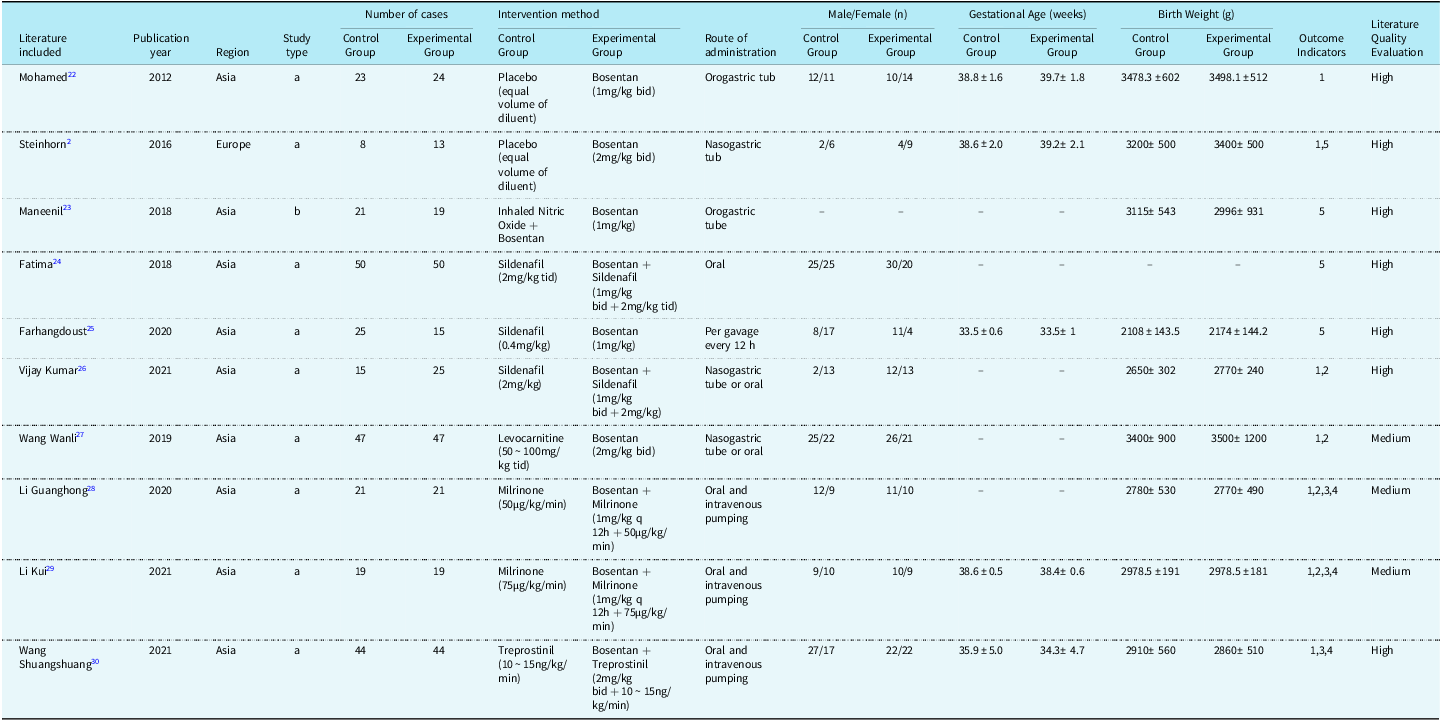
The 10 pieces of literature finally included were published from 2012 to 2021, including 9 randomised controlled studies and 1 retrospective study. Reference Maneenil, Thatrimontrichai and Janjindamai23 One study was conducted in Europe, Reference Steinhorn, Fineman and Kusic-Pajic2 and the remaining studies were conducted in Asia, of which 4 were conducted in China. Reference Wang, Sun and Pi27–Reference Wang, Kuang and Zuo30 A total of 550 samples were included, including 277 in the experimental group and 273 in the control group. The basic characteristics of the included literature are shown in Table 1.
Basic characteristics of selected studies

a = Randomised controlled trial, b = Retrospective study.
Quality evaluation of included studies
The 9 included randomised controlled trial studies were all conducted using a randomised method. Among them, 4 studies Reference Steinhorn, Fineman and Kusic-Pajic2,Reference Mohamed and Ismail22,Reference Fatima, Arshad and Quddusi24,Reference Farhangdoust, Mehralizadeh and Bordbar25 achieved allocation concealment, blinding of participants and personnel, blinding of the outcome assessment, complete outcome data, no selective reporting of study results, and no other bias; accordingly, they were considered high-quality studies with a low risk of bias. The remaining 3 randomised controlled trial studies Reference Wang, Sun and Pi27–Reference Li and Bai29 achieved complete outcome data and no selective reporting of study results, but there may have been other risks of bias; as such, they were considered to be medium-quality studies. The Newcastle–Ottawa Scale score of the retrospective study was 7, indicating a high-quality study.
Meta-analysis results
Treatment failure rate
Treatment failure rates were reported in 7 studies. Reference Steinhorn, Fineman and Kusic-Pajic2,Reference Mohamed and Ismail22,Reference Vijay Kumar, Natraj Setty and Jayaranganath26–Reference Wang, Kuang and Zuo30 Due to the homogeneity among the studies (I2 = 0%, P = 0.71), a fixed-effects model was used for the meta-analysis. The results showed that the treatment failure rate in the experimental group was lower than in the control group, with a statistically significant difference (relative risk = 0.25, 95% confidence interval: 0.14–0.44, standardised mean difference (Z-score) = 4.74, P < 0.001) as shown in Figure 2.
Forest plot of treatment failure rate.

Pulmonary artery pressure
Pulmonary artery pressure before and after treatment was reported in 4 studies, Reference Vijay Kumar, Natraj Setty and Jayaranganath26–Reference Li and Bai29 and the magnitude of the decrease in this pressure was analysed in this study. Due to the low heterogeneity among studies (I2 = 14%, P = 0.32), a fixed-effects model was used for the meta-analysis. The results showed that the decrease in pulmonary artery pressure in the experimental group was lower than in the control group, with a statistically significant difference (mean difference = −11.79, 95% confidence interval: −14.85 to − 8.73, Z-score = 7.56, P < 0.001) as shown in Figure 3.
Forest plot of the decrease in pulmonary artery pressure.

Partial pressure of oxygen
The partial pressure of oxygen before and after treatment was reported in 3 studies, Reference Li and Bai28–Reference Wang, Kuang and Zuo30 and the magnitude of the decrease in the partial pressure of oxygen was analysed in this study. Due to the high heterogeneity among the studies (I Reference Steinhorn, Fineman and Kusic-Pajic2 = 86%, P = 0.0009), a random-effects model was used for the meta-analysis. The results showed that the increase in partial pressure of oxygen in the experimental group was greater than in the control group, with a statistically significant difference (mean difference = 10.02, 95% confidence interval: 5.45–14.58, Z-score = 4.30, P < 0.001) as shown in Figure 4.
Forest plot of the increase in partial pressure of oxygen.

Blood oxygen saturation
The blood oxygen saturation before and after treatment was reported in three studies, Reference Li and Bai28–Reference Wang, Kuang and Zuo30 and the magnitude of the decrease in oxygen saturation was analysed in this study. Due to the heterogeneity among studies (I2 = 0%, P = 0.74), a fixed-effects model was used for the meta-analysis. The results showed that the increase in the blood oxygen saturation in the experimental group was greater than in the control group, with a statistically significant difference (mean difference = 8.24, 95% confidence interval: 6.32–10.15, Z-score = 8.44, P < 0.001) as shown in Figure 5.
Forest plot of the increase in oxygen saturation of blood.

Length of hospital stay
Length of hospital stay was reported in 4 studies. Reference Steinhorn, Fineman and Kusic-Pajic2,Reference Maneenil, Thatrimontrichai and Janjindamai23–Reference Farhangdoust, Mehralizadeh and Bordbar25 Due to the low heterogeneity among studies (I Reference Steinhorn, Fineman and Kusic-Pajic2 = 27%, P = 0.25), a fixed-effects model was used for the meta-analysis. The results showed that the length of hospital stay in the experimental group was shorter than in the control group, with a statistically significant difference (mean difference = −1.04, 95% confidence interval: −1.74 to − 0.35, Z-score = 2.96, P = 0.003) as shown in Figure 6.
Forest plot of length of hospital stay.

Adverse reactions
The occurrence of adverse reactions after treatment was mentioned in 6 studies. Reference Steinhorn, Fineman and Kusic-Pajic2,Reference Mohamed and Ismail22–Reference Vijay Kumar, Natraj Setty and Jayaranganath26 Because of the different types of adverse reactions, a combined analysis could not be performed; descriptive analysis was thus performed. Mohamed et al. Reference Mohamed and Ismail22 reported that in the experimental group, there was 1 case of bronchopulmonary dysplasia and 1 case of increased airway reactivity, while in the control group, there were 3 cases of neurological diseases, 2 cases of bronchopulmonary dysplasia, and 1 case of increased airway reactivity. Steinhorn et al. Reference Steinhorn, Fineman and Kusic-Pajic2 reported 3 cases of anaemia, 3 cases of oedema, and 2 cases of vomiting in the experimental group after treatment and only 1 case of anaemia in the control group. Moreover, Maneenil et al. Reference Maneenil, Thatrimontrichai and Janjindamai23 reported 3 cases of bronchopulmonary dysplasia and 3 cases of air leakage syndrome in the experimental group, while in the control group, there were 2 and 4 cases, respectively. Studies by Fatima et al. Reference Fatima, Arshad and Quddusi24 and Farhangdoust et al. Reference Farhangdoust, Mehralizadeh and Bordbar25 reported no adverse reactions, such as hypotension, after treatment with bosentan. Vijay Kumar et al. Reference Vijay Kumar, Natraj Setty and Jayaranganath26 found that 2 cases in the experimental group had abnormal liver function after treatment with bosentan, while no adverse reactions such as abnormal liver function were found in the control group.
Sensitivity analysis
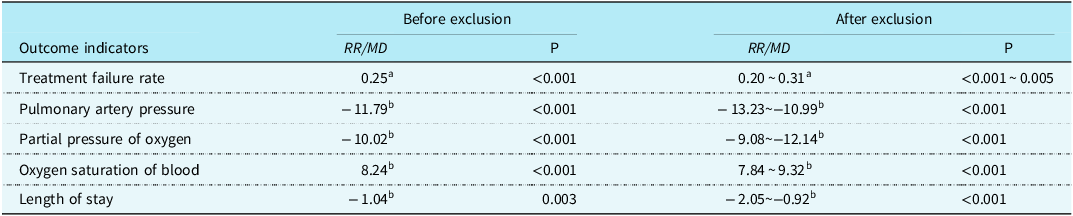
Sensitivity analysis was conducted on the study outcomes by omitting individual literature studies systematically, and the results were consistent with those before this process (see Table 2 for detailed results).
Sensitivity analysis of various indicators

Discussion
Newborns typically do not have reduced pulmonary vascular resistance due to various risk factors after birth but may suffer from persistent pulmonary hypertension, which poses a serious threat to their lives. Reference Pan, Sun and Zhao31 At present, high-frequency ventilation and inhaled nitric oxide are the preferred methods in the treatment of neonatal persistent pulmonary hypertension, but these approaches do not yield satisfactory results. Therefore, there is an urgent need to explore more effective treatments. Reference Qian and Jiao32,Reference Li, Shen and Gong33 Bosentan is an endothelin receptor antagonist that induces potent affinity between endothelinA and endothelinB receptors. It can significantly reduce pulmonary vascular resistance and increase cardiac output, thereby improving the symptoms of shortness of breath and cyanotic lips in newborns. Reference Zhang, Zhang and Chen34 However, no clear conclusion has been reached on the efficacy and safety of bosentan in the treatment of persistent pulmonary hypertension of the newborn. To this end, we systematically searched the literature on bosentan use in the treatment of persistent pulmonary hypertension of the newborn and conducted a meta-analysis to provide evidence-based results for clinical treatment.
The analysis results showed that the treatment failure rate of the experimental group was lower than that of the control group, while the decrease in pulmonary artery pressure was greater than in the control group. Moreover, the increase in partial pressure of oxygen and blood oxygen saturation in the experimental group was greater than in the control group, and the length of hospital stay was shorter than in the control group. These results are consistent with the results of Goissen et al. Reference Goissen, Ghyselen and Tourneux35 and Nakwan et al. Reference Nakwan, Choksuchat and Saksawad36 In addition, Radicioni et al. Reference Radicioni, Bruni and Camerini37 reported the improvement of pulmonary artery pressure and blood oxygen saturation in a 28-week-old premature infant with persistent pulmonary hypertension of the newborn who received bosentan treatment. It is speculated that bosentan is effective in newborns with persistent pulmonary hypertension of the newborn and may be independent of gestational age. Bosentan can simultaneously combine with endothelinA and endothelinB to cause a decrease in systolic function and an increase in diastolic function (mediated by the two receptors), thereby achieving the dilation of pulmonary blood vessels, a reduction in pulmonary artery pressure, and oxygenation amelioration. Given that the studies included in this meta-analysis involved small sample sizes, and the samples in most studies comprised full-term infants, more randomised controlled trials are needed to further evaluate and verify this conclusion in the future.
In a stratified analysis of the effects of treatment regimen, study region and drug dose on the efficacy of bosentan, the treatment failure rate of bosentan only or combined with other drugs in the experimental group, and that of bosentan at home or abroad, was lower than in the control group, and the reduction of pulmonary artery pressure was greater than that of the control group. The results were the same as before stratification and also consistent with the results of the retrospective study conducted by Maneenil et al. Reference Maneenil, Thatrimontrichai and Janjindamai23 on 40 newborns with persistent pulmonary hypertension of the newborn. It is concluded that bosentan only or as an adjuvant therapy is effective in newborns with persistent pulmonary hypertension of the newborn.
We conducted a sensitivity analysis on the included studies and the results indicated no impact, suggesting the reliability of the above-noted conclusion. When bosentan is expressed on vascular smooth muscle cells throughout the body, adverse reactions such as hypotension, abnormal liver function, and liver failure may occur. Reference Kinsella, McQueston, Rosenberg and Abman4 Drug-induced liver injury is the most common adverse reaction of Bosentan in the treatment of adult pulmonary arterial hypertension. Reference Humbert, Segal and Kiely38 In this meta-analysis, 6 studies mentioned adverse reactions, mainly abnormal liver function, anaemia and oedema. Anaemia and oedema may be attributed to bosentan’s inhibition of ET protection of red blood cells and its natriuretic effect. Reference Wolf, Tseng and Seedorf39
Our findings are consistent with previous studies that suggested bosentan may have a beneficial effect on persistent pulmonary hypertension of the newborn by reducing pulmonary vascular resistance, improving oxygenation and preventing the development of chronic lung disease. Reference Steinhorn, Fineman and Kusic-Pajic2,Reference Maneenil, Thatrimontrichai and Janjindamai23 However, our findings also contrast other studies that failed to demonstrate any additive effect of bosentan alongside inhaled NO or other therapies. Reference Fatima, Arshad and Quddusi24,Reference Farhangdoust, Mehralizadeh and Bordbar25 Moreover, our findings differ from those of Radicioni et al. Reference Radicioni, Bruni and Camerini37 and Maneenil et al. Reference Maneenil, Thatrimontrichai and Janjindamai23 , who reported transient hypotension during treatment with bosentan. These discrepancies may be due to several sources of heterogeneity among the studies, such as the differences in study design (randomised controlled trials versus retrospective studies), population characteristics (term versus preterm infants, the severity of persistent pulmonary hypertension of the newborn), intervention methods (bosentan only versus Bosentan combined with other drugs), outcome measurements pulmonary artery pressure versus pulmonary vascular resistance versus oxygenation index, and follow-up duration (3 versus 14 days).
We performed subgroup analysis and meta-regression to explore the impact of these factors on the efficacy and safety of bosentan for patients with persistent pulmonary hypertension of the newborn. However, due to the limited number and quality of the included studies, we could not account for all the potential sources of heterogeneity or adjust for confounding variables. Therefore, our results should be interpreted with caution and further studies with larger and more homogeneous samples are needed to confirm our results.
To our knowledge, this is the first meta-analysis that systematically assessed the efficacy and safety of bosentan for persistent pulmonary hypertension of the newborn in newborns. Our meta-analysis has several strengths, including a comprehensive literature search, a rigorous quality assessment, a sensitivity analysis, and a publication bias assessment. However, our meta-analysis also has limitations that should be acknowledged. First, the number and quality of the included studies were relatively low, which may affect the reliability and generalisability of our results. Second, the dose and duration of bosentan treatment varied among the included studies, which may introduce heterogeneity and confounding factors. Third, some outcome indicators, such as pulmonary vascular resistance, oxygenation index, and alveolar-arterial oxygen gradient, were not reported in most of the included studies, which may limit the comprehensiveness and comparability of our analysis. Fourth, we did not perform subgroup analysis or meta-regression to explore the potential sources of heterogeneity or the effect of moderators such as age, weight, gestational age, severity of persistent pulmonary hypertension of the newborn, or type and dose of other drugs used in the control group. Fifth, we did not assess the long-term outcomes or the cost-effectiveness of bosentan treatment for patients with persistent pulmonary hypertension of the newborn.
Conclusion
To sum up, current evidence shows that when treating newborns with persistent pulmonary hypertension of the newborn, bosentan only or as an adjuvant therapy can reduce the treatment failure rate, pulmonary artery pressure, and length of hospital stay, and increase partial pressure of oxygen and blood oxygen saturation. However, when using bosentan for treatment, liver function should be monitored, and attention should be paid to the occurrence of other adverse reactions. Clinically, more large-scale and high-quality randomised controlled trials are needed for further verification to provide a more reliable evidence-based framework for the treatment of persistent pulmonary hypertension of the newborn.
Data availability
All data generated or analysed during this study are included in this published article.
Acknowledgements
None.
Author contribution
Gao N and Lv YY conceived of the study and designed it. Cui YB and Wang PC participated in the data collection. He X helped with the data analysis. All authors took part in drafting and revising the manuscript. All authors read and approved the final manuscript.
Funding
None.
Competing interests
None.
Ethics approval
An ethics approval and consent to participate statement is not applicable because this study is based exclusively on published literature.