While numerous single-nation studies have found that the higher educated have less antipathy toward ethnic minorities than the lower educated, scholars continue to debate how this effect should be interpreted.Footnote 1 Socialization theory suggests that the higher educated have less anti-foreigner sentiment because educational institutions have taught them to be loyal toward state-authorized democratic values, which do not permit negative reactions toward ethnic minorities.Footnote 2 Interestingly, this theory implies that the capacity of higher education to reduce anti-foreigner sentiment should be enhanced as democratic institutions mature.
Obviously, the mechanisms by which longer-established democracies constrain anti-foreigner sentiment cannot be examined on the basis of single-nation studies utilizing cross-sectional data.Footnote 3 Yet previous cross-national tests of socialization theory remain inconclusive.Footnote 4 In his innovative study, Weil concluded that the education effect is stronger in long-consolidated democracies; as his study only included four countries, however, his results could only be a suggestion.Footnote 5 Likewise, the education effect has been found to be strongest in the oldest democracies and weakest in the youngest European democracies. Previous cross-national research also reports that the effects of education in medium-aged democracies (e.g., Portugal and Spain) and the oldest European democracies (e.g., Sweden and Great Britain) are indistinguishable.Footnote 6 However, this finding remains puzzling. It seems unlikely that a few decades of continuous democratic rule and unbroken democratic rule for about a century should have similar influence on the relationship between education and anti-foreigner sentiment. Even more, previous studies have left another complementary implication of socialization theory unexamined.Footnote 7 To test socialization theory convincingly, higher educated persons should prove to be particularly sensitive toward regime characteristics because they spend longer time in educational institutions.
Consequently, we contribute to the existing cross-national research on political socialization in two ways. First, we show that the impact of education on reducing anti-foreigner sentiment is strongest among the oldest democracies, moderate among the medium-aged, and weakest among the youngest. Second, and most importantly, we show that the higher educated have increasingly less anti-foreigner sentiment than lower educated persons as any given democracy matures. This means that the dispositions of the higher educated are the most influenced by political regime characteristics. Taken together, these results vindicate the claim that political authorities stimulate educational institutions to socialize generations of students into the official values. The results also suggest that education has characteristics that remain irreducible to economic vulnerability or self-interest. Indeed, higher education fosters reactions that reflect distinctive values.
There is a surprising absence of multilevel analyses of the influence of democratic legacy on the education–anti-foreigner sentiment relationship, with Hello, Scheepers and Gijsberts representing a notable exception.Footnote 8 This is unfortunate, since multilevel modeling is the appropriate way of testing the crucial implications of socialization theory. In effect, using the European Social Survey (ESS) fielded in 2008, we perform multilevel analysis with 40,902 individuals from twenty-eight countries. This means that the present study includes more countries than any other previous study.
SOCIALIZATION THEORY: ATTACHMENT TO THE POLITICAL SYSTEM
Socialization theory proceeds from an indisputable observation: during their life cycle, the higher educated spend considerably more time in educational institutions than the lower educated. That this may have distinctive formative effects on the former was first suggested long ago. Stouffer concluded that education tends to induce respect for ‘dissenting points of view.’Footnote 9 Almost contemporaneously, Lipset reached a similar conclusion, arguing that the lower educated are attracted to prejudiced attitudes, which in turn are associated with a ‘poorly developed frame of reference.’Footnote 10
Stouffer and Lipset did not clarify why education fosters libertarian and unprejudiced attitudes. One of the most interesting attempts at answering this central question was made by Selznick and Steinberg, who observed on the basis of American data that the lower educated tended to accept anti-Semitism while the higher educated rejected it.Footnote 11 Invoking an implicitly Parsonian systems-theoretical perspective, they subsequently reinterpreted education as a macro-based socialization mechanism. According to Parsons, educational institutions internalize specific patterns of value orientation.Footnote 12 Identifying the cause of ethnic resentment beyond the level of individual-level characteristics, Selznick and Steinberg defined education as a social institution that ‘constitutes and sustains a democratic and humane society.’Footnote 13
People acquire values in various places in society, most notably in the family and to a lesser extent at the workplace, but these social institutions do not necessarily internalize democratic values.Footnote 14 As a consequence, prejudice or resentment toward minorities often flourish in the private spheres of society and become widely accepted. In contrast, the official (i.e., state-authorized) political culture in fully democratized countries does not permit bigotry, ethnocentrism, or simple claims of out-group inferiority. After all, the Lockean maxim ‘that all men by nature are equal’ serves as one of the primary justifications for the worth of democracy.Footnote 15 Echoing Locke, Selznick and Steinberg stated that ‘democratic values provide ample grounds for rejecting prejudice and discrimination.’Footnote 16 By implication, human equality as a democratic value also involves acceptance of other cultures as legitimate within the nation.
Assuming that educational institutions avoid ‘folklore’ and unofficial values, they play a unique role in the persistent transmission and enforcement of the official culture.Footnote 17 In a fundamental sense, educational institutions represent an immediate extension of state authority. Accordingly, socialization theory relates intimately to the traditional approach to the function of political socialization. EastonFootnote 18 and Almond and VerbaFootnote 19 have all emphasized that all political systems tend to reproduce their cultures by means of the socializing influences of the primary and secondary institutions through which the younger generations continuously pass.Footnote 20
Mechanisms Conducive to Micro-Level Socialization
Despite their undeniable merits, previous studies have paid insufficient attention to mechanisms conducive to socialization within educational institutions.Footnote 21 To avoid functionalist mysticism, one needs to ask: how does the so-called transmission process from political authorities to students occur? One way to address this question is to distinguish between extra-organizational and intra-organizational factors that jointly stimulate individual academic staff members in educational institutions to be loyal toward official values. Our expansion of the original theory is also predicated on two assumptions: first, most organizations involve a mobilization of bias in favor of particular values and, second, organizational norms constrain staff members’ activities.Footnote 22
Extra-organizational factors relate to the way educational institutions are, directly or indirectly, influenced by their political environment.Footnote 23 Most politicians pay steady attention to educational institutions because of their national importance.Footnote 24 In particular, politicians recognize that higher educational institutions recruit future generations of executive leaders who will have major influence on national maintenance and development. These characteristics make educational standards a public, political issue. This does not mean that politicians regulate the education area in detail, but it does follow that educational institutions need to be considered legitimate according to official values. A questionable reputation according to official criteria may have unpleasant consequences such as reduced funding, more government control, or official condemnation. Indeed, negative reactions among politicians toward particular educational institutions may also frighten corporate sponsors off.
Because extra-organizational influences from the political system are potentially punitive, they are likely to have intra-organizational consequences, referring to the imposition of a ‘logic of appropriateness’ that is supportive of official regime values. The notion of a logic of appropriateness as introduced by March and Olsen refers to norms and values in organizations.Footnote 25 According to March and Olsen, staff members’ activities are shaped by pre-defined norms and values rather than their own personal (political) preferences. For example, in universities among consolidated democracies, norms prescribe impartiality, while ethnic diversity among staff members and students is perceived as valuable.Footnote 26
The consequences of the logic of appropriateness embedded in organizations should not be misunderstood. Academic staff members have considerable discretionary power in professional matters concerning choice of reading lists, methods, theoretical perspectives and pedagogical approaches. Yet, it follows from March and Olsen’s theoretical framework that street-level discretion does not give academic staff members carte blanche permission to pursue whatever personal preference they like at work. Some political preferences will be considered unacceptable because they conflict with an organization’s prevailing norms and values. Specifically, in consolidated democracies, academic staff members are likely to face social control mechanisms such as disciplinary warnings if they repeatedly air anti-foreigner sentiments in the class room.
Mechanisms of social control extend beyond managerial level to staff members: individual staff members who show disrespect for ethnic diversity may face complaints from their colleagues, or external examiners. In the oldest democracies, the average academic staff member in higher educational institutions is highly educated, positioned left of center and predisposed in favor of post-materialist values.Footnote 27
Combined with managerial staff commitments, these characteristics suggest that particular values are causally effective as they are likely to be defended within educational institutions, although their substantial implications will vary across nations according to our argument. Educational institutions in well-consolidated democracies are presumably more biased toward democratic values than their East European counterparts.
To exemplify, it is hardly a mere coincidence that many universities in consolidated democracies declare on their home pages that they welcome multi-ethnic communities.Footnote 28 Certainly, no one would suggest that such a commitment is intended to meet popular demands from below.Footnote 29 Rather, calls for cultural openness including exchange of foreign students and academic staff are consistent with official values. Thus, managerial staff purposefully assure political decision makers that their moral standards are uncontroversial and certainly not undermining official values. In contrast, prejudiced reactions toward ethnic minorities in educational institutions may cause considerable concern among the political elite in established democracies (and much less so in the youngest democracies).
Still, the micro-level involves another related question: why is it plausible to assume that academic staff actually influences students? Talcott Parsons conceptualized the mechanisms as ‘socialization by instruction.’Footnote 30 The socializing agent, performing as a legitimate ‘teacher,’ formulates the values with which to identify. Given the authoritative role structure of educational institutions, pupils and students imitate the socializing agent. But all this can only happen when there is a model for imitation. The model for imitation in modern advanced society is liberal democracy, and this model is transmitted from state authorities to educational institutions, and eventually converted into effect by teachers. Thus, the immediate mechanism of learning is imitation, but this process also triggers reward–punishment mechanisms. Teachers usually reward conformity, and (consciously or unconsciously) penalize deviance from the implications of democratic values such as acceptance of cultural diversity. Consistent with the democratic principle of human equality, particular value orientations (e.g., cultural pluralism) are ‘organized into’ educational institutions, while others (e.g., claims of in-group superiority) are ‘organized out’ by the teaching personnel. By implication, academic staff bestow democratic values on higher educated persons, which lead them to take specific positions on political issues. That is to argue, a higher educated person strongly attached to the democratic value of human quality, is more likely to reject anti-foreigner sentiment than a lower educated person less attached to this value (or less committed to accepting the implications of this value).Footnote 31
Qualifications and Hypotheses
As Weil emphasizes, however, an official democratic culture does not become dominant from Day 1, because the actual transmission of official values from state authorities to educational institutions involves a considerable time-lag.Footnote 32 As Weil did not specify the causes of this time-lag, we wish to expand on this important feature concerning the initial stages of a democratic transition process.Footnote 33 First, the mobilization of support among politicians for new educational objectives can be difficult due to their controversial nature. Second, entirely new education policies (relating to both teaching staff and students) must be carefully designed and subsequently put into effect on a nation-wide scale; this is indeed a time-consuming process. Third, generational replacements among regular staff members in educational institutions progress slowly, implying that ‘old school’ teachers will remain operative for years, or most likely decades. In combination, these implementation barriers suggest that the transition from an autocratic to a democratic regime has no immediate liberalizing effect on the existing educational institutions.Footnote 34
The fact that educational institutions ‘lag’ in their ability to socialize students according to state ideology has important consequences at the individual level in contemporary societies. Among the oldest democracies in Europe, few (if any) living citizens have had direct personal experience with nondemocratic educational institutions. Yet this category is considerably larger among societies (e.g., Spain and Portugal) that officially turned to democratic rule in the first half of the 1970s. Indeed, their educational institutions may have been influenced by nondemocratic values in the 1980s. Obviously, the category of living people who have personal experience with nondemocratic educational institutions is even larger in post-communist countries, which first ‘turned democratic’ around 1990. Time itself thus plays an important role, implying that the education effect should clearly be strongest in countries where state authorities have had most time to re-direct educational institutions away from authoritarian toward liberal democratic values. Likewise, the education effect will be relatively weaker in countries where democratic values have not had sufficient time to penetrate educational institutions; and certainly weakest among countries where most people only have authoritarian experiences with educational institutions. Accordingly, our first hypothesis runs like this:
HYPOTHESIS 1: The politically induced socialization effect. The effect of education on reducing anti-foreigner sentiment is strongest in the oldest democracies, moderate in medium-aged democracies, and weakest in the most recent democracies.
Unlike previous research, however, we argue that this hypothesis requires further specification.Footnote 35 In empirical terms: the observed effect of education becoming stronger as the age of democracy increases could result from two different dynamics. On the one hand, the effect of education becomes stronger if the lower educated have increasingly more anti-foreigner sentiment as democracy matures. On the other hand, the effect of education will also grow stronger if the higher educated have increasingly less anti-foreigner sentiment as democracy matures.
This leaves a critical question: Which outcome is most consistent with socialization theory? Secondary socialization involves a temporal component – to be most effective, socialization must occur over a long period of time. Many lower educated people have left the educational system at age 16–17, whereas many higher educated people first leave at age 25 (or older). This in itself suggests that the higher educated are more strongly socialized into the official values. Yet Niemi and Sobieszek provide an explanation for this differential impact of the educational system.Footnote 36 They conclude that elementary schools have little influence on children’s political views. In contrast, high school and college have a greater influence on young people’s political attitudes because by that time they have acquired the cognitive capacity to cope with political ideas and values – mostly as a result of education itself.Footnote 37
Accordingly, the higher educated should be relatively more sensitive toward the official values, since they are more influenced by them. In contrast, as the lower educated spend less time in educational institutions, they should be insensitive toward variability in regime and official values. Ultimately, in countries with weak democratic traditions, the higher educated should not differ considerably from the lower educated in terms of anti-foreigner sentiment. In these countries, the extent to which institutions of higher education will impose democratic value orientations is most likely limited. In contrast, among the oldest democracies, the dispositions of the higher educated should be much further away from the lower educated, since democratic values are comparatively more institutionalized and supported by the state authorities. Emphasizing the key role of the higher educated, our second hypothesis runs like this:
HYPOTHESIS 2: The divergence effect. As the democratic culture matures, the higher educated should have increasingly less anti-foreigner sentiment than the lower educated.
DATA, MEASURES, CONTROLS AND MODEL SPECIFICATION
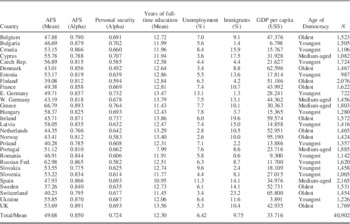
To provide a rigorous test of our hypotheses, we use the ESS 2008 (version 4.0), which contains information about 56,000 individuals from twenty-nine countries. The ESS is commonly regarded as a high-quality data source, including detailed descriptions of fieldwork and data collection guidelines. The ESS contains national probability samples, but as we focus explicitly on anti-foreigner sentiment as the dependent variable, the effective (pooled) sample was reduced to the majority population by excluding respondents who reported that they considered themselves to be members of an ethnic minority group. The national samples from Israel and Turkey were also excluded, as these countries are fundamentally different from the remaining European countries. In these two countries, the relationship between education and anti-foreigner sentiment could be influenced by numerous circumstances that fall entirely outside the scope of the present theoretical framework.Footnote 38 However, the dataset made it possible to identify a new country – the former East Germany.Footnote 39 In combination, these decisions imply that our investigation includes twenty-eight countries and 40,902 respondents. Table 1 presents the full list of countries.
Descriptive Information about Dependent and Independent Variables, by Country

Note: Anti-foreigner sentiment (AFS) is an index of three items ranging 0–100, higher values indicating greater anti-foreigner sentiment. Personal security is an index comprising three items. N=number of respondents.
Sources: European Social Survey (2008); Samanni, Teorell and Rothstein (2010); World Bank (2010); UN–International Migration (2009); Statistisches Bundesamt (2009).
Measuring Our Primary Variables
To measure anti-foreigner sentiment, we chose three items addressing attitudes toward immigrants and immigration, worded as follows: (1) ‘immigration is good or bad for [country’s] economy’, (2) ‘immigrants enrich or undermine [country’s] culture’ and (3) ‘immigrants make [country] a better or worse place to live’.Footnote 40 These three items tap varieties of the perceived ethnic threat toward immigrants without referring to any specific ethnic group. They are also likely to tap antipathy or old fashioned prejudice according to the so-called decoupling experiment. On the basis of this experiment, Sniderman, Hagendoorn and Prior concluded that threat measures are also inevitably picking up whether or not people dislike minorities.Footnote 41 In a similar vein, Semyonov, Raijman and Gorodzeisky argue that anti-foreigner sentiment is a blend of negative views, including antipathy and threat.Footnote 42 Still, we realize that the three ESS items are not typical prejudice/social distance items, and this is the reason for adopting Semyonov, Raijman and Gorodzeisky’s label for negative reactions – namely, anti-foreigner sentiment.Footnote 43
To minimize missing observations (i.e., to maintain representativeness), we allowed up to one non-response and averaged the remaining genuine responses from each respondent. Removing respondents with more than one ‘don’t know’ answer resulted in a sample loss of less than 2 percent.Footnote
44
The final anti-foreigner sentiment index was rescaled to vary 0–100, with higher values indicating greater anti-foreigner sentiment (
 $\bar{X}=49.68$
; sd=21.34). Table 1 shows that Cronbach’s alpha varies from 0.766 to 0.893 and the overall reliability (calculated on the pooled sample) is acceptable (α=0.850). Table 1 shows the mean level of anti-foreigner sentiment in the twenty-eight countries. East and South European countries tend to lie above the grand mean, whereas the Nordic countries tend to lie below it. This cross-national variation unto itself indicates the need for multilevel modeling.
Our key independent variable – education – was treated as an interval measure, as this corresponds to the socialization claim that a considerable length of time is required for a person to develop sustainable values and dispositions. The use of education as an interval variable is also quite common.Footnote 45 More importantly, the Loess estimation of co-variance between the interval education variable and our measure of anti-foreigner sentiment revealed that the two measures were indeed linearly related, which is consistent with the assumptions of the statistical model we apply in the empirical analyses below. The interval measure of education varied from seven to twenty-one years of schooling, but it was subsequently rescaled to vary 0–1, higher values indicating higher education (i.e., more years in formal education).Footnote 46
At the country level, we required a measure of the age of liberal-democratic rule specifically related to the countries included in the ESS dataset. This was provided with data from the Swedish Quality of Government Project (2010), which offers systematic information about the number of years each country has had democratic rule during the period 1930–2008.Footnote 47 The maximum value is seventy-eight years of liberal-democratic government and minimum is fifteen, covering most of the countries involved in the major sequences of democratization in European history. The first sequence (of continuous democracies) dates back to the first half of the nineteenth century, referring to the democratic transitions in Western Europe (e.g., France and Great Britain).Footnote 48 The second sequence (of medium-aged/interrupted democracies) dates back to the late 1940s in the case of Germany but primarily refers to the reestablishing of democratic rule among South European countries in the first half of the 1970s.Footnote 49 The third sequence evolved in the aftermath of the collapse of the Soviet Union in the early 1990s among East European countries. This is a rough classification but ensures sufficient variation on our key interacting variable. Table 1 presents the complete classification of the countries according to their age of liberal-democratic rule. From this, we created dummy variables distinguishing between the oldest, medium-aged and youngest democracies. The latter category was subsequently treated as the reference category.
Plausible but Not Unrivaled
Scholars commonly agree that the strongest rival to socialization theory is realistic group conflict theory, including self-interest theory.Footnote 50 Unlike socialization theory, these theories claim that education reflects an important aspect of an individuals’ socioeconomic standing.Footnote 51 Social groups compete for scarce resources, and all groups defend their existing privileges.Footnote 52 When a given society becomes multiethnic, competition is established between majority in-groups and minority out-groups. Both higher and lower educated persons will compete with ethnic minorities in the educational institutions and labor and housing markets.Footnote 53 While competition creates disadvantages for all groups, the higher educated are clearly less vulnerable than the lower educated.Footnote 54 Both privileged and less-privileged groups pursue their rational self-interest, but the very fact that personal financial resources are unequally distributed explains why these groups cannot have similar attitudes toward ethnic minorities. Compared to the lower educated, the higher educated will have less anti-foreigner sentiment due to their greater wealth.Footnote 55
The realistic group conflict perspective is not confined to properties at the individual level.Footnote 56 Individual vulnerability will most probably be intimately linked to contextual variables.Footnote 57 It is possible to distinguish between normal and more extreme circumstances that accentuate individual vulnerability in the competition over scarce resources. Specifically, comparatively high unemployment rates and large groups of immigrants are likely to be perceived as particularly threatening among the lower educated.Footnote 58 Lower educated persons are more likely to be made redundant or experience wage cuts due to competition from minority members.
Controls Derived from Realistic Group Conflict Theory
These theoretical considerations emphasize the need for including controls related to various personal resources and macroeconomic indicators. To identify key socioeconomic mediators of the education effect, we used a set of measures. First, in the ESS, occupation is a comprehensive measure which we subsequently recoded into five categories: (1) white collar professionals, (2) white collar semi-professionals, (3) skilled workers, (4) unskilled workers, and (5) self-employed (plus a residual category of non-valid answers in order to maintain representativeness). The category of unskilled workers serves as the reference category. Second, we used household income with ten categories, sorting the respondents into ten deciles. This measure classifies the respondents according to their position in relation to the entire population of the country. This variable was subsequently recoded into six categories (ranging from very low to very high income), including a residual category of missing responses. The very low income category serves as the reference category. As this measure is not a complete indicator of personal affluence, we also included an alternative measure of personal vulnerability tapping the subjective feeling of economic security. This variable is an index comprising three variables with the following wording: (1) ‘Which of the descriptions on this card comes closest to how you feel about your household’s income nowadays?’,Footnote
59
(2) ‘Please tell me how likely it is that during the next 12 months you will be unemployed and be looking for work for at least four consecutive weeks?’,Footnote
60
and (3) ‘during the next 12 months how likely is it that there will be some periods where you don’t have enough money to cover your household necessities?’Footnote
61
This index of personal economic security was recoded to vary 0–1, higher values indicating a greater sense of personal economic security. Moreover, as Table 1 shows, the reliabilities of the index are acceptable for each country and for the pooled sample (
 $\bar{X}=0.634$
; sd=0.258; α=0.724).
Consistent with realistic group conflict theory, the influence of education on anti-foreigner sentiment might be moderated by the share of immigrants and level of unemployment. Indeed, the moderating influence of democracy on the education–anti-foreigner sentiment relationship may disappear when these alternative moderators are controlled. Accordingly, we created two variables, namely the share of non-Western immigrants and aggregate unemployment in each country. The first variable was constructed from UN–International Migration (2009) and national statistics, whereas the second variable was constructed on the basis of information from the World Bank.Footnote 62 Both variables were subsequently recoded to vary between 0 and 1, higher values indicating many immigrants and high unemployment. Table 1 reports descriptive details about both country-level variables.
Additional Controls Related to Non-Economic Characteristics
Furthermore, as our aim is to isolate a system-induced effect, it follows that non-economic characteristics linking education to anti-foreigner sentiment must also be controlled. Scholars emphasize that education indicates psychological resources.Footnote
63
Warwick argues that the higher educated prioritize participatory values because they have acquired the skills with which to participate effectively.Footnote
64
It is well established that education relates positively to (internal) political efficacy, referring to the personal ability to cope with complex political matters.Footnote
65
Furthermore, as societies become more ethnically diverse, some fundamental political issues become more complicated. Consequently, the higher educated might have less anti-foreigner sentiment because their greater cognitive resources make a multiethnic society less mentally demanding. In order to test for this mediation of the education effect, we included two items measuring psychological readiness to cope with complex political matters: (1) ‘How difficult or easy do you find it to make your mind up about political issues?’ (five response categories) and (2) ‘How often does politics seem so complicated that you can’t really understand what is going on?’ (five response categories). Both variables were summated into an index measuring political efficacy, ranging 0–1, with higher values indicating greater feeling of efficacy (
 $\bar{X}=0.487$
; sd=0.231; r=0.466, p<0.001).Footnote
66
Numerous studies have shown that education and negative reactions toward ethnic minority members correlate with other demographic variables as well as national characteristics.Footnote 67 To eliminate spurious effects, the present investigation included the following controls at the individual level: (1) gender (female as the reference category), (2) the respondents’ age, which was recoded into five categories (>59 years as the reference category), (3) parental educational background as a formative index including both father’s and mother’s educational attainment (subsequently rescaled to vary 0–1, higher values indicating higher education), and (4) urbanization as a categorical variable (large city as the reference category). At the country level, we included gross domestic product (GDP) per capita (in US dollars) as it is considered a standard control in the literature and presumably related to both education and democratic legacy (see Table 1 for a detailed description). This variable was recoded to vary 0–1, higher values indicating greater national wealth. We also included a measure of father’s occupation comprising seven categories with working-class status as the reference category.Footnote 68
Finally, our theoretical argument treats the higher educated as a homogeneous group. We claim that educational institutions and ultimately state authorities socialize the higher educated irrespective of their specific academic title. Thus, respondents’ educational program must be held constant. Accordingly, we used a measure distinguishing between humanistic, business and administrative fields of study. In the analysis, this measure was treated as a set of dummy variables, humanistic programs being specified as the reference category.
Model Specification
To perform statistical tests of our hypotheses, we have chosen multilevel modeling for distinct reasons. Theoretically, we intend to test the extent to which an individual-level relationship (between education and anti-foreigner sentiment) is influenced by specific country characteristics (i.e., age of democratic rule). Technically, our individual-level observations are most likely spatially auto-correlated, and such clustering of data violates the basic assumption of independent observations in ordinary least squares (OLS) regression modeling.Footnote 69 Spatial auto-correlation generates inaccurate standard errors at the individual and contextual levels; multilevel modeling overcomes this problem, however, as country-level characteristics can be included in the model. Furthermore, the separation of distinct analytical levels is essential for our purpose, as we test cross-level interactions. Thus, the results below were generated using a random effects model specification utilizing a restricted maximum likelihood estimation procedure.Footnote 70
EMPIRICAL RESULTS
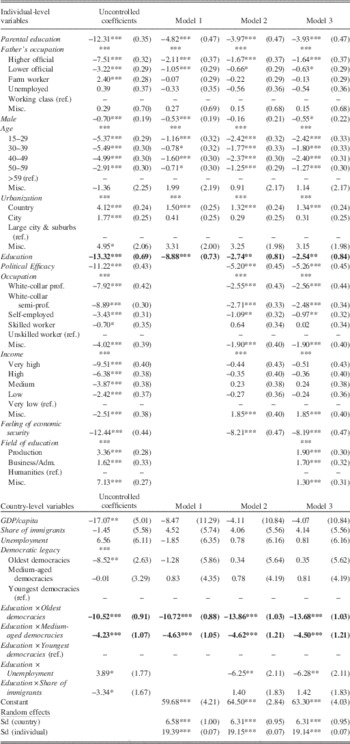
Table 2 reports our main findings. The first column reports the uncontrolled relationships, whereas Model 1 includes the control variables preceding education in the causal chain. Accordingly, if the education effect is reduced in Model 1, compared to the uncontrolled effect, this reveals a spurious component. Model 2 includes all economic and non-economic resources, GDP, share of non-Western immigrants, and the relevant cross-level interactions. Thus, if the education effect disappears when moving from Model 1 to Model 2, it follows that education is an indicator of economic and non-economic resources rather than socialization. Model 3 controls for field of study in order to eliminate this particular effect. Table 2 also presents the variance components. The respective components at the individual and country levels show the unexplained variation of the dependent variable among individuals and countries in the present investigation.
Multilevel Modeling of the Moderating Effect of Democracy on the Education–Anti-Foreigner Sentiment Relationship

Note: The table shows fixed effects, other than in the bottom two rows where standard deviations for both countries and individuals show random effects. In each model the ICC=0.10, the number of countries is 28, and the number of individuals is 40,902. Entries show restricted maximum likelihood parameter estimates, with standard errors in parentheses. The overall significance of the categorical variables is based on the F-test. Entries in boldface indicate coefficients of key theoretical interest.
*p<0.05; **p<0.01; ***p<0.001 (two-tailed t-tests).
Although not reported, the so-called empty model shows that anti-foreigner sentiment varies significantly at the individual and country levels. The empty model shows more specifically that all of the countries included are scattered around the aggregate mean level of anti-foreigner sentiment with a standard deviation of 7.308. Again, this suggests that the aggregate mean level of anti-foreigner sentiment varies cross-nationally, indicating the occurrence of spatial auto-correlation and the need for multilevel modeling. This is also vindicated by the likelihood ratio test (
 ${\rm \bar{\chi }}^{{\rm 2}} =5,\!157.53$
, p<0.001).Footnote
71
The column of uncontrolled coefficients in Table 2 shows that the education effect is clearly conditioned by the age of democratic rule. Turning to the specified models, we will focus specifically on the extent to which the education effect is conditioned by the age of democracy. When extraneous variables are controlled, Model 1 shows that the education effect is still conditioned by the age of democracy. Both interaction terms are significantly different from the reference category, which contains the youngest democracies. The interaction coefficients are also negative, meaning that age of democracy enhances how education reduces a person’s anti-foreigner sentiment. As democracy matures, the education effect becomes stronger.
Model 2 includes numerous controls indicating both economic and non-economic resources. Here, a critical issue concerns whether the education effect is reduced when personal resources are controlled. Model 2 indicates this to be the case, although the education effect does not disappear. Equally important, although the interaction between education and unemployment is statistically significant in Model 2, this does not reduce the significance of the interaction between length of education and age of democratic rule. Nor does the cross-level interaction between education and share of immigrants have any significant influence on this conclusion. Likewise, Model 3 shows that the control for field of study has almost no influence on the interaction between education and age of democracy.
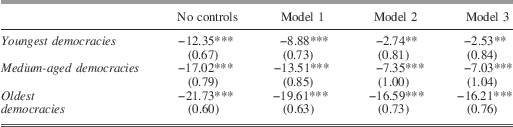
In order to show the extent to which the impact of education within the three categories of democracy is affected by various controls, we show the marginal effects of education in a separate and more easily accessible format. Table 3 shows these marginal effects based on the coefficients from Table 2. Model 1 in Table 3 shows that the interaction effect clearly survives the control for extraneous variables, although the largest spurious component seems to be related to the education effect among the youngest democracies. Table 3 also shows that the education effect is reduced when personal resources are controlled. The marginal effect of education is −8.88 in Model 1 among the youngest democracies but falls to −2.74 when personal resources are held constant in Model 2. The marginal effect of education among medium-aged democracies is −13.51 in Model 1 and falls to −7.35 when personal resources are controlled. Finally, the marginal education effect among the oldest democracies is −19.61 in Model 1, falling to −16.59 when personal resources are controlled. As the marginal effects of education are reduced within all three categories of democracy, it follows that part of the education effect can be reduced to differences in economic and non-economic personal resources. Interestingly, though, Table 3 suggests that personal resources are comparatively more important when accounting for the education effect among the youngest democracies. This may indicate that the importance of education as an indicator of personal resources increases when the socialization stimuli through educational institutions is weak.
The Marginal Effect of Education on Anti-Foreigner Sentiment, Conditional on Age of Democratic Rule

Note: Entries show marginal effect coefficients, with standard errors in parentheses. Model 1 controls for extraneous variables, whereas Model 2 also controls for various resources (see Table 2 for specification of controls). Model 3 includes field of study as additional control (N=40,902). **p<0.01; ***p<0.001 (two-tailed t-tests).
Most importantly for our purposes, Model 2 in Table 3 shows that all marginal education effects remain significant and that the effects among the medium-aged and oldest democracies in particular remain sizeable (−7.35 and −16.59). In substantial terms, this means that the effect of education cannot be fully accounted for by personal resources – as they have been controlled. Indeed, the results presented in Table 3, Model 2, are consistent with socialization theory, claiming that the education effect should be resistant to various individual-level controls because socialization is a systemic feature. In other words, Table 3 clearly indicates that education does comprise a systemic component irreducible to personal resources. Model 3 in Table 3 also confirms that the interaction between education and age of democracy is certainly resistant toward the influence of fields of study. This confirms that educational institutions and state authorities have uniform influence on higher educated persons (i.e., irrespective of their academic background).Footnote 72 Overall, the analyses in Tables 2 and 3 suggest that the effect of education is clearly conditioned by the maturation of democratic rule.Footnote 73
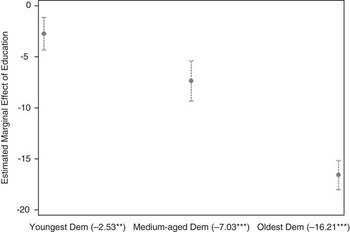
Expanding on this finding, Figure 1A shows that all three marginal education effects are significantly different from each other, as the 95 percent confidence intervals do not overlap. This figure also shows that all three education effects are significantly different from 0 (as indicated by 0 on the vertical axis). In sum, Hypothesis 1, claiming that educational institutions internalize the official values of the political regime, is clearly confirmed by our analyses, as is the predicted ranking of the education effect according to age of democratic rule.
The Effect of Education on Anti-Foreigner Sentiment, Conditional on the Age of Democracy Note: The black dots represent the estimated marginal effect on anti-foreigner sentiment of a shift in educational level from its minimum to its maximum, conditional on the age of democracy. The precise estimates are reported in parentheses. The grey dotted bands represent 95 percent confidence intervals. This figure is based on Model 3 in Table 2. **p<0.01; ***p<0.001.

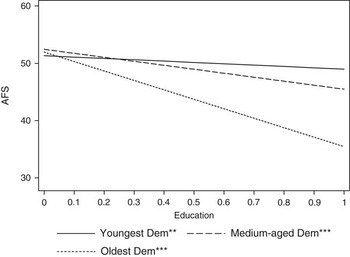
Nonetheless, we still need to establish whether the observed education effect is enhanced because of reactions among the lower or higher educated. Figure 1B clarifies this issue by revealing the predicted relationship between education and anti-foreigner sentiment conditional on the age of democratic rule. Consistent with our divergence effect hypothesis, Figure 1B offers specific information on the attitudinal positions of the lower (x = 0) versus the higher educated (x=1) when stratified according to age of democratic rule. Interestingly, Figure 1B shows that the positions of the lower educated are not affected by the age of democratic rule, whereas the higher educated differentiate considerably according to the age of democratic rule: The higher educated have gradually less anti-foreigner sentiment as the age of democratic rule increases. This also means that the dispositional differential between the higher and lower educated is trivial among the youngest democracies.
Anti-Foreigner Sentiment (AFS) as a Function of Education, Conditional on the Age of Democracy Note: The straight lines describe the predicted relationship between education and anti-foreigner sentiment, conditional on the age of democracy. This figure is based on Model 3 in Table 2 and Figure 1A. Unemployment and non-Western immigrants are held at their means. **p<0.01; ***p<0.001.

Expanding on the pattern in Figure 1B, it should be recalled that the dummies for age of democratic rule reported in Table 2 directly relate to the dispositional positions of the lower educated. Table 2 shows that these dummies are all statistically insignificant in Models 1–3, indicating that the three categories of lower educated persons are not significantly different in terms of their predicted anti-foreigner sentiment scores. Figure 1B confirms this finding since the positions of the lower educated are almost identical across the aged-based categories of democratic rule. Additional calculations (not reported) indicate that the higher educated in the oldest democracies are significantly different from the higher educated among both the medium-aged and youngest democracies.Footnote 74 The higher educated among the medium-aged and youngest democracies are not significantly different. Also noticeable is how the education effect among the oldest democracies is by far the strongest. This specific effect may suggest a comparatively more intense divergence along educational divisions among long-consolidated democracies. In sum, this additional analysis supports Hypothesis 2, claiming that the higher educated are disproportionately more socialized into the dominant official culture than the lower educated.
CONCLUSIONS AND DISCUSSION
The present investigation has shown that the impact of education on reducing anti-foreigner sentiment is strongest in the oldest, moderate in medium-aged, and weakest in the young East European democracies. All three categories of democracy are significantly different from each other as regards the education–anti-foreigner sentiment relationship. We have also shown that the higher educated are particularly influenced by the maturation of democratic rule. In contrast, the lower educated appear almost unaffected by the maturation of democratic rule.
Thus, the claim that educational institutions impose the official ‘state ideology’ on generations of students has been supported. We can only speculate about why Hello, Scheepers and Gijsberts were unable to find full support for this finding in their multilevel analysis.Footnote 75 One possible explanation is obviously that the present study includes more countries and more medium-aged democracies (five compared to two). Another explanation relates to our dependent measure which does not include items identical to those utilized by Hello, Scheepers and Gijsberts.Footnote 76 Their measure of negative reactions toward immigrants was primarily based on items referring to the negative stereotyping of immigrants, whereas our items are closer to the phenomenon of symbolic threat. In practice, however, negative stereotyping and perceived out-group member threat are inherently linked together (and strongly correlated) as emphasized by Sniderman, Hagendoorn and Prior.Footnote 77 Thus, slightly different dependent measures can hardly explain the difference. Furthermore, in many other respects the present investigation is consistent with the conclusions of the Hello, Scheepers and Gijsberts study.Footnote 78 We conclude that the greater number of countries in the present study presumably accounts for the different findings.
This study has also examined some implications of realistic group conflict theory in order to understand the characteristics of educational attainment. In the literature, the challenge has been that direct relationships between education and negative reactions toward out-group members most frequently may involve a strong component of rational self-interest deriving from personal vulnerability. The present investigation, however, has shown that education is not reducible to socioeconomic components indicating personal vulnerability. Occupation, income and sense of financial security do have some importance but cannot in any way fully account for the education–anti-foreigner sentiment relationship. We have also shown that unemployment has a limited impact on the reactions of the lower educated and that personal non-economic resources also fail to account for the education effect. In fact, controlling for numerous resource components has relatively little influence on the education–age of democracy interaction.
Although Sears and Funk may be correct in arguing that demographic measures are relatively poor indicators of self-interest,Footnote 79 we wish to make a different point. Realistic group conflict theory is inextricably linked to the notion of self-interest, which can be defined narrowly or broadly. This type of individualistic approach includes references to characteristics of the macro context, such as the number of immigrants, because they have favorable or unfavorable consequences for the individual self-interest. Although going beyond a very narrow conception of self-interest, however, realistic group conflict theory necessarily confines itself to phenomena that can influence perceived personal costs.Footnote 80 This means that the advantages or disadvantages of some social phenomena will be so dispersed and non-tangible that they cannot possibly stimulate the individual self-interest.Footnote 81 By implication, if the effect of education varies according to distinctive institutional features of the national political system, this cannot meaningfully be accounted for by the notion of a narrow or broad self-interest. Whether a country has had continuous democratic government for a hundred or twenty years does not influence the immediate self-interest of the higher or lower educated. This implication, as well as limitation, emphasizes the need for examining socialization theory, which addresses the institutional characteristics of the political system. From the perspective of realistic group conflict theory, the conditioning influence of democratic institutions is anomalous. Moreover, other competing theories face the same challenge. For instance, some have argued that the higher educated are no more liberated when measuring their attitudes by items related to ethnic minority rights.Footnote 82 This theoretical account questions whether the higher educated are genuinely committed to liberal ideology. Although offering intriguing insights, the theory cannot explain why the effect of education varies according to political regime characteristics. In effect, socialization theory offers a prediction that cannot be – or least has not been – generated by some of its rivals. This is indeed a distinctive theoretical quality.
We wish to emphasize another quality of the present investigation concerning the challenge of self-selection biases. Focusing on the variability of democratic rule across nations reduces self-selection biases, since most individuals cannot freely choose their own country or historical legacy; the vast majority is ‘forced’ into national educational institutions; and even private schools must comply with state authoritative guidelines. Yet self-selection cannot be entirely eliminated, as migration may involve selection mechanisms: long-consolidated democracies may to some extent attract higher educated persons who happen to have less anti-foreigner sentiment than the average person (e.g., higher educated persons moving from East to West Germany). Moreover, self-selection also relates to the relationship between family background and education. The higher educated encourage their children to choose an academic career, whereas parents with lower education raise their children according to other norms. Parental education is thus capable of influencing a person’s education as well as attitude toward immigrants. Unlike previous studies, however, the present one also controlled for parental educational background, implying that some (if not most) of the influence of social heritage has been effectively removed.
An implication of the present investigation concerns the economic component of education. Educational and socioeconomic status are undoubtedly correlated – the higher educated tend to be better off than the lower educated. Yet it took us by surprise that economic assets play such a minor role as components of education. This certainly confirms the need for distinguishing between education as ‘cultural’ and ‘economic capital.’ Higher educated persons obviously have economic interests that govern their reactions, but the point is that they do not overpower the distinctively pro-social values that originate from education as a cultural asset. The same may also apply to the lower educated as they also tend to defend particular clusters of immaterial dispositions favoring not only anti-foreigner sentiment but also traditionalism and anti-cosmopolitanism.
The present investigation also has its limitations. A major challenge in explaining the effect of education stems from its relationship to broader characteristics, such as the official culture, state authorities and educational institutions. The challenge is that education as an individual-level phenomenon forms part of a cluster of meso and macro causes. In his pioneer study, Weil called for more research on how particular elements of a given culture become dominant at the expense of others.Footnote 83 Obviously, the Lockean democratic value of human equality does not penetrate every corner of society as the acceptance of ethnic minorities clearly varies across levels of educational attainment. This differential pattern can be explained by meso-level socialization processes within the educational system; but cross-national variation as regards the effect of educational institutions necessarily calls for genuine macro-level factors. We believe that one of these is state authority. In all developed countries, state authorities observe educational institutions and constrain them with legal regulations if necessary. That which varies is the extent to which state authorities including their appointed and elected officials are strongly committed to democratic values related to in-group/out-group issues. Accordingly, it seems natural to conclude that state authorities and educational institutions actively co-vary to produce conformity and loyalty toward (democratic/undemocratic) official values. As the higher educated spend more time in the educational system, they are also more likely than the lower educated to be shaped by state-authorized stimuli transmitted through educational institutions.